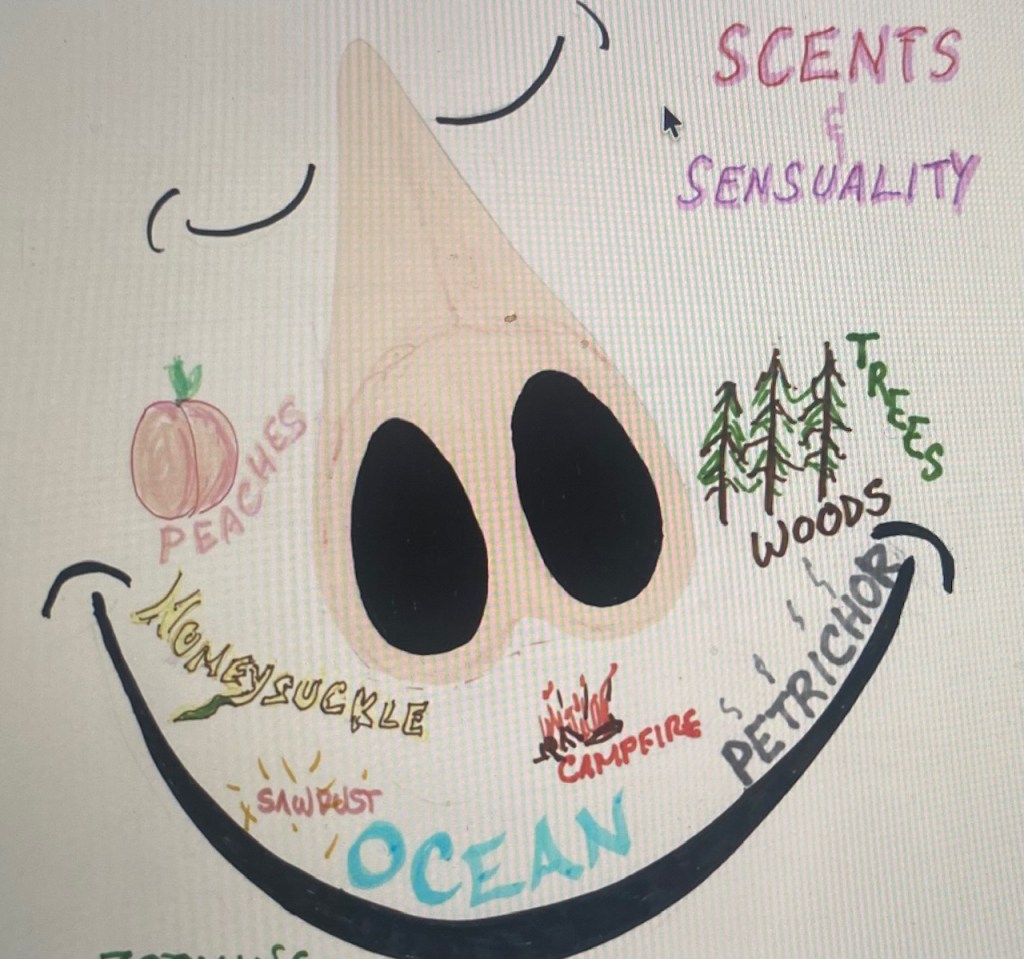
Illustration by Lisa Keppeler. Used with her kind permission.
~
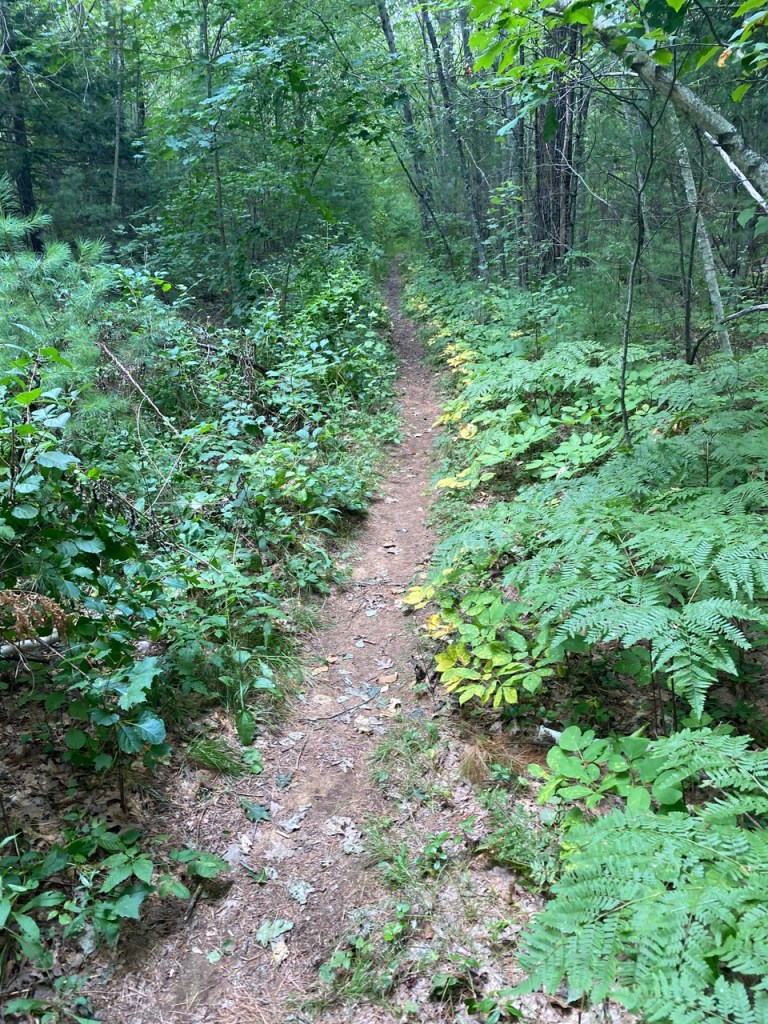
It’s September, 2019 and ten weeks after my heart surgery and I’m taking my first walk in the woods since then and the first thing I notice is the fecund smell of fallen leaves and pine needles and dying trees…
and the scents of hay and cows and horses in my great-grandfather’s barn, and the waft of fried onions and potatoes in Nanny and Grampy Lufkin’s house, and the whiff of perfume and cigarettes in Nanny Cleaves’s apartment, and the aroma of Mom’s fresh baked bread on Saturday mornings…
and a few years later: the earthy odors of the market garden where I worked summers, the pungence of wet towels, dirty socks and jockstraps in the locker-room beneath the gym where I spent so much time…
and the fragrances of my Aqua Velva, and her White Shoulders blending in the back seat of the family Ford …
and later still: the salt smack of ocean breeze thru the spruce trees around our camp in the early days of marriage when love was new and life’s possibilities seemed endless…
and because autumn is when things die, memory sniffs the acrid smoke from the Old Town Paper Company as I drift, bitter and aimless, across the university campus, no longer the high school bigshot and no idea who the hell I am or where I’m going…
and then the dank reek of the dregs of the pipe tobacco I used to smoke during the last years of that first marriage…
and the stench of shit and disinfectant in the hospital where my daughter lay dying, when I learned how life and love can also waste away and die…
and thoughts of shit spark smells of steaming cow flaps in Scottish pastures through which Mary Lee and I hike, and aromas of shawarma, spices, and pita bread mingled with the dust of pilgrims in the Old City of Jerusalem, and the sweet scent of apple tea in Turkey and animal musk on the Serengeti and incense wafting up from the altar into the stony steeple of Iona Abbey—reminders that I not only didn’t die, but flourished—
and the smell of Mary Lee lying beside me in the morning, and the fresh, slightly sweet scent of our newborn grandchild, and before I know it, going into the school building to pick up that grandchild where the fragrance of chalk and cleaners and young bodies take me back to my years as a public-school teacher—intimations that love is stronger than death…
and although I’m surrounded by the smells of dead and dying vegetation and the lingering sickly scent of Mupirocin with which I swabbed my nose prior to and after heart surgery, the decay upon which I walk and which I smell teems with the bouquet of resurrection.
…from the Spanish verb “querer,” to want, desire, love; an emotional inclination toward a location; a home ground, a favorite place.—Wikipedia.
~
“A querencia is a place the bull naturally wants to go to in the ring… In this place he feels that he has his back against the wall and in his querencia he is inestimably more dangerous and almost impossible to kill.” Ernest Hemingway, Death in the Afternoon.
~
Or man-cave or refuge or sanctuary or study or simply the room at the end of the hall where I hang out wrapping it around me like a favorite bathrobe or suit of armor depending…
where I
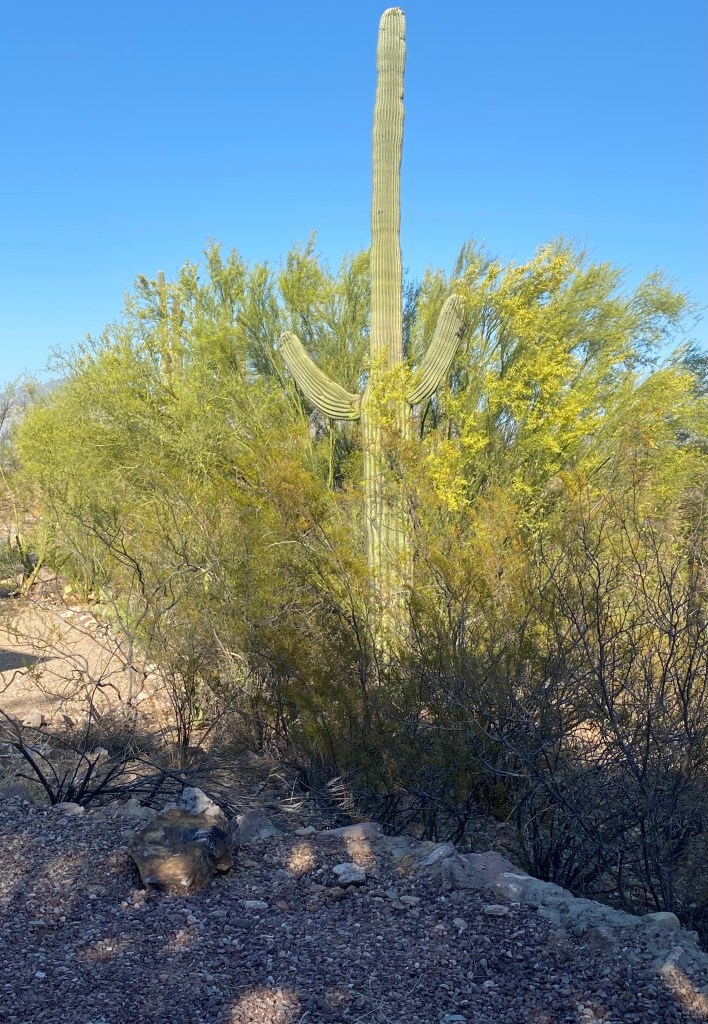
gaze at pictures of my wife ML looking radiant in her new clerical collar despite her son’s having left to live on the West Coast… my daughter Laurie’s watercolor she painted before her cancer diagnosis of a blue hand reaching up thru brown rocks toward bright flower petals … my brother sister & me skunk as a drunk before I sobered up … ML’s boys, Laurie & me swimming on Mount Desert Island when I thought we could blend our families… grandchildren sitting in my lap, playing by the river, hiking in the woods when we did…a panorama of Banjo Camp North where I named my banjo Joy… Jerry, Marty, & I—6’2” then— the Fish Factory Trio, singing “The Old Dope Pedler” at a high school variety show in 1961… four views of the Desert House of Prayer outside Tucson, Arizona where ML & I danced in the desert under a full moon Easter morning in 2001… a lioness sunning herself on a rock on the Serengeti Plains in 2018…
keep mementos such as a contestant pin from the 1961 L&M State Basketball Championship…three vintage baseball caps of my favorite teams… the skin of a rattlesnake I killed in Idaho in 1962…diaries going back to 1963…autographed books by heroes, mentors, friends and former students … cards from grandchildren… three bowls of rocks from my travels…rocks from those travels too big for bowls… a felt fedora covered in pins from airports around the world… a turkey feather from a walk in the woods… four clam shells from walks on the beach… a letter holder my father made for my mother when they were in high school… a wooden platter I remember him carving in the evenings after he’d come out of the Army & was working as an apprentice carpenter & we didn’t have a TV… my grandmother’s desk…
lose and find myself in books of non-fiction, fiction, poetry…books about travel, Maine, writing, spirituality… five banjos…one guitar…one harmonica…one mouth-harp… one Vietnamese flute… ten songbooks… two file cabinets of old writing… two coffee cups of pens…my current diary… a yellow legal pad of paper… a computer …
look out the window at a world of uncertainty for my country & my own life & those I love holding my favorite pen like Excalibur my diary like a shield enthroned in my ergonomic office chair feeling inestimably more dangerous & almost impossible to kill…
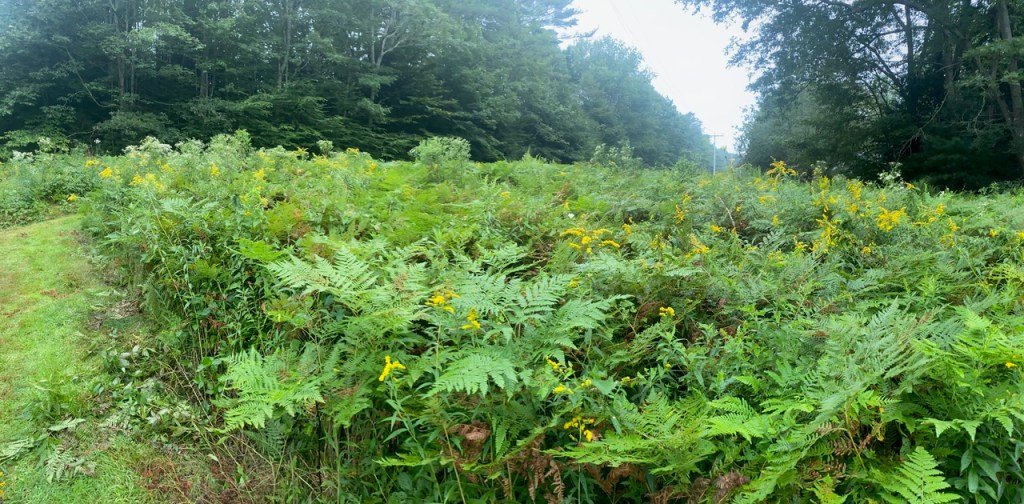
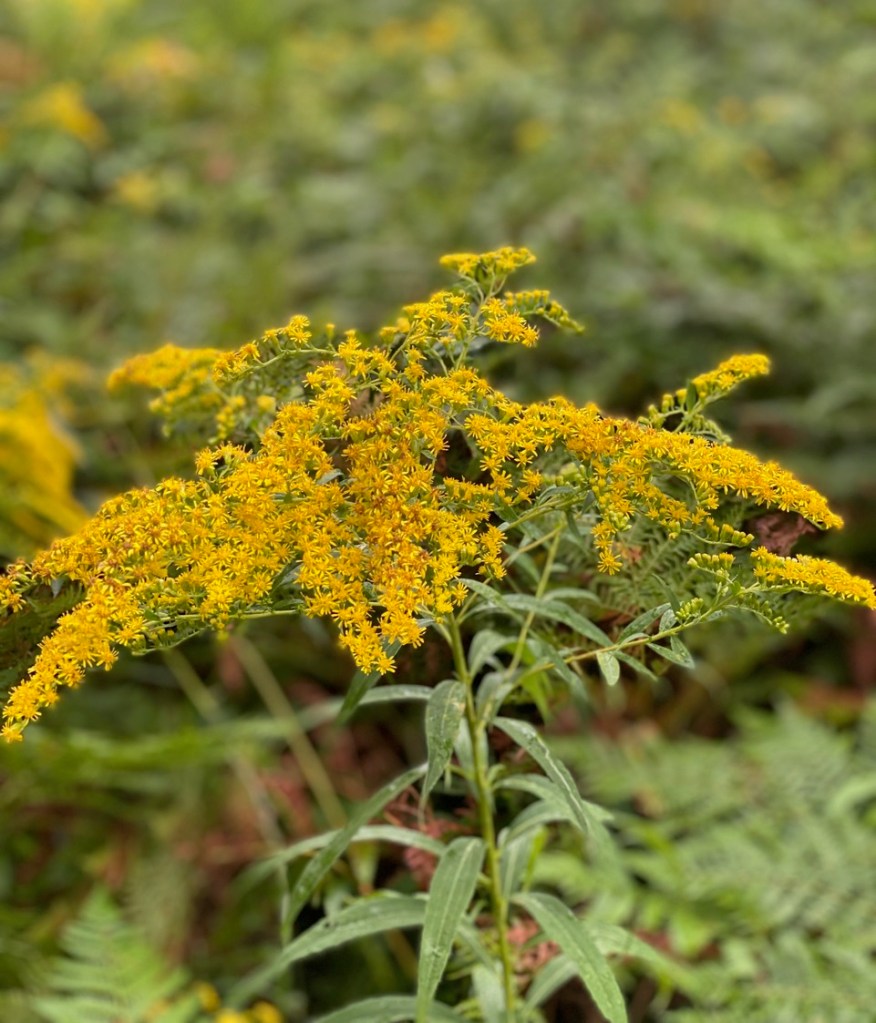
I’m walking the grass loop around our housing development. Under the power line toward the community garden, I pass through what is now a shoulder-high host of Queen Anne’s Lace, golden rod, milk weed, bracken, and many other plants I can’t name. The flies swarm. The sweet songs of the cardinals and tufted titmouses (titmice?) have given way to the screeching of blue jays and crows. Monarch butterflies flit from flower to flower. The air smells ripe. Shadows crawl like the incoming tide over the landscape. Summer is ending.
And I feel myself coming alive. Beginning again.
The reason is simple. For seventy-five years—as a student, as a teacher—the golden rod, the lengthening shadows, the Monarchs, have meant the beginning of another school year. More than New Year’s Eve, more than the first warm day of the year, this is the time when, at some deep cellular level, I can feel myself waking up, ready to start anew.
It’s a good feeling. At my age, it’s easier to focus on endings than beginnings. I now celebrate—if that’s the right word—more birthdays of the dead than of the living: my grandparents, my parents, my daughter, my first wife, close friends. Ended are my long hikes, long distant driving, lifting anything over forty pounds, staying up after midnight, jumping into bed with my wife after a sexy movie (jumping anywhere, for that matter), five-course meals, Cuban cigars, Laphroaig Scotch… the list grows longer each year.
But as T.S. Eliot wrote, “In the end is my beginning.” (Hey, I’m an old English lit teacher, I remember stuff like that.) You can’t begin something until something else ends. School can’t start until summer ends (Yeah, I know, there’s summer school, but I’m trying to make an analogy. Don’t confuse me with technicalities.) It took the end of a disastrous year of studying forestry in college for me to begin my studies in English (which is why I’m quoting T.S. Eliot and not The Journal of Forestry.) It took the end of an unhappy 20-year marriage for me to begin a happy going-on-forty-year one. It took the end of a career in public education for me to go back to school for an MFA, write a couple of books, a bunch of essays, and going on nine years’ worth of blog posts.
So, what will I begin this year? Well, Mary Lee and I have a couple of trips planned (knock on wood: last year, we had three planned and they were all canceled). I will scrape and repaint my front door and clean out the garage.
But the biggest change I want to make is with The Geriatric Pilgrim.
When I began these blogs, I was fascinated by the idea of pilgrimage: how a pilgrimage differs from a vacation, or from going on a retreat, or from study programs (what I called “edu-cations”). Besides traveling to retreat houses and other spiritual sites in the United States, Canada, the British Isles, Israel, Turkey, and Africa, I collected pages of definitions of pilgrimage and of common characteristics of pilgrimages. I read a raft of books about various pilgrimages people had made.
Along the way, I became intrigued by my fascination with pilgrims and pilgrimages. What was in it for me?
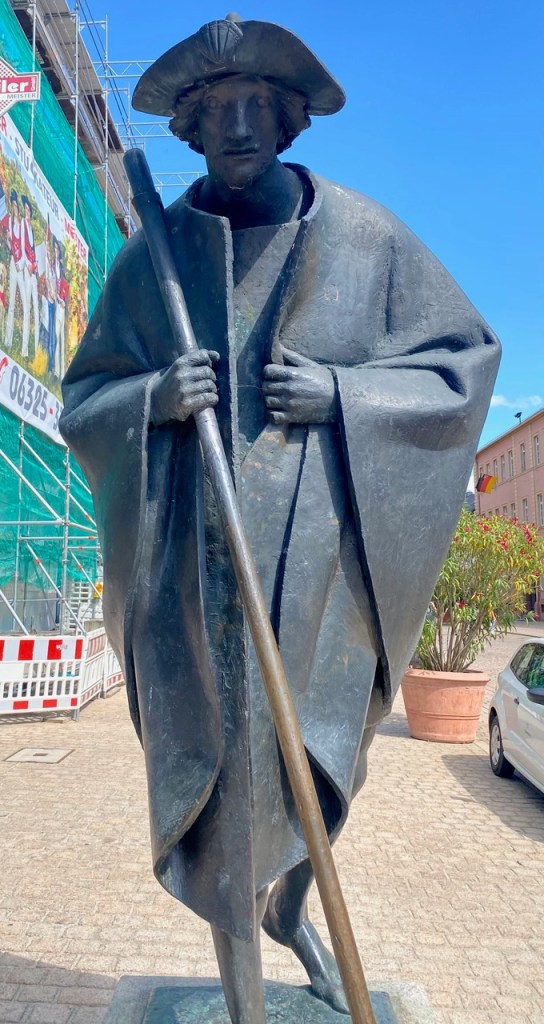
Stature of a “Jakobspilger,” or St. James’s pilgrim: Speyer, Germany
Well, probably the main thing at the time was the idea that pilgrims are often searching for a source of healing. As you know if you’ve read these blogs, I was looking for healing after the death of my eighteen-year-old daughter from a rare cancer. And I found writing about the various pilgrimages Mary Lee and I had made even more healing than the pilgrimages themselves.
Gradually, I began to realize that pilgrimage is a frame of mind—an attitude of curiosity, detachment, wonder. It’s “traveling light,” as one writer says, of risk, of living in liminal space—leaving one location but not yet arriving at another—of exploration, the end of which, to quote T.S. Eliot again, “Will be to arrive where we started/And know the place for the first time.”
Since COVID arrived, with all its restrictions on travel, followed by my 80th birthday, with its expanded waistline and diminished abilities, my blogs have focused more on applying the lessons of pilgrimage to my current life of walks in the neighboring woods, planting peas, tomatoes, and pumpkins in our community garden, and of exploring the twelve steps of my Al Anon program. This, too, has been healing.
But now I find myself no longer as interested in finding new ways to describe my pilgrimage, as I am in describing and exploring in more depth the landscape through which I’m traveling, a landscape that is always changing, sometimes in ways that please me—autumn color is just around the corner, the grandchildren are growing—sometimes in ways that piss me off or frighten me—the start of my favorite woods walk has been clear-cut, I’m finding it difficult to sing without coughing.
Writing about these joys and sorrows, I find I’m writing more poetry. I’ve just finished an on-line workshop for poets, and one of the highlights of my week is another on-line group of poets from all over the country, where we share our favorite poetry as well as poems we’ve written. I’m now subjecting my longtime writing group here in town to my poems.
So, I’m going to be posting more poetry here in these blogs as well as other experiments—prose poems, flash fiction and nonfiction—trying to look more closely at the physical and emotional landscapes through which I’m now traveling.
The way I see it, my pilgrimage continues, but the lens through which I’m seeing it and the voice in which I’m describing it is changing.
I’m excited to see where this journey will take me.
And hoping you’ll continue to join me.
So, let part of my life end, and another begin.
As Quakers say, when one door closes another opens.
Besides dealing with a decaying body and a deteriorating mind, one of my biggest challenges these days is to keep from living in the past. (And I’m sure the two struggles are connected: of course, I want to recall when I could leap tall buildings in a single bound.) It’s so tempting to spend my days reminiscing with old classmates via email or Facebook, watching “American Bandstand” on YouTube, and replaying 65-year-old high school basketball games.
This last month has been especially challenging. May began at the history center in the town in which I grew up with a program that my oldest friend (going back to the first grade) and I spent the winter planning: “Yarmouth [Maine, for those of you reading this in Singapore and elsewhere], 1955-1962: Times of Change.” We wound up with probably thirty people there who’d grown up in town during those years, bathing in the warm waters of nostalgia, as we talked to newer residents about how Yarmouth changed during that time from a low-income community of shops and small factories to a bedroom-by-the-sea for urban lawyers, doctors, and bankers. A town we kids roamed at will because everyone looked after us—where the local telephone operator would call my classmate Barbara’s house at 3:30 in the afternoon (because she knew Barbara got out of school at 2:30 and would stop at the drug store for a coke, so that’s when she’d get home) to tell Barbara that her mother would be late and that she should turn the oven on 350° and put the roast in at 4:00. (Who needed cell phones?)
Later in the month, as my brother and sister and I cleaned off stones and planted impatiens in our family cemetery plot for Memorial Day, we swapped memories of Mom and Dad and our grandparents. (Amazing how different our recollections are!) Later that week, I went with my wife, Mary Lee, to her 55th college reunion, and for three days listened to other people’s stories about their pasts. Throw in a dream in which I ran into my ex-wife—who died eight years ago—dressed in a white karate gi (still trying to work out the symbolism there), and I’m starting to sink beneath these waves of nostalgia.
I need to get out and open my eyes. Stop looking at what’s behind me and start looking at what’s around me—what’s new. I decide to check out this year’s garden. Besides, I need to put in my tomato seedlings.
It’s a beautiful June morning and the world is new. The apple blossoms and rhododendrons are in full bloom, the air smells of lilacs, and the breeze is fresh. The world is spring green: the grass hasn’t yellowed, the leaves aren’t chewed, and the caterpillars haven’t yet built their ugly tents in the trees.
I put my seedlings and watering can and trowel in the car, drive up and park on the power line road between our community garden (which I wrote about a few years ago: https://geriatricpilgrim.com/?s=Up+to+the+Gahden) and a wooded swamp, home to all kinds of birds, many of whom are singing their ever-loving hearts out.
I had no idea how many birds there are here until I got one of those apps this year for my phone that identifies birds by their songs. So, I check it: cardinal—yes, I know their pulsating whistles; song sparrow—makes sense, I see all kinds of them; gold finch and chickadee—ditto. But what’s a great crested fly-catcher? And a red-eyed vireo? They’re new, at least to me. Cool.
Turning to the garden, I think of the beginning of baseball season, when, no matter how poor a team’s prospects, there’s always hope for a championship year.
This year, I’ve got three raised beds, and—God willing; I haven’t planted it yet—a small pumpkin patch. The garlic I put in last fall is up, as are the peas which I planted on May 1st. I decided this year to stake them with some of the branches that came down from last winter’s storms—the first time I’ve ever tried that, and it seems to be working: the peas are grabbing the branches with gusto. In another bed, I’ve got the usual two kale plants which will hold us until November, but for the first time, I’m trying a couple of eggplants and a purple pepper to see what happens. I’ve also planted bush beans for the first time in years. (Mainly because last year, I almost killed myself stringing pole beans, and vowed never again.)
I wave to Karen down the way who’s working on her bee garden. She’s also building a new compost bin, for which I need to thank her.
But first, let’s get those tomato seedlings in.
The sun is warm. I take off my outer shirt and begin raking the bed where I’m going to transplant my tomatoes. I love the smell of the fresh dirt (apparently, it triggers the release of serotonin in the brain—at least that’s what I read somewhere) which makes me want to sing. And because the other night I watched a music documentary on Paul Simon, I serenade the birds with “50 Ways to Leave your Lover”—
You just slip out the back, Jack
Make a new plan, Stan
You don’t need to be coy, Roy
Just get yourself free—
The really neat thing about the documentary was it focused on Simon’s newest album of songs, many, if not all of them, as I recall, coming to him in a dream. And if at the age of what, 83?, he can still be creating new work, even though I guess he’s now deaf in one ear, then I, at 81, can, too, despite my various diminishments.
I dig six holes and put a little of Karen’s compost in each one. I find myself slipping again into the past: the summers in high school I used to work in a garden and the big garden I had during my first marriage. Cut it out! I think, and then decide, No, let’s use those memories as compost, fertilizer to help me grow.
Which would be more inspiring if my back didn’t already hurt from this minimal exercise. From my other garden bed, I grab my new kneeler and bench combination, which I bought this spring, and kneel on it to put the tomato seedlings into the dirt and the compost, which gets my hands dirty and the rest of me feeling clean. Then, I put collars that I’ve made from plastic medicine cups around the seedlings to protect them from cutworms, and, using the metal arms of the bench to get myself off my knees, rise to get my tomato cages from last year. Finally, I give my little darlings a drink to get them on their merry way.
Feeling accomplished, I sit down on the new iron bench with the “Welcome” sign that someone—probably Doug, who, along with Karen oversees our community garden—has donated. I think about how I still rely on community as much as I did when I was a kid all those centuries ago.
Looking up, I follow an exhaust vapor trail in the blue sky until I see the sun flash on a plane, high in the sky, probably starting its descent into Boston. I imagine flying to new countries and seeing new vistas and new people.
But right now, right here, there are plenty of new things going on, thank you very much.
Last Palm Sunday, Mary Lee and I were supposed to begin a two-week retreat at a monastery in the hills of California. We’ve been going on retreats now for thirty years and I was eagerly looking forward to having more silence, being more aware of the world, doing more reading (I’m on a Buddhist kick right now), drawing closer to God of my not Understanding. Then, two weeks before we were supposed to fly to San Francisco, we received word rockslides had closed the roads, and that the monastery won’t open again until at least May.
So instead of flying across the country on Palm Sunday, we spent the day encased in ice.
The previous evening, thanks to a day of snow changing to freezing rain, we lost power. That Sunday, we cooked oatmeal on top of our gas stove and wrapped in blankets in front of our gas fireplace. While the ice bent the trees and bushes lower and lower, Mary Lee and I read the Palm Sunday service from the Book of Common Prayer, wondering, along with the Psalmist, “My God, my God, why have you forsaken me.”
For the next day and a half, we ate beans and rice, read, played Scrabble and cribbage, drove around the neighborhood to charge our phones, and finally gave in and stood in line at a restaurant in another town for breakfast.
All in all, it wasn’t bad. Still, it’s hard for me to find much nice to say about ice.
I like ice cubes in my water. I use ice packs to help the bursitis in my hips. Some ice sculptures are pretty. I’m glad to have a freezer in my refrigerator to preserve food. But that’s about it. When I used to go skating, I’d divide my time between flailing my arms to keep from falling and lying prone on the ice when I did. The one time I went ice fishing, I was days warming up.
Ice has all kinds of nasty connotations. It can mean frigid, as in sexually inadequate. It can mean unfriendly, reserved, aloof, rigid, inflexible. Fear sends icy chills down our spines. We hear about the icy fingers of death.
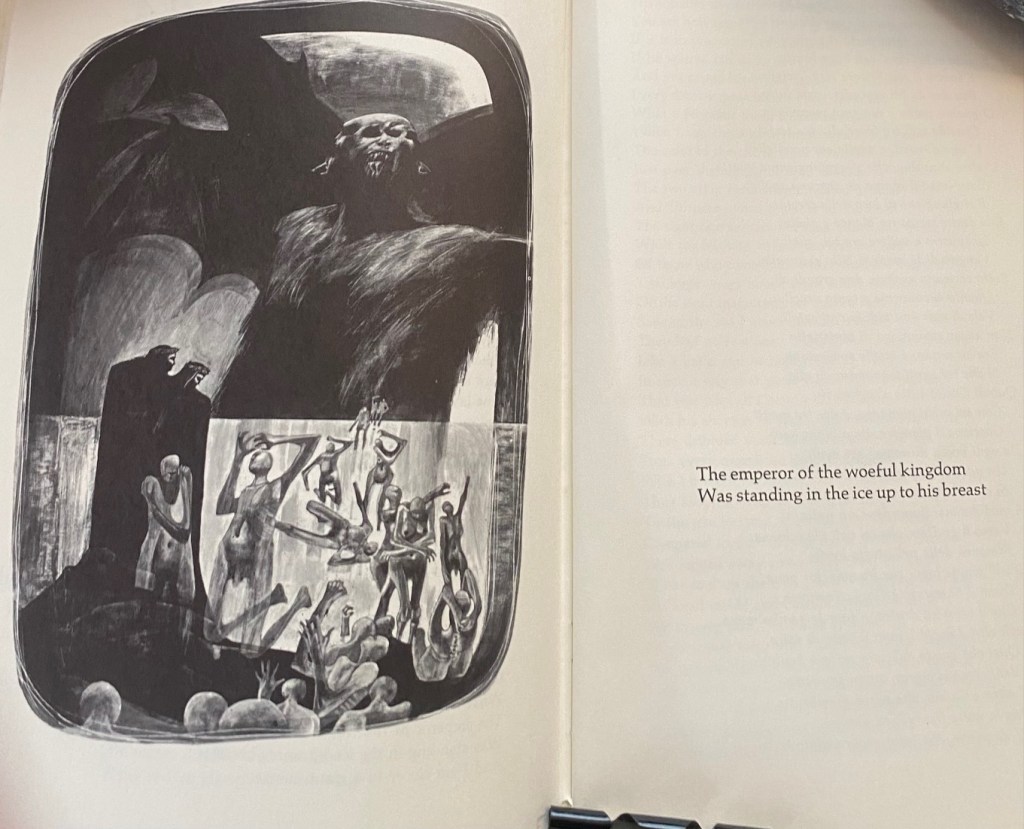
Speaking of death, while Hell (which is where some of my Fundamentalist friends tell me I’m going to go when I die) is usually pictured as a place of fire and brimstone, in Dante’s Inferno, the center of Hell is a vast lake of ice, in which Satan, along with sinners who committed treason and betrayal—such as Brutus, Cassius, and Judas—is incased.
from Dante’s The Divine Comedy, I Hell, translated by Louis Biancolli, 1966
Makes sense to me. Ice is cold. Ice is heavy. (The reason we lost electricity was because ice-laden trees fell on power lines). Ice prohibits movement. During the most hellish part of my life, after my daughter died, I couldn’t get warm. I felt as if I were carrying a 20 cubic foot freezer on my shoulders. My body was rigid and tense. Only after I’d had two or three large tumblers of scotch did I feel as if I were thawing.
And yet. For someone who dislikes ice, I realize that one of my tendencies is to want to freeze experiences and beliefs, preserve them the way we preserve meat and vegetables.
After those hellish first years when Laurie died, my life began to get better. I thought I was learning to live with loss. But five years later, at this time of year, it was as if my daughter has died all over again. I plunged back into rage and tears. I spent evenings drinking my tumblers of scotch (or maybe it was Wild Turkey 101 proof, at this point), going through old photograph albums of the two of us and listening to Laurie’s old tapes of Tracy Chapman and the Grateful Dead. The only difference was that those I was most angry with were people who talked about their own grief. I remember being at a retreat at a monastery in Cambridge, Massachusetts where a woman talked about almost losing her son in an automobile accident. A spasm of rage surged though me. I thought, What are you moaning about? He’s alive, isn’t he?
Then on Easter Sunday after this retreat, I heard a sermon based on the Gospel of Mark’s account of the Resurrection, which, unlike the other gospels, ends with Mary Magdalene, Mary the mother of James, and Salome, fleeing from the empty tomb, “for terror and amazement had seized them; and they said nothing to anyone, for they were afraid.”
Why fear, asked the preacher. Well, there might have been a lot of reasons—fear of soldiers, fear of grave robbers—but he also wondered if it wasn’t human nature to fear the unknown, to become used to, even comfortable with, our lives even if they’re full of pain and suffering. We prefer what we do know to what we don’t.
And I realized that over the years since Laurie’s death, I had grown comfortable with my image of myself as GRIEVING PARENT; I had made Laurie’s death MY STORY, trying to preserve memories of her, as in the old photograph albums I’d been perusing. And if anyone else had a similar story, I felt threatened.
In other words, I was trying to freeze my sense of myself and Laurie rather than let them evolve, flow. I wasn’t angry about the death of my daughter, I was angry at the possible death of my grief, thinking it was grief that was keeping me close to her.
That Sunday afternoon, sitting in Harvard Square amidst cigarette butts and pigeons, looking up at the sycamores and the brick buildings, listening to voices babbling in a half-dozen languages, I tried to focus on my daughter in the present moment. I don’t know where you are, Kid, I remember praying, but at some level I know you’re fine, and I want you to know that I love you.
And the sights and smells and noises of the Square seemed to fade and I felt a hand on my shoulder, and I knew it was Laurie’s.
I don’t care whether that hand was from another dimension or from my imagination. What I do know is that the great spiritual traditions are right: love transcends death. That is, if you don’t try to freeze it like leftover meatloaf.
But I’m still learning. Working a 12-Step Program, I’ve discovered traits that I developed to survive growing up in an alcoholic family—judgmentalism, people-pleasing, perfectionism—traits which no longer serve me, but have, in essence, remained frozen, damaging my relationships with others.
And I’m wondering if I may be trying to freeze my retreat experiences, and that Life, the Universe, or God of my not Understanding isn’t telling me by having this retreat in California canceled that I need to let the retreat experience—the silence, the awareness, the reading, the closeness to God— flow into my everyday life, here at home, even in the middle of an ice storm.
After a wonderful but hectic Thanksgiving, Mary Lee and I spent a weekend on retreat at the Episcopal monastery of Society of Saint John the Evangelist in Cambridge, Massachusetts, a place we’ve been coming to for twenty-five years in search of silence and slow time. On Saturday afternoon, because the sun sets in this part of the world around 4:00 p.m., I decided to catch the last daylight and take a walk before Evening Prayer.
As I left the monastery, the sun was buttering tiers of purple clouds over the Boston skyline. I jay-walked across Memorial Drive, turned right, and joined the joggers, walkers, and cyclists on the path along the Charles River—a mix of races I don’t see in Maine, some talking into microphones and headsets, others conversing with one another, possibly in Chinese.
After about a quarter of a mile, I passed the Riverside Boat Club. I turned left to cross the Eliot Bridge, pulling up the collar of my coat against a raw wind coming down the river. The late afternoon sun and clouds reflected in the rippling waters of the Charles, the lengthening shadows of the sycamores, and the dank, November wind all churned up memories of another wind coming down another river thirty years earlier. I saw myself walking back from the Eastern Maine Medical Center to the Ronald McDonald House after spending the day watching my eighteen-year-old daughter die a little more from the cancer ravaging her body. I recalled the Christmas tree sellers in their vans and pick-up trucks in Cascade Park at the bottom of the hill across from the Penobscot River and how Christmas seemed at the time like some horrible joke played on the human race by a sadistic god promising peace on earth, good will to all, and then inflicting more war, poverty, disease, and death on us suffering buggers.
Now, however, I realized as I turned left after the bridge and started walking along Storrow Drive, that although I could still vividly picture details from my walk back from the hospital—the seagulls circling over the river, the mansard roofs on the houses—I could no longer feel the anger, confusion, and shame that once consumed me. Thanks to prayer and meditation and spiritual direction—much of which happened at the SSJE monastery—I’ve had joy as well as pain since Laurie’s death. Last summer I had heart surgery which has given me renewed hope that I may be around to watch my grandchildren grow up.
#
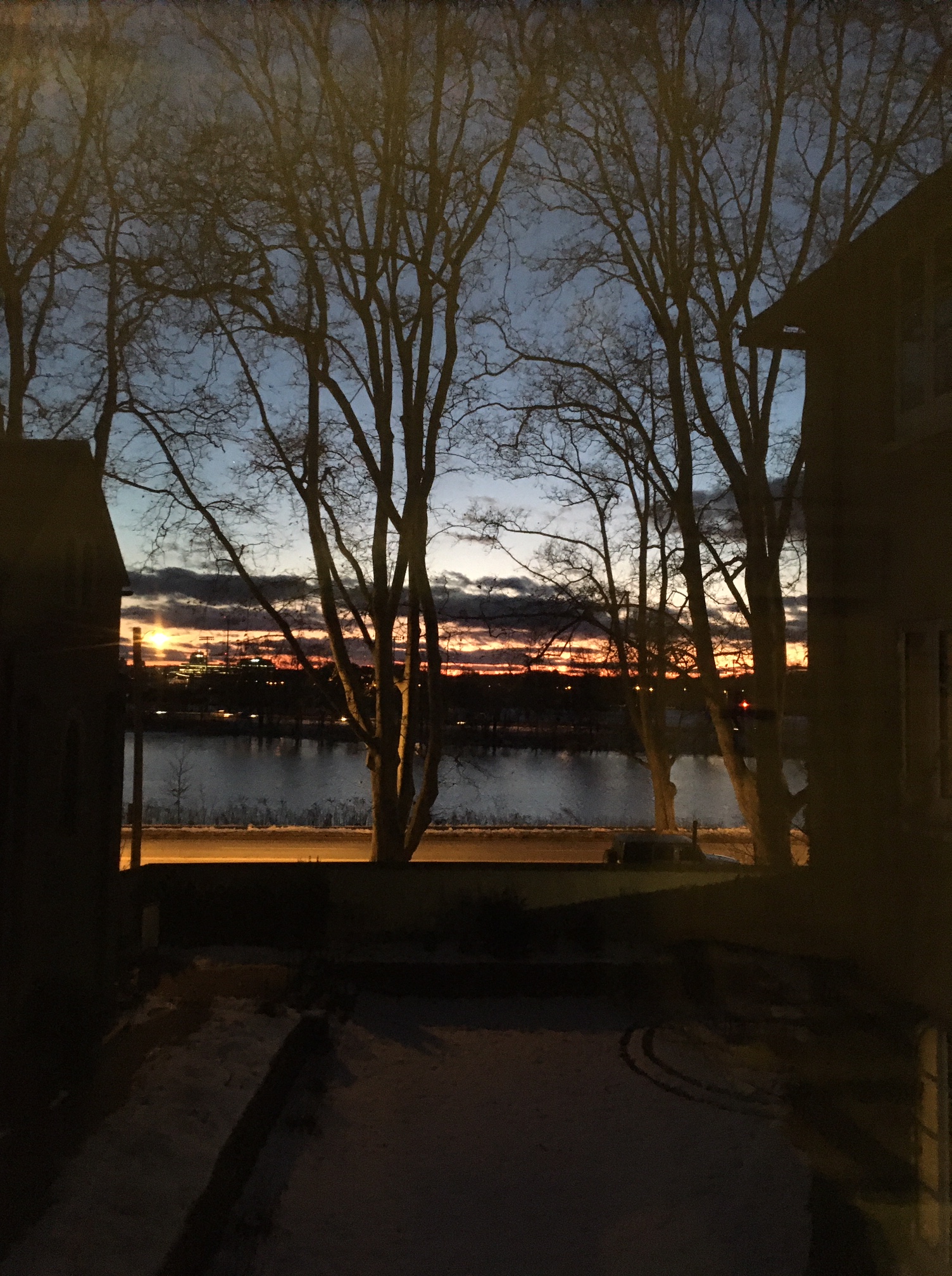
The sun dropped, gilding the tops of buildings on my right. The clouds became red and gray. Just outside a patch of skim ice near the shore of the river, a dozen geese floated tranquilly, while on the other side of me, rush hour traffic hurdled by. Horns honked.
The geese reminded me of my father-in-law, George, who used to urge his employees to work like ducks on the water: calm and serene on the surface, paddling like hell underneath. He was the one who introduced me to this walk around the Charles; he made it almost every day. One of the most gracious men I’ve ever known, he and his wife Elaine retired to Cambridge to an apartment just three doors down from the monastery, which made it that much easier for Mary Lee and me to become part of the SSJE community.
Hearing the whooshing traffic, I recalled that George used to carry a plastic bag with him when he walked here, collecting what he called “street glass,” bits of broken head and tail lights from the innumerable accidents caused by Massachusetts drivers along Memorial and Storrow Drives. By the time Elaine died and George left 985 Memorial Drive for a retirement community in Lexington, he’d collected enough colored glass and plastic to fill I don’t know how many glass jars, which reposed on bookcases and windowsills all over the apartment.
Looking across the river back at Memorial Drive, I imagined Elaine, standing in front of her window, holding her glass of gin, watching the sunset behind me before heading back to the kitchen to finish preparing another of her gourmet dinners. She used to rate sunsets; I thought she might give this one a “7” or an “8.” So I made it a “7.5.”
When she died, her service was held in the monastery, and I remembered the Brothers’ chanting, and the reception back at the apartment, monks mingling with the family of academics, doctors, and journalists I married into. When George remarried, four years later, it was in the monastery, as was his funeral ten years after that.
The SSJE Monastery from across the Charles River
#
Crossing the Weeks Foot Bridge in front of Harvard’s Leverett and Dunster Houses, I realized what an important part the monastery and the Brothers have played in my life for the last twenty-five years. I walked back Memorial Drive, past Winthrop and Eliot Houses, through John F. Kennedy Park, recalling my spiritual directors who guided me along the rocky road of grief—showed me that I couldn’t keep thinking of Laurie as some photograph in an old album, that if I actually believed in this thing called resurrection, I needed to father an ongoing relationship with her, think of her as being somehow present, here and now. And indeed, the first time after her death when I felt her touch was as I sat at a desk in one of the guest rooms of the monastery.
I thought about how my retreats and pilgrimages intertwine, like the design on the Celtic cross tattooed on my forearm. Yes, I go to the monastery on retreat to withdraw from what Jesus and St. Paul call “the world,” but I’m also making a pilgrimage to answer a call, draw near the sacred, find a source of healing, and pay homage to those I think of as the saints in my life: Laurie, George, Elaine, the Brothers who have died, like Brother Eldridge, who helped me see that like the Father in the Parable of the Prodigal Son, I can wait in continual hope for my child, sending out my love in the confidence that she’ll receive it, or Brother John, my first spiritual director, who told me, “No, I can’t help you cut down on your drinking, but if you decide you want to quit, I’ll do everything I can to help you.” Or those Brothers who continue to buoy me, like Brother Curtis, the first monk I ever talked to here, and Brother James, whom I’ve watched lose hair, put on thirty pounds, and become Brother Superior at SSJE.
#
By the time I opened the gate and entered the monastery courtyard, the sun had disappeared; inky layers of clouds, however, were still striated with gold. Streetlights glowed and lambent windows in the apartments along Memorial Drive looked warm and urbane. The illuminated cross in front of the door to the guest house welcomed me home. Although I’d been gone less than an hour and had walked maybe two miles, it felt like a much longer journey.









 The Geriatric Pilgrim: Traveling the Landscape of Faith and Grief