Behold, I give unto you power to tread on serpents and scorpions, and over all the power of the enemy: and nothing shall by any means hurt you.—Luke 10:19
Staring at my 3 a.m. fears—A burning planet, a demented president-elect, disease, death—I think of you for the first time in years: first friend, neighbor, bodyguard, mentor, and, although three years older than I, my classmate from fifth through seventh grade.
Thick black hair and an Elvis sneer, Kirk Douglas dimple in your chin, sleeves rolled up as far as they’d go to show those growing muscles, your dark eyes often flashed anger at the world, but also amusement and compassion for the pudgy, awkward kid who worshipped the ground under your motorcycle boots.
Buddy Fitts, Freddy Gallant, Bucky Lapoint—none of the playground bullies—dared trip me, twist my arm, scrub my face with snow, because they knew they’d have to fight you first. And you were tough: sauntering up Bridge Street coatless in a ten-degree storm, snow clinging to your hair like chainmail on the Black Knight, carving your name on your veiny forearm with a Gillette Blue Blade.
In class, you never raised hell, never passed in a paper, just sat in the back seat looking cool until you turned sixteen and could legally split the joint. You cut CAROL into your upper arm and went to work in the cotton mill.
Playing basketball, fumbling with the buttons on Daisey’s sweater, I hardly knew you’d left. Never saw you much afterwards. Heard you and Lapoint started a paving business.
Home from college, I once walked by your house. You hadn’t grown since grade school but your tattoo was cool—a tiger’s head spanning your boney back as you banged away on a rusty Chevy. We grunted greetings. I forgot you.
At our 50th high school reunion, your cousin Roland said you lived in Tennessee, belonged to some Pentecostal church that prays with poisonous snakes to show God’s power over evil.
This dark morning, my friend, I think of how you protected me, wish you were here to keep me safe from the serpents slithering around me.
Last Palm Sunday, Mary Lee and I were supposed to begin a two-week retreat at a monastery in the hills of California. We’ve been going on retreats now for thirty years and I was eagerly looking forward to having more silence, being more aware of the world, doing more reading (I’m on a Buddhist kick right now), drawing closer to God of my not Understanding. Then, two weeks before we were supposed to fly to San Francisco, we received word rockslides had closed the roads, and that the monastery won’t open again until at least May.
So instead of flying across the country on Palm Sunday, we spent the day encased in ice.
The previous evening, thanks to a day of snow changing to freezing rain, we lost power. That Sunday, we cooked oatmeal on top of our gas stove and wrapped in blankets in front of our gas fireplace. While the ice bent the trees and bushes lower and lower, Mary Lee and I read the Palm Sunday service from the Book of Common Prayer, wondering, along with the Psalmist, “My God, my God, why have you forsaken me.”
For the next day and a half, we ate beans and rice, read, played Scrabble and cribbage, drove around the neighborhood to charge our phones, and finally gave in and stood in line at a restaurant in another town for breakfast.
All in all, it wasn’t bad. Still, it’s hard for me to find much nice to say about ice.
I like ice cubes in my water. I use ice packs to help the bursitis in my hips. Some ice sculptures are pretty. I’m glad to have a freezer in my refrigerator to preserve food. But that’s about it. When I used to go skating, I’d divide my time between flailing my arms to keep from falling and lying prone on the ice when I did. The one time I went ice fishing, I was days warming up.
Ice has all kinds of nasty connotations. It can mean frigid, as in sexually inadequate. It can mean unfriendly, reserved, aloof, rigid, inflexible. Fear sends icy chills down our spines. We hear about the icy fingers of death.
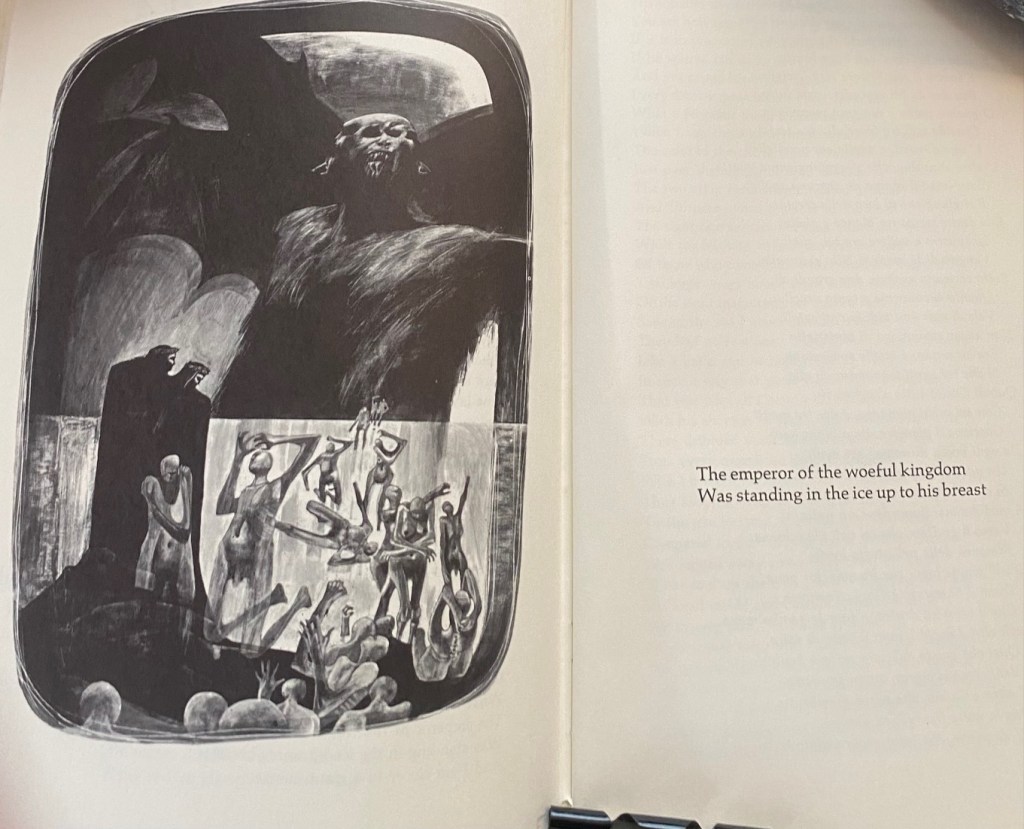
Speaking of death, while Hell (which is where some of my Fundamentalist friends tell me I’m going to go when I die) is usually pictured as a place of fire and brimstone, in Dante’s Inferno, the center of Hell is a vast lake of ice, in which Satan, along with sinners who committed treason and betrayal—such as Brutus, Cassius, and Judas—is incased.
from Dante’s The Divine Comedy, I Hell, translated by Louis Biancolli, 1966
Makes sense to me. Ice is cold. Ice is heavy. (The reason we lost electricity was because ice-laden trees fell on power lines). Ice prohibits movement. During the most hellish part of my life, after my daughter died, I couldn’t get warm. I felt as if I were carrying a 20 cubic foot freezer on my shoulders. My body was rigid and tense. Only after I’d had two or three large tumblers of scotch did I feel as if I were thawing.
And yet. For someone who dislikes ice, I realize that one of my tendencies is to want to freeze experiences and beliefs, preserve them the way we preserve meat and vegetables.
After those hellish first years when Laurie died, my life began to get better. I thought I was learning to live with loss. But five years later, at this time of year, it was as if my daughter has died all over again. I plunged back into rage and tears. I spent evenings drinking my tumblers of scotch (or maybe it was Wild Turkey 101 proof, at this point), going through old photograph albums of the two of us and listening to Laurie’s old tapes of Tracy Chapman and the Grateful Dead. The only difference was that those I was most angry with were people who talked about their own grief. I remember being at a retreat at a monastery in Cambridge, Massachusetts where a woman talked about almost losing her son in an automobile accident. A spasm of rage surged though me. I thought, What are you moaning about? He’s alive, isn’t he?
Then on Easter Sunday after this retreat, I heard a sermon based on the Gospel of Mark’s account of the Resurrection, which, unlike the other gospels, ends with Mary Magdalene, Mary the mother of James, and Salome, fleeing from the empty tomb, “for terror and amazement had seized them; and they said nothing to anyone, for they were afraid.”
Why fear, asked the preacher. Well, there might have been a lot of reasons—fear of soldiers, fear of grave robbers—but he also wondered if it wasn’t human nature to fear the unknown, to become used to, even comfortable with, our lives even if they’re full of pain and suffering. We prefer what we do know to what we don’t.
And I realized that over the years since Laurie’s death, I had grown comfortable with my image of myself as GRIEVING PARENT; I had made Laurie’s death MY STORY, trying to preserve memories of her, as in the old photograph albums I’d been perusing. And if anyone else had a similar story, I felt threatened.
In other words, I was trying to freeze my sense of myself and Laurie rather than let them evolve, flow. I wasn’t angry about the death of my daughter, I was angry at the possible death of my grief, thinking it was grief that was keeping me close to her.
That Sunday afternoon, sitting in Harvard Square amidst cigarette butts and pigeons, looking up at the sycamores and the brick buildings, listening to voices babbling in a half-dozen languages, I tried to focus on my daughter in the present moment. I don’t know where you are, Kid, I remember praying, but at some level I know you’re fine, and I want you to know that I love you.
And the sights and smells and noises of the Square seemed to fade and I felt a hand on my shoulder, and I knew it was Laurie’s.
I don’t care whether that hand was from another dimension or from my imagination. What I do know is that the great spiritual traditions are right: love transcends death. That is, if you don’t try to freeze it like leftover meatloaf.
But I’m still learning. Working a 12-Step Program, I’ve discovered traits that I developed to survive growing up in an alcoholic family—judgmentalism, people-pleasing, perfectionism—traits which no longer serve me, but have, in essence, remained frozen, damaging my relationships with others.
And I’m wondering if I may be trying to freeze my retreat experiences, and that Life, the Universe, or God of my not Understanding isn’t telling me by having this retreat in California canceled that I need to let the retreat experience—the silence, the awareness, the reading, the closeness to God— flow into my everyday life, here at home, even in the middle of an ice storm.
Recently, Hurricane Lee, at one point a Category 5 hurricane, churned up the Atlantic coast, bringing with it dire warnings such as, “Lee Drives Towards Us with a Hugh Wind Field, Damaging Waves, and Flooding.” The Episcopal Church of Maine’s website offered a prayer, which began: “Creator God, we ask you to calm the wind and the waves of the approaching hurricane and spare those in its path from harm.”
I put away lawn chairs, harvested basil, tomatoes, and beans from my garden, and checked to see that our flashlights all had new batteries and the lamps had oil. I cleaned out the garage, so that I could get my car out of the way of falling branches.
Well, the trees did some jitterbugging in the wind to the rhythm of our wind chimes, and our lawn had a smattering of small branches. My Zoom meeting with an Al-Anon sponsee on the coast ended early when his power went out, and my bean pole in the garden blew over, but all in all, the effects of the storm were minimal. A few years from now—if I’m still alive—I doubt if I’ll tell many stories about Hurricane Lee.
Hurricane Lee: 2023
There are other hurricanes, other storms, however, whose stories have stayed with me.
In 1954, Hurricane Carol, the first Category 5 hurricane to hit New England, roared through Maine, followed ten days later, by Hurricane Edna. A little research tells me that the two storms caused 25 million dollars in damages and destroyed 3500 cars and 3000 boats. What I remember was that at 11 years old, I thought hurricanes were neat. The thundering river down the hill mingled with the roar of the wind, and our house shook like some carnival ride. I couldn’t understand why my father was chain-smoking and pacing back and forth in front of the living room window, muttering, “I hope that goddamned tree doesn’t fall on us.” The day after Hurricane Carol, my friends and I walked through town, gaping at the elm trees that had blown over, amazed at the size of their roots, which rose several feet over our heads.
The next hurricane to hit Maine was Gloria, in September 1985. According to Wikipedia, this storm affected six counties in Maine, with multiple injuries, downed trees, and 250,000 people without power, some for up to fourteen days. I was living Down East at the time. Less than a month earlier, my first wife and I had separated, and the day after the storm I got up early to drive my daughter Laurie to church camp for the weekend. After dropping Laurie off, I continued on to visit my mother and father. When I pulled into the driveway, I saw Dad standing in strewn leaves and fallen branches, trying to fry bacon and eggs on a charcoal grill. My Grandmother Cleaves, who’d come over from her apartment for a hot breakfast, stood at the window.
What I recall even more clearly now was that my father, Laurie, and Nanny Cleaves all died within the next four years. Throw in a divorce and a second marriage, and I experienced an emotional hurricane that made Gloria feel like a summer breeze.
In 1991, Hurricane Bob came to Maine. Three people died, many residents lost power, and there was over five million dollars in damages. Again, the storm’s direct effect on my new family and me was minimal, but because of the heavy rains and losing power, my Grandmother Kimball’s cellar flooded because her sump pump stopped working. At 92, living alone, she couldn’t cope with the responsibility of keeping the house up, so she sold it to me. Mary Lee and I lived in that house for the next 22 years. Then, after a spring rainstorm and another flooded cellar (something like the fifth one in those 22 years), we sold the house and moved to where we now live (which, thankfully, has no cellar).
Our cellar after the Patriots’ Day Storm of 2007
I think of other storms in my life—natural ones, such as the ice storm of 1998, various nor’easters leaving two feet of snow; emotional storms, such as my defeats and disappointments, a divorce, Laurie’s death—and I realize that I remember them far more clearly than I do the sunny days—beach days, vacations with family in Florida and Bermuda—or the happy times: the victories, the times I’ve been recognized or honored. I don’t know about you, but it’s the storms rather than the sunny days in my life that have become the stories of my earthly pilgrimage, those narratives that have helped me navigate my life, and which I continue to look back on and refer to as I forge on towards whatever denouement awaits me.
So, why that is that even after sixty years, I remember my defeats on the basketball court more than the victories? That I remember my divorce settlement more than my first marriage ceremony? Laurie’s death more than her birth?
Maybe one reason these storms stay with me is that I’ve survived them all. Storms help me feel good about myself, less afraid of the future. I can be “defeated but not destroyed,” as the great storyteller Ernest Hemingway said. I recall meeting a woman who knew of Laurie’s death and who’d just lost her son in a fire. Her first words to me—even before saying hello—were “Tell me how you’ve survived!” At the time, a guy I’d come to know from being in grief counseling together, had just committed suicide and I realized surviving Laurie’s death really was an accomplishment.
As I think of it, storms have not only made me aware of surviving, they’ve made me feel more alive. And I don’t think I’m alone in feeling this way. There’s nothing like a good nor’easter or hurricane to draw people to watch the ocean waves crashing over the rock-bound coast of Maine. After Laurie died, I found myself missing those last weeks of her life when I was living at a Ronald McDonald House, spending the days beside her. There was a focus to those days, a purpose, and the great themes of Life and Death dwarfed the usual minutia of everyday life.
Speaking of less fear and more focus, I’m interested in the number of people I know who suffer from anxiety and depression but who become fearless when forced to face specific physical dangers such as a high wind or a flood.
In a storm, I let go of the old stories I tell myself about who I am. I’m forced to come to terms with the fact that life as I knew it may never be the same. I plunge into a new adventure, a tale of unknowing, which can also be a story of spiritual re-birthing if I can only recognize and surrender to that power greater than myself.
Looking back at the storm stories in my life helps me realize that while I may want to shrink God down to my size, God is always bigger than I am, will always be God of my not Understanding.
And of course I have to include a snowstorm picture—this from 2013.




 The Geriatric Pilgrim: Traveling the Landscape of Faith and Grief