Ruminations on his 83rd Birthday

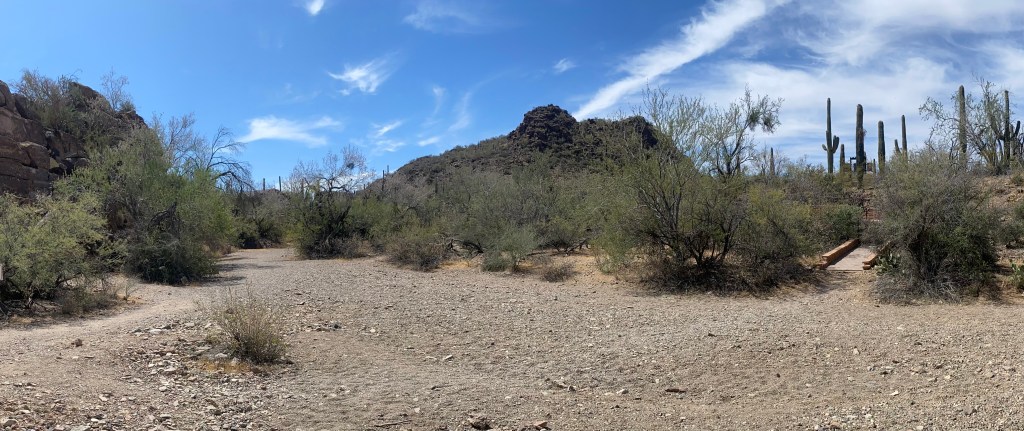
Picture Rocks Wash, Arizona. On the right, stairs lead to the Stations of the Cross. On the left are the petroglyphs.

~

His life these days is like walking a trail,

maybe that wash* in Arizona when 

he was on retreat, when on one side of 

him were the Stations of the Cross and on

the other side the picture rocks that give 

the wash its name: 1500-year-old 

petroglyphs by the Hohokam farming

people of the Sonoran Desert.

~

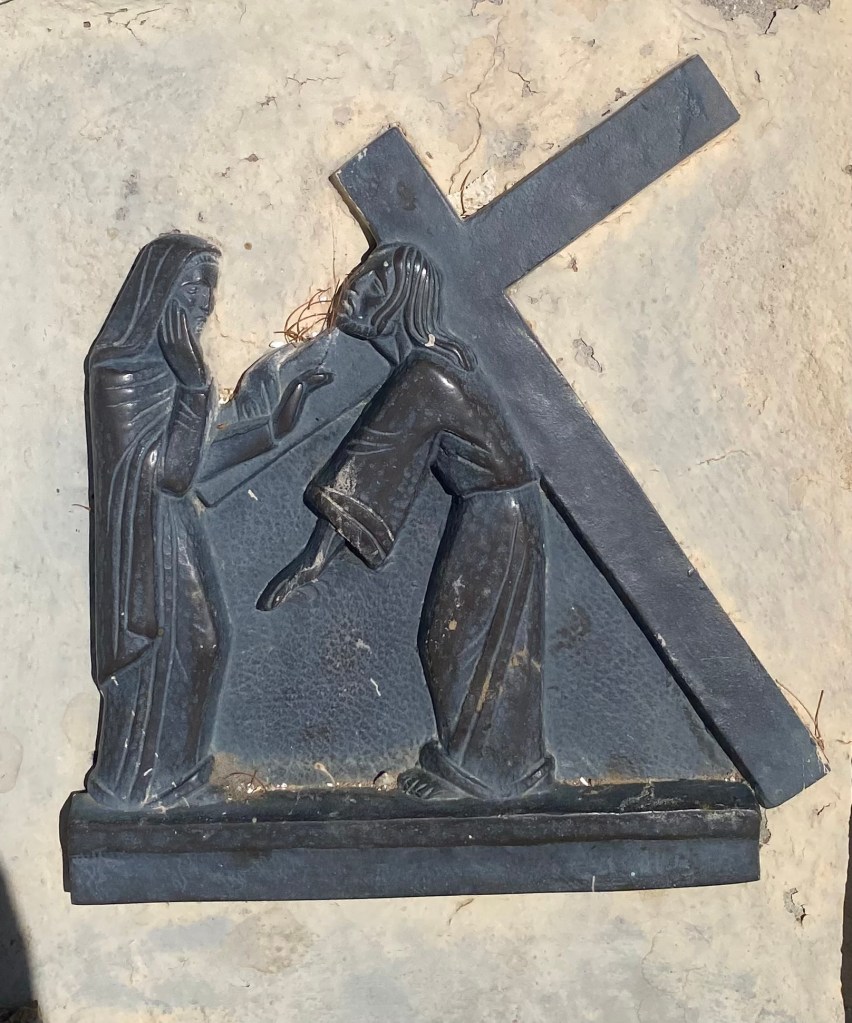
On one side, 14 etchings in metal

depict Jesus’s progression to his

death: scourging and the crown of thorns, falling 

under the cross’s weight, piercing, thirst, and 

humiliation, abandonment by 

friends, followers, even God, death. And 

he thinks of the violence and cruelty

of the empire in which he lives against

the materially poor and the sick

and the marginalized, his feeling that 

God has abandoned the country he loves,

his own pains in places he never knew

he had; indignities; lashings of fear; 

the cross he carries of his family’s

disease; the piercing loss of his daughter.
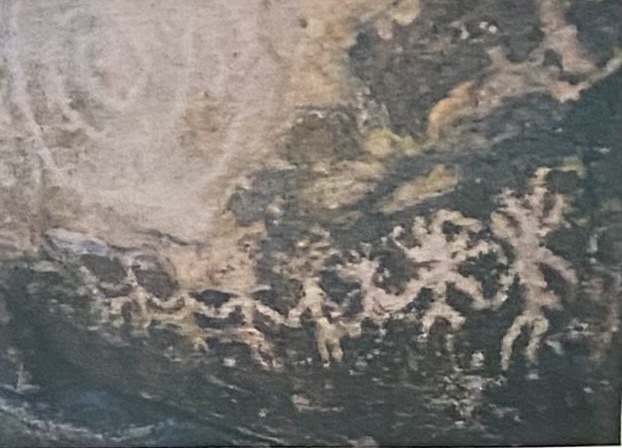
On the other side, petroglyphs show the 

the sun’s progression during the summer 

solstice: swirls and spirals and strange designs, 

images of dancing people, deer and 

antelope, alien-looking creatures

(you don’t suppose…), and something that looks like 

a picture of an atom, but which might

depict life’s interconnected circle.

He thinks of the kind and kinds of people 

he’s met in traveling from coast to coast,

this country’s mountains, deserts, and rivers, 

of the smell of the dirt in his garden,

dancing with his wife, watching grandchildren

grow up, his church men’s group, his circle of 

friends, his joy in writing a good poem.
He recalls walking between the two sides

of the wash, hearing what might have been a 

cacophony or what might have been a 

choir of quails, doves, finches, cactus wrens, 

flickers, thrashers, cardinals, fly catchers, 

pyrrhuloxia, verdins…and he hears

the sounds of his life: voices of parents 

who, despite their own horrible childhoods, 

made of themselves a living sacrifice

for their children, echoes of the friends he’s 

lost, and of the friends he still has, some of 

them going back to childhood, the teachers 

he disappointed and the teachers who

were there when he needed them, the students 

he failed, and those he inspired, the sounds 

of the tortured last breaths of his daughter, 

and the glorious voice of the woman 

he loves as she reads the Sunday Gospel. 

~

He remembers the Arizona sky

which canopied both sides of the wash,

feeling the paradox that is his life 

enfolded by Something—The Holy Spirit, 

The Tao, The Great Spirit, Jesus, Buddha,

Jehovah, Allah, Brahmin, The God of 

My Not Understanding—he doesn’t care

about names, he’s grateful to be here and

eager to see what’s around that next bend.

~~

*a wash is a dry, low, sandy riverbed that only carries water during rare rain events. It’s often called an arroyo.

Sonnet for the new Year

The hemlocks in the hollow all have toes

That curve and claw down into rocky ground

To keep them anchored when the north wind blows,

And waters rise as heavy rains come down.

But overhead, these trees sway in the gale,

Dancing a jig to nature’s stormy song,

As if in celebration while winds wail,

Of their sure faith no tumult can last long.

Great lesson, that, especially this year

When God knows what strange winds will blow ‘round me:

Grasp on to love, trees say, instead of fear;

But sway, be supple, let adversity

First rev and race and then run out of gas.

Keep faith, my soul, that this as well shall pass.

#

Our Rite of Hope for January 7, 2021

#

“…. by participating in a ritual, … [y]our consciousness is being re-minded of the wisdom of your own life. —Joseph Campbell

#

Yesterday we celebrated Epiphany,

When wise men worshipped the Christ child. 

& recalled the goons in MAGA caps who trashed the nation’s capital.

Still rattled today, we observe our annual ritual:

  We play The Christmas Revels 

                                                            Wassail, wassail, all over the town

  We strip the tree of 

   Ornaments:

     From pilgrimages—

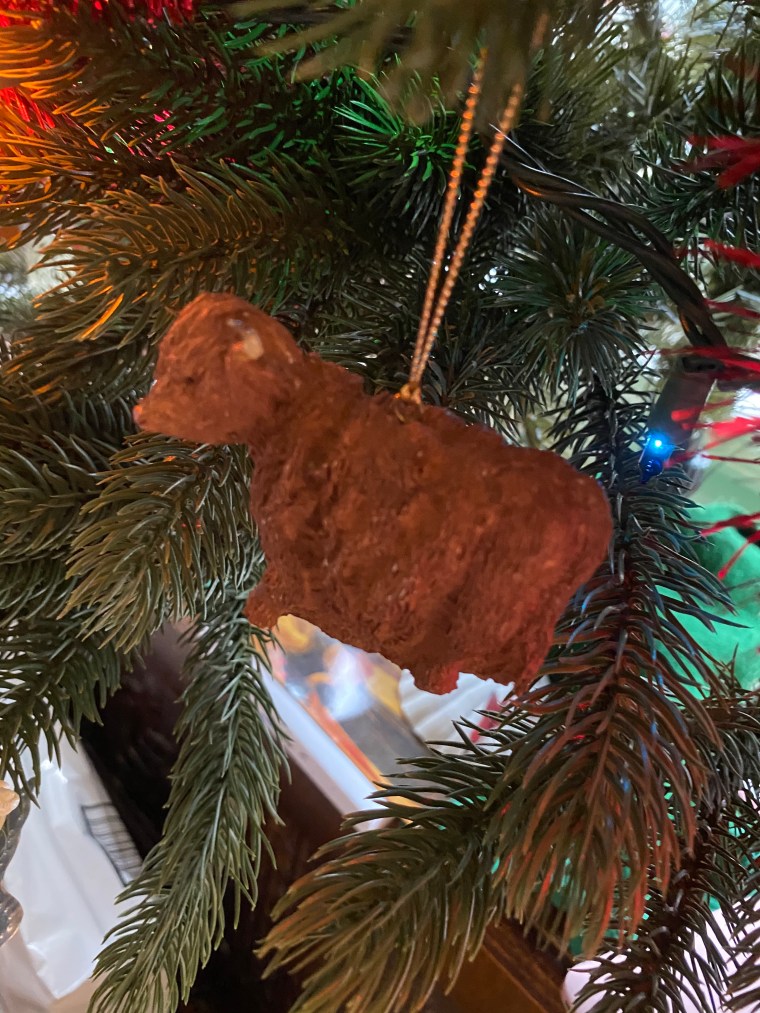
                 2 wooden sheep from Scotland 

          (my ancestors died for Bonnie Prince Charlie)

                          2 olive wood crusaders’ crosses from Jerusalem

                                    (Christians & Muslims slaughtered each other for centuries)

                          1 porcelain nazar from Istanbul

                                    (protection against evil)                      

Here come I, old Father Christmas

             From childhood—

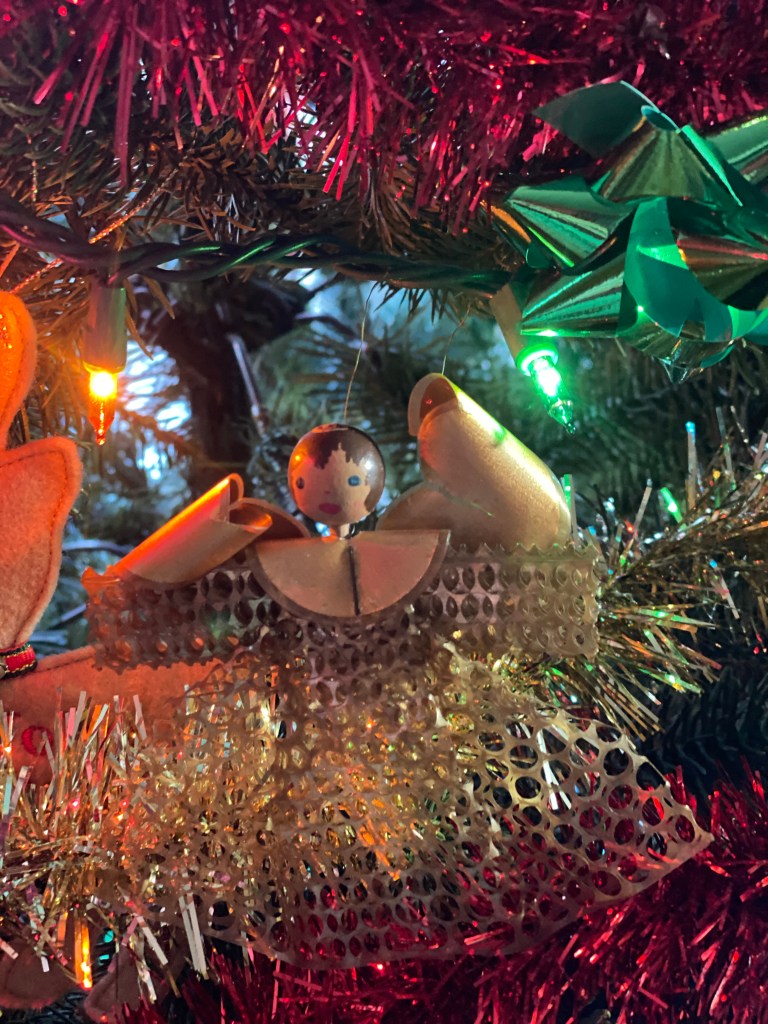
                          1 wooden and tin mesh angel from the turn of the 20th Century

(2 world wars, 2 flu epidemics, the Depression, Korea, Viet Nam, 3 assassinations, Watergate, 9-11, yesterday)


        1 plastic Santa from WWII                             

           (Dad in Belgium building bridges for tanks)

The boar’s head in hand have I

3 shiny ornaments my parents bought with green stamps 

                                    (To brighten memories of their broken childhoods)

                                                                                                There was a pig went out to dig

                                                                                                Christ-i-mas day, Christ-i-mas day  

            From children & grandchildren—

                        4 yarn & toothpick God’s-eyes

                        1 fuse-bead heart, 1 fuse-bead cat, 1 fuse-bead turtle, 

                        2 black felt cats honoring my step-son’s first pets

                        1 brown fur diarrhea microbe 

(from my daughter-in-law who helps impoverished countries improve water quality)

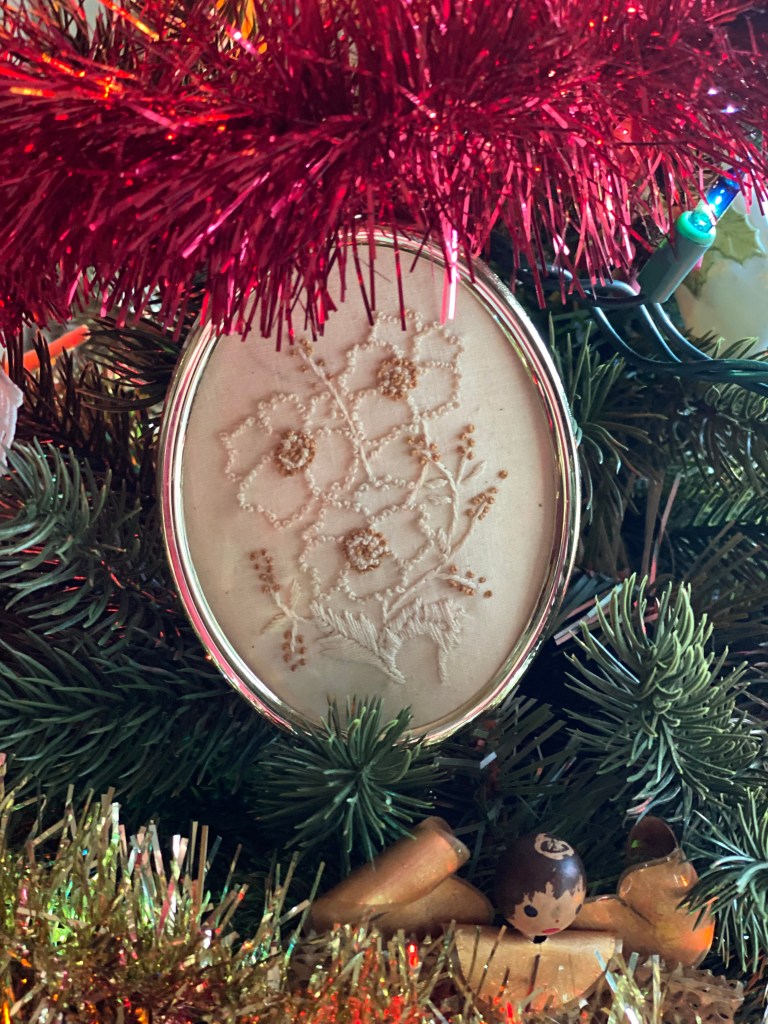
                        1 embroidered-flower ornament from my 16-year-old daughter

                                    (2 years before she died from cancer)

                                                                                                            The holly and the ivy…

     Lights:

            3 strings of red  blue  green  orange  bulbs

                        (The big painted ones long gone, but at least these aren’t white)                              

            1 yellow star

                        (“For we observed his star at its rising, and have come to pay him homage.”)

Dance, then, wherever you may be

                                                                                                I am the Lord of the Dance, said he.

So, we dance

between

Christianity & paganism

Past & present

Light & dark

Death & life

Sorrow & joy

Arms clinging to our rite of hope.

# #

Dancing Lessons

fullsizeoutput_13db
Christmas Prom 1960

#

Just before hitting the “Publish” button for my last blog on the importance of music in my life, I heard this voice in my right ear, “Of course, your next blog is going to be about dancing.” Music and dancing are intertwined, sort of like going on retreat and making a pilgrimage. My feelings about dancing, however, are more complicated than they are about music. I have always loved music; I have not always loved dancing.

I want to blame Arthur Murray, who, it has been said, taught America to dance. In the 1950s, when I first discovered rock ‘n roll and girls, there were over 3000 Arthur Murray dance studios in the United States, one of which sent instructors (I remember him as 30-ish, with thinning hair, wearing a wrinkled tuxedo, and her as blond—bleached?—in a black strapless dress that showed off her legs and the run in her stocking) to Yarmouth, Maine to line us boys up on one side of the room and the girls on the other, leaving a no-man’s land between the sexes that I spent years trying to cross.

Apparently, Murray, whose given name was Moses Teichman, felt that dancing was how people could become more sophisticated and move, as he had, into a “better” class of society. So, along with the steps to the waltz, the foxtrot, the jitterbug, or the cha-cha, the instructors also taught etiquette. Young men, for example, were instructed to walk across the floor to the young ladies, bow, and say, “May I have this dance?”

I have to say, however, that if the aim at the Masonic Grange Hall was to teach refined behavior to seventh and eighth graders, it was not a good idea after having taught us the steps to blow a goddamned whistle. The scene turned to something resembling the kickoff of a football game, as barely-pubertal males raced across the floor, elbowing each other in an effort to get to the four or five girls with breasts, the fastest and dirtiest fighters skidding to a stop in front of them, yelling “My’vethisdance!” while the chosen ones stood giggling and the rest of the girls stared at the floor, waiting for the losers to get to them.

My first experiences with dancing, then, taught me to divide the world into us and them: boys and girls, fast and slow, winners and losers, all engaged in a fight for survival of the fittest. (Which was underlined the evening my partner and I won a dance contest. I can’t remember how we won, but it certainly wasn’t because of my dancing ability. I think she and I must have been standing in the spotlight when the music was stopped or something. Anyway, my prize was a switchblade knife, once the weapon of choice used by street gangs.)

When I reached high school, the record hops in the gymnasium at first perpetuated my sense that dancing was a battle, first with myself to get up the nerve to cross the no-man’s land between the guys standing along one wall and girls standing along the other, and then with her to find something to say or how close to get or where to put my hands.

Until one night, dancing suddenly became unlike anything I’d ever experienced: losing myself in another’s embrace, looking into the eyes of someone and seeing both her and myself for the first time, forgetting my adolescent self-consciousness in our interaction with each other and with the music. (I think the song was “Dream” by the Everly Brothers.)

Fast-forward twenty-five years. I’m in Princeton, New Jersey, evaluating high school essays for the College Board. The last night of the reading, a bunch of us teachers are in a bar, bouncing our middle-aged bones around the dance floor to a collection of golden oldies played by some kids in ripped tee-shirts.  When the band switches from “Whole Lotta Shakin’ Going On,” to “I Can’t Help Falling in Love with You,” the woman I’ve been twisting with says, “Do you dance slow?”

Thirty-four years later, we still try to get in at least one slow dance a week.

#

I wonder if the reason I feel called to write about dancing is to make me more aware of how the secular and the spiritual intertwine, and to reveal how my relationship with the God of my Not Understanding has changed and where it might be going.

When my eighteen-year-old daughter Laurie died of cancer, I thought my belief in God had died with her. But after a year of raging at my family, friends, students, the driver in the next car, and Boston sports teams, I realized, no, I’m really pissed off at God, which means I think God exists. Focusing my anger at God became the first step in what I think of as my pilgrimage through grief and grace. And almost thirty years after Laurie’s death, I still often feel like Jacob in the Old Testament, wrestling with, if not God, then with God’s angel.

On my desk, I have a copy of a Rilke poem, The Man Watching, in which the speaker praises those “wrestlers of the Old Testament,” who, “…beaten by this Angel/…went away proud and strengthened/and great…” Winning, Rilke writes, is not important to such a fighter, because

This is how he grows: by being defeated, decisively,

 By constantly greater beings.”

And yet during the last few years, as I’ve become more and more aware of having received the grace not only to survive Laurie’s death, but also to have lived, all in all, a happy life surrounded by love, I’ve started wondering if I’ve really been wrestling with God, or whether I’ve been engaged in a sort of dance, where all along, God has been trying to embrace me, take me into loving arms. And if it hasn’t been during those times when I have surrendered—let God lead, if you will—that I’ve received the grace to sustain me.

Both scientists and modern writers on spirituality tell us that everything in the universe —animals, vegetables, minerals, living and dead—is interconnected. Everything exists in relationship. The question for me these days (and I wonder if it isn’t a question this country is struggling to answer), is whether this relationship is going to be in the form of a wrestling match or a dance—whether when I look out my window at tree branches in the wind, I see the trees struggling against the elements or dancing to them; whether when I see someone of another color or another life-style coming toward me on the street, I see an opponent or a partner; whether I still see the world as us and them lined up on opposite sides of the floor, or whether I see just us, moving in harmony to the music.

fullsizeoutput_13d5
Prayer flags and daffodils, dancing—I like to think—in the wind.

# #