80 is not 70

~

Over coffee the other day, I was talking with a younger friend (most of my friends these days are younger) and said, “Let me tell you: 80 is not 70.”  Like so many of my pronouncements, it sounded good at the time, but when Chuck asked me what I meant, I found myself sinking into the mudflats of my own brilliance.

What did I mean?

When I came home, I found a blog I wrote nearly eight years ago, called “Since 70” [link] in which I talked about my pilgrimage as a septuagenarian: living with my “diminishments”—both physical and mental—struggling with inertia, my changing tastes in food, entertainment, and music, and most of all, my increased awareness of my powerlessness to control people and events.

Well, the diminishments have increased: I’m living with chronic emphysema, my balance is shot, and my skin shreds like tissue paper. I no longer struggle with inertia; I’ve given in to it. To lower my carb intake, I’m eating yogurt instead of muffins, cauliflower rice instead of potatoes, and just about every kind of nut raised on this planet. Technology grows more confusing. I listen to more classical music. I’m still working on acceptance.

None of which is surprising (depressing but not surprising); what surprised me as I read my blog was my impatience with my 70’s self. Several times I thought, “Oh, for crying out loud, Rick, get to the point!” And I realized that one reason 80 is not 70 is that I’m now clearer about what is essential and what is not. I have some 50 hats hanging in my garage; I usually wear one of four. I have five banjos; I play one. I have ten kinds of tea; I drink three.

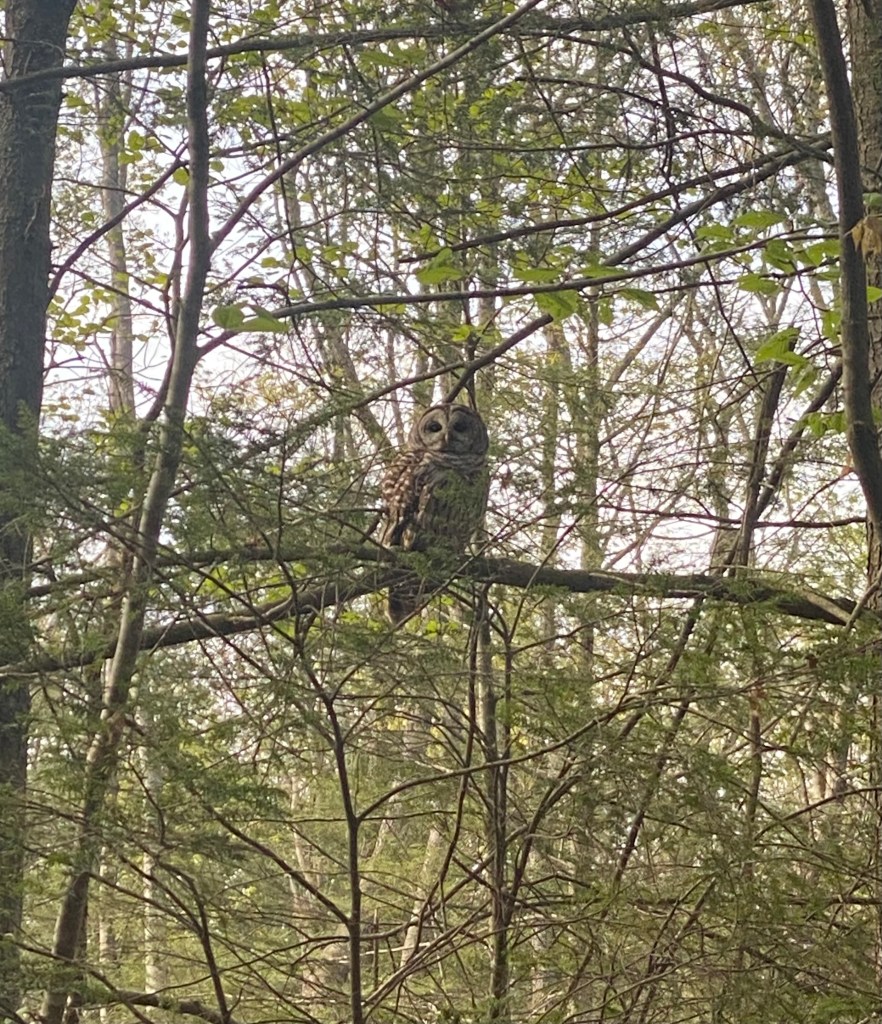
I don’t know if there’s a connection or not, but life as I know it is more intense. The highs are higher and lows are lower and there are more of both. Recently, when I was walking through the woods and looked up to see a barred owl, my heart hiccuped with joy. An email that afternoon notifying us that a new 100-unit development is probably going up in those woods plunged me into despair. (A lot of the news these days does this to me.)

One of the reasons I’ve had trouble in the past finding what’s essential is because, as my first wife used to say, “Rick, you think too much.” Until I got into my 80’s, I could stand for twenty minutes staring into my closet trying to decide what to wear. I had to set a timer when I played Scrabble or Mary Lee wouldn’t play. Most of the time, though, I was thinking about what people thought of me. When I was with someone, I never really saw them; I saw only the me I thought I saw in their eyes. As for listening, forget it; I was planning what I was going to say next. These days—thank you, Jesus or Al Anon or Father Time—by paying less attention to who I think you think I am, I’ve become more interested in you. I’ve become a better listener.

I find I’m now curious, a word that was never part of my vocabulary. Quantum physics fascinates me. So does the leaf caught in a spider web outside my window. So does my death. As a result, I think, I am far less resentful about what I don’t have and far more appreciative of what I do have.

I spent a lot of my 70s reliving life in a small Maine town during the 1950s, and I’m sure I’ll continue to write about those years. But these days, what’s more important is being here. Right now. Not this decade, not this year, not this week, or even today, but this moment in the day that I’m sitting here alternatively typing on my computer and looking out the window. Maybe that’s why I’m reading and writing more poetry: it’s more immediate, more concerned with moments than memories.

So yes, Chuck, 80 is not 70. Life is not better—for many of us, it can be more painful, lonely, and frightening. But, for me at least, it’s also more interesting, more authentic.

And I’m more grateful for it.

~
Ruminations on his 83rd Birthday

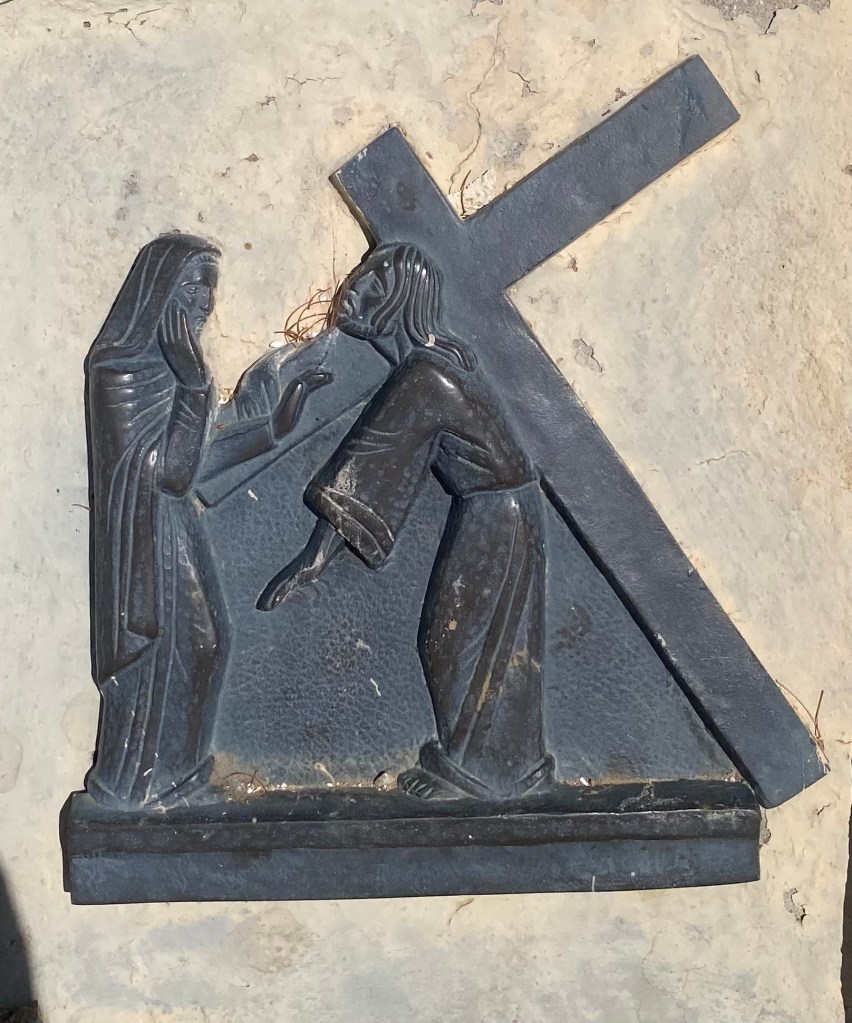
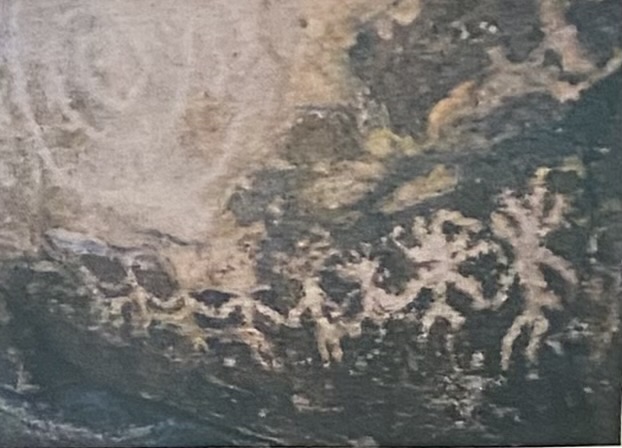
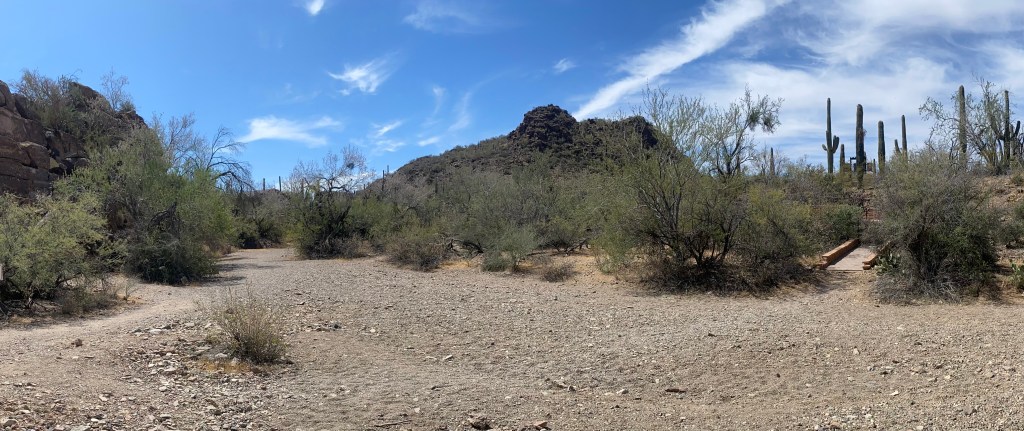
Picture Rocks Wash, Arizona. On the right, stairs lead to the Stations of the Cross. On the left are the petroglyphs.

~

His life these days is like walking a trail,

maybe that wash* in Arizona when 

he was on retreat, when on one side of 

him were the Stations of the Cross and on

the other side the picture rocks that give 

the wash its name: 1500-year-old 

petroglyphs by the Hohokam farming

people of the Sonoran Desert.

~

On one side, 14 etchings in metal

depict Jesus’s progression to his

death: scourging and the crown of thorns, falling 

under the cross’s weight, piercing, thirst, and 

humiliation, abandonment by 

friends, followers, even God, death. And 

he thinks of the violence and cruelty

of the empire in which he lives against

the materially poor and the sick

and the marginalized, his feeling that 

God has abandoned the country he loves,

his own pains in places he never knew

he had; indignities; lashings of fear; 

the cross he carries of his family’s

disease; the piercing loss of his daughter.

On the other side, petroglyphs show the 

the sun’s progression during the summer 

solstice: swirls and spirals and strange designs, 

images of dancing people, deer and 

antelope, alien-looking creatures

(you don’t suppose…), and something that looks like 

a picture of an atom, but which might

depict life’s interconnected circle.

He thinks of the kind and kinds of people 

he’s met in traveling from coast to coast,

this country’s mountains, deserts, and rivers, 

of the smell of the dirt in his garden,

dancing with his wife, watching grandchildren

grow up, his church men’s group, his circle of 

friends, his joy in writing a good poem.

He recalls walking between the two sides

of the wash, hearing what might have been a 

cacophony or what might have been a 

choir of quails, doves, finches, cactus wrens, 

flickers, thrashers, cardinals, fly catchers, 

pyrrhuloxia, verdins…and he hears

the sounds of his life: voices of parents 

who, despite their own horrible childhoods, 

made of themselves a living sacrifice

for their children, echoes of the friends he’s 

lost, and of the friends he still has, some of 

them going back to childhood, the teachers 

he disappointed and the teachers who

were there when he needed them, the students 

he failed, and those he inspired, the sounds 

of the tortured last breaths of his daughter, 

and the glorious voice of the woman 

he loves as she reads the Sunday Gospel. 

~

He remembers the Arizona sky

which canopied both sides of the wash,

feeling the paradox that is his life 

enfolded by Something—The Holy Spirit, 

The Tao, The Great Spirit, Jesus, Buddha,

Jehovah, Allah, Brahmin, The God of 

My Not Understanding—he doesn’t care

about names, he’s grateful to be here and

eager to see what’s around that next bend.

~~

*a wash is a dry, low, sandy riverbed that only carries water during rare rain events. It’s often called an arroyo.

Mid-December’s Black Ice

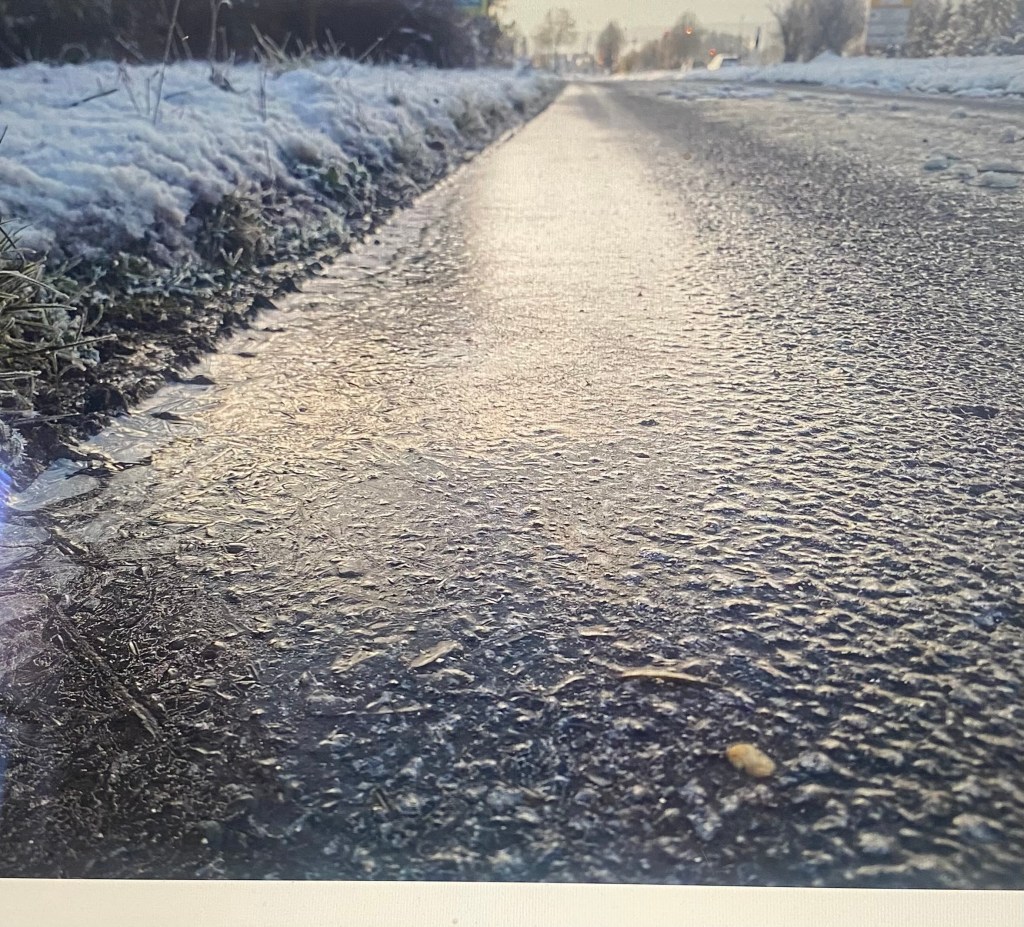
Photo from Wikipedia (but it could have been in front of my house)

◊

Yesterday’s snow became rain

before the temperature dropped

back into the teens, so that

this morning, sunshine glistens 

on the icy road over 

which I walk—an eighty-year-

old man trying to find his 

way during this season of 

Joy to the World, while he grieves

the anniversary of 

 his child’s death, and ponders what’s 

next with curiosity 

glazed with fear, poking along 

flat-footed, carefully pick-

ing his way, concentrating 

on not falling, focused on 

keeping that icy balance. 

◊

Curiosity

A poem about curiosity has got to have a cat in it somewhere, right?

~

… has become a joke between my sponsor and me.

“And, as always,” she says, “be curious.”

And I laugh because I’ve learned she’s right,

and she laughs because she knows I’ve learned she’s right:

that a shot of curiosity is vaccination against

all those viruses that have infected me for the past 80 years: 

resentment, shame, lack of self-worth, 

judgmentalism, co-dependency…

.~

Nothing defuses solipsism like a dose of “I wonder”—

wonder why that email from my old high school pissed me off for days,

wonder why I felt it was my responsibility to keep the meeting on topic,

wonder why I took an instant dislike to the woman ahead of me in the checkout line,

wonder why yesterday I felt that I was God’s gift to humanity and today that I’m a urinal cake—

shifting attention from self to subject,

neutralizing judgment, anticipation, awfulizing, expectation, and resentment.

~

Curiosity keeps me from remaining curled, like a caterpillar in a cocoon,

counsels me to explore the landscapes of my past, present, and future,

with no destination, only an appreciation for the journey.

Curiosity exercises senses I’d almost forgotten I had,

gives my racing mind a needed pit stop.

Curiosity exposes shapeless anxieties to light

where they evaporate, or (and be honest here)

sometimes spew pain previously lying dormant for years beneath denial,

erupting now in spasms of anguish until—son of a gun!—

melting into the floor like the Wicked Witch of the West.

Curiosity is what keeps the people I admire these days young,

what brings me awe,

and yes, what keeps me laughing.

~ ~