Gazebo

~

“We are saved in the end by the things that ignore us.”— Andrew Harvey

~

At the Spiritual Renewal Center in Arizona

I’m not feeling renewed spiritually or otherwise.

Dusty desert wind sears my lungs as I sit in 90° heat,

stuck to a faded plastic chair in a rundown gazebo—

rotting floor…peeling paint… broken railings—

good place, I think, for an octogenarian

with COPD, a weak heart. and arthritic joints.

Just six years ago I walked the nearby desert trails 

for miles past petroglyphs and rattlesnakes,

up rocky canyons and down sandy washes.    

This morning, I reached for my inhaler after 20 minutes 

and turned back feeling old and dilapidated.

Now, I sit in this decaying gazebo awfulizing about my future:

a sudden heart attack that strikes me down

before I can say good-bye to those I’ve loved, 

or a stroke which leaves me paralyzed and drooling 

while others change their lives to look after me,

or worse, dementia, unable even to say thank you for caring.

Which leads me to wonder: Will I be missed when I’m gone?

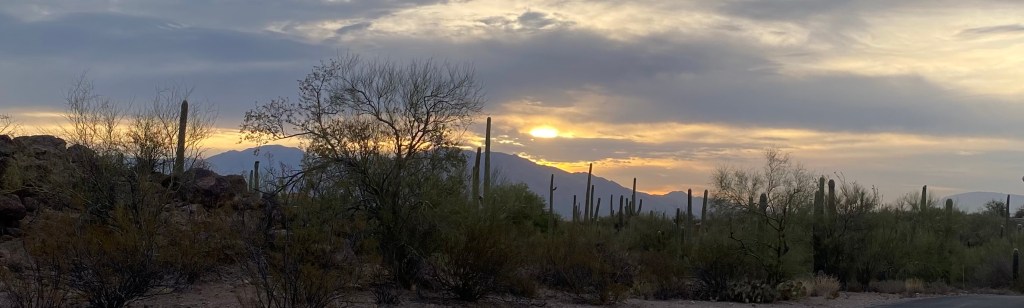
Certainly not by the flat cumulous clouds 

floating over the hills on the horizon

 or the wind through the prickly pear, cholla, barrel,

organ pipe and ocotillo cactus,

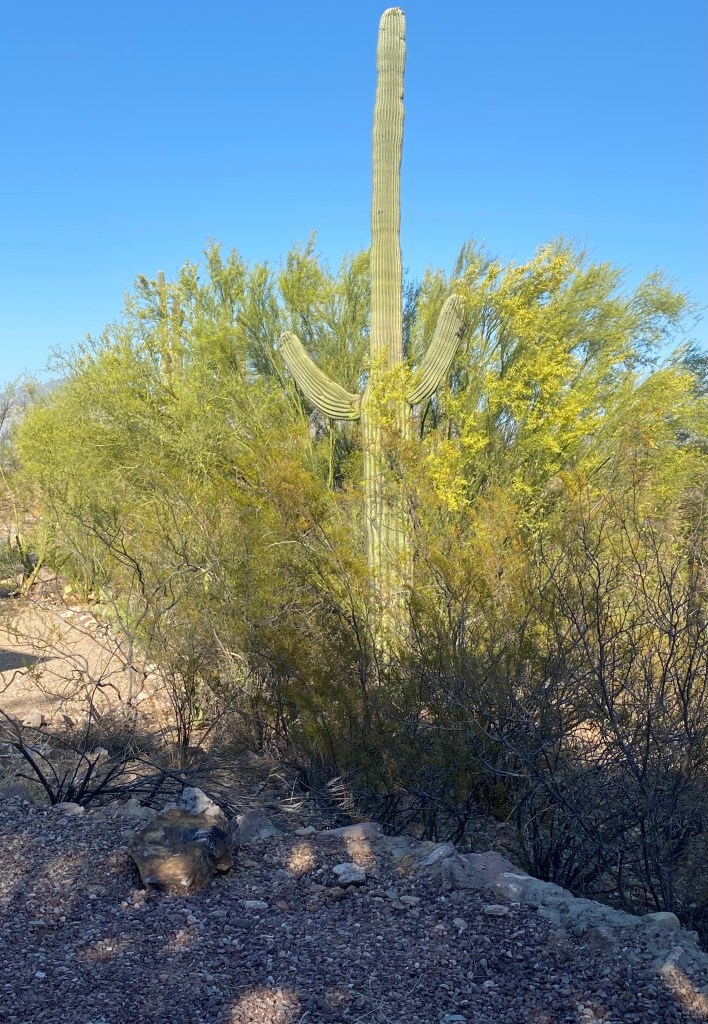
 not to mention the saguaro standing

with arms raised to the heavens,

 and certainly not by the coyotes 

barking from the copper-colored hills behind me, 

or the doves or cardinals or flycatchers or thrashers 

or warblers or wrens or quails,

nor, come to think of it, by the yellow blossoms

from the palo verdi  blowing in the desert wind, gilding

the rotten gazebo floor and my decrepitude 

with the golden certainty of new life. 

~

Acceptance

Arizona Sunrise

**

God, grant me the serenity to accept the things I cannot change…

*

When it comes, the clouds clear and the sun shines and you see things the way they are—

not perfect, certainly, maybe not even great, but all in all, not bad—

and you stop trying to change things and beating yourself up when you can’t.

*

The accusing voices in your head, the illusions of grandeur, the sirens’ songs of temptation

fade away and you find yourself singing an old Everly Brothers’ tune or a Christmas carol.

*

The gyre grows smaller, the falcon returns to the falconer, things come together,

the center holds, and serenity envelopes the world.

*

Don’t get me wrong, the clouds will return, more storms will come—

mistakes, injuries you’ll inflict (most of them upon yourself),

unrealistic expectations, failures, disappointments, defeats, deaths—

but maybe, next time, you’ll see rain, not Noah’s flood.

**

Nevertheless

Watercolor by Laurie L. Wile

~ ~

I’ve always known I’d never get

whatever it is I wanted.

No way, I’ve felt, do I deserve 

my desires—I’m just not worthy.

Nevertheless, my life’s been good.

~

(Of course, I’ve never known just what

I’ve wanted until somebody

told me just what I ought to want,

good co-dependent that I am.

Nevertheless, my life’s been good.)

~

There’s so much that I’ve never done,

and much that I’ve done I failed at;

places I never went to, and

places I never really saw.

Nevertheless, my life’s been good.

~

Often, I’ve been a hollow man,

trying to stuff his emptiness

with all manner of addictions

(the list’s banal, embarrassing).

Nevertheless, my life’s been good.

~

The faces of the people that

I’ve ignored, hurt, disappointed,

abandoned, disdained, or abused

haunt me in the wee small hours. 

Nevertheless, my life’s been good.

~

Now diminished by old age to

a funhouse mirror of myself,

I sense Death looking at his watch,

impatient, counting down the time.

Nevertheless, my life’s been good.

Through all of it, I have been loved.

~ ~

Somehow

Somehow, my parents from broken homes gave me a whole one.

Somehow, I met the right teachers at the right time.

Somehow, I fell into a vocation I loved instead of a job I endured.

Somehow, I survived my child’s death. 

Somehow, I stopped trying to drown my problems in cheap scotch.

Somehow, I learned to listen.

Somehow, I discovered joy.

Somehow, I no longer feel ashamed of being human.

Somehow, I’ve kept going even when I feel I’m walking in a circular trench.

Somehow, I’m still alive.

Somehow, I’ve not only survived, but grown.

Somehow, I remain hopeful.

Somehow, I believe, is another name for Grace.

Sanctuary

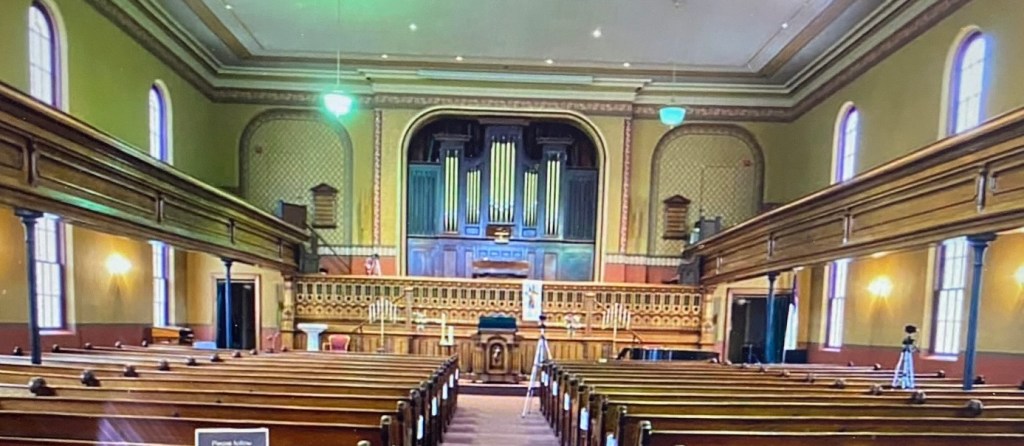
First Parish Church of Yarmouth, Maine 70 years later

~          

Now is the time to sit, be still, recall

those Saturdays at the First Parish Church,

where through stained glass, sun shines on empty pews,

and dust mots dance a silent jitterbug,

while I, at twelve years old, help out my dad, 

who moonlights as the sexton of our church. 

                                    ~

The great green doors shut out the noisy world—

my school with bells, droning voices, “Pipe Down!”

playground bullies’ intimidating threats;

my house with TV cowboys, Lawrence Welk,

and anxious voices trying to decide

what bills to pay and which to set aside—

as I collect last Sunday’s bulletins

from red pews tagged with names from long ago.

                                    ~

My corduroy trousers whistle as I walk.

I add my voice, which echoes off high walls

 just like Elvis singing, “Heartbreak Hotel”:

“Since my baby left me (whistle, whistle), …” 

Generations of church parishioners

like those in the old photos down the hall

silently applaud, and I feel at peace—

safe from strident voices, embraced, strengthened, 

supported by a Something I can’t name.

                                    ~

Now is the time, when storms of every kind

assault my brittle bones with screaming winds,

that I will sit, be still, watch those dancing

rainbows, sense kindly clouds of witnesses 

enfolding me as I lift soul in song

 in the sanctuary of memory. 

                                    ~

Sonnet for the new Year

The hemlocks in the hollow all have toes

That curve and claw down into rocky ground

To keep them anchored when the north wind blows,

And waters rise as heavy rains come down.

But overhead, these trees sway in the gale,

Dancing a jig to nature’s stormy song,

As if in celebration while winds wail,

Of their sure faith no tumult can last long.

Great lesson, that, especially this year

When God knows what strange winds will blow ‘round me:

Grasp on to love, trees say, instead of fear;

But sway, be supple, let adversity

First rev and race and then run out of gas.

Keep faith, my soul, that this as well shall pass.

#

On Hope: an Admonition

#

Stop confusing it with expectation.

You’re going to be disappointed,

resentful, angry, pissed off at God

because the cancer didn’t disappear,

you didn’t get that new job you wanted,

Hurricane Hattie flooded your basement.

#

(Write this down: Don’t hope for anything

you can see, hear, touch, smell, or taste.)

#

And even if you do get to come home

from the hospital a day early,

or the car coming right at you swerves

away at the last saving second,

or your friend’s stock tip pays off enough

to finance an Aruba vacation,

please, please, please don’t proclaim to the world

how God in His goodness answered your prayers.

You’re only setting yourself up for

future resentment, not to mention

guilt and shame for having somehow displeased

His Royal Holy Hood.

#

Instead, divest, dismantle, ditch, doff, dump

expectations, anticipations, wishes.

Take a deep breath, and go for a walk

along that path you’ve been walking all

your life. Don’t worry about what’s ahead

Here be dragons, right?—

but have a seat on this old tree stump.

Take more deep breaths, turn, look back

at all those times when, despite all your

mistakes, your blindness to injustice,

your embracing each Seven Deadly Sin

as if your happiness depended on it

while breaking all Ten Commandments

like you were making a hash omelet,

times when, despite your screwed-up family,

the hereditary overbite,

hip dysplasia, and weak heart,

times when despite the ugly divorce,

your daughter’s even uglier death,

all those goddamn operations,

the loss of lung capacity and libido,

you love the woman you wake up next to,

you sing to Sirius FM’s ‘Fifties Gold,’

you savor your morning hot chocolate,

you look forward to lunch with old classmates,

you feed the birds, play the banjo, plant

a garden, enjoy Wordle and Brit Box,

worshiping in silence, dabbling in poetry,

watching the grandchildren grow up.

#

Hope is not about getting what you want,

it’s about seeing what you already have,

the force that makes life worth living,

that same power that is pushing new growth

from this dead tree stump you’re sitting on.

#

Now, go get those dragons!
First Friend


Behold, I give unto you power to tread on serpents and scorpions, and over all the power of the enemy: and nothing shall by any means hurt you. —Luke 10:19

Staring at my 3 a.m. fears—A burning planet, a demented president-elect, disease, death—I think of you for the first time in years: first friend, neighbor, bodyguard, mentor, and, although three years older than I, my classmate from fifth through seventh grade.

Thick black hair and an Elvis sneer, Kirk Douglas dimple in your chin, sleeves rolled up as far as they’d go to show those growing muscles, your dark eyes often flashed anger at the world, but also amusement and compassion for the pudgy, awkward kid who worshipped the ground under your motorcycle boots.

Buddy Fitts, Freddy Gallant, Bucky Lapoint—none of the playground bullies—dared trip me, twist my arm, scrub my face with snow, because they knew they’d have to fight you first. And you were tough: sauntering up Bridge Street coatless in a ten-degree storm, snow clinging to your hair like chainmail on the Black Knight, carving your name on your veiny forearm with a Gillette Blue Blade.

In class, you never raised hell, never passed in a paper, just sat in the back seat looking cool until you turned sixteen and could legally split the joint. You cut CAROL into your upper arm and went to work in the cotton mill.

Playing basketball, fumbling with the buttons on Daisey’s sweater, I hardly knew you’d left. Never saw you much afterwards. Heard you and Lapoint started a paving business.

Home from college, I once walked by your house. You hadn’t grown since grade school but your tattoo was cool—a tiger’s head spanning your boney back as you banged away on a rusty Chevy. We grunted greetings. I forgot you.

At our 50th high school reunion, your cousin Roland said you lived in Tennessee, belonged to some Pentecostal church that prays with poisonous snakes to show God’s power over evil.

This dark morning, my friend, I think of how you protected me, wish you were here to keep me safe from the serpents slithering around me.

# #

Welcome, November

#

As readers of this blog know, my daughter Laurie died at the age of 18 from a rare cancer. In November, seven months after the cancer was first diagnosed, she went into Eastern Maine Medical Center. Living 120 miles away, I took a leave of absence from my teaching job and moved into a Ronald McDonald House where I spent the next two months with my daughter until she died on December 23.

Since then, each November as the days grow darker and colder, I can feel my body chemistry change. I’ve coped in many ways, but the most helpful has been through writing. It’s no accident that the first Geriatric Pilgrim blog appeared in November 2015.

#

Sonnet for November

Novembers, I would drive my daughter past

Men in blaze-orange caps, crouched on a hill,

Their 30-30’s sighted, set to kill

Most anything, just so the gun would blast.

My heart began to flutter, then beat fast

As we drove by them—silent, savage, still—

And I could feel the air around us chill.

I’d think, how long, dear God, will this month last?

But I’ve since learned of other ways to die,

And russet hills now fill with memories:

Her gentle, kind, abbreviated life.

These days, I treasure the November sky

Which broadens once the leaves drop from the trees.

November wind is clean, a whetted knife.

#

Darkness

Now darkness begins:

light dimming after lunch,

long shadows on the lawn.

I curse the old lady

crossing the street

in front of my car,

lose gloves,

feel the familiar kick

to the heart. 

You’d think after all these years

I’d be over it,

but it’s always different…

this darkness…

Gone the murky numbness,

the black rages,

no more the dim corridors

of “if only” and “what if,”

lit up by Johnny Walker.

Now, who knows what waits 

in the darkness ?

Another old friend’s Christmas card

to bring me tears?

More recurrent dreams of stumbling

through stony landscapes?

Another season of bingeing bad TV?

Still, the waning light 

is clean and clear,

the view scoured of chewed leaves, 

dead flowers, black flies.

And sometimes, just sometimes,

Love enfolds my fears,

and I hear Laurie whisper, 

“Dad, let the thoughts go.

Let darkness begin.”

My One, Unfolding Life

The beach just down the hill from where I used to live in my “other life.”

#

6:45 a.m. Driving up the turnpike from Brunswick to Bangor, headed down east to Mount Desert Island, I’m apprehensive. I’m returning to what I’ve always called my “other life”: different marriage, different house, different job, different hobbies, different self. A self, quite frankly, I’ve never liked very much.

But I’ve received an invitation to attend the 50th high school reunion of the Mount Desert Island Class of 1974. For many of these students, I was their English teacher as well as senior class advisor. And while I have, at best, mixed feelings about this other life, I enjoyed teaching at MDIHS and have continued to be in contact with some of these former students. I’d really like to see them.

My name tag at the reunion.

The reunion is tomorrow, but besides an invitation to the reunion, I’ve been asked to talk about my book, The Geriatric Pilgrim: Tales from the Journey at a gathering—which I figure will mostly be former students— in Bar Harbor a few hours from now. So, while I watch the leaves change color as I drive north, I try to figure out what I’m going to say. 

I know I’ll start by saying the most important thing I learned in writing The Geriatric Pilgrim was that the physical pilgrimages Mary Lee and I made to places like Iona, Big Sur and the redwoods, Nova Scotia, Israel, Africa, and Turkey have shown me that any journey—including the one we make as we age (and these former students are now all pushing 70. Good God!)—can be a pilgrimage. Especially if looked at with curiosity and openness, as explorations to discover new facets of ourselves, seeking surprises rather than security, looking for evidence of and trusting in a power greater than ourselves. 

Then, I think, Okay, if any journey can be a pilgrimage, that means this trip back into my other life is a pilgrimage. How?

When Mary Lee (who is sitting beside me, looking at a map of Maine—she loves those big unfolding maps that take up half the front seat) have gone on a pilgrimage, we often talk about what new insights we’re bringing back with us which we can use in the future. So, what lessons did I learn during the seventeen years I spent at MDIHS that have stayed with me? 

Well, I’ve always said that those years were the best teaching years of my life. I’ve taught in other schools, some with more impressive teachers, some with smarter students, some with better sports programs, a wider variety of extracurricular activities, more opportunities for materially or intellectually challenged students. But what made MDIHS different was that, despite the annual arguments about the budget and the tensions about dress codes and what was being taught, the parents, the school board, the administration, the faculty, and the students all agreed on one thing: MDIHS was a good school. And because we all thought it was a good school, it was—winning national awards for excellence.

MDIHS in the early years. My room was the closest on the end.

 Making a pit stop at the rest area outside of Bangor, I realize how I frame the reality of my life determines how I see that reality, which in turn determines how I live that reality. Thinking we had a good school, I went to work each day excited and proud to be there (okay, not every day, but I can honestly say, most days) which made me work harder, which made me a better teacher and the students better students. Fifty years later, when I can think of my aging not as a problem, but as an opportunity for growth, I’m less anxious about what I can no longer do and more curious about finding new things I can do, more grateful for those things, which makes me more pleasant to be around.

Back in the car, however, turning on to Route 1A and heading for the coast, I ask: if MDIHS was such a great place to teach, why did I leave, and in the middle of the school year? What’s the lesson there?

It probably begins with that guy I used to be—the one I’ve never liked. Come to think of it, he didn’t like himself either. Despite the accolades (one state evaluator said my Advanced Placement English class rivaled the one at Phillips Exeter), I was not a happy camper. I’d created this persona—loud sports coats, matching ties and pocket handkerchiefs, green ink corrections symbols and sarcastic comments in the margins of papers, pictures of sixty-four famous authors glaring down from the walls—which began to feel like a body bag. 

Soon after waking up one morning gasping for breath as if someone had their hands around my throat, I resigned. In the middle of the school year. Moved out of my house, divorced my wife, married another woman, and moved 120 miles away to teach not AP seniors but freshman juvenile delinquents (one of whom as far as I know is still in prison for murder).

And I think the reason I’ve never liked that guy in my other life is that I’ve always thought he was a fraud. But thinking about it, I honestly liked my job, and I wanted to honor my profession by looking and acting my best. I recall reading in David Whyte’s book, Work as a Pilgrimage of Identity, something to the effect that the things which once served us can imprison us if we remain with them too long. 

Which, as I think about it, is also true as I age. I can’t hold onto those activities, that self-image, those beliefs that once sustained me. When I think about making a new pilgrimage, I can’t plan—or I shouldn’t, anyway or I’m going to be disappointed, either that or die—to hike the Appalachian Trail or climb Mount Katahdin, but I can continue the journey toward what I might, for lack of a better word, call my true self. A journey, I realize, that began when I left Mount Desert Island, maybe even before.

Speaking of which, I can now see MDI on the horizon, its rocky silhouette reminding me that this is one of the most beautiful places on earth. I remember, especially in those days when most of the tourists went home after Labor Day, how many afternoons and weekends I spent walking the trails and beaches there. And I realize that those walks were the beginning of what I call —somewhat euphemistically perhaps—my spiritual journey. Sitting on the top of one of the mountains, looking out over the neighboring islands, I experienced not only the inchoate presence of a Higher Power, but also a vague sense that everything belongs.

I needed help interpreting these experiences. Which led me to religion. When I first began teaching on the island, I hadn’t been in a church since I was married in one, and by the time I left seventeen years later, I was not only a member of a church but a member of the Board of Deacons. I sang in the church choir. I advised a church youth group. 

It dawns on me that without Mount Desert Island, there’d be no Geriatric Pilgrim.

I also see that I have no “other lives,” only this one—one that has been unfolding, like one of Mary Lee’s maps, from the beginning until now and will keep unfolding (I’m guessing; I’m curious to find out) after my earthly death. 

Wow! Now, if I can just remember to talk about some of this an hour from now…

# #