As readers of this blog know, my daughter Laurie died at the age of 18 from a rare cancer. In November, seven months after the cancer was first diagnosed, she went into Eastern Maine Medical Center. Living 120 miles away, I took a leave of absence from my teaching job and moved into a Ronald McDonald House where I spent the next two months with my daughter until she died on December 23.
Since then, each November as the days grow darker and colder, I can feel my body chemistry change. I’ve coped in many ways, but the most helpful has been through writing. It’s no accident that the first Geriatric Pilgrim blog appeared in November 2015.
#
Sonnet for November
Novembers, I would drive my daughter past
Men in blaze-orange caps, crouched on a hill,
Their 30-30’s sighted, set to kill
Most anything, just so the gun would blast.
My heart began to flutter, then beat fast
As we drove by them—silent, savage, still—
And I could feel the air around us chill.
I’d think, how long, dear God, will this month last?
But I’ve since learned of other ways to die,
And russet hills now fill with memories:
Her gentle, kind, abbreviated life.
These days, I treasure the November sky
Which broadens once the leaves drop from the trees.
I’m aware of how old I am when I recall that one of my chores when I was kid was to lug old newspapers, magazines, cards and letters, anything paper, out to the old oil barrel in the back yard and burn them. No curbside pickup in those days. (Hell, our town didn’t even have curbs.) It was not a job I liked. Sometimes, I burned myself; sometimes my fingers went numb in the cold; sometimes it took me two or three or more kitchen matches to get a fire started, depending on the wind, which sometimes blew acrid smoke in my eyes.
In those days, fire was a physical force to be endured, and I was more than a little afraid of it.
Sunday School didn’t help. Mrs. Raines warned that if I wasn’t good and didn’t do my chores, I might go to Hell, which was a place of fire and brimstone (I didn’t know what brimstone was, but I was pretty sure it burned)—words I often recall when I think of the fires around me these days: the ecocide of our planet, the continued threat of nuclear annihilation, riots on our streets, countless false messiahs fanning the flames of our differences.
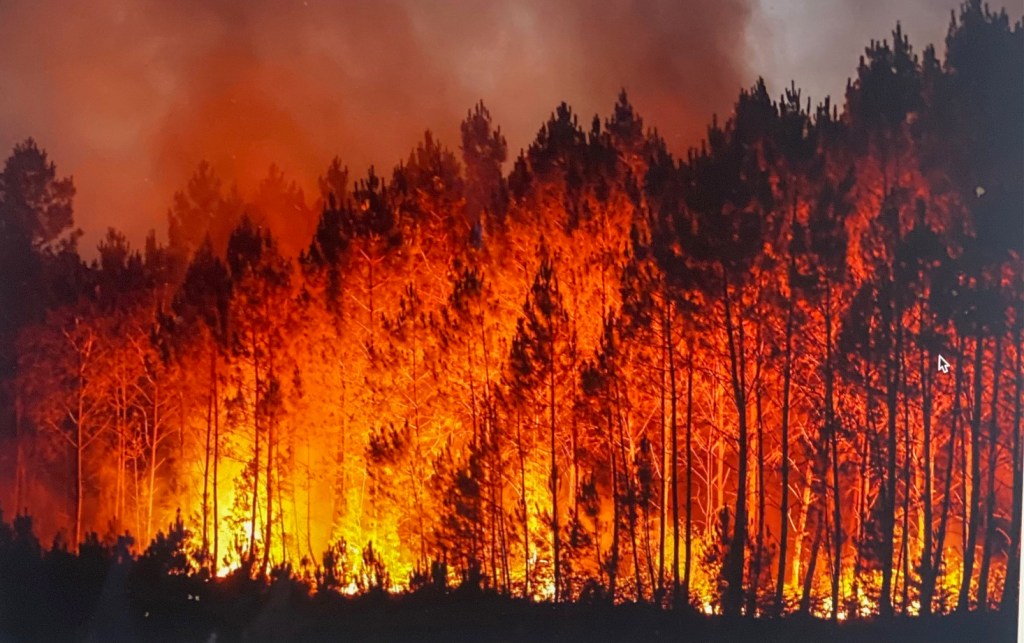
A dozen years or so after Sunday School, I saw worlds—or at least woods— go up in flames. I worked for the U.S. Forest Service on a regional Hotshot Crew based in McCall, Idaho. (The term “hotshot” describes those who work on the hottest part of a forest fire.) Looking back, it was hot, dangerous, and grueling work, and my lungs carry the scars from those fires.
But at the same time, I loved the physical challenge. (Hey, I was 20!) And there’s been nothing in my life like the thrill of watching a forest fire racing through the tops of trees. It was frightening, but at the same time enthralling.
I also learned that despite Smoky the Bear’s telling me, “Only you can prevent forest fires!” (What a burden to put on kids!) most of the fires I fought were caused by lightning strikes and that the occasional fire was actually good for the forest. When flames consume organic matter, nutrients are released back into the soil. Fires can thin the canopy allowing more sunlight to reach the forest floor, encouraging the growth of native species and eliminating invasive weeds. Fires can promote species diversity. (Some species, such as the karner blue butterfly and the wood lily depend on fire to survive.) Fires can improve habitats for wildlife by reducing dead vegetation and stimulating new growth, which can provide food and cover.
During my first marriage, I used to help my then father-in-law burn brush in the winter. It was an all-day activity. We gathered all the limbs and underbrush we’d cleared during the year from around his house, piled them on a couple of old tires filled with gasoline and set it ablaze. I was still in good physical shape, and I enjoyed the exercise. But I experienced another aspect of fire as well. Poking at the burning brush in the gathering darkness, gazing into the flickering shadows cast by the fire on the surrounding snow, I sensed my ice age ancestors dancing around the flames which protected them from wild animals and the cold.
A couple of weeks ago, Mary Lee and I watched two fireflies sparking the summer night. A little research told me that fireflies produce light in special organs in their abdomens to find mates. When a female sees a male making a signal, she flashes back. Then the two reciprocally signal as the male flies down to her. If everything goes right, they mate.
All I could think of was the Bob Seeger song, “They got the fire down below.”
Another kind of fire I remember.
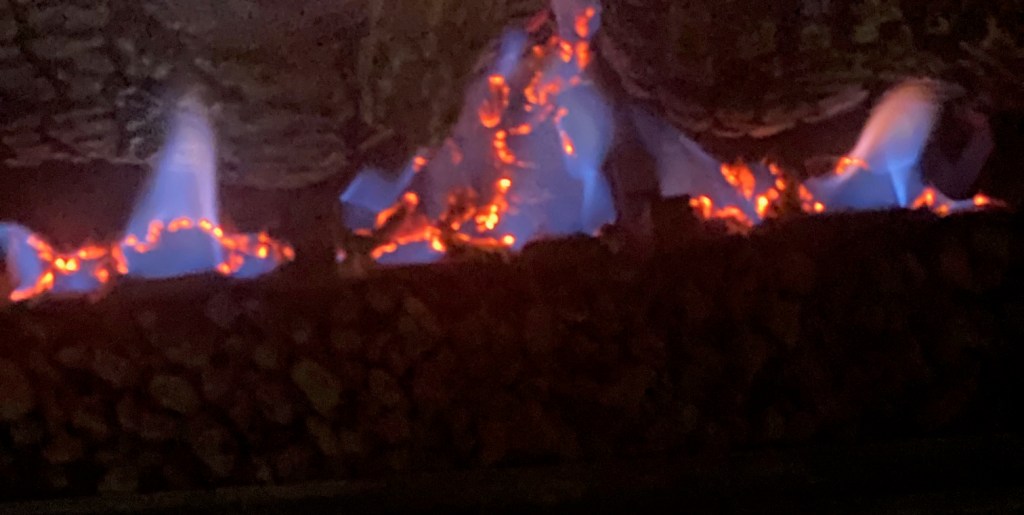
Now, it’s been sixty years since I’ve seen a live forest fire, let alone fought one, and probably forty since I’ve burned a pile of brush. I’m tired out after an hour in the garden. Often these days, a romantic evening is playing Scrabble or Canasta until 9:00 p.m. But I’m still drawn to fire: I can spend hours staring at the flames in our fireplace.
I’ve also become more aware of what I think of as the fire of Presence, represented, I think, in the Bible’s Old Testament by the burning bush that drew the attention of Moses and in the New Testament by the Holy Spirit descending upon Jesus’s followers as “Divided tongues, as of fire….”
One of my old spiritual directors used to tell a story from the Desert Fathers in which a young monk said to his teacher, “Abba, as far as I can, I say my little office, I fast a little, I pray and meditate, I live in peace as far as I can, I purify my thoughts. What else can I do?”
His teacher stood up and stretched his hands toward heaven. His fingers became like ten lamps of fire. And he said to him, “If you will, you can become all flame.”
So far, the closest I’ve come to experiencing this fire happened during the last two months of my daughter’s life. After spending the day in the hospital by Laurie’s bedside, I’d go each afternoon to the hospital chapel. I was almost always the only person there. Upon entering, I’d light two pillar candles on the altar, sit in the front row of chairs, and stare between the candles through a large round window looking out over the river. After a while, the candles would sometimes seem to glow more brightly, their light dancing. The flames would come together, enfolded by the stained glass around the window. Then, I too would become enfolded in a fiery feeling of being scoured of fear and anger and shame, which allowed me to face the next day.
These days, as I sit by our fireplace, it’s hard not to identify with the dying flames. But I realize even glowing embers can still, like forest fires and fiery brush piles, like altar candles in a hospital chapel, purge away what is false, promote new growth, light someone’s way in this burning world.
Last Palm Sunday, Mary Lee and I were supposed to begin a two-week retreat at a monastery in the hills of California. We’ve been going on retreats now for thirty years and I was eagerly looking forward to having more silence, being more aware of the world, doing more reading (I’m on a Buddhist kick right now), drawing closer to God of my not Understanding. Then, two weeks before we were supposed to fly to San Francisco, we received word rockslides had closed the roads, and that the monastery won’t open again until at least May.
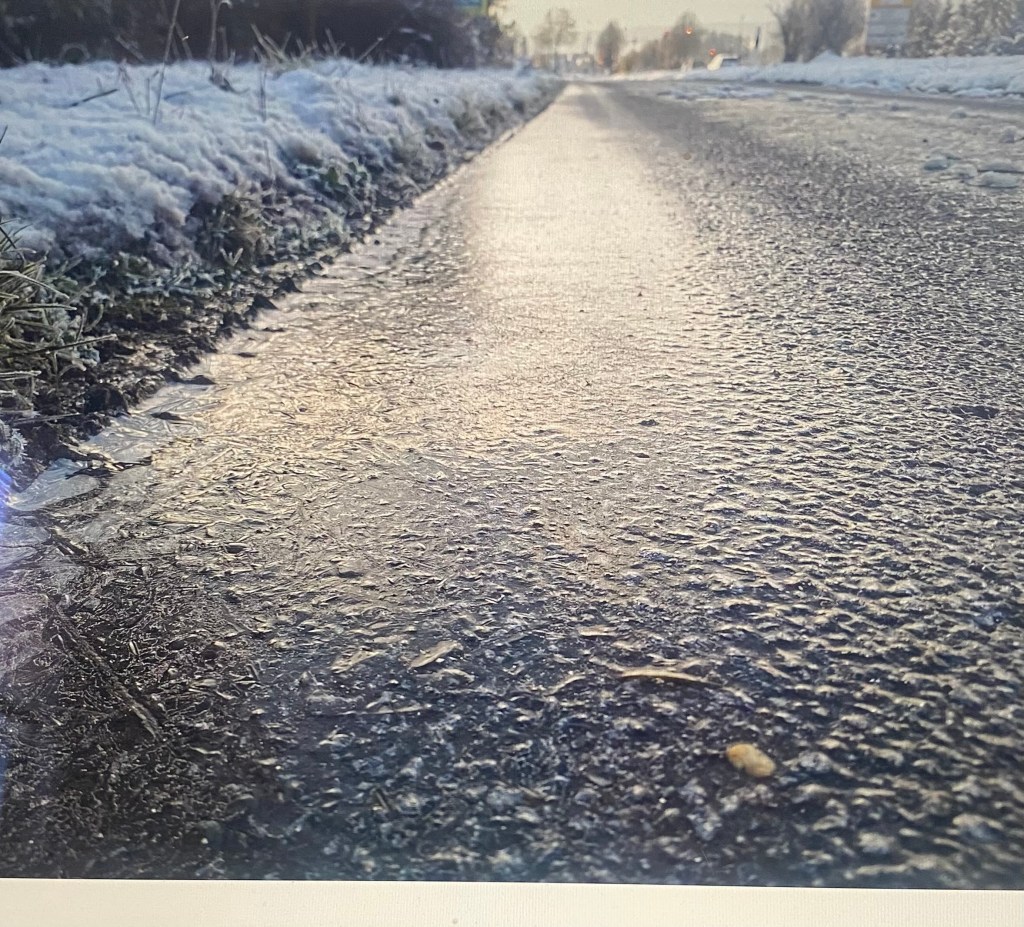
So instead of flying across the country on Palm Sunday, we spent the day encased in ice.
The previous evening, thanks to a day of snow changing to freezing rain, we lost power. That Sunday, we cooked oatmeal on top of our gas stove and wrapped in blankets in front of our gas fireplace. While the ice bent the trees and bushes lower and lower, Mary Lee and I read the Palm Sunday service from the Book of Common Prayer, wondering, along with the Psalmist, “My God, my God, why have you forsaken me.”
For the next day and a half, we ate beans and rice, read, played Scrabble and cribbage, drove around the neighborhood to charge our phones, and finally gave in and stood in line at a restaurant in another town for breakfast.
All in all, it wasn’t bad. Still, it’s hard for me to find much nice to say about ice.
I like ice cubes in my water. I use ice packs to help the bursitis in my hips. Some ice sculptures are pretty. I’m glad to have a freezer in my refrigerator to preserve food. But that’s about it. When I used to go skating, I’d divide my time between flailing my arms to keep from falling and lying prone on the ice when I did. The one time I went ice fishing, I was days warming up.
Ice has all kinds of nasty connotations. It can mean frigid, as in sexually inadequate. It can mean unfriendly, reserved, aloof, rigid, inflexible. Fear sends icy chills down our spines. We hear about the icy fingers of death.
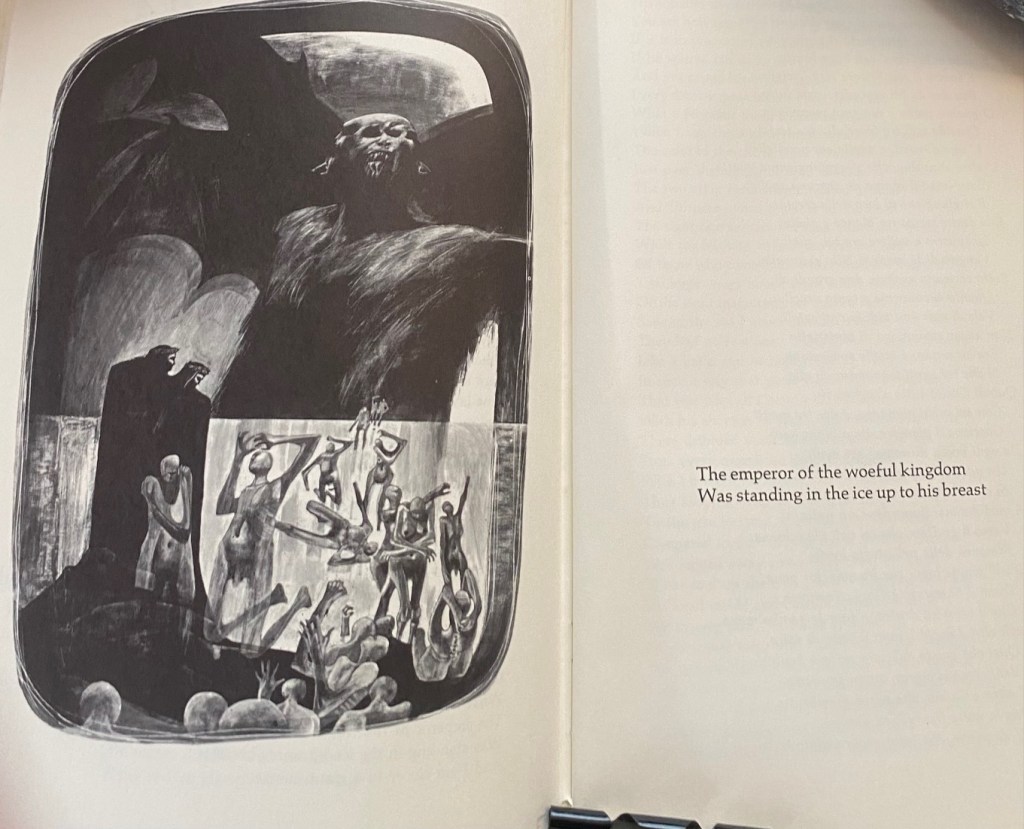
Speaking of death, while Hell (which is where some of my Fundamentalist friends tell me I’m going to go when I die) is usually pictured as a place of fire and brimstone, in Dante’s Inferno, the center of Hell is a vast lake of ice, in which Satan, along with sinners who committed treason and betrayal—such as Brutus, Cassius, and Judas—is incased.
from Dante’s The Divine Comedy, I Hell, translated by Louis Biancolli, 1966
Makes sense to me. Ice is cold. Ice is heavy. (The reason we lost electricity was because ice-laden trees fell on power lines). Ice prohibits movement. During the most hellish part of my life, after my daughter died, I couldn’t get warm. I felt as if I were carrying a 20 cubic foot freezer on my shoulders. My body was rigid and tense. Only after I’d had two or three large tumblers of scotch did I feel as if I were thawing.
And yet. For someone who dislikes ice, I realize that one of my tendencies is to want to freeze experiences and beliefs, preserve them the way we preserve meat and vegetables.
After those hellish first years when Laurie died, my life began to get better. I thought I was learning to live with loss. But five years later, at this time of year, it was as if my daughter has died all over again. I plunged back into rage and tears. I spent evenings drinking my tumblers of scotch (or maybe it was Wild Turkey 101 proof, at this point), going through old photograph albums of the two of us and listening to Laurie’s old tapes of Tracy Chapman and the Grateful Dead. The only difference was that those I was most angry with were people who talked about their own grief. I remember being at a retreat at a monastery in Cambridge, Massachusetts where a woman talked about almost losing her son in an automobile accident. A spasm of rage surged though me. I thought, What are you moaning about? He’s alive, isn’t he?
Then on Easter Sunday after this retreat, I heard a sermon based on the Gospel of Mark’s account of the Resurrection, which, unlike the other gospels, ends with Mary Magdalene, Mary the mother of James, and Salome, fleeing from the empty tomb, “for terror and amazement had seized them; and they said nothing to anyone, for they were afraid.”
Why fear, asked the preacher. Well, there might have been a lot of reasons—fear of soldiers, fear of grave robbers—but he also wondered if it wasn’t human nature to fear the unknown, to become used to, even comfortable with, our lives even if they’re full of pain and suffering. We prefer what we do know to what we don’t.
And I realized that over the years since Laurie’s death, I had grown comfortable with my image of myself as GRIEVING PARENT; I had made Laurie’s death MY STORY, trying to preserve memories of her, as in the old photograph albums I’d been perusing. And if anyone else had a similar story, I felt threatened.
In other words, I was trying to freeze my sense of myself and Laurie rather than let them evolve, flow. I wasn’t angry about the death of my daughter, I was angry at the possible death of my grief, thinking it was grief that was keeping me close to her.
That Sunday afternoon, sitting in Harvard Square amidst cigarette butts and pigeons, looking up at the sycamores and the brick buildings, listening to voices babbling in a half-dozen languages, I tried to focus on my daughter in the present moment. I don’t know where you are, Kid, I remember praying, but at some level I know you’re fine, and I want you to know that I love you.
And the sights and smells and noises of the Square seemed to fade and I felt a hand on my shoulder, and I knew it was Laurie’s.
I don’t care whether that hand was from another dimension or from my imagination. What I do know is that the great spiritual traditions are right: love transcends death. That is, if you don’t try to freeze it like leftover meatloaf.
But I’m still learning. Working a 12-Step Program, I’ve discovered traits that I developed to survive growing up in an alcoholic family—judgmentalism, people-pleasing, perfectionism—traits which no longer serve me, but have, in essence, remained frozen, damaging my relationships with others.
And I’m wondering if I may be trying to freeze my retreat experiences, and that Life, the Universe, or God of my not Understanding isn’t telling me by having this retreat in California canceled that I need to let the retreat experience—the silence, the awareness, the reading, the closeness to God— flow into my everyday life, here at home, even in the middle of an ice storm.
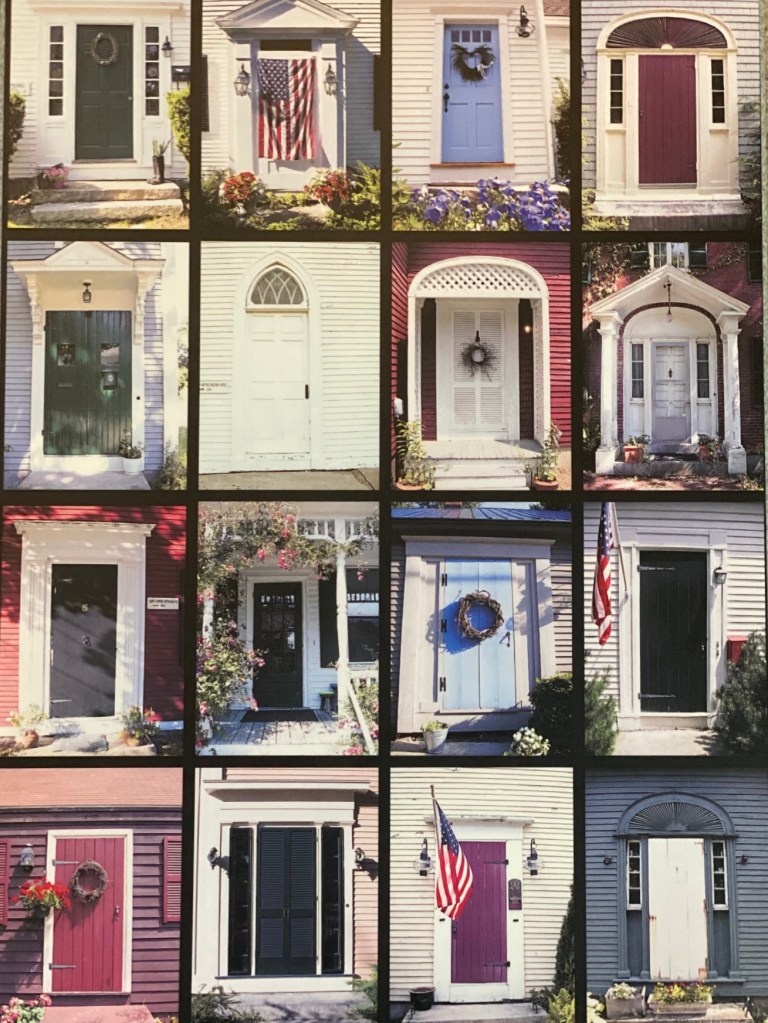
For Christmas one year, Mary Lee gave me a wooden wall hanging called “Doors of Yarmouth,” to remind me of the Maine town in which I lived for so many years. These are doors to old houses that have had careful tending (not to mention extensive and expensive remodeling). The doors come in a variety of colors. Most feature types of cross—sometimes called Christian—paneling. Three are plain wood with long hinges and latches. There are a couple of double doors and one shutter door. Some doors have glass windows, others are framed by small windows, shutters, cornices, lattice work, or flower vines. There’s a gothic arch over one door, a wooden fan over another, and several Greek canopies held up by pillars. All in all, they reveal how Yarmouth has changed from the working-class community I grew up in to the suburbia by the sea it is today.
2
A little research on the web tells me that doors were conceived in ancient Egypt around 3000 B.C.E. but another site says that archeologists in Zurich Switzerland discovered an oak door possibly dating to 3063 B.C.E. Long before that, at least according to the Bible, Noah put a door in the ark. One assumes a pretty big one. (I’m curious how it opened and closed.)
3
From the beginning, doors have had more than the utilitarian purpose of protection from nasty weather or people. They’ve identified the occupations of those living in the dwelling and served as marks of power and status. According to the Bible, when King Solomon built his great temple to show God’s power and prestige, he made doors of olivewood, covered with carvings of cherubim, palm trees, and open flowers, which he overlaid with gold. While technically not a door, I suppose, novelist Stephen King’s two iconic wrought-iron gates embellished with bats, a three-headed dragon and spider-like motifs have become a pilgrimage destination for King fans from all over the world.
4
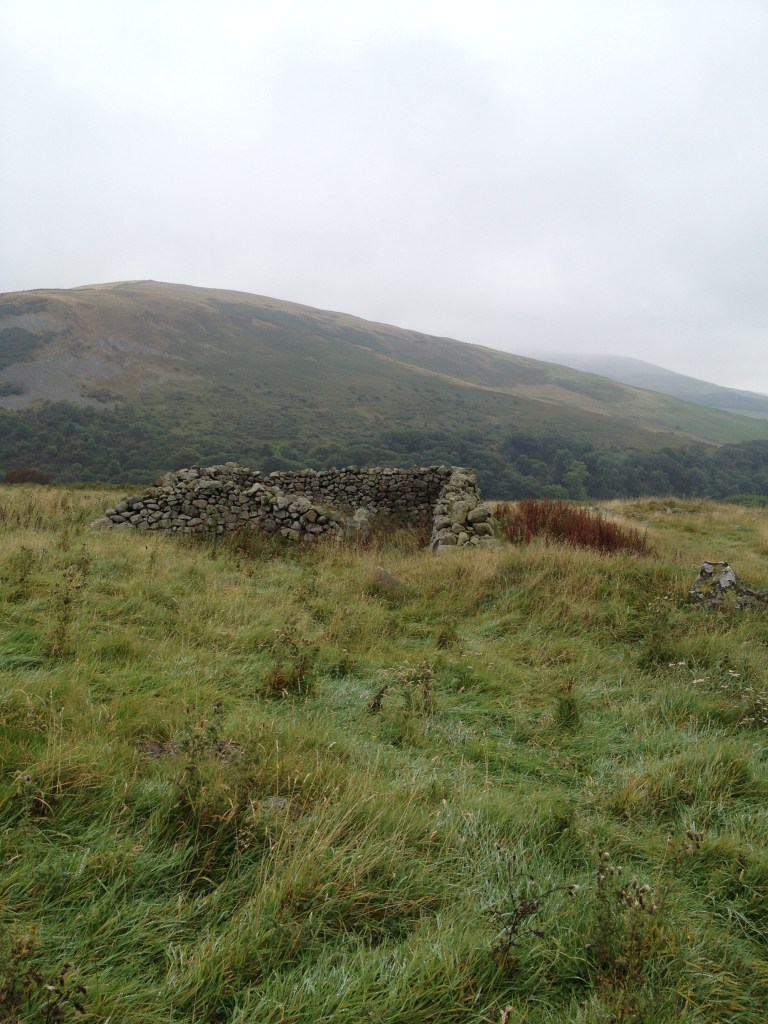
Speaking of pilgrimages, when Mary Lee and I were walking St. Cuthbert’s Way between Scotland and England, we passed a sheepfold, a circular wall of stones with an entrance, which for centuries, served as a place for shepherds to herd sheep at night for protection against predators such as wolves. To keep the sheep in and the wolves out, the shepherd would lie down across the entrance, becoming, as it were, a human door.
5
Jesus uses this image of the shepherd protecting his flock by becoming a door when he refers to himself as “the gate,” who “lays down his life for the sheep.” Which may be why cross or Christian paneled doors are so prevalent in New England (all the units in our Housing Development have them, inside and out). When my wife Mary Lee—who is a Deacon in the Episcopal Church and a lover of icons—was teaching the in a local high school, she wanted to put up an icon in her classroom but realized it wouldn’t be appropriate in a public school, so she hung a large print of a door on her back wall where she could see it when she taught. It was a great comfort, especially with certain classes.
6
Besides Jesus, the Bible refers to other kinds of gatekeepers: those appointed to control who came and left the city through the gates. Thus, the term “gatekeeper” has come to mean a person who controls access, someone in authority who acts as an arbiter of quality or legitimacy, or someone who blocks you from speaking with a decision-maker. Gatekeepers access who is “in” or “out.” I’ve had a few of those in my life, athletic coaches, teachers, whom I’ve had to please in order to succeed. I suppose, as a teacher myself, I’ve also been a gatekeeper.
7
I’ve also let others become gatekeepers, to whom I gave away authority, surrendered, as it were, the keys to doors I could have opened for myself. Growing up in an alcoholic family once limited my choices when I faced a decision to “What will the neighbors think?” to quote my mother. Through working an Al Anon program and learning to put the focus on me instead of on the me I thought you thought I was, I’ve found keys to open doors I never knew existed.
8
Some of those early Egyptian doors symbolized entrance to the afterlife. Doors can represent transition, confinement, new opportunities. Doors can be metaphors for the choices we make. We learn early on in life that we can walk through some doors and not others. As a WASP male, I know that I have more doors available to me than women, people of color, people of other religions. My destiny has been shaped by the doors I’ve walked through.
9
Or doors that have closed behind me. For a while, Mary Lee volunteered as a chaplain at the local prison. One Christmas, I helped her with a service. My clearest memory is of going through a series of doors and hearing the loud, definitive clang as each door closed behind me. I’ve had a few of those definitive door closings in my life: the death of my daughter, a divorce decree, a couple of retirement parties. Most of the time, however, I find that doors close behind me without my noticing. One reason I took early retirement from teaching high school English was that I saw too many colleagues still standing in front of their classes, even though, emotionally, they’d shut the door on their students years earlier. One of the things I dislike about the geriatric life is that doors keep silently closing, until suddenly I realize, I can’t do this anymore! Can’t climb that mountain, can’t reach that note, can’t eat that food, can’t…
10
On the other hand: My Quaker friends say that sometimes a door needs to close before another can open. That’s certainly been the case with me. I had to close the door on a forest management program before I could open the door to what’s been for me a fulfilling teaching career. I had to retire from public education before I started writing. After my daughter died, I had to lose every image of God I’d ever had before I encountered the Grace of God of my not Understanding.
11
In late 1960’s, I listened to a rock group, The Doors, who named themselves after the title of Aldous Huxley’s book, The Doors of Perception, in which he reflects on his psychedelic experiences. Huxley himself had based his title on a line in English poet William Blake’s The Marriage of Heaven and Hell: “If the doors of perception were cleansed, everything would appear to man as it is: infinite.”
12
These days I’m trying to clean the doors of my perception through contemplative practices such as meditation, going on more retreats, walking meditation, contemplative reading, sessions with my Feldenkrais teacher, journaling, music, working on my listening, writing these blogs, and of course, making more pilgrimages, even if they’re only to the compost pile.
13
And I’m not done opening new doors. I’m hoping I have a few longer trips left ahead of me. Speaking of trips, I note that interest in psychedelic drugs is again increasing, thanks to books like Michael Pollen’s book How to Change your Mind.Indeed, I have a 92-year-old friend who’s seriously considering a guided psychedelic experience. That’s another possible door.
And, of course, there’s the Big Door ahead of me. That, too, will be quite a trip, I suspect.
As New Englanders know, each year has six seasons: the usual spring, summer, autumn, winter, plus mud season—between winter and spring—and stick season—between autumn and winter.
You know about our autumns and winters. These are the seasons in all those lovely photographs of New England. You know, the flaming foliage ones, mountains ablaze in orange, yellow, and red, and the snowy ones, white trees bowing as skiers whiz past. But in between—usually it’s the entire month of November but it could be December as well—the leaves have left, the snow hasn’t arrived, and the trees become stick figures. “Bare ruin’d choirs, where late the sweet birds sang,” to quote Mr. Shakespeare.
Stick season has been getting a lot of press these days, thanks to a young singer named Noah Kahan, whose song “Stick Season” about the pain of lost love—“And I love Vermont, but it’s the season of the sticks/ And I saw your mom, she forgot that I existed…”—was a viral hit in 2022. (And as synchronicity would have it, as I was planning this blog, he sang it on Saturday Night Live, December 2nd. Check it out on YouTube.)
For years, Shakespeare and Kahan described the way I felt about this time of year. As readers of this blog and my book, The Geriatric Pilgrim: Tales from the Journey, know, my daughter Laurie entered Eastern Maine Medical Center in November of 1988 and died there on December 23rd. For those two months, I lived at a Ronald McDonald house about a mile away and walked back and forth to the hospital twice a day along the Penobscot River, where the skeletal maples, elms, birches, and oaks mocked any hope for Laurie’s recovery.
Over the next 30 years, each stick season was the backdrop for my anger, sorrow, withdrawal, guilt, and shame, exacerbated by a holiday season, which now starts about November 1, with its Hallmark images of healthy happy families gathered round a perfectly shaped Christmas tree. Throw in the Christian season of Advent—four weeks of paradoxical readings about Christ the child and Christ the judge, sin and grace, justice and mercy, comfort and challenge—and I came to dread this time of year.
But about five years ago, thanks to my Al Anon program, I was able to separate my shame, guilt, and anger from my grief. I saw that because of growing up in a family riddled with alcoholism, those noxious emotions were there long before Laurie died. And I realized that I didn’t have to hang on to them to grieve the sorrow and emptiness that one must accept when they lose a loved one. That I could feel sad without feeling angry.
At the same time—and I’m sure it was no coincidence—as I walked the woods behind our house, I began to appreciate the stark beauty of stick season. Without all the foliage, the sky is larger, and sometimes it’s a November blue unlike at any other time of the year. The wind is bracing. The flies are gone. Unlike in mud season, the paths are still dry. Even the sticks themselves—the tree branches—have a stark beauty, like Japanese calligraphy.
I started to see the departed leaves as images of my departing shame, guilt, and anger.
Which helped me see Advent as a time for letting the spirit blow away what the Bible often calls our “iniquities,” but what I think of as my “survival mechanisms”: those behaviors I developed as a kid to survive family disfunction, but which have become injurious not only to my health but to those around me.
These days I think of stick season as a time to simplify my life. Which has been especially easy this year. After 37 years of hosting a Thanksgiving for anywhere from ten to 24 people, Mary Lee and I turned over the apron to her younger son, who, along with his fiancé, did a fantastic job feeding and making us all feel comfortable.
Last week, Mary Lee retired after 22 years as the ordained Deacon at our Episcopal Church. For 22 years, churchy stuff has filled not only our Sundays, but other days of the week, as I have also been an active member of St. Paul’s. Now, as is our diocesan policy, we will worship elsewhere for a while. We will listen for other callings to where—as Aristotle said—the needs of the world and our talents cross.
Sadly, but I guess appropriately, our cat Zeke has used up his 9th life (I didn’t think he’d make it to 2023), leaving our house pet-less for the first time in our marriage.
I have given up driving 30 miles once a week to play in my old-time music jams. Mary Lee and I have decided we no longer enjoy going out for dinner once a week.
So, I suppose, I am in the stick season of my life. If so, it’s not bad.
Let’s talk about Advent again. One thing I’ve always had trouble with is this idea that not only are we awaiting the celebration of the birth of Jesus, but we are supposed to be awaiting the Second Coming of Christ, when, according to some scripture passages, Christ will come to judge us and send some of us to hell and some of us to heaven.
Sorry, I can’t buy the judgment thing. My experience is that I’m surrounded by Grace, if I can just (“just’? Ha!) open my eyes to it. So that when Jesus tells his disciples to “Keep awake!”—which he does a lot—I think he’s talking about opening our eyes to what’s already there, not what’s going to suddenly appear descending from a cloud.
Sort of like seeing the sky that’s always there, but only fully visible during stick season.
(Or the water, for that matter)
So, for me, the Second Coming is an invitation to awaken into a new consciousness, a new appreciation, a new seeing, of life, the universe, and everything.
I watched a YouTube interview with Noah Kahan, in which he said that his hit song represented a new musical path for him. And as blogger Mitch Teemley wrote recently about Advent, the word serves as the root of our word “adventure,” which, of course, I like because that makes me think of “pilgrimage.” “In short,” as Mitch wrote about Advent and I would write about pilgrimage, it is “an experience that can change a person forever. If they let it.”
Recently, Hurricane Lee, at one point a Category 5 hurricane, churned up the Atlantic coast, bringing with it dire warnings such as, “Lee Drives Towards Us with a Hugh Wind Field, Damaging Waves, and Flooding.” The Episcopal Church of Maine’s website offered a prayer, which began: “Creator God, we ask you to calm the wind and the waves of the approaching hurricane and spare those in its path from harm.”
I put away lawn chairs, harvested basil, tomatoes, and beans from my garden, and checked to see that our flashlights all had new batteries and the lamps had oil. I cleaned out the garage, so that I could get my car out of the way of falling branches.
Well, the trees did some jitterbugging in the wind to the rhythm of our wind chimes, and our lawn had a smattering of small branches. My Zoom meeting with an Al-Anon sponsee on the coast ended early when his power went out, and my bean pole in the garden blew over, but all in all, the effects of the storm were minimal. A few years from now—if I’m still alive—I doubt if I’ll tell many stories about Hurricane Lee.
Hurricane Lee: 2023
There are other hurricanes, other storms, however, whose stories have stayed with me.
In 1954, Hurricane Carol, the first Category 5 hurricane to hit New England, roared through Maine, followed ten days later, by Hurricane Edna. A little research tells me that the two storms caused 25 million dollars in damages and destroyed 3500 cars and 3000 boats. What I remember was that at 11 years old, I thought hurricanes were neat. The thundering river down the hill mingled with the roar of the wind, and our house shook like some carnival ride. I couldn’t understand why my father was chain-smoking and pacing back and forth in front of the living room window, muttering, “I hope that goddamned tree doesn’t fall on us.” The day after Hurricane Carol, my friends and I walked through town, gaping at the elm trees that had blown over, amazed at the size of their roots, which rose several feet over our heads.
The next hurricane to hit Maine was Gloria, in September 1985. According to Wikipedia, this storm affected six counties in Maine, with multiple injuries, downed trees, and 250,000 people without power, some for up to fourteen days. I was living Down East at the time. Less than a month earlier, my first wife and I had separated, and the day after the storm I got up early to drive my daughter Laurie to church camp for the weekend. After dropping Laurie off, I continued on to visit my mother and father. When I pulled into the driveway, I saw Dad standing in strewn leaves and fallen branches, trying to fry bacon and eggs on a charcoal grill. My Grandmother Cleaves, who’d come over from her apartment for a hot breakfast, stood at the window.
What I recall even more clearly now was that my father, Laurie, and Nanny Cleaves all died within the next four years. Throw in a divorce and a second marriage, and I experienced an emotional hurricane that made Gloria feel like a summer breeze.
In 1991, Hurricane Bob came to Maine. Three people died, many residents lost power, and there was over five million dollars in damages. Again, the storm’s direct effect on my new family and me was minimal, but because of the heavy rains and losing power, my Grandmother Kimball’s cellar flooded because her sump pump stopped working. At 92, living alone, she couldn’t cope with the responsibility of keeping the house up, so she sold it to me. Mary Lee and I lived in that house for the next 22 years. Then, after a spring rainstorm and another flooded cellar (something like the fifth one in those 22 years), we sold the house and moved to where we now live (which, thankfully, has no cellar).
Our cellar after the Patriots’ Day Storm of 2007
I think of other storms in my life—natural ones, such as the ice storm of 1998, various nor’easters leaving two feet of snow; emotional storms, such as my defeats and disappointments, a divorce, Laurie’s death—and I realize that I remember them far more clearly than I do the sunny days—beach days, vacations with family in Florida and Bermuda—or the happy times: the victories, the times I’ve been recognized or honored. I don’t know about you, but it’s the storms rather than the sunny days in my life that have become the stories of my earthly pilgrimage, those narratives that have helped me navigate my life, and which I continue to look back on and refer to as I forge on towards whatever denouement awaits me.
So, why that is that even after sixty years, I remember my defeats on the basketball court more than the victories? That I remember my divorce settlement more than my first marriage ceremony? Laurie’s death more than her birth?
Maybe one reason these storms stay with me is that I’ve survived them all. Storms help me feel good about myself, less afraid of the future. I can be “defeated but not destroyed,” as the great storyteller Ernest Hemingway said. I recall meeting a woman who knew of Laurie’s death and who’d just lost her son in a fire. Her first words to me—even before saying hello—were “Tell me how you’ve survived!” At the time, a guy I’d come to know from being in grief counseling together, had just committed suicide and I realized surviving Laurie’s death really was an accomplishment.
As I think of it, storms have not only made me aware of surviving, they’ve made me feel more alive. And I don’t think I’m alone in feeling this way. There’s nothing like a good nor’easter or hurricane to draw people to watch the ocean waves crashing over the rock-bound coast of Maine. After Laurie died, I found myself missing those last weeks of her life when I was living at a Ronald McDonald House, spending the days beside her. There was a focus to those days, a purpose, and the great themes of Life and Death dwarfed the usual minutia of everyday life.
Speaking of less fear and more focus, I’m interested in the number of people I know who suffer from anxiety and depression but who become fearless when forced to face specific physical dangers such as a high wind or a flood.
In a storm, I let go of the old stories I tell myself about who I am. I’m forced to come to terms with the fact that life as I knew it may never be the same. I plunge into a new adventure, a tale of unknowing, which can also be a story of spiritual re-birthing if I can only recognize and surrender to that power greater than myself.
Looking back at the storm stories in my life helps me realize that while I may want to shrink God down to my size, God is always bigger than I am, will always be God of my not Understanding.
And of course I have to include a snowstorm picture—this from 2013.














 The Geriatric Pilgrim: Traveling the Landscape of Faith and Grief