Wild Willy


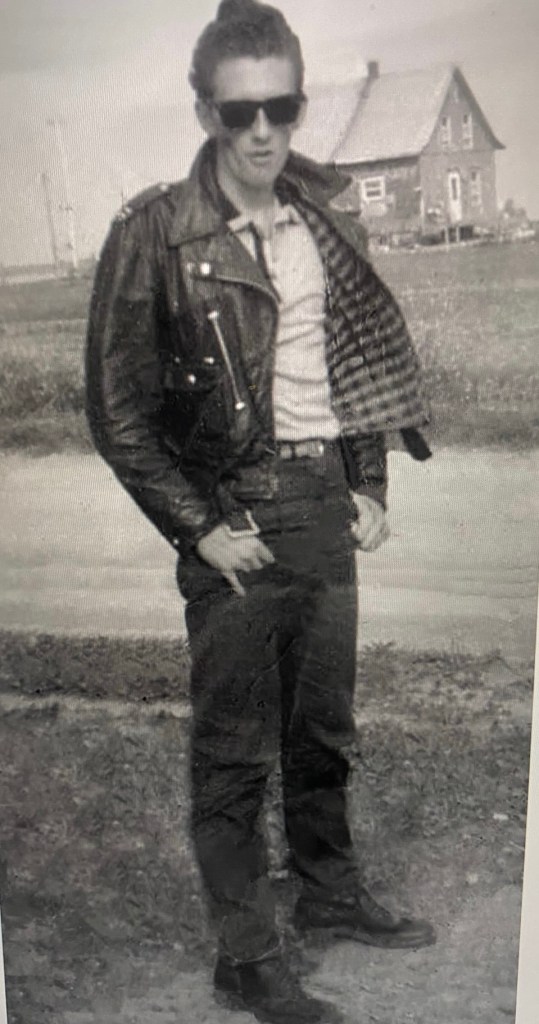
Phone curtesy of Wikipedia Commons

                        1.

Around the time this log cabin 

sold moccasins I’d see

Wild Willy Crockett 

on the corner 

with Pea Soup, Spider, and the Goose.

Taller than the others,

he stood with knees rigid, 

pigeon-toed, gazing 

up and down the street,

searching for someone with a car,

a summer chick on the make,

or Crazy Benny,

who’d buy him beer.

Balanced on a line 

between cool and caricature:

the shiny D.A.

French-inhaling Camels,

rocking with Dee Dee Dinah, 

whose tits stuck out 

of her sweater like oil funnels,

chugging three beers before the game 

and coming off the bench 

to score six straight points,

graduating high school with his pants

on backwards.

            2.

Now the log cabin 

sells organic and new-age produce, 

and Willy Crockett stands 

at the corner of tofu and prunes.

Fifty pounds heavier, 

still tall.

Wears a toupee 

that looks like roadkill,

carries a cell phone 

clipped to an alligator belt.

Assistant manager 

at the local hardware store, 

divorced from Dee Dee, 

He tells me he belongs 

to the Church of the New Kingdom.

Says the old days are long gone

—Praise the Lord!

Toes pointed in, 

he cradles his yellow basket 

of flax oil and sulfur supplement,

gazes at displays 

of crystal pyramids,

Himalayan incense,

and Navajo dreamcatchers,

still searching…

My One, Unfolding Life

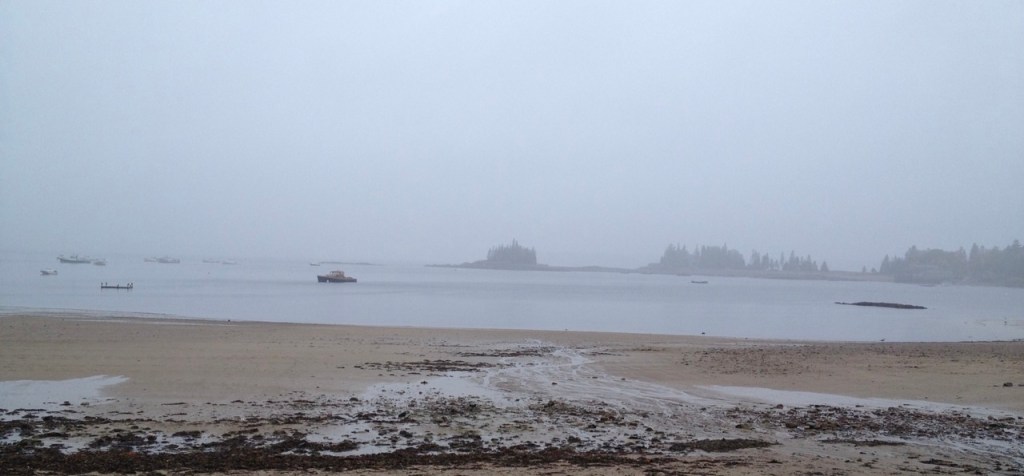
The beach just down the hill from where I used to live in my “other life.”

#

6:45 a.m. Driving up the turnpike from Brunswick to Bangor, headed down east to Mount Desert Island, I’m apprehensive. I’m returning to what I’ve always called my “other life”: different marriage, different house, different job, different hobbies, different self. A self, quite frankly, I’ve never liked very much.

But I’ve received an invitation to attend the 50th high school reunion of the Mount Desert Island Class of 1974. For many of these students, I was their English teacher as well as senior class advisor. And while I have, at best, mixed feelings about this other life, I enjoyed teaching at MDIHS and have continued to be in contact with some of these former students. I’d really like to see them.

My name tag at the reunion.

The reunion is tomorrow, but besides an invitation to the reunion, I’ve been asked to talk about my book, The Geriatric Pilgrim: Tales from the Journey at a gathering—which I figure will mostly be former students— in Bar Harbor a few hours from now. So, while I watch the leaves change color as I drive north, I try to figure out what I’m going to say. 

I know I’ll start by saying the most important thing I learned in writing The Geriatric Pilgrim was that the physical pilgrimages Mary Lee and I made to places like Iona, Big Sur and the redwoods, Nova Scotia, Israel, Africa, and Turkey have shown me that any journey—including the one we make as we age (and these former students are now all pushing 70. Good God!)—can be a pilgrimage. Especially if looked at with curiosity and openness, as explorations to discover new facets of ourselves, seeking surprises rather than security, looking for evidence of and trusting in a power greater than ourselves. 

Then, I think, Okay, if any journey can be a pilgrimage, that means this trip back into my other life is a pilgrimage. How?

When Mary Lee (who is sitting beside me, looking at a map of Maine—she loves those big unfolding maps that take up half the front seat) have gone on a pilgrimage, we often talk about what new insights we’re bringing back with us which we can use in the future. So, what lessons did I learn during the seventeen years I spent at MDIHS that have stayed with me? 

Well, I’ve always said that those years were the best teaching years of my life. I’ve taught in other schools, some with more impressive teachers, some with smarter students, some with better sports programs, a wider variety of extracurricular activities, more opportunities for materially or intellectually challenged students. But what made MDIHS different was that, despite the annual arguments about the budget and the tensions about dress codes and what was being taught, the parents, the school board, the administration, the faculty, and the students all agreed on one thing: MDIHS was a good school. And because we all thought it was a good school, it was—winning national awards for excellence.

MDIHS in the early years. My room was the closest on the end.

 Making a pit stop at the rest area outside of Bangor, I realize how I frame the reality of my life determines how I see that reality, which in turn determines how I live that reality. Thinking we had a good school, I went to work each day excited and proud to be there (okay, not every day, but I can honestly say, most days) which made me work harder, which made me a better teacher and the students better students. Fifty years later, when I can think of my aging not as a problem, but as an opportunity for growth, I’m less anxious about what I can no longer do and more curious about finding new things I can do, more grateful for those things, which makes me more pleasant to be around.

Back in the car, however, turning on to Route 1A and heading for the coast, I ask: if MDIHS was such a great place to teach, why did I leave, and in the middle of the school year? What’s the lesson there?

It probably begins with that guy I used to be—the one I’ve never liked. Come to think of it, he didn’t like himself either. Despite the accolades (one state evaluator said my Advanced Placement English class rivaled the one at Phillips Exeter), I was not a happy camper. I’d created this persona—loud sports coats, matching ties and pocket handkerchiefs, green ink corrections symbols and sarcastic comments in the margins of papers, pictures of sixty-four famous authors glaring down from the walls—which began to feel like a body bag. 

Soon after waking up one morning gasping for breath as if someone had their hands around my throat, I resigned. In the middle of the school year. Moved out of my house, divorced my wife, married another woman, and moved 120 miles away to teach not AP seniors but freshman juvenile delinquents (one of whom as far as I know is still in prison for murder).

And I think the reason I’ve never liked that guy in my other life is that I’ve always thought he was a fraud. But thinking about it, I honestly liked my job, and I wanted to honor my profession by looking and acting my best. I recall reading in David Whyte’s book, Work as a Pilgrimage of Identity, something to the effect that the things which once served us can imprison us if we remain with them too long. 

Which, as I think about it, is also true as I age. I can’t hold onto those activities, that self-image, those beliefs that once sustained me. When I think about making a new pilgrimage, I can’t plan—or I shouldn’t, anyway or I’m going to be disappointed, either that or die—to hike the Appalachian Trail or climb Mount Katahdin, but I can continue the journey toward what I might, for lack of a better word, call my true self. A journey, I realize, that began when I left Mount Desert Island, maybe even before.

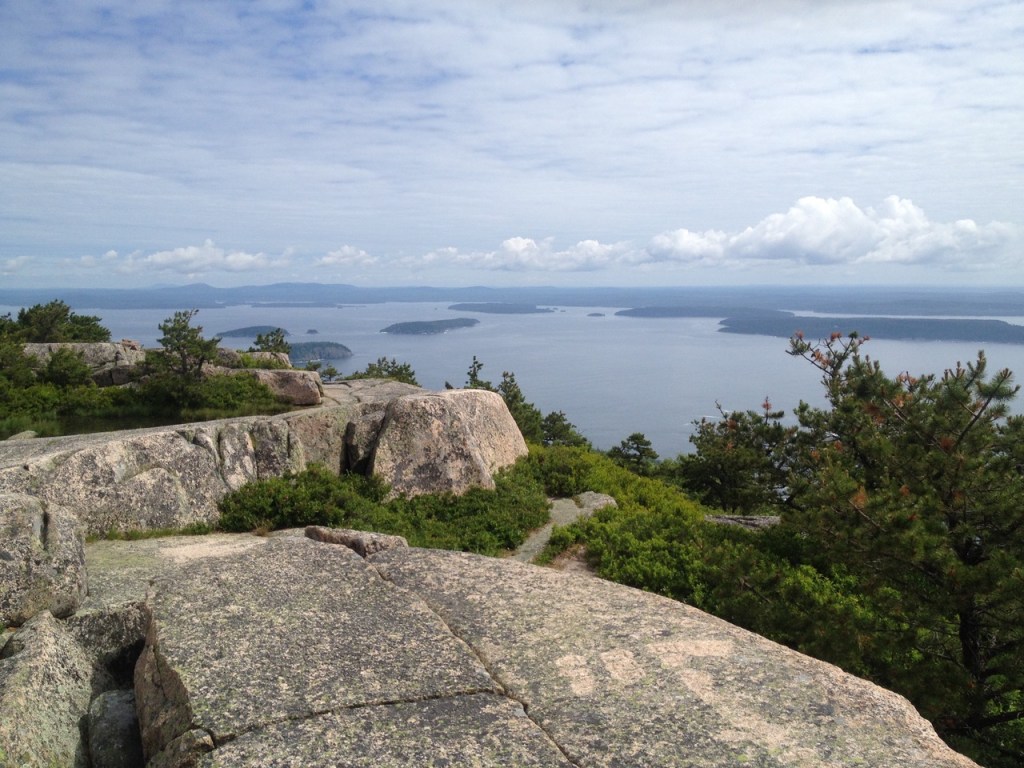
Speaking of which, I can now see MDI on the horizon, its rocky silhouette reminding me that this is one of the most beautiful places on earth. I remember, especially in those days when most of the tourists went home after Labor Day, how many afternoons and weekends I spent walking the trails and beaches there. And I realize that those walks were the beginning of what I call —somewhat euphemistically perhaps—my spiritual journey. Sitting on the top of one of the mountains, looking out over the neighboring islands, I experienced not only the inchoate presence of a Higher Power, but also a vague sense that everything belongs.

I needed help interpreting these experiences. Which led me to religion. When I first began teaching on the island, I hadn’t been in a church since I was married in one, and by the time I left seventeen years later, I was not only a member of a church but a member of the Board of Deacons. I sang in the church choir. I advised a church youth group. 

It dawns on me that without Mount Desert Island, there’d be no Geriatric Pilgrim.

I also see that I have no “other lives,” only this one—one that has been unfolding, like one of Mary Lee’s maps, from the beginning until now and will keep unfolding (I’m guessing; I’m curious to find out) after my earthly death. 

Wow! Now, if I can just remember to talk about some of this an hour from now…

# #

Swimming Upstream

#

Because once upon a time

despite the threat of my mother’s hairbrush

I swam in the river below our house

dog paddling through chicken carcasses  

rotting perch and raw sewage

drifting downstream

from the falls that from a distance

was this white rush of water

spilling over great gray rocks

I attend church despite the disdain of old friends

fight the undercurrents of doubt

dodge the dead fish of boredom and

theological questions bobbing like chicken guts

pray to catch a glimpse of Spirit

flowing from the chalice.

Beginning Again

#

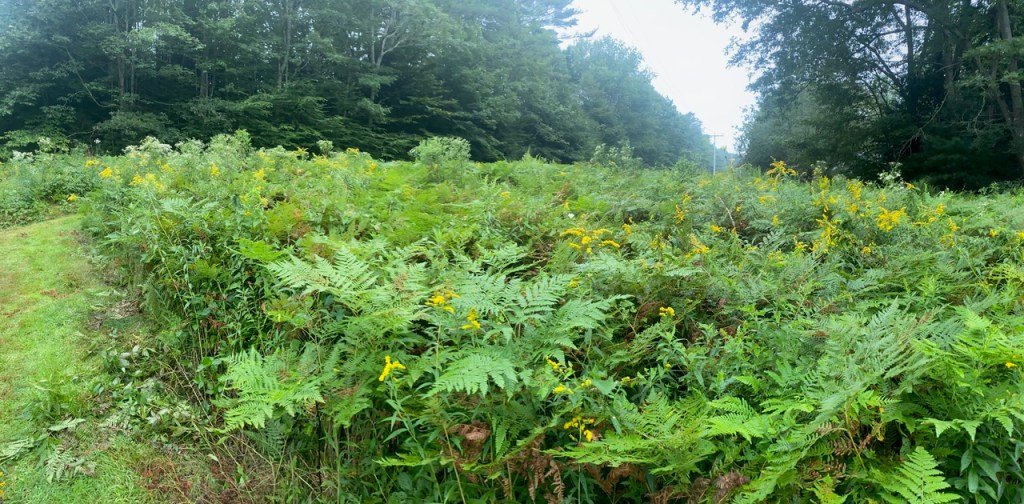
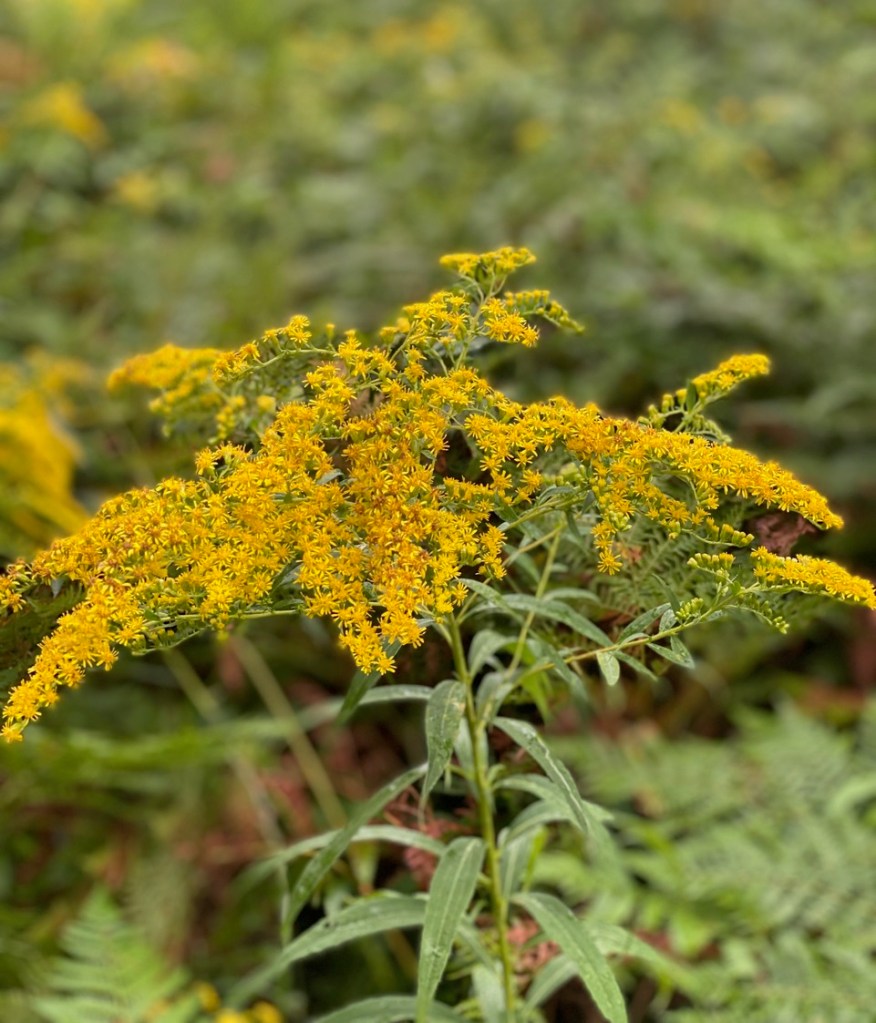
I’m walking the grass loop around our housing development. Under the power line toward the community garden, I pass through what is now a shoulder-high host of Queen Anne’s Lace, golden rod, milk weed, bracken, and many other plants I can’t name. The flies swarm. The sweet songs of the cardinals and tufted titmouses (titmice?) have given way to the screeching of blue jays and crows. Monarch butterflies flit from flower to flower. The air smells ripe. Shadows crawl like the incoming tide over the landscape. Summer is ending.

And I feel myself coming alive. Beginning again.

The reason is simple. For seventy-five years—as a student, as a teacher—the golden rod, the lengthening shadows, the Monarchs, have meant the beginning of another school year. More than New Year’s Eve, more than the first warm day of the year, this is the time when, at some deep cellular level, I can feel myself waking up, ready to start anew.

It’s a good feeling. At my age, it’s easier to focus on endings than beginnings. I now celebrate—if that’s the right word—more birthdays of the dead than of the living: my grandparents, my parents, my daughter, my first wife, close friends. Ended are my long hikes, long distant driving, lifting anything over forty pounds, staying up after midnight, jumping into bed with my wife after a sexy movie (jumping anywhere, for that matter), five-course meals, Cuban cigars, Laphroaig Scotch… the list grows longer each year.

But as T.S. Eliot wrote, “In the end is my beginning.” (Hey, I’m an old English lit teacher, I remember stuff like that.) You can’t begin something until something else ends. School can’t start until summer ends (Yeah, I know, there’s summer school, but I’m trying to make an analogy. Don’t confuse me with technicalities.) It took the end of a disastrous year of studying forestry in college for me to begin my studies in English (which is why I’m quoting T.S. Eliot and not The Journal of Forestry.) It took the end of an unhappy 20-year marriage for me to begin a happy going-on-forty-year one. It took the end of a career in public education for me to go back to school for an MFA, write a couple of books, a bunch of essays, and going on nine years’ worth of blog posts.

So, what will I begin this year? Well, Mary Lee and I have a couple of trips planned (knock on wood: last year, we had three planned and they were all canceled). I will scrape and repaint my front door and clean out the garage. 

But the biggest change I want to make is with The Geriatric Pilgrim

When I began these blogs, I was fascinated by the idea of pilgrimage: how a pilgrimage differs from a vacation, or from going on a retreat, or from study programs (what I called “edu-cations”). Besides traveling to retreat houses and other spiritual sites in the United States, Canada, the British Isles, Israel, Turkey, and Africa, I collected pages of definitions of pilgrimage and of common characteristics of pilgrimages. I read a raft of books about various pilgrimages people had made.

Along the way, I became intrigued by my fascination with pilgrims and pilgrimages. What was in it for me?

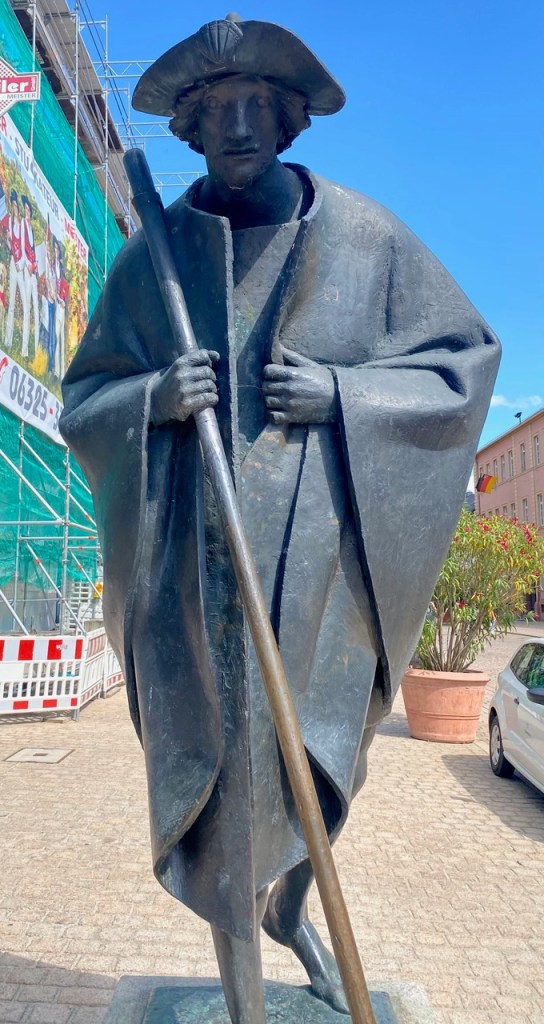
Stature of a “Jakobspilger,” or St. James’s pilgrim: Speyer, Germany

Well, probably the main thing at the time was the idea that pilgrims are often searching for a source of healing. As you know if you’ve read these blogs, I was looking for healing after the death of my eighteen-year-old daughter from a rare cancer. And I found writing about the various pilgrimages Mary Lee and I had made even more healing than the pilgrimages themselves.

Gradually, I began to realize that pilgrimage is a frame of mind—an attitude of curiosity, detachment, wonder. It’s “traveling light,” as one writer says, of risk, of living in liminal space—leaving one location but not yet arriving at another—of exploration, the end of which, to quote T.S. Eliot again, “Will be to arrive where we started/And know the place for the first time.”

Since COVID arrived, with all its restrictions on travel, followed by my 80th birthday, with its expanded waistline and diminished abilities, my blogs have focused more on applying the lessons of pilgrimage to my current life of walks in the neighboring woods, planting peas, tomatoes, and pumpkins in our community garden, and of exploring the twelve steps of my Al Anon program. This, too, has been healing.

 But now I find myself no longer as interested in finding new ways to describe my pilgrimage, as I am in describing and exploring in more depth the landscape through which I’m traveling, a landscape that is always changing, sometimes in ways that please me—autumn color is just around the corner, the grandchildren are growing—sometimes in ways that piss me off or frighten me—the start of my favorite woods walk has been clear-cut, I’m finding it difficult to sing without coughing.

Writing about these joys and sorrows, I find I’m writing more poetry. I’ve just finished an on-line workshop for poets, and one of the highlights of my week is another on-line group of poets from all over the country, where we share our favorite poetry as well as poems we’ve written. I’m now subjecting my longtime writing group here in town to my poems.

So, I’m going to be posting more poetry here in these blogs as well as other experiments—prose poems, flash fiction and nonfiction—trying to look more closely at the physical and emotional landscapes through which I’m now traveling.

The way I see it, my pilgrimage continues, but the lens through which I’m seeing it and the voice in which I’m describing it is changing.

I’m excited to see where this journey will take me. 

And hoping you’ll continue to join me.

So, let part of my life end, and another begin.

As Quakers say, when one door closes another opens.

For all my losses, I’ve also had wins;

let part of my life end and another begin.

Sure, it’s tempting to focus on what has been,

but I don’t want only to go through the motions.

Let part of my life end and another begin,

as one door closes and another opens.

# #

Playing with Fire

#

The only hope or else despair…

To be redeemed from fire by fire.

            —T.S. Eliot

#

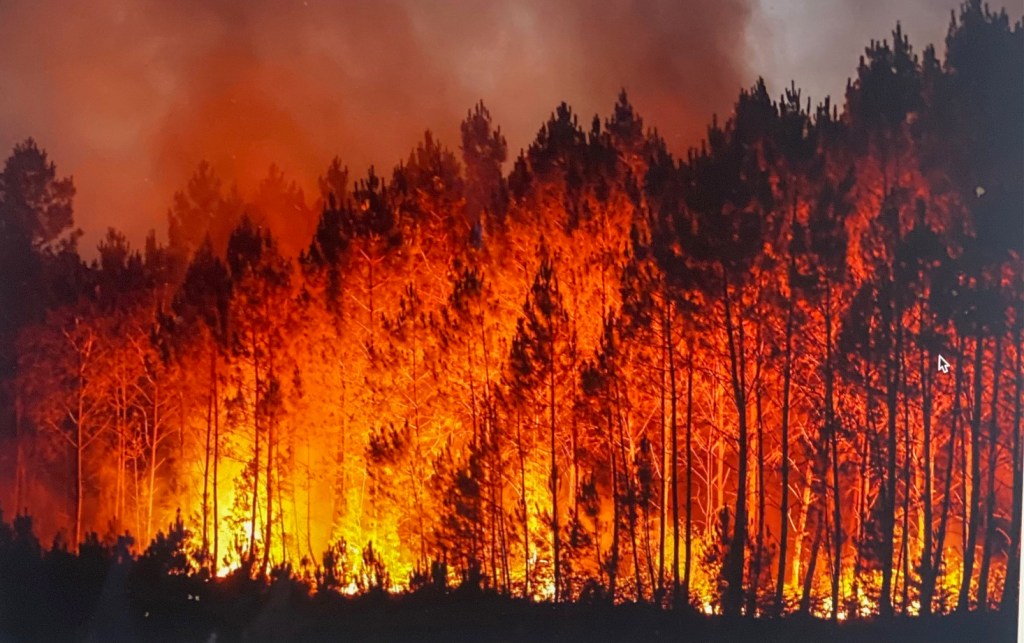
I’m aware of how old I am when I recall that one of my chores when I was kid was to lug old newspapers, magazines, cards and letters, anything paper, out to the old oil barrel in the back yard and burn them. No curbside pickup in those days. (Hell, our town didn’t even have curbs.) It was not a job I liked. Sometimes, I burned myself; sometimes my fingers went numb in the cold; sometimes it took me two or three or more kitchen matches to get a fire started, depending on the wind, which sometimes blew acrid smoke in my eyes. 

In those days, fire was a physical force to be endured, and I was more than a little afraid of it. 

Sunday School didn’t help. Mrs. Raines warned that if I wasn’t good and didn’t do my chores, I might go to Hell, which was a place of fire and brimstone (I didn’t know what brimstone was, but I was pretty sure it burned)—words I often recall when I think of the fires around me these days: the ecocide of our planet, the continued threat of nuclear annihilation, riots on our streets, countless false messiahs fanning the flames of our differences.

A dozen years or so after Sunday School, I saw worlds—or at least woods— go up in flames. I worked for the U.S. Forest Service on a regional Hotshot Crew based in McCall, Idaho. (The term “hotshot” describes those who work on the hottest part of a forest fire.) Looking back, it was hot, dangerous, and grueling work, and my lungs carry the scars from those fires.

But at the same time, I loved the physical challenge. (Hey, I was 20!) And there’s been nothing in my life like the thrill of watching a forest fire racing through the tops of trees. It was frightening, but at the same time enthralling. 

I also learned that despite Smoky the Bear’s telling me, “Only you can prevent forest fires!” (What a burden to put on kids!) most of the fires I fought were caused by lightning strikes and that the occasional fire was actually good for the forest. When flames consume organic matter, nutrients are released back into the soil. Fires can thin the canopy allowing more sunlight to reach the forest floor, encouraging the growth of native species and eliminating invasive weeds. Fires can promote species diversity. (Some species, such as the karner blue butterfly and the wood lily depend on fire to survive.) Fires can improve habitats for wildlife by reducing dead vegetation and stimulating new growth, which can provide food and cover.

During my first marriage, I used to help my then father-in-law burn brush in the winter. It was an all-day activity. We gathered all the limbs and underbrush we’d cleared during the year from around his house, piled them on a couple of old tires filled with gasoline and set it ablaze. I was still in good physical shape, and I enjoyed the exercise. But I experienced another aspect of fire as well. Poking at the burning brush in the gathering darkness, gazing into the flickering shadows cast by the fire on the surrounding snow, I sensed my ice age ancestors dancing around the flames which protected them from wild animals and the cold. 

A couple of weeks ago, Mary Lee and I watched two fireflies sparking the summer night. A little research told me that fireflies produce light in special organs in their abdomens to find mates. When a female sees a male making a signal, she flashes back. Then the two reciprocally signal as the male flies down to her. If everything goes right, they mate.

All I could think of was the Bob Seeger song, “They got the fire down below.”

Another kind of fire I remember.

Now, it’s been sixty years since I’ve seen a live forest fire, let alone fought one, and probably forty since I’ve burned a pile of brush. I’m tired out after an hour in the garden. Often these days, a romantic evening is playing Scrabble or Canasta until 9:00 p.m. But I’m still drawn to fire: I can spend hours staring at the flames in our fireplace. 

I’ve also become more aware of what I think of as the fire of Presence, represented, I think, in the Bible’s Old Testament by the burning bush that drew the attention of Moses and in the New Testament by the Holy Spirit descending upon Jesus’s followers as “Divided tongues, as of fire….” 

One of my old spiritual directors used to tell a story from the Desert Fathers in which a young monk said to his teacher, “Abba, as far as I can, I say my little office, I fast a little, I pray and meditate, I live in peace as far as I can, I purify my thoughts. What else can I do?” 

His teacher stood up and stretched his hands toward heaven. His fingers became like ten lamps of fire. And he said to him, “If you will, you can become all flame.”

So far, the closest I’ve come to experiencing this fire happened during the last two months of my daughter’s life. After spending the day in the hospital by Laurie’s bedside, I’d go each afternoon to the hospital chapel. I was almost always the only person there. Upon entering, I’d light two pillar candles on the altar, sit in the front row of chairs, and stare between the candles through a large round window looking out over the river. After a while, the candles would sometimes seem to glow more brightly, their light dancing. The flames would come together, enfolded by the stained glass around the window. Then, I too would become enfolded in a fiery feeling of being scoured of fear and anger and shame, which allowed me to face the next day.

These days, as I sit by our fireplace, it’s hard not to identify with the dying flames. But I realize even glowing embers can still, like forest fires and fiery brush piles, like altar candles in a hospital chapel, purge away what is false, promote new growth, light someone’s way in this burning world.

            May it be so.

# #

Another G… D…. Learning Experience

Henry Fonda as Norman Thayer lost in the woods behind his house.

#

It started when I left my phone behind. 

I’ve always known that my phone provides many of the same comforts cigarettes used to. My phone fits easily into my pocket so it’s handy. It gives me something to do with my hands if I’m nervous or bored. If I’m waiting for someone, I can check on how the Red Sox did, or when I need to use a bathroom, I can do something besides look out the window, assuming there is a window, and if there isn’t, I don’t care because I’m checking my email on my phone. 

But until now I’ve never realized how, like cigarettes, psychologically addictive a phone can be. All that weekend, I felt tense, anxious.

Now, the reason I suffered for an entire weekend was that Mary Lee and I spent it in Vermont celebrating my sister-in-law Anne’s birthday. I couldn’t very well say, “I left my phone in our bedroom. Would you excuse me while I drive four hours back home so I can see how many ‘likes’ my last post got on Facebook?”

And for those of you who don’t live in New England, the reason it takes four hours to go 160 miles, as the crow flies, from Maine to Vermont is that you can’t go by crow. The most direct route cuts through western Maine and central New Hampshire—a narrow two-lane road through small towns and past lakes and cabins and antique shops and combination hardware stores/greenhouses/ice cream parlors—and takes two hours longer than the quickest route which is to first drive south for 85 miles then west for 31 miles, then north for 69 miles, then west again until you get lost. 

 And you will get lost, because while the first 185 miles are doable if your car has a GPS and you follow the signs, once you get to Vermont, you’re driving through small towns and along one lane dirt roads through mountains that baffle even the best GPS systems. At least, you do if you want to get to my sister-in-law’s place.

View from Anne’s porch.

But although I left my phone behind and got lost for a bit that weekend, I remained reasonably calm. It was a nice day and Vermont was beautiful. As I often do (hence these blogs) I tried to think of the trip as a pilgrimage, this one honoring my past. I lived in Vermont for four years and my first teaching job was actually in the town just down the mountain from Anne’s. The wide, shallow streams paralleling the roads, the cow pastures under the green hills, the sweeping vistas were worth dead ending in a driveway. Especially when the nice lady there gave us directions to Anne’s, saying, “You couldn’t follow the damn GPS even if it worked… not unless you have a Humvee and a chainsaw.”

Still, while we had a lovely weekend celebrating my sister-in-law’s birthday, the anxiety of smart phone withdrawal grew. It was like I wasn’t me anymore—a feeling that metastasized when I tried show Mary Lee the first apartment I ever lived in. It was as if someone had moved the street to a completely different part of town. 

It certainly was hidden. (I lived on the second floor.)

By the time we headed back to Maine, I was feeling unhinged and uncertain. To regain my manly sense of mastery (at least that’s the only reason I can think of) I decided I didn’t need any help from any GPS getting from Anne’s to the paved road to the interstate to the Maine Turnpike to home, thank you very much.

Setting the car radio on “50’s Gold,” I drove south on the interstate, missing the exit for New Hampshire and Maine, and continuing for another ten miles before I turned around and headed north. After an hour of ignoring Mary Lee’s suggestion that it might be time to find out where we were, I pulled off the interstate and plugged our home address into the GPS, which informed us that we were almost fifty miles north of where we should be. Surrendering to that damn voice (which I swear was snickering)— “In one half-mile, prepare to turn left… turn left in 100 yards…turn left”—we eventually came to that cow path I talked about earlier through New Hampshire and Maine, the one that got us home two hours later than we would have if I’d used the GPS the way I should have. By that time, my hands were shaking, my stomach was in knots, and my head was pounding. Even the familiar roads near home looked strange and forbidding. 

At one point on that interminable drive home, we drove by Squam Lake, where the movie On Golden Pond was filmed, and since then, I’ve been thinking about Henry Fonda’s 80-year-old character getting lost picking strawberries in a place he’d been going to for years, stumbling through the forest, become more and more disoriented, more and more frightened. 

And I ask myself: Is that who I’m becoming?

I’m trying not to panic. I tell myself that as I’ve become 80, I’ve been focused on my physical diminishments, and maybe God of my not Understanding is telling me it’s time to prepare for the mental changes ahead—that I should think of that weekend as—to use a 12-step term—another “Goddamned learning experience.”

I’ve just read David Shields’s book, The Thing About Life is That One Day You’ll Be Dead. Normal geriatrics, he says, don’t have poorer memories, but it does take us longer to retrieve those memories. We’re more susceptible to distractions, have trouble coordinating multiple tasks, and suffer decreased attention spans. In simple duties and common situations, we’re fine, but when stress is added (loss of a smart phone, for example) we often struggle. “Perhaps,” Shields writes, “this is why some older people, finding it harder to cope, tend to start searching for comfort rather than excitement.”

I’m tempted, but I’m not ready. Instead, I’m going to send my ego to the store for a quart of milk and do what Mary Lee does and make a checklist for when I travel: 

Underwear?    Check. 

Pills?               Check.

Phone?            Check. 

And at the top of the list, I’m going to write: 

Don’t assume you know where you’re going. 

Ask for help.

Actually, that sounds like pretty good advice for any pilgrimage.

# #

Memories of a 50’s 4th

Google Image

#

Back then

firecrackers popped all day long.

Anyone could buy them at the drug store,

along with caps for your pistol,

and black pellets that, when lit,

curled into snakes.

Stores, many draped in American flag, closed,

and until noon or so, a dog could

lie down in the middle of Main Street

without fear of being run over

by anything except a bicycle

papered in red, white, and blue crepe.

Well, most bicycles didn’t look like this, but you get the idea.

In the afternoon, relatives got together

or families drove to the beach

or attended a baseball game

between neighboring town teams.

Family gathering at my grandparents.

Back then

after supper, many folks drove

over to John Rizzoli’s for fireworks.

A large man with a big smile and cold eyes,

John had immigrated here after WWI,

becoming, rumor had it,

“Al Capone’s man in Maine,” during Prohibition.

He and his eight or ten sons,

now legally supplied the state with beer:

Budweiser,

Schlitz,

Pabst,

and Narragansett

(“Nasty-Ganset,” my grandfather, who lived on the stuff, called it).

“Thank-a-full for what this-a country

give-a me,” once a year, John opened his garage,

moved out his Cadillacs, put in a bar,

and sold red, white, and blue dixie cups of his wares

prior to shooting off the fireworks.

Back then

as the sun set over the field behind the Rizzoli’s

families spread blankets.

While their children in shorts

and Keds and Davy Crocket caps

played cowboys and Indians

and shot off more firecrackers,

women, wearing bright lipstick and checkered dresses,

their hair curled, courtesy of Toni or Lilt,

visited each other,

comparing kids,

their new washing machines and dryers,

the cost of pine-paneling their rec rooms.

Mom getting ready to go out.

Men, clean-shaven with crewcuts, many in white shirts and gabardine pants,

visited John’s garage,

complained about the Red Sox,

argued the merits of the new Fords, Chevys, Dodges, and Hudsons,

swapped war stories and dirty jokes.

Dad’s new car

Teenagers in jeans stood around the edges of the field

bragging about their new “Hi Fi” record players,

arguing who kicked more ass, Elvis or Jerry Lee,

wondering who was going all the way,

while single men in overalls and slouch hats, stood against the garage

bitching about

taxes,

teenagers,

the new interstate through-way.

Back then

somewhere close to 9:00 p.m.

when it got completely dark,

men returned to their families

and a holy hush fell over the field.

Flashes of fireflies, like votive candles,

lit the night.

The smell of cigarette, cigar, and pipe smoke

wafted like incense.

As someone started singing, “God, Bless America,”

dixie cups were passed.

Suddenly, light and noise filled the sky—

rockets’ red glares, bombs bursting in air—

and sounds of a collective “Aahhh”

rose into the heavens,

as we worshipped the American Dream.

Google Image

# #

Looking for What’s New

#

Besides dealing with a decaying body and a deteriorating mind, one of my biggest challenges these days is to keep from living in the past. (And I’m sure the two struggles are connected: of course, I want to recall when I could leap tall buildings in a single bound.) It’s so tempting to spend my days reminiscing with old classmates via email or Facebook, watching “American Bandstand” on YouTube, and replaying 65-year-old high school basketball games.

This last month has been especially challenging. May began at the history center in the town in which I grew up with a program that my oldest friend (going back to the first grade) and I spent the winter planning: “Yarmouth [Maine, for those of you reading this in Singapore and elsewhere], 1955-1962: Times of Change.” We wound up with probably thirty people there who’d grown up in town during those years, bathing in the warm waters of nostalgia, as we talked to newer residents about how Yarmouth changed during that time from a low-income community of shops and small factories to a bedroom-by-the-sea for urban lawyers, doctors, and bankers. A town we kids roamed at will because everyone looked after us—where the local telephone operator would call my classmate Barbara’s house at 3:30 in the afternoon (because she knew Barbara got out of school at 2:30 and would stop at the drug store for a coke, so that’s when she’d get home) to tell Barbara that her mother would be late and that she should turn the oven on 350° and put the roast in at 4:00. (Who needed cell phones?)

Later in the month, as my brother and sister and I cleaned off stones and planted impatiens in our family cemetery plot for Memorial Day, we swapped memories of Mom and Dad and our grandparents. (Amazing how different our recollections are!) Later that week, I went with my wife, Mary Lee, to her 55th college reunion, and for three days listened to other people’s stories about their pasts. Throw in a dream in which I ran into my ex-wife—who died eight years ago—dressed in a white karate gi (still trying to work out the symbolism there), and I’m starting to sink beneath these waves of nostalgia.

I need to get out and open my eyes. Stop looking at what’s behind me and start looking at what’s around me—what’s new. I decide to check out this year’s garden. Besides, I need to put in my tomato seedlings.

It’s a beautiful June morning and the world is new. The apple blossoms and rhododendrons are in full bloom, the air smells of lilacs, and the breeze is fresh. The world is spring green: the grass hasn’t yellowed, the leaves aren’t chewed, and the caterpillars haven’t yet built their ugly tents in the trees.

I put my seedlings and watering can and trowel in the car, drive up and park on the power line road between our community garden (which I wrote about a few years ago: https://geriatricpilgrim.com/?s=Up+to+the+Gahden) and a wooded swamp, home to all kinds of birds, many of whom are singing their ever-loving hearts out.

I had no idea how many birds there are here until I got one of those apps this year for my phone that identifies birds by their songs. So, I check it: cardinal—yes, I know their pulsating whistles; song sparrow—makes sense, I see all kinds of them; gold finch and chickadee—ditto. But what’s a great crested fly-catcher? And a red-eyed vireo? They’re new, at least to me. Cool. 

Turning to the garden, I think of the beginning of baseball season, when, no matter how poor a team’s prospects, there’s always hope for a championship year. 

This year, I’ve got three raised beds, and—God willing; I haven’t planted it yet—a small pumpkin patch. The garlic I put in last fall is up, as are the peas which I planted on May 1st. I decided this year to stake them with some of the branches that came down from last winter’s storms—the first time I’ve ever tried that, and it seems to be working: the peas are grabbing the branches with gusto. In another bed, I’ve got the usual two kale plants which will hold us until November, but for the first time, I’m trying a couple of eggplants and a purple pepper to see what happens. I’ve also planted bush beans for the first time in years. (Mainly because last year, I almost killed myself stringing pole beans, and vowed never again.)

 I wave to Karen down the way who’s working on her bee garden. She’s also building a new compost bin, for which I need to thank her. 

But first, let’s get those tomato seedlings in. 

The sun is warm. I take off my outer shirt and begin raking the bed where I’m going to transplant my tomatoes. I love the smell of the fresh dirt (apparently, it triggers the release of serotonin in the brain—at least that’s what I read somewhere) which makes me want to sing. And because the other night I watched a music documentary on Paul Simon, I serenade the birds with “50 Ways to Leave your Lover”—

            You just slip out the back, Jack

  Make a new plan, Stan

            You don’t need to be coy, Roy

            Just get yourself free—

The really neat thing about the documentary was it focused on Simon’s newest album of songs, many, if not all of them, as I recall, coming to him in a dream. And if at the age of what, 83?, he can still be creating new work, even though I guess he’s now deaf in one ear, then I, at 81, can, too, despite my various diminishments.

I dig six holes and put a little of Karen’s compost in each one. I find myself slipping again into the past: the summers in high school I used to work in a garden and the big garden I had during my first marriage. Cut it out! I think, and then decide, No, let’s use those memories as compost, fertilizer to help me grow.

Which would be more inspiring if my back didn’t already hurt from this minimal exercise. From my other garden bed, I grab my new kneeler and bench combination, which I bought this spring, and kneel on it to put the tomato seedlings into the dirt and the compost, which gets my hands dirty and the rest of me feeling clean. Then, I put collars that I’ve made from plastic medicine cups around the seedlings to protect them from cutworms, and, using the metal arms of the bench to get myself off my knees, rise to get my tomato cages from last year. Finally, I give my little darlings a drink to get them on their merry way.

Feeling accomplished, I sit down on the new iron bench with the “Welcome” sign that someone—probably Doug, who, along with Karen oversees our community garden—has donated. I think about how I still rely on community as much as I did when I was a kid all those centuries ago. 

Looking up, I follow an exhaust vapor trail in the blue sky until I see the sun flash on a plane, high in the sky, probably starting its descent into Boston. I imagine flying to new countries and seeing new vistas and new people.

But right now, right here, there are plenty of new things going on, thank you very much.

# #

Physical Therapies

PT After Heart Surgery

#

A few weeks ago, after seeing a doctor about increased soreness in her knee, my wife Mary Lee began a new regimen of physical therapy: quad stretches, hamstring stretches, mini squats, wall sits, looped elastic band hip extensions. These to go with exercises she’s been doing for years to restore movement to her right shoulder. (I like the one where her hands look like frightened spiders scampering up the wall, and another one where she uses a can of Great Northern beans.)

Because I’ve been doing various daily exercises since back surgery in 1977, mornings at the Wile residence resound with creaking bones, tendons rubbing on cartilage, occasional grunts punctuated by yawns and a “meow” or two from our cat, who has taken on the role of personal trainer.

“Faster! Move it, move it!”

Our bedroom looks a bit like Rick’s Sporting Goods, with two sizes of exercise mats, two sizes of weights (in addition to the can of beans), rubber stretch bands, and folding chairs. A treadmill resides in the guest bedroom across the hall. 

Physical therapy after my back fusion was deceptively simple: walk ten miles a day for three months. Every day. Sun, rain, snow, sleet, hail. And since I was operated on at the end of December, I walked through it all. Sometimes in the same day. But you know, I grew to love those walks (Well, Route One got a little boring but at least it was clear after a snowstorm), and I kept walking—maybe not ten miles every day, but often five or six. 

Twenty years later, after bi-lateral hip surgery, my physical therapy involved water exercises; walking back and forth for 30-45 minutes in the shallow end of a pool, pool dumb bells, and gloves that made me look and feel like Aqua-Man. But it worked. On a trip to Florida to visit my parents over school vacation, two months after the surgery, Mary Lee pushed me through Newark Airport in a wheelchair to get to our connecting flight. On our return a week later, after spending most of my time walking the swimming pool, I strode through the same airport feeling like Hercules Unchained. 

That led to yoga, tai-chi, back to walking, this time with my hiking poles that I named Waldo & Henry (To learn why, go to https://geriatricpilgrim.com/2020/02/07/waldo-and-henry/), which led to the hikes and pilgrimages that became the blog you’re reading.

Flash ahead another twenty years: open heart surgery, and more physical therapy at a rehabilitation center, where three times a week for six weeks, I taped on my heart monitor, rode a stationary bike, walked a treadmill, and lifted weights. When the program ended, I bought the treadmill that sits in the guest bedroom (great for watching TED talks, but I still miss those cute nurses at ReHab) and the weights that I use instead of cans of Great Northern Beans.

I don’t do the Kettlebell Squat Swings

But I’m falling apart more quickly these days. Over the last two years I’ve added breathing exercises to help my “moderate” COPD, more stretches to help with the bursitis that seems to have camped out next to both my bionic hips, daily exercises at the computer to ward off Carpel Tunnel and something called Ulna Nerve Entrapment, and weekly sessions with a Feldenkrais instructor.

As Thomas Jefferson said, the price of freedom is eternal vigilance. Or in the words of my old PCP, move it or lose it.

#

Before Mary Lee and I begin our morning grunting, stretching, creaking, and moaning, we sit in contemplative prayer for twenty minutes, a practice I’ve maintained since my daughter died 35 years ago, when, after raging at God for several years, I decided I needed to listen to what God had to say back. This listening—with my whole body, with all my senses—is what I continue to try to do. As I think about it, this, too, is a kind of physical therapy. 

Starting the day

I’m reading a lot these days about quantum physics and spirituality. As I understand it, quantum physics posits that the universe is conscious, if by “conscious,” one means a system that can communicate or process information and then use this information to organize itself (which is what all those protons, neutrons, and electrons that make up the atoms that make up all matter do). So, mind and body aren’t two separate things but rather two aspects of the same cosmic material. 

Modern writers about spirituality, such as Richard Rohr, Diana Butler Bass, Phillip Clayton, and Ilia Delio, seem to me to propose that this cosmic material, this “consciousness” that resides within me as well as around me, is the incarnational presence of God. So that in meditation, I am trying, as I am when I do my stretches and lift my weights, to reestablish pathways, strengthen relationship with what 12-steppers call a Higher Power. 

Besides meditation, I do other exercises to strengthen my spiritual muscles. My Feldenkrais sessions, focusing on integrating eyes, head, shoulders, ribs, pelvis, legs, and feet to facilitate ease of movement, remind me that one of the great spiritual lessons is that everything is connected. And that my job—my “exercise,” if you will—is to recognize and facilitate these connections.(And for more about the importance of connecting, go to https://geriatricpilgrim.com/2024/02/01/connecting-the-dots/)

One of my character defects that keeps me from connecting is trying to control everything and everybody. So, at the suggestion of my Al Anon sponsor, I’ve been taking Waldo and Henry for walks without having a destination. When I first started doing this, I felt lost. I walked in circles. But as I persisted, I discovered roads in the neighborhood and paths in the woods I’d never noticed before. Which is leading me to try to approach other activities, such as meetings, book readings, and potential confrontations with family and acquaintances with the same curiosity, trying to surrender presumptions, looking for the sacred in situations I’ve always avoided and spiritual teachers in people I’ve always disliked.

Probably more than anything else, it’s the physical act of writing which connects me with the Sacred. The only way I can even begin to understand concepts such as quantum physics and the ideas of those spiritual writers I’ve mentioned is to first put the ideas down in my own words on a yellow legal pad with my bold-ink pen. I can write second/ third/ fourth/ ad infinitum drafts of my blogs on a computer. I can edit on a computer. But first I need to work those pen and paper muscles.

Of course, the ultimate integration of mind and body (and what I’ve been working my pen and paper muscles on for the last eight-plus years) is the pilgrimage. Last week, a friend sent me a recent article in The Guardian about the increasing numbers of people making pilgrimages. (In the early 1980s, for example, the number of people who walked the Camino de Santiago—the most famous of all pilgrimages—was in the low hundreds; last year, the number was 446,000.) I’m delighted that people are finding that this combination of physical and spiritual activity can be healthy, healing, and holy.

It sure is for me.

In a California red wood forest

# #

Ice

#

Last Palm Sunday, Mary Lee and I were supposed to begin a two-week retreat at a monastery in the hills of California. We’ve been going on retreats now for thirty years and I was eagerly looking forward to having more silence, being more aware of the world, doing more reading (I’m on a Buddhist kick right now), drawing closer to God of my not Understanding. Then, two weeks before we were supposed to fly to San Francisco, we received word rockslides had closed the roads, and that the monastery won’t open again until at least May. 

So instead of flying across the country on Palm Sunday, we spent the day encased in ice.

The previous evening, thanks to a day of snow changing to freezing rain, we lost power. That Sunday, we cooked oatmeal on top of our gas stove and wrapped in blankets in front of our gas fireplace. While the ice bent the trees and bushes lower and lower, Mary Lee and I read the Palm Sunday service from the Book of Common Prayer, wondering, along with the Psalmist, “My God, my God, why have you forsaken me.” 

For the next day and a half, we ate beans and rice, read, played Scrabble and cribbage, drove around the neighborhood to charge our phones, and finally gave in and stood in line at a restaurant in another town for breakfast. 

All in all, it wasn’t bad. Still, it’s hard for me to find much nice to say about ice. 

I like ice cubes in my water. I use ice packs to help the bursitis in my hips. Some ice sculptures are pretty. I’m glad to have a freezer in my refrigerator to preserve food. But that’s about it. When I used to go skating, I’d divide my time between flailing my arms to keep from falling and lying prone on the ice when I did. The one time I went ice fishing, I was days warming up.

Ice has all kinds of nasty connotations. It can mean frigid, as in sexually inadequate. It can mean unfriendly, reserved, aloof, rigid, inflexible. Fear sends icy chills down our spines. We hear about the icy fingers of death.

Speaking of death, while Hell (which is where some of my Fundamentalist friends tell me I’m going to go when I die) is usually pictured as a place of fire and brimstone, in Dante’s Inferno, the center of Hell is a vast lake of ice, in which Satan, along with sinners who committed treason and betrayal—such as Brutus, Cassius, and Judas—is incased.

from Dante’s The Divine Comedy, I Hell, translated by Louis Biancolli, 1966

Makes sense to me. Ice is cold. Ice is heavy. (The reason we lost electricity was because ice-laden trees fell on power lines). Ice prohibits movement. During the most hellish part of my life, after my daughter died, I couldn’t get warm. I felt as if I were carrying a 20 cubic foot freezer on my shoulders. My body was rigid and tense. Only after I’d had two or three large tumblers of scotch did I feel as if I were thawing. 

And yet. For someone who dislikes ice, I realize that one of my tendencies is to want to freeze experiences and beliefs, preserve them the way we preserve meat and vegetables. 

After those hellish first years when Laurie died, my life began to get better. I thought I was learning to live with loss. But five years later, at this time of year, it was as if my daughter has died all over again. I plunged back into rage and tears. I spent evenings drinking my tumblers of scotch (or maybe it was Wild Turkey 101 proof, at this point), going through old photograph albums of the two of us and listening to Laurie’s old tapes of Tracy Chapman and the Grateful Dead. The only difference was that those I was most angry with were people who talked about their own grief. I remember being at a retreat at a monastery in Cambridge, Massachusetts where a woman talked about almost losing her son in an automobile accident. A spasm of rage surged though me. I thought, What are you moaning about? He’s alive, isn’t he?

Then on Easter Sunday after this retreat, I heard a sermon based on the Gospel of Mark’s account of the Resurrection, which, unlike the other gospels, ends with Mary Magdalene, Mary the mother of James, and Salome, fleeing from the empty tomb, “for terror and amazement had seized them; and they said nothing to anyone, for they were afraid.”

Why fear, asked the preacher. Well, there might have been a lot of reasons—fear of soldiers, fear of grave robbers—but he also wondered if it wasn’t human nature to fear the unknown, to become used to, even comfortable with, our lives even if they’re full of pain and suffering. We prefer what we do know to what we don’t.

And I realized that over the years since Laurie’s death, I had grown comfortable with my image of myself as GRIEVING PARENT; I had made Laurie’s death MY STORY, trying to preserve memories of her, as in the old photograph albums I’d been perusing. And if anyone else had a similar story, I felt threatened. 

In other words, I was trying to freeze my sense of myself and Laurie rather than let them evolve, flow. I wasn’t angry about the death of my daughter, I was angry at the possible death of my grief, thinking it was grief that was keeping me close to her. 

That Sunday afternoon, sitting in Harvard Square amidst cigarette butts and pigeons, looking up at the sycamores and the brick buildings, listening to voices babbling in a half-dozen languages, I tried to focus on my daughter in the present moment. I don’t know where you are, Kid, I remember praying, but at some level I know you’re fine, and I want you to know that I love you.

And the sights and smells and noises of the Square seemed to fade and I felt a hand on my shoulder, and I knew it was Laurie’s.

I don’t care whether that hand was from another dimension or from my imagination. What I do know is that the great spiritual traditions are right: love transcends death. That is, if you don’t try to freeze it like leftover meatloaf.

But I’m still learning. Working a 12-Step Program, I’ve discovered traits that I developed to survive growing up in an alcoholic family—judgmentalism, people-pleasing, perfectionism—traits which no longer serve me, but have, in essence, remained frozen, damaging my relationships with others.

And I’m wondering if I may be trying to freeze my retreat experiences, and that Life, the Universe, or God of my not Understanding isn’t telling me by having this retreat in California canceled that I need to let the retreat experience—the silence, the awareness, the reading, the closeness to God— flow into my everyday life, here at home, even in the middle of an ice storm.

#