Desert Labyrinth

**

Entering:

Heel…toe…heel…toe

trying to focus on the boots

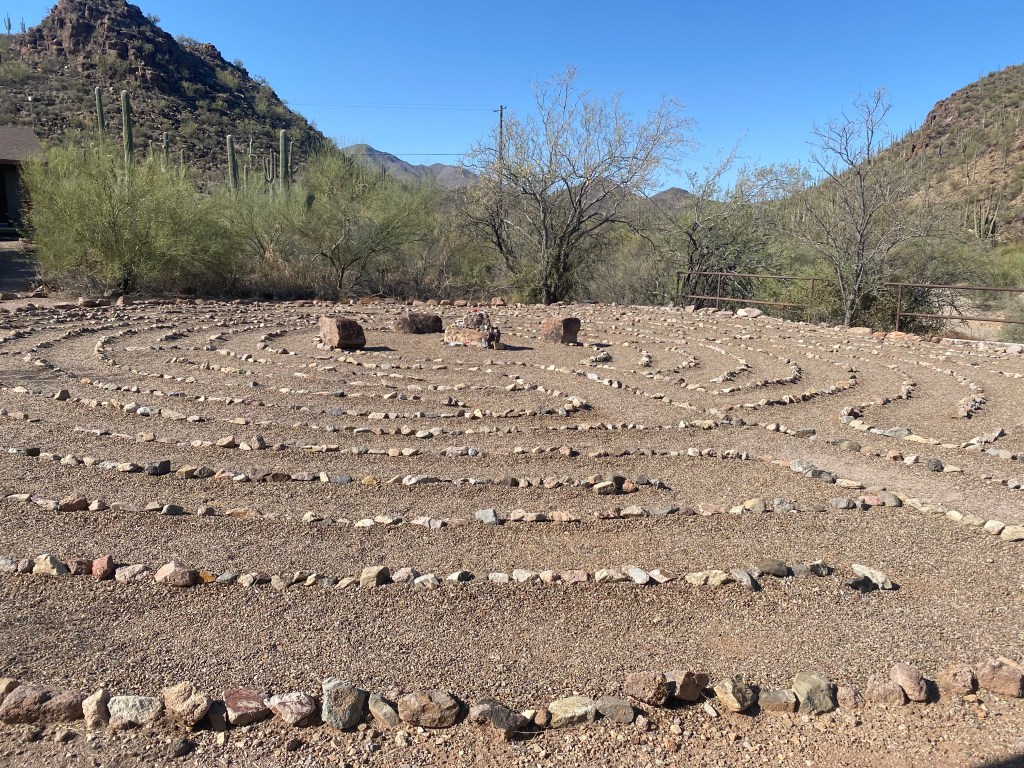
that walk this path lined with

tan, gray, white, russet

stones snaking its way

over copper-colored gravel.

Still, the mind twists, bends, curves

with the path going around, back, between

the blue of the sky, labored breathing,

the inhaler back in the room, 

past mistakes, future apprehensions,

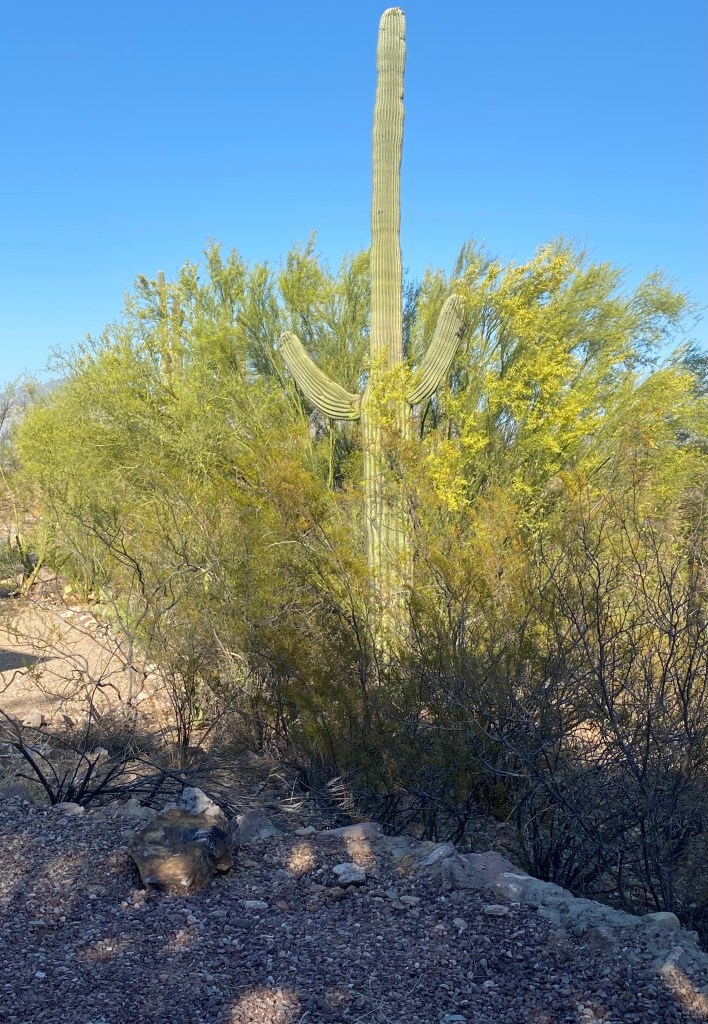
prickly pear, barrel, saguaro cactus,

fantasies, “if onlys,”

scrunch of footsteps.

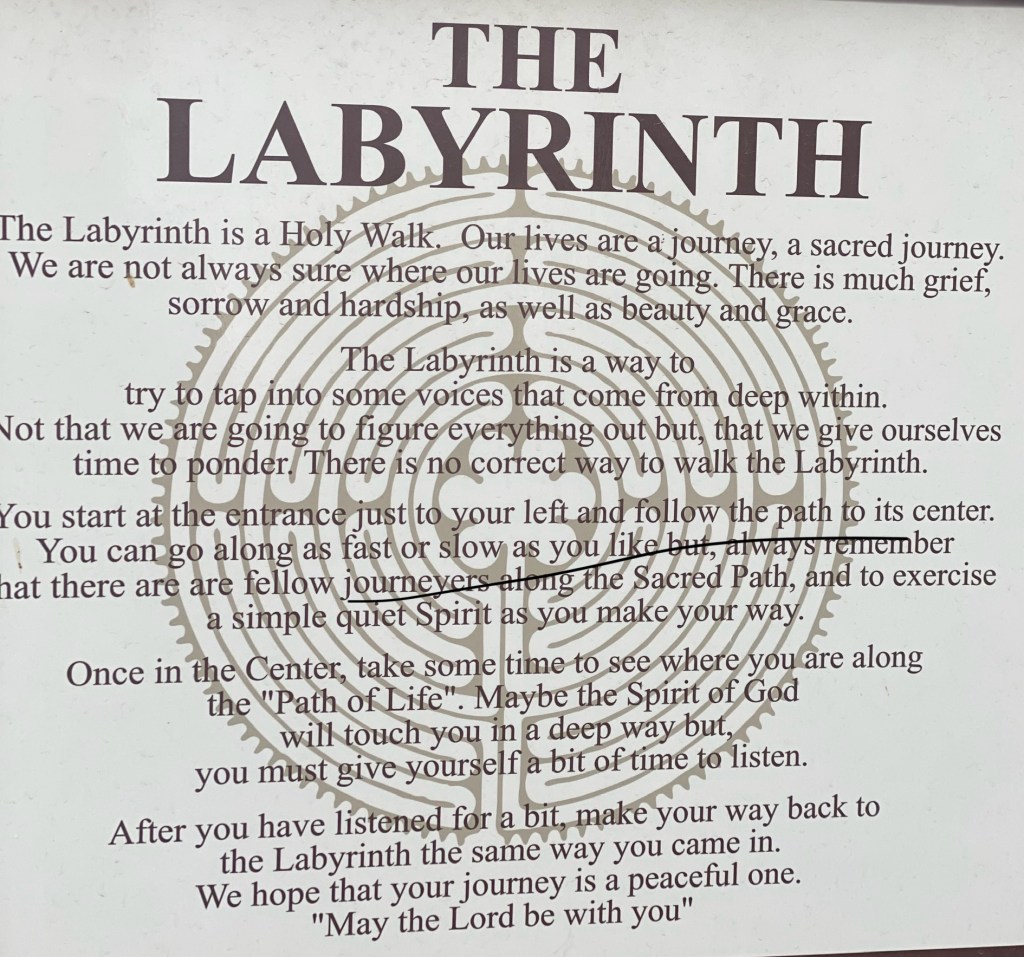
Following the narrow road of stones

toward the center of what looks

like a petrified brain

which is right ahead

and then it’s not,

spiraling further away.

Turning a corner

torso teeters, trips,

boot kicks

a rock into the path.

Voices from the past snicker

Clumsy klutz!

Kicking the rock back into place.

Walking on.

*

The Center:

Finally

three red rocks triangle

a flat altar stone

spilling painted stones, shells,

ribbons, bracelets, a plastic flower,

a wooden plaque that says:

“Too much of anything is bad,

 but too much good whiskey is barely enough,”

left perhaps by someone hoping to leave 

both plaque and whiskey behind.

Sitting on a red rock wondering

Where is my center?

What do I need to leave behind?

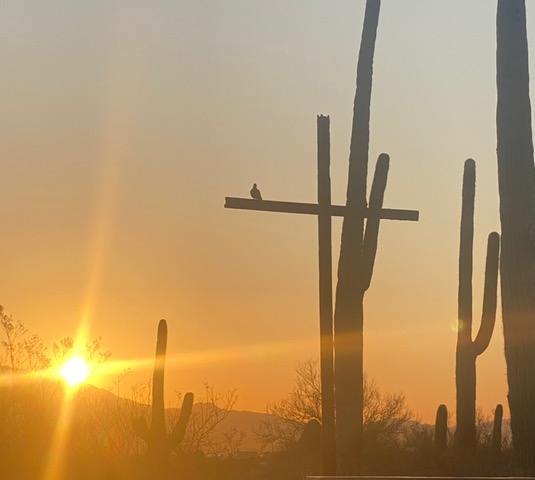
Brown rumpled hills dotted with saguaro,

prickly arms lifted as if in praise,

reply with silence

punctuated by

the cooing of a distant dove.

*

Returning:

Heel…toe…heel…toe

trying to focus on the ground beneath the maze,

the silences between 

the ripples of wind, a cardinal’s whistle,

yellow palo verdi blossoms, azure sky,

sunlight on sweaty skin,

overhanging mesquit branch that 

grabs a shirtsleeve like a past sin.

Stumbling again

kicking another stone again

booting the rock back into place again,

breathing to Thich Nhat Hanh

(breathing in, I calm my body,

breathing out, I smile.)

circling, looping, spiraling,

remembering the center—

The soul? Love? Divine Spark?

Face before you were born?—

circling, looping, spiraling.

Gazing over russet, white, brown, tan

stones to the exit

except it’s also the entrance—

accept it’s also the entrance—

to life’s labyrinthian journey.

**

Querencia

~

…from the Spanish verb “querer,” to want, desire, love; an emotional inclination toward a location; a home ground, a favorite place.—Wikipedia.

~

“A querencia is a place the bull naturally wants to go to in the ring… In this place he feels that he has his back against the wall and in his querencia he is inestimably more dangerous and almost impossible to kill.” Ernest Hemingway, Death in the Afternoon.

~

Or man-cave or refuge or sanctuary or study or simply the room at the end of the hall where I hang out wrapping it around me like a favorite bathrobe or suit of armor depending…

where I 

gaze at pictures of my wife ML looking radiant in her new clerical collar despite her son’s having left to live on the West Coast… my daughter Laurie’s watercolor she painted before her cancer diagnosis of a blue hand reaching up thru brown rocks toward bright flower petals … my brother sister & me skunk as a drunk before I sobered up … ML’s boys, Laurie & me swimming on Mount Desert Island when I thought we could blend our families… grandchildren sitting in my lap, playing by the river, hiking in the woods when we did…a panorama of Banjo Camp North where I named my banjo Joy… Jerry, Marty, & I—6’2” then— the Fish Factory Trio, singing “The Old Dope Pedler” at a high school variety show in 1961… four views of the Desert House of Prayer outside Tucson, Arizona where ML & I danced in the desert under a full moon Easter morning in 2001… a lioness sunning herself on a rock on the Serengeti Plains in 2018…

keep mementos such as a contestant pin from the 1961 L&M State Basketball Championship…three vintage baseball caps of my favorite teams… the skin of a rattlesnake I killed in Idaho in 1962…diaries going back to 1963…autographed books by heroes, mentors, friends and former students … cards from grandchildren… three bowls of rocks from my travels…rocks from those travels too big for bowls… a felt fedora covered in pins from airports around the world… a turkey feather from a walk in the woods… four clam shells from walks on the beach… a letter holder my father made for my mother when they were in high school… a wooden platter I remember him carving in the evenings after he’d come out of the Army & was working as an apprentice carpenter & we didn’t have a TV… my grandmother’s desk… 

lose and find myself in books of non-fiction, fiction, poetry…books about travel, Maine, writing, spirituality… five banjos…one guitar…one harmonica…one mouth-harp… one Vietnamese flute… ten songbooks… two file cabinets of old writing… two coffee cups of pens…my current diary… a yellow legal pad of paper… a computer … 

look out the window at a world of uncertainty for my country & my own life & those I love holding my favorite pen like Excalibur my diary like a shield enthroned in my ergonomic office chair feeling inestimably more dangerous & almost impossible to kill…

~ ~

Gazebo

~

“We are saved in the end by the things that ignore us.”— Andrew Harvey

~

At the Spiritual Renewal Center in Arizona

I’m not feeling renewed spiritually or otherwise.

Dusty desert wind sears my lungs as I sit in 90° heat,

stuck to a faded plastic chair in a rundown gazebo—

rotting floor…peeling paint… broken railings—

good place, I think, for an octogenarian

with COPD, a weak heart. and arthritic joints.

Just six years ago I walked the nearby desert trails 

for miles past petroglyphs and rattlesnakes,

up rocky canyons and down sandy washes.    

This morning, I reached for my inhaler after 20 minutes 

and turned back feeling old and dilapidated.

Now, I sit in this decaying gazebo awfulizing about my future:

a sudden heart attack that strikes me down

before I can say good-bye to those I’ve loved, 

or a stroke which leaves me paralyzed and drooling 

while others change their lives to look after me,

or worse, dementia, unable even to say thank you for caring.

Which leads me to wonder: Will I be missed when I’m gone?

Certainly not by the flat cumulous clouds 

floating over the hills on the horizon

 or the wind through the prickly pear, cholla, barrel,

organ pipe and ocotillo cactus,

 not to mention the saguaro standing

with arms raised to the heavens,

 and certainly not by the coyotes 

barking from the copper-colored hills behind me, 

or the doves or cardinals or flycatchers or thrashers 

or warblers or wrens or quails,

nor, come to think of it, by the yellow blossoms

from the palo verdi  blowing in the desert wind, gilding

the rotten gazebo floor and my decrepitude 

with the golden certainty of new life. 

~

Pondering Pants

~

He remembers the corduroys 

that whistled when he ran away 

from his mother and her hairbrush.

~

Then later, dungarees, 

rolled up at the bottom, 

when he wanted to look tough,

and pegged chinos, 

black with a belt in the back, 

when he wanted to look cool.

~

At his local college, 

to let people know he’d worked Out West,

he wore frayed Frisco Jeans 

with a faded circle on the left back pocket

where he stuck his tin of smokeless tobacco.

~

As an English teacher, 

he wore striped bell bottoms, 

along with double-breasted sports coats, 

and paisley ties with matching pocket handkerchiefs, 

his armor against feeling incompetent.

~

To become a writer, 

he decided he must have khakis

because the New Yorker ad 

said Kerouac wore them.

~

He switched to cargo pants

to enhance his image 

of poet, pilgrim, seeker,

setting forth on the Camino de Santiago,

with all those pockets.

~

Until, proud to proclaim

his waist size hadn’t changed

in over forty years,

he made sure his pants

had elastic waist bands

to go around an expanding gut.

~

These days, however, 

he’s discovered sweatpants, 

because they’re comfortable 

and he no longer 

gives a rat’s ass what he looks like.

~

The Old Lesson

~

71 years old,

lungs aflame,

lower back throbbing,

I rest on my hiking poles

halfway up 

still another hill 

at an iron gate

amid gorse and nettles, 

trying to pick 

out the path rising 

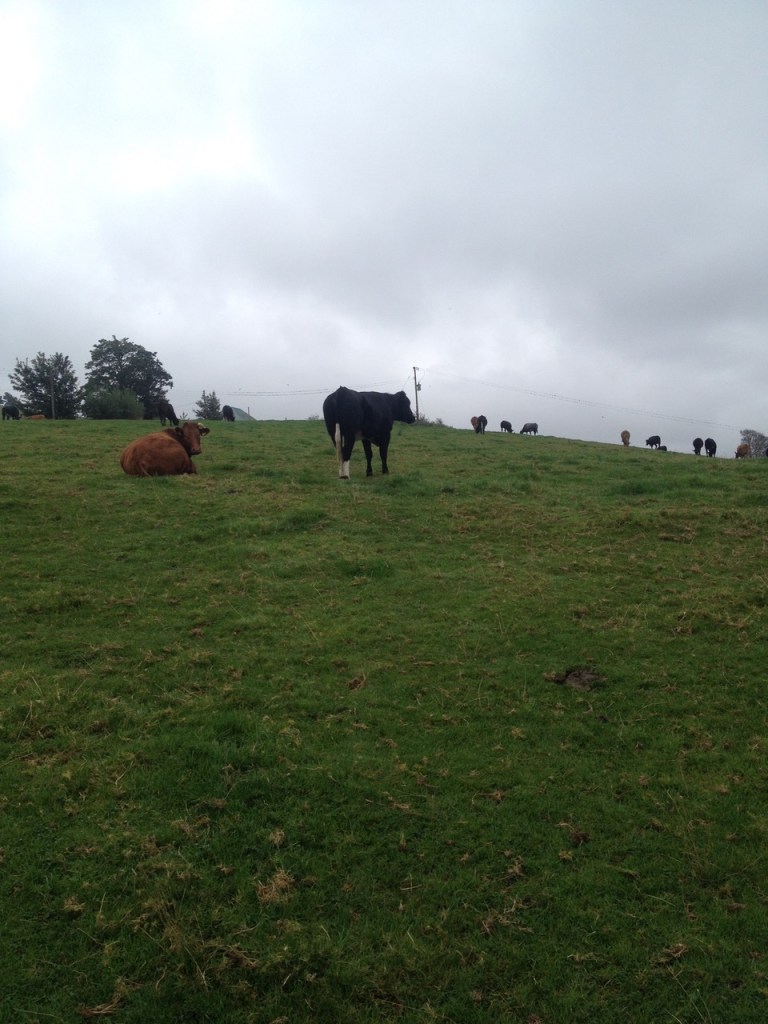
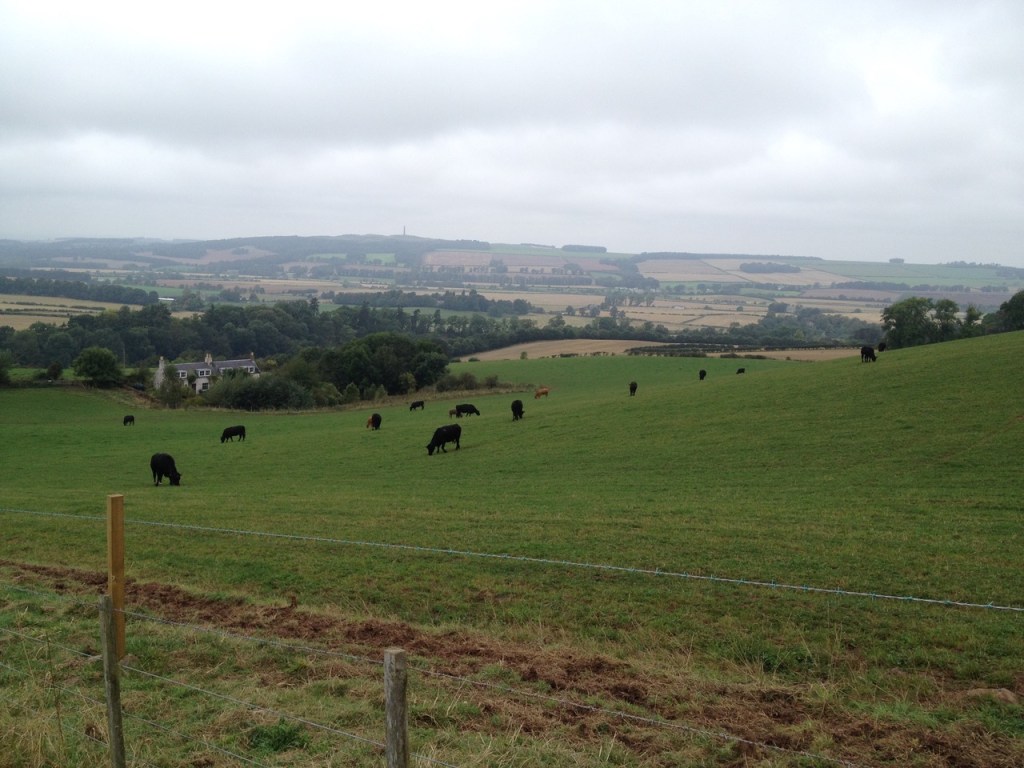
through a herd

of cows grazing on 

gangrenous grass between me 

and another gate 

and the trail that 

winds through woods

to tonight’s B&B

and the joy of a hot bath.

~

The gate clangs as 

I trudge into the herd,

which parts before me 

like the red sea

except for one

brown and white cow,

legs tucked beneath her,

who stares at me 

impassively,

before lifting her haunches, 

and dropping a steamy 

pile on the path

already strewn with

“chips,” “dung,” 

“flaps,” “muffins,” 

“patties,” “pies” —

choose your euphemism.

            ~

The pasture’s a mine field.

 I zig, zag, circle, 

back-track, hop—

marching thirty yards

to advance ten.

Fog mists my glasses.

Sweat soaks my shirt.

The air smells of decay.

At this rate,

I’ll still be 

hiking after dark.

Panic attacks like

a squad of minges.

            ~

Then, like an aging general 

roused from his nap

to lead me once more 

into battle against 

my old foe, Avoidance, 

comes the prayer: 

            ~

God, grant me the serenity

to accept those things

I cannot change …

            ~

I keep to the path, 

hear the squish,

feel my boots slide, 

raise my eyes 

to silver clouds

billowing over a line

of ancient trees,

glimpse red sandstone,

            ~

the courage to change

the things I can …

            ~

squish, slog, slide,

watch a brown hare

scamper to a stone wall

adorning the hill

like a necklace,

            ~

And the wisdom

to know the difference. 

            ~

Now at the gate

to freedom,

I bow to the sky,

having learned 

yet again

that to get to joy

you often have

to walk through shit.

            ~          

(after David Whyte’s The Old Interior Angel)

Family Triptych

Weilburg

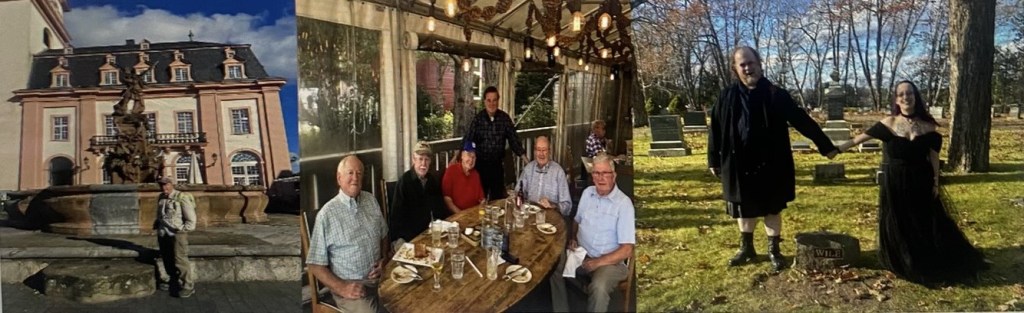
Traveling 3500 miles to a town in Germany

smaller than the one in Maine where I live—

no tours, no souvenir shops, 

no one speaking English except back at the hotel, 

I stand by Neptune’s Fountain 

in Market Square beneath the God of the Sea 

thrusting his trident into the head of some leviathan, 

my lungs still burning from climbing the hill to get here, 

trying to imagine 25-year-old Johann Frederich Weil 

wandering the square 

before leaving for Halifax, Nova Scotia, 

lured by the British Government’s offer 

of free passage, free land, & a year of free rations, 

knowing from Ancestry.com 

his descendants will anglicize the name & populate places 

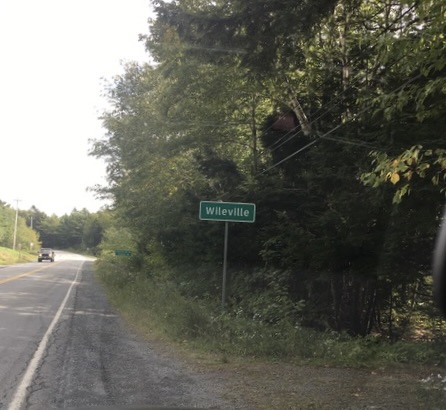
like Wile’s Lake, Wileville, & Wiles Road, 

until the turn of the 20th Century 

when Lyman & Lester Wile 

leave Canada for a shoe factory 

in Marlboro, Massachusetts 

where Lyman will marry Edith Conrey 

& sire my father who 

because his mother left Lyman when Dad was 4 years old

(apparently because of spousal abuse) 

didn’t give a shit about his father or his family. 

Then Johann dissolves—

if he was ever here in the first place—

into the salmon & cream-colored two-story buildings, 

round-arched arcades, & a matching-colored four-story Italianate castle 

as my wife and I join the half-dozen folks in leather & wool 

sipping beer & coffee at outdoor tables by a small restaurant. 

Still, walking back to the hotel 

looking down the hill 

at the Lahn River, a small waterfall, an old stone bridge, 

I think of the hill I grew up on, the bridge below my house 

over a similar river by a similar waterfall, 

& I feel a weird calm, 

connected by currents beyond my ken.

The Royal River Grill

Walking into a restaurant 

with large windows looking out on the harbor 

& soft lights meant to look like candles, 

I see Buzz & Chuck & Ted sitting at a long oak table. 

A shiver of both anxiety & eagerness 

& the next thing I know it’s 1953, 

when this building was the site of the Stinson Sardine packing plant 

& I’m ten years old & in fourth grade 

& I’m going to my first meeting of Mike’nBuzzie’s Gang 

at Mike’s house just up the hill from here, 

because earlier that afternoon 

when it had been my turn to stay after school 

to erase blackboards, 

as soon as Mrs. Croudis left for the teachers’ room, 

Buzzie’s brother Craig ran into the classroom. 

“We’re getting a gang together 

for an apple fight with the uptown kids! 

Big meeting at Mike’s house! Let’s go!”

Dropping the eraser, I ran out the door—

the first time in my life I’d ever disobeyed one of my teachers. 

But for the first time in my life I didn’t care. 

A timid kid, raised in a family 

where a miasma of alcoholic anger & anxiety 

hung over us like the fumes 

from the neighboring paper company,

I’d lie awake mornings before school 

afraid of the day ahead, 

of having my arm twisted or my face washed with dirty snow 

by sixth graders like Mike’nBuzzie,

and now they want me to join them! 

Never mind that the apple fight with the uptown kids never happened, 

or that Mike now has Parkinson’s & stays home 

& that Buzz & Chuck & Ted & I, and later, Allie & John, 

have little in common these days 

except our L.L. Bean khakis & plaid shirts. 

I laugh & reminisce. 

At home. 

Still part of the gang.

The Cemetery

Under gnarled & broken maple trees, 

I walk around my family cemetery plot, 

taking pictures of the wedding—

of the bride, who stands 5 feet 

& maybe weighs 100 pounds, 

her upper chest tattooed with angels, 

her dyed magenta hair, & flowing black gown, 

& the groom, my stepson, 

probably 6’4” & 270, 

black lipstick & kilt, red-haired & bearded, 

standing in front of the family stone, 

originally part of the cellar of my mother’s grandfather’s house, 

while my second wife, 

an ordained Deacon in the Episcopal Church, 

performs the ceremony. 

My stepson’s two daughters stand as ring bearers 

near the memorial stone for my daughter, 

who died at 18. 

My wife’s ex-husband & his wife 

stand between my grandmother’s granite stone 

& the memorial stone for Nanny’s ex-husband. 

Not far from my great-grandfather & great-grandmother’s marble stone, 

my stepson’s nonbinary stepson from his first marriage 

& their partner also take pictures. 

The bride’s parents view the proceedings 

in front of my mother’s bronze marker 

between my father’s & my stepfather’s bronze markers 

while my second wife’s sister, her daughter & son-in-law 

watch both the wedding and a grandson 

climbing the near-by gravestones 

of my barber, my favorite teacher, 

a classmate killed in Viet Nam,  

& my little league baseball coach—

all of whom, I imagine, 

rolling over in horror at this spectacle 

of everyone dressed in black, 

everyone smiling, 

one big happy family.

#

Beginning Again

#

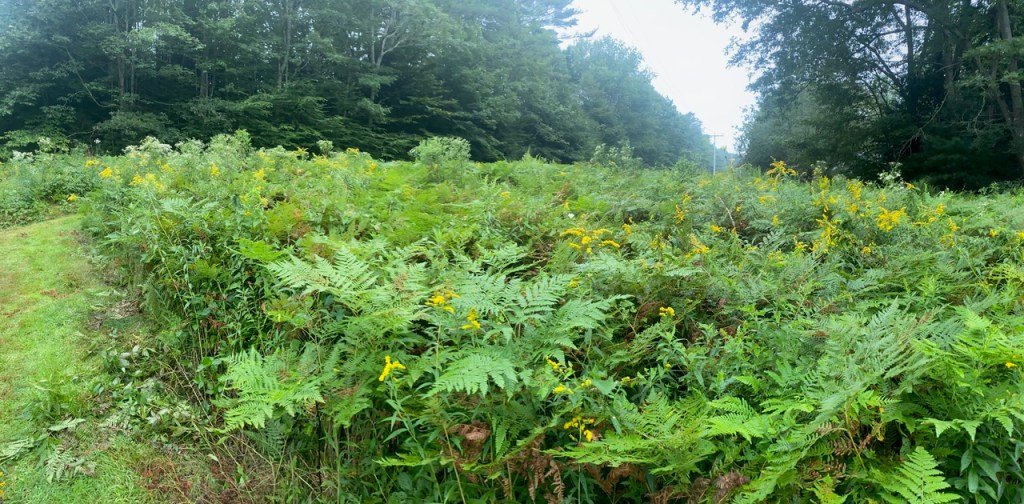
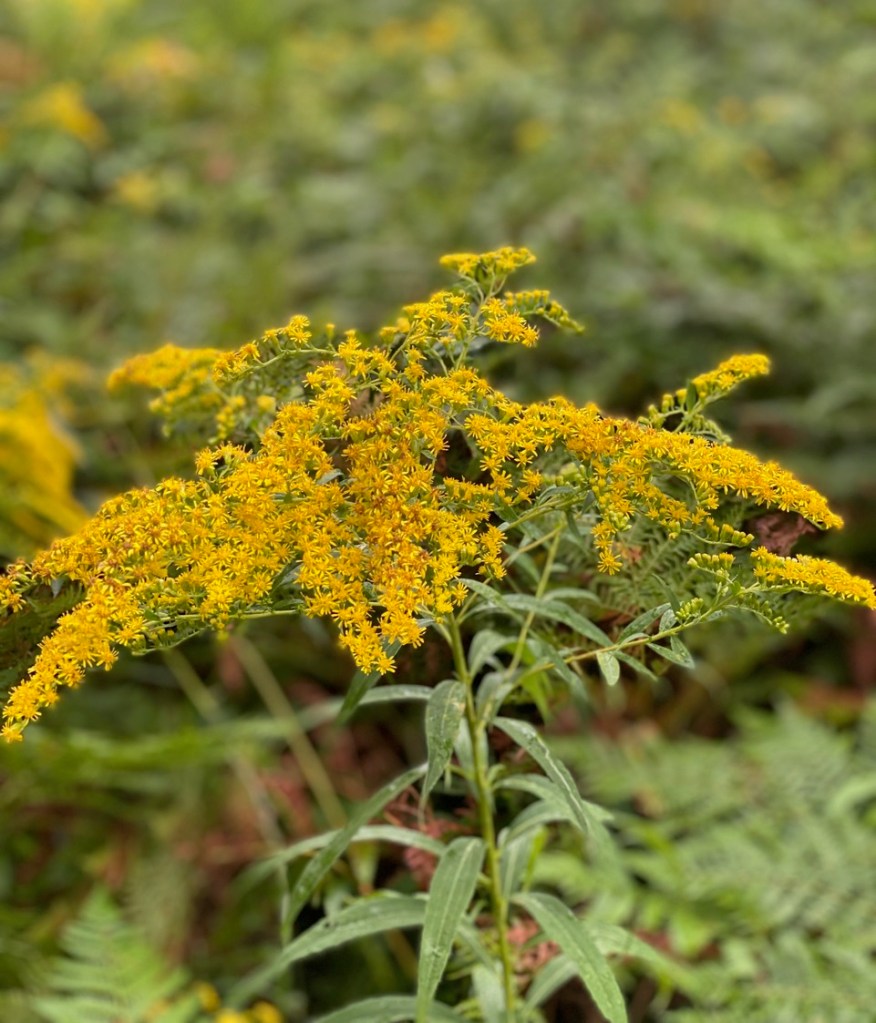
I’m walking the grass loop around our housing development. Under the power line toward the community garden, I pass through what is now a shoulder-high host of Queen Anne’s Lace, golden rod, milk weed, bracken, and many other plants I can’t name. The flies swarm. The sweet songs of the cardinals and tufted titmouses (titmice?) have given way to the screeching of blue jays and crows. Monarch butterflies flit from flower to flower. The air smells ripe. Shadows crawl like the incoming tide over the landscape. Summer is ending.

And I feel myself coming alive. Beginning again.

The reason is simple. For seventy-five years—as a student, as a teacher—the golden rod, the lengthening shadows, the Monarchs, have meant the beginning of another school year. More than New Year’s Eve, more than the first warm day of the year, this is the time when, at some deep cellular level, I can feel myself waking up, ready to start anew.

It’s a good feeling. At my age, it’s easier to focus on endings than beginnings. I now celebrate—if that’s the right word—more birthdays of the dead than of the living: my grandparents, my parents, my daughter, my first wife, close friends. Ended are my long hikes, long distant driving, lifting anything over forty pounds, staying up after midnight, jumping into bed with my wife after a sexy movie (jumping anywhere, for that matter), five-course meals, Cuban cigars, Laphroaig Scotch… the list grows longer each year.

But as T.S. Eliot wrote, “In the end is my beginning.” (Hey, I’m an old English lit teacher, I remember stuff like that.) You can’t begin something until something else ends. School can’t start until summer ends (Yeah, I know, there’s summer school, but I’m trying to make an analogy. Don’t confuse me with technicalities.) It took the end of a disastrous year of studying forestry in college for me to begin my studies in English (which is why I’m quoting T.S. Eliot and not The Journal of Forestry.) It took the end of an unhappy 20-year marriage for me to begin a happy going-on-forty-year one. It took the end of a career in public education for me to go back to school for an MFA, write a couple of books, a bunch of essays, and going on nine years’ worth of blog posts.

So, what will I begin this year? Well, Mary Lee and I have a couple of trips planned (knock on wood: last year, we had three planned and they were all canceled). I will scrape and repaint my front door and clean out the garage. 

But the biggest change I want to make is with The Geriatric Pilgrim

When I began these blogs, I was fascinated by the idea of pilgrimage: how a pilgrimage differs from a vacation, or from going on a retreat, or from study programs (what I called “edu-cations”). Besides traveling to retreat houses and other spiritual sites in the United States, Canada, the British Isles, Israel, Turkey, and Africa, I collected pages of definitions of pilgrimage and of common characteristics of pilgrimages. I read a raft of books about various pilgrimages people had made.

Along the way, I became intrigued by my fascination with pilgrims and pilgrimages. What was in it for me?

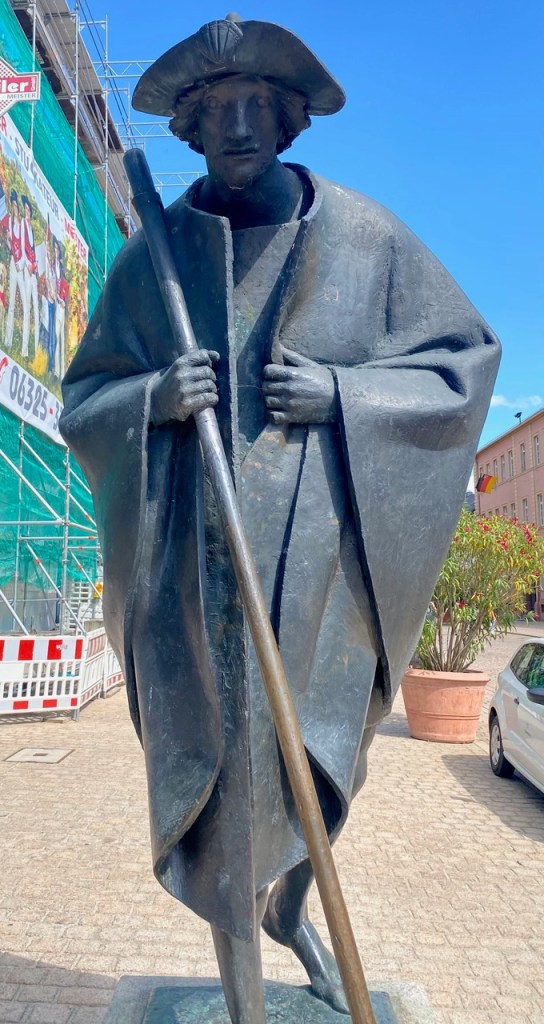
Stature of a “Jakobspilger,” or St. James’s pilgrim: Speyer, Germany

Well, probably the main thing at the time was the idea that pilgrims are often searching for a source of healing. As you know if you’ve read these blogs, I was looking for healing after the death of my eighteen-year-old daughter from a rare cancer. And I found writing about the various pilgrimages Mary Lee and I had made even more healing than the pilgrimages themselves.

Gradually, I began to realize that pilgrimage is a frame of mind—an attitude of curiosity, detachment, wonder. It’s “traveling light,” as one writer says, of risk, of living in liminal space—leaving one location but not yet arriving at another—of exploration, the end of which, to quote T.S. Eliot again, “Will be to arrive where we started/And know the place for the first time.”

Since COVID arrived, with all its restrictions on travel, followed by my 80th birthday, with its expanded waistline and diminished abilities, my blogs have focused more on applying the lessons of pilgrimage to my current life of walks in the neighboring woods, planting peas, tomatoes, and pumpkins in our community garden, and of exploring the twelve steps of my Al Anon program. This, too, has been healing.

 But now I find myself no longer as interested in finding new ways to describe my pilgrimage, as I am in describing and exploring in more depth the landscape through which I’m traveling, a landscape that is always changing, sometimes in ways that please me—autumn color is just around the corner, the grandchildren are growing—sometimes in ways that piss me off or frighten me—the start of my favorite woods walk has been clear-cut, I’m finding it difficult to sing without coughing.

Writing about these joys and sorrows, I find I’m writing more poetry. I’ve just finished an on-line workshop for poets, and one of the highlights of my week is another on-line group of poets from all over the country, where we share our favorite poetry as well as poems we’ve written. I’m now subjecting my longtime writing group here in town to my poems.

So, I’m going to be posting more poetry here in these blogs as well as other experiments—prose poems, flash fiction and nonfiction—trying to look more closely at the physical and emotional landscapes through which I’m now traveling.

The way I see it, my pilgrimage continues, but the lens through which I’m seeing it and the voice in which I’m describing it is changing.

I’m excited to see where this journey will take me. 

And hoping you’ll continue to join me.

So, let part of my life end, and another begin.

As Quakers say, when one door closes another opens.

For all my losses, I’ve also had wins;

let part of my life end and another begin.

Sure, it’s tempting to focus on what has been,

but I don’t want only to go through the motions.

Let part of my life end and another begin,

as one door closes and another opens.

# #

Another G… D…. Learning Experience

Henry Fonda as Norman Thayer lost in the woods behind his house.

#

It started when I left my phone behind. 

I’ve always known that my phone provides many of the same comforts cigarettes used to. My phone fits easily into my pocket so it’s handy. It gives me something to do with my hands if I’m nervous or bored. If I’m waiting for someone, I can check on how the Red Sox did, or when I need to use a bathroom, I can do something besides look out the window, assuming there is a window, and if there isn’t, I don’t care because I’m checking my email on my phone. 

But until now I’ve never realized how, like cigarettes, psychologically addictive a phone can be. All that weekend, I felt tense, anxious.

Now, the reason I suffered for an entire weekend was that Mary Lee and I spent it in Vermont celebrating my sister-in-law Anne’s birthday. I couldn’t very well say, “I left my phone in our bedroom. Would you excuse me while I drive four hours back home so I can see how many ‘likes’ my last post got on Facebook?”

And for those of you who don’t live in New England, the reason it takes four hours to go 160 miles, as the crow flies, from Maine to Vermont is that you can’t go by crow. The most direct route cuts through western Maine and central New Hampshire—a narrow two-lane road through small towns and past lakes and cabins and antique shops and combination hardware stores/greenhouses/ice cream parlors—and takes two hours longer than the quickest route which is to first drive south for 85 miles then west for 31 miles, then north for 69 miles, then west again until you get lost. 

 And you will get lost, because while the first 185 miles are doable if your car has a GPS and you follow the signs, once you get to Vermont, you’re driving through small towns and along one lane dirt roads through mountains that baffle even the best GPS systems. At least, you do if you want to get to my sister-in-law’s place.

View from Anne’s porch.

But although I left my phone behind and got lost for a bit that weekend, I remained reasonably calm. It was a nice day and Vermont was beautiful. As I often do (hence these blogs) I tried to think of the trip as a pilgrimage, this one honoring my past. I lived in Vermont for four years and my first teaching job was actually in the town just down the mountain from Anne’s. The wide, shallow streams paralleling the roads, the cow pastures under the green hills, the sweeping vistas were worth dead ending in a driveway. Especially when the nice lady there gave us directions to Anne’s, saying, “You couldn’t follow the damn GPS even if it worked… not unless you have a Humvee and a chainsaw.”

Still, while we had a lovely weekend celebrating my sister-in-law’s birthday, the anxiety of smart phone withdrawal grew. It was like I wasn’t me anymore—a feeling that metastasized when I tried show Mary Lee the first apartment I ever lived in. It was as if someone had moved the street to a completely different part of town. 

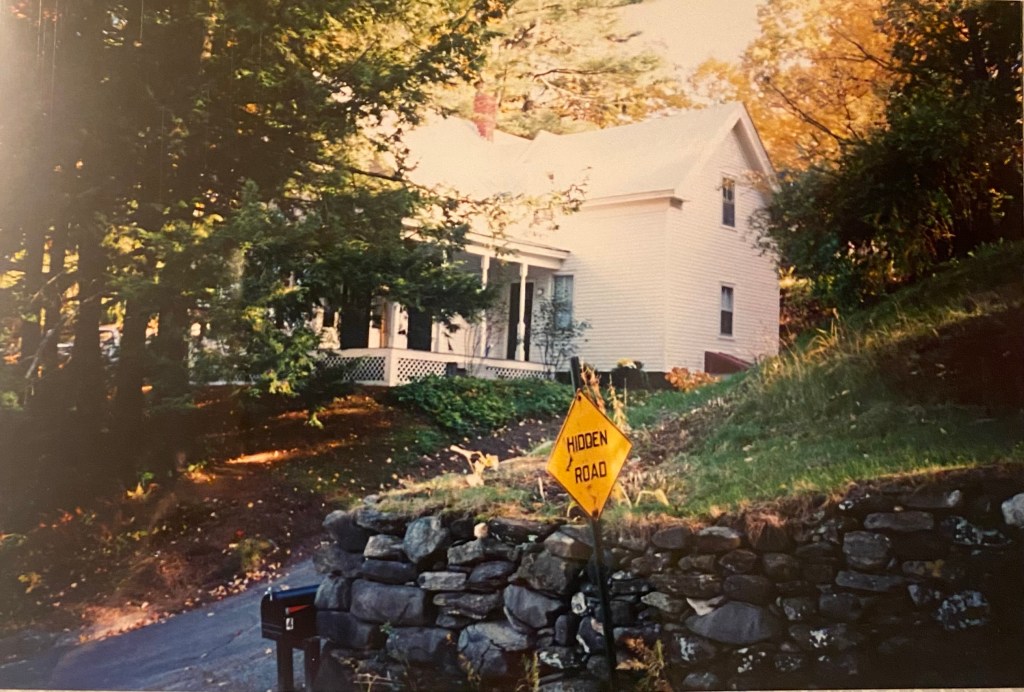
It certainly was hidden. (I lived on the second floor.)

By the time we headed back to Maine, I was feeling unhinged and uncertain. To regain my manly sense of mastery (at least that’s the only reason I can think of) I decided I didn’t need any help from any GPS getting from Anne’s to the paved road to the interstate to the Maine Turnpike to home, thank you very much.

Setting the car radio on “50’s Gold,” I drove south on the interstate, missing the exit for New Hampshire and Maine, and continuing for another ten miles before I turned around and headed north. After an hour of ignoring Mary Lee’s suggestion that it might be time to find out where we were, I pulled off the interstate and plugged our home address into the GPS, which informed us that we were almost fifty miles north of where we should be. Surrendering to that damn voice (which I swear was snickering)— “In one half-mile, prepare to turn left… turn left in 100 yards…turn left”—we eventually came to that cow path I talked about earlier through New Hampshire and Maine, the one that got us home two hours later than we would have if I’d used the GPS the way I should have. By that time, my hands were shaking, my stomach was in knots, and my head was pounding. Even the familiar roads near home looked strange and forbidding. 

At one point on that interminable drive home, we drove by Squam Lake, where the movie On Golden Pond was filmed, and since then, I’ve been thinking about Henry Fonda’s 80-year-old character getting lost picking strawberries in a place he’d been going to for years, stumbling through the forest, become more and more disoriented, more and more frightened. 

And I ask myself: Is that who I’m becoming?

I’m trying not to panic. I tell myself that as I’ve become 80, I’ve been focused on my physical diminishments, and maybe God of my not Understanding is telling me it’s time to prepare for the mental changes ahead—that I should think of that weekend as—to use a 12-step term—another “Goddamned learning experience.”

I’ve just read David Shields’s book, The Thing About Life is That One Day You’ll Be Dead. Normal geriatrics, he says, don’t have poorer memories, but it does take us longer to retrieve those memories. We’re more susceptible to distractions, have trouble coordinating multiple tasks, and suffer decreased attention spans. In simple duties and common situations, we’re fine, but when stress is added (loss of a smart phone, for example) we often struggle. “Perhaps,” Shields writes, “this is why some older people, finding it harder to cope, tend to start searching for comfort rather than excitement.”

I’m tempted, but I’m not ready. Instead, I’m going to send my ego to the store for a quart of milk and do what Mary Lee does and make a checklist for when I travel: 

Underwear?    Check. 

Pills?               Check.

Phone?            Check. 

And at the top of the list, I’m going to write: 

Don’t assume you know where you’re going. 

Ask for help.

Actually, that sounds like pretty good advice for any pilgrimage.

# #

Physical Therapies

PT After Heart Surgery

#

A few weeks ago, after seeing a doctor about increased soreness in her knee, my wife Mary Lee began a new regimen of physical therapy: quad stretches, hamstring stretches, mini squats, wall sits, looped elastic band hip extensions. These to go with exercises she’s been doing for years to restore movement to her right shoulder. (I like the one where her hands look like frightened spiders scampering up the wall, and another one where she uses a can of Great Northern beans.)

Because I’ve been doing various daily exercises since back surgery in 1977, mornings at the Wile residence resound with creaking bones, tendons rubbing on cartilage, occasional grunts punctuated by yawns and a “meow” or two from our cat, who has taken on the role of personal trainer.

“Faster! Move it, move it!”

Our bedroom looks a bit like Rick’s Sporting Goods, with two sizes of exercise mats, two sizes of weights (in addition to the can of beans), rubber stretch bands, and folding chairs. A treadmill resides in the guest bedroom across the hall. 

Physical therapy after my back fusion was deceptively simple: walk ten miles a day for three months. Every day. Sun, rain, snow, sleet, hail. And since I was operated on at the end of December, I walked through it all. Sometimes in the same day. But you know, I grew to love those walks (Well, Route One got a little boring but at least it was clear after a snowstorm), and I kept walking—maybe not ten miles every day, but often five or six. 

Twenty years later, after bi-lateral hip surgery, my physical therapy involved water exercises; walking back and forth for 30-45 minutes in the shallow end of a pool, pool dumb bells, and gloves that made me look and feel like Aqua-Man. But it worked. On a trip to Florida to visit my parents over school vacation, two months after the surgery, Mary Lee pushed me through Newark Airport in a wheelchair to get to our connecting flight. On our return a week later, after spending most of my time walking the swimming pool, I strode through the same airport feeling like Hercules Unchained. 

That led to yoga, tai-chi, back to walking, this time with my hiking poles that I named Waldo & Henry (To learn why, go to https://geriatricpilgrim.com/2020/02/07/waldo-and-henry/), which led to the hikes and pilgrimages that became the blog you’re reading.

Flash ahead another twenty years: open heart surgery, and more physical therapy at a rehabilitation center, where three times a week for six weeks, I taped on my heart monitor, rode a stationary bike, walked a treadmill, and lifted weights. When the program ended, I bought the treadmill that sits in the guest bedroom (great for watching TED talks, but I still miss those cute nurses at ReHab) and the weights that I use instead of cans of Great Northern Beans.

I don’t do the Kettlebell Squat Swings

But I’m falling apart more quickly these days. Over the last two years I’ve added breathing exercises to help my “moderate” COPD, more stretches to help with the bursitis that seems to have camped out next to both my bionic hips, daily exercises at the computer to ward off Carpel Tunnel and something called Ulna Nerve Entrapment, and weekly sessions with a Feldenkrais instructor.

As Thomas Jefferson said, the price of freedom is eternal vigilance. Or in the words of my old PCP, move it or lose it.

#

Before Mary Lee and I begin our morning grunting, stretching, creaking, and moaning, we sit in contemplative prayer for twenty minutes, a practice I’ve maintained since my daughter died 35 years ago, when, after raging at God for several years, I decided I needed to listen to what God had to say back. This listening—with my whole body, with all my senses—is what I continue to try to do. As I think about it, this, too, is a kind of physical therapy. 

Starting the day

I’m reading a lot these days about quantum physics and spirituality. As I understand it, quantum physics posits that the universe is conscious, if by “conscious,” one means a system that can communicate or process information and then use this information to organize itself (which is what all those protons, neutrons, and electrons that make up the atoms that make up all matter do). So, mind and body aren’t two separate things but rather two aspects of the same cosmic material. 

Modern writers about spirituality, such as Richard Rohr, Diana Butler Bass, Phillip Clayton, and Ilia Delio, seem to me to propose that this cosmic material, this “consciousness” that resides within me as well as around me, is the incarnational presence of God. So that in meditation, I am trying, as I am when I do my stretches and lift my weights, to reestablish pathways, strengthen relationship with what 12-steppers call a Higher Power. 

Besides meditation, I do other exercises to strengthen my spiritual muscles. My Feldenkrais sessions, focusing on integrating eyes, head, shoulders, ribs, pelvis, legs, and feet to facilitate ease of movement, remind me that one of the great spiritual lessons is that everything is connected. And that my job—my “exercise,” if you will—is to recognize and facilitate these connections.(And for more about the importance of connecting, go to https://geriatricpilgrim.com/2024/02/01/connecting-the-dots/)

One of my character defects that keeps me from connecting is trying to control everything and everybody. So, at the suggestion of my Al Anon sponsor, I’ve been taking Waldo and Henry for walks without having a destination. When I first started doing this, I felt lost. I walked in circles. But as I persisted, I discovered roads in the neighborhood and paths in the woods I’d never noticed before. Which is leading me to try to approach other activities, such as meetings, book readings, and potential confrontations with family and acquaintances with the same curiosity, trying to surrender presumptions, looking for the sacred in situations I’ve always avoided and spiritual teachers in people I’ve always disliked.

Probably more than anything else, it’s the physical act of writing which connects me with the Sacred. The only way I can even begin to understand concepts such as quantum physics and the ideas of those spiritual writers I’ve mentioned is to first put the ideas down in my own words on a yellow legal pad with my bold-ink pen. I can write second/ third/ fourth/ ad infinitum drafts of my blogs on a computer. I can edit on a computer. But first I need to work those pen and paper muscles.

Of course, the ultimate integration of mind and body (and what I’ve been working my pen and paper muscles on for the last eight-plus years) is the pilgrimage. Last week, a friend sent me a recent article in The Guardian about the increasing numbers of people making pilgrimages. (In the early 1980s, for example, the number of people who walked the Camino de Santiago—the most famous of all pilgrimages—was in the low hundreds; last year, the number was 446,000.) I’m delighted that people are finding that this combination of physical and spiritual activity can be healthy, healing, and holy.

It sure is for me.

In a California red wood forest

# #

Our Rite of Hope for January 7, 2021

#

“…. by participating in a ritual, … [y]our consciousness is being re-minded of the wisdom of your own life. —Joseph Campbell

#

Yesterday we celebrated Epiphany,

When wise men worshipped the Christ child. 

& recalled the goons in MAGA caps who trashed the nation’s capital.

Still rattled today, we observe our annual ritual:

  We play The Christmas Revels 

                                                            Wassail, wassail, all over the town

  We strip the tree of 

   Ornaments:

     From pilgrimages—

                 2 wooden sheep from Scotland 

          (my ancestors died for Bonnie Prince Charlie)

                          2 olive wood crusaders’ crosses from Jerusalem

                                    (Christians & Muslims slaughtered each other for centuries)

                          1 porcelain nazar from Istanbul

                                    (protection against evil)                      

Here come I, old Father Christmas

             From childhood—

                          1 wooden and tin mesh angel from the turn of the 20th Century

(2 world wars, 2 flu epidemics, the Depression, Korea, Viet Nam, 3 assassinations, Watergate, 9-11, yesterday)


        1 plastic Santa from WWII                             

           (Dad in Belgium building bridges for tanks)

The boar’s head in hand have I

3 shiny ornaments my parents bought with green stamps 

                                    (To brighten memories of their broken childhoods)

                                                                                                There was a pig went out to dig

                                                                                                Christ-i-mas day, Christ-i-mas day  

            From children & grandchildren—

                        4 yarn & toothpick God’s-eyes

                        1 fuse-bead heart, 1 fuse-bead cat, 1 fuse-bead turtle, 

                        2 black felt cats honoring my step-son’s first pets

                        1 brown fur diarrhea microbe 

(from my daughter-in-law who helps impoverished countries improve water quality)

                        1 embroidered-flower ornament from my 16-year-old daughter

                                    (2 years before she died from cancer)

                                                                                                            The holly and the ivy…

     Lights:

            3 strings of red  blue  green  orange  bulbs

                        (The big painted ones long gone, but at least these aren’t white)                              

            1 yellow star

                        (“For we observed his star at its rising, and have come to pay him homage.”)

Dance, then, wherever you may be

                                                                                                I am the Lord of the Dance, said he.

So, we dance

between

Christianity & paganism

Past & present

Light & dark

Death & life

Sorrow & joy

Arms clinging to our rite of hope.

# #