Looking for What’s New

#

Besides dealing with a decaying body and a deteriorating mind, one of my biggest challenges these days is to keep from living in the past. (And I’m sure the two struggles are connected: of course, I want to recall when I could leap tall buildings in a single bound.) It’s so tempting to spend my days reminiscing with old classmates via email or Facebook, watching “American Bandstand” on YouTube, and replaying 65-year-old high school basketball games.

This last month has been especially challenging. May began at the history center in the town in which I grew up with a program that my oldest friend (going back to the first grade) and I spent the winter planning: “Yarmouth [Maine, for those of you reading this in Singapore and elsewhere], 1955-1962: Times of Change.” We wound up with probably thirty people there who’d grown up in town during those years, bathing in the warm waters of nostalgia, as we talked to newer residents about how Yarmouth changed during that time from a low-income community of shops and small factories to a bedroom-by-the-sea for urban lawyers, doctors, and bankers. A town we kids roamed at will because everyone looked after us—where the local telephone operator would call my classmate Barbara’s house at 3:30 in the afternoon (because she knew Barbara got out of school at 2:30 and would stop at the drug store for a coke, so that’s when she’d get home) to tell Barbara that her mother would be late and that she should turn the oven on 350° and put the roast in at 4:00. (Who needed cell phones?)

Later in the month, as my brother and sister and I cleaned off stones and planted impatiens in our family cemetery plot for Memorial Day, we swapped memories of Mom and Dad and our grandparents. (Amazing how different our recollections are!) Later that week, I went with my wife, Mary Lee, to her 55th college reunion, and for three days listened to other people’s stories about their pasts. Throw in a dream in which I ran into my ex-wife—who died eight years ago—dressed in a white karate gi (still trying to work out the symbolism there), and I’m starting to sink beneath these waves of nostalgia.

I need to get out and open my eyes. Stop looking at what’s behind me and start looking at what’s around me—what’s new. I decide to check out this year’s garden. Besides, I need to put in my tomato seedlings.

It’s a beautiful June morning and the world is new. The apple blossoms and rhododendrons are in full bloom, the air smells of lilacs, and the breeze is fresh. The world is spring green: the grass hasn’t yellowed, the leaves aren’t chewed, and the caterpillars haven’t yet built their ugly tents in the trees.

I put my seedlings and watering can and trowel in the car, drive up and park on the power line road between our community garden (which I wrote about a few years ago: https://geriatricpilgrim.com/?s=Up+to+the+Gahden) and a wooded swamp, home to all kinds of birds, many of whom are singing their ever-loving hearts out.

I had no idea how many birds there are here until I got one of those apps this year for my phone that identifies birds by their songs. So, I check it: cardinal—yes, I know their pulsating whistles; song sparrow—makes sense, I see all kinds of them; gold finch and chickadee—ditto. But what’s a great crested fly-catcher? And a red-eyed vireo? They’re new, at least to me. Cool. 

Turning to the garden, I think of the beginning of baseball season, when, no matter how poor a team’s prospects, there’s always hope for a championship year. 

This year, I’ve got three raised beds, and—God willing; I haven’t planted it yet—a small pumpkin patch. The garlic I put in last fall is up, as are the peas which I planted on May 1st. I decided this year to stake them with some of the branches that came down from last winter’s storms—the first time I’ve ever tried that, and it seems to be working: the peas are grabbing the branches with gusto. In another bed, I’ve got the usual two kale plants which will hold us until November, but for the first time, I’m trying a couple of eggplants and a purple pepper to see what happens. I’ve also planted bush beans for the first time in years. (Mainly because last year, I almost killed myself stringing pole beans, and vowed never again.)

 I wave to Karen down the way who’s working on her bee garden. She’s also building a new compost bin, for which I need to thank her. 

But first, let’s get those tomato seedlings in. 

The sun is warm. I take off my outer shirt and begin raking the bed where I’m going to transplant my tomatoes. I love the smell of the fresh dirt (apparently, it triggers the release of serotonin in the brain—at least that’s what I read somewhere) which makes me want to sing. And because the other night I watched a music documentary on Paul Simon, I serenade the birds with “50 Ways to Leave your Lover”—

            You just slip out the back, Jack

  Make a new plan, Stan

            You don’t need to be coy, Roy

            Just get yourself free—

The really neat thing about the documentary was it focused on Simon’s newest album of songs, many, if not all of them, as I recall, coming to him in a dream. And if at the age of what, 83?, he can still be creating new work, even though I guess he’s now deaf in one ear, then I, at 81, can, too, despite my various diminishments.

I dig six holes and put a little of Karen’s compost in each one. I find myself slipping again into the past: the summers in high school I used to work in a garden and the big garden I had during my first marriage. Cut it out! I think, and then decide, No, let’s use those memories as compost, fertilizer to help me grow.

Which would be more inspiring if my back didn’t already hurt from this minimal exercise. From my other garden bed, I grab my new kneeler and bench combination, which I bought this spring, and kneel on it to put the tomato seedlings into the dirt and the compost, which gets my hands dirty and the rest of me feeling clean. Then, I put collars that I’ve made from plastic medicine cups around the seedlings to protect them from cutworms, and, using the metal arms of the bench to get myself off my knees, rise to get my tomato cages from last year. Finally, I give my little darlings a drink to get them on their merry way.

Feeling accomplished, I sit down on the new iron bench with the “Welcome” sign that someone—probably Doug, who, along with Karen oversees our community garden—has donated. I think about how I still rely on community as much as I did when I was a kid all those centuries ago. 

Looking up, I follow an exhaust vapor trail in the blue sky until I see the sun flash on a plane, high in the sky, probably starting its descent into Boston. I imagine flying to new countries and seeing new vistas and new people.

But right now, right here, there are plenty of new things going on, thank you very much.

# #

Stick Season

#

As New Englanders know, each year has six seasons: the usual spring, summer, autumn, winter, plus mud season—between winter and spring—and stick season—between autumn and winter.

I’ve written about mud season before (https://geriatricpilgrim.com/2019/03/). Now it’s time to talk about stick season. 

You know about our autumns and winters. These are the seasons in all those lovely photographs of New England. You know, the flaming foliage ones, mountains ablaze in orange, yellow, and red, and the snowy ones, white trees bowing as skiers whiz past. But in between—usually it’s the entire month of November but it could be December as well—the leaves have left, the snow hasn’t arrived, and the trees become stick figures. “Bare ruin’d choirs, where late the sweet birds sang,” to quote Mr. Shakespeare.

Stick season has been getting a lot of press these days, thanks to a young singer named Noah Kahan, whose song “Stick Season” about the pain of lost love—“And I love Vermont, but it’s the season of the sticks/ And I saw your mom, she forgot that I existed…”—was a viral hit in 2022. (And as synchronicity would have it, as I was planning this blog, he sang it on Saturday Night Live, December 2nd. Check it out on YouTube.)

For years, Shakespeare and Kahan described the way I felt about this time of year. As readers of this blog and my book, The Geriatric Pilgrim: Tales from the Journey, know, my daughter Laurie entered Eastern Maine Medical Center in November of 1988 and died there on December 23rd. For those two months, I lived at a Ronald McDonald house about a mile away and walked back and forth to the hospital twice a day along the Penobscot River, where the skeletal maples, elms, birches, and oaks mocked any hope for Laurie’s recovery.

Over the next 30 years, each stick season was the backdrop for my anger, sorrow, withdrawal, guilt, and shame, exacerbated by a holiday season, which now starts about November 1, with its Hallmark images of healthy happy families gathered round a perfectly shaped Christmas tree. Throw in the Christian season of Advent—four weeks of paradoxical readings about Christ the child and Christ the judge, sin and grace, justice and mercy, comfort and challenge—and I came to dread this time of year.

But about five years ago, thanks to my Al Anon program, I was able to separate my shame, guilt, and anger from my grief. I saw that because of growing up in a family riddled with alcoholism, those noxious emotions were there long before Laurie died. And I realized that I didn’t have to hang on to them to grieve the sorrow and emptiness that one must accept when they lose a loved one. That I could feel sad without feeling angry. 

At the same time—and I’m sure it was no coincidence—as I walked the woods behind our house, I began to appreciate the stark beauty of stick season. Without all the foliage, the sky is larger, and sometimes it’s a November blue unlike at any other time of the year. The wind is bracing. The flies are gone. Unlike in mud season, the paths are still dry. Even the sticks themselves—the tree branches—have a stark beauty, like Japanese calligraphy. 

 I started to see the departed leaves as images of my departing shame, guilt, and anger.

Which helped me see Advent as a time for letting the spirit blow away what the Bible often calls our “iniquities,” but what I think of as my “survival mechanisms”: those behaviors I developed as a kid to survive family disfunction, but which have become injurious not only to my health but to those around me. 

These days I think of stick season as a time to simplify my life. Which has been especially easy this year. After 37 years of hosting a Thanksgiving for anywhere from ten to 24 people, Mary Lee and I turned over the apron to her younger son, who, along with his fiancé, did a fantastic job feeding and making us all feel comfortable.

Last week, Mary Lee retired after 22 years as the ordained Deacon at our Episcopal Church. For 22 years, churchy stuff has filled not only our Sundays, but other days of the week, as I have also been an active member of St. Paul’s. Now, as is our diocesan policy, we will worship elsewhere for a while. We will listen for other callings to where—as Aristotle said—the needs of the world and our talents cross.

Sadly, but I guess appropriately, our cat Zeke has used up his 9th life (I didn’t think he’d make it to 2023), leaving our house pet-less for the first time in our marriage.

I have given up driving 30 miles once a week to play in my old-time music jams. Mary Lee and I have decided we no longer enjoy going out for dinner once a week.

So, I suppose, I am in the stick season of my life. If so, it’s not bad. 

Let’s talk about Advent again. One thing I’ve always had trouble with is this idea that not only are we awaiting the celebration of the birth of Jesus, but we are supposed to be awaiting the Second Coming of Christ, when, according to some scripture passages, Christ will come to judge us and send some of us to hell and some of us to heaven. 

Sorry, I can’t buy the judgment thing. My experience is that I’m surrounded by Grace, if I can just (“just’? Ha!) open my eyes to it. So that when Jesus tells his disciples to “Keep awake!”—which he does a lot—I think he’s talking about opening our eyes to what’s already there, not what’s going to suddenly appear descending from a cloud.

Sort of like seeing the sky that’s always there, but only fully visible during stick season. 

(Or the water, for that matter)

So, for me, the Second Coming is an invitation to awaken into a new consciousness, a new appreciation, a new seeing, of life, the universe, and everything.

I watched a YouTube interview with Noah Kahan, in which he said that his hit song  represented a new musical path for him. And as blogger Mitch Teemley wrote recently about Advent, the word serves as the root of our word “adventure,” which, of course, I like because that makes me think of “pilgrimage.” “In short,” as Mitch wrote about Advent and I would write about pilgrimage,  it is “an experience that can change a person forever. If they let it.”

I’m going to stick with that for a Wile.

# #

Storm Stories

Hurricane Carol: 1954. Northeast Historical Film

#

Recently, Hurricane Lee, at one point a Category 5 hurricane, churned up the Atlantic coast, bringing with it dire warnings such as, “Lee Drives Towards Us with a Hugh Wind Field, Damaging Waves, and Flooding.” The Episcopal Church of Maine’s website offered a prayer, which began: “Creator God, we ask you to calm the wind and the waves of the approaching hurricane and spare those in its path from harm.”

I put away lawn chairs, harvested basil, tomatoes, and beans from my garden, and checked to see that our flashlights all had new batteries and the lamps had oil. I cleaned out the garage, so that I could get my car out of the way of falling branches.

Well, the trees did some jitterbugging in the wind to the rhythm of our wind chimes, and our lawn had a smattering of small branches. My Zoom meeting with an Al-Anon sponsee on the coast ended early when his power went out, and my bean pole in the garden blew over, but all in all, the effects of the storm were minimal. A few years from now—if I’m still alive—I doubt if I’ll tell many stories about Hurricane Lee.

Hurricane Lee: 2023

There are other hurricanes, other storms, however, whose stories have stayed with me.

In 1954, Hurricane Carol, the first Category 5 hurricane to hit New England, roared through Maine, followed ten days later, by Hurricane Edna. A little research tells me that the two storms caused 25 million dollars in damages and destroyed 3500 cars and 3000 boats. What I remember was that at 11 years old, I thought hurricanes were neat. The thundering river down the hill mingled with the roar of the wind, and our house shook like some carnival ride. I couldn’t understand why my father was chain-smoking and pacing back and forth in front of the living room window, muttering, “I hope that goddamned tree doesn’t fall on us.” The day after Hurricane Carol, my friends and I walked through town, gaping at the elm trees that had blown over, amazed at the size of their roots, which rose several feet over our heads.

The next hurricane to hit Maine was Gloria, in September 1985. According to Wikipedia, this storm affected six counties in Maine, with multiple injuries, downed trees, and 250,000 people without power, some for up to fourteen days. I was living Down East at the time. Less than a month earlier, my first wife and I had separated, and the day after the storm I got up early to drive my daughter Laurie to church camp for the weekend. After dropping Laurie off, I continued on to visit my mother and father. When I pulled into the driveway, I saw Dad standing in strewn leaves and fallen branches, trying to fry bacon and eggs on a charcoal grill. My Grandmother Cleaves, who’d come over from her apartment for a hot breakfast, stood at the window.

What I recall even more clearly now was that my father, Laurie, and Nanny Cleaves all died within the next four years. Throw in a divorce and a second marriage, and I experienced an emotional hurricane that made Gloria feel like a summer breeze.

In 1991, Hurricane Bob came to Maine. Three people died, many residents lost power, and there was over five million dollars in damages. Again, the storm’s direct effect on my new family and me was minimal, but because of the heavy rains and losing power, my Grandmother Kimball’s cellar flooded because her sump pump stopped working. At 92, living alone, she couldn’t cope with the responsibility of keeping the house up, so she sold it to me. Mary Lee and I lived in that house for the next 22 years. Then, after a spring rainstorm and another flooded cellar (something like the fifth one in those 22 years), we sold the house and moved to where we now live (which, thankfully, has no cellar).

Our cellar after the Patriots’ Day Storm of 2007

I think of other storms in my life—natural ones, such as the ice storm of 1998, various nor’easters leaving two feet of snow; emotional storms, such as my defeats and disappointments, a divorce, Laurie’s death—and I realize that I remember them far more clearly than I do the sunny days—beach days, vacations with family in Florida and Bermuda—or the happy times: the victories, the times I’ve been recognized or honored. I don’t know about you, but it’s the storms rather than the sunny days in my life that have become the stories of my earthly pilgrimage, those narratives that have helped me navigate my life, and which I continue to look back on and refer to as I forge on towards whatever denouement awaits me.

So, why that is that even after sixty years, I remember my defeats on the basketball court more than the victories? That I remember my divorce settlement more than my first marriage ceremony? Laurie’s death more than her birth?

Maybe one reason these storms stay with me is that I’ve survived them all. Storms help me feel good about myself, less afraid of the future. I can be “defeated but not destroyed,” as the great storyteller Ernest Hemingway said. I recall meeting a woman who knew of Laurie’s death and who’d just lost her son in a fire. Her first words to me—even before saying hello—were “Tell me how you’ve survived!” At the time, a guy I’d come to know from being in grief counseling together, had just committed suicide and I realized surviving Laurie’s death really was an accomplishment.

As I think of it, storms have not only made me aware of surviving, they’ve made me feel more alive. And I don’t think I’m alone in feeling this way. There’s nothing like a good nor’easter or hurricane to draw people to watch the ocean waves crashing over the rock-bound coast of Maine. After Laurie died, I found myself missing those last weeks of her life when I was living at a Ronald McDonald House, spending the days beside her. There was a focus to those days, a purpose, and the great themes of Life and Death dwarfed the usual minutia of everyday life.

Speaking of less fear and more focus, I’m interested in the number of people I know who suffer from anxiety and depression but who become fearless when forced to face specific physical dangers such as a high wind or a flood.

In a storm, I let go of the old stories I tell myself about who I am. I’m forced to come to terms with the fact that life as I knew it may never be the same. I plunge into a new adventure, a tale of unknowing, which can also be a story of spiritual re-birthing if I can only recognize and surrender to that power greater than myself.

Looking back at the storm stories in my life helps me realize that while I may want to shrink God down to my size, God is always bigger than I am, will always be God of my not Understanding.

And of course I have to include a snowstorm picture—this from 2013.

# #

Leaving “the Little Lightless Caverns”

#

I waste too much time in the little lightless caverns of my own mind.”

—Christian Wiman

#

            My first wife used to say to me, “Rick, you think too much.”

            It pains me to say it, but she was right. I can turn anything into a problem to be solved: what I want for breakfast, what clothes I want to wear for the day (I’m retired, for godssake, who cares what I wear?), where I want to go for a morning walk, whether I want to go first to the grocery store and then to the hardware store (well, the grocery store is closer and if I get delayed there, I can always wait until tomorrow to do the hardware store) or go first to the hardware story and then to the grocery store (but because the grocery store is closer, I need to get the refrigerated items home before they spoil).

            So that by lunchtime I’m tired out (and then do I want a nap or should I read?).

            Minor stuff, I know, but as I look back at my life, I see that overthinking has caused me and those around me serious problems. Part of the reason I almost flunked out of college was because I waffled about not only what career path to follow, but also whether I wanted to join a fraternity, ask Ginny out or Pat, hang out with jocks or artsy types, take a year off.

            In later years, I agonized over if I should get married, go to graduate school, take a college or a high school teaching job, join a church (what denomination?), join the Rotary, or tell my first wife I was unhappy in our marriage.

            After my daughter died, my mind became a prison. When all my efforts to understand why a previously healthy and happy 18-year-old should suddenly die from a rare cancer—radon in our water supply, McDonald’s cutting down rain forests, accident, fate, God wanting “another angel in heaven,”(all reasons people gave me)—failed, I decided I had to be the one to blame, either because Laurie’s mother and I divorced or because we didn’t divorce soon enough. For several years, the only relief I could find was through alcohol and anger, both of which threatened not only my life but the lives of those close to me.

            As I’ve written before in these blogs, I credit meditation with first helping me see the destructive nature of thoughts and to unload much of my anger and shame—give it to God, as one of my first mentors suggested.

But meditation can become its own “little lightless cavern,” as poet Christian Wiman calls his mind: a place to escape an argument or a fear or a resentment by retreating into old patterns of thinking. (What will I have for breakfast, what shall I wear today…)

            So, what else has helped?

            Seeing myself as the Geriatric Pilgrim has become more than a literary conceit. Looking at life as a pilgrimage has taught me to be curious, to look for surprises, to live without planning every single detail, to put myself in uncomfortable situations (even if it’s just going for a walk and having no destination or closing my eyes before grabbing a shirt to wear for the day). I’ve learned to embrace the unknown—including a Higher Power totally outside my understanding, and to look for evidence of that Higher Power—what I would call grace—all around me.

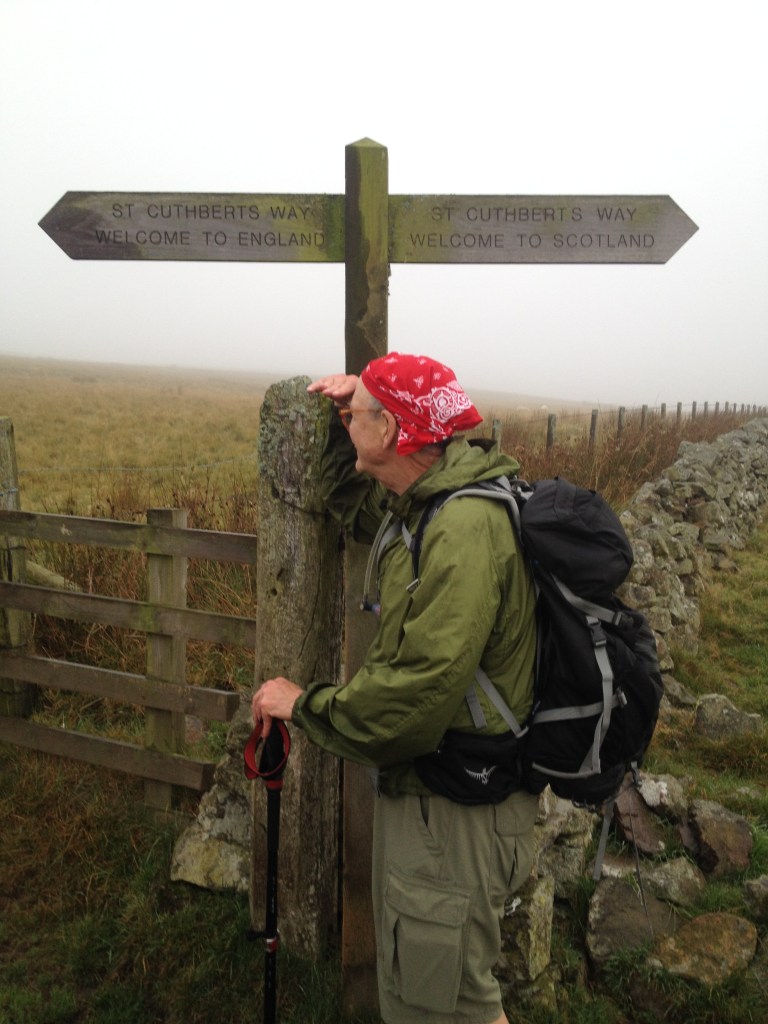
            A pilgrimage always involves some type of movement, whether it’s walking Saint Cuthbert’s Way or walking downtown. Despite having grown up playing sports, I’ve never paid more attention than I do these days to movement. Yes, regular exercise has long been known to improve and maintain key aspects of cognitive function such as attention, learning, and memory, but neuroscientist Daniel Wolpert posits that our brains evolved, not to think or feel, but to produce adaptable and complex movements. He points out that it’s a lot easier to create a computer that thinks than to create a computer which can move anything like we do. (If you’d like to learn more see https://www.ted.com/talks/daniel_wolpert_the_real_reason_for_brains.)

For the last year and a half, I’ve been practicing the Feldenkrais Method of exercise therapy, learning to reorganize connections between the brain and body, which has improved both the way I move and the way I think, helping me pay less attention to my mind and more attention to my heart and my gut—my instincts.

            The slogans of Al Anon, the 12-step program for families and friends of alcoholics, have become my roadmap on this pilgrimage out of the caverns of my mind. When I first started attending meetings and saw slogans set out on the floor, I thought, “God, how simplistic!” Another example of how thinking can mislead me. Try following a few of these slogans and see how simple they are. To give just one example, let’s look at “One Day at a Time.”

            What’s so hard about that? Well, for someone like me—and, I find, many people who’ve grown up in alcoholic families, who continually try to anticipate and resolve every problem they think they may encounter, attempting to make decisions on information they don’t have—it’s damn hard. Instead of responding to what’s in front of me, both the challenges and the gifts that come my way, I’m obsessing about all the possibilities (most of them bad) that might befall me, even though, looking back over the almost 80 years of my life, I can say that not once did any of this preparation spare me a single moment of pain. In fact, it just lengthened my suffering.

            Still, at my age, it’s hard for me not to think about—which in my case means understand, anticipant, awfulize—my death. It was helpful this week to hear a podcast in which Ariel Burger, protégé and friend of Holocaust survivor and Nobel Peace Prize recipient Elie Wiesel, talk about Wiesel’s teaching that there are no answers to life’s big questions, only responses.

            So, I’m trying to respond to these questions by breaking them into small daily tasks. Instead of trying to answer the question, how can my grandchildren survive in a world that seems to be hurtling toward destruction, I focus what I can do with them today. If I’m worried about the Supreme Court or the swelling in my jaw, what can I do about either one today? Call my senator? Pop into the walk-in clinic (which I did this weekend. It’s “an obstructed parotid gland”)? Then it’s time to go for a walk, pick up a banjo, write a poem or a blog. Get out of my head.

            In other words, as one of the AA’s oldest slogans puts it, “Move a muscle, change a thought.”

            And leave a little lightless cavern.

# #

Of Smells

fullsizeoutput_16e8

#

“Nothing revives the past so completely as a smell that was once associated with it.”

—Vladimir Nabokov

#

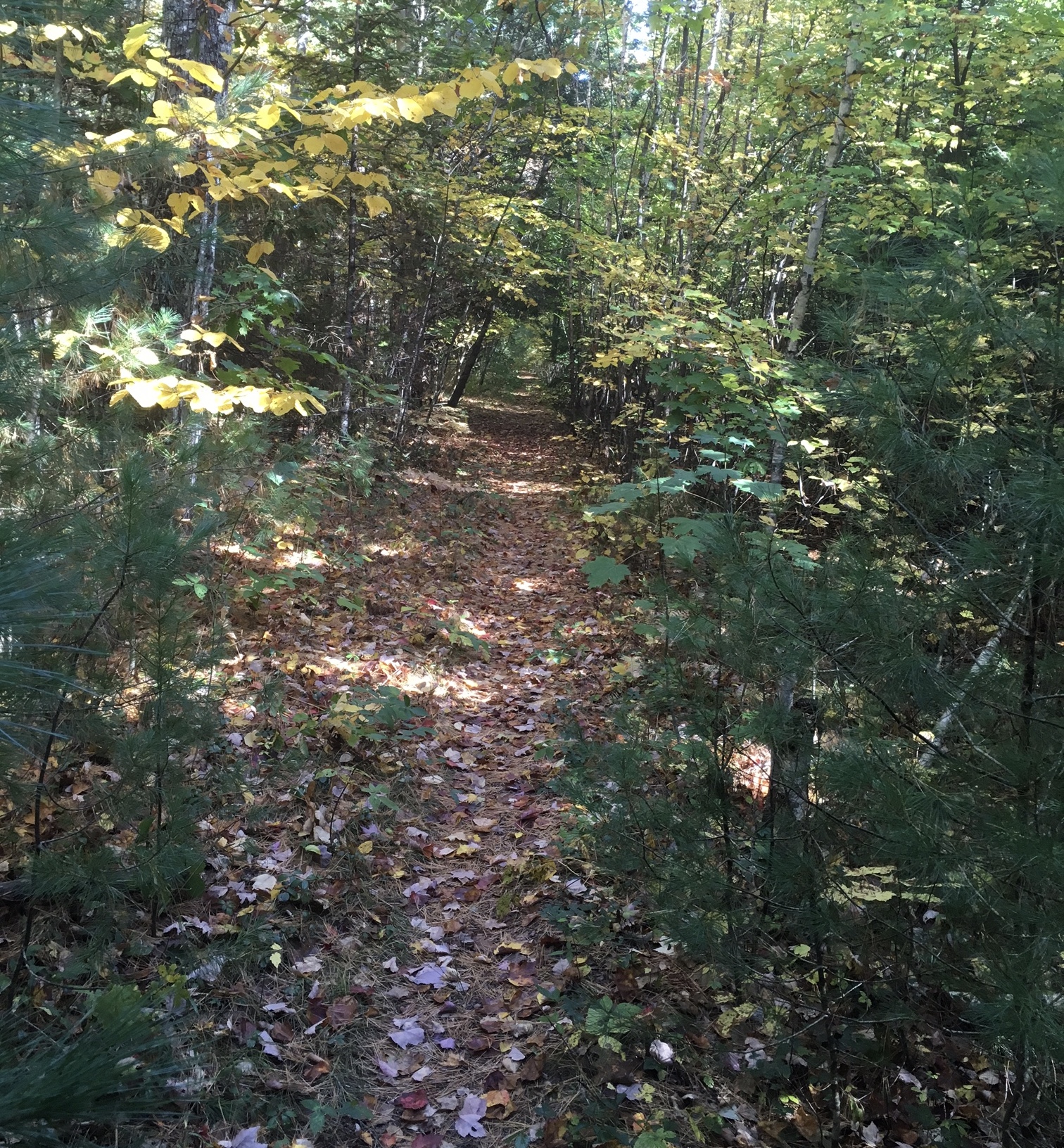
One of the joys of being 10 weeks past heart surgery is that I can resume daily walks, especially in the woods not far from where I live. And this is a great time of year for it. The leaves are beginning to turn, the air is drier, and the blackflies are gone. But I’m interested that the first thing I noticed when I entered woods after over two months were the smells: the musky, fecund tang of fallen leaves and pine needles, yellowing bracken, and decayed trees. Not only did the smells welcome me back into the present, they took me back to walks through Scotland and England, California, Massachusetts, Vermont, and even further back to the Ponderosa forests of Idaho during my college years and the piney woods behind my house when I was growing up.

Our sense of smell, I’m told, is linked to the part of our brains that processes emotions and memories. Probably every college English major (even if, like me, they’ve never read it) knows that Marcel Proust’s Remembrances of Things Past begins when the narrator tastes a cookie called a madeleine dipped in tea, which triggers seven volumes of memories.

Fear not, gentle reader, I’m not about to attempt anything of that magnitude, but I do feel compelled to ponder a few memories—some pleasant, some not so pleasant—I tripped over the other day as I sauntered through the woods.

I don’t think any smell evokes happier memories than the smell of baking bread. (I’m told real estate agents tell people who want to sell their houses to fill them with the smells of baked bread prior to showing them to prospective buyers.) Every Saturday morning when I was growing up, my mother would bake bread for the week, filling the house with the aroma of love and security. Having spent the last couple of years working with a sponsor in a twelve-step program, I find it healing to remember that in spite of the emotional scars I carry from being raised in an alcoholic family, I was always loved and cared for.

It’s probably nostalgia, but remembrances of my growing up are filled largely with happy smells: the smell of hay and cows and horses in my great-grandfather’s barn, the smell of fried onions and potatoes in my Nanny and Grampy Lufkin’s house, the smell of perfume and cigarettes in Nanny Cleaves’s apartment, the smell of  Aqua Velva, my first aftershave lotion, the White Shoulders perfume my first girlfriend Susan wore, even the smell of wet towels, dirty socks and jock-straps in the locker-room underneath the gymnasium where I spent so much time playing basketball. (Okay, that memory’s definitely nostalgia.)

Conversely, no smell brings back more pain than the smells of shit and disinfectant in nursing homes and hospitals (where between visiting others and my own stay I’m spending more and more time these days), which invariably take me back to the two months when my daughter lay in the hospital dying of cancer—a time of fear, loneliness, and guilt—literally a shitty time.

Memories of my unhappy college years come enveloped with the acrid smell of the Old Town Paper Company blown by a stiff wind down the Stillwater River in 10° temperatures, as I pulled my collar up and stumbled my way across campus to classes I never figured out how to study for, filled with students I felt no connection with, and who, I was convinced, disdained me. And the last years of my first marriage seem in my mind’s nostrils as rank as the dregs of the pipe tobacco I used to smoke during those years.

These days, I love the smell of Mary Lee beside me in the morning, of my hot chocolate in the afternoon, of popcorn in the evening. Of seaweed and mudflats along the Maine Coast. Of dirt in the spring. Of going into the school building to pick up my grandchildren and the smells of chalk and disinfectant and young bodies taking me back to my years as a public-school teacher. And speaking of grandchildren, is there anything more uplifting than the fresh, slightly sweet smell of a newborn child?

On the other hand, I hate the heavy perfumey smell when I enter the Maine Mall, damp cellars (probably because they remind me of the cellar I lived over for twenty-two years), car exhaust on a hot day, and now, the smell of the antibiotic Mupirocin, with which I had to swab my nose prior to and after this summer’s heart surgery.

Recalling smells revives memories of my various pilgrimages and retreats even more than photographs. The exotic and sometimes stomach-churning smells of the Old City of Jerusalem—schwarma, spices, and pita bread mingled with the dust of centuries of pilgrims.

fullsizeoutput_16e9

The aroma of apple tea in Turkey. The salt-laden breezes on Iona. The tangy musk smell of the cow pastures through which Mary Lee and I hiked St. Cuthbert’s Way. The dry smoky smell of Tanzania. One of my first memories of the Episcopal monastery in Massachusetts with which I’m associated is the smell of incense wafting up from the altar into the stony steeple.

At this time of year, the woods are full of smells, full of ambivalent emotions. Fall in Maine is when the trees let go of their leaves, which brings for me not only nostalgia, but also a kind of grief. I’m well into the autumn of my life, which, along with the recent surgery, has me thinking about my mortality. So many of the smells in the woods I’ve started walking again arise from dead and dying vegetation. And yet, autumn is also the season I always feel most alive, and never more so than this year, as I find my strength (not to mention gratitude) returning. Yes, the leaves and needles and branches under my feet are dying, but at the same time the decay upon which I walk and which I smell teems with the seeds of regeneration—not only the forest’s, but also, I like to think, mine as well.

  fullsizeoutput_f5c

 # #


Ebb and Flow

IMG_2923

IMG_2951
Minas Basin, Nova Scotia


#

Expose a child to a particular environment at his susceptible time and he will perceive in the shapes of that environment until he dies. —Wallace Stegner

#

I think one of the reasons I like to travel is because I’ve lived almost my entire life in one small part of the country: the Maine coast. Like the seamen who used to live here, I want to see the world but then return home—a kind of going out and coming back mirrored in the rising and falling of the tides I’ve grown up with. The ebb and flow of the ocean has embedded itself in my imagination, shaping the way I understand my life.

For example, when I was growing up in Yarmouth, Maine, I used to play—despite my mother’s warnings and wallops with her hairbrush—in what was called “The Black Ash,” acres of black soot and gravel created some twenty years earlier when the town’s paper company, at the turn of the twentieth century one of the largest in the world, burned to the ground, leaving a cavernous wasteland of toxic ash. In college, when I had dreams of becoming the next Ernest Hemingway, I used the Black Ash in my creative writing class as a symbol of how a once prosperous town had died. Today, however, the land is grass-covered and home to a post office, a number of businesses, doctors’ offices, and a large assisted-living facility. Ebb and flow.

What I don’t think I’ve ever realized before now is that for most of my life, I’ve tended to think of ebb as something negative or low, and flow as positive or high: low as in mud flats, empty, weak, enervated, poor; high as in more spiritual, more beautiful, full, at your peak, prosperous.

The thing is, I have great memories of the Black Ash. There were ash-gray canyons peopled with—depending on what movie I’d last seen at Carlton’s movie theater—Indians, space aliens, or Nazis. I’m sure the reason my mother didn’t want me playing there was because the landscape was punctuated with dangerously deep brick wells, but as far as I was concerned, the wells led down to a land of dinosaurs and curvaceous women in leopard-skin bikinis. In the 1950s, when I played in the Black Ash, the town was small and the people friendly. It was a great place to grow up.

When I moved back to Yarmouth as an adult, I took my two step-sons to the Black Ash a year or so before the town began to clean it up and got a chance to relive my childhood.

fullsizeoutput_1665

But, to be honest, one of the reasons I’ve since moved away again is because I never felt I belonged in the designer coffee shops, chiropractors’ and psychiatrists’ offices located where the Black Ash used to be.

Is high tide better than low tide? If you’re a swimmer, perhaps, but not for if you dig clams for a living. And while I may feel that the current political situation shows this country to be at its lowest ebb, I have conservative friends who feel we are at our highest point in history.

Ebb and flow, then, are relative, not only to each person, but, I find, to all of life. Albert Einstein’s Theory of Relativity and Max Planck’s work in quantum physics has shown how everything is dependent upon everything else. You can’t have an “in” without an “out,” you can’t have an “up” without a “down,” and you can’t have an “ebb” without a “flow.” Everything is relative; everything is connected.  Something the Buddhists have been telling us all along.

My daughter’s death was certainly the lowest point in my life, a time when I felt all my hope, contentment, and well-being had ebbed away. And yet, it is only in the years following her death, that I have felt joy, felt overflowing with happiness. Before Laurie’s death, my emotional life was limited by my New England upbringing compounded by being raised in an alcoholic family. Laurie’s death broke me open. Only by going to the depths was I able to realize the heights, feel the joy of music, grandchildren, and, most important, the physical, emotional, and spiritual love I share with my wife.

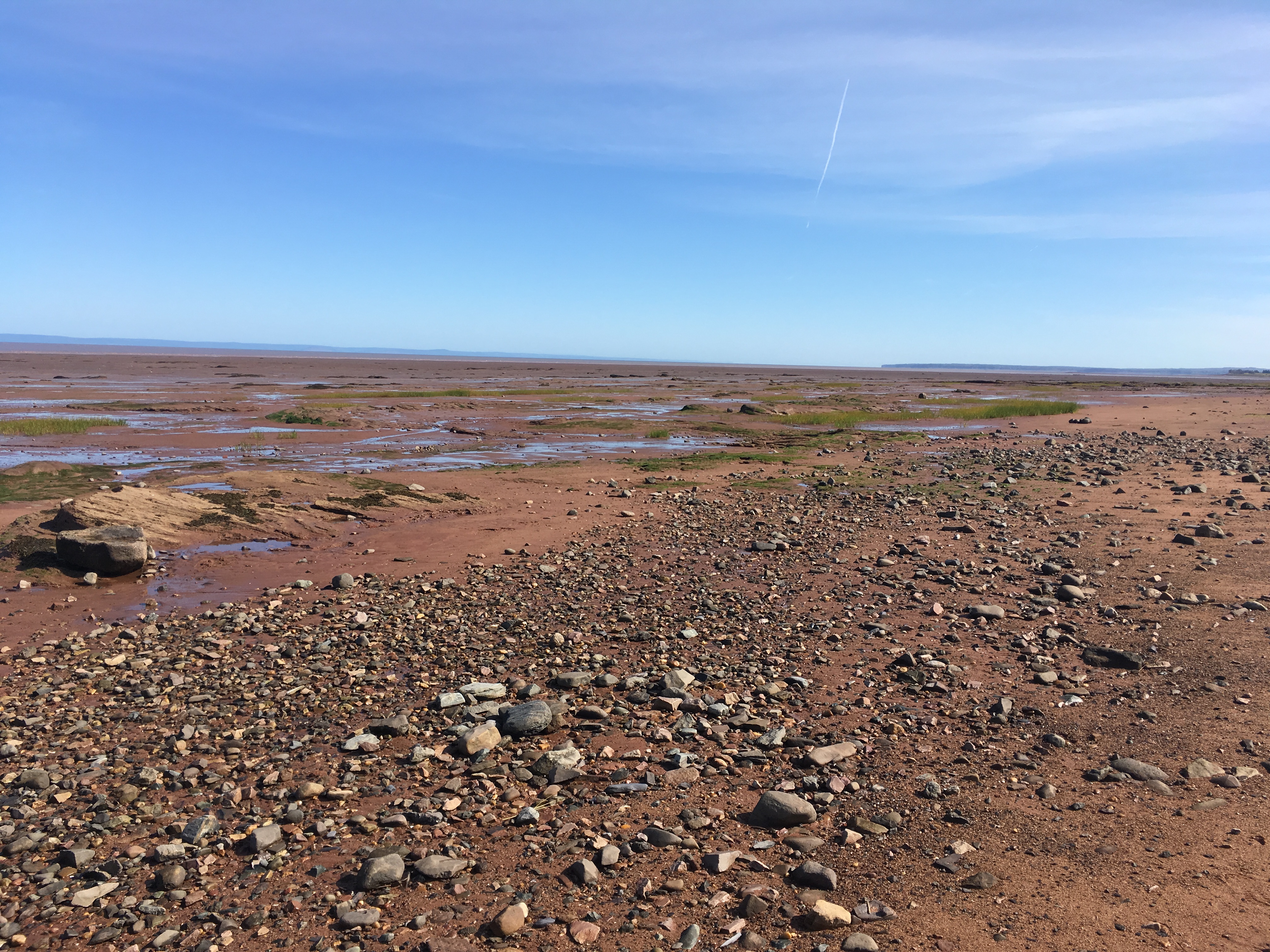
A couple of years ago, Mary Lee and I drove through Nova Scotia and spent several hours walking Minas Basin, the site of the world’s highest tidal ranges, where twice a day, the Bay of Fundy ebbs and flows through the Minas Channel between Cape Split and Cape Sharp, completely emptying and filling the Basin. At high tide, the ocean seems vast, while at low tide we walked through a landscape of red sandstone and volcanic rocks, cliffs, and sea stacks. Now you can see ocean vistas like Minas Basin at high tide up and down the Northeastern coast, and you can see sandstone and volcanic rock all over this planet. It’s the relationship between the two landscapes —the tidal range of what can be as much as 50 feet—that makes them both unique and one and the same. Much the same way Laurie’s death has emptied me with grief and let joy into my life.

As I travel further along this pilgrimage through life, I’m more aware of how its ebbs and flows run like water-colors, painting a single picture, one I can only see by looking back, but which gives me hope for what lies ahead.

And I find myself more and more intrigued by the question: Who is the artist painting this picture?

fullsizeoutput_1662
Watercolor by Laurie Wile

# #

For more on Nova Scotia, you might be interested in my blogs: https://geriatricpilgrim.com/2017/10/16/here-comes-the-judge/ https://geriatricpilgrim.com/2017/10/02/rooting-around/)


Hats for the Journey

fullsizeoutput_1633

#

Mary Lee and I are getting ready for our next trip. This one is a cruise, something neither of us has ever been on before, and one of our concerns is what clothes we should pack. The information we’ve received is helpful—dress casually, plenty of active wear for sun and rain, no jeans at dinner… Still, I’m concerned, especially about what hats to bring.

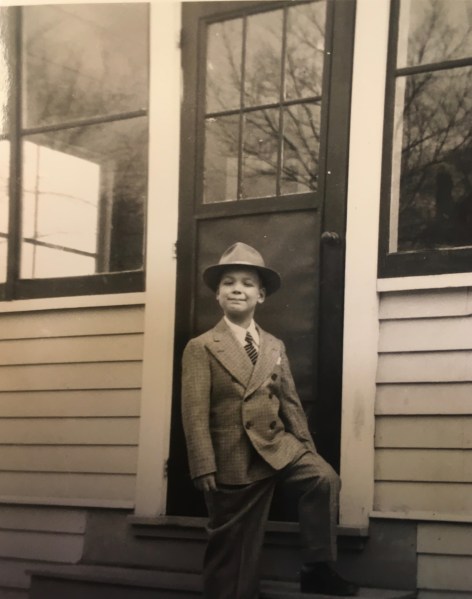
Hats have always been a part of my life. Many early pictures show me wearing a hat. I started with one of my Grandfather Lufkin’s fedoras, and then graduated to having one of my own. (How many five-year-olds can you think of who had his own fedora?)

fullsizeoutput_1631

I also remember getting a cowboy hat for a birthday present, and of course, my little league baseball caps. In early adolescence, I played trombone in a Dixieland band called the “Ivy Leaguers.” We wore chinos and plaid caps, both with belts in the back. During my senior year in high school, our basketball coach required us to wear not only a coat and tie to games, but also a hat, because he told us wearing a hat reduced our risk of catching cold.

We had no problem with this (my hat, I think, was an Alpine job with a small feather in the band), for in 1961, all men still wore hats. Men who worked blue-collar jobs wore caps while men who had white-collar jobs sported fedoras. (Usually. One of the things that made Art Carney so funny on the Jackie Gleason show was that his character, Ed Norton, wore a fedora and worked in the sewers.)  Even though he wasn’t employed by the railroad, Grampy Lufkin often wore a blue and white striped railroad cap; a lot of men did. My father wore a khaki colored cap to work in the summer and a green and black checked cap in the winter; then, after he retired and spent a lot of time fishing, he wore a long-billed cap called a “swordfish.” No matter the occupation, however, every man had at least one fedora for Sundays. (Women, too, always wore hats when they dressed up.)

As legend has it, all that changed when John F. Kennedy was elected President. As I understand it, he had a large head and didn’t like hats, so that when he was inaugurated, he eschewed the traditional top hat and went hatless, thus creating a precedent that lasted for several generations.

I still wore hats, however, usually either to keep my head warm in the winter or ward away bugs in the summer. And without really noticing, I added a hat here and a hat there, until today 30 hats hang in the garage by the back door, not to mention another three or four stocking caps tossed in with my gloves. Some hats I take with me on pilgrimage: summer and winter weight Irish caps when I’m going to the British Isles; wide-brimmed sun hats for Israel, Africa, and Arizona.

fullsizeoutput_163d

For over twenty years, I’ve worn a Tilley Hat, complete with horse-hair hat band, for hiking. When I play the banjo, I wear a fiddler’s cap (sort of like a Greek fisherman’s cap) or an old fedora.

IMG_0732

I have a fedora for church, and all kinds of baseball caps—Boston Red Sox, Portland Sea Dogs (a Red Sox affiliate for those of you not from New England), a blaze orange one for hiking the woods in the fall, and one with a blackfly over the words, “Maine State Bird.” In preparation for summer, I just bought a new Panama.

How did that happen? Why am I so drawn to hats? I read somewhere recently that almost all of us collect one thing or another. One theory is that this desire is instinctual, going back to our early ancestors who stocked food, clothing, and so forth in times of plenty for the times of famine. Okay, but I don’t see a lot of pictures of cavemen in hats.

I know that some of my hats help me preserve the past; for example, my fedoras remind me of the men of my youth that I wanted to emulate. I have baseball caps reminding me of San Antonio, Texas, and of my MFA program. I bought a winter stocking cap in the Old City of Jerusalem when the temperature was at least 90°. The hat I wear most, year-round and both around town and on pilgrimages, is a long-billed swordfish cap that I bought to replace my father’s which I wore after he died until the strap in back broke. It keeps both sun and rain out of my eyes, can be worn under a hood, and, of course, reminds me of Dad.

fullsizeoutput_1635

One day just before my daughter’s death, before going into a conference room with some of her doctors, I put an Irish tweed cap in a closet by the door, and someone took it—I’m assuming by mistake—and left me a cap like it, only with ear flaps for cold weather. I still often wear it in her memory.

After Laurie died, during probably the worst time in my life, Mary Lee and I went to Colorado for April vacation. There, I bought a cowboy hat and wore it the whole time. The hat made me feel like Tommy Lee Jones, plain-spoken, tough, in complete control. I’ve still got a couple of cowboy hats, one straw and one wool. For some reason, they always make me feel better when I’m upset or anxious about something.

I also find it calming to go out once or twice a year and rearrange hats.

As I think about it, I started adding hats when I began teaching high school English in Down East Maine. At a time when teachers were dressing more and more informally, I wore ties with matching pocket handkerchiefs, double breasted blazers, and bell-bottomed pants, all topped with either that Irish cap I wore before Laurie died, or a wool bucket hat that matched my topcoat. They validated me as “Mr. Wile,” just as, I suppose, my other hats validate me as a hiker, a writer, a musician, or a pilgrim.

fullsizeoutput_1640

Do I really need this validation, especially now, at my age? Do my hats represent all my “false selves”—cowboy, adventurer, academic, musician, and so on—revealing my inability to get in touch with my real self? Are they a kind of role playing, or a form of security blanket, a way for me to hide from the world?

Maybe. But I’d like to think that they represent—even proclaim—that I am multi-faceted. That, as Whitman wrote, “I am large, I contain multitudes.” Perhaps my hats are a way to ask, “Who does God want me to be today?” That they are a cause to celebrate, not denigrate.

So, what do you think, maybe the swordfish cap and the new Panama for the cruise?

# #


Mud Season

fullsizeoutput_15fe

#

“Poor March. It is the homeliest month of the year. Most of it is mud, every imaginable form of mud, and what isn’t mud in March is ugly late-season snow falling onto ground in filthy mud heaps that look like dirty laundry.” —Vivian Swift, When Wanderers Cease to Roam: a Traveler’s Journal of Staying.

#

Mud is the most poetic thing in the world. —R. H. Blyth.

#

I’ve just returned from what is becoming an annual retreat at the Desert House of Prayer, outside of Tucson, Arizona. But if you want to read about the desert, you should read a couple of my earlier blogs— https://geriatricpilgrim.com/2016/03/07/dont-ask-why-just-ask-for-help/ and https://geriatricpilgrim.com/2018/03/19/return-to-the-desert/.  I’m going to write about mud.

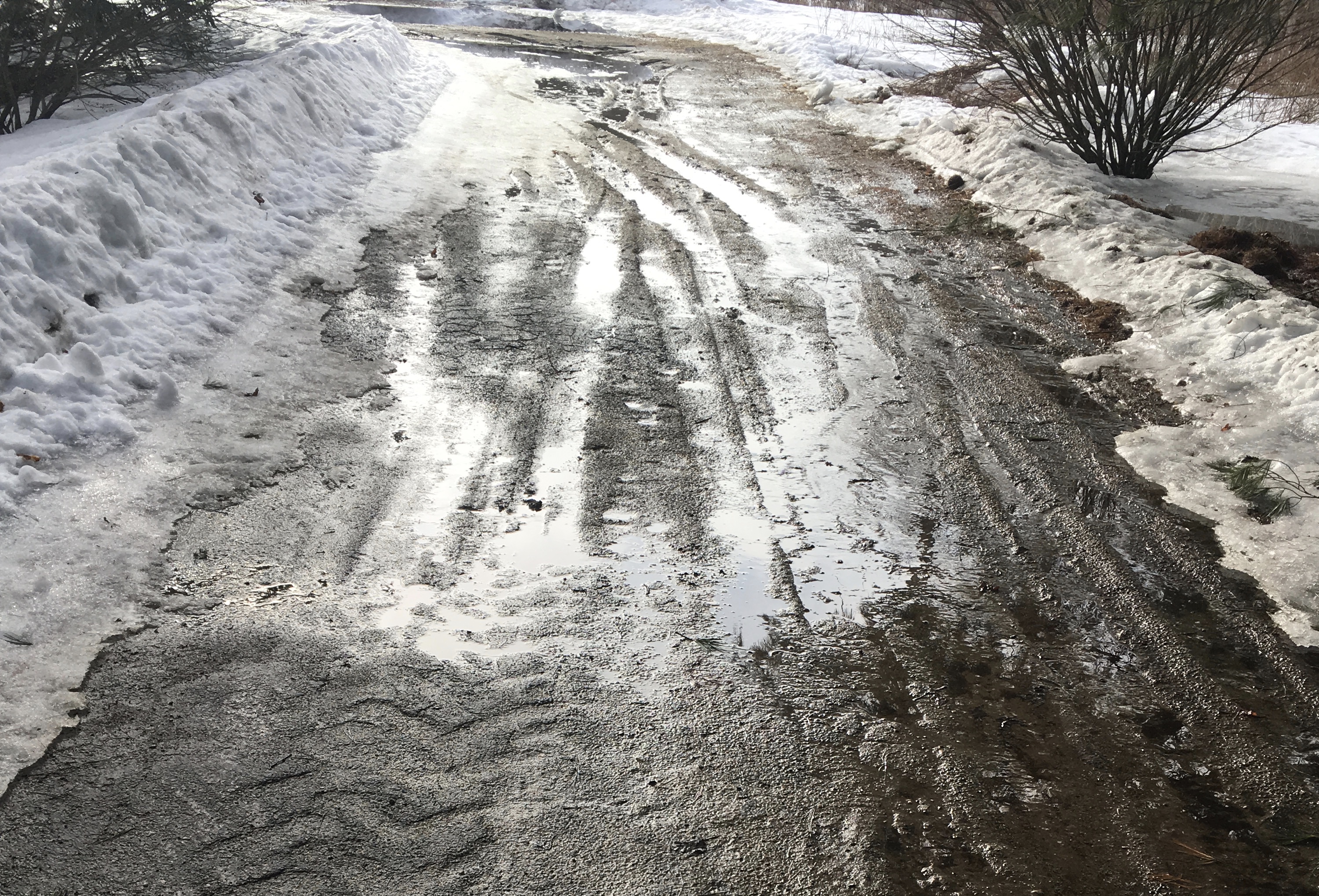
Which was the first thing I thought of when I woke up the morning after returning from my retreat and looked at a brown, wet, New England landscape choked with trees that looked like sticks, the houses dirty and sad, muddy cars sloshing through puddles, splashing up brown water. Later, I walked to our development’s compost pile through a morass of muck that coated my shoes and tracked into the house, the gunky footprints welcoming me to what we call mud season. Which here in Maine can last longer than springtime.

Let’s face it, mud can be depressing on any number of levels. Our language is full of negative responses to mud: we are “bogged down” in work, “swamped” by debts, “mired” in triviality. We don’t want to “muddy the waters,” and we accuse politicians of “slinging mud.” The Psalmist writes, “… the Lord drew me…out of the miry bog, and set my feet upon a rock.”

Speaking of bogs, one of our current President’s campaign pledges was to “drain the swamp in Washington.” Whether or not he’s succeeding or sinking us deeper into “the miry bog” in debatable, but generally speaking, our civilization has tried to move out of swamps, draining them of mud, replacing them with concrete. (Not always successfully. I once owned a house built on old swamp land, and for the twelve years I lived there, the swamp kept inviting itself back, flooding the cellar, leaving a rug of mud on the cement floor.)

Mud is a place of ambiguity. It’s indefinite, uncertain, and we are a culture that values a distinct, separate self, even if it means putting up walls to keep things and people from seeping through. My Puritan ancestors hated swamps, I suspect, because, in a spiritual sense, there’s nothing to hold on to. Everything is fluid, murky. Like the swamp my house was built on, nature is always about to leak through the tight barriers of morality and hard work.

And yet, while on retreat, I spent time going back into my early childhood, doing some twelve-step work, and realizing that my earliest memory is of playing in the mud. Most children, in fact, are drawn to mud; making mud pies apparently gratifies our first creative instincts. And it’s actually good for us. According to a neuroscience journal, dirt and mud are natural anti-depressants, because the bacteria found in them trigger the release of serotonin in our brains.

Mud rejuvenates. When Mary Lee and I were in Israel, we went to the Dead Sea and covered ourselves in mud—something about the slight buoyancy of mud together with traces of pumice scouring off our dead skin cells. I just thought we looked cool.

fullsizeoutput_1601

And also sort of sexy. Which makes sense because life on this planet may have been conceived in the mud. Adam, we read in one version of creation, was made from mud. In many Native American creation stories, our continent began with mud. Several recent scientific theories—and one not so recent by Charles Darwin— suggest that the early building blocks of life may have been created in a mud puddle of volcanic ash and warm water some 3.8 billion years ago.

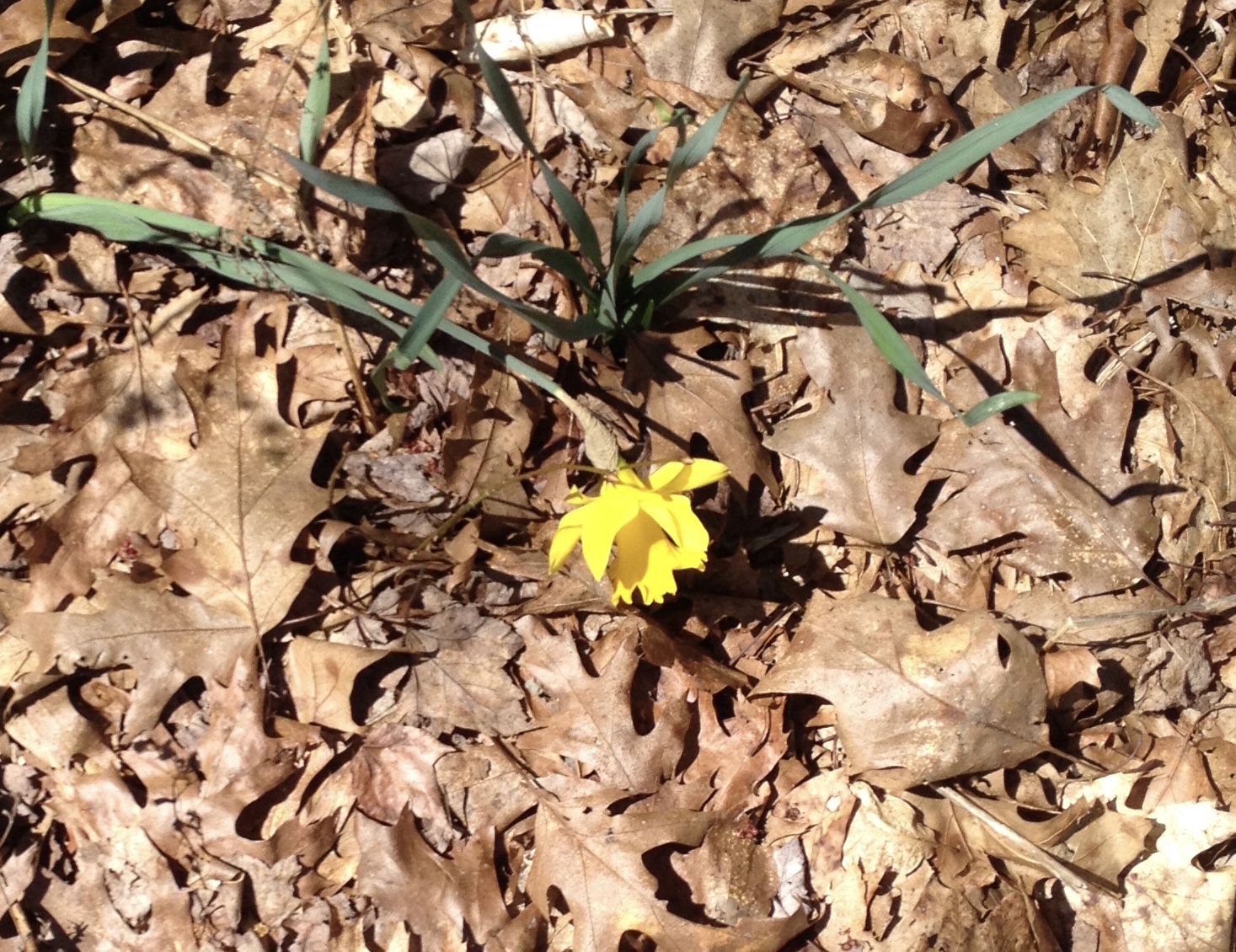
Every year mud season brings new life: daffodils poke from the ground and buds swell on the trees. So, we need the mud for what grows from it. At the same time, when you realize that mud is made up of decayed vegetation and rocks that have been pounded for millions and millions of years into silt, every mud season is also a kind of death. More of that messy ambiguity again.

My trouble is not so much where mud season is taking me, but what I have to go through to get there. I’ve certainly gone through my own personal mud seasons: depression, divorce, the death of a child, illness, addictions, crises of faith. I expect you have, too. Times when nothing is clear, when you have no firm foundation, when you seem to sink deeper and deeper into the mire. And yet, out of these times, you find new life, find yourself growing in ways you never expected.

When I returned to school to get an MFA, one of my mentors was Barbara Hurd, who wrote a wonderful book called Stirring the Mud. In mud, she writes, “the boundary between physical and spiritual melts and we see that one is always infused with the other.” She points out that all of us are more than ninety percent water—“liquid mosaics of mutable and transient urges, and we give ourselves headaches when we pretend otherwise, when we stiffen ourselves into permanent and separate identities.”

Maybe I’m supposed to get dirty. Maybe I’m not supposed to be clear about the fluidity of self. Last week on retreat, during our daily meditation sessions, I saw how elusive, insubstantial, and fleeting my thoughts are. Looking back over my life, I can count at least ten different “identities” I’ve assumed over my almost seventy-six years. I used to call these identities “false selves.” Now, I’m not so sure but that these selves simply leaked back and forth through my life, and what made them “false” was that I clung to them instead of letting them flow.

I have not only returned from Arizona to mud season, I have also returned to the Christian season of Lent, which, as I think about it, is its own kind of mud season, a time of ambiguity, of waiting for new life, while watching where I put my feet. As Philip Simmons puts it in his book, Learning to Fall, “The path to resurrection lies through the mud.”

I’m hoping that during this Lent and this mud season, I will be granted the grace to let the mud teach me to be ambiguous, paradoxical, non-dualistic, non-hierarchical, and receptive—that I may learn to play in the primordial soup of possibility.

fullsizeoutput_1600

# #


Climbing (Part of) Mount Kilimanjaro

fullsizeoutput_1585

#

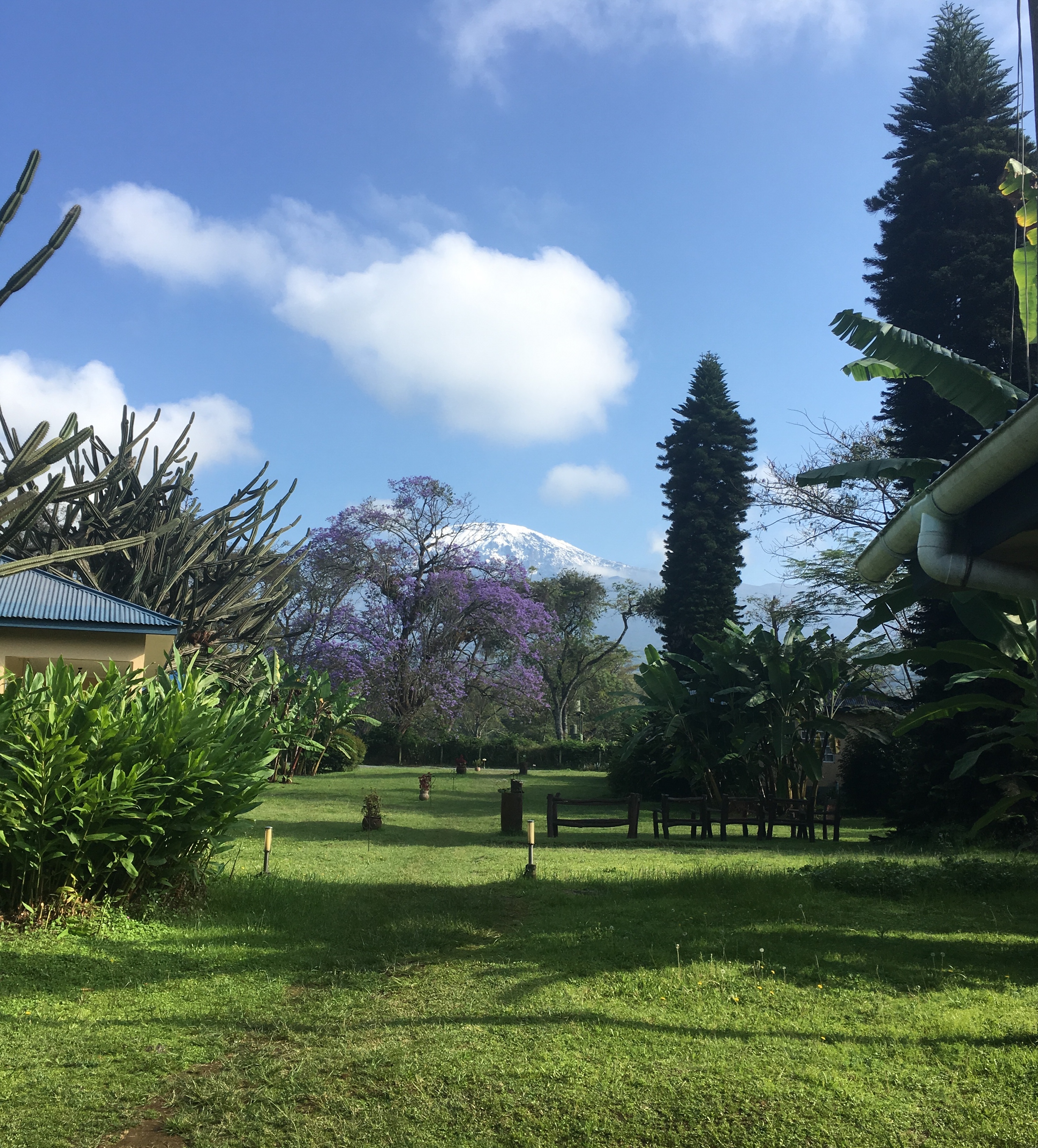
The first morning of my recent trip to Tanzania, I went out on our cabin porch and the first thing I saw was Mount Kilimanjaro, its snow-capped peak rising over a blue jacaranda tree into cotton clouds and a blue sky. It was breathtaking … for a minute or two.

Then my demons woke up. Ever since Mary Lee and I had reviewed our itinerary back in the spring, I’d had apprehensions about the second day of our trip: a hike up part of Kilimanjaro. It wasn’t much a climb, if you were a climber or if you were fifty-five instead of seventy-five, but the idea of trekking eight kilometers (about five miles) up the mountain and then the same distance back at an altitude that began at 1879 meters (or 6165 feet, higher than any mountain on the East Coast of the United States) filled me with not a little trepidation.

Compounded by the fact that I felt I had to do it or I would somehow be a failure, less of a man. All my life I have measured my worth by what I’ve done. Probably because I grew up in an alcoholic family, shame has been the driving force in my life, and the approval of others my drug of choice, far more addictive than booze or caffeine.

That first day, while Mary Lee and I rested from our 18-hour trip by touring a coffee plantation, I kept glancing up at Kilimanjaro—or where I knew the mountain was; most of the day, it was hidden by clouds—wondering, Can I do this? What will people think of me if I can’t make it?

#

The next day, Rashid, our guide came to our cabin to pick us up. Short and wiry in his mesh REI baseball cap, sweatshirt, and jeans, he looked about eighteen (although I found out later, he was in his late thirties). During the hour drive to Kilimanjaro National Park, as he talked to our driver in Swahili, I wondered if they were talking about us—okay, talking about me—my pot belly, my hunched back. Climbing a long flight of stairs from the parking lot to the Kinapa Headquarters, my lungs burned and my heart raced. There’s no way in hell I can do this!

While we were taking pictures at the Marangu Gate Entrance, I told Rashid, “Look, my wife and I do a lot of walking, but not much climbing. I’m not sure we can make it to the Mandara Huts and back.”
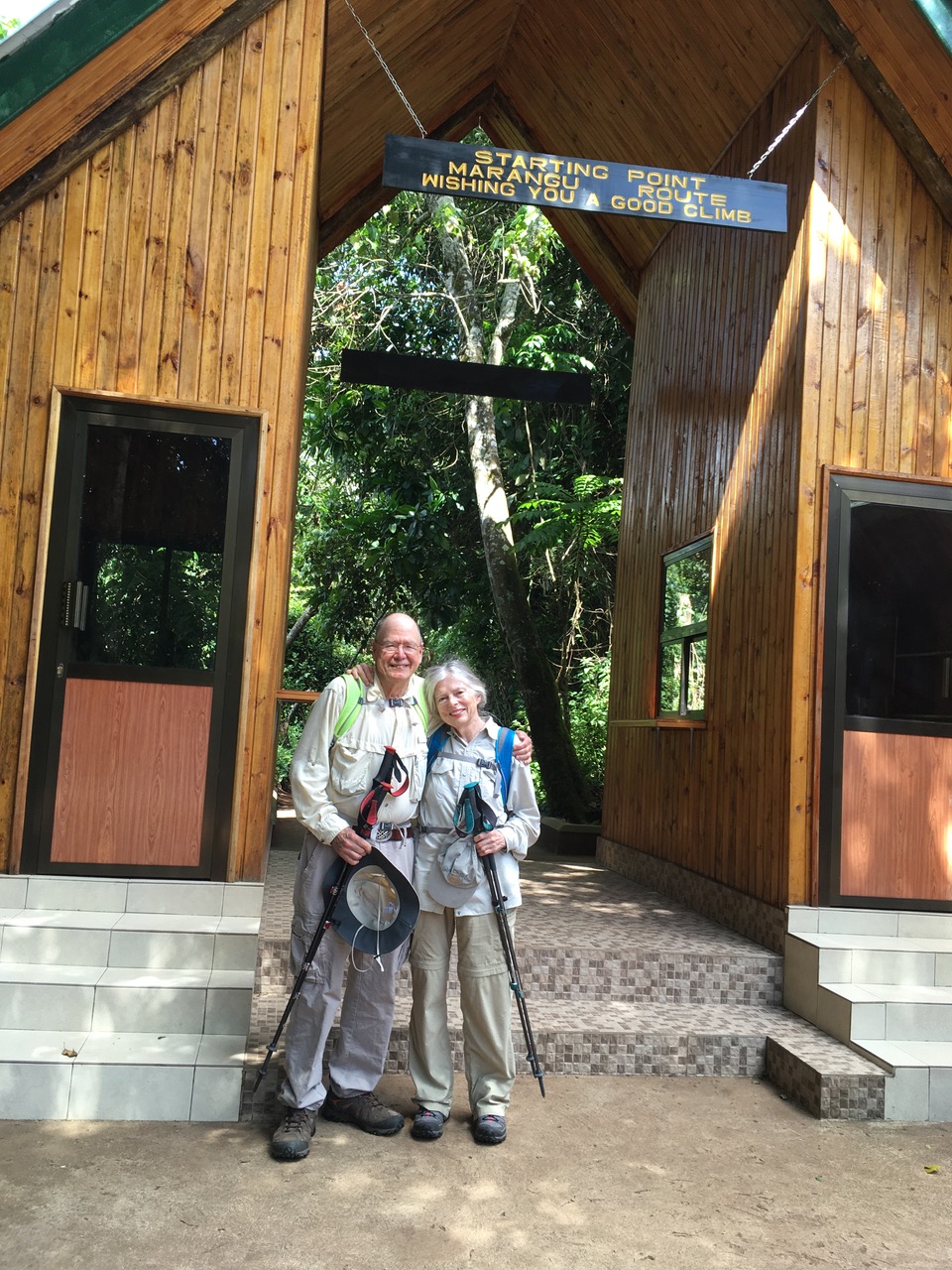
IMG_2673

Rashid grinned. “No problem,” he said. “We’re here to enjoy the mountain. Poli Poli. Slowly, slowly.”

When I start walking, my tendency is to begin at brisk pace and then slow down when I get out of breath, speed up, slow down…. Rashid set out on about the same pace I use when I’m going from the TV set to the bathroom. I took it personally. What kind of whimp does he think I am? I wanted to speed up. Maybe we could do the whole hike after all.

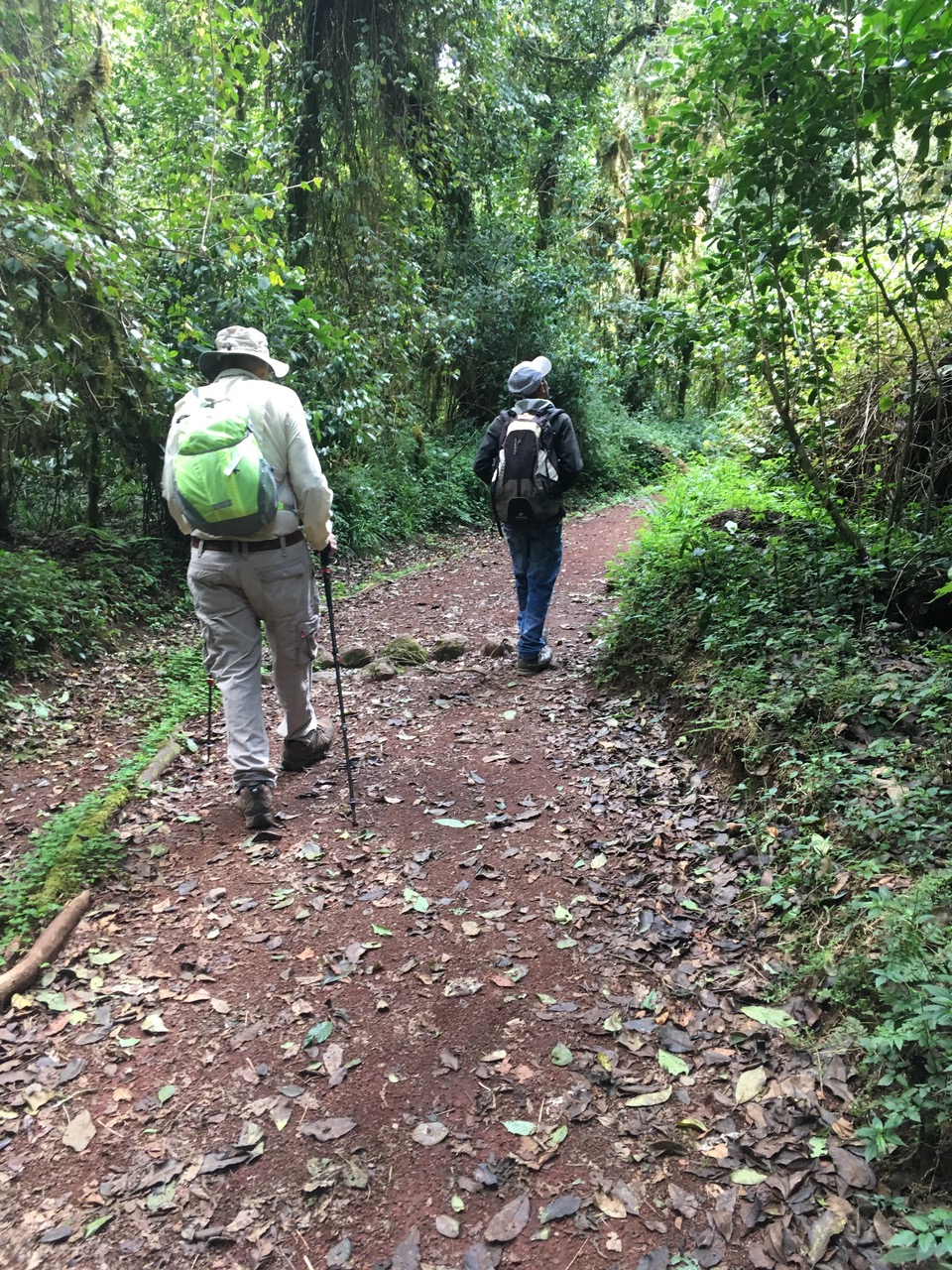
But Rashid seemed to be enjoying himself. He walked ahead of me, hands behind his back, looking around, a smile on his face. I found I had the breath to ask him questions about his life as a guide. He said he started as a porter. As a guide for the last fifteen years, he’d climbed all eight routes to the summit. When I said it must be dull walking with two old people like us, he replied, “No, I always find something beautiful to see. Kilimanjaro is my office.”

On the plane ride from the States, I’d read that Kilimanjaro has five ecological zones. We were hiking through the second zone of dense rain forest. Huge tree ferns surrounded us. Rashid pointed out sycamore trees, junipers, and some incredible moss called “old man’s beard” hanging from their branches. He showed us red gladiolas, a lily with yellow and red spikes, a yellow hibiscus, and “impatiens Kilimanjaro,” which only grows on this mountain and whose blossoms look like pink seahorses with yellow tails.
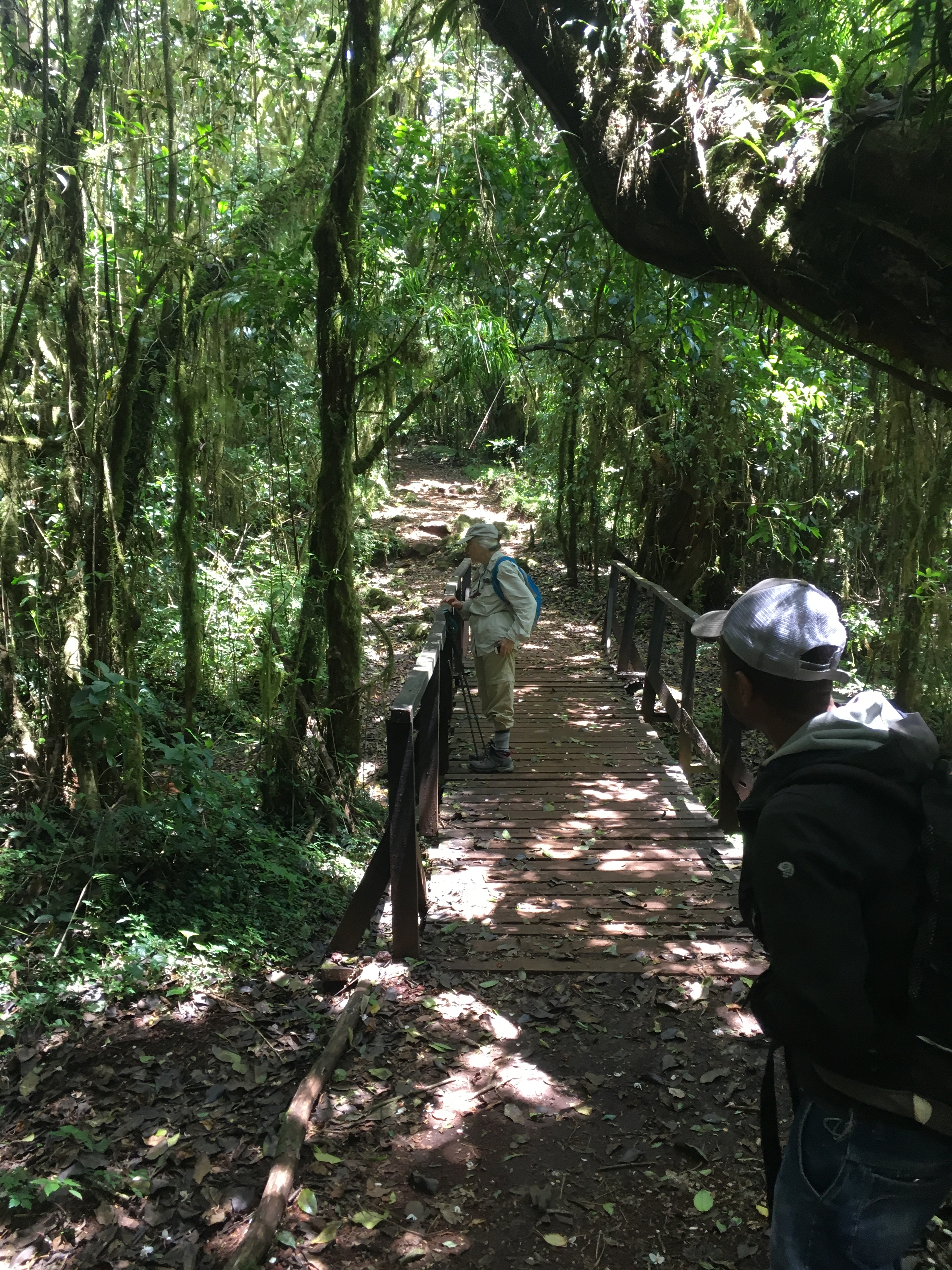
IMG_3768

#

Jambo.” A young woman in a red and brown striped skirt and a bright tourquoise bandanna around her head passed us as if we were standing still. She carried a large knife.

Jambo.” Rashid returned the traditional Swahili greeting. It seemed to me they winked at one another. As she disappeared around a bend ahead, he told us that she was a member of the Chagga tribe, who use the forest for firewood, farming, beekeeping, and logging. I was envious of her youth, her grace, her speed.

Still, when we came to a steep rise, I was grateful for Rashid’s slow pace. Zig-zagging up rocks and roots, I noticed my lungs seemed to have adjusted to the altitude. Rashid began pointing out birds: boubous, hoopoes, hornbills, and my favorite, a turaco, sporting what looked like a purple mohawk haircut on a green head.

#

Just before noon, we reached a rest area, which Rashid said was about half-way to the Mandara Huts. Now, I knew for certain there was no way we were going to do all of our scheduled hike. My nemesis Shame pointed his finger at me and laughed.

Six German hikers— beginning, they told us, their ascent to the summit—were finishing their lunch. Rashid and their guide talked in Swahili, while Mary Lee and I ate our sandwiches. As this guide was leaving, he smiled at Mary Lee, “Good-bye, Bibi.” He turned to me, “Good-bye, Babu.”

Rashid smiled. “That means “Grandmother and Grandfather.”

My spirits sank. Shame snickered. What, you think he thought you were Robert Redford in Out of Africa?

I don’t know if my disappointment showed or not, but Rashid added, “In Africa, that is a term of respect.”

I thought, Well, Grandfather is what you are, aren’t you? And aren’t you happy to be one? Then I realized that not only was I a grandfather to four kids under seven, but I could be the grandfather of any of the six German climbers. Our guide Rashid was ten years younger than my daughter would have been if she’d lived.

I had a brief vision of eighteen-year-old Laurie lying on her hospital bed, her labored breathing: “Ash…es, ash…es.” I saw my classmate Scott, one of the best athletes I’ve ever played with, struggling to get out of bed a month or so before he died.

Hell, you’re lucky to be anywhere on this mountain.

Shame was silent.

#

We continued upward. The terrain grew steeper, the vegetation less dense. Suddenly Rashid stopped. “Over to your left. Blue monkey. You don’t see them on the ground much.”

Through the trees, I saw a bluish-black monkey ambling up some rocks. Male, probably 15 pounds, maybe two feet long, with another two feet of tail that looked like a piece of rope.

Would I have seen him, I wondered, if I’d been clamoring up the mountain intent only on getting to the Huts?

An hour or so later, we hit the steepest rise of our hike. Rashid said that at the top we’d see a waterfall. Mary Lee and I looked at each other, and I said what I’d never thought I’d hear myself say: “No, I think we’ve gone as far as we need to. We’re ready to go back.”

I don’t think we’d taken more than a few steps down the path before our guide pointed up. “Colobus monkeys!” Through an overhead canopy of leaves, I saw two large monkeys, black with white trim and magnificent white tails, peacefully munching away.

If we’d kept on climbing, I’d have missed them.

#

The descent was faster and easier, not only because my lungs weren’t working as hard, but because it felt as if a weight had been removed from my shoulders. As we passed through the forest of variegated flowers, feathery ferns, and lichen-bearded trees, I wondered if what hadn’t lifted was the weight of responsibility to those self-images I keep creating. How often, I thought, have I been a slave to how I want people to see me: the varsity athlete, the Kerouac hipster, the wise, knowing teacher, the grieving parent raging against God, the great writer… always reacting; seldom receiving.

As we made our way down the last slope just before the entrance to Kilimanjaro, Rashid cautioned us, “Poli poli.”

“Yes, slowly slowly. Thank you,” I said, grateful not only for his concern, but also for the gift of the day.
IMG_2678

# #


Being in Tanzania

IMG_3894

#

I traveled to Tanzania with no expectations. My reason for going was to accompany my wife, for whom Africa had been a dream since she was in grade school. Yet, when I returned two weeks later, I felt I’d been on one of the most spiritually significant pilgrimages of my life. Whether or not I’ll say this five years from now remains to be seen, but right now, I’m reflecting on my exterior and interior journeys.

What keeps coming back to me is a comment our guide, Abel, made the morning he drove Mary Lee and me to the Serengeti Plains. We’d begun to see tall, red-robed people herding hump-backed cattle on the hills. He told us these were Africa’s iconic Masai, the semi-nomadic tribe who live in Kenya and Tanzania, continuing their age-old customs, persisting in speaking their own language, in spite of both governments’ instituted programs to encourage them to assimilate into the general culture.

“I like the Masai,” Abel said. “They are proud just to be.”

Since then, I’ve become aware of how hard it is for me to feel that way. Oh, I can remember when I was proud to be a varsity basketball player; when I was (and am) proud to be a teacher; proud to be a parent and grandparent; proud to be an American. But proud just to be? The idea has always been as foreign to me as a Masai diet of blood and curdled milk. I was raised always to consider, “What will the neighbors think?” To get my worth from how others perceive me.

The problem is that I make assumptions about how others see me, which has led to a lifetime of anxiety and resentments. With no idea who I was after I stopped playing basketball, I went into a depression that lasted almost four years. Even after thirty years of teaching, I considered myself an abysmal failure as a human being if I had a bad class. When my daughter died from cancer, convinced people saw me as a poor parent who couldn’t look after his child, my pride in being a father turned to shame. In Africa, I found myself embarrassed to admit to being from the United States for fear of being seen as a supporter of the policies of our current government.

And as the morning continued, and I got used to seeing the Masai and the motorcycles and the open fires and the outdoor furniture stores beside the road on our long drive to the Serengeti, my mind reverted to playing the same old home movies it always does when it wanders. I’m back in high school, changing the outcome of the state basketball championship game, winning by 20 points this time instead of losing by that much. I’m arguing today’s politics with some of those same teammates whose views now differ 180 degrees from mine, destroying their feeble arguments with my brilliant sarcasm. I’m dying of lung cancer, stomach cancer, melanoma, cancer of the esophagus, or Parkinson’s Disease. I’m making plans to change my life when I get back from this trip, eating more fruits and vegetables, giving up cheese and chocolate, losing ten pounds, growing another beard, maybe getting another tattoo. All of which, I see now, are just more examples of getting my identity from what I imagine other people think of me.

#

But after lunch, we entered the Serengeti— miles and miles of lion-brown plains dotted with feathery trees under a vast sky. Abel raised the roof of his Land Cruiser. Mary Lee and I stood and began to see animals: gazelles and antelope at first, then the occasional ostrich and wart hog. In the distance, a road seemed to move until we came closer and saw that it was a large herd of cape buffalo chugging across the landscape. On a large boulder, a lion gazed into the distance.

fullsizeoutput_156d

Slowly, my mind started to shift its focus, still returning, however, between animals, to those old illusions and assumptions.

Until, in the late afternoon, we saw a circle of land cruisers around an Acacia Tree. Pulling in, I could make out a female lion sleeping on a limb. At first, peering through the same sarcastic lens through which I often see things, I found the scene ridiculous—a half-dozen vehicles, at least that many telephoto lenses and maybe twenty people, all watching one lion trying to sleep? Then Abel gave me his binoculars and I watched the lion stretching and contracting her front legs. She swished her tail, arched her back, and moved higher into the tree. Onyx-colored eyes glanced at me dispassionately. She yawned, revealing a large tongue and sharp teeth. Behind her, the air seemed to glow golden and great clouds towered.

When I handed the binoculars back to Abel, most of the other land cruisers had left. I realized I had no idea how long I’d been looking at the lion. Suddenly (a word that’s easy for me to overuse, but in this case it really was sudden) I felt a feeling of peace, of “evenness,” of lightness, followed by a sense of gratitude—Wow! I just got to see that. Thank you!

The feeling didn’t last of course, but over the next week it did return and last longer: lying in our tent at night, listening to the hyenas’ r-r-r-upe, r-r-r-rip, and the heavy breathing of what we found out later were two old male buffalo who liked to wander the grounds; the sight of over a hundred hippopotamuses wedged together like sausages in a river; herds of twenty to fifty elephants parading down to another river to drink and splash and roll in the mud; a cheetah and her two cubs prowling through the grass; seven giraffe standing silhouetted on a ridge; the strange baobab trees, a prehistoric species that predates both mankind and the splitting of the continents over 200 million years ago, whose branches look like roots, and whose gnarled bark has been worn by wind and rain and millennia of elephants using them for scratching posts.

fullsizeoutput_15c0

Now I wonder if what happened was that I was, simply, being. If I set aside the old baggage I usually carry around, so that I became more open with no preconceived ideas of what I thought I needed to prove to someone else. It’s not so much that I lost the sense of who I was, it’s that I became more of who I was: in union with a much larger whole, not just a bunch of weird looking animals, but an energy, a spirit, if you will, running through animals, trees, grass, sky, clouds, Abel, Mary Lee, and me.  I may not have been “proud just to be,” but I certainly was grateful.

#

Even if you don’t journey to honor a saint or to see a holy place, I think any trip can become a pilgrimage when the exterior journey triggers an interior one. Brother David Vryhof of the Society of Saint John the Evangelist recently wrote: “A pilgrimage typically involves three experiences: leaving something, gaining something, and struggling with something.” I’m hoping I left some of my defensive, passive-aggressive sarcasm behind. I know the peace and lightness I experienced continues; I notice more. I’m thinking less about who or what I am and more about that I am.

The struggle is to try to maintain this sense of just being now that I’m back dealing with jet lag that lasted a week, the cough that I brought back that won’t go away (I know it’s probably not lung cancer, but…) the season’s first snow storms, obligations, and the memories that metastasize this time of year of my daughter’s last months in the hospital and her death two days before Christmas. I’m trying to think of being in Tanzania not as some abnormal “blip” outside of the reality of my usual assumptions and illusions, but as a step toward experiencing the greater reality I’ve occasionally glimpsed, and with it, gratitude for the life I have, and the serenity of not caring what the hell the neighbors think.

IMG_4090

# #