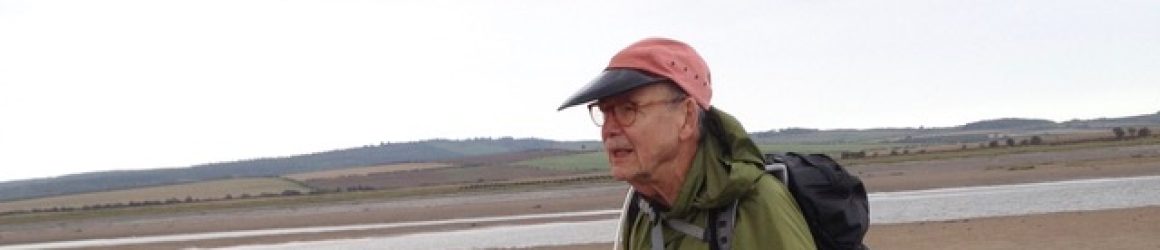

Mid-December’s Black Ice

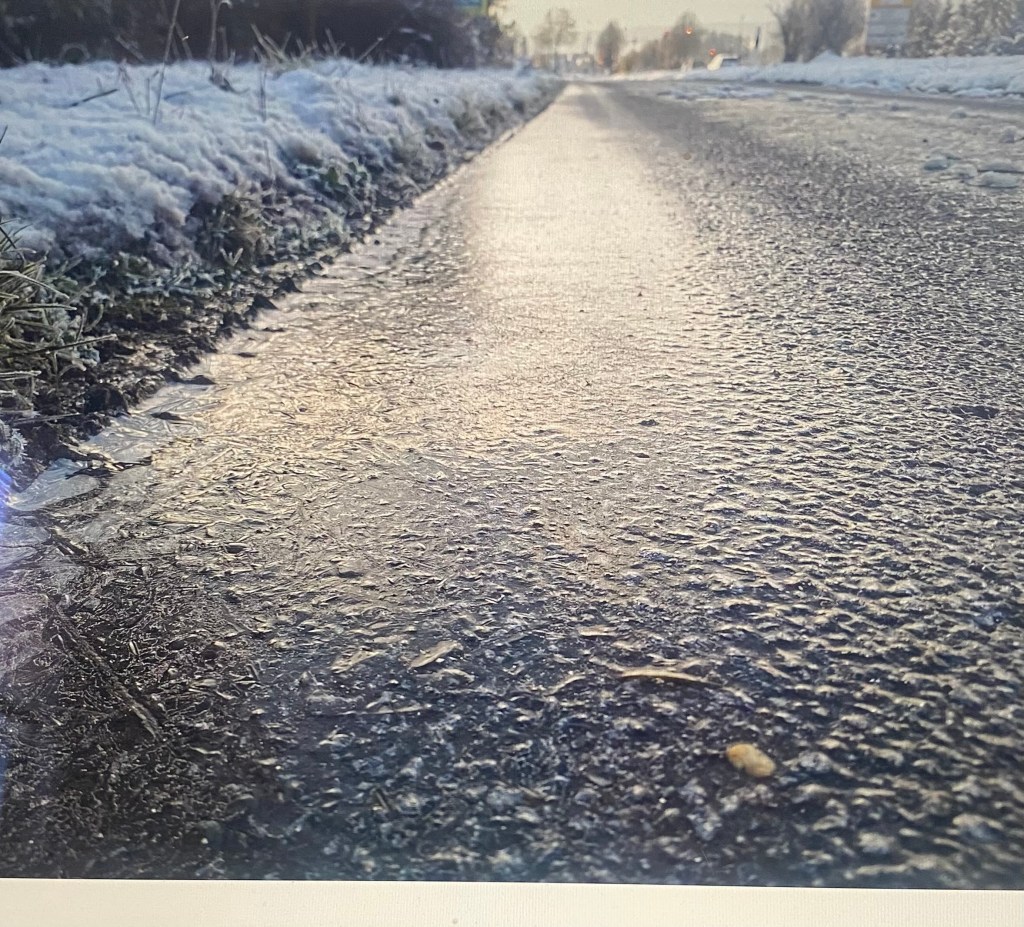
Photo from Wikipedia (but it could have been in front of my house)

Yesterday’s snow became rain

before the temperature dropped

back into the teens, so that

this morning, sunshine glistens 

on the icy road over 

which I walk—an eighty-year-

old man trying to find his 

way during this season of 

Joy to the World, while he grieves

the anniversary of 

 his child’s death, and ponders what’s 

next with curiosity 

glazed with fear, poking along 

flat-footed, carefully pick-

ing his way, concentrating 

on not falling, focused on 

keeping that icy balance. 

Broomstick Season

~

The trees that can have given up their leaves—

the reds and golds you see in magazines,

(though dry and chewed and rotting with black mold)—

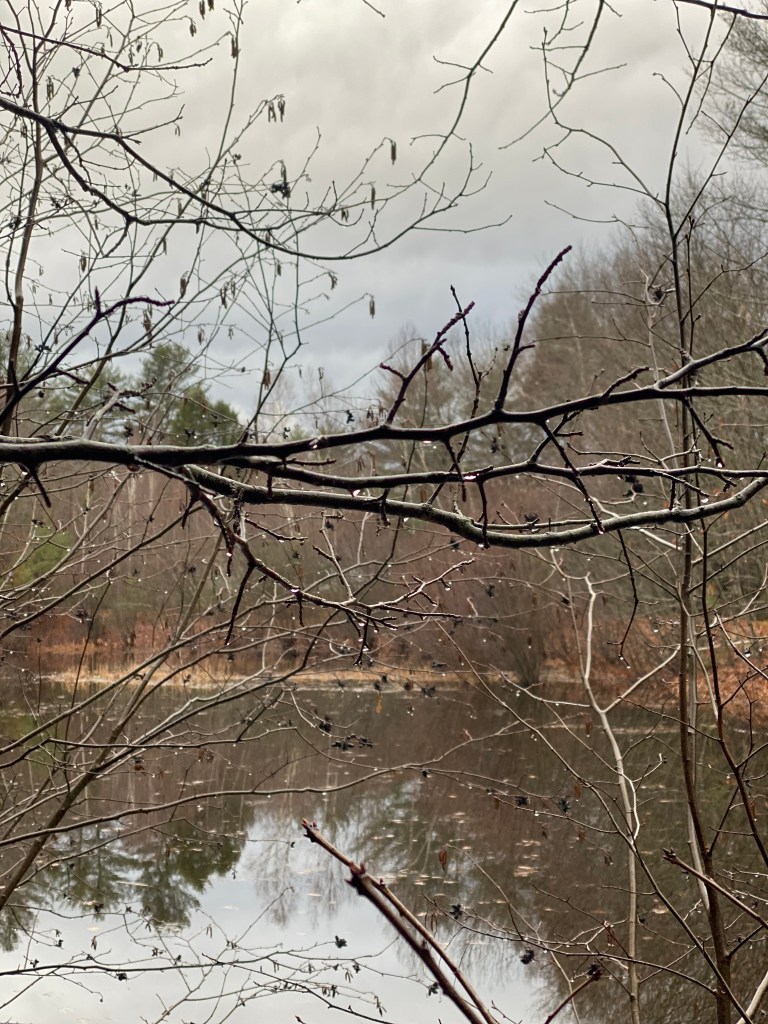
standing outlined against the sky: broom sticks

whose branches seem about to sweep the clouds.

~

Hard not to recall those who died this month:

a grandmother, father, mother-in-law,

Thanksgivings when their absence filled our plates.

The Ronald McDonald House Thanksgiving

of turkey, fear, anxiety, and tears,

as my wife and her sons saw my daughter

for what we all knew would be the last time.

~

Well into the November of my life,

I mourn the green and teeming dreams I had,

The gaudy colored leaves of happiness,

chewed by anger and blackened by misdeeds.

Now naked of ambition, strength, shame, guilt,

but rooted in the rocky soil of Grace,

supported by my friends and families,

I raise my bony, brittle arms to sweep

away remorse, and cry in gratitude:

Thank you, thank you, and thank you, for it all.

~ ~

Duende

◊◊

Duende:…[T]he “bitter root” of human existence, what Lorca referred to as “the pain that has no explanation” … and the source of much great art.—Christopher Maurer

After the rain, the trees are weeping,

tears glistening in the setting sun. 

And suddenly

I feel the fierce force flowing through my veins 

along with the red cells and white cells and platelets, 

to and from the heart (the center of grief, I heard somewhere). 

I wail once more my family’s demise:

 my father’s frightened eyes, my mother’s waxy hands,

  my daughter’s last labored breaths.

´◊

I recoil as if for the first time at

old failures, sins, embarrassments, what-ifs

 that float before me like dead fish.

I watch my friends diminish—

cancer, Parkinson’s, heart problems, Alzheimer’s—

I shave an old man’s face.

This week, I’ll pray, write a poem, plant flowers in the family cemetery, meet friends,

take grandchildren for ice cream, work in my garden, make love to my wife, 

tenacity momentarily victorious. 

Still, coursing through my triumphs like a deep and dark river,

demolishing and nourishing as it surges to the sea, 

Duende.

◊◊

Nevertheless

Watercolor by Laurie L. Wile

~ ~

I’ve always known I’d never get

whatever it is I wanted.

No way, I’ve felt, do I deserve 

my desires—I’m just not worthy.

Nevertheless, my life’s been good.

~

(Of course, I’ve never known just what

I’ve wanted until somebody

told me just what I ought to want,

good co-dependent that I am.

Nevertheless, my life’s been good.)

~

There’s so much that I’ve never done,

and much that I’ve done I failed at;

places I never went to, and

places I never really saw.

Nevertheless, my life’s been good.

~

Often, I’ve been a hollow man,

trying to stuff his emptiness

with all manner of addictions

(the list’s banal, embarrassing).

Nevertheless, my life’s been good.

~

The faces of the people that

I’ve ignored, hurt, disappointed,

abandoned, disdained, or abused

haunt me in the wee small hours. 

Nevertheless, my life’s been good.

~

Now diminished by old age to

a funhouse mirror of myself,

I sense Death looking at his watch,

impatient, counting down the time.

Nevertheless, my life’s been good.

Through all of it, I have been loved.

~ ~

The Old Lesson

~

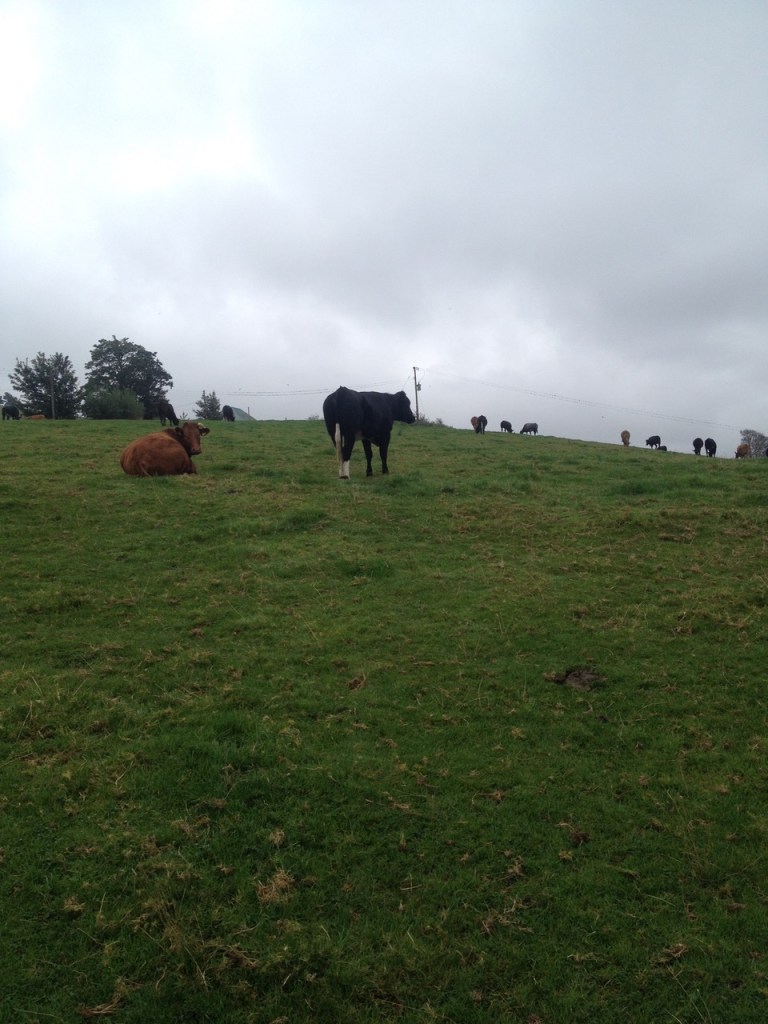
71 years old,

lungs aflame,

lower back throbbing,

I rest on my hiking poles

halfway up 

still another hill 

at an iron gate

amid gorse and nettles, 

trying to pick 

out the path rising 

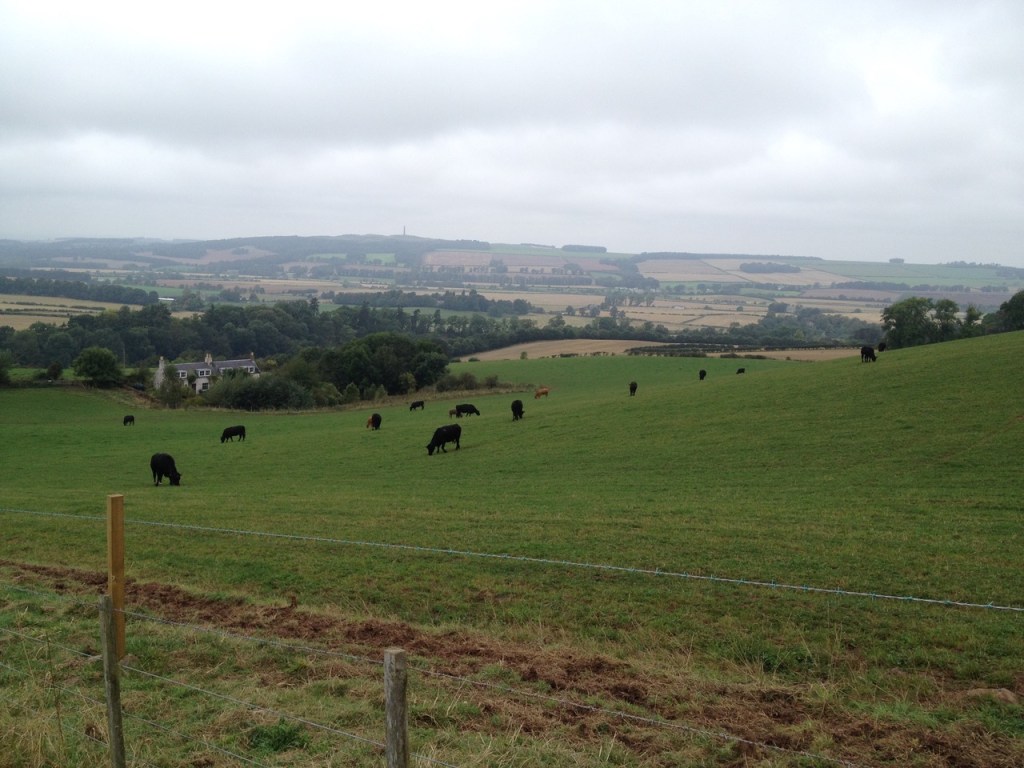
through a herd

of cows grazing on 

gangrenous grass between me 

and another gate 

and the trail that 

winds through woods

to tonight’s B&B

and the joy of a hot bath.

~

The gate clangs as 

I trudge into the herd,

which parts before me 

like the red sea

except for one

brown and white cow,

legs tucked beneath her,

who stares at me 

impassively,

before lifting her haunches, 

and dropping a steamy 

pile on the path

already strewn with

“chips,” “dung,” 

“flaps,” “muffins,” 

“patties,” “pies” —

choose your euphemism.

            ~

The pasture’s a mine field.

 I zig, zag, circle, 

back-track, hop—

marching thirty yards

to advance ten.

Fog mists my glasses.

Sweat soaks my shirt.

The air smells of decay.

At this rate,

I’ll still be 

hiking after dark.

Panic attacks like

a squad of minges.

            ~

Then, like an aging general 

roused from his nap

to lead me once more 

into battle against 

my old foe, Avoidance, 

comes the prayer: 

            ~

God, grant me the serenity

to accept those things

I cannot change …

            ~

I keep to the path, 

hear the squish,

feel my boots slide, 

raise my eyes 

to silver clouds

billowing over a line

of ancient trees,

glimpse red sandstone,

            ~

the courage to change

the things I can …

            ~

squish, slog, slide,

watch a brown hare

scamper to a stone wall

adorning the hill

like a necklace,

            ~

And the wisdom

to know the difference. 

            ~

Now at the gate

to freedom,

I bow to the sky,

having learned 

yet again

that to get to joy

you often have

to walk through shit.

            ~          

(after David Whyte’s The Old Interior Angel)

Joy

#

Oh, there were early inklings: 

the feel of my bat sending the ball over the left-field fence, 

speeding in a convertible over the one-lane wooden bridge at 60 m.p.h. 

watching the sun set behind Wyoming’s Grand Tetons—

strange times when I somehow escaped the carefully cultivated confines of my mind. 

But with no idea what those moments meant, I forgot them. 

Only after the Great Loss, 

And years of slogging 

through missing keys and sleepless nights, 

of being terrified strife would strike again, 

of sarcasm, swearing, pounding the walls, 

of regrets for what I had and hadn’t done, 

of downcast eyes and hunched shoulders, 

of tears during saccharine movies

and sobbing on anniversaries,

came the song: 

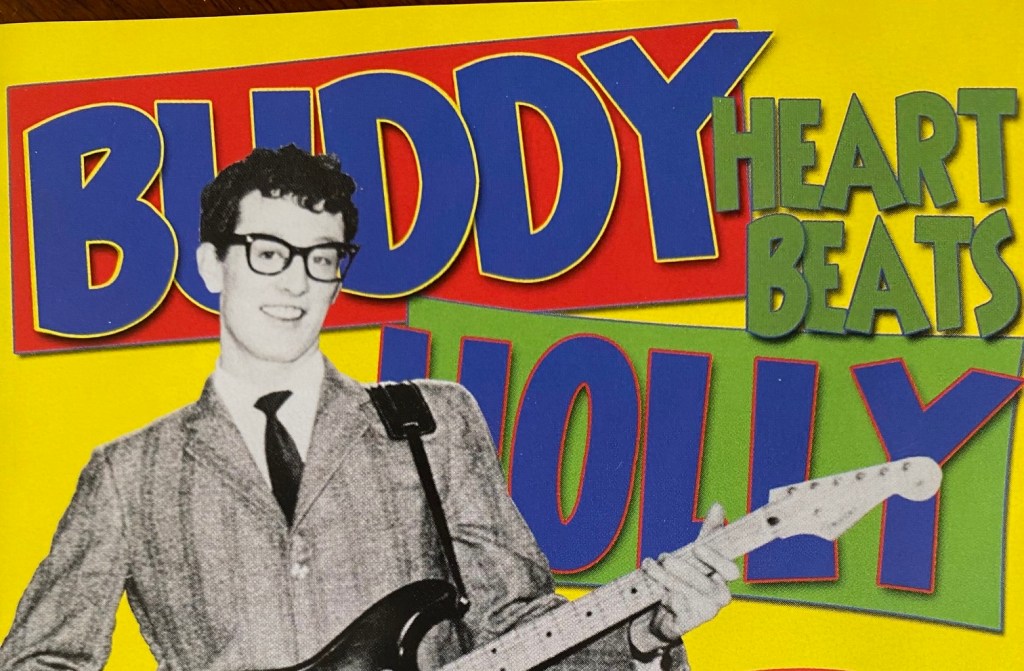
Buddy Holly on the car radio after a really bad day.

First humming along, then softly singing, 

then louder, louder, until at the top of my lungs: 

“It’s so easy to fall in love!”

Broken open,

releasing embarrassment, lethargy, fear, anger, guilt, shame, and sorrow.

Later, I realized how foolish I must have looked to other motorists. 

But I didn’t care. There was no going back.

No retreat. No surrender. 

No forgetting such a gift.

##

Family Triptych

Weilburg

Traveling 3500 miles to a town in Germany

smaller than the one in Maine where I live—

no tours, no souvenir shops, 

no one speaking English except back at the hotel, 

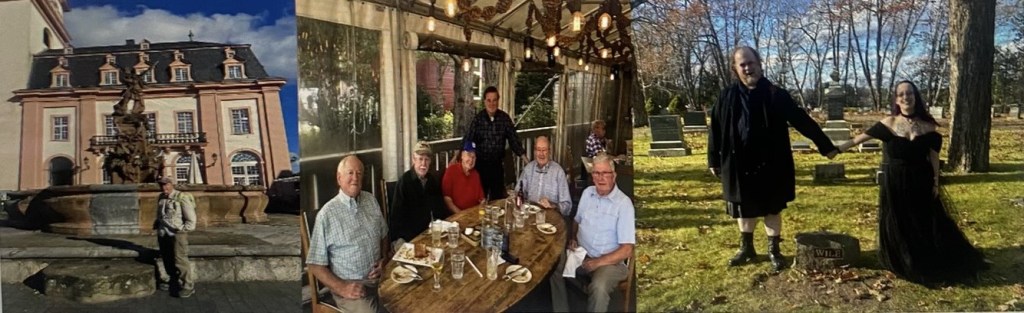
I stand by Neptune’s Fountain 

in Market Square beneath the God of the Sea 

thrusting his trident into the head of some leviathan, 

my lungs still burning from climbing the hill to get here, 

trying to imagine 25-year-old Johann Frederich Weil 

wandering the square 

before leaving for Halifax, Nova Scotia, 

lured by the British Government’s offer 

of free passage, free land, & a year of free rations, 

knowing from Ancestry.com 

his descendants will anglicize the name & populate places 

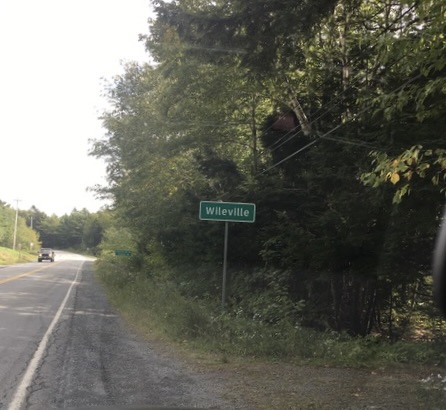
like Wile’s Lake, Wileville, & Wiles Road, 

until the turn of the 20th Century 

when Lyman & Lester Wile 

leave Canada for a shoe factory 

in Marlboro, Massachusetts 

where Lyman will marry Edith Conrey 

& sire my father who 

because his mother left Lyman when Dad was 4 years old

(apparently because of spousal abuse) 

didn’t give a shit about his father or his family. 

Then Johann dissolves—

if he was ever here in the first place—

into the salmon & cream-colored two-story buildings, 

round-arched arcades, & a matching-colored four-story Italianate castle 

as my wife and I join the half-dozen folks in leather & wool 

sipping beer & coffee at outdoor tables by a small restaurant. 

Still, walking back to the hotel 

looking down the hill 

at the Lahn River, a small waterfall, an old stone bridge, 

I think of the hill I grew up on, the bridge below my house 

over a similar river by a similar waterfall, 

& I feel a weird calm, 

connected by currents beyond my ken.

The Royal River Grill

Walking into a restaurant 

with large windows looking out on the harbor 

& soft lights meant to look like candles, 

I see Buzz & Chuck & Ted sitting at a long oak table. 

A shiver of both anxiety & eagerness 

& the next thing I know it’s 1953, 

when this building was the site of the Stinson Sardine packing plant 

& I’m ten years old & in fourth grade 

& I’m going to my first meeting of Mike’nBuzzie’s Gang 

at Mike’s house just up the hill from here, 

because earlier that afternoon 

when it had been my turn to stay after school 

to erase blackboards, 

as soon as Mrs. Croudis left for the teachers’ room, 

Buzzie’s brother Craig ran into the classroom. 

“We’re getting a gang together 

for an apple fight with the uptown kids! 

Big meeting at Mike’s house! Let’s go!”

Dropping the eraser, I ran out the door—

the first time in my life I’d ever disobeyed one of my teachers. 

But for the first time in my life I didn’t care. 

A timid kid, raised in a family 

where a miasma of alcoholic anger & anxiety 

hung over us like the fumes 

from the neighboring paper company,

I’d lie awake mornings before school 

afraid of the day ahead, 

of having my arm twisted or my face washed with dirty snow 

by sixth graders like Mike’nBuzzie,

and now they want me to join them! 

Never mind that the apple fight with the uptown kids never happened, 

or that Mike now has Parkinson’s & stays home 

& that Buzz & Chuck & Ted & I, and later, Allie & John, 

have little in common these days 

except our L.L. Bean khakis & plaid shirts. 

I laugh & reminisce. 

At home. 

Still part of the gang.

The Cemetery

Under gnarled & broken maple trees, 

I walk around my family cemetery plot, 

taking pictures of the wedding—

of the bride, who stands 5 feet 

& maybe weighs 100 pounds, 

her upper chest tattooed with angels, 

her dyed magenta hair, & flowing black gown, 

& the groom, my stepson, 

probably 6’4” & 270, 

black lipstick & kilt, red-haired & bearded, 

standing in front of the family stone, 

originally part of the cellar of my mother’s grandfather’s house, 

while my second wife, 

an ordained Deacon in the Episcopal Church, 

performs the ceremony. 

My stepson’s two daughters stand as ring bearers 

near the memorial stone for my daughter, 

who died at 18. 

My wife’s ex-husband & his wife 

stand between my grandmother’s granite stone 

& the memorial stone for Nanny’s ex-husband. 

Not far from my great-grandfather & great-grandmother’s marble stone, 

my stepson’s nonbinary stepson from his first marriage 

& their partner also take pictures. 

The bride’s parents view the proceedings 

in front of my mother’s bronze marker 

between my father’s & my stepfather’s bronze markers 

while my second wife’s sister, her daughter & son-in-law 

watch both the wedding and a grandson 

climbing the near-by gravestones 

of my barber, my favorite teacher, 

a classmate killed in Viet Nam,  

& my little league baseball coach—

all of whom, I imagine, 

rolling over in horror at this spectacle 

of everyone dressed in black, 

everyone smiling, 

one big happy family.

#

First Friend


Behold, I give unto you power to tread on serpents and scorpions, and over all the power of the enemy: and nothing shall by any means hurt you. —Luke 10:19

Staring at my 3 a.m. fears—A burning planet, a demented president-elect, disease, death—I think of you for the first time in years: first friend, neighbor, bodyguard, mentor, and, although three years older than I, my classmate from fifth through seventh grade.

Thick black hair and an Elvis sneer, Kirk Douglas dimple in your chin, sleeves rolled up as far as they’d go to show those growing muscles, your dark eyes often flashed anger at the world, but also amusement and compassion for the pudgy, awkward kid who worshipped the ground under your motorcycle boots.

Buddy Fitts, Freddy Gallant, Bucky Lapoint—none of the playground bullies—dared trip me, twist my arm, scrub my face with snow, because they knew they’d have to fight you first. And you were tough: sauntering up Bridge Street coatless in a ten-degree storm, snow clinging to your hair like chainmail on the Black Knight, carving your name on your veiny forearm with a Gillette Blue Blade.

In class, you never raised hell, never passed in a paper, just sat in the back seat looking cool until you turned sixteen and could legally split the joint. You cut CAROL into your upper arm and went to work in the cotton mill.

Playing basketball, fumbling with the buttons on Daisey’s sweater, I hardly knew you’d left. Never saw you much afterwards. Heard you and Lapoint started a paving business.

Home from college, I once walked by your house. You hadn’t grown since grade school but your tattoo was cool—a tiger’s head spanning your boney back as you banged away on a rusty Chevy. We grunted greetings. I forgot you.

At our 50th high school reunion, your cousin Roland said you lived in Tennessee, belonged to some Pentecostal church that prays with poisonous snakes to show God’s power over evil.

This dark morning, my friend, I think of how you protected me, wish you were here to keep me safe from the serpents slithering around me.

# #

Welcome, November

#

As readers of this blog know, my daughter Laurie died at the age of 18 from a rare cancer. In November, seven months after the cancer was first diagnosed, she went into Eastern Maine Medical Center. Living 120 miles away, I took a leave of absence from my teaching job and moved into a Ronald McDonald House where I spent the next two months with my daughter until she died on December 23.

Since then, each November as the days grow darker and colder, I can feel my body chemistry change. I’ve coped in many ways, but the most helpful has been through writing. It’s no accident that the first Geriatric Pilgrim blog appeared in November 2015.

#

Sonnet for November

Novembers, I would drive my daughter past

Men in blaze-orange caps, crouched on a hill,

Their 30-30’s sighted, set to kill

Most anything, just so the gun would blast.

My heart began to flutter, then beat fast

As we drove by them—silent, savage, still—

And I could feel the air around us chill.

I’d think, how long, dear God, will this month last?

But I’ve since learned of other ways to die,

And russet hills now fill with memories:

Her gentle, kind, abbreviated life.

These days, I treasure the November sky

Which broadens once the leaves drop from the trees.

November wind is clean, a whetted knife.

#

Darkness

Now darkness begins:

light dimming after lunch,

long shadows on the lawn.

I curse the old lady

crossing the street

in front of my car,

lose gloves,

feel the familiar kick

to the heart. 

You’d think after all these years

I’d be over it,

but it’s always different…

this darkness…

Gone the murky numbness,

the black rages,

no more the dim corridors

of “if only” and “what if,”

lit up by Johnny Walker.

Now, who knows what waits 

in the darkness ?

Another old friend’s Christmas card

to bring me tears?

More recurrent dreams of stumbling

through stony landscapes?

Another season of bingeing bad TV?

Still, the waning light 

is clean and clear,

the view scoured of chewed leaves, 

dead flowers, black flies.

And sometimes, just sometimes,

Love enfolds my fears,

and I hear Laurie whisper, 

“Dad, let the thoughts go.

Let darkness begin.”

Playing with Fire

#

The only hope or else despair…

To be redeemed from fire by fire.

            —T.S. Eliot

#

I’m aware of how old I am when I recall that one of my chores when I was kid was to lug old newspapers, magazines, cards and letters, anything paper, out to the old oil barrel in the back yard and burn them. No curbside pickup in those days. (Hell, our town didn’t even have curbs.) It was not a job I liked. Sometimes, I burned myself; sometimes my fingers went numb in the cold; sometimes it took me two or three or more kitchen matches to get a fire started, depending on the wind, which sometimes blew acrid smoke in my eyes. 

In those days, fire was a physical force to be endured, and I was more than a little afraid of it. 

Sunday School didn’t help. Mrs. Raines warned that if I wasn’t good and didn’t do my chores, I might go to Hell, which was a place of fire and brimstone (I didn’t know what brimstone was, but I was pretty sure it burned)—words I often recall when I think of the fires around me these days: the ecocide of our planet, the continued threat of nuclear annihilation, riots on our streets, countless false messiahs fanning the flames of our differences.

A dozen years or so after Sunday School, I saw worlds—or at least woods— go up in flames. I worked for the U.S. Forest Service on a regional Hotshot Crew based in McCall, Idaho. (The term “hotshot” describes those who work on the hottest part of a forest fire.) Looking back, it was hot, dangerous, and grueling work, and my lungs carry the scars from those fires.

But at the same time, I loved the physical challenge. (Hey, I was 20!) And there’s been nothing in my life like the thrill of watching a forest fire racing through the tops of trees. It was frightening, but at the same time enthralling. 

I also learned that despite Smoky the Bear’s telling me, “Only you can prevent forest fires!” (What a burden to put on kids!) most of the fires I fought were caused by lightning strikes and that the occasional fire was actually good for the forest. When flames consume organic matter, nutrients are released back into the soil. Fires can thin the canopy allowing more sunlight to reach the forest floor, encouraging the growth of native species and eliminating invasive weeds. Fires can promote species diversity. (Some species, such as the karner blue butterfly and the wood lily depend on fire to survive.) Fires can improve habitats for wildlife by reducing dead vegetation and stimulating new growth, which can provide food and cover.

During my first marriage, I used to help my then father-in-law burn brush in the winter. It was an all-day activity. We gathered all the limbs and underbrush we’d cleared during the year from around his house, piled them on a couple of old tires filled with gasoline and set it ablaze. I was still in good physical shape, and I enjoyed the exercise. But I experienced another aspect of fire as well. Poking at the burning brush in the gathering darkness, gazing into the flickering shadows cast by the fire on the surrounding snow, I sensed my ice age ancestors dancing around the flames which protected them from wild animals and the cold. 

A couple of weeks ago, Mary Lee and I watched two fireflies sparking the summer night. A little research told me that fireflies produce light in special organs in their abdomens to find mates. When a female sees a male making a signal, she flashes back. Then the two reciprocally signal as the male flies down to her. If everything goes right, they mate.

All I could think of was the Bob Seeger song, “They got the fire down below.”

Another kind of fire I remember.

Now, it’s been sixty years since I’ve seen a live forest fire, let alone fought one, and probably forty since I’ve burned a pile of brush. I’m tired out after an hour in the garden. Often these days, a romantic evening is playing Scrabble or Canasta until 9:00 p.m. But I’m still drawn to fire: I can spend hours staring at the flames in our fireplace. 

I’ve also become more aware of what I think of as the fire of Presence, represented, I think, in the Bible’s Old Testament by the burning bush that drew the attention of Moses and in the New Testament by the Holy Spirit descending upon Jesus’s followers as “Divided tongues, as of fire….” 

One of my old spiritual directors used to tell a story from the Desert Fathers in which a young monk said to his teacher, “Abba, as far as I can, I say my little office, I fast a little, I pray and meditate, I live in peace as far as I can, I purify my thoughts. What else can I do?” 

His teacher stood up and stretched his hands toward heaven. His fingers became like ten lamps of fire. And he said to him, “If you will, you can become all flame.”

So far, the closest I’ve come to experiencing this fire happened during the last two months of my daughter’s life. After spending the day in the hospital by Laurie’s bedside, I’d go each afternoon to the hospital chapel. I was almost always the only person there. Upon entering, I’d light two pillar candles on the altar, sit in the front row of chairs, and stare between the candles through a large round window looking out over the river. After a while, the candles would sometimes seem to glow more brightly, their light dancing. The flames would come together, enfolded by the stained glass around the window. Then, I too would become enfolded in a fiery feeling of being scoured of fear and anger and shame, which allowed me to face the next day.

These days, as I sit by our fireplace, it’s hard not to identify with the dying flames. But I realize even glowing embers can still, like forest fires and fiery brush piles, like altar candles in a hospital chapel, purge away what is false, promote new growth, light someone’s way in this burning world.

            May it be so.

# #