
Our Rite of Hope for January 7, 2021

#

“…. by participating in a ritual, … [y]our consciousness is being re-minded of the wisdom of your own life. —Joseph Campbell

#

Yesterday we celebrated Epiphany,

When wise men worshipped the Christ child. 

& recalled the goons in MAGA caps who trashed the nation’s capital.

Still rattled today, we observe our annual ritual:

  We play The Christmas Revels 

                                                            Wassail, wassail, all over the town

  We strip the tree of 

   Ornaments:

     From pilgrimages—

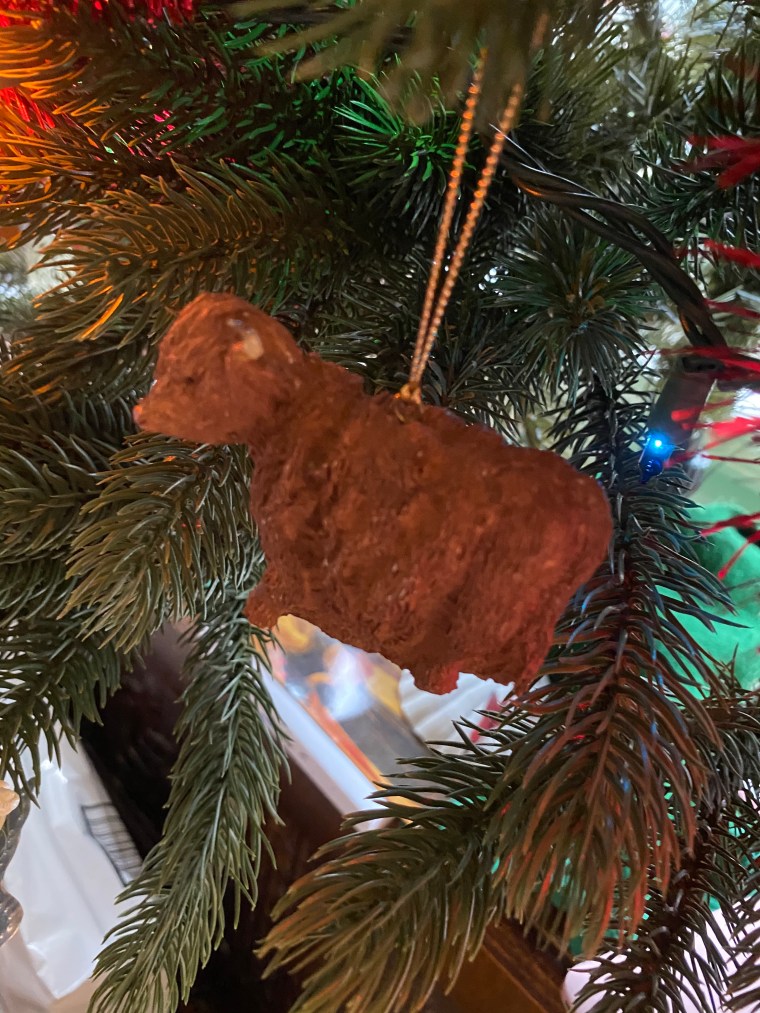
                 2 wooden sheep from Scotland 

          (my ancestors died for Bonnie Prince Charlie)

                          2 olive wood crusaders’ crosses from Jerusalem

                                    (Christians & Muslims slaughtered each other for centuries)

                          1 porcelain nazar from Istanbul

                                    (protection against evil)                      

Here come I, old Father Christmas

             From childhood—

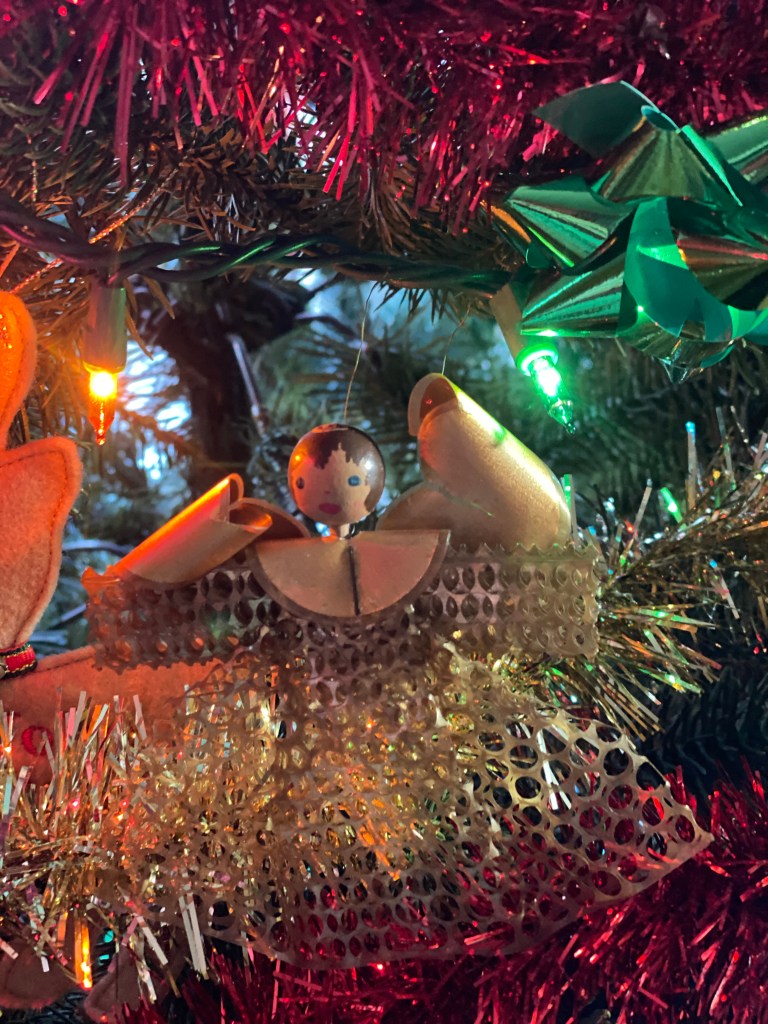
                          1 wooden and tin mesh angel from the turn of the 20th Century

(2 world wars, 2 flu epidemics, the Depression, Korea, Viet Nam, 3 assassinations, Watergate, 9-11, yesterday)


        1 plastic Santa from WWII                             

           (Dad in Belgium building bridges for tanks)

The boar’s head in hand have I

3 shiny ornaments my parents bought with green stamps 

                                    (To brighten memories of their broken childhoods)

                                                                                                There was a pig went out to dig

                                                                                                Christ-i-mas day, Christ-i-mas day  

            From children & grandchildren—

                        4 yarn & toothpick God’s-eyes

                        1 fuse-bead heart, 1 fuse-bead cat, 1 fuse-bead turtle, 

                        2 black felt cats honoring my step-son’s first pets

                        1 brown fur diarrhea microbe 

(from my daughter-in-law who helps impoverished countries improve water quality)

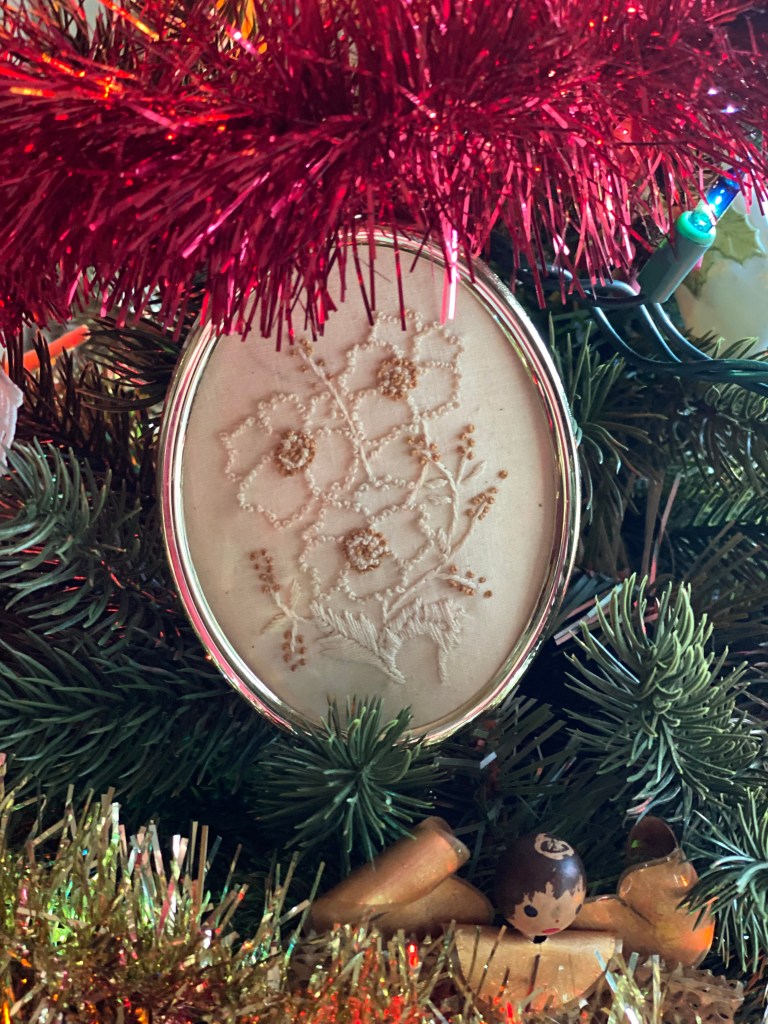
                        1 embroidered-flower ornament from my 16-year-old daughter

                                    (2 years before she died from cancer)

                                                                                                            The holly and the ivy…

     Lights:

            3 strings of red  blue  green  orange  bulbs

                        (The big painted ones long gone, but at least these aren’t white)                              

            1 yellow star

                        (“For we observed his star at its rising, and have come to pay him homage.”)

Dance, then, wherever you may be

                                                                                                I am the Lord of the Dance, said he.

So, we dance

between

Christianity & paganism

Past & present

Light & dark

Death & life

Sorrow & joy

Arms clinging to our rite of hope.

# #

Stick Season

#

As New Englanders know, each year has six seasons: the usual spring, summer, autumn, winter, plus mud season—between winter and spring—and stick season—between autumn and winter.

I’ve written about mud season before (https://geriatricpilgrim.com/2019/03/). Now it’s time to talk about stick season. 

You know about our autumns and winters. These are the seasons in all those lovely photographs of New England. You know, the flaming foliage ones, mountains ablaze in orange, yellow, and red, and the snowy ones, white trees bowing as skiers whiz past. But in between—usually it’s the entire month of November but it could be December as well—the leaves have left, the snow hasn’t arrived, and the trees become stick figures. “Bare ruin’d choirs, where late the sweet birds sang,” to quote Mr. Shakespeare.

Stick season has been getting a lot of press these days, thanks to a young singer named Noah Kahan, whose song “Stick Season” about the pain of lost love—“And I love Vermont, but it’s the season of the sticks/ And I saw your mom, she forgot that I existed…”—was a viral hit in 2022. (And as synchronicity would have it, as I was planning this blog, he sang it on Saturday Night Live, December 2nd. Check it out on YouTube.)

For years, Shakespeare and Kahan described the way I felt about this time of year. As readers of this blog and my book, The Geriatric Pilgrim: Tales from the Journey, know, my daughter Laurie entered Eastern Maine Medical Center in November of 1988 and died there on December 23rd. For those two months, I lived at a Ronald McDonald house about a mile away and walked back and forth to the hospital twice a day along the Penobscot River, where the skeletal maples, elms, birches, and oaks mocked any hope for Laurie’s recovery.

Over the next 30 years, each stick season was the backdrop for my anger, sorrow, withdrawal, guilt, and shame, exacerbated by a holiday season, which now starts about November 1, with its Hallmark images of healthy happy families gathered round a perfectly shaped Christmas tree. Throw in the Christian season of Advent—four weeks of paradoxical readings about Christ the child and Christ the judge, sin and grace, justice and mercy, comfort and challenge—and I came to dread this time of year.

But about five years ago, thanks to my Al Anon program, I was able to separate my shame, guilt, and anger from my grief. I saw that because of growing up in a family riddled with alcoholism, those noxious emotions were there long before Laurie died. And I realized that I didn’t have to hang on to them to grieve the sorrow and emptiness that one must accept when they lose a loved one. That I could feel sad without feeling angry. 

At the same time—and I’m sure it was no coincidence—as I walked the woods behind our house, I began to appreciate the stark beauty of stick season. Without all the foliage, the sky is larger, and sometimes it’s a November blue unlike at any other time of the year. The wind is bracing. The flies are gone. Unlike in mud season, the paths are still dry. Even the sticks themselves—the tree branches—have a stark beauty, like Japanese calligraphy. 

 I started to see the departed leaves as images of my departing shame, guilt, and anger.

Which helped me see Advent as a time for letting the spirit blow away what the Bible often calls our “iniquities,” but what I think of as my “survival mechanisms”: those behaviors I developed as a kid to survive family disfunction, but which have become injurious not only to my health but to those around me. 

These days I think of stick season as a time to simplify my life. Which has been especially easy this year. After 37 years of hosting a Thanksgiving for anywhere from ten to 24 people, Mary Lee and I turned over the apron to her younger son, who, along with his fiancé, did a fantastic job feeding and making us all feel comfortable.

Last week, Mary Lee retired after 22 years as the ordained Deacon at our Episcopal Church. For 22 years, churchy stuff has filled not only our Sundays, but other days of the week, as I have also been an active member of St. Paul’s. Now, as is our diocesan policy, we will worship elsewhere for a while. We will listen for other callings to where—as Aristotle said—the needs of the world and our talents cross.

Sadly, but I guess appropriately, our cat Zeke has used up his 9th life (I didn’t think he’d make it to 2023), leaving our house pet-less for the first time in our marriage.

I have given up driving 30 miles once a week to play in my old-time music jams. Mary Lee and I have decided we no longer enjoy going out for dinner once a week.

So, I suppose, I am in the stick season of my life. If so, it’s not bad. 

Let’s talk about Advent again. One thing I’ve always had trouble with is this idea that not only are we awaiting the celebration of the birth of Jesus, but we are supposed to be awaiting the Second Coming of Christ, when, according to some scripture passages, Christ will come to judge us and send some of us to hell and some of us to heaven. 

Sorry, I can’t buy the judgment thing. My experience is that I’m surrounded by Grace, if I can just (“just’? Ha!) open my eyes to it. So that when Jesus tells his disciples to “Keep awake!”—which he does a lot—I think he’s talking about opening our eyes to what’s already there, not what’s going to suddenly appear descending from a cloud.

Sort of like seeing the sky that’s always there, but only fully visible during stick season. 

(Or the water, for that matter)

So, for me, the Second Coming is an invitation to awaken into a new consciousness, a new appreciation, a new seeing, of life, the universe, and everything.

I watched a YouTube interview with Noah Kahan, in which he said that his hit song  represented a new musical path for him. And as blogger Mitch Teemley wrote recently about Advent, the word serves as the root of our word “adventure,” which, of course, I like because that makes me think of “pilgrimage.” “In short,” as Mitch wrote about Advent and I would write about pilgrimage,  it is “an experience that can change a person forever. If they let it.”

I’m going to stick with that for a Wile.

# #
Celebrating a Milestone

Looking back at the Eildon Hills in Scotland.

#

 “Great things are not done by impulse, but by a series of small things brought together.”

—Vincent Van Gogh

#

This blog is a milestone for me. Eight years ago this month, I published my first Geriatric Pilgrim blogs (https://geriatricpilgrim.com/2015/11/). And while I’m not big on party hats and horns, I want to celebrate.

The Romans erected the first stone markers to let travelers know not only the number of miles they had to go to reach their destinations, but also the distances they’d covered. Today, businesses talk about a milestone as something that demonstrates a significant, marked change or step in the development of a project. Parents keep track of milestones in their child’s development. (“Look, little Leslie’s walking! Where’s the camera?”)

When I think of the importance of milestones in my life, I think of the second day of our seven-day walking pilgrimage along St. Cuthbert’s Way through Scotland and England. Still apprehensive about being able to complete the 72-mile trek, I looked back across a newly mown field to the Eildon Hills fading into the dimly distant horizon. The day before, my wife Mary Lee and I had crossed those three hills.  I felt a burst of energy. Look at how far we’ve come, I thought. We can do this!

And as I look back at those first blogs from 2015, I’m also surprised and energized by how far I’ve come in the last eight years.

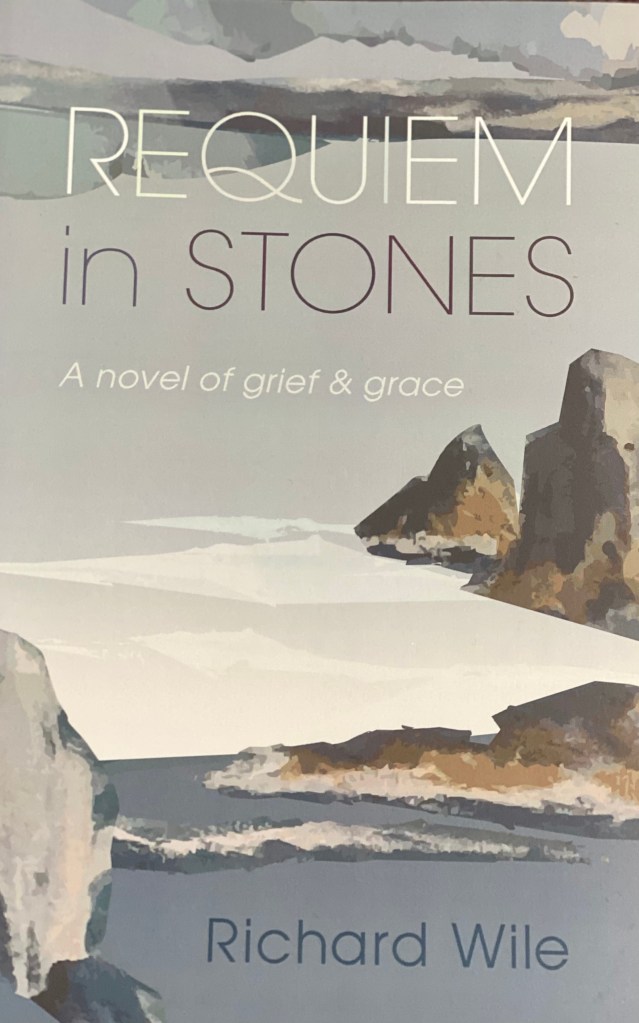
In 2015, I’d just published a novel, Requiem in Stones: A Novel of Grief and Grace, based on my experiences after my daughter Laurie died of cancer.

This novel about the effects of a child’s death upon a family, had taken me 20 years to write and I was emotionally drained. For the sake of my sanity (not to mention the wellbeing of those around me), I wanted to write something for fun.

Two years earlier, Mary Lee and I had walked St. Cuthbert’s Way, and I’d become curious as to how pilgrimages differed from vacations, business trips, escapes, or educational trips. I was especially interested in the inner journey one makes on a pilgrimage. I read books about some of the pilgrimages people had taken, drawn especially to those who approached the spiritual journey with humor and curiosity. I decided to try to use the same approach in a blog about my travels.

But now when I reread those first blogs, I can’t find much humor. Like the novel, they still seem to me focused on the effects of my grief—physical problems, nasty thoughts and visions. What humor I find now sounds to me sarcastic.

Still, because I’m also writing about specific places—Jerusalem, retreat houses—I can also see the beginnings of my detaching, of stepping back, of broadening my horizons.

And that’s what writing these blogs over the next eight years has done for me. By focusing first on my various exterior journeys, and then going inward, I’ve given my grief more room to live in, so that it doesn’t dominate either my life or my writing. My grief over Laurie’s death is no smaller, but the landscape in which it resides has expanded to include not only a dozen countries, but also my family history and my geriatric journey as well.

Probably nothing has helped me better understand this interior landscape over the last eight years than joining two 12-step programs. Al Anon, the program for families and friends of alcoholics, and ACA, the program for adult children of alcoholics, have become like lenses on a pair of binoculars, helping me view the effects of my grief—especially fear, anger, and shame—as mountains that make the Eildon Hills look as level as pool tables.

I remember telling my Al Anon sponsor in one of our first meetings, “I will always feel at some level that I killed my daughter.” Even 25 years after Laurie died, I blamed my daughter’s death on my divorcing her mother two years earlier or by not divorcing her mother soon enough. I said that every year, right around Thanksgiving, I could feel my body chemistry change. For the next month or so, right up until the anniversary of Laurie’s death on December 23, I said, I never knew how I would react. Some years I was angry at everyone, some years I cried at anything remotely sad, some years I spent the months hiding from the world by reading mysteries. I said that I’d just accepted this response as the way it would always be.

And I remember my sponsor’s reply: “Okay. Maybe… Let’s see what happens.”

Through working the Al Anon program, especially Step Four, taking “a fearless moral inventory” of myself, I discovered that because I’d grown up in a family riddled with alcoholism, I’d been clambering up and down those mountains of fear, shame, and anger long before Laurie’s death. Fear and my need for what I thought was security had driven me into an unhappy first marriage. Shame and my need for respect had driven me into erecting any number of false personas. My need to deaden my anger had driven me into my own alcoholic behaviors. Using ACA, I learned about the long-term effects of growing up in an alcoholic family, while Al Anon gave me the tools to separate my grief for my daughter’s death from my fear, anger, and shame over losing her.

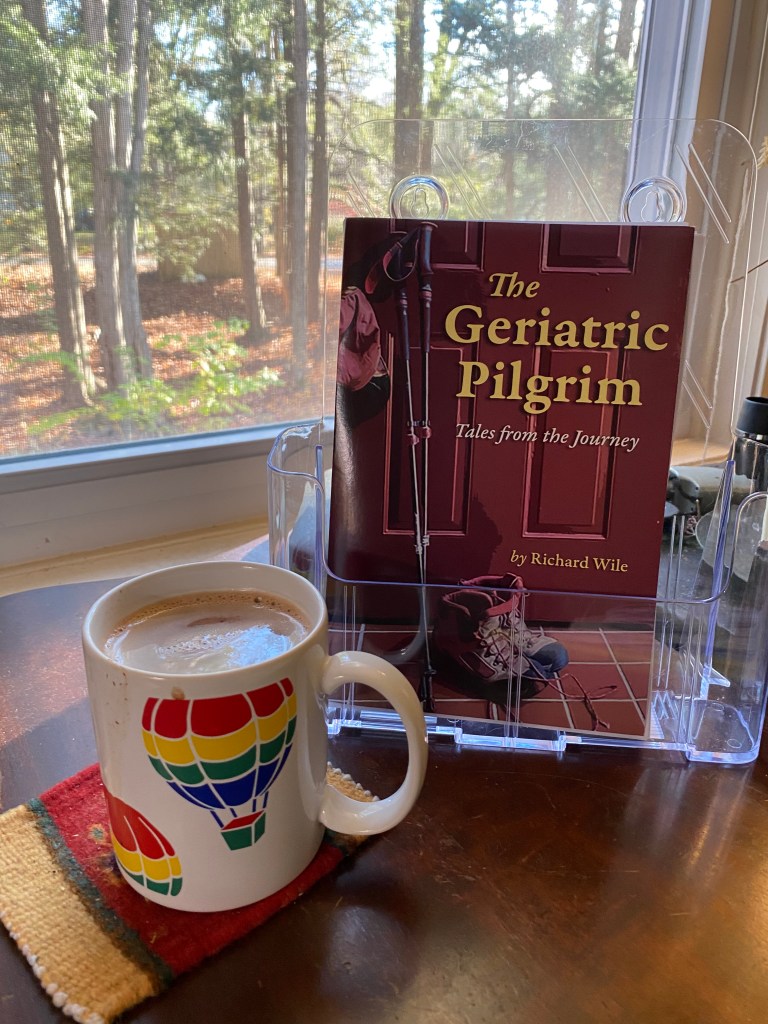
So that four years ago, I realized that I was enjoying the Christmas season—no tears, no angry outbursts at the baggers at the grocery store, no reading marathons. And as I was collecting fifty of my blogs to put together in my second book, The Geriatric Pilgrim: Tales from the Journey, I had to revise several blogs which had talked about how hard the Christmas season still was for me.

There’s also nothing like successful heart surgery for expanding one’s inner landscape. Only through a timely wellness checkup and the perspicacity of my PCP—“No, being out of breath is not normal. I want you to take a stress test this week!”—did I avoid another family disease: falling dead of a heart attack. Only because of what I’ve called in these blogs “grace” am I’m still here. Only through grace am I grateful for the life I’ve lived, even for those demanding hikes over mountainous landscapes.

All of which is worth celebrating. If not with paper hats and party horns, at least with a cup of hot chocolate.

Cheers!

# #

Storm Stories

Hurricane Carol: 1954. Northeast Historical Film

#

Recently, Hurricane Lee, at one point a Category 5 hurricane, churned up the Atlantic coast, bringing with it dire warnings such as, “Lee Drives Towards Us with a Hugh Wind Field, Damaging Waves, and Flooding.” The Episcopal Church of Maine’s website offered a prayer, which began: “Creator God, we ask you to calm the wind and the waves of the approaching hurricane and spare those in its path from harm.”

I put away lawn chairs, harvested basil, tomatoes, and beans from my garden, and checked to see that our flashlights all had new batteries and the lamps had oil. I cleaned out the garage, so that I could get my car out of the way of falling branches.

Well, the trees did some jitterbugging in the wind to the rhythm of our wind chimes, and our lawn had a smattering of small branches. My Zoom meeting with an Al-Anon sponsee on the coast ended early when his power went out, and my bean pole in the garden blew over, but all in all, the effects of the storm were minimal. A few years from now—if I’m still alive—I doubt if I’ll tell many stories about Hurricane Lee.

Hurricane Lee: 2023

There are other hurricanes, other storms, however, whose stories have stayed with me.

In 1954, Hurricane Carol, the first Category 5 hurricane to hit New England, roared through Maine, followed ten days later, by Hurricane Edna. A little research tells me that the two storms caused 25 million dollars in damages and destroyed 3500 cars and 3000 boats. What I remember was that at 11 years old, I thought hurricanes were neat. The thundering river down the hill mingled with the roar of the wind, and our house shook like some carnival ride. I couldn’t understand why my father was chain-smoking and pacing back and forth in front of the living room window, muttering, “I hope that goddamned tree doesn’t fall on us.” The day after Hurricane Carol, my friends and I walked through town, gaping at the elm trees that had blown over, amazed at the size of their roots, which rose several feet over our heads.

The next hurricane to hit Maine was Gloria, in September 1985. According to Wikipedia, this storm affected six counties in Maine, with multiple injuries, downed trees, and 250,000 people without power, some for up to fourteen days. I was living Down East at the time. Less than a month earlier, my first wife and I had separated, and the day after the storm I got up early to drive my daughter Laurie to church camp for the weekend. After dropping Laurie off, I continued on to visit my mother and father. When I pulled into the driveway, I saw Dad standing in strewn leaves and fallen branches, trying to fry bacon and eggs on a charcoal grill. My Grandmother Cleaves, who’d come over from her apartment for a hot breakfast, stood at the window.

What I recall even more clearly now was that my father, Laurie, and Nanny Cleaves all died within the next four years. Throw in a divorce and a second marriage, and I experienced an emotional hurricane that made Gloria feel like a summer breeze.

In 1991, Hurricane Bob came to Maine. Three people died, many residents lost power, and there was over five million dollars in damages. Again, the storm’s direct effect on my new family and me was minimal, but because of the heavy rains and losing power, my Grandmother Kimball’s cellar flooded because her sump pump stopped working. At 92, living alone, she couldn’t cope with the responsibility of keeping the house up, so she sold it to me. Mary Lee and I lived in that house for the next 22 years. Then, after a spring rainstorm and another flooded cellar (something like the fifth one in those 22 years), we sold the house and moved to where we now live (which, thankfully, has no cellar).

Our cellar after the Patriots’ Day Storm of 2007

I think of other storms in my life—natural ones, such as the ice storm of 1998, various nor’easters leaving two feet of snow; emotional storms, such as my defeats and disappointments, a divorce, Laurie’s death—and I realize that I remember them far more clearly than I do the sunny days—beach days, vacations with family in Florida and Bermuda—or the happy times: the victories, the times I’ve been recognized or honored. I don’t know about you, but it’s the storms rather than the sunny days in my life that have become the stories of my earthly pilgrimage, those narratives that have helped me navigate my life, and which I continue to look back on and refer to as I forge on towards whatever denouement awaits me.

So, why that is that even after sixty years, I remember my defeats on the basketball court more than the victories? That I remember my divorce settlement more than my first marriage ceremony? Laurie’s death more than her birth?

Maybe one reason these storms stay with me is that I’ve survived them all. Storms help me feel good about myself, less afraid of the future. I can be “defeated but not destroyed,” as the great storyteller Ernest Hemingway said. I recall meeting a woman who knew of Laurie’s death and who’d just lost her son in a fire. Her first words to me—even before saying hello—were “Tell me how you’ve survived!” At the time, a guy I’d come to know from being in grief counseling together, had just committed suicide and I realized surviving Laurie’s death really was an accomplishment.

As I think of it, storms have not only made me aware of surviving, they’ve made me feel more alive. And I don’t think I’m alone in feeling this way. There’s nothing like a good nor’easter or hurricane to draw people to watch the ocean waves crashing over the rock-bound coast of Maine. After Laurie died, I found myself missing those last weeks of her life when I was living at a Ronald McDonald House, spending the days beside her. There was a focus to those days, a purpose, and the great themes of Life and Death dwarfed the usual minutia of everyday life.

Speaking of less fear and more focus, I’m interested in the number of people I know who suffer from anxiety and depression but who become fearless when forced to face specific physical dangers such as a high wind or a flood.

In a storm, I let go of the old stories I tell myself about who I am. I’m forced to come to terms with the fact that life as I knew it may never be the same. I plunge into a new adventure, a tale of unknowing, which can also be a story of spiritual re-birthing if I can only recognize and surrender to that power greater than myself.

Looking back at the storm stories in my life helps me realize that while I may want to shrink God down to my size, God is always bigger than I am, will always be God of my not Understanding.

And of course I have to include a snowstorm picture—this from 2013.

# #

On Vulnerability

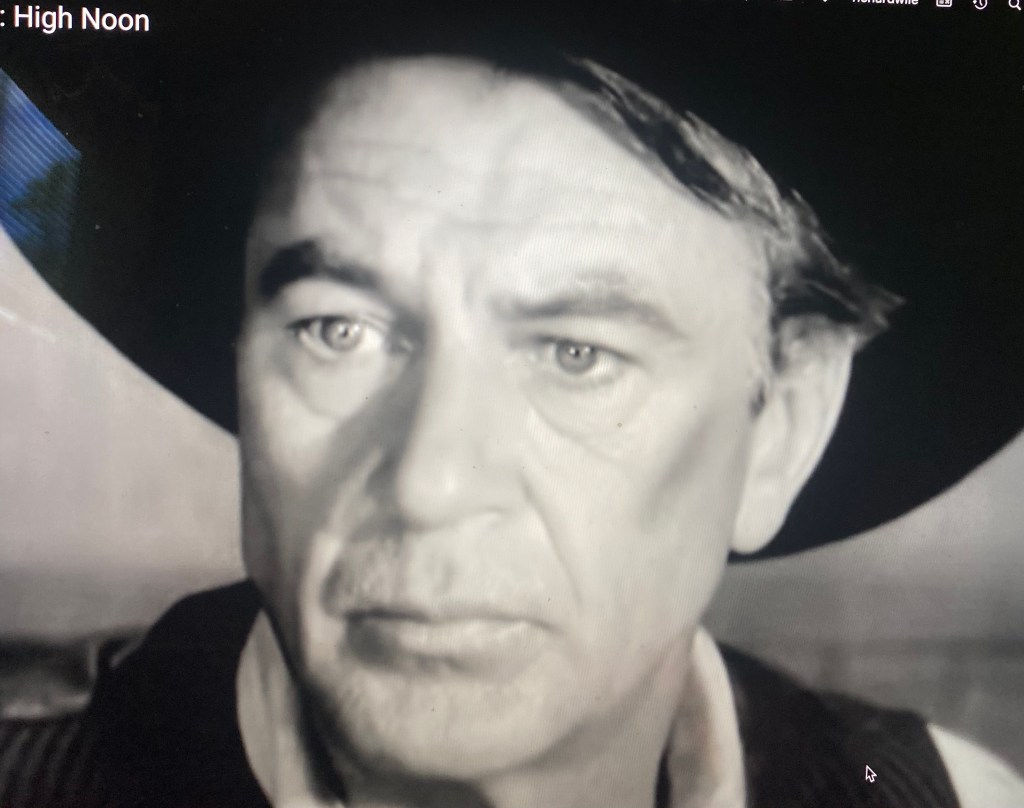
Will Kane, as the clock strikes high noon.

#

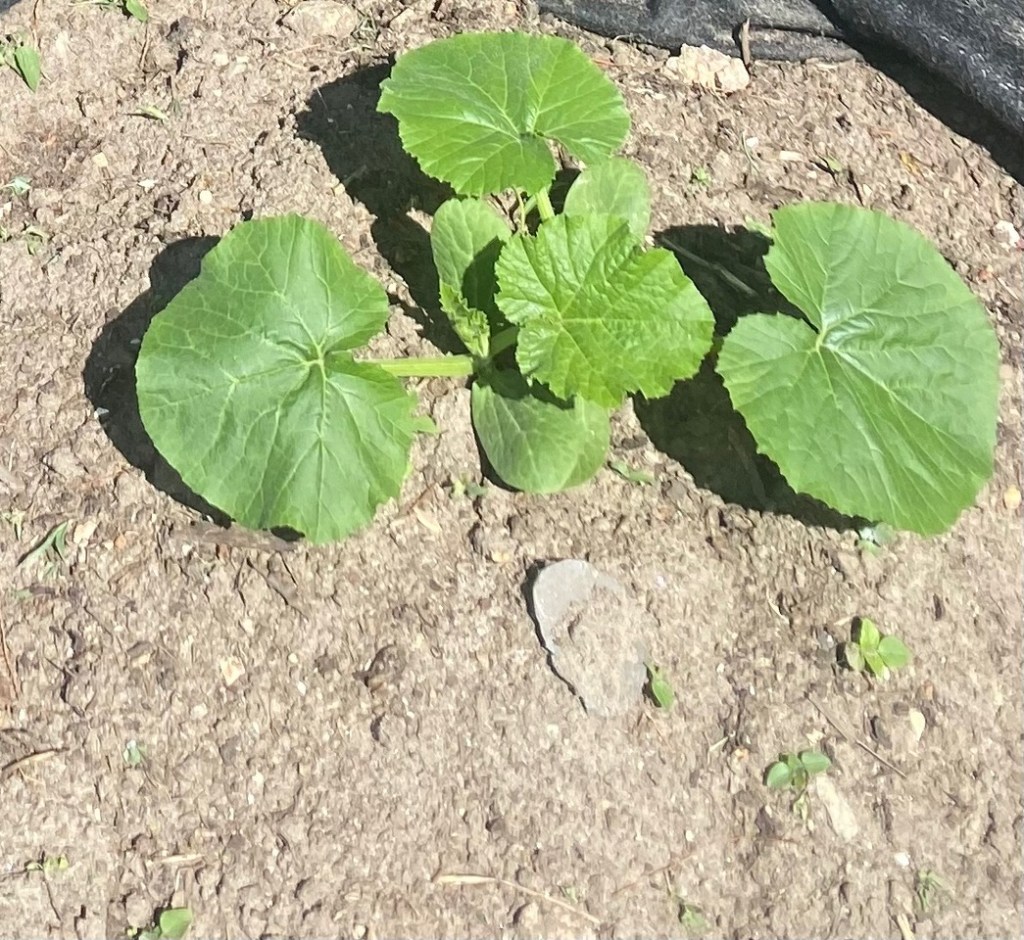
Perhaps it’s because I turned 80 this year. Maybe it’s because this summer has been hot and muggy. Whatever the reason, I’ve found myself more aware lately of my vulnerability. Walking in the woods these days requires changing into insect-resistant clothing because of ticks; on walks, working in the garden, I need to be sure to bring water with me or I get weak and dizzy; after heart surgery, I need to keep checking my fancy watch to make sure my heart rate doesn’t get much over 120 bpm. I’m tripping more often and have removed several rugs from our house. Earlier this year, I fell in my garden and only by grace/luck/whatever did I miss cracking my head on a rock by about 6 inches. And on a recent hot day, I was mulching my pumpkins, felt weak, saw that my heart rate was 145, sat down, and couldn’t get up. Fortunately, I had my water, and was finally able to get home after a half-hour or so (whereupon I had a 1½ hour nap).

I don’t like being this vulnerable, probably because I’ve spent a lot of my life trying to avoid showing vulnerability. As a boy in a small New England town in the 1950’s, I learned vulnerability was for sissies. Never ask for help; never let anyone see you cry. In high school, I learned success, whether on the basketball court or getting Suzie’s bra off, was a matter of will power. Mind over matter.

But these days, I find that what I mind doesn’t seem to matter. Which is why I’ve made a pilgrimage through the internet in search of something good to feel about vulnerability. At first, I didn’t have much luck. If you google the word “vulnerable,” most of the definitions have negative connotations: “capable of or susceptible to being attacked, damaged, or hurt; open to moral attack, criticism, temptation, etc.”

Still, looking up “Articles on Vulnerability,” I found advocates. Researcher and storyteller Dr. Brene Brown writes, “vulnerability is the core, the heart, the center, of meaningful human experiences.” Others write that vulnerability allows us to be authentic. It can bring a sense of closeness and fulfillment. It can bring about more honesty, more trust. Brene Brown again: “Vulnerability is the birthplace of innovation, creativity, and change.”

As synchronicity would have it, as I was reading about vulnerability, I was finishing the book, High Noon: The Hollywood Blacklist and the Making of an American Classic by Glenn Frankel. Which led me to watch for probably the tenth time, the movie on which the book was based. In case you’ve forgotten the plot, former marshal Will Kane (Gary Cooper) is preparing to leave the small town of Hadleyville, New Mexico, with his new bride, Amy (Grace Kelly), when he learns that local criminal Frank Miller has been set free and is coming to seek revenge on Kane for turning him in. When the marshal tries to recruit deputies to fight Miller, he finds the town’s people have turned cowardly. His wife, a Quaker opposed to violence, doesn’t understand why her new husband feels he must stay, so she decides to leave town. When the time comes for a showdown, Kane must face Miller and his three cronies alone.

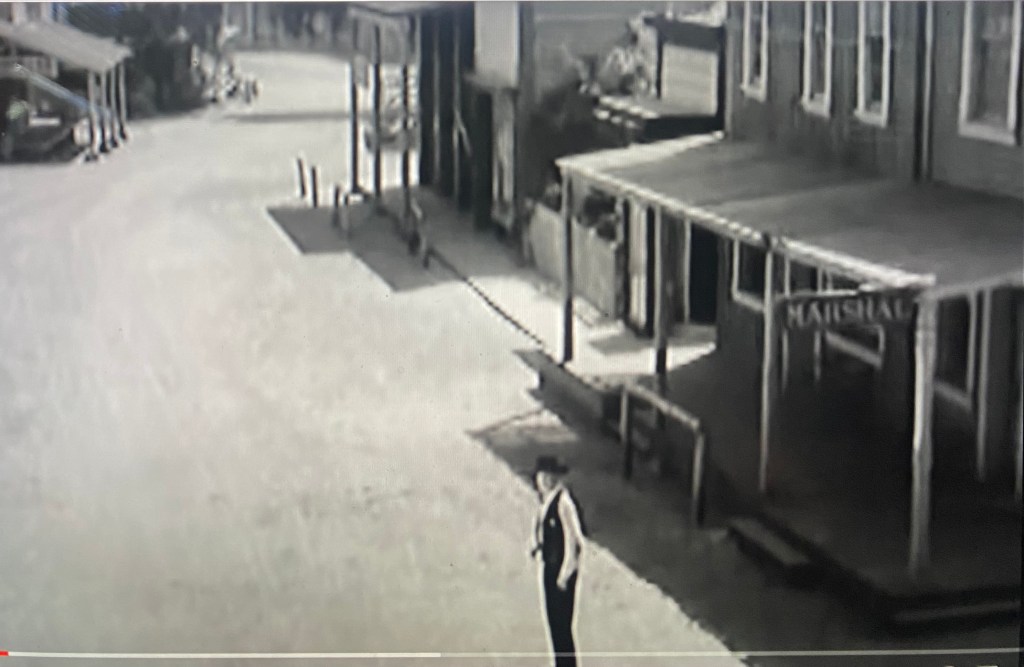
This time, when I watched the film, I was aware of how the writer, Carl Foreman (who was being investigated for having been a Communist and who saw himself forsaken by people he thought were his friends), and the director emphasize Kane’s vulnerability. Through closeups of an aging Gary Cooper’s face, we see his fear, and scene after scene of overhead camera shots of his walking alone up and down what looks to be a deserted town show his smallness. Meanwhile, Tex Ritter is singing: “Do not forsake me, O my darlin’.” 

Well, his darlin’ doesn’t. Amy comes back to help Will kill those nasty bad guys, and, after throwing his marshal’s badge at the yellow-bellied citizens of Hadleyville, Will rides off with his wife into the afternoon sunlight.

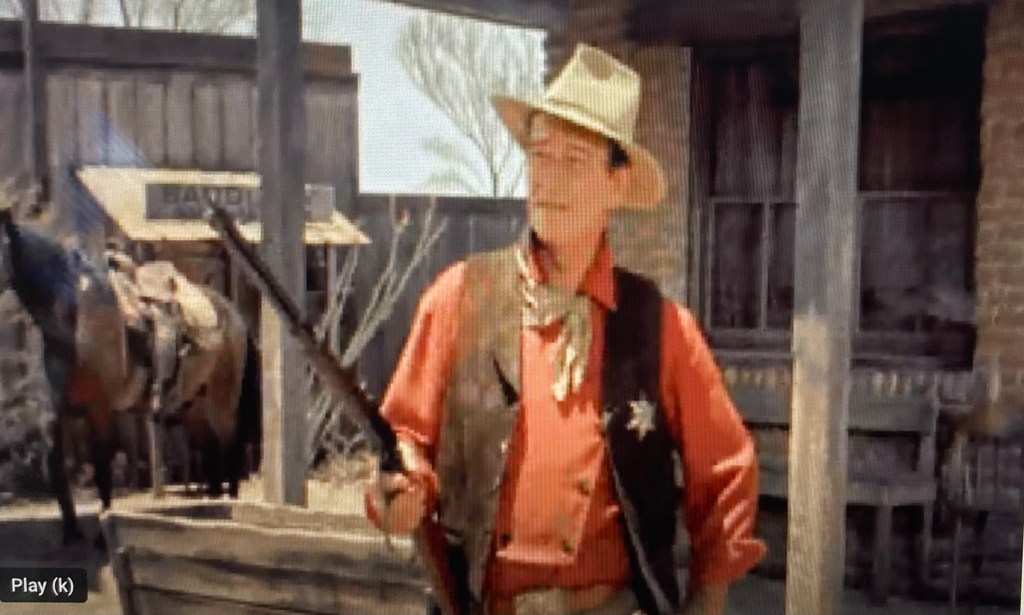
But although law and order triumphs in the end, the movie apparently infuriated traditionalists, like movie hero John Wayne and director Howard Hawkes, who said he didn’t “think a good sheriff was going to go running around town like a chicken with his head cut off asking for help.” So, Hawkes and Wayne made the western, Rio Bravo. In this movie, gunslinger Joe Burdette kills a man in a saloon, and Sheriff John T. Chance (John Wayne) arrests him. Before long, Burdette’s brother, Nathan, comes around, threatening that he and his men are going to bust his brother out of jail. Chance decides to make a stand. Does he ask the townsfolk for help? No way. “They’ll only get hurt,” John Wayne growls.

John T. facing the bad guys.

Meanwhile, unlike Will Kane’s wife, Chance’s love interest (Angie Dickenson), refuses to leave town. As the time for the showdown nears, she tells Big John, “You better run along and do your job.”

The message here seems to be that real men don’t need to ask for help; they inspire loyalty. Other reinforcements arrive: Dude, the town drunk, an old cripple named Stumpy, and a baby-faced cowboy, Colorado Ryan. Rather than showing fear as they await the arrival of the bad guys, they sit in the sheriff’s office making wise cracks and singing songs. After winning the inevitable shootout, they all stay in town to sing and crack more jokes with the lovable town’s folk.

In the face of danger, real men don’t ask for help, the movie proclaims. Real men don’t show fear. Real men sing and tell jokes.

Maybe it’s a sign of the times (my times, anyway), but I admire Will Kane, who overcomes his age, his fear, and his despair to uphold his principles, more than I admire John T. Chance who doesn’t seem to have a vulnerable bone in his body. I realize that thirty-five years ago, after my daughter Laurie died, still thinking that will power solves all problems, I tried to avoid asking for help, and how the resulting anger almost tore me apart, until, exhausted, I finally surrendered my will to a god I didn’t really believe in. Only then was I able to feel relief, and eventually even experience moments of joy, an emotion I’d never felt before in my life because I’d been too concerned with not being vulnerable.

Brene Brown and others go so far as to say that vulnerability is a sign of courage and strength. I can see that. To be vulnerable, I need to have a strong sense of self. I have to be honest about what I can and I can’t do, and I have to be honest with others, even if it means being rejected. I need to stop trying to prove myself. I must own my past mistakes, make amends to others, and move on. I have to be able to face difficult emotions, especially these days, about my diminishments, dying, and death. I must continue to ask for help and accept it.

And I damn-sure need to wait until cooler weather to mulch pumpkins.

And spend more time in this chair by the garden.

# #

Weeding

#

It’s 4:30 in the afternoon and the temperature is still over 80°. A breeze blows from the southwest, making the air feel even hotter. Black flies swarm around my floppy hat as I crawl through the dirt, weeding pumpkin plants. Every few minutes I need to lean back and stretch my aching back. My hand is cramping.

And I’m as happy as a clam at high tide.

From the swamp on the other side of the road by our community garden, sparrows and cardinals chirp and whistle. I listen and drop back to my hands and knees to pull up small bunches of crab grass, pigweed, and plantain. I’ll let the milkweed grow for the butterflies which should be here soon.

I’m not entirely sure I know why I enjoy weeding. I never used to. When I was in high school, working summers in a market garden, weeding was the worst job there was. I’d start out bending over, then drop to my hands and knees, then to my elbows, then to one side, and the next thing I knew I’d be asleep.

But now, far less agile and able than I was at seventeen, there’s something satisfying about seeing a weedless garden. Unlike grandparenting or writing or even playing my banjo—all things I enjoy—I can see immediate results. I really don’t have a lot of control over how many pumpkins I’ll get this fall. That’s up to how much rain and sun we get and whether animals chew things up. But I can control the weeds.

At least if I get them early. Once weeds take root, they take over, sending roots deep into the soil, so that when I pull the weed, the root remains, sending up new weeds, sometimes the next day, and I don’t have the strength anymore to wrestle them out of the ground. Then, my self-satisfaction turns to self-deprecation: Why didn’t you get those damn things earlier? You’re a failure as a gardener, just as you’re a failure at everything else.

So not only is it important to weed the landscape in which I move, I need to weed the landscape in which I think—those weedy thoughts that clutter the garden of my mind.

 While I have a lot of trouble with many parts of the Bible, I’m continually drawn to the parables of Jesus, and in two them, Jesus talks about weeds. In the Parable of the Sower, a farmer is sowing seeds. Some seeds fall on rocky soil, some on weedy soil, and some on good soil. The first seeds don’t grow on rock, the second seeds come up but are choked by thorns, while in the good soil, the seeds produce abundantly.

As Jesus explains, the sower represents someone sowing the word of God. Some who listen are like those who hear the word joyously but can’t take it in and grow from it because they “have no root,” as one of the gospels puts it.  Then there are those who hear the word, grow a bit, but then “the cares of the world and the deceitfulness of riches and the desires for other things enter in and choke the word, and it proves unfruitful.”

That me. How many times have I choked on “cares” and “desires for other things”! The Old Farmer’s Almanac lists 13 common weeds in Maine. I can easily come up with at least that many cares and desires that have choked my ability to become like those in the parable who “hear the word and accept it and bear fruit, thirtyfold and sixtyfold and a hundredfold”: from my sense that nothing I do is ever good enough to my judgmentalism of myself and others to my need for control and an even greater need for the approval of others to my passive-aggressive sarcasm to my perfectionism to…

I think that’s why, for me, any kind of spiritual growth has involved subtraction rather than addition. Whether it’s through meditation, Feldenkrais exercises, or working the 12-steps, I’m weeding rather than planting—trying to remove what 12-steppers call “defects of character.”

But, as 12-steppers know, we can’t do this ourselves. Step Six says, “Were entirely ready to have God remove all these defects in character,” and Step Seven says, “Humbly asked God to remove our shortcomings.”

Which gets me to the other parable Jesus tells, the parable of the wheat and the weeds.

In this story, a man plants wheat seed in his field. That night, while everyone is asleep, the man’s enemy plants weeds among the wheat (which, I guess did happen in those days). Later, when the wheat grows, so do the weeds. Then the man’s servants come to him and say, “Do you want us to go and pull up the weeds?” He answers, “No, because when you pull up the weeds, you might also pull up the wheat. Let the weeds and the wheat grow together until the harvest time. At the harvest time I will tell the workers first, to gather the weeds and tie them together to be burned, and then to gather the wheat and bring it to my barn.”

I like the parable. What I don’t like is the interpretation of it attributed to Jesus. The man who planted the good seed in the field is supposed to be Jesus, and the field is the world. The good seed are the people in God’s kingdom, and the weeds are the people who belong to the “Evil One.” The enemy who planted the bad seed is the devil. The harvest is the end of time, and the workers who gather are God’s angels. At the end of time, Jesus will send his angels, and they will find the people who cause sin and all those who do evil, take those people out of his kingdom and throw them into the place of fire. Then the “good” people will be taken into the kingdom of God.

This interpretation of separating “good” people from “bad” and condemning those bad folk to eternal hell fire not only seems contrary to Jesus’s other teaching about loving your enemy and his compassion for tax collectors, prostitutes, and other sinners, but also—it seems to me—cultivates self-righteous and judgmental behavior about who’s “good” and who’s “bad,” which, as I’ve already said, are some of the weeds in my interior garden.

So, for me, what the parable promises is that at some point—possibly at my death, possibly in some afterlife— those weeds that I struggle with, that I’ve let get out of control for the past 80 years, will be removed, and that what remains will be something pure and shining like wheat in the sun. (Or pumpkins in the field.)

In the meantime, I’m trying to pull out the newer weeds, asking myself the following questions:

—What seeds have I planted for the future?

—What recent weeds—complacency, smugness, procrastination, and the like—have taken hold and need to be pulled out for these seeds to grow and produce?

Now weeds I’m happy to send to “the place of fire.”

# #

Sifting Ashes

#

                        Grant that these ashes may be a sign of our mortality and penitence ….

  • “Ash Wednesday Liturgy,” Book of Common Prayer

I return to my pew, ashes feeling like paste on my forehead, past the smattering of people scattered throughout the church, their faces already smudged between their eyes, my mind sifting through ashy thoughts of age and mortality.

#

Love is the fire, and sighs the smoke, the ashes shame and scorns ….

—Robert Southwell

When I was growing up in a small Maine town in the 1950s, the only church that observed Ash Wednesday was the Catholic Church. (Those snooty Episcopalians drove to a more affluent community.) Which confirmed for my family and many others in town that Catholics were not like (meaning not a good as) us Congregationalists and Baptists. My great-grandfather told his daughter he’d rather see her dead than marry the Catholic man she loved, and when she did marry the man, her father never spoke to her again. On Ash Wednesday, we kids looked out of the corner of our eyes at the Catholic kids with the smudges on their foreheads as if they’d somehow become lepers with signs proclaiming them “Unclean.”

There was a lot of “Us and Them” in those days. In the newspapers and on TV, I read about Red-blooded Americans versus Dirty Commies; on Saturday afternoons I saw westerns with the White Hats against the Black Hats and science-fiction flicks with titles like Them; and on Friday night at the gym, there were our Good Guys versus the neighboring towns’ Bad Guys.

Thus, I started climbing what Courage to Change, an Al-Anon daily reader, calls “The Ladder of Judgment,” where everyone is somehow either below me or above me— economically, physically, intellectually, spiritually—with God far, far away at the top. Comparing myself to others—judging them, judging myself—has become a life-long addiction, isolating me from people, from God, even at times, from myself.

#

                                                A bucket of ash

                                                and smoke

                                                gone

                                                into the air.

                                                                        —David Budbill, “Smoke and Ash”

Still, I have a nostalgia for ashes. I don’t think I ever light our charcoal grill without remembering that one of my first jobs around the house when I was growing up was to take the trash to the back yard and burn it in an old oil drum set on top of cement blocks. After pulling the newspapers apart (because if I didn’t, they didn’t burn completely and my father had a fit), I lit the trash with a kitchen match. Then I’d usually stand for a while watching the smoke billow out of the oil drum. In winter, it was a lousy job, but most of the time, I liked being outside by the fire. I still do. There’s something primordially comforting about a fire.

Every few weeks, my father would shovel the ashes into a large pail and either take them to the town dump, or save them for winter, when he’d spread them on the icy driveway. I also remember Dad, who moon-lighted as sexton at our church, in his topcoat and fedora methodically dipping his coal shovel into a bucket of ashes from the furnace on Sunday mornings and spreading the cinders across the icy sidewalk so that no one would fall going into the service.

#

                        … I marle what pleasure or felicity they have in taking their roguish tobacco. It is good for nothing but to choke a man, and fill him full of smoke and embers. 

                                                                        —Ben Jonson, Every Man in His Humour

 I grew up surrounded by ashtrays. I recall square ashtrays and round ashtrays, glass ashtrays, wooden ashtrays, metal ashtrays. I remember a bumpy white ashtray in the dining room, and a small clear glass ashtray on the toilet tank in our bathroom and a matching one beside the bathtub. In the living room stood a metal stand holding a large glass brown ashtray beside Dad’s chair, where, on Friday nights, he sat and drank Blue Ribbon and ate Spanish peanuts and smoked his Camels, watching The Gillette Friday Night Fights on our black and white Philco. One memory I have of my mother is of her standing in the kitchen, ironing, with a cup of black coffee and a cigarette smoldering in an ashtray, singing along with Bing Crosby’s voice on our old record player: “Where the blue of the night meets the gold of the day  …”

My senior year in high school, the day after my last varsity basketball game, I filched a pack of Dad’s Camels from the carton he always had in his bedroom closet. I spent one afternoon learning to inhale and the next forty years trying to quit, something I remember every time I pant and gasp and puff walking up a hill.

#

Through [cremation] … the body is reduced to its basic elements, which are referred to as the “cremated body” or “cremated remains.”… Depending upon the size of the body, there are normally three to nine pounds of fragments resulting.

                                                                        — cremationinfo.com

The purpose of Ash Wednesday, which marks the beginning of Lent, is to remind us of our mortality—Remember that you are dust, and to dust you shall return. At my age, coming off heart surgery, watching friends die, I don’t need much reminding.

This year, I find myself wondering what will remain of me after my death. I don’t mean how many pounds of “cremains,” but what will I leave behind for others? A few published stories, a novel, hopefully another book or two. Far too many photograph albums. But I think it was Maya Angelou (it was; I just Googled it) who said, “At the end of the day people won’t remember what you said or did, they will remember how you made them feel.” And in this season of penitence, I realize that it’s not so much what I’ve done wrong in my life that I regret, it’s what I haven’t done to make people feel better that gnaws at me.

#

[Ashes form because]…almost everything in nature is what chemists call “heterogeneous”—that is, its composition is not uniform. For this reason, not every part is “pure” substance and will not burn.

                                                                                    —Caveman Chemistry

But I’m realizing in my “golden years” that to be human is to be, as us Protestant kids used to see the Catholic kids, “unclean,” in the sense of being impure, of being “what chemists call ‘heterogeneous.’” Looking back over the pilgrimage of my life, I see that it has been a mix of good and bad, joy and sorrow, celebration and penitence, things done and things left undone. Moments such as watching smoke waft into the sky that still comfort me; moments such as inhaling smoke that have scarred me for life.

And maybe what I want to leave behind for my grandchildren from what time I have left before I become three to nine pounds of ashes, is an example of living as if there is no Us and Them, only Us.

# #


Walking at Sunset

 fullsizeoutput_1756

#

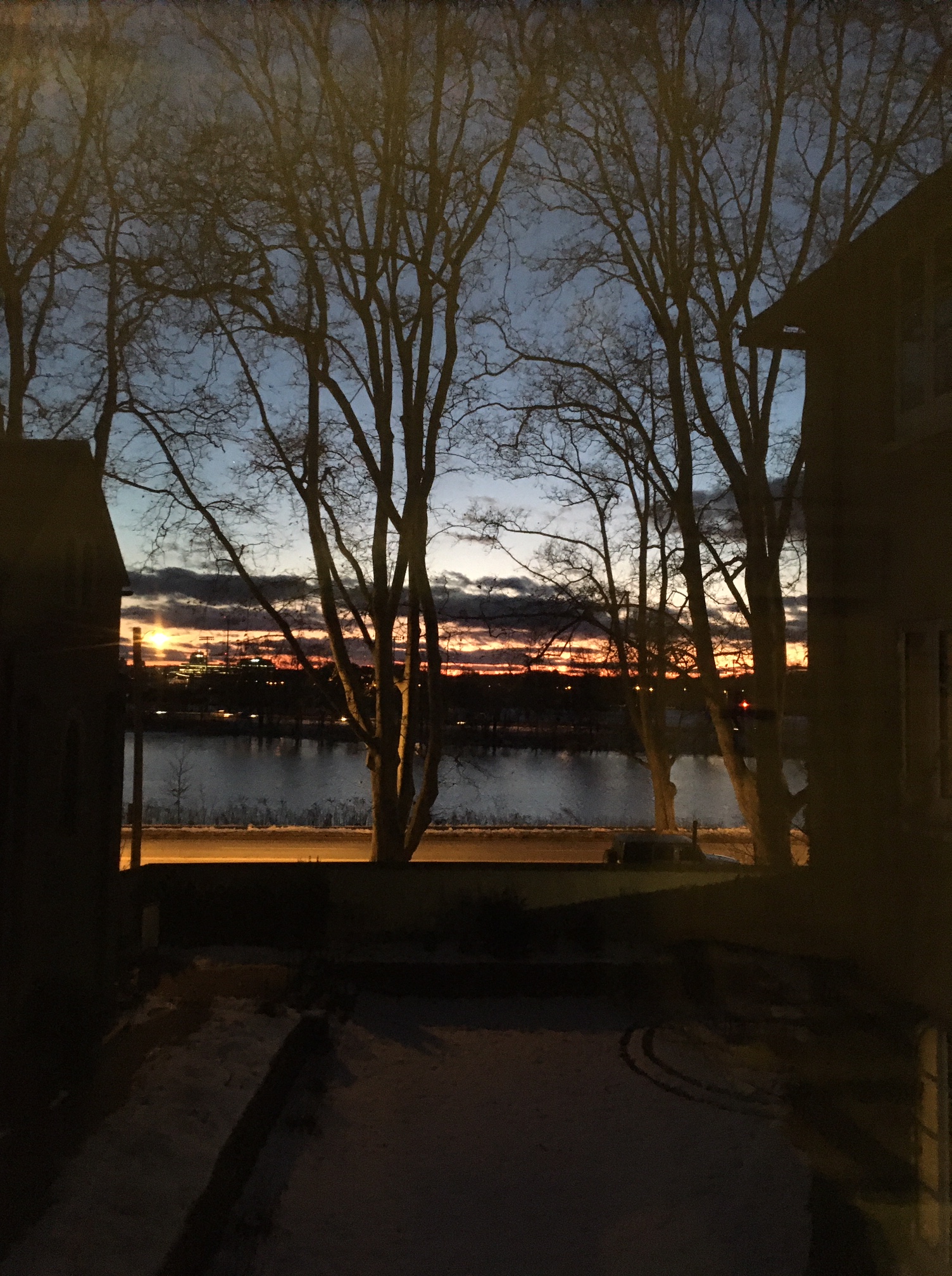
After a wonderful but hectic Thanksgiving, Mary Lee and I spent a weekend on retreat at the Episcopal monastery of Society of Saint John the Evangelist in Cambridge, Massachusetts, a place we’ve been coming to for twenty-five years in search of silence and slow time. On Saturday afternoon, because the sun sets in this part of the world around 4:00 p.m., I decided to catch the last daylight and take a walk before Evening Prayer.

As I left the monastery, the sun was buttering tiers of purple clouds over the Boston skyline. I jay-walked across Memorial Drive, turned right, and joined the joggers, walkers, and cyclists on the path along the Charles River—a mix of races I don’t see in Maine, some talking into microphones and headsets, others conversing with one another, possibly in Chinese.

After about a quarter of a mile, I passed the Riverside Boat Club. I turned left to cross the Eliot Bridge, pulling up the collar of my coat against a raw wind coming down the river. The late afternoon sun and clouds reflected in the rippling waters of the Charles, the lengthening shadows of the sycamores, and the dank, November wind all churned up memories of another wind coming down another river thirty years earlier. I saw myself walking back from the Eastern Maine Medical Center to the Ronald McDonald House after spending the day watching my eighteen-year-old daughter die a little more from the cancer ravaging her body. I recalled the Christmas tree sellers in their vans and pick-up trucks in Cascade Park at the bottom of the hill across from the Penobscot River and how Christmas seemed at the time like some horrible joke played on the human race by a sadistic god promising peace on earth, good will to all, and then inflicting more war, poverty, disease, and death on us suffering buggers.

Now, however, I realized as I turned left after the bridge and started walking along Storrow Drive, that although I could still vividly picture details from my walk back from the hospital—the seagulls circling over the river, the mansard roofs on the houses—I could no longer feel the anger, confusion, and shame that once consumed me. Thanks to prayer and meditation and spiritual direction—much of which happened at the SSJE monastery—I’ve had joy as well as pain since Laurie’s death. Last summer I had heart surgery which has given me renewed hope that I may be around to watch my grandchildren grow up.

#

The sun dropped, gilding the tops of buildings on my right. The clouds became red and gray. Just outside a patch of skim ice near the shore of the river, a dozen geese floated tranquilly, while on the other side of me, rush hour traffic hurdled by. Horns honked.

The geese reminded me of my father-in-law, George, who used to urge his employees to work like ducks on the water: calm and serene on the surface, paddling like hell underneath. He was the one who introduced me to this walk around the Charles; he made it almost every day. One of the most gracious men I’ve ever known, he and his wife Elaine retired to Cambridge to an apartment just three doors down from the monastery, which made it that much easier for Mary Lee and me to become part of the SSJE community.

Hearing the whooshing traffic, I recalled that George used to carry a plastic bag with him when he walked here, collecting what he called “street glass,” bits of broken head and tail lights from the innumerable accidents caused by Massachusetts drivers along Memorial and Storrow Drives. By the time Elaine died and George left 985 Memorial Drive for a retirement community in Lexington, he’d collected enough colored glass and plastic to fill I don’t know how many glass jars, which reposed on bookcases and windowsills all over the apartment.

Looking across the river back at Memorial Drive, I imagined Elaine, standing in front of her window, holding her glass of gin, watching the sunset behind me before heading back to the kitchen to finish preparing another of her gourmet dinners. She used to rate sunsets; I thought she might give this one a “7” or an “8.” So I made it a “7.5.”

When she died, her service was held in the monastery, and I remembered the Brothers’ chanting, and the reception back at the apartment, monks mingling with the family of academics, doctors, and journalists I married into. When George remarried, four years later, it was in the monastery, as was his funeral ten years after that.

fullsizeoutput_1755
The SSJE Monastery from across the Charles River

#

Crossing the Weeks Foot Bridge in front of Harvard’s Leverett and Dunster Houses, I realized what an important part the monastery and the Brothers have played in my life for the last twenty-five years. I walked back Memorial Drive, past Winthrop and Eliot Houses, through John F. Kennedy Park, recalling my spiritual directors who guided me along the rocky road of grief—showed me that I couldn’t keep thinking of Laurie as some photograph in an old album, that if I actually believed in this thing called resurrection,  I needed to father an ongoing relationship with her, think of her as being somehow present, here and now.  And indeed, the first time after her death when I felt her touch was as I sat at a desk in one of the guest rooms of the monastery.

I thought about how my retreats and pilgrimages intertwine, like the design on the Celtic cross tattooed on my forearm. Yes, I go to the monastery on retreat to withdraw from what Jesus and St. Paul call “the world,” but I’m also making a pilgrimage to answer a call, draw near the sacred, find a source of healing, and pay homage to those I think of as the saints in my life: Laurie, George, Elaine, the Brothers who have died, like Brother Eldridge, who helped me see that like the Father in the Parable of the Prodigal Son, I can wait in continual hope for my child, sending out my love in the confidence that she’ll receive it, or Brother John, my first spiritual director, who told me, “No, I can’t help you cut down on your drinking, but if you decide you want to quit, I’ll do everything I can to help you.” Or those Brothers who continue to buoy me, like Brother Curtis, the first monk I ever talked to here, and Brother James, whom I’ve watched lose hair, put on thirty pounds, and become Brother Superior at SSJE.

IMG_4217

#

By the time I opened the gate and entered the monastery courtyard, the sun had disappeared; inky layers of clouds, however, were still striated with gold. Streetlights glowed and lambent windows in the apartments along Memorial Drive looked warm and urbane. The illuminated cross in front of the door to the guest house welcomed me home. Although I’d been gone less than an hour and had walked maybe two miles, it felt like a much longer journey.

IMG_4377

# #


Of Luck and Grace

The_First_Thanksgiving_cph.3g04961
The First Thanksgiving, 1621—J.L.G. Ferris/The Foundation Press, Inc./Library of Congress

#

The first time I ever heard about “pilgrims” was as a kid learning about some people by that name who sailed to America to have Thanksgiving dinner. Later, I learned it was a little more complicated than that—that these people were actually “Separatists” who had broken from the Church of England and come to this country by way of Holland in search of religious freedom. But they thought of themselves as pilgrims (the first child born in the Plymouth Colony was named “Peregrine,” which means pilgrim), travelers on a journey to find a home where they could worship the God of their understanding. The name stuck.

My sister tells me that she, my brother, and I are the descendants of John and Priscilla Alden and George and Mary Soule, couples who came over on the Mayflower, which may account for why I think of myself as a pilgrim and why Thanksgiving is my favorite holiday of the year. It’s a day to be with family and to give thanks.

This year, however, besides counting blessings, I’ve also been thinking a lot about luck.

Last spring, when I happened to mention to my family doctor during a routine follow-up to an earlier procedure that I was getting more and more out of breath, he told me to get a stress test and get it soon. Which I did and which led to an arterial catheterization which led to by-pass surgery. Now, I feel great. I have more energy than I’ve had in years.

I want to thank God for my good fortune, feel that I’ve been blessed. Except: as anyone who’s read this blog knows, the pivotal point in my life was the death of my eighteen-year-old daughter in 1988. Laurie didn’t smoke, didn’t drink, didn’t even eat meat. Still, she was the victim of Primitive Neuroectodermal Tumor, a rare and virulent cancer that when it strikes, usually attacks much younger children.

So how can I thank God for my life, while letting God off the hook for Laurie’s death?

Since my surgery in July, two men whom I’d known fairly well dropped dead from the same type of blocked left main artery that I had. Both men were active; both seemed healthy; neither was overweight; both died while exercising. Why am I still alive and they’re not?

I’m reminded of the evening of September 11, 2001, when our church held a meeting for all those who wanted to respond to the bombings of the twin towers and of the pentagon. At one point, a woman—let’s call her Agnes—rose and said that her son had been working that day in the South Tower, but that he was safe. “I want to take this opportunity to thank God for protecting my son four times.” Agnes said. “God showed him the way down the stairs. He moved him out of the way of fallen debris twice. He provided my boy with a private boat to offer him a ride across the river to Hoboken. I’m so grateful!”

I was happy for the woman. I was sure her son was a great guy. But I asked myself then and I ask myself now: why did God save him and let 7,000 other people die?

So although I want to thank God for my being able to be sitting here tapping out this blog instead of moldering in an urn under the snow in our family’s cemetery plot, I have to think that I was lucky, just as my daughter was unlucky enough to carry the wrong combination of inherited DNA to make her susceptible to the cancer than killed her.

Does this mean I’m not grateful this Thanksgiving? That I don’t think my Higher Power affects my life? That I’m not blessed?

Absolutely not.

As I think about how “unlucky” I was when Laurie died, and how “lucky” I am now, I find a common thread. In both instances I’ve seen, as I usually don’t, just how precious, how holy life is. I’ve never enjoyed the autumn foliage as much as I have this year. I don’t even mind (much) standing in line at the grocery checkout line.

I’m also aware, even though it’s hard to articulate, of a growing sense that this life is always being renewed, even reborn. That what I, as a Christian, call resurrection didn’t just happen once to one person, but happens to all of us many times. Someone said to me the other day that I looked like a new man. Well, in some ways, I am. I have a new heart.

Getting that new heart was at times painful; still, it was nothing like thirty years ago, when Laurie’s death broke me open. But although that hurt in ways I hope I’ll never have to feel again, her death also opened me to receive love and joy that I’d never experienced before in my closed off, child-of-alcoholic, New England male life. And it’s this experience that I’m guessing we’ve all had sometime in our lives—where from somewhere we get the strength not only to carry on but also to laugh and sing when by rights we ought to give up and die—that I give thanks for.

Which I think is the difference between luck and Grace. Luck depends on circumstances. Grace, on the other hand, is there for everyone all the time.

So I’m looking forward to Thanksgiving. This, despite sorrowful memories of my father, one of my grandmothers, and my mother-in-law all dying during the week of Thanksgiving, and a painful recollection of a Thanksgiving at the Ronald McDonald House after which Laurie’s two stepbrothers saw her for the last time. Or maybe those deaths actually help make the celebration more joyous. That when Mary Lee’s children and their families and her sister and sometimes her family come, we are surrounded by what St. Paul calls “Clouds of Witness.”

That these loved ones died, that my daughter-in-law is about to undergo surgery for cancer, and that one of my grandchildren is emotionally scarred from having been abused by her pre-school teacher is probably a matter of bad luck. That for the most part our families have the health and the means to come to our house for Thanksgiving and that Mary Lee and I feel well enough and are financially secure enough to host them is probably a matter of good luck. But that we are able to celebrate, to laugh, to cry, to love together is, I believe, a matter of Grace.

When I was finishing this blog, Mary Lee sent me a daily reading for November 22, 2019 (the anniversary of John F. Kennedy’s assassination, appropriately enough) from a website called gratefulness.org.

Grief and gratitude are kindred souls, each pointing to the beauty of what is transient and given to us by grace.—Patricia Campbell Carlson

Yup. Happy Thanksgiving, y’all.

IMG_0343
Another Thanksgiving, a few years later…

# #


Of Smells

fullsizeoutput_16e8

#

“Nothing revives the past so completely as a smell that was once associated with it.”

—Vladimir Nabokov

#

One of the joys of being 10 weeks past heart surgery is that I can resume daily walks, especially in the woods not far from where I live. And this is a great time of year for it. The leaves are beginning to turn, the air is drier, and the blackflies are gone. But I’m interested that the first thing I noticed when I entered woods after over two months were the smells: the musky, fecund tang of fallen leaves and pine needles, yellowing bracken, and decayed trees. Not only did the smells welcome me back into the present, they took me back to walks through Scotland and England, California, Massachusetts, Vermont, and even further back to the Ponderosa forests of Idaho during my college years and the piney woods behind my house when I was growing up.

Our sense of smell, I’m told, is linked to the part of our brains that processes emotions and memories. Probably every college English major (even if, like me, they’ve never read it) knows that Marcel Proust’s Remembrances of Things Past begins when the narrator tastes a cookie called a madeleine dipped in tea, which triggers seven volumes of memories.

Fear not, gentle reader, I’m not about to attempt anything of that magnitude, but I do feel compelled to ponder a few memories—some pleasant, some not so pleasant—I tripped over the other day as I sauntered through the woods.

I don’t think any smell evokes happier memories than the smell of baking bread. (I’m told real estate agents tell people who want to sell their houses to fill them with the smells of baked bread prior to showing them to prospective buyers.) Every Saturday morning when I was growing up, my mother would bake bread for the week, filling the house with the aroma of love and security. Having spent the last couple of years working with a sponsor in a twelve-step program, I find it healing to remember that in spite of the emotional scars I carry from being raised in an alcoholic family, I was always loved and cared for.

It’s probably nostalgia, but remembrances of my growing up are filled largely with happy smells: the smell of hay and cows and horses in my great-grandfather’s barn, the smell of fried onions and potatoes in my Nanny and Grampy Lufkin’s house, the smell of perfume and cigarettes in Nanny Cleaves’s apartment, the smell of  Aqua Velva, my first aftershave lotion, the White Shoulders perfume my first girlfriend Susan wore, even the smell of wet towels, dirty socks and jock-straps in the locker-room underneath the gymnasium where I spent so much time playing basketball. (Okay, that memory’s definitely nostalgia.)

Conversely, no smell brings back more pain than the smells of shit and disinfectant in nursing homes and hospitals (where between visiting others and my own stay I’m spending more and more time these days), which invariably take me back to the two months when my daughter lay in the hospital dying of cancer—a time of fear, loneliness, and guilt—literally a shitty time.

Memories of my unhappy college years come enveloped with the acrid smell of the Old Town Paper Company blown by a stiff wind down the Stillwater River in 10° temperatures, as I pulled my collar up and stumbled my way across campus to classes I never figured out how to study for, filled with students I felt no connection with, and who, I was convinced, disdained me. And the last years of my first marriage seem in my mind’s nostrils as rank as the dregs of the pipe tobacco I used to smoke during those years.

These days, I love the smell of Mary Lee beside me in the morning, of my hot chocolate in the afternoon, of popcorn in the evening. Of seaweed and mudflats along the Maine Coast. Of dirt in the spring. Of going into the school building to pick up my grandchildren and the smells of chalk and disinfectant and young bodies taking me back to my years as a public-school teacher. And speaking of grandchildren, is there anything more uplifting than the fresh, slightly sweet smell of a newborn child?

On the other hand, I hate the heavy perfumey smell when I enter the Maine Mall, damp cellars (probably because they remind me of the cellar I lived over for twenty-two years), car exhaust on a hot day, and now, the smell of the antibiotic Mupirocin, with which I had to swab my nose prior to and after this summer’s heart surgery.

Recalling smells revives memories of my various pilgrimages and retreats even more than photographs. The exotic and sometimes stomach-churning smells of the Old City of Jerusalem—schwarma, spices, and pita bread mingled with the dust of centuries of pilgrims.

fullsizeoutput_16e9

The aroma of apple tea in Turkey. The salt-laden breezes on Iona. The tangy musk smell of the cow pastures through which Mary Lee and I hiked St. Cuthbert’s Way. The dry smoky smell of Tanzania. One of my first memories of the Episcopal monastery in Massachusetts with which I’m associated is the smell of incense wafting up from the altar into the stony steeple.

At this time of year, the woods are full of smells, full of ambivalent emotions. Fall in Maine is when the trees let go of their leaves, which brings for me not only nostalgia, but also a kind of grief. I’m well into the autumn of my life, which, along with the recent surgery, has me thinking about my mortality. So many of the smells in the woods I’ve started walking again arise from dead and dying vegetation. And yet, autumn is also the season I always feel most alive, and never more so than this year, as I find my strength (not to mention gratitude) returning. Yes, the leaves and needles and branches under my feet are dying, but at the same time the decay upon which I walk and which I smell teems with the seeds of regeneration—not only the forest’s, but also, I like to think, mine as well.

  fullsizeoutput_f5c

 # #