The Snows of Christmas Past

#

After years of counseling and going to meetings, remembering Christmas when I was a kid now feels like peering through my frosted window at a soft and steady snow covering up dead leaves, discarded pumpkins, and broken branches under the diseased hemlocks beside the house.

My family’s disease was alcoholism. Mom’s memories of her drunken father passed out on Christmas Day, her shame at not being able to bring friends home, Dad’s bitter memories of Christmases in a Home for Wayward Boys and in the Army during WWII, his sense of being victimized by a social system he saw based on greed—feelings he tried to wash away with a pint of Old Crow—the arrival each Christmas of my mother’s mother, Nanny C, a large bitter woman whose acid tongue could peel paint, permeated our house during the holidays like their cigarette smoke.

In the weeks before Christmas, I’d hear Dad’s grumpy voice through the register in the floor of the bathroom asking where the hell were they going to get the money and Mom’s brittle reply they were just going to have to find a way; her children weren’t going to have the shitty Christmases she did. And I’d know it was up to me to make sure the holidays were happy. So that Christmas morning when Dad groaned because his head hurt, and Mom and Nanny perched on the edge of their chairs hovering like crows on telephone poles watching my younger brother and sister and me open our presents, and I ripped off Christmas wrapping to find a rainbow-colored wool hat that only a girl would wear, I said, “Oh, I love this. Thank you!” 

Ah, but here come the snows of nostalgia, which, I’ve discovered, is not all bad, especially when it brings memories of wading up to my knees in in the white stuff to help my father cut a tree, the smell of fresh fir as Mom and Dad set up the tree on the porch, decorating it with ornaments I still have 70 years later, popping corn and stringing it on the tree, smelling Nanny C’s fudge and Mom’s cookies and bread, and hearing my grandmother playing carols on our piano.

Or of walking home from sledding in the 5:00 p.m. darkness, carrying my Flexible Flyer past the drug store and the hardware store, their neon lights shimmering, casting shadows on the snow banks, past the big white Georgian houses on Main Street with their candles in the windows, then down Bridge Street, seeing my house and our lighted tree on the back porch, and feeling the Christmas excitement when the possibilities of happiness were as many as the stars in the frozen sky.

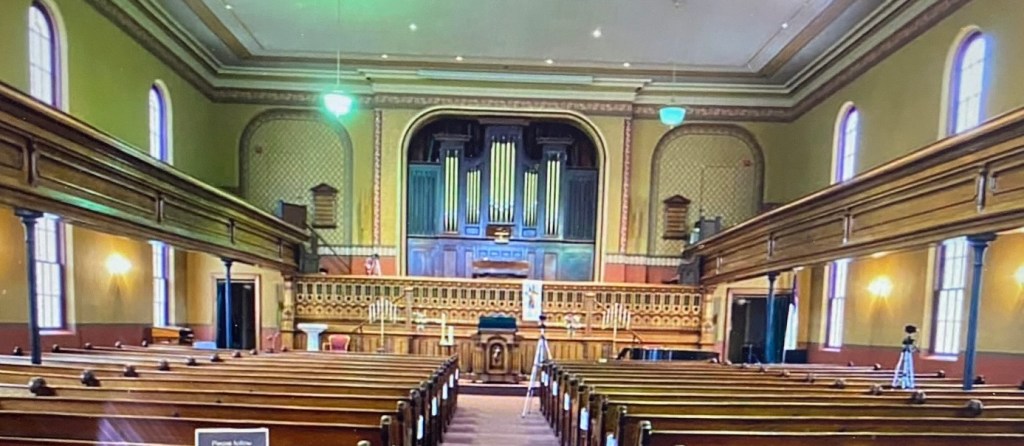
Or of helping my father, who moon-lighted as sexton in our church, get ready for the Christmas service by picking up last week’s bulletins from the Sanctuary, alone in this great empty space, the whistling of my corduroy pants as I walked echoing in a great and holy silence, and somehow feeling safe—held, enfolded by a Great Presence.

Then Christmas day: giggling in bed with Jaye and Roger, as we wait for 6:00 a.m. when we can wake the grownups, not knowing that Nanny C is in the next room listening to us with tears of joy running down her face—“Oh, you kids are so good, God bless you!” Christmas dinners of turkey, mashed potatoes, gravy, stuffing, homemade bread, and cranberry sauce (which is what I ate. Let the grownups eat the squash and turnips and beans), followed by Mom’s pumpkin, apple, and blueberry pies topped with Sealtest Ice Cream. In the afternoon, Dad slept off his hangover on the couch, Nanny went back to the piano and she and Mom sang “White Christmas,” “The Christmas Song,” “I’ll be Home for Christmas,” while I played with my new model airplane or helped my brother or sister put together their farm or showed them how to play the new Parcheesi game or took my new skates (but, gee, I forgot my new hat) which Mom and Dad had bought on time to the town rink behind the movie theater or went up to my room to read the book I’d received: maybe Treasure Island, Tom Sawyer, Herb Kent West Point Fullback, a Hardy Boy’s mystery, or Zane Gray.

On Christmas night I went to bed with a plate of cookies and a glass of milk, turning on the radio to my favorite programs, most of which were having Christmas specials: Jack Benny exclaiming after having spent the last thirty minutes buying the cheapest gifts he could find, “Good night, everyone, and merry Christmas!” George Burns telling his wife, “Say good night, Gracie,” and her reply, “Good night, Gracie, and Merry Christmas,” and of course, a version of Dicken’s “Christmas Carol,” probably starring Lionel Barrymore. I ate, finished my milk, and crawled completely under the covers with the cookie crumbs, following Scrooge on his journey from “Bah, humbug!” to “God bless us, everyone!”

 While outside the window, at least in my memory, snow fell in great white, silent flakes.

My sister, Jaye, circa 1954, with her new poodle skirt, doll, and whatever it is on her wrist.

# #

First Friend


Behold, I give unto you power to tread on serpents and scorpions, and over all the power of the enemy: and nothing shall by any means hurt you. —Luke 10:19

Staring at my 3 a.m. fears—A burning planet, a demented president-elect, disease, death—I think of you for the first time in years: first friend, neighbor, bodyguard, mentor, and, although three years older than I, my classmate from fifth through seventh grade.

Thick black hair and an Elvis sneer, Kirk Douglas dimple in your chin, sleeves rolled up as far as they’d go to show those growing muscles, your dark eyes often flashed anger at the world, but also amusement and compassion for the pudgy, awkward kid who worshipped the ground under your motorcycle boots.

Buddy Fitts, Freddy Gallant, Bucky Lapoint—none of the playground bullies—dared trip me, twist my arm, scrub my face with snow, because they knew they’d have to fight you first. And you were tough: sauntering up Bridge Street coatless in a ten-degree storm, snow clinging to your hair like chainmail on the Black Knight, carving your name on your veiny forearm with a Gillette Blue Blade.

In class, you never raised hell, never passed in a paper, just sat in the back seat looking cool until you turned sixteen and could legally split the joint. You cut CAROL into your upper arm and went to work in the cotton mill.

Playing basketball, fumbling with the buttons on Daisey’s sweater, I hardly knew you’d left. Never saw you much afterwards. Heard you and Lapoint started a paving business.

Home from college, I once walked by your house. You hadn’t grown since grade school but your tattoo was cool—a tiger’s head spanning your boney back as you banged away on a rusty Chevy. We grunted greetings. I forgot you.

At our 50th high school reunion, your cousin Roland said you lived in Tennessee, belonged to some Pentecostal church that prays with poisonous snakes to show God’s power over evil.

This dark morning, my friend, I think of how you protected me, wish you were here to keep me safe from the serpents slithering around me.

# #

How are You?

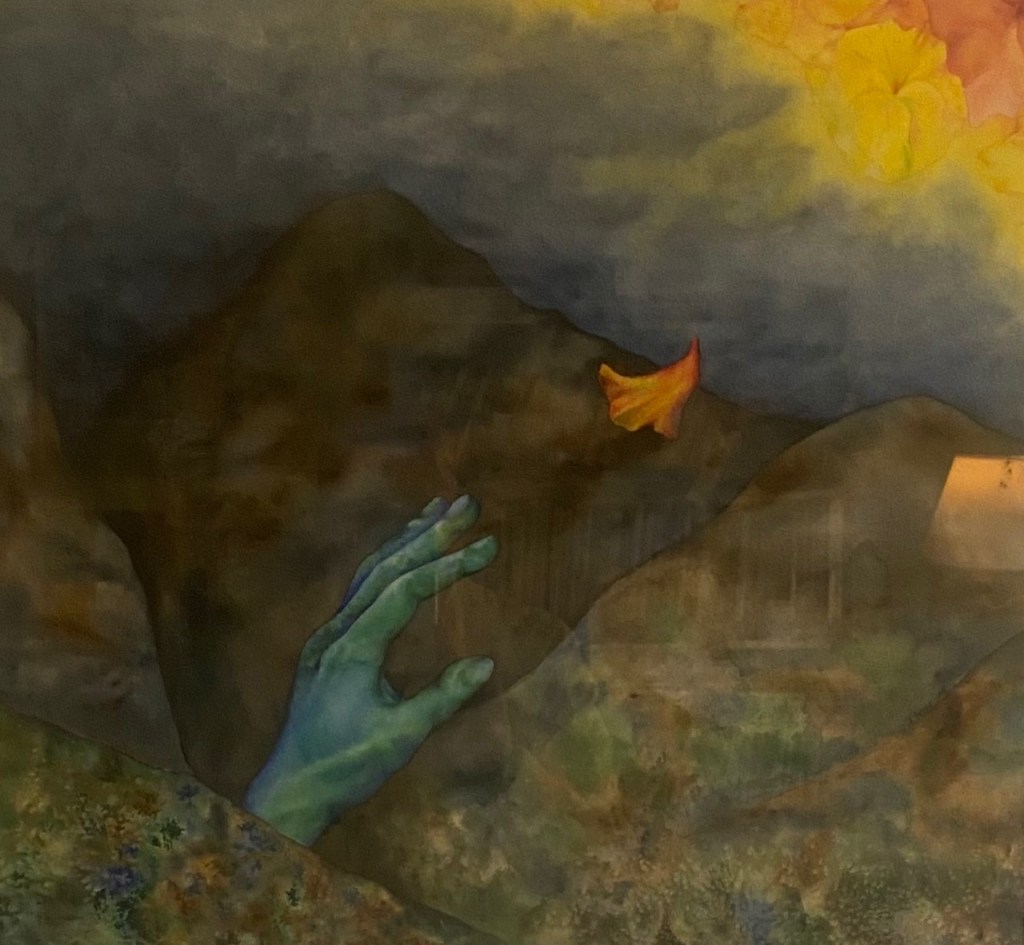
Watercolor by Laurie L. Wile

#

Well, despite the more or less constant pain in my lower back

and the burn of bursitis in both hips,

and not withstanding my apprehension about that new smell in the garage

and the housing development going in where I like to walk in the woods, 

and despite the fear that my grandchildren will live in a Fourth Reich

while this world turns to burnt toast,

and regardless of worrying about having a stroke which will paralyze the left side of my 

body so that I drool down one side of my mouth and lose control of my bowels,

and in spite of my nagging fear that there’s really nothing but darkness after death,

and the even greater fear that I will be reincarnated and have to learn all those goddamned

            things I’ve had to learn all over again,

I would say I’m grateful to be here. 

Thank you for asking.

Welcome, November

#

As readers of this blog know, my daughter Laurie died at the age of 18 from a rare cancer. In November, seven months after the cancer was first diagnosed, she went into Eastern Maine Medical Center. Living 120 miles away, I took a leave of absence from my teaching job and moved into a Ronald McDonald House where I spent the next two months with my daughter until she died on December 23.

Since then, each November as the days grow darker and colder, I can feel my body chemistry change. I’ve coped in many ways, but the most helpful has been through writing. It’s no accident that the first Geriatric Pilgrim blog appeared in November 2015.

#

Sonnet for November

Novembers, I would drive my daughter past

Men in blaze-orange caps, crouched on a hill,

Their 30-30’s sighted, set to kill

Most anything, just so the gun would blast.

My heart began to flutter, then beat fast

As we drove by them—silent, savage, still—

And I could feel the air around us chill.

I’d think, how long, dear God, will this month last?

But I’ve since learned of other ways to die,

And russet hills now fill with memories:

Her gentle, kind, abbreviated life.

These days, I treasure the November sky

Which broadens once the leaves drop from the trees.

November wind is clean, a whetted knife.

#

Darkness

Now darkness begins:

light dimming after lunch,

long shadows on the lawn.

I curse the old lady

crossing the street

in front of my car,

lose gloves,

feel the familiar kick

to the heart. 

You’d think after all these years

I’d be over it,

but it’s always different…

this darkness…

Gone the murky numbness,

the black rages,

no more the dim corridors

of “if only” and “what if,”

lit up by Johnny Walker.

Now, who knows what waits 

in the darkness ?

Another old friend’s Christmas card

to bring me tears?

More recurrent dreams of stumbling

through stony landscapes?

Another season of bingeing bad TV?

Still, the waning light 

is clean and clear,

the view scoured of chewed leaves, 

dead flowers, black flies.

And sometimes, just sometimes,

Love enfolds my fears,

and I hear Laurie whisper, 

“Dad, let the thoughts go.

Let darkness begin.”

My One, Unfolding Life

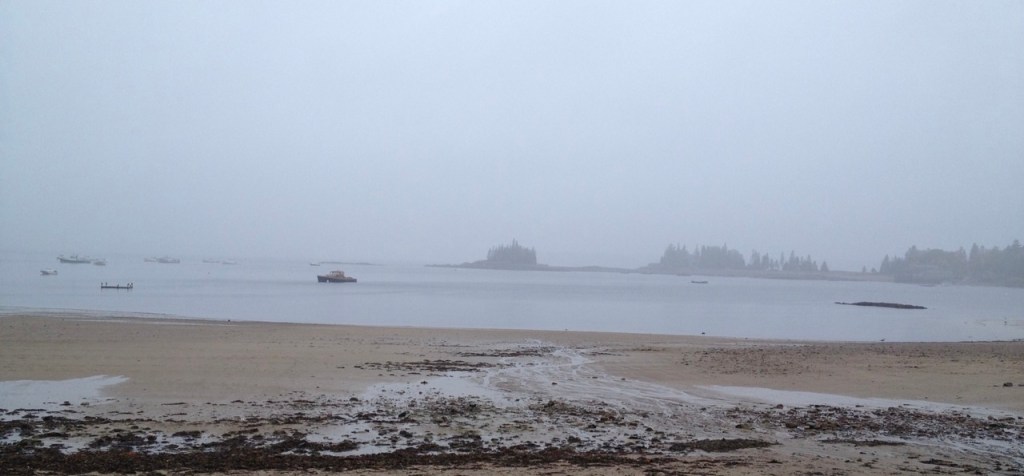
The beach just down the hill from where I used to live in my “other life.”

#

6:45 a.m. Driving up the turnpike from Brunswick to Bangor, headed down east to Mount Desert Island, I’m apprehensive. I’m returning to what I’ve always called my “other life”: different marriage, different house, different job, different hobbies, different self. A self, quite frankly, I’ve never liked very much.

But I’ve received an invitation to attend the 50th high school reunion of the Mount Desert Island Class of 1974. For many of these students, I was their English teacher as well as senior class advisor. And while I have, at best, mixed feelings about this other life, I enjoyed teaching at MDIHS and have continued to be in contact with some of these former students. I’d really like to see them.

My name tag at the reunion.

The reunion is tomorrow, but besides an invitation to the reunion, I’ve been asked to talk about my book, The Geriatric Pilgrim: Tales from the Journey at a gathering—which I figure will mostly be former students— in Bar Harbor a few hours from now. So, while I watch the leaves change color as I drive north, I try to figure out what I’m going to say. 

I know I’ll start by saying the most important thing I learned in writing The Geriatric Pilgrim was that the physical pilgrimages Mary Lee and I made to places like Iona, Big Sur and the redwoods, Nova Scotia, Israel, Africa, and Turkey have shown me that any journey—including the one we make as we age (and these former students are now all pushing 70. Good God!)—can be a pilgrimage. Especially if looked at with curiosity and openness, as explorations to discover new facets of ourselves, seeking surprises rather than security, looking for evidence of and trusting in a power greater than ourselves. 

Then, I think, Okay, if any journey can be a pilgrimage, that means this trip back into my other life is a pilgrimage. How?

When Mary Lee (who is sitting beside me, looking at a map of Maine—she loves those big unfolding maps that take up half the front seat) have gone on a pilgrimage, we often talk about what new insights we’re bringing back with us which we can use in the future. So, what lessons did I learn during the seventeen years I spent at MDIHS that have stayed with me? 

Well, I’ve always said that those years were the best teaching years of my life. I’ve taught in other schools, some with more impressive teachers, some with smarter students, some with better sports programs, a wider variety of extracurricular activities, more opportunities for materially or intellectually challenged students. But what made MDIHS different was that, despite the annual arguments about the budget and the tensions about dress codes and what was being taught, the parents, the school board, the administration, the faculty, and the students all agreed on one thing: MDIHS was a good school. And because we all thought it was a good school, it was—winning national awards for excellence.

MDIHS in the early years. My room was the closest on the end.

 Making a pit stop at the rest area outside of Bangor, I realize how I frame the reality of my life determines how I see that reality, which in turn determines how I live that reality. Thinking we had a good school, I went to work each day excited and proud to be there (okay, not every day, but I can honestly say, most days) which made me work harder, which made me a better teacher and the students better students. Fifty years later, when I can think of my aging not as a problem, but as an opportunity for growth, I’m less anxious about what I can no longer do and more curious about finding new things I can do, more grateful for those things, which makes me more pleasant to be around.

Back in the car, however, turning on to Route 1A and heading for the coast, I ask: if MDIHS was such a great place to teach, why did I leave, and in the middle of the school year? What’s the lesson there?

It probably begins with that guy I used to be—the one I’ve never liked. Come to think of it, he didn’t like himself either. Despite the accolades (one state evaluator said my Advanced Placement English class rivaled the one at Phillips Exeter), I was not a happy camper. I’d created this persona—loud sports coats, matching ties and pocket handkerchiefs, green ink corrections symbols and sarcastic comments in the margins of papers, pictures of sixty-four famous authors glaring down from the walls—which began to feel like a body bag. 

Soon after waking up one morning gasping for breath as if someone had their hands around my throat, I resigned. In the middle of the school year. Moved out of my house, divorced my wife, married another woman, and moved 120 miles away to teach not AP seniors but freshman juvenile delinquents (one of whom as far as I know is still in prison for murder).

And I think the reason I’ve never liked that guy in my other life is that I’ve always thought he was a fraud. But thinking about it, I honestly liked my job, and I wanted to honor my profession by looking and acting my best. I recall reading in David Whyte’s book, Work as a Pilgrimage of Identity, something to the effect that the things which once served us can imprison us if we remain with them too long. 

Which, as I think about it, is also true as I age. I can’t hold onto those activities, that self-image, those beliefs that once sustained me. When I think about making a new pilgrimage, I can’t plan—or I shouldn’t, anyway or I’m going to be disappointed, either that or die—to hike the Appalachian Trail or climb Mount Katahdin, but I can continue the journey toward what I might, for lack of a better word, call my true self. A journey, I realize, that began when I left Mount Desert Island, maybe even before.

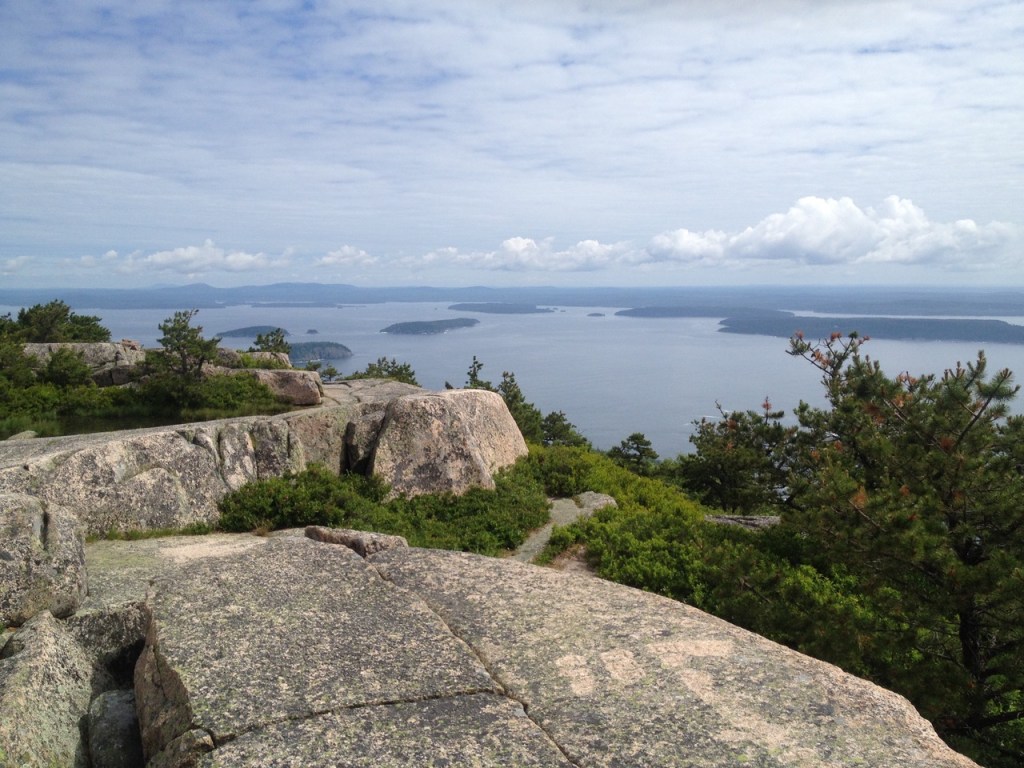
Speaking of which, I can now see MDI on the horizon, its rocky silhouette reminding me that this is one of the most beautiful places on earth. I remember, especially in those days when most of the tourists went home after Labor Day, how many afternoons and weekends I spent walking the trails and beaches there. And I realize that those walks were the beginning of what I call —somewhat euphemistically perhaps—my spiritual journey. Sitting on the top of one of the mountains, looking out over the neighboring islands, I experienced not only the inchoate presence of a Higher Power, but also a vague sense that everything belongs.

I needed help interpreting these experiences. Which led me to religion. When I first began teaching on the island, I hadn’t been in a church since I was married in one, and by the time I left seventeen years later, I was not only a member of a church but a member of the Board of Deacons. I sang in the church choir. I advised a church youth group. 

It dawns on me that without Mount Desert Island, there’d be no Geriatric Pilgrim.

I also see that I have no “other lives,” only this one—one that has been unfolding, like one of Mary Lee’s maps, from the beginning until now and will keep unfolding (I’m guessing; I’m curious to find out) after my earthly death. 

Wow! Now, if I can just remember to talk about some of this an hour from now…

# #

Looking for What’s New

#

Besides dealing with a decaying body and a deteriorating mind, one of my biggest challenges these days is to keep from living in the past. (And I’m sure the two struggles are connected: of course, I want to recall when I could leap tall buildings in a single bound.) It’s so tempting to spend my days reminiscing with old classmates via email or Facebook, watching “American Bandstand” on YouTube, and replaying 65-year-old high school basketball games.

This last month has been especially challenging. May began at the history center in the town in which I grew up with a program that my oldest friend (going back to the first grade) and I spent the winter planning: “Yarmouth [Maine, for those of you reading this in Singapore and elsewhere], 1955-1962: Times of Change.” We wound up with probably thirty people there who’d grown up in town during those years, bathing in the warm waters of nostalgia, as we talked to newer residents about how Yarmouth changed during that time from a low-income community of shops and small factories to a bedroom-by-the-sea for urban lawyers, doctors, and bankers. A town we kids roamed at will because everyone looked after us—where the local telephone operator would call my classmate Barbara’s house at 3:30 in the afternoon (because she knew Barbara got out of school at 2:30 and would stop at the drug store for a coke, so that’s when she’d get home) to tell Barbara that her mother would be late and that she should turn the oven on 350° and put the roast in at 4:00. (Who needed cell phones?)

Later in the month, as my brother and sister and I cleaned off stones and planted impatiens in our family cemetery plot for Memorial Day, we swapped memories of Mom and Dad and our grandparents. (Amazing how different our recollections are!) Later that week, I went with my wife, Mary Lee, to her 55th college reunion, and for three days listened to other people’s stories about their pasts. Throw in a dream in which I ran into my ex-wife—who died eight years ago—dressed in a white karate gi (still trying to work out the symbolism there), and I’m starting to sink beneath these waves of nostalgia.

I need to get out and open my eyes. Stop looking at what’s behind me and start looking at what’s around me—what’s new. I decide to check out this year’s garden. Besides, I need to put in my tomato seedlings.

It’s a beautiful June morning and the world is new. The apple blossoms and rhododendrons are in full bloom, the air smells of lilacs, and the breeze is fresh. The world is spring green: the grass hasn’t yellowed, the leaves aren’t chewed, and the caterpillars haven’t yet built their ugly tents in the trees.

I put my seedlings and watering can and trowel in the car, drive up and park on the power line road between our community garden (which I wrote about a few years ago: https://geriatricpilgrim.com/?s=Up+to+the+Gahden) and a wooded swamp, home to all kinds of birds, many of whom are singing their ever-loving hearts out.

I had no idea how many birds there are here until I got one of those apps this year for my phone that identifies birds by their songs. So, I check it: cardinal—yes, I know their pulsating whistles; song sparrow—makes sense, I see all kinds of them; gold finch and chickadee—ditto. But what’s a great crested fly-catcher? And a red-eyed vireo? They’re new, at least to me. Cool. 

Turning to the garden, I think of the beginning of baseball season, when, no matter how poor a team’s prospects, there’s always hope for a championship year. 

This year, I’ve got three raised beds, and—God willing; I haven’t planted it yet—a small pumpkin patch. The garlic I put in last fall is up, as are the peas which I planted on May 1st. I decided this year to stake them with some of the branches that came down from last winter’s storms—the first time I’ve ever tried that, and it seems to be working: the peas are grabbing the branches with gusto. In another bed, I’ve got the usual two kale plants which will hold us until November, but for the first time, I’m trying a couple of eggplants and a purple pepper to see what happens. I’ve also planted bush beans for the first time in years. (Mainly because last year, I almost killed myself stringing pole beans, and vowed never again.)

 I wave to Karen down the way who’s working on her bee garden. She’s also building a new compost bin, for which I need to thank her. 

But first, let’s get those tomato seedlings in. 

The sun is warm. I take off my outer shirt and begin raking the bed where I’m going to transplant my tomatoes. I love the smell of the fresh dirt (apparently, it triggers the release of serotonin in the brain—at least that’s what I read somewhere) which makes me want to sing. And because the other night I watched a music documentary on Paul Simon, I serenade the birds with “50 Ways to Leave your Lover”—

            You just slip out the back, Jack

  Make a new plan, Stan

            You don’t need to be coy, Roy

            Just get yourself free—

The really neat thing about the documentary was it focused on Simon’s newest album of songs, many, if not all of them, as I recall, coming to him in a dream. And if at the age of what, 83?, he can still be creating new work, even though I guess he’s now deaf in one ear, then I, at 81, can, too, despite my various diminishments.

I dig six holes and put a little of Karen’s compost in each one. I find myself slipping again into the past: the summers in high school I used to work in a garden and the big garden I had during my first marriage. Cut it out! I think, and then decide, No, let’s use those memories as compost, fertilizer to help me grow.

Which would be more inspiring if my back didn’t already hurt from this minimal exercise. From my other garden bed, I grab my new kneeler and bench combination, which I bought this spring, and kneel on it to put the tomato seedlings into the dirt and the compost, which gets my hands dirty and the rest of me feeling clean. Then, I put collars that I’ve made from plastic medicine cups around the seedlings to protect them from cutworms, and, using the metal arms of the bench to get myself off my knees, rise to get my tomato cages from last year. Finally, I give my little darlings a drink to get them on their merry way.

Feeling accomplished, I sit down on the new iron bench with the “Welcome” sign that someone—probably Doug, who, along with Karen oversees our community garden—has donated. I think about how I still rely on community as much as I did when I was a kid all those centuries ago. 

Looking up, I follow an exhaust vapor trail in the blue sky until I see the sun flash on a plane, high in the sky, probably starting its descent into Boston. I imagine flying to new countries and seeing new vistas and new people.

But right now, right here, there are plenty of new things going on, thank you very much.
# #

13 Ways of Looking at a Door

1

For Christmas one year, Mary Lee gave me a wooden wall hanging called “Doors of Yarmouth,” to remind me of the Maine town in which I lived for so many years. These are doors to old houses that have had careful tending (not to mention extensive and expensive remodeling). The doors come in a variety of colors. Most feature types of cross—sometimes called Christian—paneling. Three are plain wood with long hinges and latches. There are a couple of double doors and one shutter door. Some doors have glass windows, others are framed by small windows, shutters, cornices, lattice work, or flower vines. There’s a gothic arch over one door, a wooden fan over another, and several Greek canopies held up by pillars. All in all, they reveal how Yarmouth has changed from the working-class community I grew up in to the suburbia by the sea it is today. 

2

A little research on the web tells me that doors were conceived in ancient Egypt around 3000 B.C.E. but another site says that archeologists in Zurich Switzerland discovered an oak door possibly dating to 3063 B.C.E. Long before that, at least according to the Bible, Noah put a door in the ark. One assumes a pretty big one. (I’m curious how it opened and closed.)

3

 From the beginning, doors have had more than the utilitarian purpose of protection from nasty weather or people. They’ve identified the occupations of those living in the dwelling and served as marks of power and status. According to the Bible, when King Solomon built his great temple to show God’s power and prestige, he made doors of olivewood, covered with carvings of cherubim, palm trees, and open flowers, which he overlaid with gold. While technically not a door, I suppose, novelist Stephen King’s two iconic wrought-iron gates embellished with bats, a three-headed dragon and spider-like motifs have become a pilgrimage destination for King fans from all over the world.

4

Speaking of pilgrimages, when Mary Lee and I were walking St. Cuthbert’s Way between Scotland and England, we passed a sheepfold, a circular wall of stones with an entrance, which for centuries, served as a place for shepherds to herd sheep at night for protection against predators such as wolves. To keep the sheep in and the wolves out, the shepherd would lie down across the entrance, becoming, as it were, a human door. 

5

Jesus uses this image of the shepherd protecting his flock by becoming a door when he refers to himself as “the gate,” who “lays down his life for the sheep.” Which may be why cross or Christian paneled doors are so prevalent in New England (all the units in our Housing Development have them, inside and out). When my wife Mary Lee—who is a Deacon in the Episcopal Church and a lover of icons—was teaching the in a local high school, she wanted to put up an icon in her classroom but realized it wouldn’t be appropriate in a public school, so she hung a large print of a door on her back wall where she could see it when she taught. It was a great comfort, especially with certain classes. 

6

 Besides Jesus, the Bible refers to other kinds of gatekeepers: those appointed to control who came and left the city through the gates. Thus, the term “gatekeeper” has come to mean a person who controls access, someone in authority who acts as an arbiter of quality or legitimacy, or someone who blocks you from speaking with a decision-maker. Gatekeepers access who is “in” or “out.” I’ve had a few of those in my life, athletic coaches, teachers, whom I’ve had to please in order to succeed. I suppose, as a teacher myself, I’ve also been a gatekeeper. 

7

I’ve also let others become gatekeepers, to whom I gave away authority, surrendered, as it were, the keys to doors I could have opened for myself. Growing up in an alcoholic family once limited my choices when I faced a decision to “What will the neighbors think?” to quote my mother. Through working an Al Anon program and learning to put the focus on me instead of on the me I thought you thought I was, I’ve found keys to open doors I never knew existed.

8

Some of those early Egyptian doors symbolized entrance to the afterlife. Doors can represent transition, confinement, new opportunities. Doors can be metaphors for the choices we make. We learn early on in life that we can walk through some doors and not others. As a WASP male, I know that I have more doors available to me than women, people of color, people of other religions. My destiny has been shaped by the doors I’ve walked through.

9

Or doors that have closed behind me. For a while, Mary Lee volunteered as a chaplain at the local prison. One Christmas, I helped her with a service. My clearest memory is of going through a series of doors and hearing the loud, definitive clang as each door closed behind me. I’ve had a few of those definitive door closings in my life: the death of my daughter, a divorce decree, a couple of retirement parties. Most of the time, however, I find that doors close behind me without my noticing. One reason I took early retirement from teaching high school English was that I saw too many colleagues still standing in front of their classes, even though, emotionally, they’d shut the door on their students years earlier. One of the things I dislike about the geriatric life is that doors keep silently closing, until suddenly I realize, I can’t do this anymore! Can’t climb that mountain, can’t reach that note, can’t eat that food, can’t…

10

On the other hand: My Quaker friends say that sometimes a door needs to close before another can open. That’s certainly been the case with me. I had to close the door on a forest management program before I could open the door to what’s been for me a fulfilling teaching career. I had to retire from public education before I started writing. After my daughter died, I had to lose every image of God I’d ever had before I encountered the Grace of God of my not Understanding.  

11

In late 1960’s, I listened to a rock group, The Doors, who named themselves after the title of Aldous Huxley’s book, The Doors of Perception, in which he reflects on his psychedelic experiences. Huxley himself had based his title on a line in English poet William Blake’s The Marriage of Heaven and Hell: “If the doors of perception were cleansed, everything would appear to man as it is: infinite.”

12

These days I’m trying to clean the doors of my perception through contemplative practices such as meditation, going on more retreats, walking meditation, contemplative reading, sessions with my Feldenkrais teacher, journaling, music, working on my listening, writing these blogs, and of course, making more pilgrimages, even if they’re only to the compost pile. 

13

And I’m not done opening new doors. I’m hoping I have a few longer trips left ahead of me. Speaking of trips, I note that interest in psychedelic drugs is again increasing, thanks to books like Michael Pollen’s book How to Change your Mind.Indeed, I have a 92-year-old friend who’s seriously considering a guided psychedelic experience. That’s another possible door. 

And, of course, there’s the Big Door ahead of me. That, too, will be quite a trip, I suspect. 

#

Connecting the Dots

“Only connect.”—E.M. Forster

#

As a kid, some three-quarters of a century ago, I loved to “Follow the Dots.” You know, those puzzles where at first, you see nothing but a confusing morass of tiny spots, like black ants on the page, but if you connect these dots by the numbers, a cat or dog or giraffe or flower appears, as if by magic. Then, you can color it and have a lovely picture. (Or at least Mom said mine was lovely.)

And I still love following and connecting dots. It’s one reason I love poetry and admire those writers who draw connections I’ve never seen before. Everything I read about physics and the discoveries about our universe, everything I read about spirituality, everything I’ve learned about health, all say that everything is connected; what we need to do is connect the dots. 

“Connection is why we’re here,” says researcher/storyteller Brene Brown in a TED talk I recently watched. Then Brown went on to talk about our problems with connecting, problems caused by our fear of appearing vulnerable, our need for control and certainty, and most important, our shame. Because we don’t feel we’re worthy of connecting with others, we don’t try.

Well, that made me sit up and take notice. I’ve often said that shame has been the driving force of my life. Thanks to almost a dozen years working my Al Anon program, I’ve learned shame is part of growing up in a family riddled with generations of alcoholism, along with burying feelings, fearing confrontation, learning to hide behind personas, perfectionism, judgmentalism, and people-pleasing. Twelve-step literature calls these traits “character defects.” I think of them as survival mechanisms. Either way, they’ve kept me from connecting to other people. 

As Marie Howe’s writes in her poem “The Affliction”:

When I walked across a room I saw myself walking

as if I were someone else,

as if I were in a movie.

It’s what I thought you saw when you looked at me.

So when I looked at you, I didn’t see you

I saw the me I thought you saw, as if I were someone else.

This was (and can still be) me, walking into a room, convinced everyone is staring at me, first in judgment, then in disdain. I’ll run my tongue over my teeth to make sure there’s nothing stuck between them, check my fly to see if it’s zipped. Still, I’m sure people are deriding me for being the failure I know I am.

At no time was this truer than after I became a high school English teacher. Every time a student laughed, or whispered, or stared at me, I was convinced I was the subject of their ridicule. (And finding out I was known as Wiley Coyote didn’t help.)

So I created the persona of MRWILE. During the ever-more-casual 1970s, I dressed in flashy sport coats, bell-bottoms, with matching ties and pocket handkerchiefs. I spent weekends in my classroom changing bulletin boards, papering the walls with posters, and growing geraniums and begonias on the windowsills. At school, I used sarcasm and difficult reading assignments to control behavior, while at home I filled the margins of student essays with correction symbols and caustic comments—“Huh?” “What on earth does this mean?” 

Outside of school I attempted to encase myself in the same veneer of respectability. I smoked a pipe. I bought a white cape cod house with green shutters in a housing development. I put up a white picket fence and planted rose bushes. I joined the church choir, the church Board of Deacons, and the Rotary Club.

MRWILE

While MRWILE helped me gain some of the respect I craved, this persona killed my first marriage and almost killed me. I was never home, and when I was, I was never present. I began waking in the night, sweating, and panting for breath, suffocating, after nightmares of being tarred and feathered and ridden out of town on a rail.

What saved me was THE LIGHTBULB.

As I recall, I was teaching a class about a particular piece of literature. (Maybe a Shakespearean sonnet?) So that my students could understand the imagery, I was trying to connect the poet’s situation to theirs. Suddenly, I saw a face light up in understanding, as if I’d flipped a switch in the kid’s head. I remember feeling a corresponding charge, a release, that I’ve since said, felt right up there with sex. 

I’m serious. In that moment, and in the other moments since then that have kept me teaching long after I threw out the ties and matching pocket handkerchiefs, when I taught everyone from thirteen-year-olds with learning disabilities to students with combined College Board scores of 1600 to college seniors working on honors theses to homeless veterans with PTSD to Al Anon sponsees, as in sex, I’ve somehow connected with someone at a deeper level—a reciprocal give and take that goes far beyond “Oh, aren’t I a wonderful teacher!” Both teaching and sex have been means by which I have experienced real—maybe “pure” is a better word—relationship. 

If you don’t get this, I understand (when I talk about how exciting teaching can be, some people look at me as if I were extoling the taste of ground glass), but I will always remember the evening I talked about my lightbulb experiences to a teacher from Colorado when we were both reading essays for the College Board in New Jersey. She did understand. We began writing to each other. I found I could be open and vulnerable with her, and that for her, I could give up my secure and respectable life, leave the white cape and the picket fence and my advanced placement students in the middle of a school year for a three-room, 2nd floor apartment, and four classes of potential juvenile delinquents who’d driven their previous teacher to early retirement. 

And in the almost forty years since then, together we’ve faced the death of a child, financial uncertainty, several career shifts, and now, the diminishments and indignities of old age. 

As I tell the folks in my writing groups these days, I write to discover what I didn’t know I knew. Writing this blog, I’ve discovered that while shame has been one driving force in my life, my desire for connection has been another one, probably beginning with those days I spent connecting dots in puzzle books. And that when—I have to think it’s through Grace—I have connected not only to but also with my metaphorical dots, it’s resulted in a beautiful picture.

And should any of this should connect with you, dear reader, that would be pretty nice, too.

Thank you to my granddaughter Anastasia for connecting the dots and coloring the picture far better than I could

# #

Our Rite of Hope for January 7, 2021

#

“…. by participating in a ritual, … [y]our consciousness is being re-minded of the wisdom of your own life. —Joseph Campbell

#

Yesterday we celebrated Epiphany,

When wise men worshipped the Christ child. 

& recalled the goons in MAGA caps who trashed the nation’s capital.

Still rattled today, we observe our annual ritual:

  We play The Christmas Revels 

                                                            Wassail, wassail, all over the town

  We strip the tree of 

   Ornaments:

     From pilgrimages—

                 2 wooden sheep from Scotland 

          (my ancestors died for Bonnie Prince Charlie)

                          2 olive wood crusaders’ crosses from Jerusalem

                                    (Christians & Muslims slaughtered each other for centuries)

                          1 porcelain nazar from Istanbul

                                    (protection against evil)                      

Here come I, old Father Christmas

             From childhood—

                          1 wooden and tin mesh angel from the turn of the 20th Century

(2 world wars, 2 flu epidemics, the Depression, Korea, Viet Nam, 3 assassinations, Watergate, 9-11, yesterday)


        1 plastic Santa from WWII                             

           (Dad in Belgium building bridges for tanks)

The boar’s head in hand have I

3 shiny ornaments my parents bought with green stamps 

                                    (To brighten memories of their broken childhoods)

                                                                                                There was a pig went out to dig

                                                                                                Christ-i-mas day, Christ-i-mas day  

            From children & grandchildren—

                        4 yarn & toothpick God’s-eyes

                        1 fuse-bead heart, 1 fuse-bead cat, 1 fuse-bead turtle, 

                        2 black felt cats honoring my step-son’s first pets

                        1 brown fur diarrhea microbe 

(from my daughter-in-law who helps impoverished countries improve water quality)

                        1 embroidered-flower ornament from my 16-year-old daughter

                                    (2 years before she died from cancer)

                                                                                                            The holly and the ivy…

     Lights:

            3 strings of red  blue  green  orange  bulbs

                        (The big painted ones long gone, but at least these aren’t white)                              

            1 yellow star

                        (“For we observed his star at its rising, and have come to pay him homage.”)

Dance, then, wherever you may be

                                                                                                I am the Lord of the Dance, said he.

So, we dance

between

Christianity & paganism

Past & present

Light & dark

Death & life

Sorrow & joy

Arms clinging to our rite of hope.

# #

Celebrating a Milestone

Looking back at the Eildon Hills in Scotland.

#

 “Great things are not done by impulse, but by a series of small things brought together.”

—Vincent Van Gogh

#

This blog is a milestone for me. Eight years ago this month, I published my first Geriatric Pilgrim blogs (https://geriatricpilgrim.com/2015/11/). And while I’m not big on party hats and horns, I want to celebrate.

The Romans erected the first stone markers to let travelers know not only the number of miles they had to go to reach their destinations, but also the distances they’d covered. Today, businesses talk about a milestone as something that demonstrates a significant, marked change or step in the development of a project. Parents keep track of milestones in their child’s development. (“Look, little Leslie’s walking! Where’s the camera?”)

When I think of the importance of milestones in my life, I think of the second day of our seven-day walking pilgrimage along St. Cuthbert’s Way through Scotland and England. Still apprehensive about being able to complete the 72-mile trek, I looked back across a newly mown field to the Eildon Hills fading into the dimly distant horizon. The day before, my wife Mary Lee and I had crossed those three hills.  I felt a burst of energy. Look at how far we’ve come, I thought. We can do this!

And as I look back at those first blogs from 2015, I’m also surprised and energized by how far I’ve come in the last eight years.

In 2015, I’d just published a novel, Requiem in Stones: A Novel of Grief and Grace, based on my experiences after my daughter Laurie died of cancer.

This novel about the effects of a child’s death upon a family, had taken me 20 years to write and I was emotionally drained. For the sake of my sanity (not to mention the wellbeing of those around me), I wanted to write something for fun.

Two years earlier, Mary Lee and I had walked St. Cuthbert’s Way, and I’d become curious as to how pilgrimages differed from vacations, business trips, escapes, or educational trips. I was especially interested in the inner journey one makes on a pilgrimage. I read books about some of the pilgrimages people had taken, drawn especially to those who approached the spiritual journey with humor and curiosity. I decided to try to use the same approach in a blog about my travels.

But now when I reread those first blogs, I can’t find much humor. Like the novel, they still seem to me focused on the effects of my grief—physical problems, nasty thoughts and visions. What humor I find now sounds to me sarcastic.

Still, because I’m also writing about specific places—Jerusalem, retreat houses—I can also see the beginnings of my detaching, of stepping back, of broadening my horizons.

And that’s what writing these blogs over the next eight years has done for me. By focusing first on my various exterior journeys, and then going inward, I’ve given my grief more room to live in, so that it doesn’t dominate either my life or my writing. My grief over Laurie’s death is no smaller, but the landscape in which it resides has expanded to include not only a dozen countries, but also my family history and my geriatric journey as well.

Probably nothing has helped me better understand this interior landscape over the last eight years than joining two 12-step programs. Al Anon, the program for families and friends of alcoholics, and ACA, the program for adult children of alcoholics, have become like lenses on a pair of binoculars, helping me view the effects of my grief—especially fear, anger, and shame—as mountains that make the Eildon Hills look as level as pool tables.

I remember telling my Al Anon sponsor in one of our first meetings, “I will always feel at some level that I killed my daughter.” Even 25 years after Laurie died, I blamed my daughter’s death on my divorcing her mother two years earlier or by not divorcing her mother soon enough. I said that every year, right around Thanksgiving, I could feel my body chemistry change. For the next month or so, right up until the anniversary of Laurie’s death on December 23, I said, I never knew how I would react. Some years I was angry at everyone, some years I cried at anything remotely sad, some years I spent the months hiding from the world by reading mysteries. I said that I’d just accepted this response as the way it would always be.

And I remember my sponsor’s reply: “Okay. Maybe… Let’s see what happens.”

Through working the Al Anon program, especially Step Four, taking “a fearless moral inventory” of myself, I discovered that because I’d grown up in a family riddled with alcoholism, I’d been clambering up and down those mountains of fear, shame, and anger long before Laurie’s death. Fear and my need for what I thought was security had driven me into an unhappy first marriage. Shame and my need for respect had driven me into erecting any number of false personas. My need to deaden my anger had driven me into my own alcoholic behaviors. Using ACA, I learned about the long-term effects of growing up in an alcoholic family, while Al Anon gave me the tools to separate my grief for my daughter’s death from my fear, anger, and shame over losing her.

So that four years ago, I realized that I was enjoying the Christmas season—no tears, no angry outbursts at the baggers at the grocery store, no reading marathons. And as I was collecting fifty of my blogs to put together in my second book, The Geriatric Pilgrim: Tales from the Journey, I had to revise several blogs which had talked about how hard the Christmas season still was for me.

There’s also nothing like successful heart surgery for expanding one’s inner landscape. Only through a timely wellness checkup and the perspicacity of my PCP—“No, being out of breath is not normal. I want you to take a stress test this week!”—did I avoid another family disease: falling dead of a heart attack. Only because of what I’ve called in these blogs “grace” am I’m still here. Only through grace am I grateful for the life I’ve lived, even for those demanding hikes over mountainous landscapes.

All of which is worth celebrating. If not with paper hats and party horns, at least with a cup of hot chocolate.

Cheers!

# #