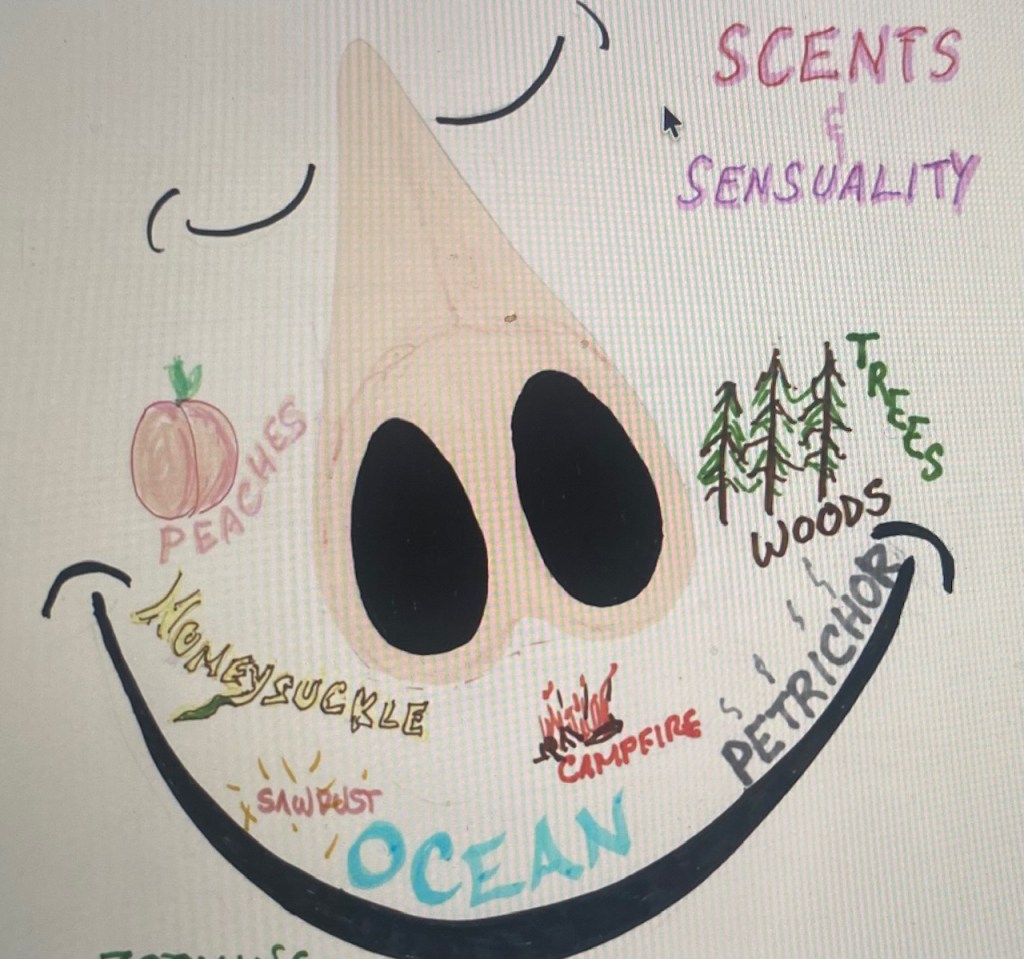
Illustration by Lisa Keppeler. Used with her kind permission.
~
It’s September, 2019 and ten weeks after my heart surgery and I’m taking my first walk in the woods since then and the first thing I notice is the fecund smell of fallen leaves and pine needles and dying trees…
and the scents of hay and cows and horses in my great-grandfather’s barn, and the waft of fried onions and potatoes in Nanny and Grampy Lufkin’s house, and the whiff of perfume and cigarettes in Nanny Cleaves’s apartment, and the aroma of Mom’s fresh baked bread on Saturday mornings…
and a few years later: the earthy odors of the market garden where I worked summers, the pungence of wet towels, dirty socks and jockstraps in the locker-room beneath the gym where I spent so much time…
and the fragrances of my Aqua Velva, and her White Shoulders blending in the back seat of the family Ford …
and later still: the salt smack of ocean breeze thru the spruce trees around our camp in the early days of marriage when love was new and life’s possibilities seemed endless…
and because autumn is when things die, memory sniffs the acrid smoke from the Old Town Paper Company as I drift, bitter and aimless, across the university campus, no longer the high school bigshot and no idea who the hell I am or where I’m going…
and then the dank reek of the dregs of the pipe tobacco I used to smoke during the last years of that first marriage…
and the stench of shit and disinfectant in the hospital where my daughter lay dying, when I learned how life and love can also waste away and die…
and thoughts of shit spark smells of steaming cow flaps in Scottish pastures through which Mary Lee and I hike, and aromas of shawarma, spices, and pita bread mingled with the dust of pilgrims in the Old City of Jerusalem, and the sweet scent of apple tea in Turkey and animal musk on the Serengeti and incense wafting up from the altar into the stony steeple of Iona Abbey—reminders that I not only didn’t die, but flourished—
and the smell of Mary Lee lying beside me in the morning, and the fresh, slightly sweet scent of our newborn grandchild, and before I know it, going into the school building to pick up that grandchild where the fragrance of chalk and cleaners and young bodies take me back to my years as a public-school teacher—intimations that love is stronger than death…
and although I’m surrounded by the smells of dead and dying vegetation and the lingering sickly scent of Mupirocin with which I swabbed my nose prior to and after heart surgery, the decay upon which I walk and which I smell teems with the bouquet of resurrection.
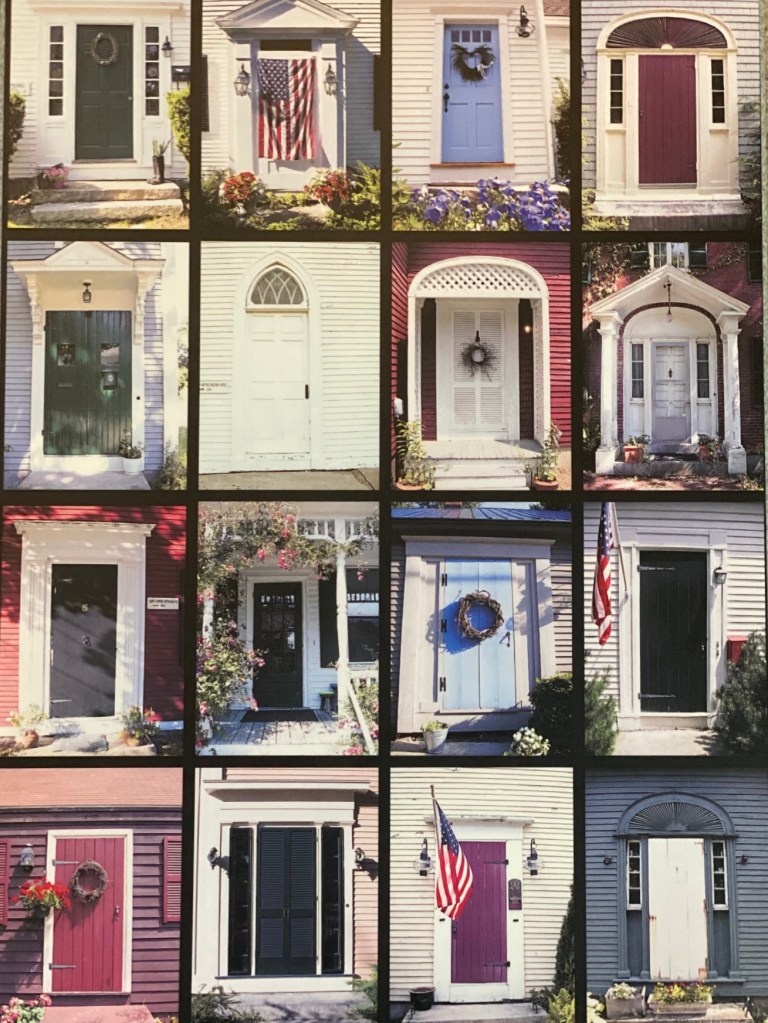
For Christmas one year, Mary Lee gave me a wooden wall hanging called “Doors of Yarmouth,” to remind me of the Maine town in which I lived for so many years. These are doors to old houses that have had careful tending (not to mention extensive and expensive remodeling). The doors come in a variety of colors. Most feature types of cross—sometimes called Christian—paneling. Three are plain wood with long hinges and latches. There are a couple of double doors and one shutter door. Some doors have glass windows, others are framed by small windows, shutters, cornices, lattice work, or flower vines. There’s a gothic arch over one door, a wooden fan over another, and several Greek canopies held up by pillars. All in all, they reveal how Yarmouth has changed from the working-class community I grew up in to the suburbia by the sea it is today.
2
A little research on the web tells me that doors were conceived in ancient Egypt around 3000 B.C.E. but another site says that archeologists in Zurich Switzerland discovered an oak door possibly dating to 3063 B.C.E. Long before that, at least according to the Bible, Noah put a door in the ark. One assumes a pretty big one. (I’m curious how it opened and closed.)
3
From the beginning, doors have had more than the utilitarian purpose of protection from nasty weather or people. They’ve identified the occupations of those living in the dwelling and served as marks of power and status. According to the Bible, when King Solomon built his great temple to show God’s power and prestige, he made doors of olivewood, covered with carvings of cherubim, palm trees, and open flowers, which he overlaid with gold. While technically not a door, I suppose, novelist Stephen King’s two iconic wrought-iron gates embellished with bats, a three-headed dragon and spider-like motifs have become a pilgrimage destination for King fans from all over the world.
4
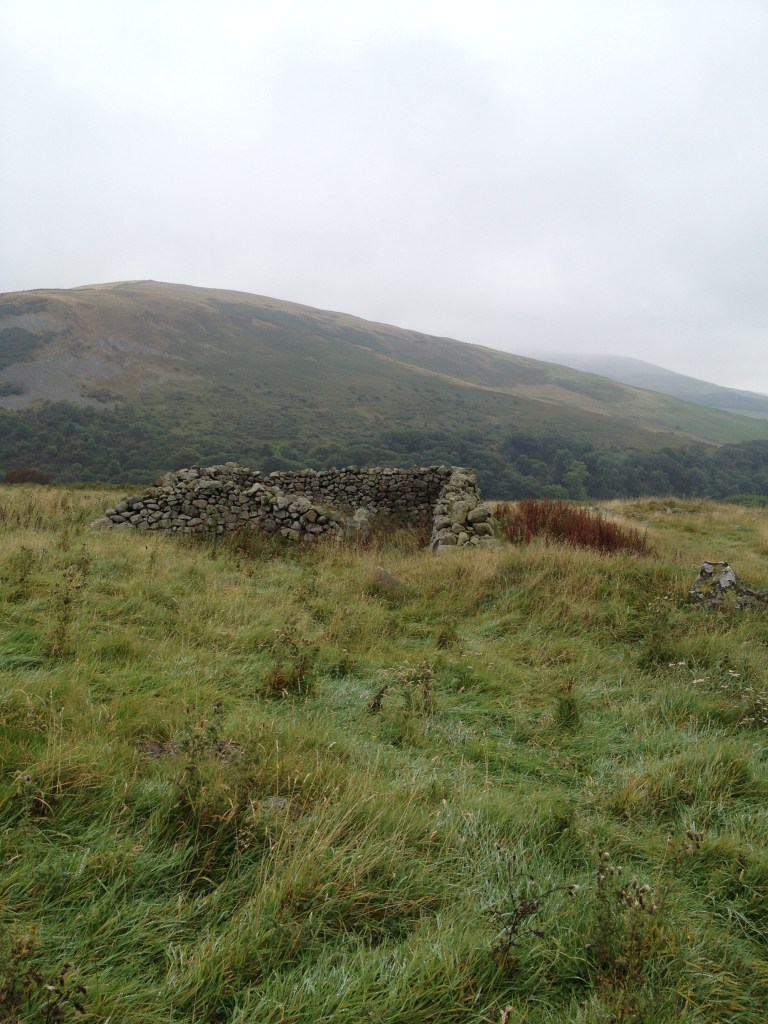
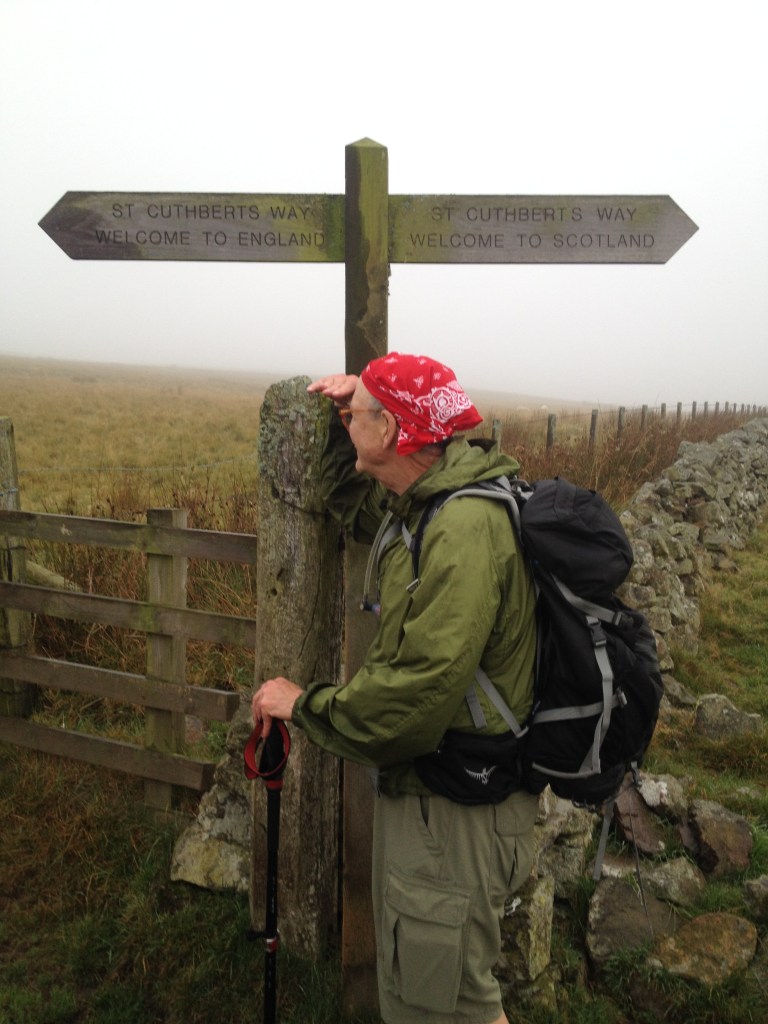
Speaking of pilgrimages, when Mary Lee and I were walking St. Cuthbert’s Way between Scotland and England, we passed a sheepfold, a circular wall of stones with an entrance, which for centuries, served as a place for shepherds to herd sheep at night for protection against predators such as wolves. To keep the sheep in and the wolves out, the shepherd would lie down across the entrance, becoming, as it were, a human door.
5
Jesus uses this image of the shepherd protecting his flock by becoming a door when he refers to himself as “the gate,” who “lays down his life for the sheep.” Which may be why cross or Christian paneled doors are so prevalent in New England (all the units in our Housing Development have them, inside and out). When my wife Mary Lee—who is a Deacon in the Episcopal Church and a lover of icons—was teaching the in a local high school, she wanted to put up an icon in her classroom but realized it wouldn’t be appropriate in a public school, so she hung a large print of a door on her back wall where she could see it when she taught. It was a great comfort, especially with certain classes.
6
Besides Jesus, the Bible refers to other kinds of gatekeepers: those appointed to control who came and left the city through the gates. Thus, the term “gatekeeper” has come to mean a person who controls access, someone in authority who acts as an arbiter of quality or legitimacy, or someone who blocks you from speaking with a decision-maker. Gatekeepers access who is “in” or “out.” I’ve had a few of those in my life, athletic coaches, teachers, whom I’ve had to please in order to succeed. I suppose, as a teacher myself, I’ve also been a gatekeeper.
7
I’ve also let others become gatekeepers, to whom I gave away authority, surrendered, as it were, the keys to doors I could have opened for myself. Growing up in an alcoholic family once limited my choices when I faced a decision to “What will the neighbors think?” to quote my mother. Through working an Al Anon program and learning to put the focus on me instead of on the me I thought you thought I was, I’ve found keys to open doors I never knew existed.
8
Some of those early Egyptian doors symbolized entrance to the afterlife. Doors can represent transition, confinement, new opportunities. Doors can be metaphors for the choices we make. We learn early on in life that we can walk through some doors and not others. As a WASP male, I know that I have more doors available to me than women, people of color, people of other religions. My destiny has been shaped by the doors I’ve walked through.
9
Or doors that have closed behind me. For a while, Mary Lee volunteered as a chaplain at the local prison. One Christmas, I helped her with a service. My clearest memory is of going through a series of doors and hearing the loud, definitive clang as each door closed behind me. I’ve had a few of those definitive door closings in my life: the death of my daughter, a divorce decree, a couple of retirement parties. Most of the time, however, I find that doors close behind me without my noticing. One reason I took early retirement from teaching high school English was that I saw too many colleagues still standing in front of their classes, even though, emotionally, they’d shut the door on their students years earlier. One of the things I dislike about the geriatric life is that doors keep silently closing, until suddenly I realize, I can’t do this anymore! Can’t climb that mountain, can’t reach that note, can’t eat that food, can’t…
10
On the other hand: My Quaker friends say that sometimes a door needs to close before another can open. That’s certainly been the case with me. I had to close the door on a forest management program before I could open the door to what’s been for me a fulfilling teaching career. I had to retire from public education before I started writing. After my daughter died, I had to lose every image of God I’d ever had before I encountered the Grace of God of my not Understanding.
11
In late 1960’s, I listened to a rock group, The Doors, who named themselves after the title of Aldous Huxley’s book, The Doors of Perception, in which he reflects on his psychedelic experiences. Huxley himself had based his title on a line in English poet William Blake’s The Marriage of Heaven and Hell: “If the doors of perception were cleansed, everything would appear to man as it is: infinite.”
12
These days I’m trying to clean the doors of my perception through contemplative practices such as meditation, going on more retreats, walking meditation, contemplative reading, sessions with my Feldenkrais teacher, journaling, music, working on my listening, writing these blogs, and of course, making more pilgrimages, even if they’re only to the compost pile.
13
And I’m not done opening new doors. I’m hoping I have a few longer trips left ahead of me. Speaking of trips, I note that interest in psychedelic drugs is again increasing, thanks to books like Michael Pollen’s book How to Change your Mind.Indeed, I have a 92-year-old friend who’s seriously considering a guided psychedelic experience. That’s another possible door.
And, of course, there’s the Big Door ahead of me. That, too, will be quite a trip, I suspect.
“Great things are not done by impulse, but by a series of small things brought together.”
—Vincent Van Gogh
#
This blog is a milestone for me. Eight years ago this month, I published my first Geriatric Pilgrim blogs (https://geriatricpilgrim.com/2015/11/). And while I’m not big on party hats and horns, I want to celebrate.
The Romans erected the first stone markers to let travelers know not only the number of miles they had to go to reach their destinations, but also the distances they’d covered. Today, businesses talk about a milestone as something that demonstrates a significant, marked change or step in the development of a project. Parents keep track of milestones in their child’s development. (“Look, little Leslie’s walking! Where’s the camera?”)
When I think of the importance of milestones in my life, I think of the second day of our seven-day walking pilgrimage along St. Cuthbert’s Way through Scotland and England. Still apprehensive about being able to complete the 72-mile trek, I looked back across a newly mown field to the Eildon Hills fading into the dimly distant horizon. The day before, my wife Mary Lee and I had crossed those three hills. I felt a burst of energy. Look at how far we’ve come, I thought. We can do this!
And as I look back at those first blogs from 2015, I’m also surprised and energized by how far I’ve come in the last eight years.
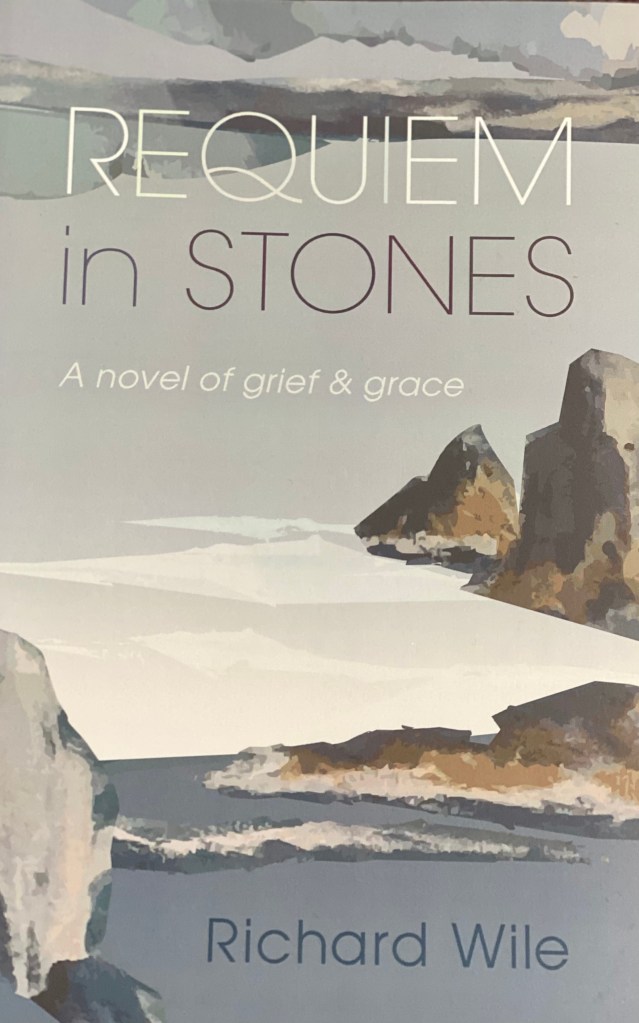
In 2015, I’d just published a novel, Requiem in Stones: A Novel of Grief and Grace, based on my experiences after my daughter Laurie died of cancer.
This novel about the effects of a child’s death upon a family, had taken me 20 years to write and I was emotionally drained. For the sake of my sanity (not to mention the wellbeing of those around me), I wanted to write something for fun.
Two years earlier, Mary Lee and I had walked St. Cuthbert’s Way, and I’d become curious as to how pilgrimages differed from vacations, business trips, escapes, or educational trips. I was especially interested in the inner journey one makes on a pilgrimage. I read books about some of the pilgrimages people had taken, drawn especially to those who approached the spiritual journey with humor and curiosity. I decided to try to use the same approach in a blog about my travels.
But now when I reread those first blogs, I can’t find much humor. Like the novel, they still seem to me focused on the effects of my grief—physical problems, nasty thoughts and visions. What humor I find now sounds to me sarcastic.
Still, because I’m also writing about specific places—Jerusalem, retreat houses—I can also see the beginnings of my detaching, of stepping back, of broadening my horizons.
And that’s what writing these blogs over the next eight years has done for me. By focusing first on my various exterior journeys, and then going inward, I’ve given my grief more room to live in, so that it doesn’t dominate either my life or my writing.My grief over Laurie’s death is no smaller, but the landscape in which it resides has expanded to include not only a dozen countries, but also my family history and my geriatric journey as well.
Probably nothing has helped me better understand this interior landscape over the last eight years than joining two 12-step programs. Al Anon, the program for families and friends of alcoholics, and ACA, the program for adult children of alcoholics, have become like lenses on a pair of binoculars, helping me view the effects of my grief—especially fear, anger, and shame—as mountains that make the Eildon Hills look as level as pool tables.
I remember telling my Al Anon sponsor in one of our first meetings, “I will always feel at some level that I killed my daughter.” Even 25 years after Laurie died, I blamed my daughter’s death on my divorcing her mother two years earlier or by not divorcing her mother soon enough. I said that every year, right around Thanksgiving, I could feel my body chemistry change. For the next month or so, right up until the anniversary of Laurie’s death on December 23, I said, I never knew how I would react. Some years I was angry at everyone, some years I cried at anything remotely sad, some years I spent the months hiding from the world by reading mysteries. I said that I’d just accepted this response as the way it would always be.
And I remember my sponsor’s reply: “Okay. Maybe… Let’s see what happens.”
Through working the Al Anon program, especially Step Four, taking “a fearless moral inventory” of myself, I discovered that because I’d grown up in a family riddled with alcoholism, I’d been clambering up and down those mountains of fear, shame, and anger long before Laurie’s death. Fear and my need for what I thought was security had driven me into an unhappy first marriage. Shame and my need for respect had driven me into erecting any number of false personas. My need to deaden my anger had driven me into my own alcoholic behaviors. Using ACA, I learned about the long-term effects of growing up in an alcoholic family, while Al Anon gave me the tools to separate my grief for my daughter’s death from my fear, anger, and shame over losing her.
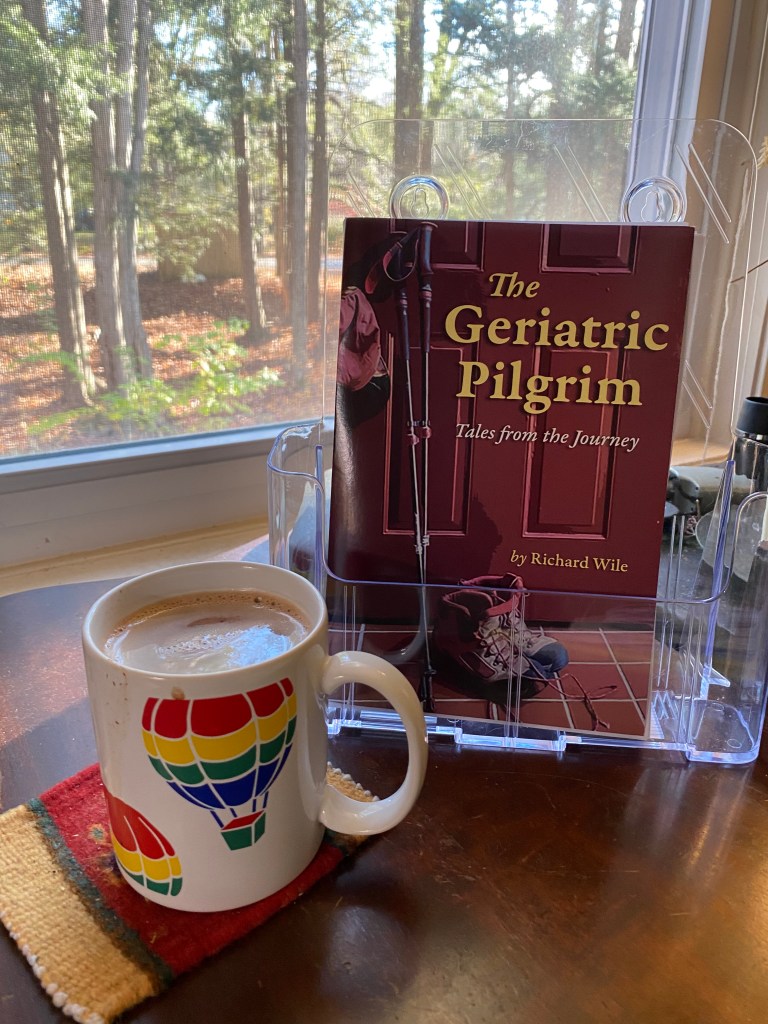
So that four years ago, I realized that I was enjoying the Christmas season—no tears, no angry outbursts at the baggers at the grocery store, no reading marathons. And as I was collecting fifty of my blogs to put together in my second book, The Geriatric Pilgrim: Tales from the Journey, I had to revise several blogs which had talked about how hard the Christmas season still was for me.
There’s also nothing like successful heart surgery for expanding one’s inner landscape. Only through a timely wellness checkup and the perspicacity of my PCP—“No, being out of breath is not normal. I want you to take a stress test this week!”—did I avoid another family disease: falling dead of a heart attack. Only because of what I’ve called in these blogs “grace” am I’m still here. Only through grace am I grateful for the life I’ve lived, even for those demanding hikes over mountainous landscapes.
All of which is worth celebrating. If not with paper hats and party horns, at least with a cup of hot chocolate.
“I waste too much time in the little lightless caverns of my own mind.”
—Christian Wiman
#
My first wife used to say to me, “Rick, you think too much.”
It pains me to say it, but she was right. I can turn anything into a problem to be solved: what I want for breakfast, what clothes I want to wear for the day (I’m retired, for godssake, who cares what I wear?), where I want to go for a morning walk, whether I want to go first to the grocery store and then to the hardware store (well, the grocery store is closer and if I get delayed there, I can always wait until tomorrow to do the hardware store) or go first to the hardware story and then to the grocery store (but because the grocery store is closer, I need to get the refrigerated items home before they spoil).
So that by lunchtime I’m tired out (and then do I want a nap or should I read?).
Minor stuff, I know, but as I look back at my life, I see that overthinking has caused me and those around me serious problems. Part of the reason I almost flunked out of college was because I waffled about not only what career path to follow, but also whether I wanted to join a fraternity, ask Ginny out or Pat, hang out with jocks or artsy types, take a year off.
In later years, I agonized over if I should get married, go to graduate school, take a college or a high school teaching job, join a church (what denomination?), join the Rotary, or tell my first wife I was unhappy in our marriage.
After my daughter died, my mind became a prison. When all my efforts to understand why a previously healthy and happy 18-year-old should suddenly die from a rare cancer—radon in our water supply, McDonald’s cutting down rain forests, accident, fate, God wanting “another angel in heaven,”(all reasons people gave me)—failed, I decided I had to be the one to blame, either because Laurie’s mother and I divorced or because we didn’t divorce soon enough. For several years, the only relief I could find was through alcohol and anger, both of which threatened not only my life but the lives of those close to me.
As I’ve written before in these blogs, I credit meditation with first helping me see the destructive nature of thoughts and to unload much of my anger and shame—give it to God, as one of my first mentors suggested.
But meditation can become its own “little lightless cavern,” as poet Christian Wiman calls his mind: a place to escape an argument or a fear or a resentment by retreating into old patterns of thinking. (What will I have for breakfast, what shall I wear today…)
So, what else has helped?
Seeing myself as the Geriatric Pilgrim has become more than a literary conceit. Looking at life as a pilgrimage has taught me to be curious, to look for surprises, to live without planning every single detail, to put myself in uncomfortable situations (even if it’s just going for a walk and having no destination or closing my eyes before grabbing a shirt to wear for the day). I’ve learned to embrace the unknown—including a Higher Power totally outside my understanding, and to look for evidence of that Higher Power—what I would call grace—all around me.
A pilgrimage always involves some type of movement, whether it’s walking Saint Cuthbert’s Way or walking downtown. Despite having grown up playing sports, I’ve never paid more attention than I do these days to movement. Yes, regular exercise has long been known to improve and maintain key aspects of cognitive function such as attention, learning, and memory, but neuroscientist Daniel Wolpert posits that our brains evolved, not to think or feel, but to produce adaptable and complex movements. He points out that it’s a lot easier to create a computer that thinks than to create a computer which can move anything like we do. (If you’d like to learn more see https://www.ted.com/talks/daniel_wolpert_the_real_reason_for_brains.)
For the last year and a half, I’ve been practicing the Feldenkrais Method of exercise therapy, learning to reorganize connections between the brain and body, which has improved both the way I move and the way I think, helping me pay less attention to my mind and more attention to my heart and my gut—my instincts.
The slogans of Al Anon, the 12-step program for families and friends of alcoholics, have become my roadmap on this pilgrimage out of the caverns of my mind. When I first started attending meetings and saw slogans set out on the floor, I thought, “God, how simplistic!” Another example of how thinking can mislead me. Try following a few of these slogans and see how simple they are. To give just one example, let’s look at “One Day at a Time.”
What’s so hard about that? Well, for someone like me—and, I find, many people who’ve grown up in alcoholic families, who continually try to anticipate and resolve every problem they think they may encounter, attempting to make decisions on information they don’t have—it’s damn hard. Instead of responding to what’s in front of me, both the challenges and the gifts that come my way, I’m obsessing about all the possibilities (most of them bad) that might befall me, even though, looking back over the almost 80 years of my life, I can say that not once did any of this preparation spare me a single moment of pain. In fact, it just lengthened my suffering.
Still, at my age, it’s hard for me not to think about—which in my case means understand, anticipant, awfulize—my death. It was helpful this week to hear a podcast in which Ariel Burger, protégé and friend of Holocaust survivor and Nobel Peace Prize recipient Elie Wiesel, talk about Wiesel’s teaching that there are no answers to life’s big questions, only responses.
So, I’m trying to respond to these questions by breaking them into small daily tasks. Instead of trying to answer the question, how can my grandchildren survive in a world that seems to be hurtling toward destruction, I focus what I can do with them today. If I’m worried about the Supreme Court or the swelling in my jaw, what can I do about either one today? Call my senator? Pop into the walk-in clinic (which I did this weekend. It’s “an obstructed parotid gland”)? Then it’s time to go for a walk, pick up a banjo, write a poem or a blog. Get out of my head.
In other words, as one of the AA’s oldest slogans puts it, “Move a muscle, change a thought.”
One of the joys of my various pilgrimages is remembering them: looking at the photographs, rereading journals, comparing notes with other people who’ve made the same journeys. I can always discover something I haven’t seen before. The other night, when Mary Lee and I were reminiscing about our 72-mile walking pilgrimage from Melrose, Scotland to the Island of Lindisfarne off the east coast of England, we found ourselves asking each other what foods we recalled. Remember when we got off the bus in Melrose, how hungry we were, and how good that ham and cheese toastie was? And that salmon in Dryburgh? Nothing was better that the lamb, though, in Jedburgh. Unless it was the scallops in Fenwick. And weren’t the chips always good, no matter where we were?
Which got me thinking that food has always been part of every pilgrimage I’ve ever been on: Brother Bernie’s blueberry pie the first time we went to what turned out to be our favorite retreat center; the falafel and shawarma, figs and dates in Israel; Scottish haigis (I actually like the stuff); ploughman’s lunches in England and once for breakfast, the largest kipper I’ve ever seen; Irish soda bread; New Mexican tamales; just about anything on the menu in San Francisco’s China Town; Turkish mezze platters; Nova Scotia seafood chowder.
Likewise, I often identify the stages of my life’s pilgrimages by the food I remember: the smell of the bread and rolls my mother baked every Saturday morning and the taste of butter melting on hot, yeasty dough; chicken fried steak and creamed sausage over biscuits when I worked for the Forest Service in Idaho; the pizza in Orono, Maine, where I went to college; pancakes soaked in Vermont maple syrup; baked beans and codfish cakes when I lived in Down East Maine; butterflied leg of lamb, new potatoes, and fresh corn on the cob with Mary Lee’s Wellesley Fudge Cake for dessert.
I’m not sure about the future, but based on my observation of the active octogenarians and nonagenarians I know, I expect I’ll eat a lot of oatmeal and ice cream.
Maybe because years of smoking have dulled my taste buds, or because I don’t cook, or because it’s just the way I see the world, food for me is seldom just food. For example, I think of food as romantic love. Yes, there is our traditional Valentine’s night out at a four-star restaurant, but thirty-two years ago, after Mary Lee and I stood on the rocks of Casco Bay with an Episcopal priest who blessed our civil marriage, the three of us went to the local pizza place, which is still where Mary Lee and I go on our anniversary. Even though we no longer live in town, we also try to stop there on the way home after being on a trip. Our love, one might say, is grounded in pizza.
When I had basketball practice in high school, my mother made the rest of the family wait to eat dinner until I got home. I really didn’t care if they waited for me and I think my father was pissed, but since then, I’ve read that one of the marks of successful, well-adjusted young people is that they eat dinner with their families—something that happens less and less in these days of individual TVs, computers, sports practices, and erratic work schedules. Food, then, helps bond the family unit.
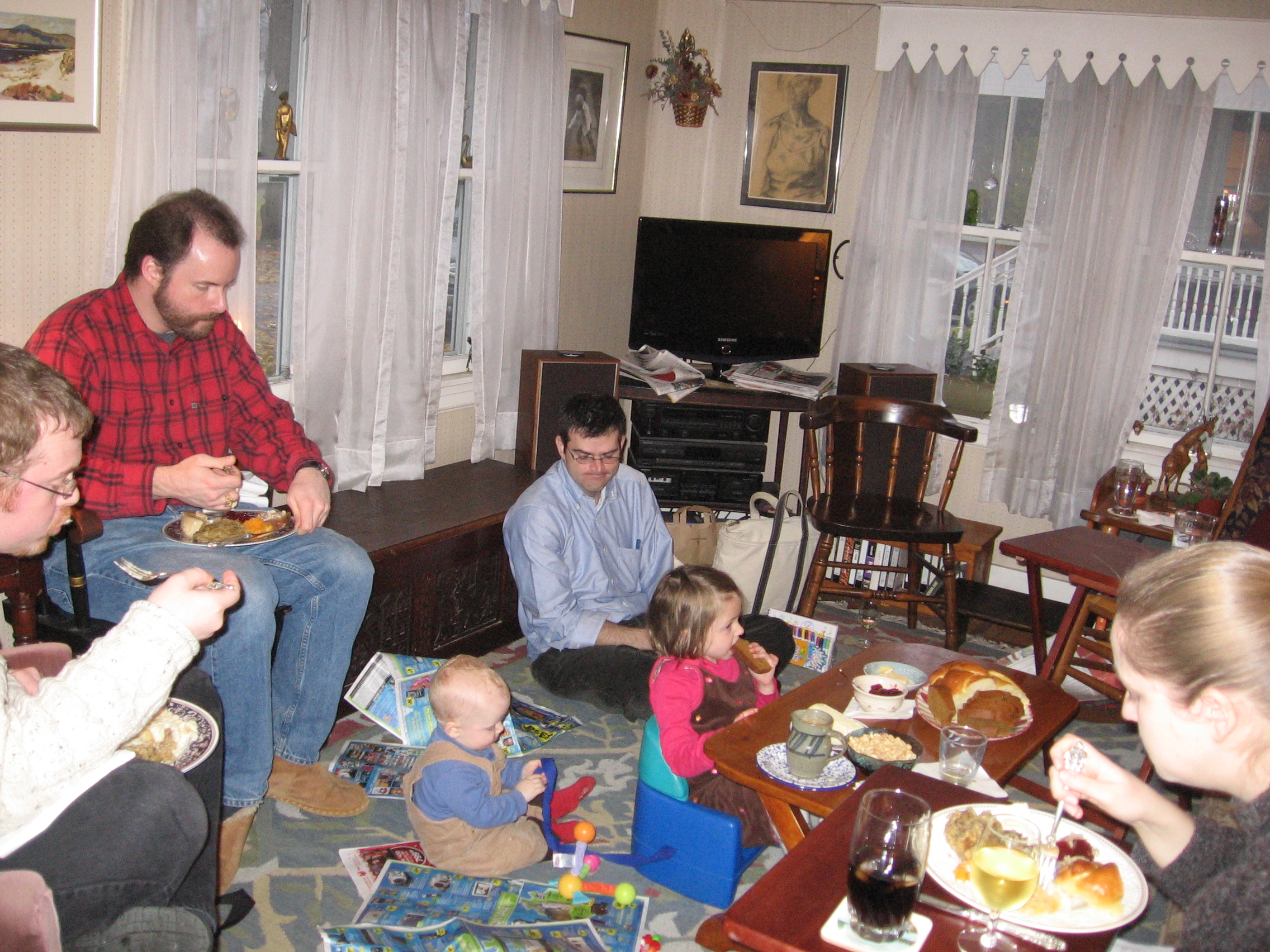
Don’t most family celebrations revolve around food? Thanksgiving is the big one for us. Ever since Mary Lee and I were living in a small apartment, with next to no money, beginning our lives all over again at the age of forty, we hosted our families—adults sitting on couches with TV trays, children on the stairs, so that grandparents could sit at our tiny dining room table. (Not that we had a dining room.) We felt it important to make both sides of our families know they were part of our new lives. Now, as the oldest members of our families, we host not only Thanksgiving, but also often Christmas, Easter, and birthdays, as a way to stay connected to the next generations.
How many photographs do you have of holiday meals?
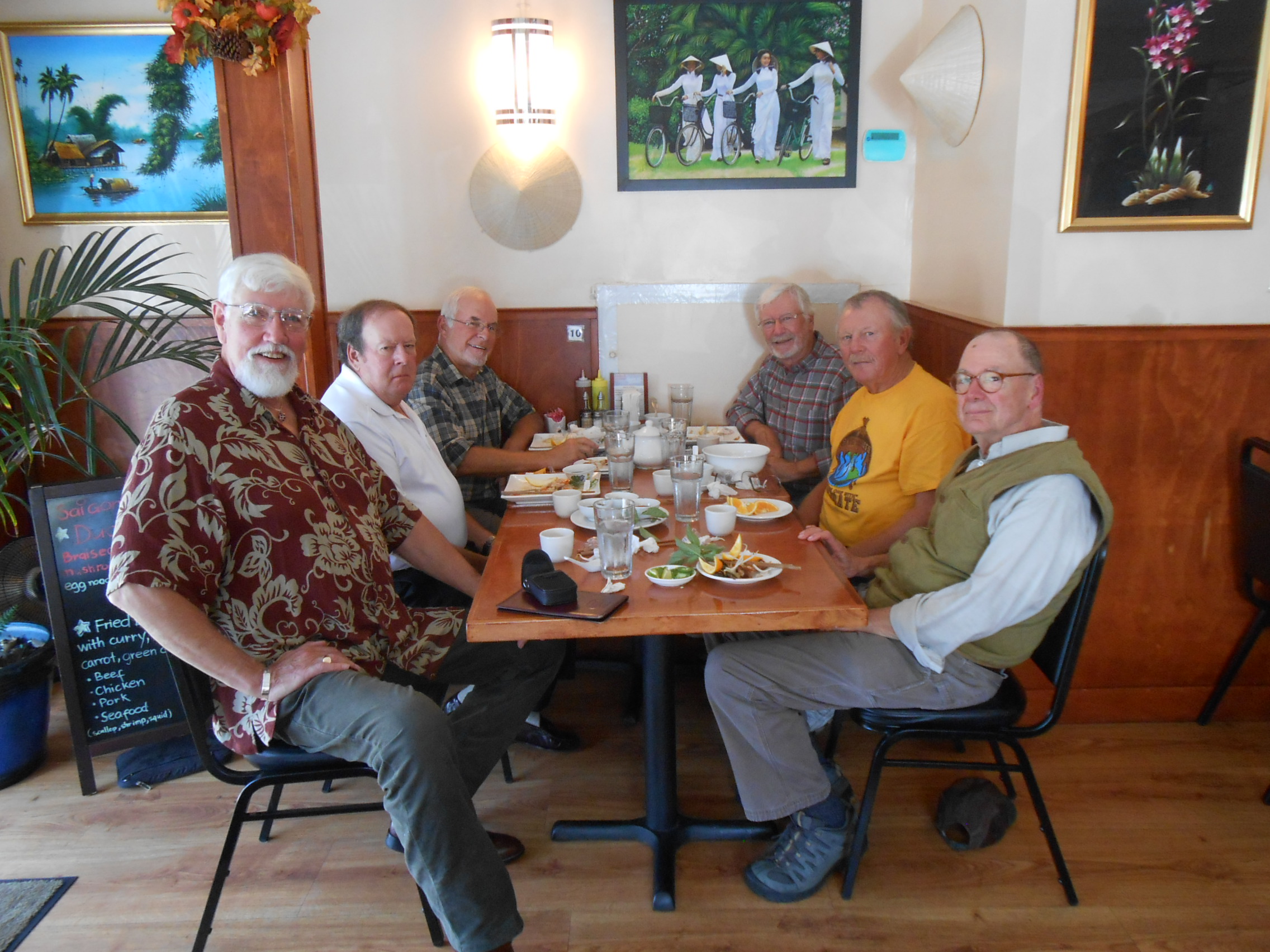
Food is friendship. After my weekly Men’s Group meeting at our church, most of us go for coffee at a local bakery, where I have some kind of muffin, scone, or coffee cake, savoring the calories and the conversation. Every month or so, I join the ROMEOs (Retired Old Men Eating Out) from the high school class of 1961 at an area restaurant for lunch. Sometimes, we search out new places for German or Indian or Japanese food; other times we return to old standbys for fish & chips, burgers, and fried clams. But the kind and quality of the food is not the reason we’re often the first customers to arrive, and some of the last to leave.
The ROMEOS (R.I.P. Scott)
When my non-church going friends ask me why I go to church every week and several times a day when I’m on retreat, I say I go to be fed. I don’t know what happens to that wafer and wine on Sunday, but I’ll take it. And do. Not to mention the refreshments at coffee hour, the pot luck suppers, picnics, and other meals our church serves.
During a brief flirtation with Buddhism, I attended six-hour sesshins, which, besides silent meditation, included walking meditation, talking meditation, and eating meditation. At the end of the day, we were served tea and a cookie. That cookie was the best tasting cookie I’ve ever eaten. A year or so later, after I’d decided I was a Christian and had stopped going to these sesshins, I discovered those same cookies in the grocery store. I brought them home and made a cup of tea. At my kitchen table, away the Zen community which had fed me, those same cookies tasted like cardboard.
So, maybe the lesson here—for me at least—is that the meals I remember have less to do with food, and more to do the people who’ve been with me when I’ve eaten that food. In the Bible’s Gospel of John, Jesus alienates the religious authorities and loses many of his followers when he talks about being “the bread of life,” and that “whoever eats this bread will live forever.” But I think I get it: looking back at my various pilgrimages, I have been fed more by the companionship (the word “companion” literally means “with bread”) than by the bread itself. And if I am to continue to live, not just exist, I need to be nourished by more than oatmeal and ice cream.
On my mother’s 90th birthday, her church threw her a party,
“When you assume, you make an ass out of u and me.”
—Oscar Wilde
#
Mary Lee and I are planning a trip to Africa. We’re reading up on where we think we might like to go and watching YouTubes made by people who’ve taken trips there. I’ve just finished Paul Theroux’s Dark Star Safari: Overland from Cairo to Cape Town. We’re getting shots for typhoid and hepatitis, and reading up on the kind of pills we need for malaria and what bug sprays to take along.
Planning, writers on pilgrimage agree, is essential to the pilgrimage experience.
What I need to be careful about is that I don’t confuse making plans with making assumptions. I’m better at separating the two—one of the benefits of aging (they do exist)—but I still fall prey to the anxieties, delusions, and disappointments that occur when I make assumptions about what’s going to happen, whether on a pilgrimage, retreat, or quick trip to the grocery store.
Several years ago, as Mary Lee and I planned our pilgrimage to Jerusalem, I assumed the old city would look like all the photographs and paintings I’d seen of glorious holy sites and people kneeling quietly in prayer. Israel, I assumed, would look like the 23rd Psalm: green pastures and still waters. I assumed I would be filled with awe and reverence. I did not assume how steep the streets are, how relentlessly hot the weather can be, and how the crowds could at times be suffocating; nor that I would become sick with dysentery, and that most of the holy sites were swarming with packs of children hounding us for money. Only later—when I returned home, really—did I recognize how important a pilgrimage I’d made. But my assumptions, I think, ruined much of my actual time there.
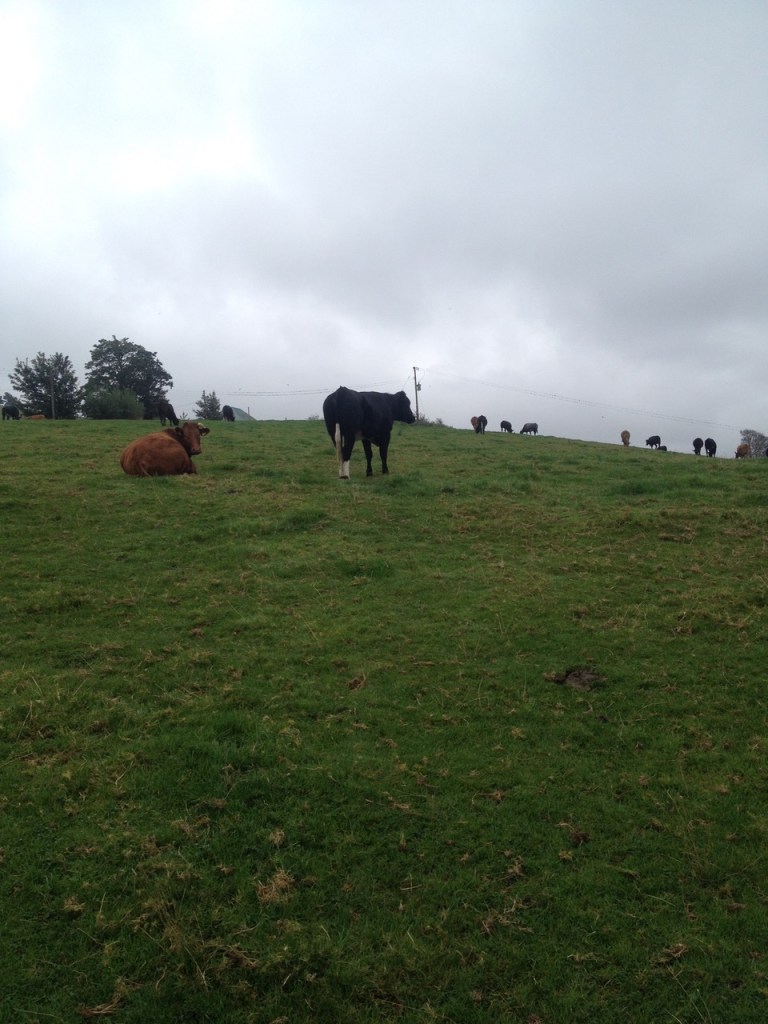
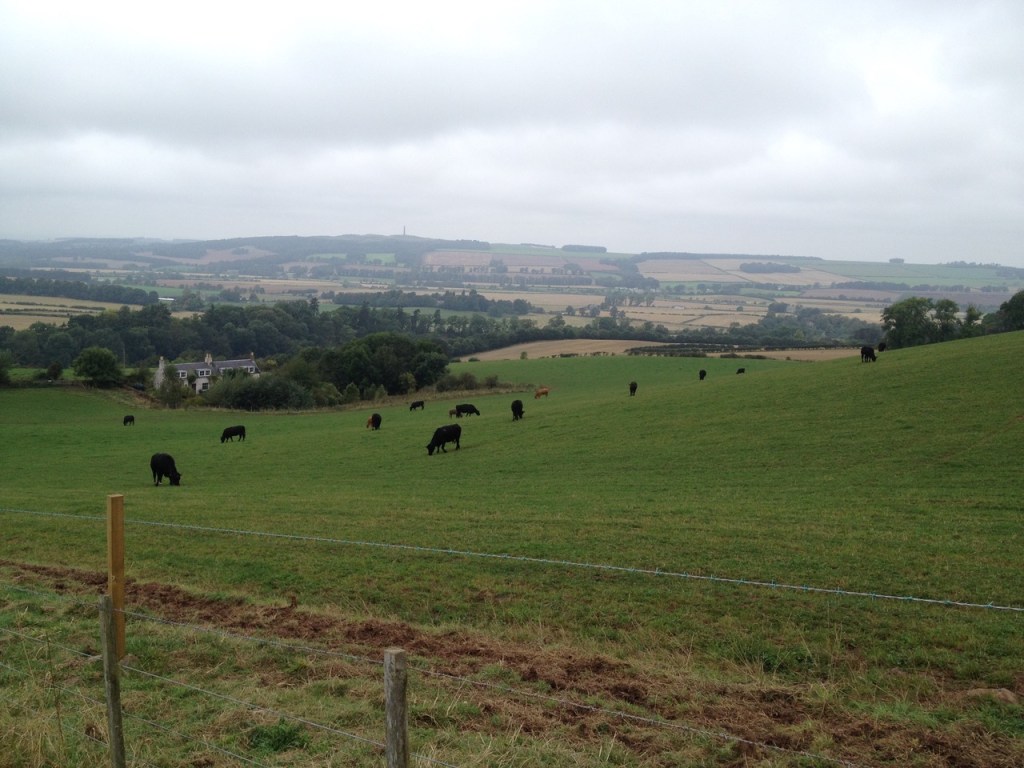
None of the YouTubes—and I saw a lot of them—on hiking St. Cuthbert’s Way from Melrose, Scotland to the Island of Lindesfarne off the coast of England prepared us for the hills and the cow shit. (See above photo.) None of the brochures on San Francisco prepared us for the mosquitos that attacked us one night in our hotel. On the other hand, when Mary Lee and I traveled to Iona off the west coast of Scotland, we assumed that a couple of days would be more than enough to cover an island just four miles long and a mile wide. The next year, we spent a week there and still didn’t feel as if we’d stayed long enough.
I’ve made similar faulty assumptions before going on a retreat. Once, I assumed I’d spend my time snowshoeing in the woods and spent it in bed with excruciating back pains. Another time, I thought I would enter a period of silence and slow time and wound up spending several days in tears, banging my head in rage against the side of my bed.
These previous pilgrimages and retreats have helped me learn to put aside preconceived notions about what may or may not happen and accept that what will be is what will be—a lesson I’m trying to carry over into my day-to-day pilgrimage through life. If I’m going to have lunch with some of my old classmates, I try not to assume I’ll wind up arguing over politics and spend that morning getting ready to do battle, because if the subject of whoever’s President never comes up, (which it often doesn’t) I’ve wasted the morning. If I’m going to be spending time with my one, two, and five-year-old grandchildren, I’ve learned that to assume they’re going to arrive at the house wanting me to fix them oatmeal and read books and go to a playground is only going to make both them and me miserable.
It’s taken thirty years, but I’ve learned never to assume how I will be each year from November to Christmas—the two months I spent at my daughter’s bedside when she was dying of cancer. Some years, I’m overly angry or forgetful or sad or sick. Last year, I realized that I wasn’t any of those things; that, in fact, I was cheerful and looking forward to Christmas—until the anniversary of Laurie’s death, when I suddenly spasmed into tears.
Assumptions illustrate how, as the Buddhists say, “We do not see things as they are; we see things as we are.” The year after Laurie died, besides being angry, I was confused and afraid. But what I wrote in my journal that year were rants about news articles in which I disdained everyone else for being confused and afraid: book sellers for pulling Salman Rushdie’s The Satanic Verses off their shelves because of fear of Muslim reprisals; people for taking anti-depressants because they were afraid of not feeling happy all the time. These days, I find myself fighting the assumption that because I’m not as strong as I was fifty years ago, neither is my country; that because I’m going to die within the next twenty or so years, the United States will as well.
I find it interesting that when we talk about assumptions, we do not have them, we make them. Assumptions, then, are what we create, we fabricate. There’s also the implication that what we create is false, as when we assume a role in a play or assume a pseudonym. We make these assumptions, I think—okay, I make assumptions, I think—in order to bolster the ego, convince myself that I have control over the future, hide my anxieties about the unknown.
The problem is that these assumptions keep my mind closed to possibility, to mystery. Last week, I ran across a quote by Albert Einstein:
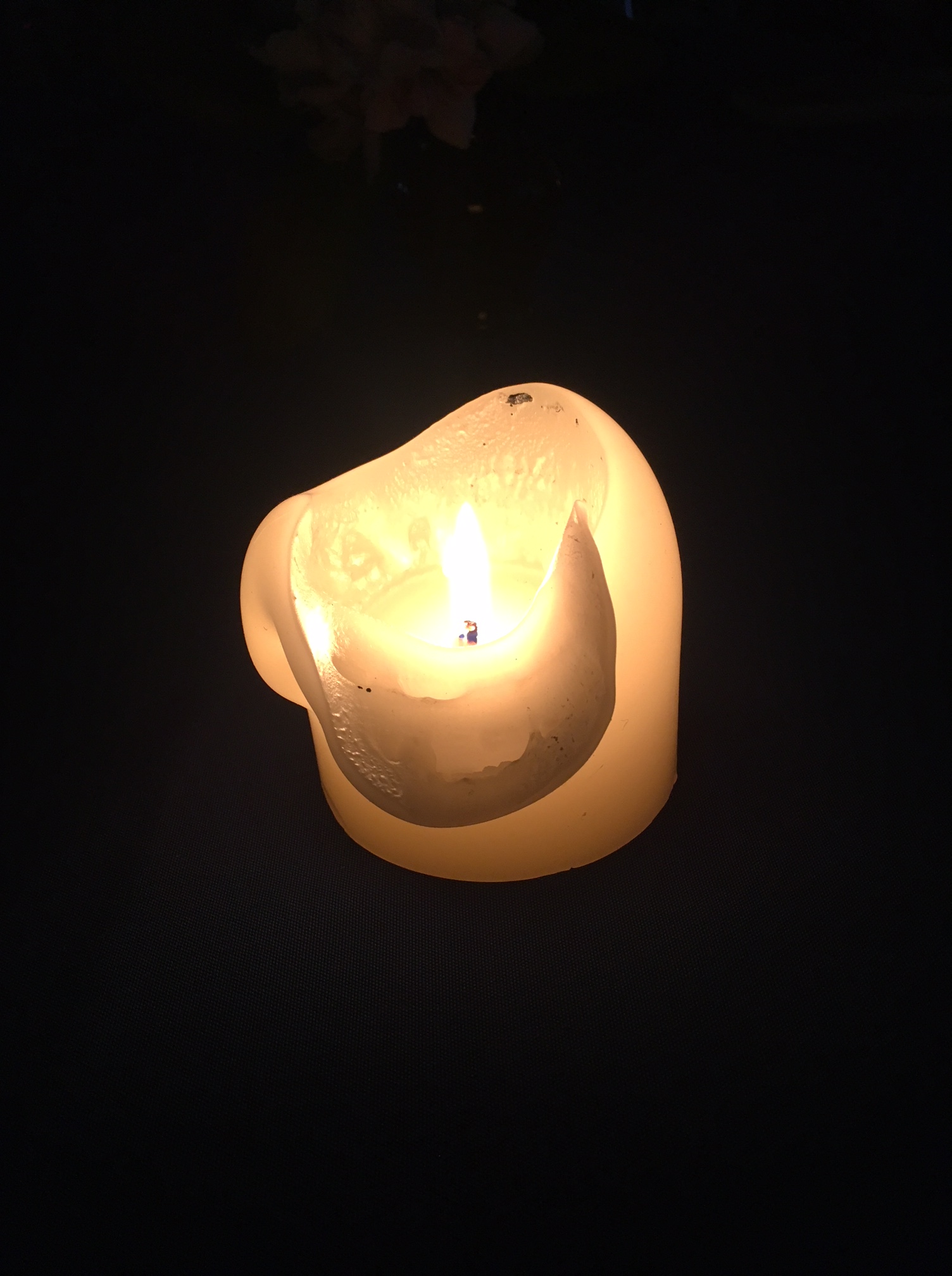
The most beautiful thing we can experience is the mysterious. It is the fundamental emotion that stands at the cradle of all true art and science. He to whom this emotion is a stranger, who can no long wonder and stand rapt in awe, is as good as dead, a snuffed out candle.
One thing I do now to try to avoid making assumptions is to end each day asking, “What surprised me today?” Not all of these surprises are, of course, pleasant ones—yesterday I was surprised to find caterpillar nests in the beautiful apple blossoms on the tree at the end of our street—but the practice has opened me up a little more to some of life’s mysteries. And at my age, I want to be open and standing in awe as long as I can. My candle’s going to go out pretty soon anyway; I don’t want to snuff it ahead of time.







 The Geriatric Pilgrim: Traveling the Landscape of Faith and Grief