Ice

#

Last Palm Sunday, Mary Lee and I were supposed to begin a two-week retreat at a monastery in the hills of California. We’ve been going on retreats now for thirty years and I was eagerly looking forward to having more silence, being more aware of the world, doing more reading (I’m on a Buddhist kick right now), drawing closer to God of my not Understanding. Then, two weeks before we were supposed to fly to San Francisco, we received word rockslides had closed the roads, and that the monastery won’t open again until at least May. 

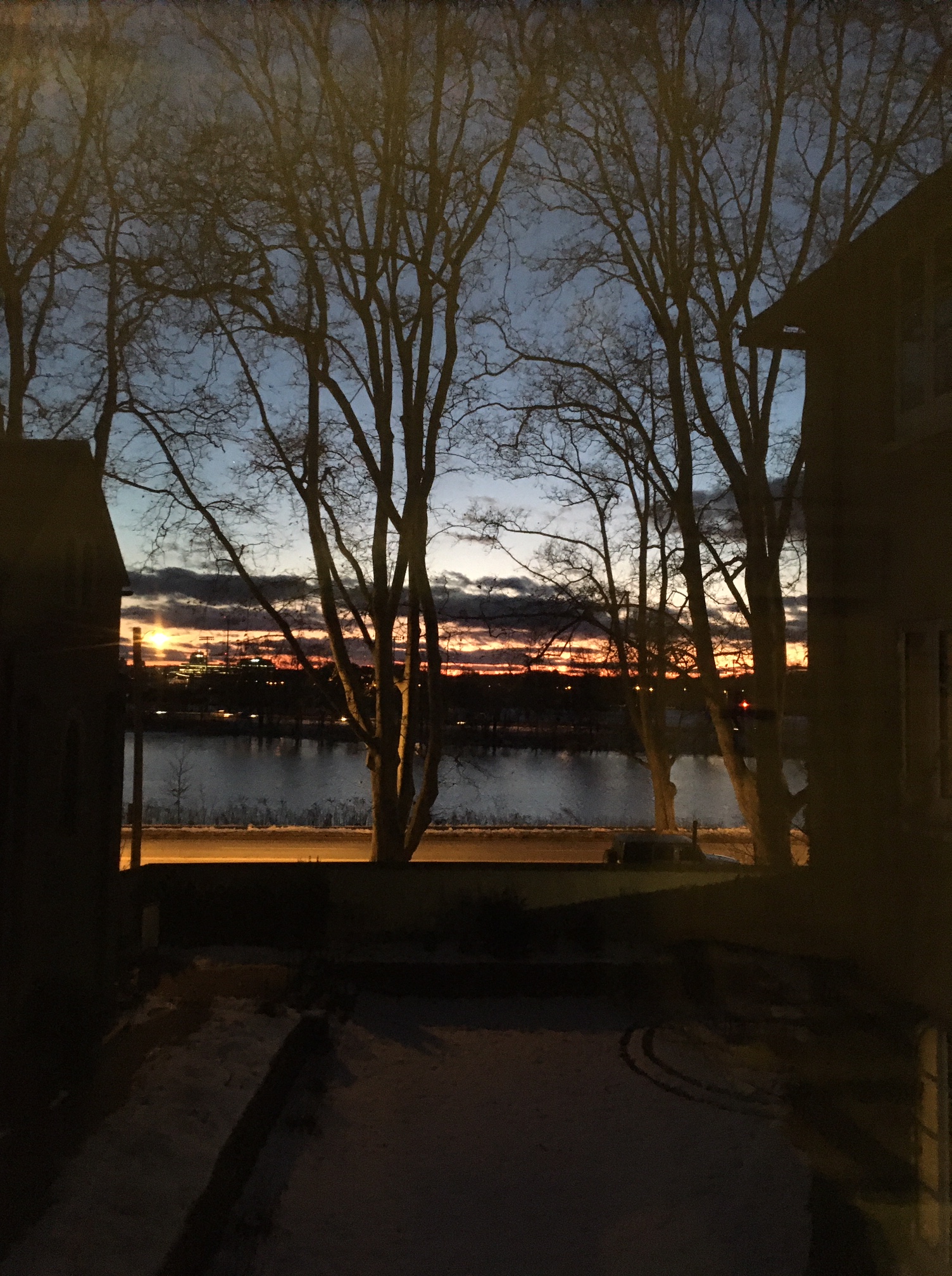
So instead of flying across the country on Palm Sunday, we spent the day encased in ice.

The previous evening, thanks to a day of snow changing to freezing rain, we lost power. That Sunday, we cooked oatmeal on top of our gas stove and wrapped in blankets in front of our gas fireplace. While the ice bent the trees and bushes lower and lower, Mary Lee and I read the Palm Sunday service from the Book of Common Prayer, wondering, along with the Psalmist, “My God, my God, why have you forsaken me.” 

For the next day and a half, we ate beans and rice, read, played Scrabble and cribbage, drove around the neighborhood to charge our phones, and finally gave in and stood in line at a restaurant in another town for breakfast. 

All in all, it wasn’t bad. Still, it’s hard for me to find much nice to say about ice. 

I like ice cubes in my water. I use ice packs to help the bursitis in my hips. Some ice sculptures are pretty. I’m glad to have a freezer in my refrigerator to preserve food. But that’s about it. When I used to go skating, I’d divide my time between flailing my arms to keep from falling and lying prone on the ice when I did. The one time I went ice fishing, I was days warming up.

Ice has all kinds of nasty connotations. It can mean frigid, as in sexually inadequate. It can mean unfriendly, reserved, aloof, rigid, inflexible. Fear sends icy chills down our spines. We hear about the icy fingers of death.

Speaking of death, while Hell (which is where some of my Fundamentalist friends tell me I’m going to go when I die) is usually pictured as a place of fire and brimstone, in Dante’s Inferno, the center of Hell is a vast lake of ice, in which Satan, along with sinners who committed treason and betrayal—such as Brutus, Cassius, and Judas—is incased.
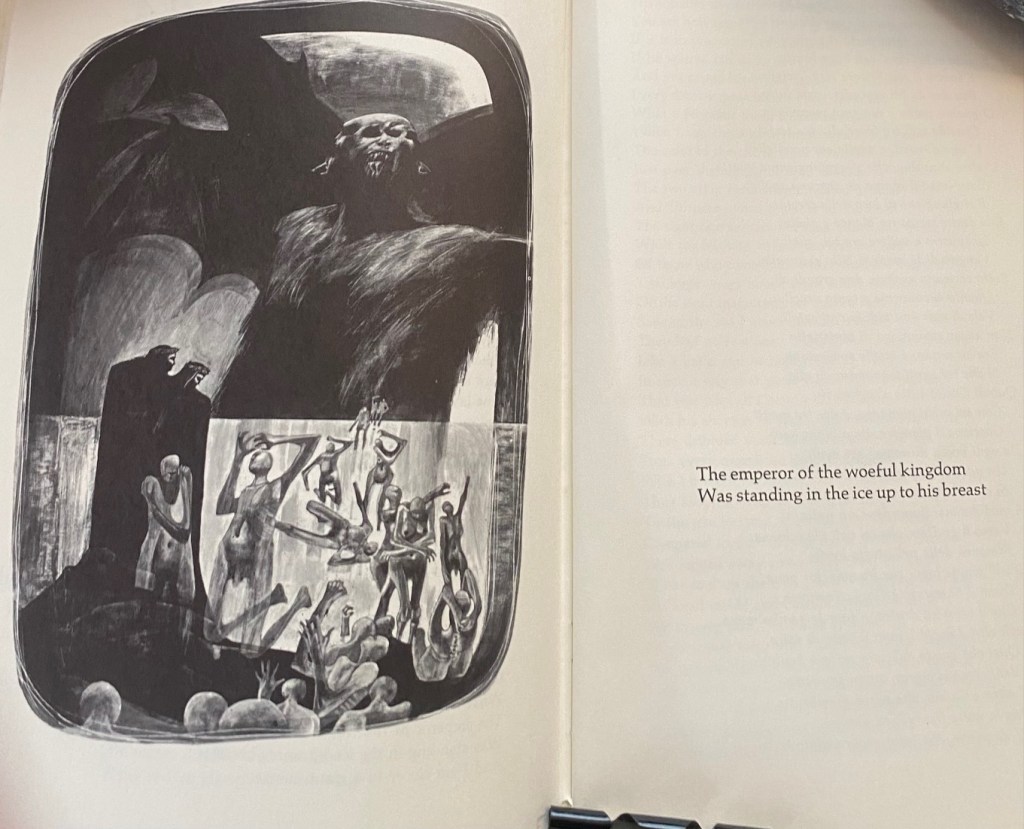
from Dante’s The Divine Comedy, I Hell, translated by Louis Biancolli, 1966

Makes sense to me. Ice is cold. Ice is heavy. (The reason we lost electricity was because ice-laden trees fell on power lines). Ice prohibits movement. During the most hellish part of my life, after my daughter died, I couldn’t get warm. I felt as if I were carrying a 20 cubic foot freezer on my shoulders. My body was rigid and tense. Only after I’d had two or three large tumblers of scotch did I feel as if I were thawing. 

And yet. For someone who dislikes ice, I realize that one of my tendencies is to want to freeze experiences and beliefs, preserve them the way we preserve meat and vegetables. 

After those hellish first years when Laurie died, my life began to get better. I thought I was learning to live with loss. But five years later, at this time of year, it was as if my daughter has died all over again. I plunged back into rage and tears. I spent evenings drinking my tumblers of scotch (or maybe it was Wild Turkey 101 proof, at this point), going through old photograph albums of the two of us and listening to Laurie’s old tapes of Tracy Chapman and the Grateful Dead. The only difference was that those I was most angry with were people who talked about their own grief. I remember being at a retreat at a monastery in Cambridge, Massachusetts where a woman talked about almost losing her son in an automobile accident. A spasm of rage surged though me. I thought, What are you moaning about? He’s alive, isn’t he?

Then on Easter Sunday after this retreat, I heard a sermon based on the Gospel of Mark’s account of the Resurrection, which, unlike the other gospels, ends with Mary Magdalene, Mary the mother of James, and Salome, fleeing from the empty tomb, “for terror and amazement had seized them; and they said nothing to anyone, for they were afraid.”

Why fear, asked the preacher. Well, there might have been a lot of reasons—fear of soldiers, fear of grave robbers—but he also wondered if it wasn’t human nature to fear the unknown, to become used to, even comfortable with, our lives even if they’re full of pain and suffering. We prefer what we do know to what we don’t.

And I realized that over the years since Laurie’s death, I had grown comfortable with my image of myself as GRIEVING PARENT; I had made Laurie’s death MY STORY, trying to preserve memories of her, as in the old photograph albums I’d been perusing. And if anyone else had a similar story, I felt threatened. 

In other words, I was trying to freeze my sense of myself and Laurie rather than let them evolve, flow. I wasn’t angry about the death of my daughter, I was angry at the possible death of my grief, thinking it was grief that was keeping me close to her. 

That Sunday afternoon, sitting in Harvard Square amidst cigarette butts and pigeons, looking up at the sycamores and the brick buildings, listening to voices babbling in a half-dozen languages, I tried to focus on my daughter in the present moment. I don’t know where you are, Kid, I remember praying, but at some level I know you’re fine, and I want you to know that I love you.

And the sights and smells and noises of the Square seemed to fade and I felt a hand on my shoulder, and I knew it was Laurie’s.

I don’t care whether that hand was from another dimension or from my imagination. What I do know is that the great spiritual traditions are right: love transcends death. That is, if you don’t try to freeze it like leftover meatloaf.

But I’m still learning. Working a 12-Step Program, I’ve discovered traits that I developed to survive growing up in an alcoholic family—judgmentalism, people-pleasing, perfectionism—traits which no longer serve me, but have, in essence, remained frozen, damaging my relationships with others.

And I’m wondering if I may be trying to freeze my retreat experiences, and that Life, the Universe, or God of my not Understanding isn’t telling me by having this retreat in California canceled that I need to let the retreat experience—the silence, the awareness, the reading, the closeness to God— flow into my everyday life, here at home, even in the middle of an ice storm.

#

Walking at Sunset

 fullsizeoutput_1756

#

After a wonderful but hectic Thanksgiving, Mary Lee and I spent a weekend on retreat at the Episcopal monastery of Society of Saint John the Evangelist in Cambridge, Massachusetts, a place we’ve been coming to for twenty-five years in search of silence and slow time. On Saturday afternoon, because the sun sets in this part of the world around 4:00 p.m., I decided to catch the last daylight and take a walk before Evening Prayer.

As I left the monastery, the sun was buttering tiers of purple clouds over the Boston skyline. I jay-walked across Memorial Drive, turned right, and joined the joggers, walkers, and cyclists on the path along the Charles River—a mix of races I don’t see in Maine, some talking into microphones and headsets, others conversing with one another, possibly in Chinese.

After about a quarter of a mile, I passed the Riverside Boat Club. I turned left to cross the Eliot Bridge, pulling up the collar of my coat against a raw wind coming down the river. The late afternoon sun and clouds reflected in the rippling waters of the Charles, the lengthening shadows of the sycamores, and the dank, November wind all churned up memories of another wind coming down another river thirty years earlier. I saw myself walking back from the Eastern Maine Medical Center to the Ronald McDonald House after spending the day watching my eighteen-year-old daughter die a little more from the cancer ravaging her body. I recalled the Christmas tree sellers in their vans and pick-up trucks in Cascade Park at the bottom of the hill across from the Penobscot River and how Christmas seemed at the time like some horrible joke played on the human race by a sadistic god promising peace on earth, good will to all, and then inflicting more war, poverty, disease, and death on us suffering buggers.

Now, however, I realized as I turned left after the bridge and started walking along Storrow Drive, that although I could still vividly picture details from my walk back from the hospital—the seagulls circling over the river, the mansard roofs on the houses—I could no longer feel the anger, confusion, and shame that once consumed me. Thanks to prayer and meditation and spiritual direction—much of which happened at the SSJE monastery—I’ve had joy as well as pain since Laurie’s death. Last summer I had heart surgery which has given me renewed hope that I may be around to watch my grandchildren grow up.

#

The sun dropped, gilding the tops of buildings on my right. The clouds became red and gray. Just outside a patch of skim ice near the shore of the river, a dozen geese floated tranquilly, while on the other side of me, rush hour traffic hurdled by. Horns honked.

The geese reminded me of my father-in-law, George, who used to urge his employees to work like ducks on the water: calm and serene on the surface, paddling like hell underneath. He was the one who introduced me to this walk around the Charles; he made it almost every day. One of the most gracious men I’ve ever known, he and his wife Elaine retired to Cambridge to an apartment just three doors down from the monastery, which made it that much easier for Mary Lee and me to become part of the SSJE community.

Hearing the whooshing traffic, I recalled that George used to carry a plastic bag with him when he walked here, collecting what he called “street glass,” bits of broken head and tail lights from the innumerable accidents caused by Massachusetts drivers along Memorial and Storrow Drives. By the time Elaine died and George left 985 Memorial Drive for a retirement community in Lexington, he’d collected enough colored glass and plastic to fill I don’t know how many glass jars, which reposed on bookcases and windowsills all over the apartment.

Looking across the river back at Memorial Drive, I imagined Elaine, standing in front of her window, holding her glass of gin, watching the sunset behind me before heading back to the kitchen to finish preparing another of her gourmet dinners. She used to rate sunsets; I thought she might give this one a “7” or an “8.” So I made it a “7.5.”

When she died, her service was held in the monastery, and I remembered the Brothers’ chanting, and the reception back at the apartment, monks mingling with the family of academics, doctors, and journalists I married into. When George remarried, four years later, it was in the monastery, as was his funeral ten years after that.

fullsizeoutput_1755
The SSJE Monastery from across the Charles River

#

Crossing the Weeks Foot Bridge in front of Harvard’s Leverett and Dunster Houses, I realized what an important part the monastery and the Brothers have played in my life for the last twenty-five years. I walked back Memorial Drive, past Winthrop and Eliot Houses, through John F. Kennedy Park, recalling my spiritual directors who guided me along the rocky road of grief—showed me that I couldn’t keep thinking of Laurie as some photograph in an old album, that if I actually believed in this thing called resurrection,  I needed to father an ongoing relationship with her, think of her as being somehow present, here and now.  And indeed, the first time after her death when I felt her touch was as I sat at a desk in one of the guest rooms of the monastery.

I thought about how my retreats and pilgrimages intertwine, like the design on the Celtic cross tattooed on my forearm. Yes, I go to the monastery on retreat to withdraw from what Jesus and St. Paul call “the world,” but I’m also making a pilgrimage to answer a call, draw near the sacred, find a source of healing, and pay homage to those I think of as the saints in my life: Laurie, George, Elaine, the Brothers who have died, like Brother Eldridge, who helped me see that like the Father in the Parable of the Prodigal Son, I can wait in continual hope for my child, sending out my love in the confidence that she’ll receive it, or Brother John, my first spiritual director, who told me, “No, I can’t help you cut down on your drinking, but if you decide you want to quit, I’ll do everything I can to help you.” Or those Brothers who continue to buoy me, like Brother Curtis, the first monk I ever talked to here, and Brother James, whom I’ve watched lose hair, put on thirty pounds, and become Brother Superior at SSJE.

IMG_4217

#

By the time I opened the gate and entered the monastery courtyard, the sun had disappeared; inky layers of clouds, however, were still striated with gold. Streetlights glowed and lambent windows in the apartments along Memorial Drive looked warm and urbane. The illuminated cross in front of the door to the guest house welcomed me home. Although I’d been gone less than an hour and had walked maybe two miles, it felt like a much longer journey.

IMG_4377

# #


Being in Tanzania

IMG_3894

#

I traveled to Tanzania with no expectations. My reason for going was to accompany my wife, for whom Africa had been a dream since she was in grade school. Yet, when I returned two weeks later, I felt I’d been on one of the most spiritually significant pilgrimages of my life. Whether or not I’ll say this five years from now remains to be seen, but right now, I’m reflecting on my exterior and interior journeys.

What keeps coming back to me is a comment our guide, Abel, made the morning he drove Mary Lee and me to the Serengeti Plains. We’d begun to see tall, red-robed people herding hump-backed cattle on the hills. He told us these were Africa’s iconic Masai, the semi-nomadic tribe who live in Kenya and Tanzania, continuing their age-old customs, persisting in speaking their own language, in spite of both governments’ instituted programs to encourage them to assimilate into the general culture.

“I like the Masai,” Abel said. “They are proud just to be.”

Since then, I’ve become aware of how hard it is for me to feel that way. Oh, I can remember when I was proud to be a varsity basketball player; when I was (and am) proud to be a teacher; proud to be a parent and grandparent; proud to be an American. But proud just to be? The idea has always been as foreign to me as a Masai diet of blood and curdled milk. I was raised always to consider, “What will the neighbors think?” To get my worth from how others perceive me.

The problem is that I make assumptions about how others see me, which has led to a lifetime of anxiety and resentments. With no idea who I was after I stopped playing basketball, I went into a depression that lasted almost four years. Even after thirty years of teaching, I considered myself an abysmal failure as a human being if I had a bad class. When my daughter died from cancer, convinced people saw me as a poor parent who couldn’t look after his child, my pride in being a father turned to shame. In Africa, I found myself embarrassed to admit to being from the United States for fear of being seen as a supporter of the policies of our current government.

And as the morning continued, and I got used to seeing the Masai and the motorcycles and the open fires and the outdoor furniture stores beside the road on our long drive to the Serengeti, my mind reverted to playing the same old home movies it always does when it wanders. I’m back in high school, changing the outcome of the state basketball championship game, winning by 20 points this time instead of losing by that much. I’m arguing today’s politics with some of those same teammates whose views now differ 180 degrees from mine, destroying their feeble arguments with my brilliant sarcasm. I’m dying of lung cancer, stomach cancer, melanoma, cancer of the esophagus, or Parkinson’s Disease. I’m making plans to change my life when I get back from this trip, eating more fruits and vegetables, giving up cheese and chocolate, losing ten pounds, growing another beard, maybe getting another tattoo. All of which, I see now, are just more examples of getting my identity from what I imagine other people think of me.

#

But after lunch, we entered the Serengeti— miles and miles of lion-brown plains dotted with feathery trees under a vast sky. Abel raised the roof of his Land Cruiser. Mary Lee and I stood and began to see animals: gazelles and antelope at first, then the occasional ostrich and wart hog. In the distance, a road seemed to move until we came closer and saw that it was a large herd of cape buffalo chugging across the landscape. On a large boulder, a lion gazed into the distance.

fullsizeoutput_156d

Slowly, my mind started to shift its focus, still returning, however, between animals, to those old illusions and assumptions.

Until, in the late afternoon, we saw a circle of land cruisers around an Acacia Tree. Pulling in, I could make out a female lion sleeping on a limb. At first, peering through the same sarcastic lens through which I often see things, I found the scene ridiculous—a half-dozen vehicles, at least that many telephoto lenses and maybe twenty people, all watching one lion trying to sleep? Then Abel gave me his binoculars and I watched the lion stretching and contracting her front legs. She swished her tail, arched her back, and moved higher into the tree. Onyx-colored eyes glanced at me dispassionately. She yawned, revealing a large tongue and sharp teeth. Behind her, the air seemed to glow golden and great clouds towered.

When I handed the binoculars back to Abel, most of the other land cruisers had left. I realized I had no idea how long I’d been looking at the lion. Suddenly (a word that’s easy for me to overuse, but in this case it really was sudden) I felt a feeling of peace, of “evenness,” of lightness, followed by a sense of gratitude—Wow! I just got to see that. Thank you!

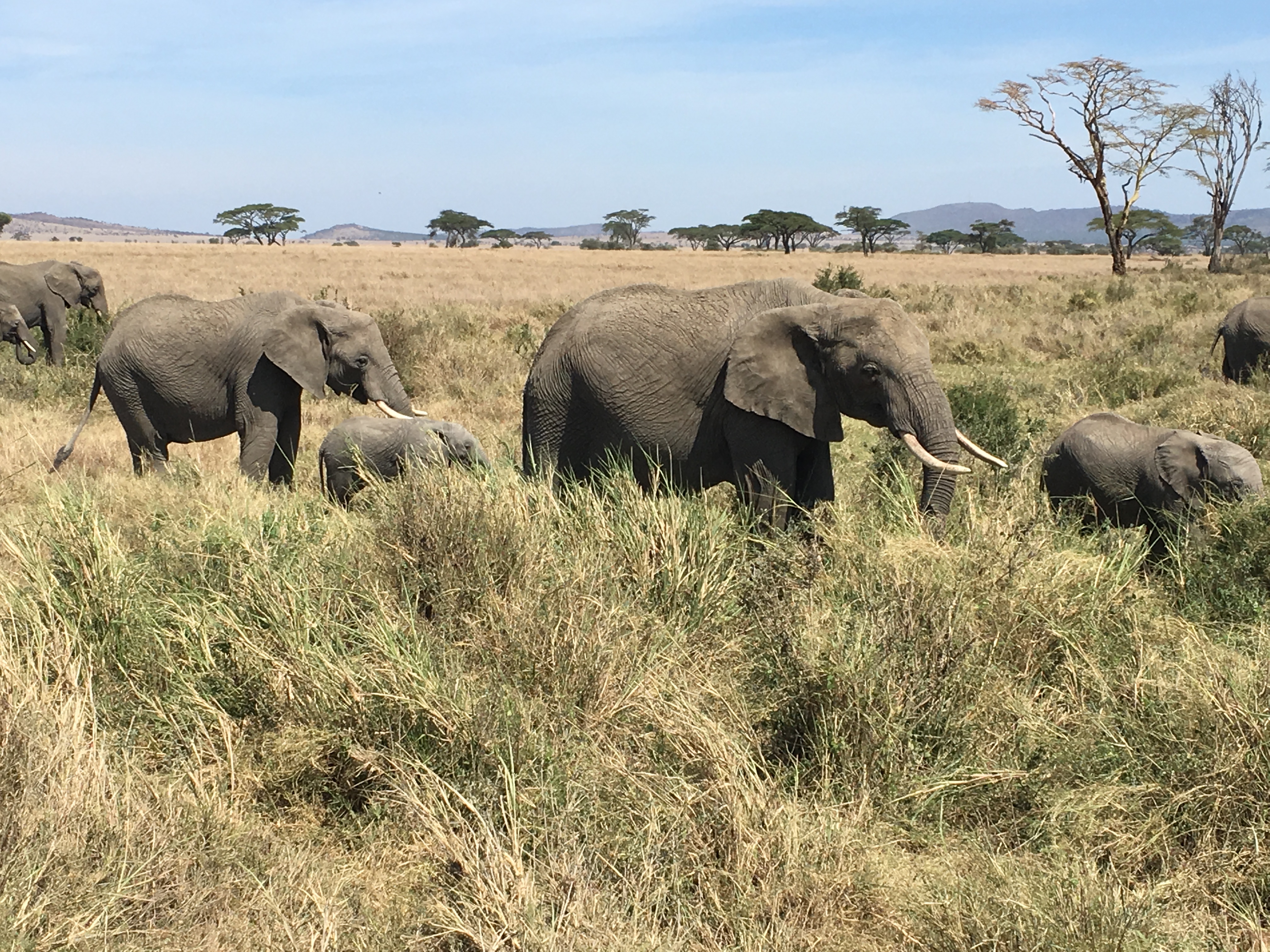
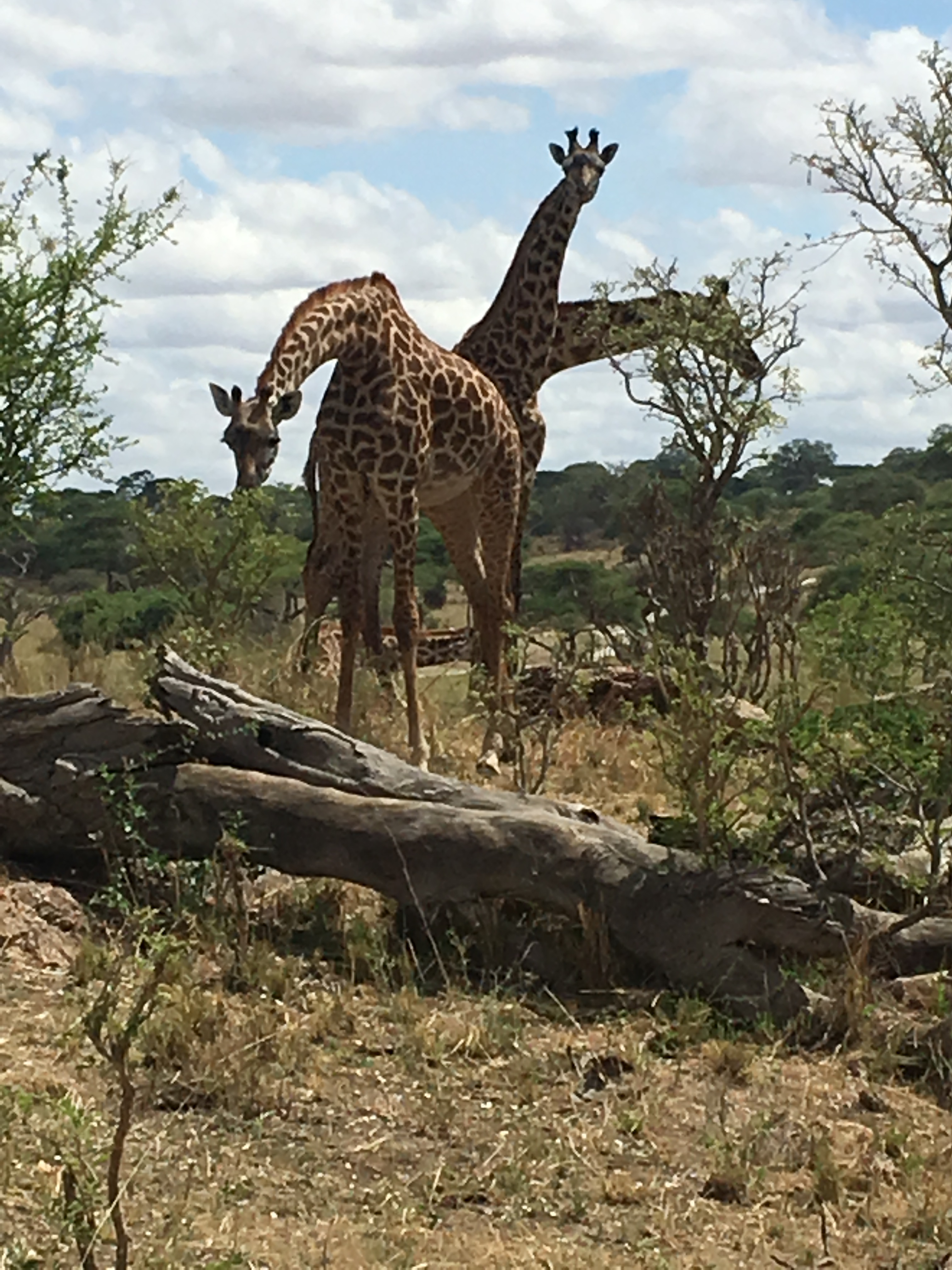
The feeling didn’t last of course, but over the next week it did return and last longer: lying in our tent at night, listening to the hyenas’ r-r-r-upe, r-r-r-rip, and the heavy breathing of what we found out later were two old male buffalo who liked to wander the grounds; the sight of over a hundred hippopotamuses wedged together like sausages in a river; herds of twenty to fifty elephants parading down to another river to drink and splash and roll in the mud; a cheetah and her two cubs prowling through the grass; seven giraffe standing silhouetted on a ridge; the strange baobab trees, a prehistoric species that predates both mankind and the splitting of the continents over 200 million years ago, whose branches look like roots, and whose gnarled bark has been worn by wind and rain and millennia of elephants using them for scratching posts.

fullsizeoutput_15c0

Now I wonder if what happened was that I was, simply, being. If I set aside the old baggage I usually carry around, so that I became more open with no preconceived ideas of what I thought I needed to prove to someone else. It’s not so much that I lost the sense of who I was, it’s that I became more of who I was: in union with a much larger whole, not just a bunch of weird looking animals, but an energy, a spirit, if you will, running through animals, trees, grass, sky, clouds, Abel, Mary Lee, and me.  I may not have been “proud just to be,” but I certainly was grateful.

#

Even if you don’t journey to honor a saint or to see a holy place, I think any trip can become a pilgrimage when the exterior journey triggers an interior one. Brother David Vryhof of the Society of Saint John the Evangelist recently wrote: “A pilgrimage typically involves three experiences: leaving something, gaining something, and struggling with something.” I’m hoping I left some of my defensive, passive-aggressive sarcasm behind. I know the peace and lightness I experienced continues; I notice more. I’m thinking less about who or what I am and more about that I am.

The struggle is to try to maintain this sense of just being now that I’m back dealing with jet lag that lasted a week, the cough that I brought back that won’t go away (I know it’s probably not lung cancer, but…) the season’s first snow storms, obligations, and the memories that metastasize this time of year of my daughter’s last months in the hospital and her death two days before Christmas. I’m trying to think of being in Tanzania not as some abnormal “blip” outside of the reality of my usual assumptions and illusions, but as a step toward experiencing the greater reality I’ve occasionally glimpsed, and with it, gratitude for the life I have, and the serenity of not caring what the hell the neighbors think.

IMG_4090

# #