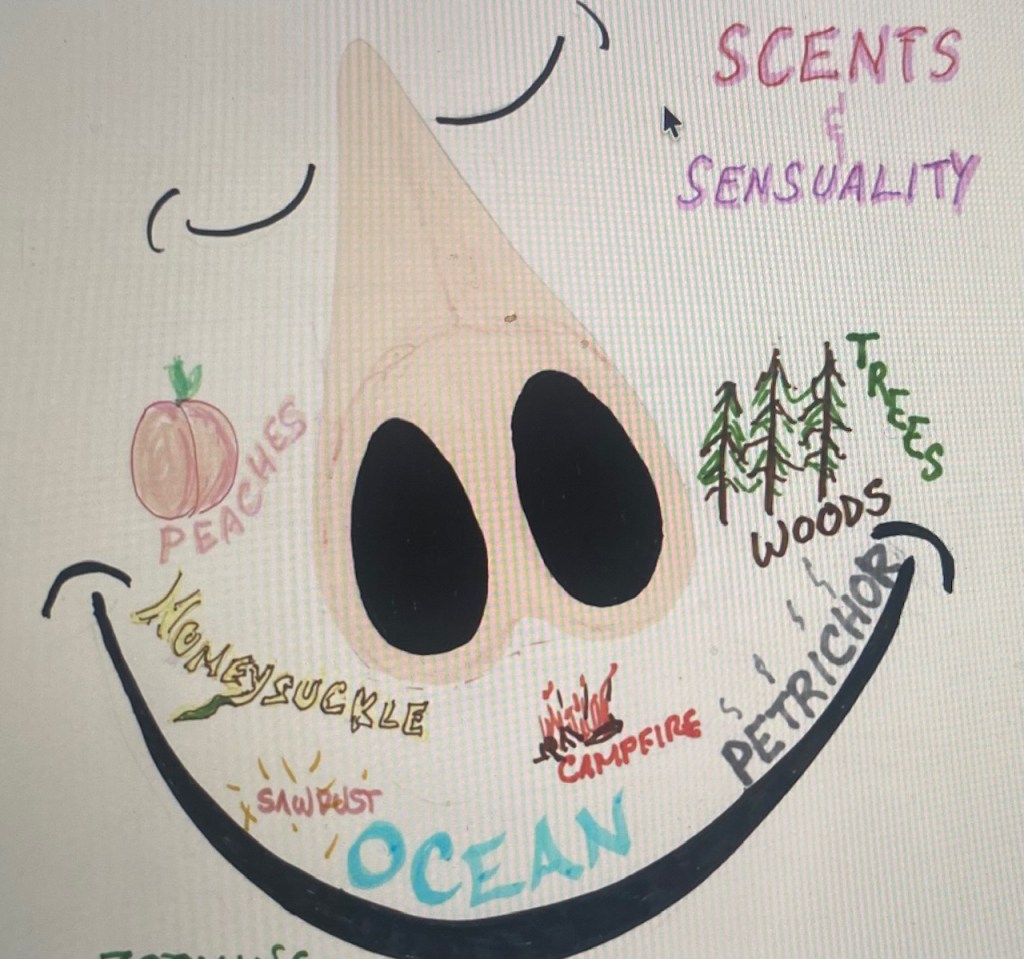
Illustration by Lisa Keppeler. Used with her kind permission.
~
It’s September, 2019 and ten weeks after my heart surgery and I’m taking my first walk in the woods since then and the first thing I notice is the fecund smell of fallen leaves and pine needles and dying trees…
and the scents of hay and cows and horses in my great-grandfather’s barn, and the waft of fried onions and potatoes in Nanny and Grampy Lufkin’s house, and the whiff of perfume and cigarettes in Nanny Cleaves’s apartment, and the aroma of Mom’s fresh baked bread on Saturday mornings…
and a few years later: the earthy odors of the market garden where I worked summers, the pungence of wet towels, dirty socks and jockstraps in the locker-room beneath the gym where I spent so much time…
and the fragrances of my Aqua Velva, and her White Shoulders blending in the back seat of the family Ford …
and later still: the salt smack of ocean breeze thru the spruce trees around our camp in the early days of marriage when love was new and life’s possibilities seemed endless…
and because autumn is when things die, memory sniffs the acrid smoke from the Old Town Paper Company as I drift, bitter and aimless, across the university campus, no longer the high school bigshot and no idea who the hell I am or where I’m going…
and then the dank reek of the dregs of the pipe tobacco I used to smoke during the last years of that first marriage…
and the stench of shit and disinfectant in the hospital where my daughter lay dying, when I learned how life and love can also waste away and die…
and thoughts of shit spark smells of steaming cow flaps in Scottish pastures through which Mary Lee and I hike, and aromas of shawarma, spices, and pita bread mingled with the dust of pilgrims in the Old City of Jerusalem, and the sweet scent of apple tea in Turkey and animal musk on the Serengeti and incense wafting up from the altar into the stony steeple of Iona Abbey—reminders that I not only didn’t die, but flourished—
and the smell of Mary Lee lying beside me in the morning, and the fresh, slightly sweet scent of our newborn grandchild, and before I know it, going into the school building to pick up that grandchild where the fragrance of chalk and cleaners and young bodies take me back to my years as a public-school teacher—intimations that love is stronger than death…
and although I’m surrounded by the smells of dead and dying vegetation and the lingering sickly scent of Mupirocin with which I swabbed my nose prior to and after heart surgery, the decay upon which I walk and which I smell teems with the bouquet of resurrection.
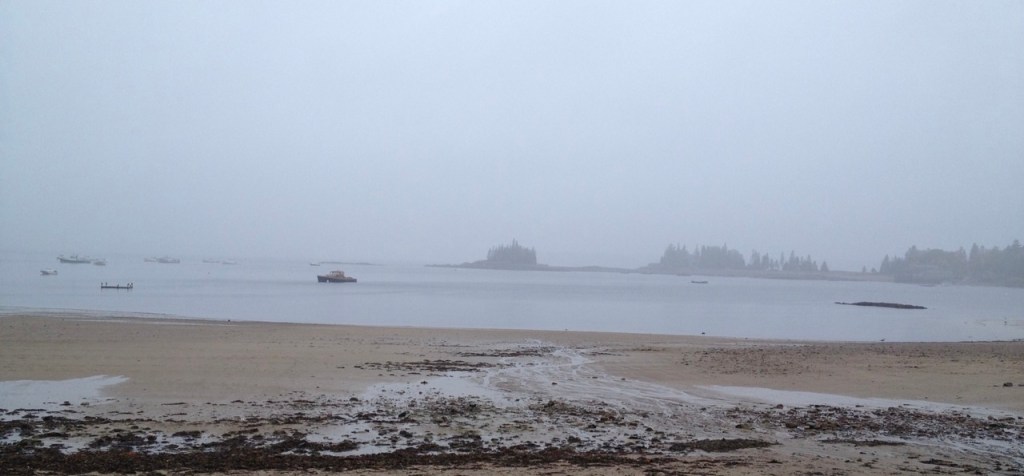
The beach just down the hill from where I used to live in my “other life.”
#
6:45 a.m. Driving up the turnpike from Brunswick to Bangor, headed down east to Mount Desert Island, I’m apprehensive. I’m returning to what I’ve always called my “other life”: different marriage, different house, different job, different hobbies, different self. A self, quite frankly, I’ve never liked very much.
But I’ve received an invitation to attend the 50th high school reunion of the Mount Desert Island Class of 1974. For many of these students, I was their English teacher as well as senior class advisor. And while I have, at best, mixed feelings about this other life, I enjoyed teaching at MDIHS and have continued to be in contact with some of these former students. I’d really like to see them.
My name tag at the reunion.
The reunion is tomorrow, but besides an invitation to the reunion, I’ve been asked to talk about my book, The Geriatric Pilgrim: Tales from the Journey at a gathering—which I figure will mostly be former students— in Bar Harbor a few hours from now. So, while I watch the leaves change color as I drive north, I try to figure out what I’m going to say.
I know I’ll start by saying the most important thing I learned in writing The Geriatric Pilgrim was that the physical pilgrimages Mary Lee and I made to places like Iona, Big Sur and the redwoods, Nova Scotia, Israel, Africa, and Turkey have shown me that any journey—including the one we make as we age (and these former students are now all pushing 70. Good God!)—can be a pilgrimage. Especially if looked at with curiosity and openness, as explorations to discover new facets of ourselves, seeking surprises rather than security, looking for evidence of and trusting in a power greater than ourselves.
Then, I think, Okay, if any journey can be a pilgrimage, that means this trip back into my other life is a pilgrimage. How?
When Mary Lee (who is sitting beside me, looking at a map of Maine—she loves those big unfolding maps that take up half the front seat) have gone on a pilgrimage, we often talk about what new insights we’re bringing back with us which we can use in the future. So, what lessons did I learn during the seventeen years I spent at MDIHS that have stayed with me?
Well, I’ve always said that those years were the best teaching years of my life. I’ve taught in other schools, some with more impressive teachers, some with smarter students, some with better sports programs, a wider variety of extracurricular activities, more opportunities for materially or intellectually challenged students. But what made MDIHS different was that, despite the annual arguments about the budget and the tensions about dress codes and what was being taught, the parents, the school board, the administration, the faculty, and the students all agreed on one thing: MDIHS was a good school. And because we all thought it was a good school, it was—winning national awards for excellence.
MDIHS in the early years. My room was the closest on the end.
Making a pit stop at the rest area outside of Bangor, I realize how I frame the reality of my life determines how I see that reality, which in turn determines how I live that reality. Thinking we had a good school, I went to work each day excited and proud to be there (okay, not every day, but I can honestly say, most days) which made me work harder, which made me a better teacher and the students better students. Fifty years later, when I can think of my aging not as a problem, but as an opportunity for growth, I’m less anxious about what I can no longer do and more curious about finding new things I can do, more grateful for those things, which makes me more pleasant to be around.
Back in the car, however, turning on to Route 1A and heading for the coast, I ask: if MDIHS was such a great place to teach, why did I leave, and in the middle of the school year? What’s the lesson there?
It probably begins with that guy I used to be—the one I’ve never liked. Come to think of it, he didn’t like himself either. Despite the accolades (one state evaluator said my Advanced Placement English class rivaled the one at Phillips Exeter), I was not a happy camper. I’d created this persona—loud sports coats, matching ties and pocket handkerchiefs, green ink corrections symbols and sarcastic comments in the margins of papers, pictures of sixty-four famous authors glaring down from the walls—which began to feel like a body bag.
Soon after waking up one morning gasping for breath as if someone had their hands around my throat, I resigned. In the middle of the school year. Moved out of my house, divorced my wife, married another woman, and moved 120 miles away to teach not AP seniors but freshman juvenile delinquents (one of whom as far as I know is still in prison for murder).
And I think the reason I’ve never liked that guy in my other life is that I’ve always thought he was a fraud. But thinking about it, I honestly liked my job, and I wanted to honor my profession by looking and acting my best. I recall reading in David Whyte’s book, Work as a Pilgrimage of Identity, something to the effect that the things which once served us can imprison us if we remain with them too long.
Which, as I think about it, is also true as I age. I can’t hold onto those activities, that self-image, those beliefs that once sustained me. When I think about making a new pilgrimage, I can’t plan—or I shouldn’t, anyway or I’m going to be disappointed, either that or die—to hike the Appalachian Trail or climb Mount Katahdin, but I can continue the journey toward what I might, for lack of a better word, call my true self. A journey, I realize, that began when I left Mount Desert Island, maybe even before.
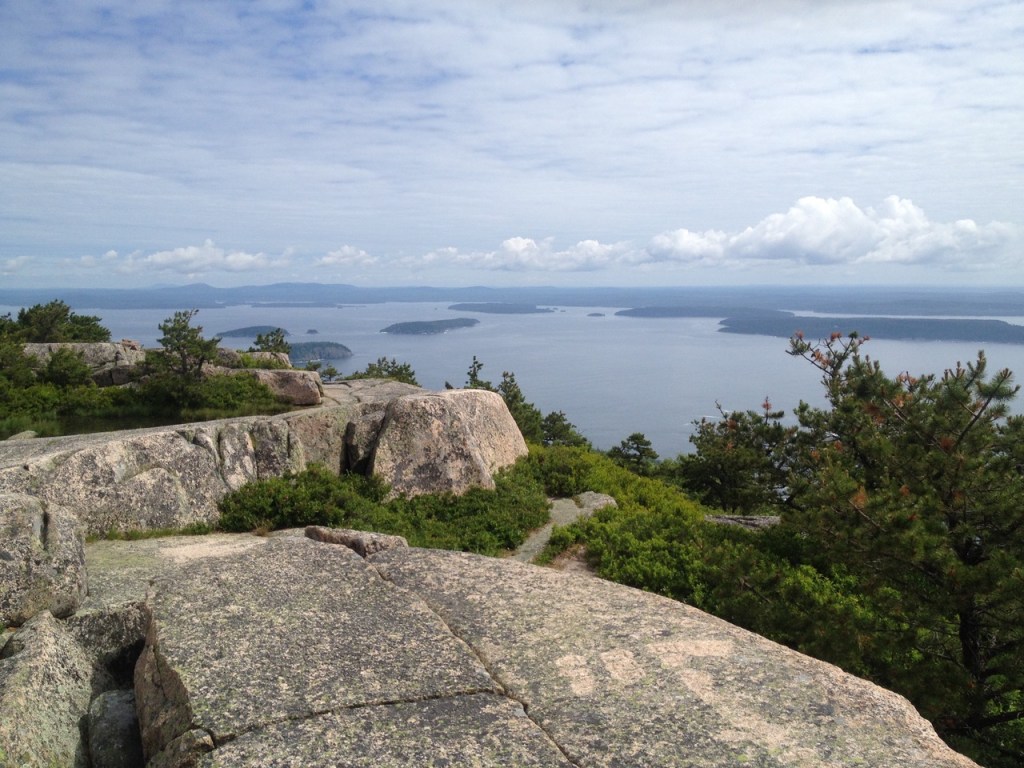
Speaking of which, I can now see MDI on the horizon, its rocky silhouette reminding me that this is one of the most beautiful places on earth. I remember, especially in those days when most of the tourists went home after Labor Day, how many afternoons and weekends I spent walking the trails and beaches there. And I realize that those walks were the beginning of what I call —somewhat euphemistically perhaps—my spiritual journey. Sitting on the top of one of the mountains, looking out over the neighboring islands, I experienced not only the inchoate presence of a Higher Power, but also a vague sense that everything belongs.
I needed help interpreting these experiences. Which led me to religion. When I first began teaching on the island, I hadn’t been in a church since I was married in one, and by the time I left seventeen years later, I was not only a member of a church but a member of the Board of Deacons. I sang in the church choir. I advised a church youth group.
It dawns on me that without Mount Desert Island, there’d be no Geriatric Pilgrim.
I also see that I have no “other lives,” only this one—one that has been unfolding, like one of Mary Lee’s maps, from the beginning until now and will keep unfolding (I’m guessing; I’m curious to find out) after my earthly death.
Wow! Now, if I can just remember to talk about some of this an hour from now…
“The crowd of people around us suddenly became menacing.”
#
I was reminiscing with myself the other day about various pilgrimages I’ve been on and got to thinking about the only one during which I was afraid. It was in 1997, when Mary Lee and I were in Israel. We’d taken a sherut, a minivan-style taxi, from Jerusalem to visit the Church of the Nativity, the supposed site of Jesus’s birth, in Bethlehem. Because Bethlehem was under the administration of the Palestinian National Authority, when we reached the outskirts of the city, the Israeli sherut stopped at a bus stop to let people out for the Palestinian bus into town. On the way, however, we’d been talking with a Palestinian couple—teachers in Europe, I forget where. Their car was in the parking lot, so they gave us a ride up to the Church. Mary Lee and I did our sight-seeing, saw the cave where Jesus was supposed to be born. (Ever since then, I’ve wondered why all mangers at Christmas time look like tropical huts), went to the gift store where we bought an olive wood creche, and then walked out into the square to find the bus.
Only to realize that I had no idea what the bus looked like or where it was. My stomach suddenly knotted. For the first time since we’d been in Israel, I became aware that Mary Lee and I were traveling alone in a strange, war-torn country. The crowd of people around us suddenly became menacing. Then, I heard a voice off to the side: “Hey! You want bus? Over here!”
The voice came from inside a beat-up blue bus hiding behind the corner of a building. The speaker was an unshaven young man of at most twenty years of age. We walked over and tentatively started to board. Before we were even settled, the guy stepped on the gas, his momentum knocking us into our seats. That was when I saw four or five teenage boys in tee-shirts and jeans behind us, their mouths curled with James Dean sneers around their cigarettes.
A cold hand grabbed my heart and squeezed. I envisioned our being kidnapped, forced in front of TV cameras to denounce the United States, and then beheaded or shot. Only when the bus squealed to a stop and an elderly woman got on did I begin to breathe more normally.
It was a good lesson in fear—what I’ve since learned is often an acronym for “False Evidence Appearing Real.” The divided country, the beat-up bus, the scruffy teenagers and their cigarettes (remember when cigarettes were sophisticated?), the speed with which we left the square were all in hindsight false evidence that these were terrorists intent on holding two middle-aged high school English teachers as political prisoners.
#
Throughout my life, most of my fears have been mental: fear of abandonment, fear of not being seen (while I’ve struggled with alcohol over the years, my real drug of choice has been the approval of others), fear of ridicule, or just plain anxiety about… well, I don’t usually know what about. To use a twelve-step word, I tend to “awfulize” when anything new happens, creating worse-case scenarios in my head.
What’s helped over the years is recalling my Bethlehem experience, and that, as then, my fears are almost always false evidence appearing real. And the less I know about something, the more my mind will supply the false evidence. Even when I have had something concrete to worry about—my deteriorating first marriage, my daughter’s cancer—being afraid has never helped me change the outcome.
Life has taught me a few ways to deal with my fears and anxieties. One way is to stay in the moment. The Vietnamese monk Thich Nhat Hahn has a number of breathing exercises that I’ve found helpful over the years, one of which is breathing in and out, saying “Breathing in, I calm my body, breathing out, I smile. Dwelling in the present moment, I know this is a wonderful moment.”
Another way is journaling. I once took a day-long workshop in journaling, and one of our exercises was to draw a picture of one of our fears. I drew a huge finger pointing at me and laughing in ridicule. Next, we were directed to give our fear a name (mine was Freddy). Then, we wrote a conversation with our fear. (“Me: Don’t you shake your finger at me, Asshole. I’m not as afraid of you as I used to be. Freddy: That’s what you think, Buddy Boy …”)
Freddy Fear
A third way, and probably the most effective when I can do it, is to turn my fear over to the God of My Not Understanding. “Courage,” as my twelve-step program says, “is fear that has said its prayers.”
#
That I’ve been thinking about our trip to Bethlehem and my various fears is no surprise: I’m starting another pilgrimage. No, not the cruise Mary Lee and I are planning to make next week, but open-heart surgery.
This journey began about a month ago, when during a routine follow-up with my primary care doctor, I mentioned to him that I was having more and more shortness of breath, and that my daily walks—for years a source of joy and relaxation—now felt like climbing Mount Washington with a fifty-pound backpack. “I think we’d better schedule you for a stress test,” he said.
A few days later, after getting wired up and pounding a treadmill for six or seven minutes, I listened to a diagnosis of an “abnormality” in my heart rate. That led to first one and then two arterial catherizations, which revealed that my left main coronary artery is just over the line between “moderately” and “severely” narrowed. Since I have no shortness of breath doing normal activity, doctors have given me the okay (as well as a bottle of nitroglycerine tablets) for the cruise. Then I will have by-pass surgery when I return.
So I’m practicing my Thich Nhat Hahn, journaling (not to mention writing this blog), and spending a lot of time with my Higher Power, trying to hand over my various fears and anxieties about dying, of not seeing my grandchildren grow, of becoming a burden to Mary Lee, yadda, ad nauseum. I’m also trying to let go of my tendency to blame myself—which I realize has always been my go-to way to avoid anxiety by swapping it for guilt—feeling that my narrowed artery is because I didn’t exercise more, eat better, lose the ten pounds I’ve been thinking I should lose for the last fifteen years.
I don’t know what’s going to happen, which, as I’ve written about now for almost four years, is one of the characteristics of pilgrimage, along with hearing the call and responding, crossing the threshold where the old has fallen away and the new hasn’t yet emerged, being uncomfortable, beginning again, embracing the unknown, and coming home (wherever home may be.)
The trick, I’m finding, as with all pilgrimages, is to prepare for the future without living in it, and ignore all the false evidence appearing real.
The Road goes ever on and on Down from the door where it began. Now far ahead the Road has gone, And I must follow, if I can… (from The Lord of the Rings)
Mary Lee and I are getting ready for our next trip. This one is a cruise, something neither of us has ever been on before, and one of our concerns is what clothes we should pack. The information we’ve received is helpful—dress casually, plenty of active wear for sun and rain, no jeans at dinner… Still, I’m concerned, especially about what hats to bring.
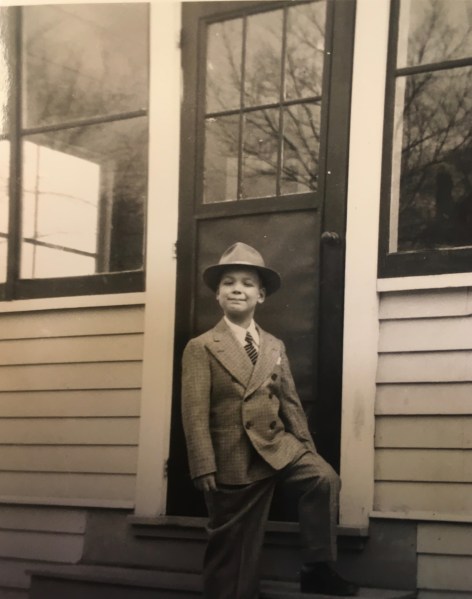
Hats have always been a part of my life. Many early pictures show me wearing a hat. I started with one of my Grandfather Lufkin’s fedoras, and then graduated to having one of my own. (How many five-year-olds can you think of who had his own fedora?)
I also remember getting a cowboy hat for a birthday present, and of course, my little league baseball caps. In early adolescence, I played trombone in a Dixieland band called the “Ivy Leaguers.” We wore chinos and plaid caps, both with belts in the back. During my senior year in high school, our basketball coach required us to wear not only a coat and tie to games, but also a hat, because he told us wearing a hat reduced our risk of catching cold.
We had no problem with this (my hat, I think, was an Alpine job with a small feather in the band), for in 1961, all men still wore hats. Men who worked blue-collar jobs wore caps while men who had white-collar jobs sported fedoras. (Usually. One of the things that made Art Carney so funny on the Jackie Gleason show was that his character, Ed Norton, wore a fedora and worked in the sewers.) Even though he wasn’t employed by the railroad, Grampy Lufkin often wore a blue and white striped railroad cap; a lot of men did. My father wore a khaki colored cap to work in the summer and a green and black checked cap in the winter; then, after he retired and spent a lot of time fishing, he wore a long-billed cap called a “swordfish.” No matter the occupation, however, every man had at least one fedora for Sundays. (Women, too, always wore hats when they dressed up.)
As legend has it, all that changed when John F. Kennedy was elected President. As I understand it, he had a large head and didn’t like hats, so that when he was inaugurated, he eschewed the traditional top hat and went hatless, thus creating a precedent that lasted for several generations.
I still wore hats, however, usually either to keep my head warm in the winter or ward away bugs in the summer. And without really noticing, I added a hat here and a hat there, until today 30 hats hang in the garage by the back door, not to mention another three or four stocking caps tossed in with my gloves. Some hats I take with me on pilgrimage: summer and winter weight Irish caps when I’m going to the British Isles; wide-brimmed sun hats for Israel, Africa, and Arizona.
For over twenty years, I’ve worn a Tilley Hat, complete with horse-hair hat band, for hiking. When I play the banjo, I wear a fiddler’s cap (sort of like a Greek fisherman’s cap) or an old fedora.
I have a fedora for church, and all kinds of baseball caps—Boston Red Sox, Portland Sea Dogs (a Red Sox affiliate for those of you not from New England), a blaze orange one for hiking the woods in the fall, and one with a blackfly over the words, “Maine State Bird.” In preparation for summer, I just bought a new Panama.
How did that happen? Why am I so drawn to hats? I read somewhere recently that almost all of us collect one thing or another. One theory is that this desire is instinctual, going back to our early ancestors who stocked food, clothing, and so forth in times of plenty for the times of famine. Okay, but I don’t see a lot of pictures of cavemen in hats.
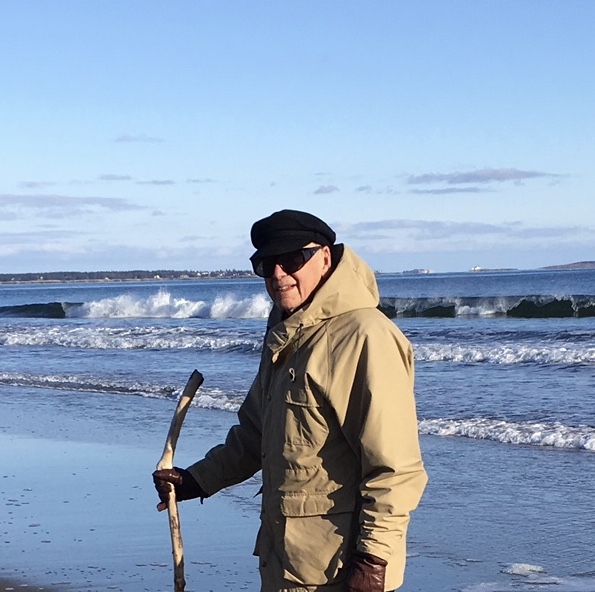
I know that some of my hats help me preserve the past; for example, my fedoras remind me of the men of my youth that I wanted to emulate. I have baseball caps reminding me of San Antonio, Texas, and of my MFA program. I bought a winter stocking cap in the Old City of Jerusalem when the temperature was at least 90°. The hat I wear most, year-round and both around town and on pilgrimages, is a long-billed swordfish cap that I bought to replace my father’s which I wore after he died until the strap in back broke. It keeps both sun and rain out of my eyes, can be worn under a hood, and, of course, reminds me of Dad.
One day just before my daughter’s death, before going into a conference room with some of her doctors, I put an Irish tweed cap in a closet by the door, and someone took it—I’m assuming by mistake—and left me a cap like it, only with ear flaps for cold weather. I still often wear it in her memory.
After Laurie died, during probably the worst time in my life, Mary Lee and I went to Colorado for April vacation. There, I bought a cowboy hat and wore it the whole time. The hat made me feel like Tommy Lee Jones, plain-spoken, tough, in complete control. I’ve still got a couple of cowboy hats, one straw and one wool. For some reason, they always make me feel better when I’m upset or anxious about something.
I also find it calming to go out once or twice a year and rearrange hats.
As I think about it, I started adding hats when I began teaching high school English in Down East Maine. At a time when teachers were dressing more and more informally, I wore ties with matching pocket handkerchiefs, double breasted blazers, and bell-bottomed pants, all topped with either that Irish cap I wore before Laurie died, or a wool bucket hat that matched my topcoat. They validated me as “Mr. Wile,” just as, I suppose, my other hats validate me as a hiker, a writer, a musician, or a pilgrim.
Do I really need this validation, especially now, at my age? Do my hats represent all my “false selves”—cowboy, adventurer, academic, musician, and so on—revealing my inability to get in touch with my real self? Are they a kind of role playing, or a form of security blanket, a way for me to hide from the world?
Maybe. But I’d like to think that they represent—even proclaim—that I am multi-faceted. That, as Whitman wrote, “I am large, I contain multitudes.” Perhaps my hats are a way to ask, “Who does God want me to be today?” That they are a cause to celebrate, not denigrate.
So, what do you think, maybe the swordfish cap and the new Panama for the cruise?
“A tree stands strong not by its fruits or branches, but by the depth of its roots.”
— Anthony Liccione.
#
Trees have always called to me, from the white pine tree I used to climb behind my house as a kid, to the stately Douglas Fir and Ponderosa pine I fought forest fires to save when I was in college, to the four-trunked maple tree in the back yard of my home for over twenty-years, to the mighty redwoods I visited a few years ago. Lately, though, I’ve been thinking more about the roots of trees than their trunks or branches, perhaps because I’ve been thinking a lot about my own roots.
In doing some reading about trees, I find that their roots can branch out seven times the height of the tree. When these roots interweave with other roots, they create a single organism. “You can think of a [tree] trunk as really fingertips on a buried hand,” writes ecosystem ecologist Dylan Fisher. The 106 acres of quaking aspen in Fishlake National Forest in Utah are all connected by one 80,000-year-old root system known as Pando, or The Trembling Giant. The trunks, branches, and leaves connected to this system weigh in at 6,600 tons, making this the heaviest known organism on earth.
In thinking of my own roots, I find they also spread out as least seven times beyond the family trunk. My trip to Canada last fall introduced me to an interconnected web of Wiles I never knew existed, stretching throughout southcentral Nova Scotia. My sister spent last year engaged in a genealogical pilgrimage, and has traced the names of our immediate family—Wile, Cleaves, Bennett, and Conrey—back to Reeds, Pooles, Hitchcocks, and Crocketts, back further to Whitneys, Davises, Rosses, and Hamiltons, and before that to Giles Corey, the only accused witch in Salem Massachusetts to have been pressed to death instead of hung (his last words were supposedly, “More weight!”), and Priscilla and John Alden (“Speak for yourself, John Alden”). Branching further back to England, my roots include Franklins, Densytes, and Mullins; and in Germany, the Weils, one of whom— Johann Frederich—emigrated to Nova Scotia.
Trees survive through their roots. Fungi infiltrate roots, not to attack but to partner with them, sharing nutrients across threads of what are called fungal hyphae that form what’s known as a mycelium web—a kind of underground internet, linking roots of different plants, helping one another with not only food, but information. Jennifer Frazier, writing in Scientific American, describes how plants being eaten by herbivores release chemicals that are sensed by neighboring plants, who then increase their defenses. Paper birch send carbon to Douglas-fir seedlings, especially when they are shaded in summer, probably enhancing their survival. In spring and fall, the Douglas-fir return the favor when the birch have no leaves.
And what’s my mycelium web? What nourishes me, gives me information, helps me survive? I have survived as long as I have because of my second wife, Mary Lee, who has been a beacon of love during the darkest days of my life and who continues to nourish me with laughter, eros, food, and friendship. Her children, her grandchildren, her friends, her sister and her sister’s children all grace me with their affection.
My oldest community is made up of the friends I grew up with, many of whom I still get together with regularly, either in person or electronically. Through them, I’m fed not only through stories that no one else but us know (and we’d just as soon keep it that way), but also by the sharing of our pilgrimages through life—our ups, our downs that both sadden and gladden my heart.
There are the teachers I’ve taught with who continue to inspire me with their wisdom, the writers in my various writing groups who educate and challenge me to, as Herman Melville put it, “dive deeper,” the musicians I jam with who bring song and rhythm to my life, the folks I take Communion to in nursing homes who sustain me with their inner strength and perseverance. The writers I’ve read, the records, tapes, and CDs I’ve listened to, the chocolate I’ve eaten. There are the pilgrims I’ve met as I’ve journeyed to my roots, whether they be family homesteads in New England and Nova Scotia or the roots of my faith in Jerusalem, Ephesus, Iona, and Lindisfarne.
More and more as I age, I find my roots sustained by the unseen and the silent. “Everything you see has its roots in the unseen world,” wrote the Persian poet, Rumi. The Jewish Kabbalah’s mystical Tree of Life is pictured with its roots in heaven and its branches and leaves reaching down toward us. Many of the communities that nurture me are connected with this unseen world: my church, the Episcopal monastic order to which I’m an associate, the interfaith organization of contemplatives I belong to, the men’s group I attend Wednesday morning and the Al-Anon groups I attend.
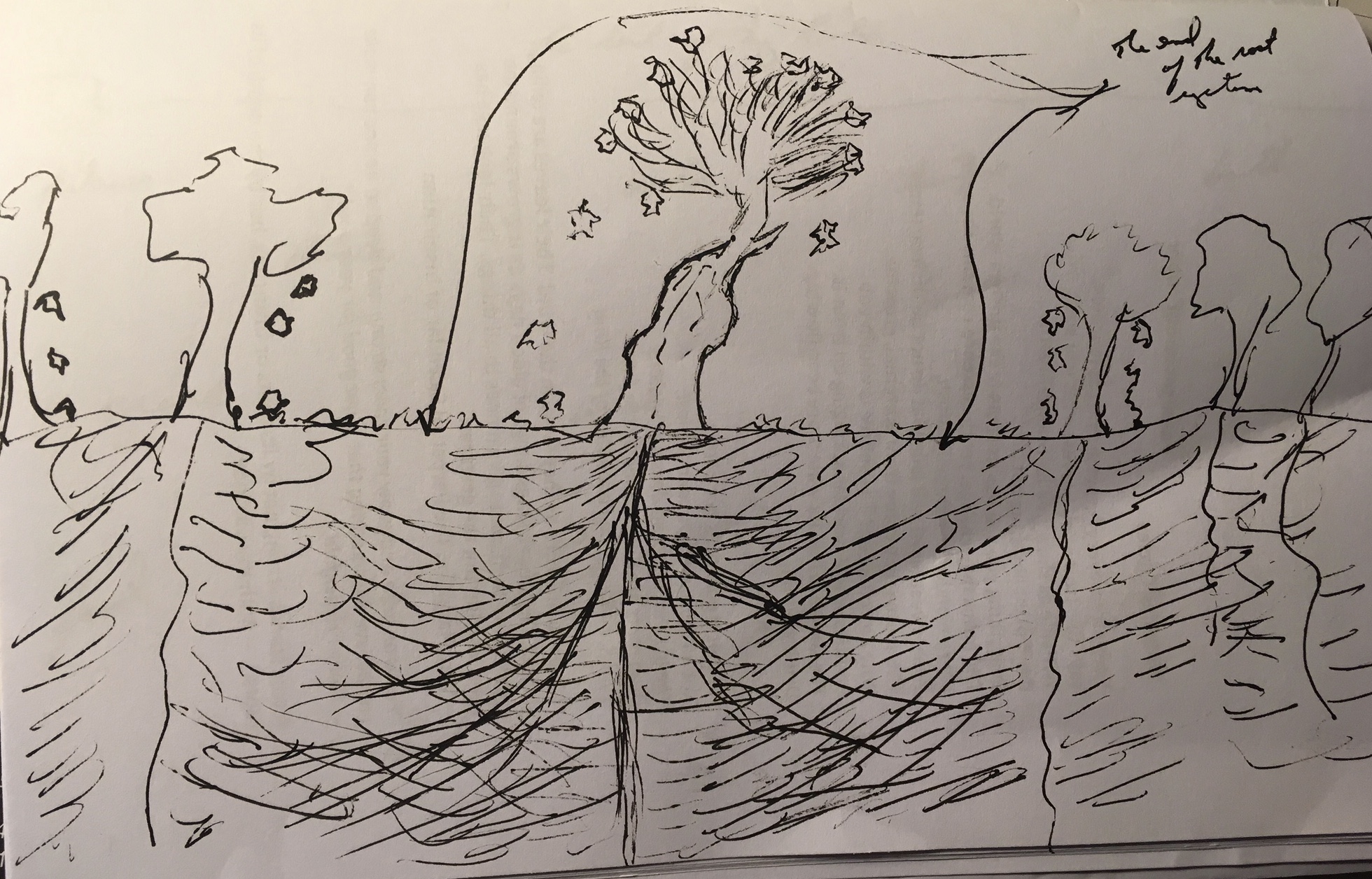
During a recent Quiet Day at my church, I realized that one reason I’ve become concerned with roots is because mine have stopped growing. My only child died of cancer. My brother is gay. My sister’s only son and his wife cannot have children. Thus, my family name ends with my brother and me, and my family tree ends with my nephew and his wife. I found myself drawing the follow picture:
But even dying trees can support not only their own species but other species as well. For example, according to Jennifer Frazier, when Douglas-fir begin to die, their roots, through fungi, send food to young ponderosa pine battling to survive. I’d like to think that I might also nourish others who are struggling, through the stories, laughter, love of silence, perseverance, and music that have fed me through the years.
Probably one of the purposes of these blogs, come to think of it.
# #
And if you liked this blog, you might also be interested in reading:
“When you assume, you make an ass out of u and me.”
—Oscar Wilde
#
Mary Lee and I are planning a trip to Africa. We’re reading up on where we think we might like to go and watching YouTubes made by people who’ve taken trips there. I’ve just finished Paul Theroux’s Dark Star Safari: Overland from Cairo to Cape Town. We’re getting shots for typhoid and hepatitis, and reading up on the kind of pills we need for malaria and what bug sprays to take along.
Planning, writers on pilgrimage agree, is essential to the pilgrimage experience.
What I need to be careful about is that I don’t confuse making plans with making assumptions. I’m better at separating the two—one of the benefits of aging (they do exist)—but I still fall prey to the anxieties, delusions, and disappointments that occur when I make assumptions about what’s going to happen, whether on a pilgrimage, retreat, or quick trip to the grocery store.
Several years ago, as Mary Lee and I planned our pilgrimage to Jerusalem, I assumed the old city would look like all the photographs and paintings I’d seen of glorious holy sites and people kneeling quietly in prayer. Israel, I assumed, would look like the 23rd Psalm: green pastures and still waters. I assumed I would be filled with awe and reverence. I did not assume how steep the streets are, how relentlessly hot the weather can be, and how the crowds could at times be suffocating; nor that I would become sick with dysentery, and that most of the holy sites were swarming with packs of children hounding us for money. Only later—when I returned home, really—did I recognize how important a pilgrimage I’d made. But my assumptions, I think, ruined much of my actual time there.
None of the YouTubes—and I saw a lot of them—on hiking St. Cuthbert’s Way from Melrose, Scotland to the Island of Lindesfarne off the coast of England prepared us for the hills and the cow shit. (See above photo.) None of the brochures on San Francisco prepared us for the mosquitos that attacked us one night in our hotel. On the other hand, when Mary Lee and I traveled to Iona off the west coast of Scotland, we assumed that a couple of days would be more than enough to cover an island just four miles long and a mile wide. The next year, we spent a week there and still didn’t feel as if we’d stayed long enough.
I’ve made similar faulty assumptions before going on a retreat. Once, I assumed I’d spend my time snowshoeing in the woods and spent it in bed with excruciating back pains. Another time, I thought I would enter a period of silence and slow time and wound up spending several days in tears, banging my head in rage against the side of my bed.
These previous pilgrimages and retreats have helped me learn to put aside preconceived notions about what may or may not happen and accept that what will be is what will be—a lesson I’m trying to carry over into my day-to-day pilgrimage through life. If I’m going to have lunch with some of my old classmates, I try not to assume I’ll wind up arguing over politics and spend that morning getting ready to do battle, because if the subject of whoever’s President never comes up, (which it often doesn’t) I’ve wasted the morning. If I’m going to be spending time with my one, two, and five-year-old grandchildren, I’ve learned that to assume they’re going to arrive at the house wanting me to fix them oatmeal and read books and go to a playground is only going to make both them and me miserable.
It’s taken thirty years, but I’ve learned never to assume how I will be each year from November to Christmas—the two months I spent at my daughter’s bedside when she was dying of cancer. Some years, I’m overly angry or forgetful or sad or sick. Last year, I realized that I wasn’t any of those things; that, in fact, I was cheerful and looking forward to Christmas—until the anniversary of Laurie’s death, when I suddenly spasmed into tears.
Assumptions illustrate how, as the Buddhists say, “We do not see things as they are; we see things as we are.” The year after Laurie died, besides being angry, I was confused and afraid. But what I wrote in my journal that year were rants about news articles in which I disdained everyone else for being confused and afraid: book sellers for pulling Salman Rushdie’s The Satanic Verses off their shelves because of fear of Muslim reprisals; people for taking anti-depressants because they were afraid of not feeling happy all the time. These days, I find myself fighting the assumption that because I’m not as strong as I was fifty years ago, neither is my country; that because I’m going to die within the next twenty or so years, the United States will as well.
I find it interesting that when we talk about assumptions, we do not have them, we make them. Assumptions, then, are what we create, we fabricate. There’s also the implication that what we create is false, as when we assume a role in a play or assume a pseudonym. We make these assumptions, I think—okay, I make assumptions, I think—in order to bolster the ego, convince myself that I have control over the future, hide my anxieties about the unknown.
The problem is that these assumptions keep my mind closed to possibility, to mystery. Last week, I ran across a quote by Albert Einstein:
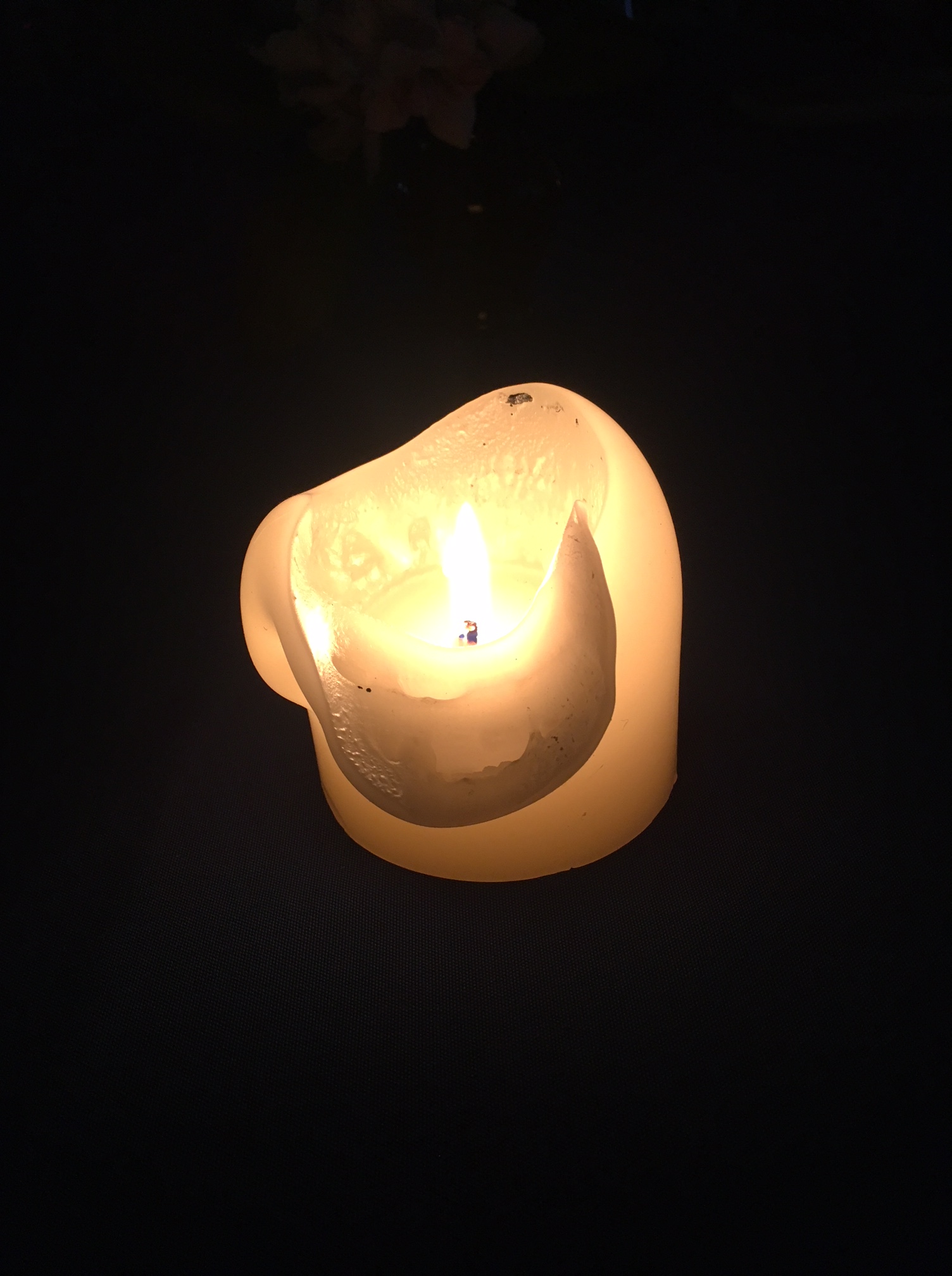
The most beautiful thing we can experience is the mysterious. It is the fundamental emotion that stands at the cradle of all true art and science. He to whom this emotion is a stranger, who can no long wonder and stand rapt in awe, is as good as dead, a snuffed out candle.
One thing I do now to try to avoid making assumptions is to end each day asking, “What surprised me today?” Not all of these surprises are, of course, pleasant ones—yesterday I was surprised to find caterpillar nests in the beautiful apple blossoms on the tree at the end of our street—but the practice has opened me up a little more to some of life’s mysteries. And at my age, I want to be open and standing in awe as long as I can. My candle’s going to go out pretty soon anyway; I don’t want to snuff it ahead of time.








 The Geriatric Pilgrim: Traveling the Landscape of Faith and Grief