In the Automobile Service Center Lounge

~

Along the white walls,

we lounge in black chairs

fiddling with iPhones,

flipping through magazines,

Or sit at round tables 

scattered like planets 

in a mini-solar system, 

hunched over computers 

or in my case 

a moleskin journal. 

~

Under the dealership’s framed 

five-star rating for satisfaction,

a woman whose glasses frames 

match the color of her blue book-

mark purses her lips, lost in

a paperback world of 

broad-shouldered men 

and black-haired vixens.

~

Two chairs down, a white-haired 

guy —green polo shirt, khakis— 

swaps a newspaper for 

a magazine, trades that for 

his iPhone, gets up, goes 

to the lobby door and 

stares through the window

before sitting down again 

to play with his beard.

~

At another table, a gray-haired

woman in jeans and a flannel shirt 

is scrolling through 

pictures of kids or cats 

(I can’t tell), until

Sonny, the Service Manager 

calls, “Wilson!”

She rises. 

“Talk to you for a minute?” 

She leaves with him, 

returns a few minutes later, 

sits down, sighs, says 

to no one in particular:

 “Well, I’m going to be 

here a while longer.”

~

At the other end of the room—

past a guy in a dirty 

baseball cap, his computer 

speckled with stickers

(I thought Yeti was a snowman),

And two gals in tan jackets 

sitting at the same table 

but ignoring each other—

a woman in a gray raincoat 

with large silver buttons 

paws through her leather handbag.

Tanned, with blonde hair,

probably dyed, large hands 

and arthritic fingers 

adorned with silver rings,

she looks up, sees me, smiles.

Embarrassed, I burrow 

back into my journal.

~

Sonny returns, calls, “Fiori?”

The white-haired guy jumps up. 

“All set. No hurry.”

Fiori exits into the lobby …

and for a palpable moment

The rest of us leave

our separate worlds,

finally looking at one other,

connecting through our need 

to hear that voice 

 of authority tell us,

“You’re all set!”

~ ~ ~

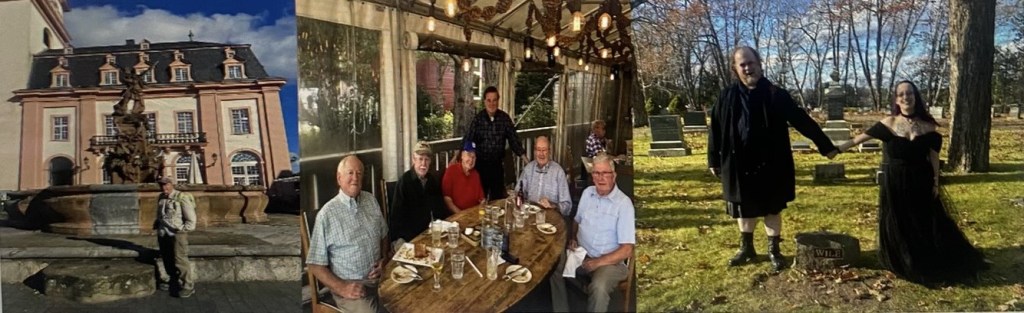
Family Triptych

Weilburg

Traveling 3500 miles to a town in Germany

smaller than the one in Maine where I live—

no tours, no souvenir shops, 

no one speaking English except back at the hotel, 

I stand by Neptune’s Fountain 

in Market Square beneath the God of the Sea 

thrusting his trident into the head of some leviathan, 

my lungs still burning from climbing the hill to get here, 

trying to imagine 25-year-old Johann Frederich Weil 

wandering the square 

before leaving for Halifax, Nova Scotia, 

lured by the British Government’s offer 

of free passage, free land, & a year of free rations, 

knowing from Ancestry.com 

his descendants will anglicize the name & populate places 

like Wile’s Lake, Wileville, & Wiles Road, 

until the turn of the 20th Century 

when Lyman & Lester Wile 

leave Canada for a shoe factory 

in Marlboro, Massachusetts 

where Lyman will marry Edith Conrey 

& sire my father who 

because his mother left Lyman when Dad was 4 years old

(apparently because of spousal abuse) 

didn’t give a shit about his father or his family. 

Then Johann dissolves—

if he was ever here in the first place—

into the salmon & cream-colored two-story buildings, 

round-arched arcades, & a matching-colored four-story Italianate castle 

as my wife and I join the half-dozen folks in leather & wool 

sipping beer & coffee at outdoor tables by a small restaurant. 

Still, walking back to the hotel 

looking down the hill 

at the Lahn River, a small waterfall, an old stone bridge, 

I think of the hill I grew up on, the bridge below my house 

over a similar river by a similar waterfall, 

& I feel a weird calm, 

connected by currents beyond my ken.

The Royal River Grill

Walking into a restaurant 

with large windows looking out on the harbor 

& soft lights meant to look like candles, 

I see Buzz & Chuck & Ted sitting at a long oak table. 

A shiver of both anxiety & eagerness 

& the next thing I know it’s 1953, 

when this building was the site of the Stinson Sardine packing plant 

& I’m ten years old & in fourth grade 

& I’m going to my first meeting of Mike’nBuzzie’s Gang 

at Mike’s house just up the hill from here, 

because earlier that afternoon 

when it had been my turn to stay after school 

to erase blackboards, 

as soon as Mrs. Croudis left for the teachers’ room, 

Buzzie’s brother Craig ran into the classroom. 

“We’re getting a gang together 

for an apple fight with the uptown kids! 

Big meeting at Mike’s house! Let’s go!”

Dropping the eraser, I ran out the door—

the first time in my life I’d ever disobeyed one of my teachers. 

But for the first time in my life I didn’t care. 

A timid kid, raised in a family 

where a miasma of alcoholic anger & anxiety 

hung over us like the fumes 

from the neighboring paper company,

I’d lie awake mornings before school 

afraid of the day ahead, 

of having my arm twisted or my face washed with dirty snow 

by sixth graders like Mike’nBuzzie,

and now they want me to join them! 

Never mind that the apple fight with the uptown kids never happened, 

or that Mike now has Parkinson’s & stays home 

& that Buzz & Chuck & Ted & I, and later, Allie & John, 

have little in common these days 

except our L.L. Bean khakis & plaid shirts. 

I laugh & reminisce. 

At home. 

Still part of the gang.

The Cemetery

Under gnarled & broken maple trees, 

I walk around my family cemetery plot, 

taking pictures of the wedding—

of the bride, who stands 5 feet 

& maybe weighs 100 pounds, 

her upper chest tattooed with angels, 

her dyed magenta hair, & flowing black gown, 

& the groom, my stepson, 

probably 6’4” & 270, 

black lipstick & kilt, red-haired & bearded, 

standing in front of the family stone, 

originally part of the cellar of my mother’s grandfather’s house, 

while my second wife, 

an ordained Deacon in the Episcopal Church, 

performs the ceremony. 

My stepson’s two daughters stand as ring bearers 

near the memorial stone for my daughter, 

who died at 18. 

My wife’s ex-husband & his wife 

stand between my grandmother’s granite stone 

& the memorial stone for Nanny’s ex-husband. 

Not far from my great-grandfather & great-grandmother’s marble stone, 

my stepson’s nonbinary stepson from his first marriage 

& their partner also take pictures. 

The bride’s parents view the proceedings 

in front of my mother’s bronze marker 

between my father’s & my stepfather’s bronze markers 

while my second wife’s sister, her daughter & son-in-law 

watch both the wedding and a grandson 

climbing the near-by gravestones 

of my barber, my favorite teacher, 

a classmate killed in Viet Nam,  

& my little league baseball coach—

all of whom, I imagine, 

rolling over in horror at this spectacle 

of everyone dressed in black, 

everyone smiling, 

one big happy family.

#
My One, Unfolding Life

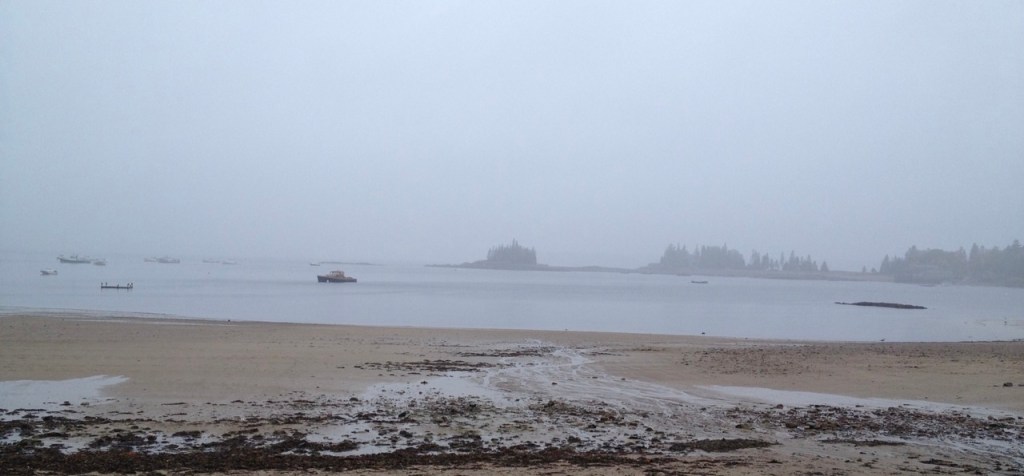
The beach just down the hill from where I used to live in my “other life.”

#

6:45 a.m. Driving up the turnpike from Brunswick to Bangor, headed down east to Mount Desert Island, I’m apprehensive. I’m returning to what I’ve always called my “other life”: different marriage, different house, different job, different hobbies, different self. A self, quite frankly, I’ve never liked very much.

But I’ve received an invitation to attend the 50th high school reunion of the Mount Desert Island Class of 1974. For many of these students, I was their English teacher as well as senior class advisor. And while I have, at best, mixed feelings about this other life, I enjoyed teaching at MDIHS and have continued to be in contact with some of these former students. I’d really like to see them.

My name tag at the reunion.

The reunion is tomorrow, but besides an invitation to the reunion, I’ve been asked to talk about my book, The Geriatric Pilgrim: Tales from the Journey at a gathering—which I figure will mostly be former students— in Bar Harbor a few hours from now. So, while I watch the leaves change color as I drive north, I try to figure out what I’m going to say. 

I know I’ll start by saying the most important thing I learned in writing The Geriatric Pilgrim was that the physical pilgrimages Mary Lee and I made to places like Iona, Big Sur and the redwoods, Nova Scotia, Israel, Africa, and Turkey have shown me that any journey—including the one we make as we age (and these former students are now all pushing 70. Good God!)—can be a pilgrimage. Especially if looked at with curiosity and openness, as explorations to discover new facets of ourselves, seeking surprises rather than security, looking for evidence of and trusting in a power greater than ourselves. 

Then, I think, Okay, if any journey can be a pilgrimage, that means this trip back into my other life is a pilgrimage. How?

When Mary Lee (who is sitting beside me, looking at a map of Maine—she loves those big unfolding maps that take up half the front seat) have gone on a pilgrimage, we often talk about what new insights we’re bringing back with us which we can use in the future. So, what lessons did I learn during the seventeen years I spent at MDIHS that have stayed with me? 

Well, I’ve always said that those years were the best teaching years of my life. I’ve taught in other schools, some with more impressive teachers, some with smarter students, some with better sports programs, a wider variety of extracurricular activities, more opportunities for materially or intellectually challenged students. But what made MDIHS different was that, despite the annual arguments about the budget and the tensions about dress codes and what was being taught, the parents, the school board, the administration, the faculty, and the students all agreed on one thing: MDIHS was a good school. And because we all thought it was a good school, it was—winning national awards for excellence.

MDIHS in the early years. My room was the closest on the end.

 Making a pit stop at the rest area outside of Bangor, I realize how I frame the reality of my life determines how I see that reality, which in turn determines how I live that reality. Thinking we had a good school, I went to work each day excited and proud to be there (okay, not every day, but I can honestly say, most days) which made me work harder, which made me a better teacher and the students better students. Fifty years later, when I can think of my aging not as a problem, but as an opportunity for growth, I’m less anxious about what I can no longer do and more curious about finding new things I can do, more grateful for those things, which makes me more pleasant to be around.

Back in the car, however, turning on to Route 1A and heading for the coast, I ask: if MDIHS was such a great place to teach, why did I leave, and in the middle of the school year? What’s the lesson there?

It probably begins with that guy I used to be—the one I’ve never liked. Come to think of it, he didn’t like himself either. Despite the accolades (one state evaluator said my Advanced Placement English class rivaled the one at Phillips Exeter), I was not a happy camper. I’d created this persona—loud sports coats, matching ties and pocket handkerchiefs, green ink corrections symbols and sarcastic comments in the margins of papers, pictures of sixty-four famous authors glaring down from the walls—which began to feel like a body bag. 

Soon after waking up one morning gasping for breath as if someone had their hands around my throat, I resigned. In the middle of the school year. Moved out of my house, divorced my wife, married another woman, and moved 120 miles away to teach not AP seniors but freshman juvenile delinquents (one of whom as far as I know is still in prison for murder).

And I think the reason I’ve never liked that guy in my other life is that I’ve always thought he was a fraud. But thinking about it, I honestly liked my job, and I wanted to honor my profession by looking and acting my best. I recall reading in David Whyte’s book, Work as a Pilgrimage of Identity, something to the effect that the things which once served us can imprison us if we remain with them too long. 

Which, as I think about it, is also true as I age. I can’t hold onto those activities, that self-image, those beliefs that once sustained me. When I think about making a new pilgrimage, I can’t plan—or I shouldn’t, anyway or I’m going to be disappointed, either that or die—to hike the Appalachian Trail or climb Mount Katahdin, but I can continue the journey toward what I might, for lack of a better word, call my true self. A journey, I realize, that began when I left Mount Desert Island, maybe even before.

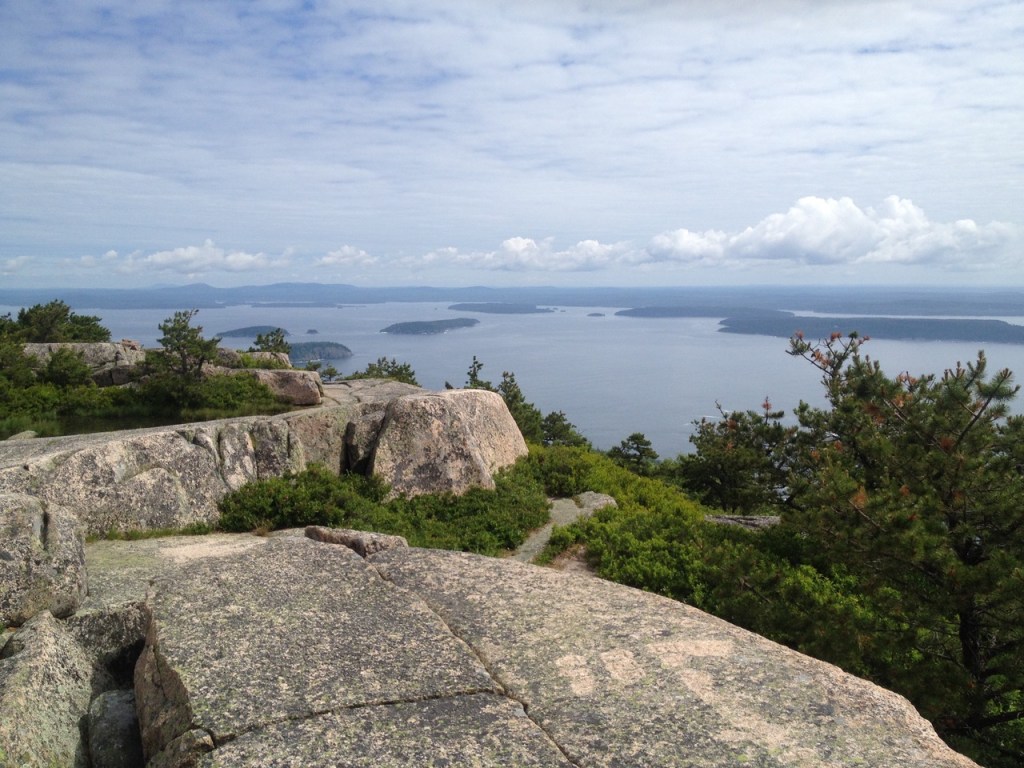
Speaking of which, I can now see MDI on the horizon, its rocky silhouette reminding me that this is one of the most beautiful places on earth. I remember, especially in those days when most of the tourists went home after Labor Day, how many afternoons and weekends I spent walking the trails and beaches there. And I realize that those walks were the beginning of what I call —somewhat euphemistically perhaps—my spiritual journey. Sitting on the top of one of the mountains, looking out over the neighboring islands, I experienced not only the inchoate presence of a Higher Power, but also a vague sense that everything belongs.

I needed help interpreting these experiences. Which led me to religion. When I first began teaching on the island, I hadn’t been in a church since I was married in one, and by the time I left seventeen years later, I was not only a member of a church but a member of the Board of Deacons. I sang in the church choir. I advised a church youth group. 

It dawns on me that without Mount Desert Island, there’d be no Geriatric Pilgrim.

I also see that I have no “other lives,” only this one—one that has been unfolding, like one of Mary Lee’s maps, from the beginning until now and will keep unfolding (I’m guessing; I’m curious to find out) after my earthly death. 

Wow! Now, if I can just remember to talk about some of this an hour from now…

# #

Beginning Again

#

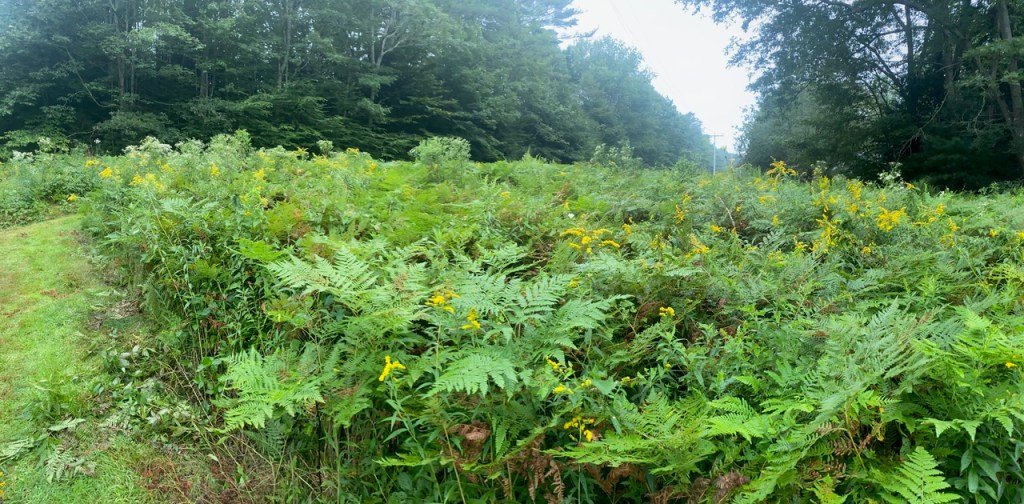
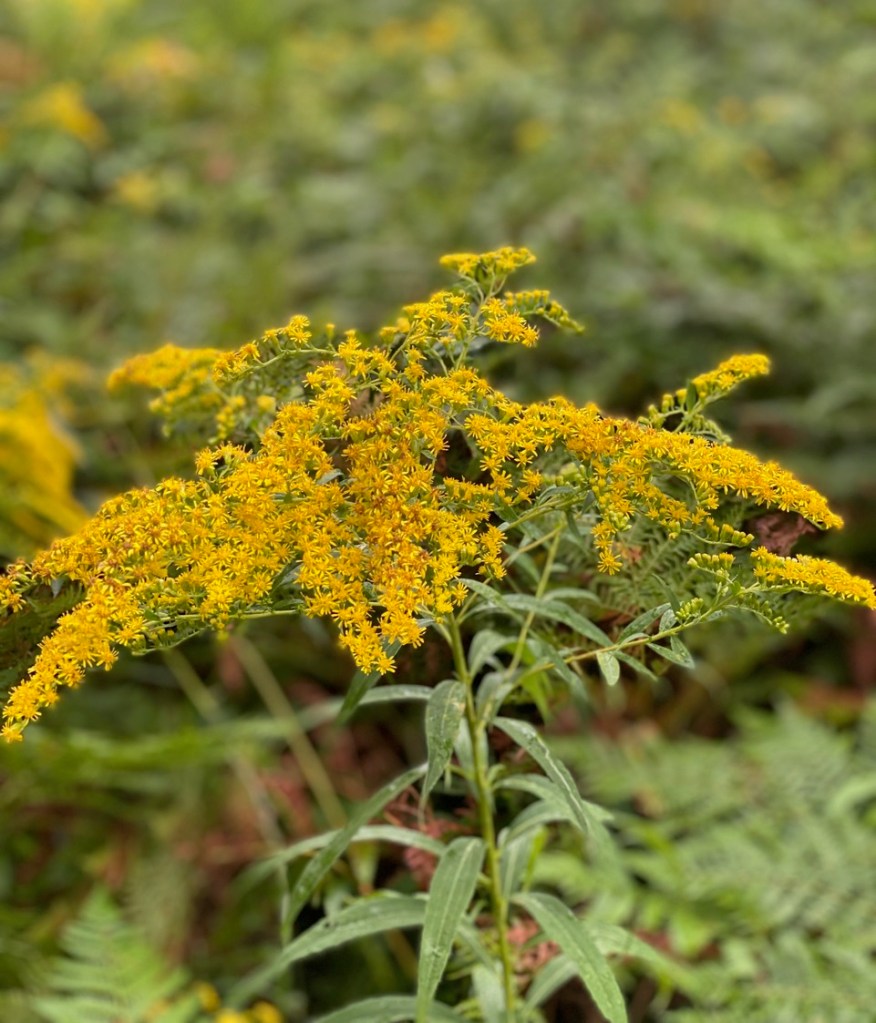
I’m walking the grass loop around our housing development. Under the power line toward the community garden, I pass through what is now a shoulder-high host of Queen Anne’s Lace, golden rod, milk weed, bracken, and many other plants I can’t name. The flies swarm. The sweet songs of the cardinals and tufted titmouses (titmice?) have given way to the screeching of blue jays and crows. Monarch butterflies flit from flower to flower. The air smells ripe. Shadows crawl like the incoming tide over the landscape. Summer is ending.

And I feel myself coming alive. Beginning again.

The reason is simple. For seventy-five years—as a student, as a teacher—the golden rod, the lengthening shadows, the Monarchs, have meant the beginning of another school year. More than New Year’s Eve, more than the first warm day of the year, this is the time when, at some deep cellular level, I can feel myself waking up, ready to start anew.

It’s a good feeling. At my age, it’s easier to focus on endings than beginnings. I now celebrate—if that’s the right word—more birthdays of the dead than of the living: my grandparents, my parents, my daughter, my first wife, close friends. Ended are my long hikes, long distant driving, lifting anything over forty pounds, staying up after midnight, jumping into bed with my wife after a sexy movie (jumping anywhere, for that matter), five-course meals, Cuban cigars, Laphroaig Scotch… the list grows longer each year.

But as T.S. Eliot wrote, “In the end is my beginning.” (Hey, I’m an old English lit teacher, I remember stuff like that.) You can’t begin something until something else ends. School can’t start until summer ends (Yeah, I know, there’s summer school, but I’m trying to make an analogy. Don’t confuse me with technicalities.) It took the end of a disastrous year of studying forestry in college for me to begin my studies in English (which is why I’m quoting T.S. Eliot and not The Journal of Forestry.) It took the end of an unhappy 20-year marriage for me to begin a happy going-on-forty-year one. It took the end of a career in public education for me to go back to school for an MFA, write a couple of books, a bunch of essays, and going on nine years’ worth of blog posts.

So, what will I begin this year? Well, Mary Lee and I have a couple of trips planned (knock on wood: last year, we had three planned and they were all canceled). I will scrape and repaint my front door and clean out the garage. 

But the biggest change I want to make is with The Geriatric Pilgrim

When I began these blogs, I was fascinated by the idea of pilgrimage: how a pilgrimage differs from a vacation, or from going on a retreat, or from study programs (what I called “edu-cations”). Besides traveling to retreat houses and other spiritual sites in the United States, Canada, the British Isles, Israel, Turkey, and Africa, I collected pages of definitions of pilgrimage and of common characteristics of pilgrimages. I read a raft of books about various pilgrimages people had made.

Along the way, I became intrigued by my fascination with pilgrims and pilgrimages. What was in it for me?

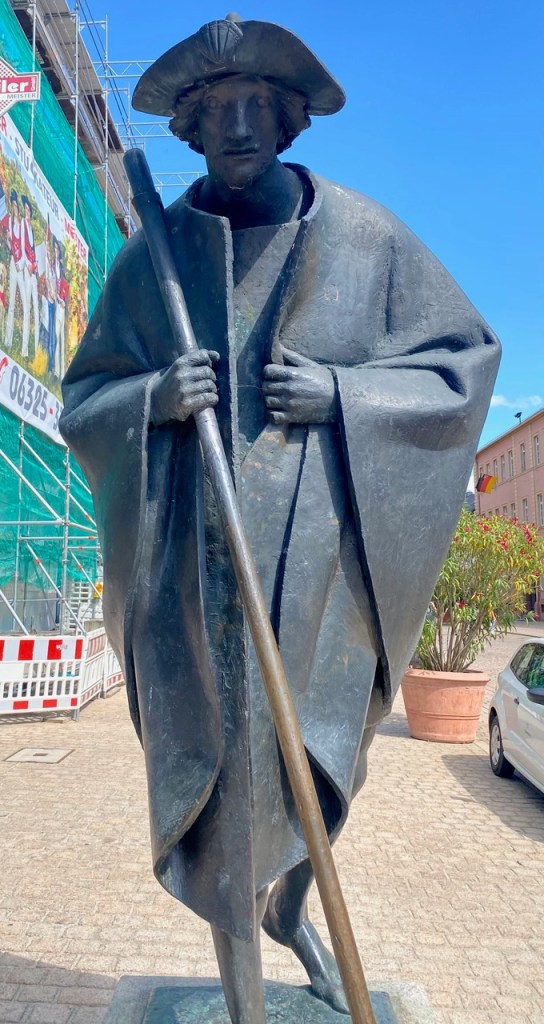
Stature of a “Jakobspilger,” or St. James’s pilgrim: Speyer, Germany

Well, probably the main thing at the time was the idea that pilgrims are often searching for a source of healing. As you know if you’ve read these blogs, I was looking for healing after the death of my eighteen-year-old daughter from a rare cancer. And I found writing about the various pilgrimages Mary Lee and I had made even more healing than the pilgrimages themselves.

Gradually, I began to realize that pilgrimage is a frame of mind—an attitude of curiosity, detachment, wonder. It’s “traveling light,” as one writer says, of risk, of living in liminal space—leaving one location but not yet arriving at another—of exploration, the end of which, to quote T.S. Eliot again, “Will be to arrive where we started/And know the place for the first time.”

Since COVID arrived, with all its restrictions on travel, followed by my 80th birthday, with its expanded waistline and diminished abilities, my blogs have focused more on applying the lessons of pilgrimage to my current life of walks in the neighboring woods, planting peas, tomatoes, and pumpkins in our community garden, and of exploring the twelve steps of my Al Anon program. This, too, has been healing.

 But now I find myself no longer as interested in finding new ways to describe my pilgrimage, as I am in describing and exploring in more depth the landscape through which I’m traveling, a landscape that is always changing, sometimes in ways that please me—autumn color is just around the corner, the grandchildren are growing—sometimes in ways that piss me off or frighten me—the start of my favorite woods walk has been clear-cut, I’m finding it difficult to sing without coughing.

Writing about these joys and sorrows, I find I’m writing more poetry. I’ve just finished an on-line workshop for poets, and one of the highlights of my week is another on-line group of poets from all over the country, where we share our favorite poetry as well as poems we’ve written. I’m now subjecting my longtime writing group here in town to my poems.

So, I’m going to be posting more poetry here in these blogs as well as other experiments—prose poems, flash fiction and nonfiction—trying to look more closely at the physical and emotional landscapes through which I’m now traveling.

The way I see it, my pilgrimage continues, but the lens through which I’m seeing it and the voice in which I’m describing it is changing.

I’m excited to see where this journey will take me. 

And hoping you’ll continue to join me.

So, let part of my life end, and another begin.

As Quakers say, when one door closes another opens.

For all my losses, I’ve also had wins;

let part of my life end and another begin.

Sure, it’s tempting to focus on what has been,

but I don’t want only to go through the motions.

Let part of my life end and another begin,

as one door closes and another opens.

# #

The Frames I see Through

fullsizeoutput_14f0

#

For reasons I didn’t understand at the time, I recently decided to make a pilgrimage to the Eastern Maine Medical Center in Bangor, Maine where my daughter Laurie died almost thirty years ago of cancer. My specific destination was the hospital chapel where I’d spent so much time during the last six weeks of her life, and where I encountered perhaps the closest thing I’ve ever had to a “spiritual” experience.

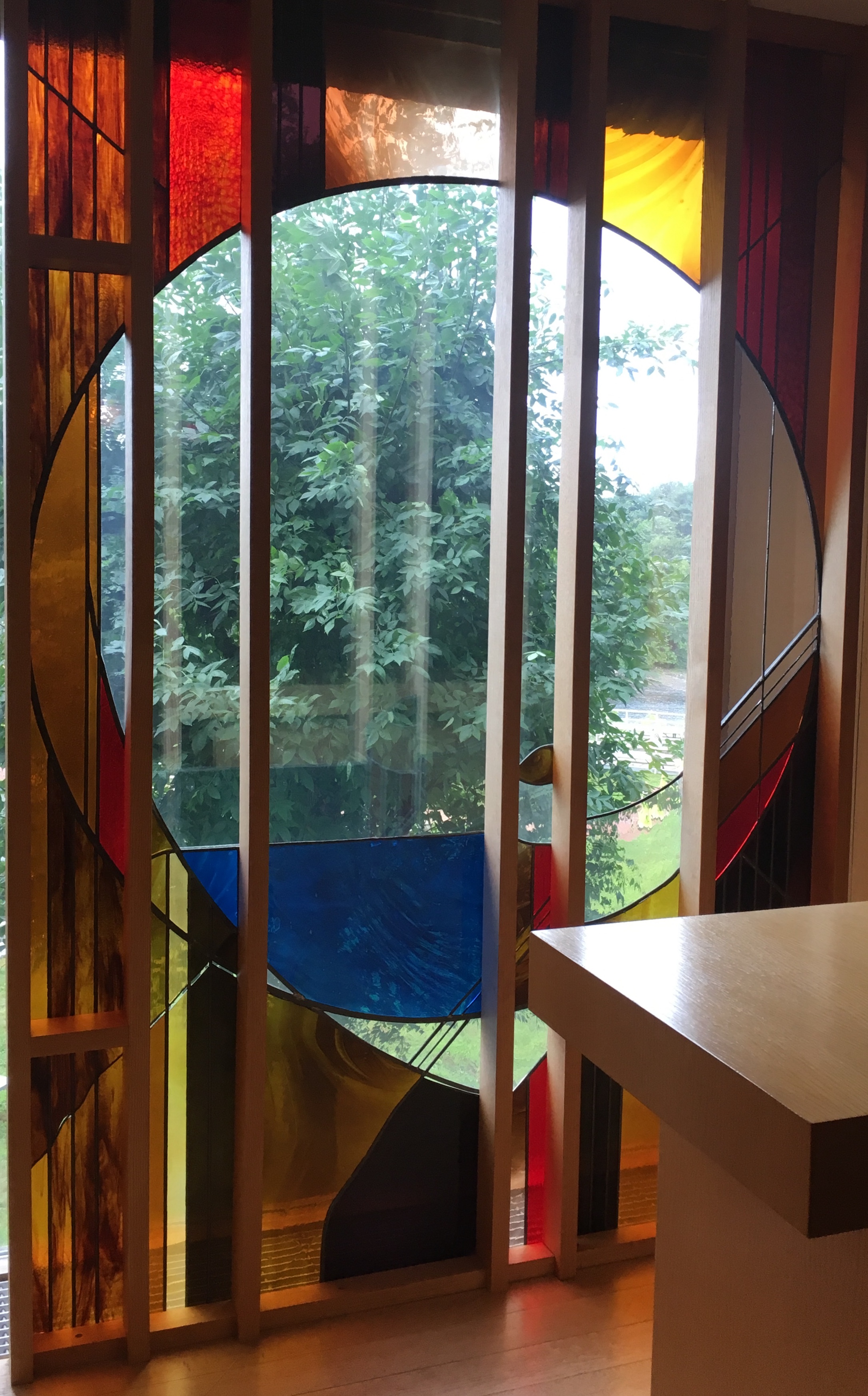
The chapel hadn’t changed at all that I could see: same walnut paneled walls and altar, same cushioned chairs; the familiar hum of air conditioning punctuated by occasional voices in the hall, and, what I most remember, the large round window framed by red, yellow, brown, and blue panels, through which I could see the Penobscot River flowing downstream over the rocks—a living stained-glass window.

I sat as I used to on the left side of the altar in front of the window and thought of that surrealistic time and of my struggles to understand my daughter’s illness and impending death. But while I could recall the details, I could no longer feel the waves of anger that sometimes surged around the numbness in my heart. It was as if I were watching myself thirty years earlier, sorry for the poor bastard and all that he was going through, but at the same time more emotionally concerned with life now—working my 12-step program, dealing with the diminishments of aging and my apprehensions about dying.

Then I thought of my daughter’s dying in a room two floors above me, and about how I used to look out her hospital window at the same river, but how different the view here in the chapel was because of the shape of the window and its stained-glass frame. Which led me to consider the various ways I’ve framed events in my life, and on how often the way I’ve framed a particular incident has determined how I’ve responded to it.

#

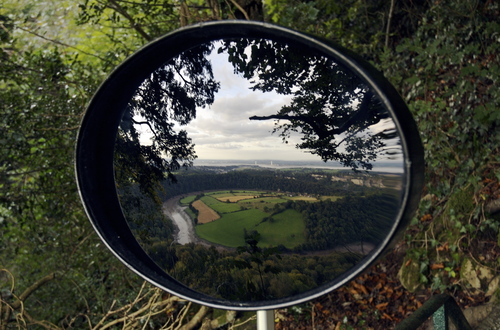
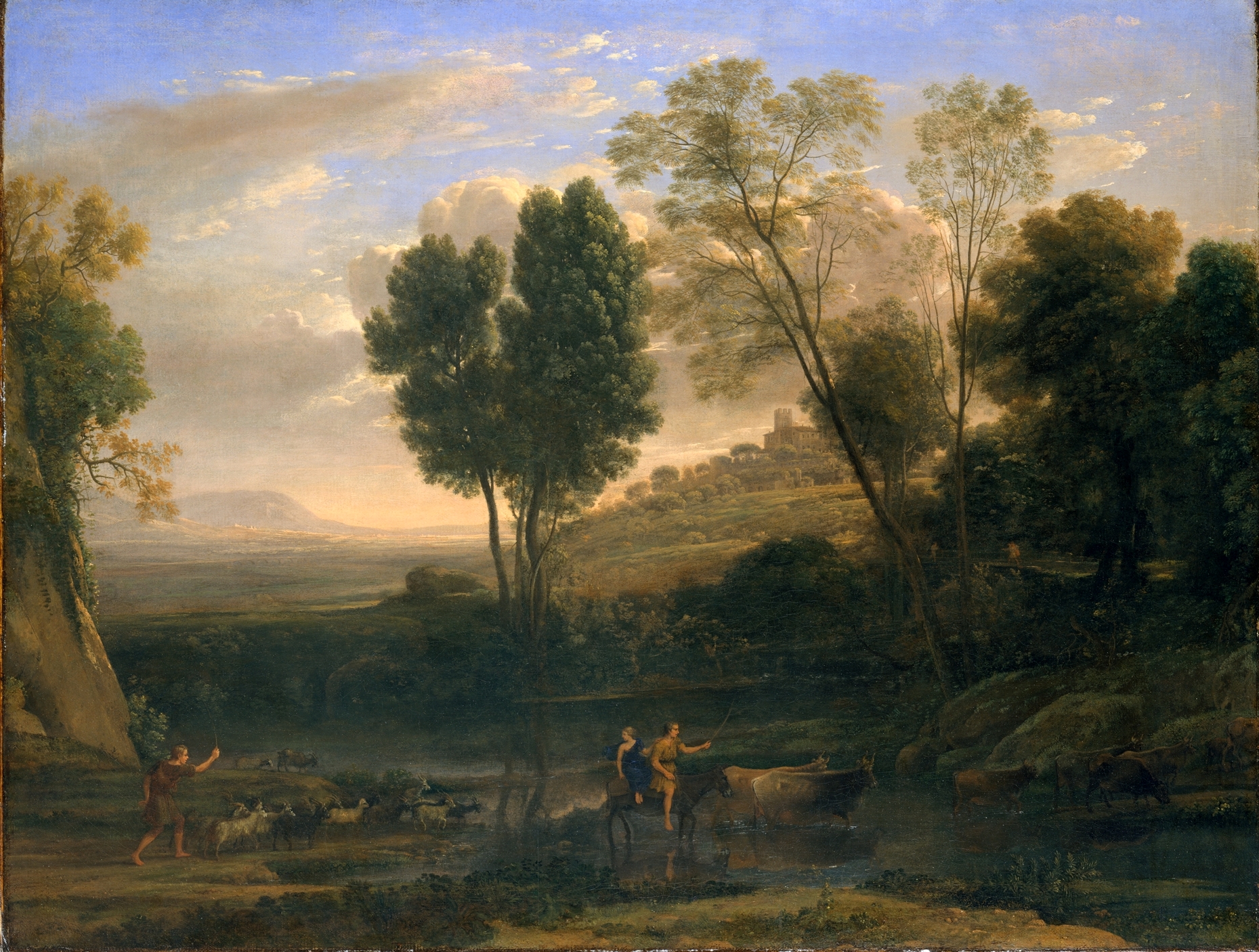
I remember hearing from one of my college English Literature professors that 18th Century travelers, uncomfortable—even afraid—of the uninhabited natural world, would carry empty picture frames with them in order to frame their views of the Alps. I can’t find anything on line about those traveling frames, but I have found that many travelers during this period put a convex tinted filter on a frame called a “Claude Glass.” Apparently, they would sit with their backs to a scene, holding the folding glass so they could see behind them. The convex shape of the frame brushed background objects into the far distance and the tinted glass softened the reflected tones in order to make settings look like the paintings of the popular 17th century French artist, Claude Lorraine.

Claude Glass
You can still buy Claude Glass frames today.This tinted frame by Alex McKay : (http://claudemirror.com)is of the River Wye from an 18th c viewing station known as The Eagle’s Nest. 

These frames helped control and tame what travelers were seeing. They also gave a distorted picture of reality. I don’t know about you, but the way I’ve framed events in my life has often done the same thing. My 12-step sponsor talks about our “frame of reference,” the values and attitudes which we use to filter perceptions to create meaning. Our frame becomes our assumptions, our “shoulds.” And it is these frames, not the events themselves, that we react to emotionally. As the Greek philosopher Epictetus wrote some two thousand years ago: “Men [sic] are disturbed not by things but by the view they take of them.”

I’ve become aware lately that my frame of reference is often one created from growing up in an alcoholic family, so that for most of my life I’ve framed events by judgments, resentments, and fear of confrontation. Thirty years ago, when I sat in the chapel at EMMC, I judged myself responsible for my daughter’s death because I had left her mother and married another woman. Rather than confront my ex-wife when she said that she wasn’t going to honor Laurie’s request for her ashes to be scattered, I refused to come to our daughter’s burial service.

With the help of my sponsor I’ve been working to “re-frame” my view of the world—looking at situations from different angles, shifting my frame of reference.

And I wonder if I went back to the chapel a couple of weeks ago because at some level I knew I needed to learn something from the time my frame of reference dramatically changed.

#

Thirty years ago, when I went to the hospital chapel I saw the events around me through the frame of “Why is my daughter dying?” None of the answers—cutting down rain forests is increasing cancer rates, her cancer is a statistical accident like getting struck by lightning, God is a sadistic bastard getting kicks from torturing innocent girls, and, of course, her death is my fault—did anything to relieve her pain, and only increased my suffering.

And still, “Why?” was the question that pounded in my blood as I sat in the chair on the left side of the altar and stared for the first time through the stained-glass frame at the river roiling in a December wind.

But as I sat, I became enfolded into the window, and from somewhere I heard the words, “Don’t ask why, just ask for help.”

At first, I didn’t realize what I’d heard. When I did, I angrily framed it, OK, help me understand the reason for my daughter’s pain and why she’s going to die before she’s ever really lived.

But I couldn’t take my eyes from the window. I felt my body loosen. The stained glass seemed to keep drawing first my angry words and then all of me into its embrace.

I didn’t understand then—in fact, I may not have fully understood until now—how the words “Don’t ask why, just ask for help” encouraged me to reframe Laurie’s death, shift the question from “Why is my daughter dying?” to “How do I cope with the death of a child? How do I find the help I need? How do I gain the courage to ask for that help?”

But it was through seeking the help of counselors, spiritual directors, my wife, my family, and the grace of the God of My Not Understanding that my life has been one of not only deep sadness but great joy.

#

The older I get, the more my pilgrimages involve relearning the lessons I first learned years ago. It would be great if I’d fused “don’t ask why, just ask for help” into my frame of reference thirty years earlier, but unfortunately that didn’t happen. I still ask myself, “Why can’t people think the way I do, act as I act?” instead of asking, “How do I get the help I need to speak my truth with kindness and not worry about what others think or how they behave?” Or instead of asking, “Why am I going to die?” asking, “Who and what can help make what time I have left as productive and joyful as possible?”

Claude Lorraine
Claude Gellée (Lorrain) – The Metropolitan Museum of Art 47.12. Title: Sunrise. Date: c. 1646-1647. Materials: oil on canvas. Dimensions: 102.9 x 134 cm. Nr.: 47.12. Source: http://images.metmuseum.org/CRDImages/ep/original/DT226758.jpg. 

# #