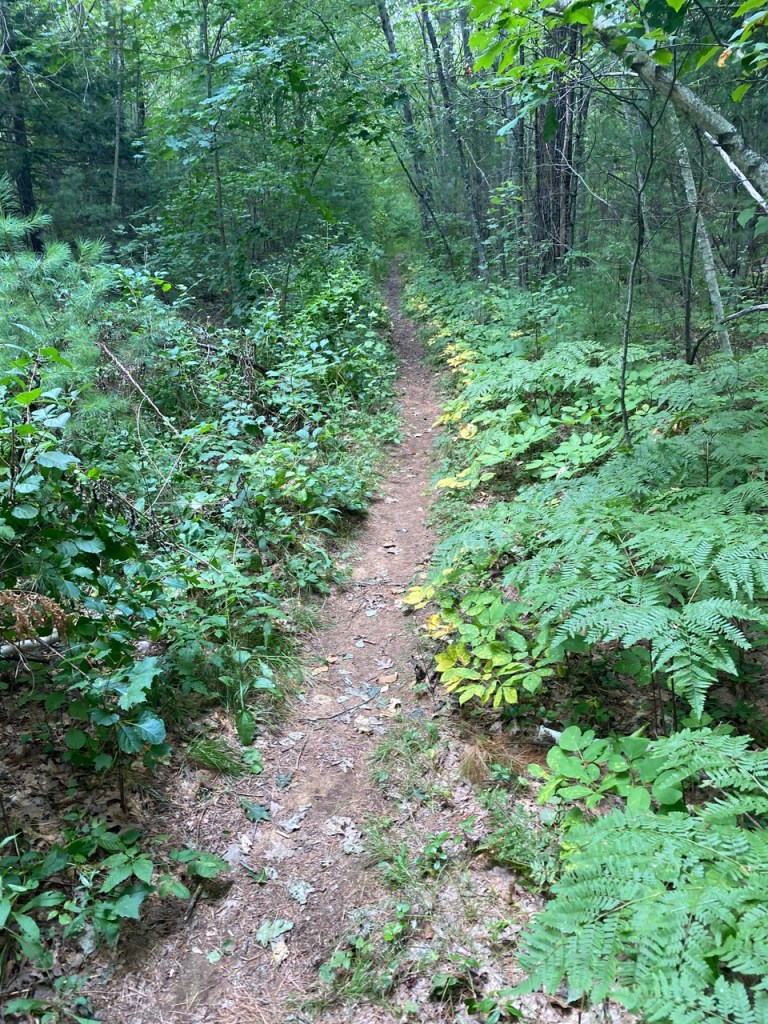
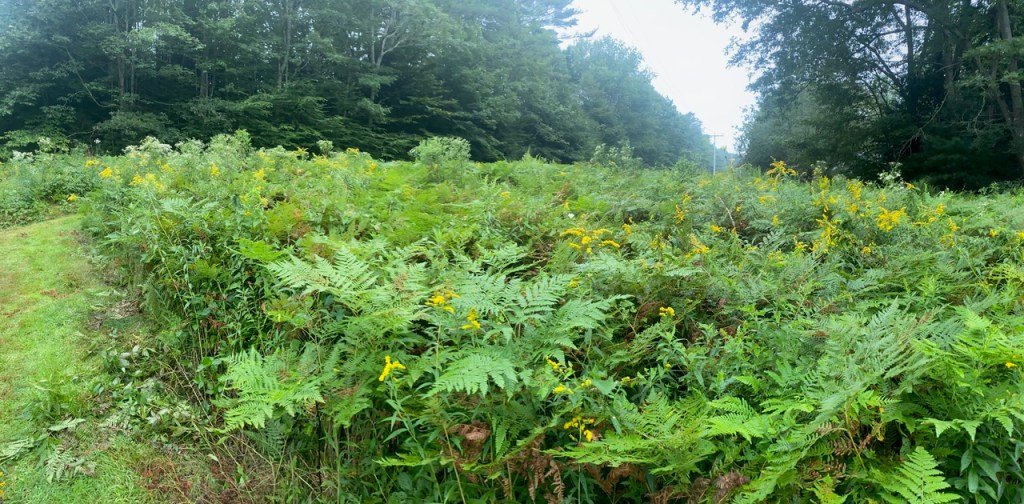
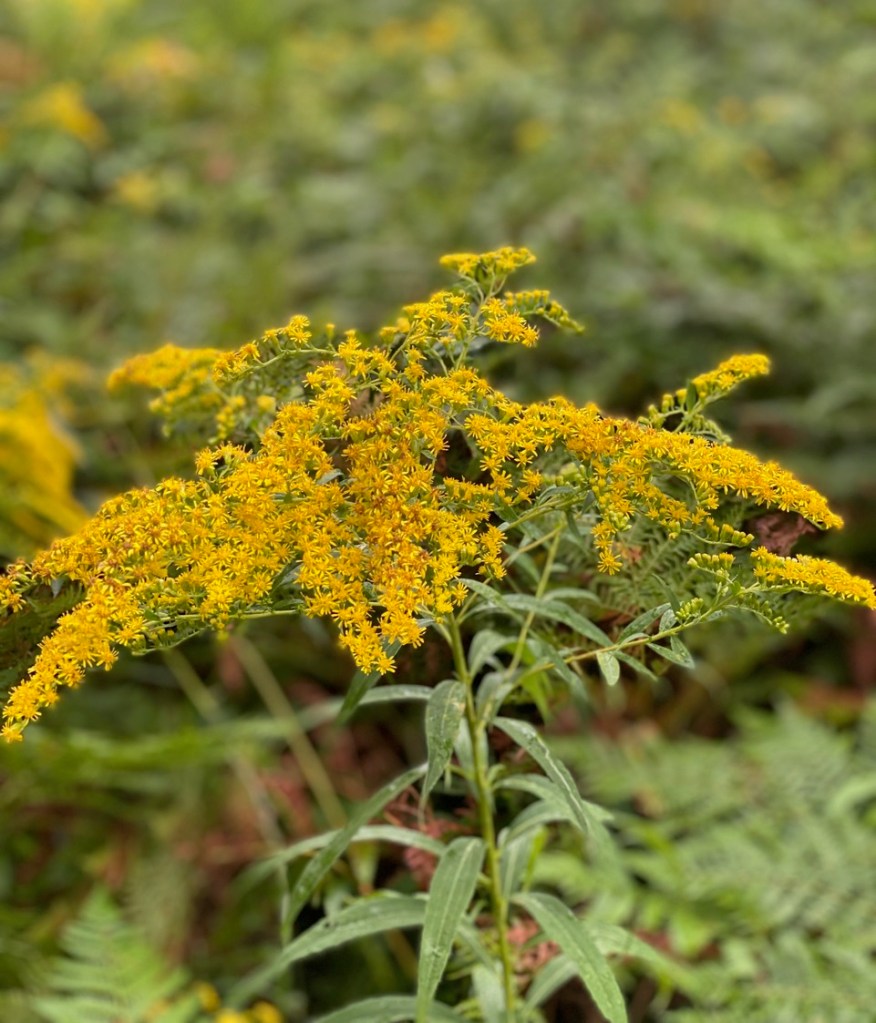
I’m walking the grass loop around our housing development. Under the power line toward the community garden, I pass through what is now a shoulder-high host of Queen Anne’s Lace, golden rod, milk weed, bracken, and many other plants I can’t name. The flies swarm. The sweet songs of the cardinals and tufted titmouses (titmice?) have given way to the screeching of blue jays and crows. Monarch butterflies flit from flower to flower. The air smells ripe. Shadows crawl like the incoming tide over the landscape. Summer is ending.
And I feel myself coming alive. Beginning again.
The reason is simple. For seventy-five years—as a student, as a teacher—the golden rod, the lengthening shadows, the Monarchs, have meant the beginning of another school year. More than New Year’s Eve, more than the first warm day of the year, this is the time when, at some deep cellular level, I can feel myself waking up, ready to start anew.
It’s a good feeling. At my age, it’s easier to focus on endings than beginnings. I now celebrate—if that’s the right word—more birthdays of the dead than of the living: my grandparents, my parents, my daughter, my first wife, close friends. Ended are my long hikes, long distant driving, lifting anything over forty pounds, staying up after midnight, jumping into bed with my wife after a sexy movie (jumping anywhere, for that matter), five-course meals, Cuban cigars, Laphroaig Scotch… the list grows longer each year.
But as T.S. Eliot wrote, “In the end is my beginning.” (Hey, I’m an old English lit teacher, I remember stuff like that.) You can’t begin something until something else ends. School can’t start until summer ends (Yeah, I know, there’s summer school, but I’m trying to make an analogy. Don’t confuse me with technicalities.) It took the end of a disastrous year of studying forestry in college for me to begin my studies in English (which is why I’m quoting T.S. Eliot and not The Journal of Forestry.) It took the end of an unhappy 20-year marriage for me to begin a happy going-on-forty-year one. It took the end of a career in public education for me to go back to school for an MFA, write a couple of books, a bunch of essays, and going on nine years’ worth of blog posts.
So, what will I begin this year? Well, Mary Lee and I have a couple of trips planned (knock on wood: last year, we had three planned and they were all canceled). I will scrape and repaint my front door and clean out the garage.
But the biggest change I want to make is with The Geriatric Pilgrim.
When I began these blogs, I was fascinated by the idea of pilgrimage: how a pilgrimage differs from a vacation, or from going on a retreat, or from study programs (what I called “edu-cations”). Besides traveling to retreat houses and other spiritual sites in the United States, Canada, the British Isles, Israel, Turkey, and Africa, I collected pages of definitions of pilgrimage and of common characteristics of pilgrimages. I read a raft of books about various pilgrimages people had made.
Along the way, I became intrigued by my fascination with pilgrims and pilgrimages. What was in it for me?
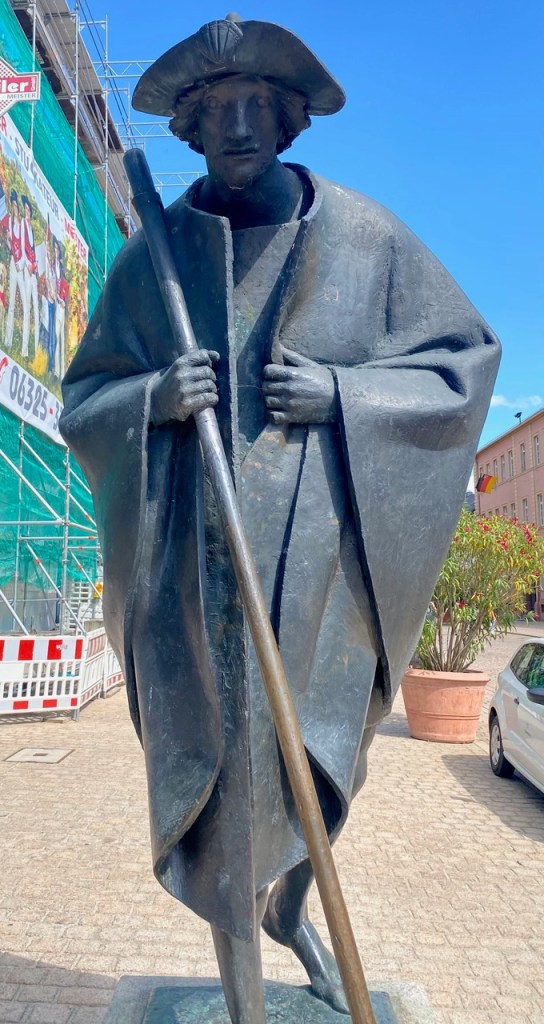
Stature of a “Jakobspilger,” or St. James’s pilgrim: Speyer, Germany
Well, probably the main thing at the time was the idea that pilgrims are often searching for a source of healing. As you know if you’ve read these blogs, I was looking for healing after the death of my eighteen-year-old daughter from a rare cancer. And I found writing about the various pilgrimages Mary Lee and I had made even more healing than the pilgrimages themselves.
Gradually, I began to realize that pilgrimage is a frame of mind—an attitude of curiosity, detachment, wonder. It’s “traveling light,” as one writer says, of risk, of living in liminal space—leaving one location but not yet arriving at another—of exploration, the end of which, to quote T.S. Eliot again, “Will be to arrive where we started/And know the place for the first time.”
Since COVID arrived, with all its restrictions on travel, followed by my 80th birthday, with its expanded waistline and diminished abilities, my blogs have focused more on applying the lessons of pilgrimage to my current life of walks in the neighboring woods, planting peas, tomatoes, and pumpkins in our community garden, and of exploring the twelve steps of my Al Anon program. This, too, has been healing.
But now I find myself no longer as interested in finding new ways to describe my pilgrimage, as I am in describing and exploring in more depth the landscape through which I’m traveling, a landscape that is always changing, sometimes in ways that please me—autumn color is just around the corner, the grandchildren are growing—sometimes in ways that piss me off or frighten me—the start of my favorite woods walk has been clear-cut, I’m finding it difficult to sing without coughing.
Writing about these joys and sorrows, I find I’m writing more poetry. I’ve just finished an on-line workshop for poets, and one of the highlights of my week is another on-line group of poets from all over the country, where we share our favorite poetry as well as poems we’ve written. I’m now subjecting my longtime writing group here in town to my poems.
So, I’m going to be posting more poetry here in these blogs as well as other experiments—prose poems, flash fiction and nonfiction—trying to look more closely at the physical and emotional landscapes through which I’m now traveling.
The way I see it, my pilgrimage continues, but the lens through which I’m seeing it and the voice in which I’m describing it is changing.
I’m excited to see where this journey will take me.
And hoping you’ll continue to join me.
So, let part of my life end, and another begin.
As Quakers say, when one door closes another opens.
Besides dealing with a decaying body and a deteriorating mind, one of my biggest challenges these days is to keep from living in the past. (And I’m sure the two struggles are connected: of course, I want to recall when I could leap tall buildings in a single bound.) It’s so tempting to spend my days reminiscing with old classmates via email or Facebook, watching “American Bandstand” on YouTube, and replaying 65-year-old high school basketball games.
This last month has been especially challenging. May began at the history center in the town in which I grew up with a program that my oldest friend (going back to the first grade) and I spent the winter planning: “Yarmouth [Maine, for those of you reading this in Singapore and elsewhere], 1955-1962: Times of Change.” We wound up with probably thirty people there who’d grown up in town during those years, bathing in the warm waters of nostalgia, as we talked to newer residents about how Yarmouth changed during that time from a low-income community of shops and small factories to a bedroom-by-the-sea for urban lawyers, doctors, and bankers. A town we kids roamed at will because everyone looked after us—where the local telephone operator would call my classmate Barbara’s house at 3:30 in the afternoon (because she knew Barbara got out of school at 2:30 and would stop at the drug store for a coke, so that’s when she’d get home) to tell Barbara that her mother would be late and that she should turn the oven on 350° and put the roast in at 4:00. (Who needed cell phones?)
Later in the month, as my brother and sister and I cleaned off stones and planted impatiens in our family cemetery plot for Memorial Day, we swapped memories of Mom and Dad and our grandparents. (Amazing how different our recollections are!) Later that week, I went with my wife, Mary Lee, to her 55th college reunion, and for three days listened to other people’s stories about their pasts. Throw in a dream in which I ran into my ex-wife—who died eight years ago—dressed in a white karate gi (still trying to work out the symbolism there), and I’m starting to sink beneath these waves of nostalgia.
I need to get out and open my eyes. Stop looking at what’s behind me and start looking at what’s around me—what’s new. I decide to check out this year’s garden. Besides, I need to put in my tomato seedlings.
It’s a beautiful June morning and the world is new. The apple blossoms and rhododendrons are in full bloom, the air smells of lilacs, and the breeze is fresh. The world is spring green: the grass hasn’t yellowed, the leaves aren’t chewed, and the caterpillars haven’t yet built their ugly tents in the trees.
I put my seedlings and watering can and trowel in the car, drive up and park on the power line road between our community garden (which I wrote about a few years ago: https://geriatricpilgrim.com/?s=Up+to+the+Gahden) and a wooded swamp, home to all kinds of birds, many of whom are singing their ever-loving hearts out.
I had no idea how many birds there are here until I got one of those apps this year for my phone that identifies birds by their songs. So, I check it: cardinal—yes, I know their pulsating whistles; song sparrow—makes sense, I see all kinds of them; gold finch and chickadee—ditto. But what’s a great crested fly-catcher? And a red-eyed vireo? They’re new, at least to me. Cool.
Turning to the garden, I think of the beginning of baseball season, when, no matter how poor a team’s prospects, there’s always hope for a championship year.
This year, I’ve got three raised beds, and—God willing; I haven’t planted it yet—a small pumpkin patch. The garlic I put in last fall is up, as are the peas which I planted on May 1st. I decided this year to stake them with some of the branches that came down from last winter’s storms—the first time I’ve ever tried that, and it seems to be working: the peas are grabbing the branches with gusto. In another bed, I’ve got the usual two kale plants which will hold us until November, but for the first time, I’m trying a couple of eggplants and a purple pepper to see what happens. I’ve also planted bush beans for the first time in years. (Mainly because last year, I almost killed myself stringing pole beans, and vowed never again.)
I wave to Karen down the way who’s working on her bee garden. She’s also building a new compost bin, for which I need to thank her.
But first, let’s get those tomato seedlings in.
The sun is warm. I take off my outer shirt and begin raking the bed where I’m going to transplant my tomatoes. I love the smell of the fresh dirt (apparently, it triggers the release of serotonin in the brain—at least that’s what I read somewhere) which makes me want to sing. And because the other night I watched a music documentary on Paul Simon, I serenade the birds with “50 Ways to Leave your Lover”—
You just slip out the back, Jack
Make a new plan, Stan
You don’t need to be coy, Roy
Just get yourself free—
The really neat thing about the documentary was it focused on Simon’s newest album of songs, many, if not all of them, as I recall, coming to him in a dream. And if at the age of what, 83?, he can still be creating new work, even though I guess he’s now deaf in one ear, then I, at 81, can, too, despite my various diminishments.
I dig six holes and put a little of Karen’s compost in each one. I find myself slipping again into the past: the summers in high school I used to work in a garden and the big garden I had during my first marriage. Cut it out! I think, and then decide, No, let’s use those memories as compost, fertilizer to help me grow.
Which would be more inspiring if my back didn’t already hurt from this minimal exercise. From my other garden bed, I grab my new kneeler and bench combination, which I bought this spring, and kneel on it to put the tomato seedlings into the dirt and the compost, which gets my hands dirty and the rest of me feeling clean. Then, I put collars that I’ve made from plastic medicine cups around the seedlings to protect them from cutworms, and, using the metal arms of the bench to get myself off my knees, rise to get my tomato cages from last year. Finally, I give my little darlings a drink to get them on their merry way.
Feeling accomplished, I sit down on the new iron bench with the “Welcome” sign that someone—probably Doug, who, along with Karen oversees our community garden—has donated. I think about how I still rely on community as much as I did when I was a kid all those centuries ago.
Looking up, I follow an exhaust vapor trail in the blue sky until I see the sun flash on a plane, high in the sky, probably starting its descent into Boston. I imagine flying to new countries and seeing new vistas and new people.
But right now, right here, there are plenty of new things going on, thank you very much.
Recently, Hurricane Lee, at one point a Category 5 hurricane, churned up the Atlantic coast, bringing with it dire warnings such as, “Lee Drives Towards Us with a Hugh Wind Field, Damaging Waves, and Flooding.” The Episcopal Church of Maine’s website offered a prayer, which began: “Creator God, we ask you to calm the wind and the waves of the approaching hurricane and spare those in its path from harm.”
I put away lawn chairs, harvested basil, tomatoes, and beans from my garden, and checked to see that our flashlights all had new batteries and the lamps had oil. I cleaned out the garage, so that I could get my car out of the way of falling branches.
Well, the trees did some jitterbugging in the wind to the rhythm of our wind chimes, and our lawn had a smattering of small branches. My Zoom meeting with an Al-Anon sponsee on the coast ended early when his power went out, and my bean pole in the garden blew over, but all in all, the effects of the storm were minimal. A few years from now—if I’m still alive—I doubt if I’ll tell many stories about Hurricane Lee.
Hurricane Lee: 2023
There are other hurricanes, other storms, however, whose stories have stayed with me.
In 1954, Hurricane Carol, the first Category 5 hurricane to hit New England, roared through Maine, followed ten days later, by Hurricane Edna. A little research tells me that the two storms caused 25 million dollars in damages and destroyed 3500 cars and 3000 boats. What I remember was that at 11 years old, I thought hurricanes were neat. The thundering river down the hill mingled with the roar of the wind, and our house shook like some carnival ride. I couldn’t understand why my father was chain-smoking and pacing back and forth in front of the living room window, muttering, “I hope that goddamned tree doesn’t fall on us.” The day after Hurricane Carol, my friends and I walked through town, gaping at the elm trees that had blown over, amazed at the size of their roots, which rose several feet over our heads.
The next hurricane to hit Maine was Gloria, in September 1985. According to Wikipedia, this storm affected six counties in Maine, with multiple injuries, downed trees, and 250,000 people without power, some for up to fourteen days. I was living Down East at the time. Less than a month earlier, my first wife and I had separated, and the day after the storm I got up early to drive my daughter Laurie to church camp for the weekend. After dropping Laurie off, I continued on to visit my mother and father. When I pulled into the driveway, I saw Dad standing in strewn leaves and fallen branches, trying to fry bacon and eggs on a charcoal grill. My Grandmother Cleaves, who’d come over from her apartment for a hot breakfast, stood at the window.
What I recall even more clearly now was that my father, Laurie, and Nanny Cleaves all died within the next four years. Throw in a divorce and a second marriage, and I experienced an emotional hurricane that made Gloria feel like a summer breeze.
In 1991, Hurricane Bob came to Maine. Three people died, many residents lost power, and there was over five million dollars in damages. Again, the storm’s direct effect on my new family and me was minimal, but because of the heavy rains and losing power, my Grandmother Kimball’s cellar flooded because her sump pump stopped working. At 92, living alone, she couldn’t cope with the responsibility of keeping the house up, so she sold it to me. Mary Lee and I lived in that house for the next 22 years. Then, after a spring rainstorm and another flooded cellar (something like the fifth one in those 22 years), we sold the house and moved to where we now live (which, thankfully, has no cellar).
Our cellar after the Patriots’ Day Storm of 2007
I think of other storms in my life—natural ones, such as the ice storm of 1998, various nor’easters leaving two feet of snow; emotional storms, such as my defeats and disappointments, a divorce, Laurie’s death—and I realize that I remember them far more clearly than I do the sunny days—beach days, vacations with family in Florida and Bermuda—or the happy times: the victories, the times I’ve been recognized or honored. I don’t know about you, but it’s the storms rather than the sunny days in my life that have become the stories of my earthly pilgrimage, those narratives that have helped me navigate my life, and which I continue to look back on and refer to as I forge on towards whatever denouement awaits me.
So, why that is that even after sixty years, I remember my defeats on the basketball court more than the victories? That I remember my divorce settlement more than my first marriage ceremony? Laurie’s death more than her birth?
Maybe one reason these storms stay with me is that I’ve survived them all. Storms help me feel good about myself, less afraid of the future. I can be “defeated but not destroyed,” as the great storyteller Ernest Hemingway said. I recall meeting a woman who knew of Laurie’s death and who’d just lost her son in a fire. Her first words to me—even before saying hello—were “Tell me how you’ve survived!” At the time, a guy I’d come to know from being in grief counseling together, had just committed suicide and I realized surviving Laurie’s death really was an accomplishment.
As I think of it, storms have not only made me aware of surviving, they’ve made me feel more alive. And I don’t think I’m alone in feeling this way. There’s nothing like a good nor’easter or hurricane to draw people to watch the ocean waves crashing over the rock-bound coast of Maine. After Laurie died, I found myself missing those last weeks of her life when I was living at a Ronald McDonald House, spending the days beside her. There was a focus to those days, a purpose, and the great themes of Life and Death dwarfed the usual minutia of everyday life.
Speaking of less fear and more focus, I’m interested in the number of people I know who suffer from anxiety and depression but who become fearless when forced to face specific physical dangers such as a high wind or a flood.
In a storm, I let go of the old stories I tell myself about who I am. I’m forced to come to terms with the fact that life as I knew it may never be the same. I plunge into a new adventure, a tale of unknowing, which can also be a story of spiritual re-birthing if I can only recognize and surrender to that power greater than myself.
Looking back at the storm stories in my life helps me realize that while I may want to shrink God down to my size, God is always bigger than I am, will always be God of my not Understanding.
And of course I have to include a snowstorm picture—this from 2013.
Several years after her death, I visited the grave sites of my ex and our daughter
#
I have been with my parents during their final hours. I have witnessed my daughter take her last tortured breaths. I am watching old friends die almost monthly. Still, I’ve never felt such a mix of emotions as I did when I stumbled across my ex-wife’s obituary in the newspaper.
Happily remarried for thirty years, I’d had no contact with her since our daughter’s death four years after the divorce. Since that time, I seldom thought of my first marriage except as a twenty-year mistake, most of the mistakes being hers.
But now I felt weak. I found myself thinking, if only we’d stayed in our first house instead of moving back to her hometown, we might have made the marriage work. If only we’d seen a marriage counselor. If only I’d gone for a PhD and become a college professor instead of remaining a high school English teacher…
Then I thought, if my ex and I had stayed married, I wouldn’t be with Mary Lee, who showed me what marriage can be, who was the reason I didn’t drink myself to death when Laurie died, who makes me believe God really does exist. There’s no way I could be happier than I am now.
For weeks, I felt like a racquetball, caroming off walls of shock, relief, regret, and gratitude.
But there was no one to talk with about how I felt. No action I could take. When my mother and father died, my brother, sister, and I shared memories. We purchased another stone for the family cemetery to decorate on Memorial Day. After Laurie died, I found groups like Compassionate Friends with whom I could talk. I made contributions for cancer research. I counseled other grieving parents.
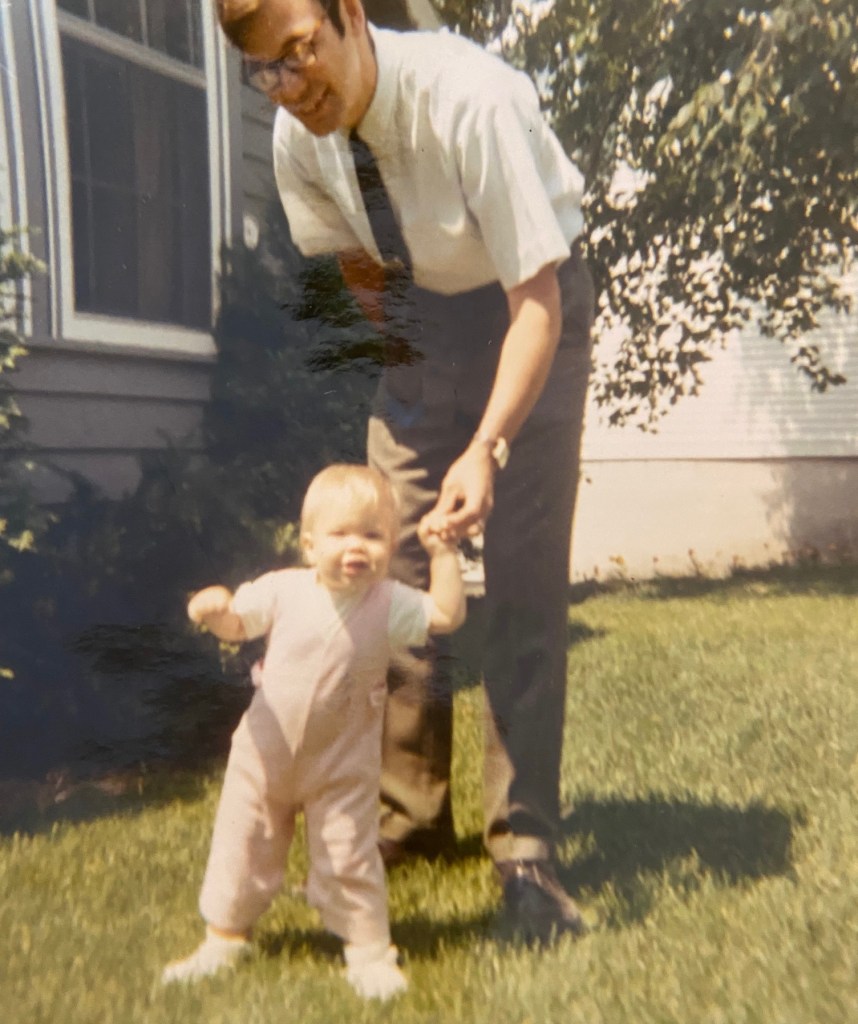
But I couldn’t put a memorial stone for my ex-wife in our family lot. And while Mary Lee was sympathetic—she’d spent an afternoon listening to a friend describe her conflicted feelings after her ex died—I couldn’t talk to her about the “if onlys” and the “what ifs” of my first marriage, the experiences only my ex and I shared, especially with our daughter. I was now the only one alive to remember Laurie’s first steps as she stumbled between her mother and me, or my sitting with her mother during our daughter’s first piano recital, or the three of us decorating the Christmas tree.
First steps.
Add loneliness to the emotional cesspool in which I swam.
Then, during a meeting of the 12-step program to which I belong, when my emotions about my ex-wife’s death swarmed like black flies, I shared that when I’d gone away to college, I anticipated getting away from my dysfunctional family, but that my mother’s shame and my father’s angry resentments had come with me. My grades were lousy. I sat alone in the back of the college den, bitterly envious of the laughing fraternity brothers and sorority sisters I saw at the front tables yet afraid to make conversation with anyone around me for fear they would reject me for being the loser I thought I was.
Driving home after the meeting, I realized how being a child of alcoholism had drawn me into marrying the only child from a closely knit family with strong Yankee values who seemed confident and strong, who, I thought, would offer me the stability I craved.
I started to realize how being that child had also contributed to the breakup of my marriage. How, to keep feeling safe and secure, I never expressed any of my own needs. How I used sarcasm or said, “I’m sorry” without meaning it to avoid arguments. How I worked long hours at school to gain respect from my students and to avoid problems at home. How I built up resentments like building blocks until they finally came crashing down around us.
I found myself feeling not only more compassion for my ex, but also for the marriage itself. We did remain married for twenty years. At least ten of them were pretty good. Most important, we created an intelligent, beautiful, compassionate daughter, who, although she died at eighteen, continues to inspire me every day. There’s no way in the world I could wish Laurie had never happened.
With the help of my 12-step sponsor, I began to see the best way—maybe the only way—for me to grieve my ex’s death was to honor the good times in our marriage and learn from the mistakes I made and not repeat them.
I wrote a letter to my sarcasm, thanking him for helping me get through some ugly times, but saying his services were no longer needed and it was time for him to retire to a condo in Florida.
I worked to become more honest, more open in my relationships with others. Probably because of our struggles to understand each other after Laurie’s death, Mary Lee and I had usually been able to speak openly with each other, but I made even more of an effort. With other people, I tried to listen more, wait (a 12-step acronym, by the way, for “Why Am I Talking?) before reacting, and focus on “I” statements—“I feel…” “I see it this way…”—rather than “you” statements—“You’re wrong…” “You don’t understand…” “You need to …”—when I did respond. (Which has also helped me talk with Mary Lee, come to think of it.)
Since the advent of COVID—and now with the events in Ukraine—I’m learning another lesson from my first marriage. I was drawn to my ex because she made me feel strong and secure. As she and I discovered, however, the world is not a safe place: I brought my dysfunctional family behavior into our marriage; both she and I underwent major surgeries; our daughter died of a rare cancer. Mary Lee and I are in our seventies and although we’re vaccinated and still mask, we’re at risk. I’ve had more surgery; she’s prone to pneumonia. I’m watching more and more friends die from other causes—cancer of the jaw, Parkinson’s, heart disease—and I find myself wanting to hunker down, stay home, or perhaps sell our house and move into a continuing care facility as some other friends are doing because they feel they’ll have more security.
But looking at the failure of my first marriage helps me see real strength comes not from trying to avoid risk, but from living with curiosity, honesty, and love, both for my family and for myself.
Which is why at the beginning of last summer, Mary Lee and I found a window between the waves of pandemic to take a European cruise. I’ve called a contractor to do some remodeling of our house. We both volunteered to facilitate adult programs.
On the Rhine
And in the years to come? I can’t know, of course. I expect that my family’s history of heart disease and cancer will hunt me down. Grieving my ex-wife’s death, however, has helped me see that I can’t let the desire for stability dictate the way I live my life.





 The Geriatric Pilgrim: Traveling the Landscape of Faith and Grief