#
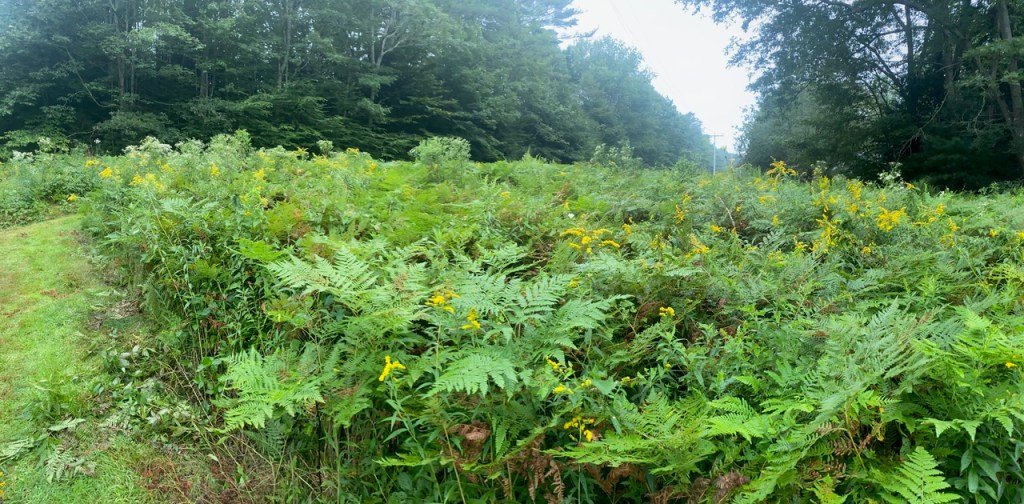
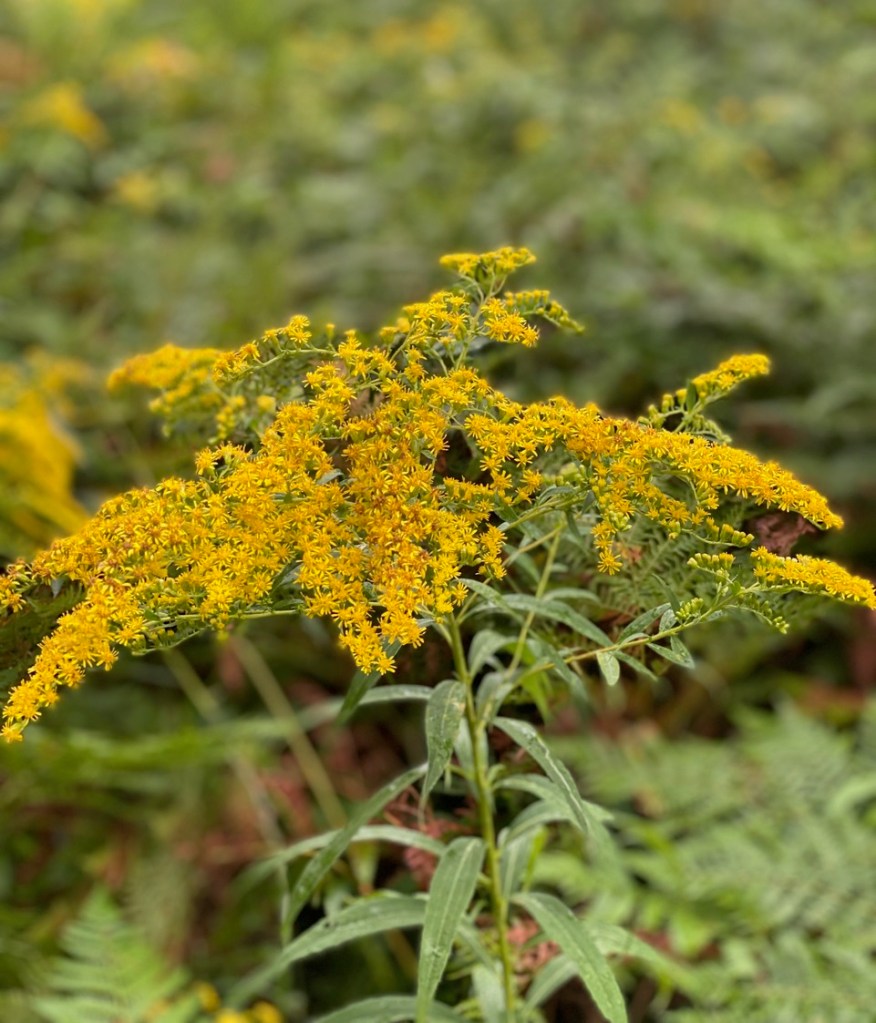
I’m walking the grass loop around our housing development. Under the power line toward the community garden, I pass through what is now a shoulder-high host of Queen Anne’s Lace, golden rod, milk weed, bracken, and many other plants I can’t name. The flies swarm. The sweet songs of the cardinals and tufted titmouses (titmice?) have given way to the screeching of blue jays and crows. Monarch butterflies flit from flower to flower. The air smells ripe. Shadows crawl like the incoming tide over the landscape. Summer is ending.
And I feel myself coming alive. Beginning again.
The reason is simple. For seventy-five years—as a student, as a teacher—the golden rod, the lengthening shadows, the Monarchs, have meant the beginning of another school year. More than New Year’s Eve, more than the first warm day of the year, this is the time when, at some deep cellular level, I can feel myself waking up, ready to start anew.
It’s a good feeling. At my age, it’s easier to focus on endings than beginnings. I now celebrate—if that’s the right word—more birthdays of the dead than of the living: my grandparents, my parents, my daughter, my first wife, close friends. Ended are my long hikes, long distant driving, lifting anything over forty pounds, staying up after midnight, jumping into bed with my wife after a sexy movie (jumping anywhere, for that matter), five-course meals, Cuban cigars, Laphroaig Scotch… the list grows longer each year.
But as T.S. Eliot wrote, “In the end is my beginning.” (Hey, I’m an old English lit teacher, I remember stuff like that.) You can’t begin something until something else ends. School can’t start until summer ends (Yeah, I know, there’s summer school, but I’m trying to make an analogy. Don’t confuse me with technicalities.) It took the end of a disastrous year of studying forestry in college for me to begin my studies in English (which is why I’m quoting T.S. Eliot and not The Journal of Forestry.) It took the end of an unhappy 20-year marriage for me to begin a happy going-on-forty-year one. It took the end of a career in public education for me to go back to school for an MFA, write a couple of books, a bunch of essays, and going on nine years’ worth of blog posts.
So, what will I begin this year? Well, Mary Lee and I have a couple of trips planned (knock on wood: last year, we had three planned and they were all canceled). I will scrape and repaint my front door and clean out the garage.
But the biggest change I want to make is with The Geriatric Pilgrim.
When I began these blogs, I was fascinated by the idea of pilgrimage: how a pilgrimage differs from a vacation, or from going on a retreat, or from study programs (what I called “edu-cations”). Besides traveling to retreat houses and other spiritual sites in the United States, Canada, the British Isles, Israel, Turkey, and Africa, I collected pages of definitions of pilgrimage and of common characteristics of pilgrimages. I read a raft of books about various pilgrimages people had made.
Along the way, I became intrigued by my fascination with pilgrims and pilgrimages. What was in it for me?
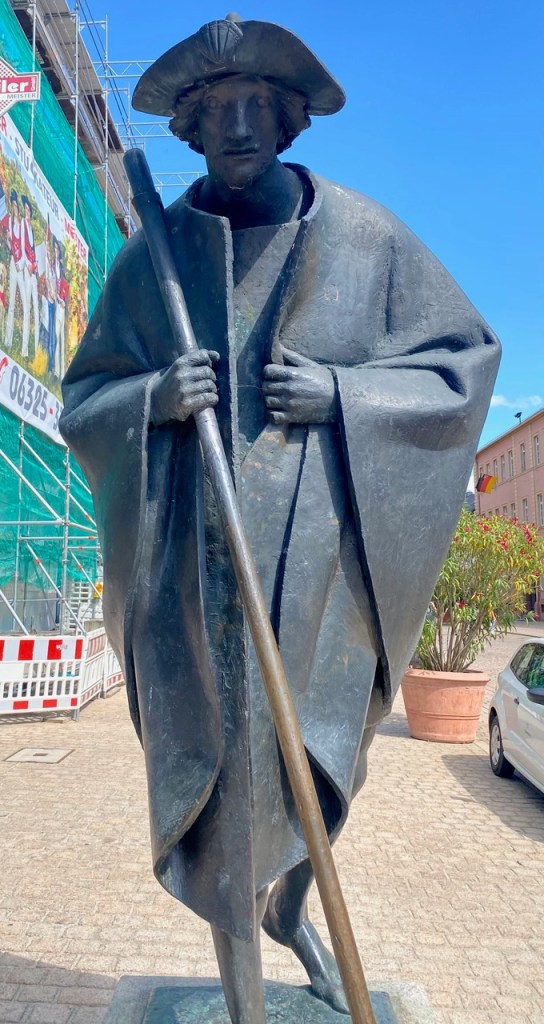
Well, probably the main thing at the time was the idea that pilgrims are often searching for a source of healing. As you know if you’ve read these blogs, I was looking for healing after the death of my eighteen-year-old daughter from a rare cancer. And I found writing about the various pilgrimages Mary Lee and I had made even more healing than the pilgrimages themselves.
Gradually, I began to realize that pilgrimage is a frame of mind—an attitude of curiosity, detachment, wonder. It’s “traveling light,” as one writer says, of risk, of living in liminal space—leaving one location but not yet arriving at another—of exploration, the end of which, to quote T.S. Eliot again, “Will be to arrive where we started/And know the place for the first time.”
Since COVID arrived, with all its restrictions on travel, followed by my 80th birthday, with its expanded waistline and diminished abilities, my blogs have focused more on applying the lessons of pilgrimage to my current life of walks in the neighboring woods, planting peas, tomatoes, and pumpkins in our community garden, and of exploring the twelve steps of my Al Anon program. This, too, has been healing.
But now I find myself no longer as interested in finding new ways to describe my pilgrimage, as I am in describing and exploring in more depth the landscape through which I’m traveling, a landscape that is always changing, sometimes in ways that please me—autumn color is just around the corner, the grandchildren are growing—sometimes in ways that piss me off or frighten me—the start of my favorite woods walk has been clear-cut, I’m finding it difficult to sing without coughing.
Writing about these joys and sorrows, I find I’m writing more poetry. I’ve just finished an on-line workshop for poets, and one of the highlights of my week is another on-line group of poets from all over the country, where we share our favorite poetry as well as poems we’ve written. I’m now subjecting my longtime writing group here in town to my poems.
So, I’m going to be posting more poetry here in these blogs as well as other experiments—prose poems, flash fiction and nonfiction—trying to look more closely at the physical and emotional landscapes through which I’m now traveling.
The way I see it, my pilgrimage continues, but the lens through which I’m seeing it and the voice in which I’m describing it is changing.
I’m excited to see where this journey will take me.
And hoping you’ll continue to join me.
So, let part of my life end, and another begin.
As Quakers say, when one door closes another opens.
For all my losses, I’ve also had wins;
let part of my life end and another begin.
Sure, it’s tempting to focus on what has been,
but I don’t want only to go through the motions.
Let part of my life end and another begin,
as one door closes and another opens.
# #


 The Geriatric Pilgrim: Traveling the Landscape of Faith and Grief