Beginning Again

#

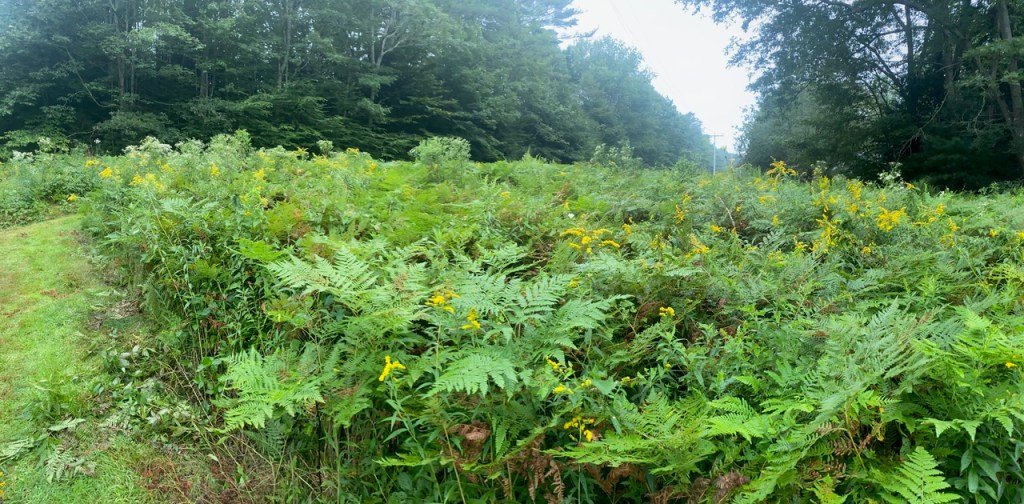
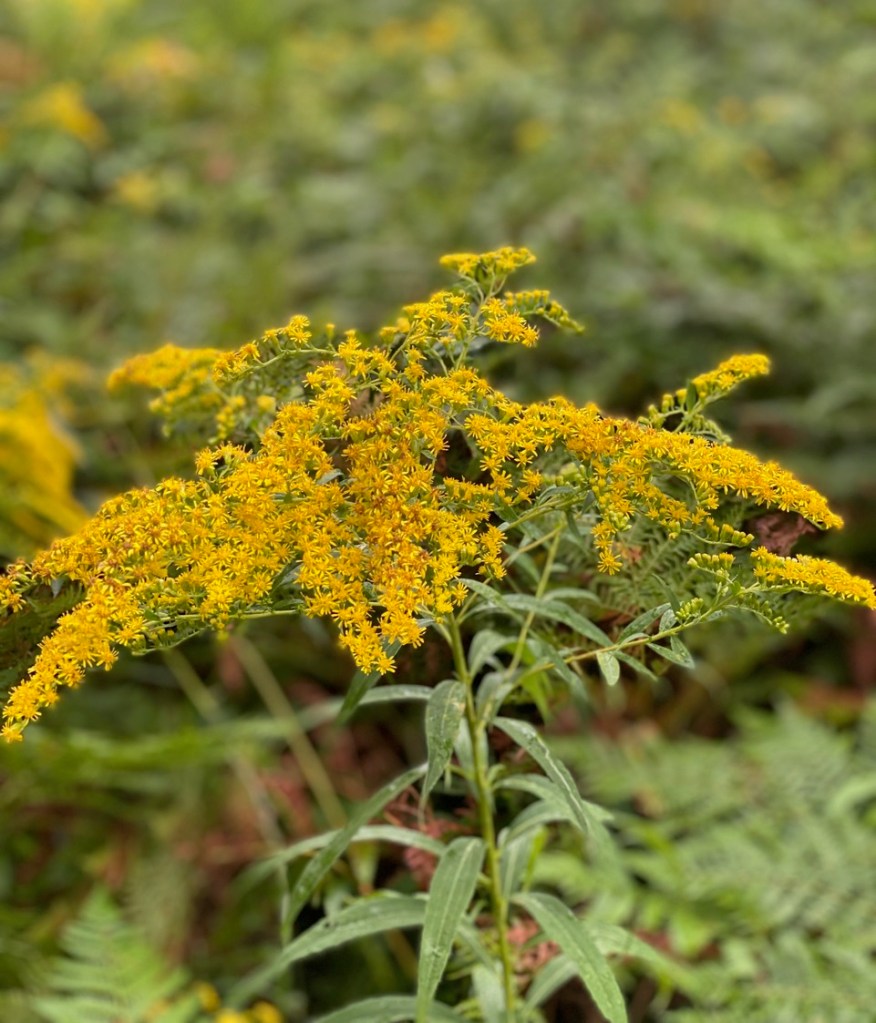
I’m walking the grass loop around our housing development. Under the power line toward the community garden, I pass through what is now a shoulder-high host of Queen Anne’s Lace, golden rod, milk weed, bracken, and many other plants I can’t name. The flies swarm. The sweet songs of the cardinals and tufted titmouses (titmice?) have given way to the screeching of blue jays and crows. Monarch butterflies flit from flower to flower. The air smells ripe. Shadows crawl like the incoming tide over the landscape. Summer is ending.

And I feel myself coming alive. Beginning again.

The reason is simple. For seventy-five years—as a student, as a teacher—the golden rod, the lengthening shadows, the Monarchs, have meant the beginning of another school year. More than New Year’s Eve, more than the first warm day of the year, this is the time when, at some deep cellular level, I can feel myself waking up, ready to start anew.

It’s a good feeling. At my age, it’s easier to focus on endings than beginnings. I now celebrate—if that’s the right word—more birthdays of the dead than of the living: my grandparents, my parents, my daughter, my first wife, close friends. Ended are my long hikes, long distant driving, lifting anything over forty pounds, staying up after midnight, jumping into bed with my wife after a sexy movie (jumping anywhere, for that matter), five-course meals, Cuban cigars, Laphroaig Scotch… the list grows longer each year.

But as T.S. Eliot wrote, “In the end is my beginning.” (Hey, I’m an old English lit teacher, I remember stuff like that.) You can’t begin something until something else ends. School can’t start until summer ends (Yeah, I know, there’s summer school, but I’m trying to make an analogy. Don’t confuse me with technicalities.) It took the end of a disastrous year of studying forestry in college for me to begin my studies in English (which is why I’m quoting T.S. Eliot and not The Journal of Forestry.) It took the end of an unhappy 20-year marriage for me to begin a happy going-on-forty-year one. It took the end of a career in public education for me to go back to school for an MFA, write a couple of books, a bunch of essays, and going on nine years’ worth of blog posts.

So, what will I begin this year? Well, Mary Lee and I have a couple of trips planned (knock on wood: last year, we had three planned and they were all canceled). I will scrape and repaint my front door and clean out the garage. 

But the biggest change I want to make is with The Geriatric Pilgrim

When I began these blogs, I was fascinated by the idea of pilgrimage: how a pilgrimage differs from a vacation, or from going on a retreat, or from study programs (what I called “edu-cations”). Besides traveling to retreat houses and other spiritual sites in the United States, Canada, the British Isles, Israel, Turkey, and Africa, I collected pages of definitions of pilgrimage and of common characteristics of pilgrimages. I read a raft of books about various pilgrimages people had made.

Along the way, I became intrigued by my fascination with pilgrims and pilgrimages. What was in it for me?

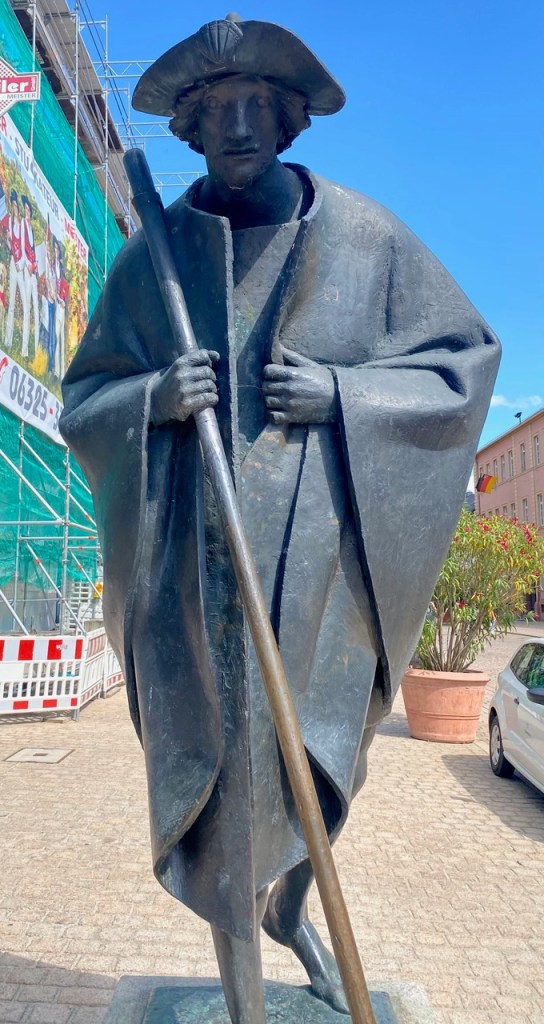
Stature of a “Jakobspilger,” or St. James’s pilgrim: Speyer, Germany

Well, probably the main thing at the time was the idea that pilgrims are often searching for a source of healing. As you know if you’ve read these blogs, I was looking for healing after the death of my eighteen-year-old daughter from a rare cancer. And I found writing about the various pilgrimages Mary Lee and I had made even more healing than the pilgrimages themselves.

Gradually, I began to realize that pilgrimage is a frame of mind—an attitude of curiosity, detachment, wonder. It’s “traveling light,” as one writer says, of risk, of living in liminal space—leaving one location but not yet arriving at another—of exploration, the end of which, to quote T.S. Eliot again, “Will be to arrive where we started/And know the place for the first time.”

Since COVID arrived, with all its restrictions on travel, followed by my 80th birthday, with its expanded waistline and diminished abilities, my blogs have focused more on applying the lessons of pilgrimage to my current life of walks in the neighboring woods, planting peas, tomatoes, and pumpkins in our community garden, and of exploring the twelve steps of my Al Anon program. This, too, has been healing.

 But now I find myself no longer as interested in finding new ways to describe my pilgrimage, as I am in describing and exploring in more depth the landscape through which I’m traveling, a landscape that is always changing, sometimes in ways that please me—autumn color is just around the corner, the grandchildren are growing—sometimes in ways that piss me off or frighten me—the start of my favorite woods walk has been clear-cut, I’m finding it difficult to sing without coughing.

Writing about these joys and sorrows, I find I’m writing more poetry. I’ve just finished an on-line workshop for poets, and one of the highlights of my week is another on-line group of poets from all over the country, where we share our favorite poetry as well as poems we’ve written. I’m now subjecting my longtime writing group here in town to my poems.

So, I’m going to be posting more poetry here in these blogs as well as other experiments—prose poems, flash fiction and nonfiction—trying to look more closely at the physical and emotional landscapes through which I’m now traveling.

The way I see it, my pilgrimage continues, but the lens through which I’m seeing it and the voice in which I’m describing it is changing.

I’m excited to see where this journey will take me. 

And hoping you’ll continue to join me.

So, let part of my life end, and another begin.

As Quakers say, when one door closes another opens.

For all my losses, I’ve also had wins;

let part of my life end and another begin.

Sure, it’s tempting to focus on what has been,

but I don’t want only to go through the motions.

Let part of my life end and another begin,

as one door closes and another opens.

# #

Another G… D…. Learning Experience

Henry Fonda as Norman Thayer lost in the woods behind his house.

#

It started when I left my phone behind. 

I’ve always known that my phone provides many of the same comforts cigarettes used to. My phone fits easily into my pocket so it’s handy. It gives me something to do with my hands if I’m nervous or bored. If I’m waiting for someone, I can check on how the Red Sox did, or when I need to use a bathroom, I can do something besides look out the window, assuming there is a window, and if there isn’t, I don’t care because I’m checking my email on my phone. 

But until now I’ve never realized how, like cigarettes, psychologically addictive a phone can be. All that weekend, I felt tense, anxious.

Now, the reason I suffered for an entire weekend was that Mary Lee and I spent it in Vermont celebrating my sister-in-law Anne’s birthday. I couldn’t very well say, “I left my phone in our bedroom. Would you excuse me while I drive four hours back home so I can see how many ‘likes’ my last post got on Facebook?”

And for those of you who don’t live in New England, the reason it takes four hours to go 160 miles, as the crow flies, from Maine to Vermont is that you can’t go by crow. The most direct route cuts through western Maine and central New Hampshire—a narrow two-lane road through small towns and past lakes and cabins and antique shops and combination hardware stores/greenhouses/ice cream parlors—and takes two hours longer than the quickest route which is to first drive south for 85 miles then west for 31 miles, then north for 69 miles, then west again until you get lost. 

 And you will get lost, because while the first 185 miles are doable if your car has a GPS and you follow the signs, once you get to Vermont, you’re driving through small towns and along one lane dirt roads through mountains that baffle even the best GPS systems. At least, you do if you want to get to my sister-in-law’s place.

View from Anne’s porch.

But although I left my phone behind and got lost for a bit that weekend, I remained reasonably calm. It was a nice day and Vermont was beautiful. As I often do (hence these blogs) I tried to think of the trip as a pilgrimage, this one honoring my past. I lived in Vermont for four years and my first teaching job was actually in the town just down the mountain from Anne’s. The wide, shallow streams paralleling the roads, the cow pastures under the green hills, the sweeping vistas were worth dead ending in a driveway. Especially when the nice lady there gave us directions to Anne’s, saying, “You couldn’t follow the damn GPS even if it worked… not unless you have a Humvee and a chainsaw.”

Still, while we had a lovely weekend celebrating my sister-in-law’s birthday, the anxiety of smart phone withdrawal grew. It was like I wasn’t me anymore—a feeling that metastasized when I tried show Mary Lee the first apartment I ever lived in. It was as if someone had moved the street to a completely different part of town. 

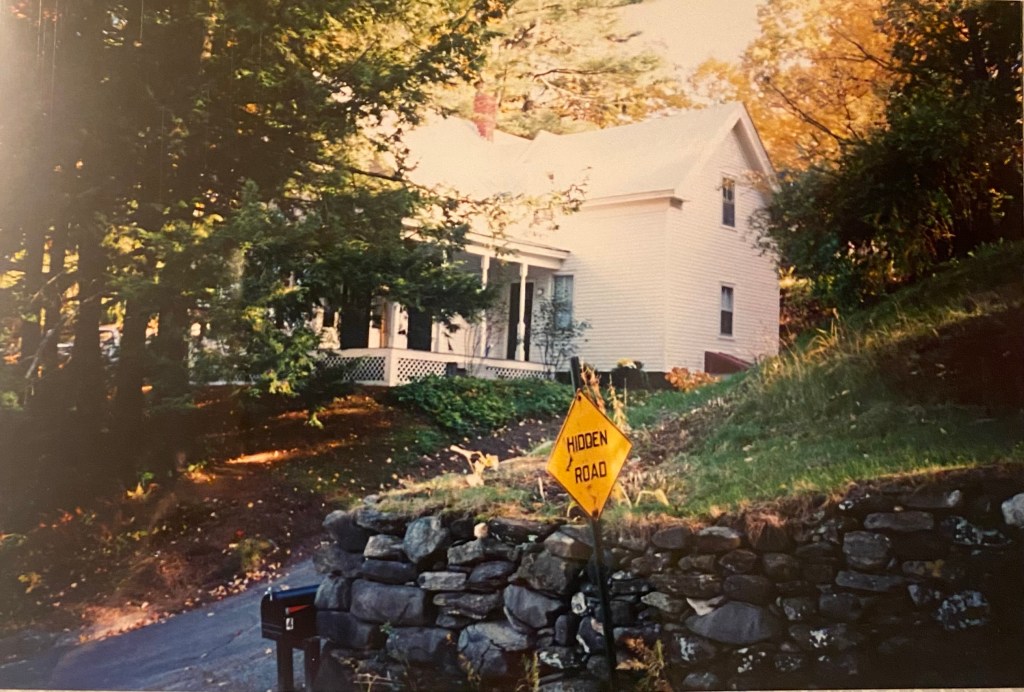
It certainly was hidden. (I lived on the second floor.)

By the time we headed back to Maine, I was feeling unhinged and uncertain. To regain my manly sense of mastery (at least that’s the only reason I can think of) I decided I didn’t need any help from any GPS getting from Anne’s to the paved road to the interstate to the Maine Turnpike to home, thank you very much.

Setting the car radio on “50’s Gold,” I drove south on the interstate, missing the exit for New Hampshire and Maine, and continuing for another ten miles before I turned around and headed north. After an hour of ignoring Mary Lee’s suggestion that it might be time to find out where we were, I pulled off the interstate and plugged our home address into the GPS, which informed us that we were almost fifty miles north of where we should be. Surrendering to that damn voice (which I swear was snickering)— “In one half-mile, prepare to turn left… turn left in 100 yards…turn left”—we eventually came to that cow path I talked about earlier through New Hampshire and Maine, the one that got us home two hours later than we would have if I’d used the GPS the way I should have. By that time, my hands were shaking, my stomach was in knots, and my head was pounding. Even the familiar roads near home looked strange and forbidding. 

At one point on that interminable drive home, we drove by Squam Lake, where the movie On Golden Pond was filmed, and since then, I’ve been thinking about Henry Fonda’s 80-year-old character getting lost picking strawberries in a place he’d been going to for years, stumbling through the forest, become more and more disoriented, more and more frightened. 

And I ask myself: Is that who I’m becoming?

I’m trying not to panic. I tell myself that as I’ve become 80, I’ve been focused on my physical diminishments, and maybe God of my not Understanding is telling me it’s time to prepare for the mental changes ahead—that I should think of that weekend as—to use a 12-step term—another “Goddamned learning experience.”

I’ve just read David Shields’s book, The Thing About Life is That One Day You’ll Be Dead. Normal geriatrics, he says, don’t have poorer memories, but it does take us longer to retrieve those memories. We’re more susceptible to distractions, have trouble coordinating multiple tasks, and suffer decreased attention spans. In simple duties and common situations, we’re fine, but when stress is added (loss of a smart phone, for example) we often struggle. “Perhaps,” Shields writes, “this is why some older people, finding it harder to cope, tend to start searching for comfort rather than excitement.”

I’m tempted, but I’m not ready. Instead, I’m going to send my ego to the store for a quart of milk and do what Mary Lee does and make a checklist for when I travel: 

Underwear?    Check. 

Pills?               Check.

Phone?            Check. 

And at the top of the list, I’m going to write: 

Don’t assume you know where you’re going. 

Ask for help.

Actually, that sounds like pretty good advice for any pilgrimage.

# #

Physical Therapies

PT After Heart Surgery

#

A few weeks ago, after seeing a doctor about increased soreness in her knee, my wife Mary Lee began a new regimen of physical therapy: quad stretches, hamstring stretches, mini squats, wall sits, looped elastic band hip extensions. These to go with exercises she’s been doing for years to restore movement to her right shoulder. (I like the one where her hands look like frightened spiders scampering up the wall, and another one where she uses a can of Great Northern beans.)

Because I’ve been doing various daily exercises since back surgery in 1977, mornings at the Wile residence resound with creaking bones, tendons rubbing on cartilage, occasional grunts punctuated by yawns and a “meow” or two from our cat, who has taken on the role of personal trainer.

“Faster! Move it, move it!”

Our bedroom looks a bit like Rick’s Sporting Goods, with two sizes of exercise mats, two sizes of weights (in addition to the can of beans), rubber stretch bands, and folding chairs. A treadmill resides in the guest bedroom across the hall. 

Physical therapy after my back fusion was deceptively simple: walk ten miles a day for three months. Every day. Sun, rain, snow, sleet, hail. And since I was operated on at the end of December, I walked through it all. Sometimes in the same day. But you know, I grew to love those walks (Well, Route One got a little boring but at least it was clear after a snowstorm), and I kept walking—maybe not ten miles every day, but often five or six. 

Twenty years later, after bi-lateral hip surgery, my physical therapy involved water exercises; walking back and forth for 30-45 minutes in the shallow end of a pool, pool dumb bells, and gloves that made me look and feel like Aqua-Man. But it worked. On a trip to Florida to visit my parents over school vacation, two months after the surgery, Mary Lee pushed me through Newark Airport in a wheelchair to get to our connecting flight. On our return a week later, after spending most of my time walking the swimming pool, I strode through the same airport feeling like Hercules Unchained. 

That led to yoga, tai-chi, back to walking, this time with my hiking poles that I named Waldo & Henry (To learn why, go to https://geriatricpilgrim.com/2020/02/07/waldo-and-henry/), which led to the hikes and pilgrimages that became the blog you’re reading.

Flash ahead another twenty years: open heart surgery, and more physical therapy at a rehabilitation center, where three times a week for six weeks, I taped on my heart monitor, rode a stationary bike, walked a treadmill, and lifted weights. When the program ended, I bought the treadmill that sits in the guest bedroom (great for watching TED talks, but I still miss those cute nurses at ReHab) and the weights that I use instead of cans of Great Northern Beans.

I don’t do the Kettlebell Squat Swings

But I’m falling apart more quickly these days. Over the last two years I’ve added breathing exercises to help my “moderate” COPD, more stretches to help with the bursitis that seems to have camped out next to both my bionic hips, daily exercises at the computer to ward off Carpel Tunnel and something called Ulna Nerve Entrapment, and weekly sessions with a Feldenkrais instructor.

As Thomas Jefferson said, the price of freedom is eternal vigilance. Or in the words of my old PCP, move it or lose it.

#

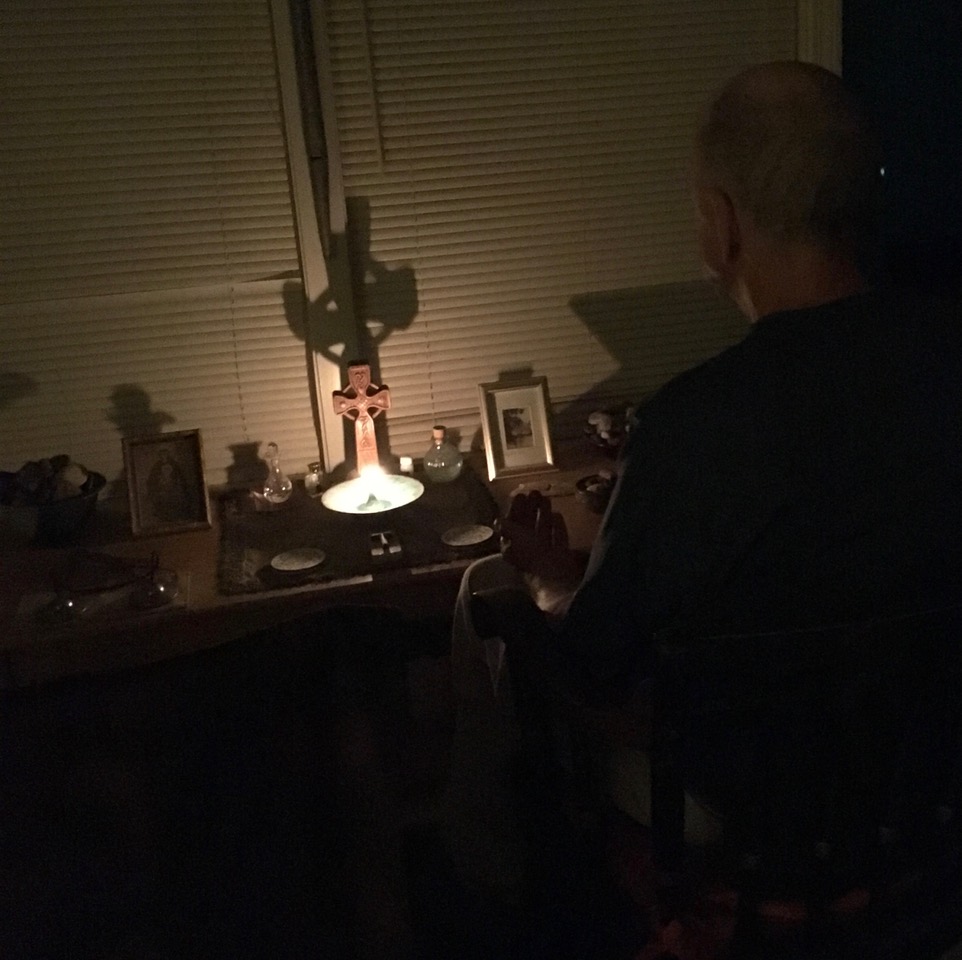
Before Mary Lee and I begin our morning grunting, stretching, creaking, and moaning, we sit in contemplative prayer for twenty minutes, a practice I’ve maintained since my daughter died 35 years ago, when, after raging at God for several years, I decided I needed to listen to what God had to say back. This listening—with my whole body, with all my senses—is what I continue to try to do. As I think about it, this, too, is a kind of physical therapy. 

Starting the day

I’m reading a lot these days about quantum physics and spirituality. As I understand it, quantum physics posits that the universe is conscious, if by “conscious,” one means a system that can communicate or process information and then use this information to organize itself (which is what all those protons, neutrons, and electrons that make up the atoms that make up all matter do). So, mind and body aren’t two separate things but rather two aspects of the same cosmic material. 

Modern writers about spirituality, such as Richard Rohr, Diana Butler Bass, Phillip Clayton, and Ilia Delio, seem to me to propose that this cosmic material, this “consciousness” that resides within me as well as around me, is the incarnational presence of God. So that in meditation, I am trying, as I am when I do my stretches and lift my weights, to reestablish pathways, strengthen relationship with what 12-steppers call a Higher Power. 

Besides meditation, I do other exercises to strengthen my spiritual muscles. My Feldenkrais sessions, focusing on integrating eyes, head, shoulders, ribs, pelvis, legs, and feet to facilitate ease of movement, remind me that one of the great spiritual lessons is that everything is connected. And that my job—my “exercise,” if you will—is to recognize and facilitate these connections.(And for more about the importance of connecting, go to https://geriatricpilgrim.com/2024/02/01/connecting-the-dots/)

One of my character defects that keeps me from connecting is trying to control everything and everybody. So, at the suggestion of my Al Anon sponsor, I’ve been taking Waldo and Henry for walks without having a destination. When I first started doing this, I felt lost. I walked in circles. But as I persisted, I discovered roads in the neighborhood and paths in the woods I’d never noticed before. Which is leading me to try to approach other activities, such as meetings, book readings, and potential confrontations with family and acquaintances with the same curiosity, trying to surrender presumptions, looking for the sacred in situations I’ve always avoided and spiritual teachers in people I’ve always disliked.

Probably more than anything else, it’s the physical act of writing which connects me with the Sacred. The only way I can even begin to understand concepts such as quantum physics and the ideas of those spiritual writers I’ve mentioned is to first put the ideas down in my own words on a yellow legal pad with my bold-ink pen. I can write second/ third/ fourth/ ad infinitum drafts of my blogs on a computer. I can edit on a computer. But first I need to work those pen and paper muscles.

Of course, the ultimate integration of mind and body (and what I’ve been working my pen and paper muscles on for the last eight-plus years) is the pilgrimage. Last week, a friend sent me a recent article in The Guardian about the increasing numbers of people making pilgrimages. (In the early 1980s, for example, the number of people who walked the Camino de Santiago—the most famous of all pilgrimages—was in the low hundreds; last year, the number was 446,000.) I’m delighted that people are finding that this combination of physical and spiritual activity can be healthy, healing, and holy.

It sure is for me.

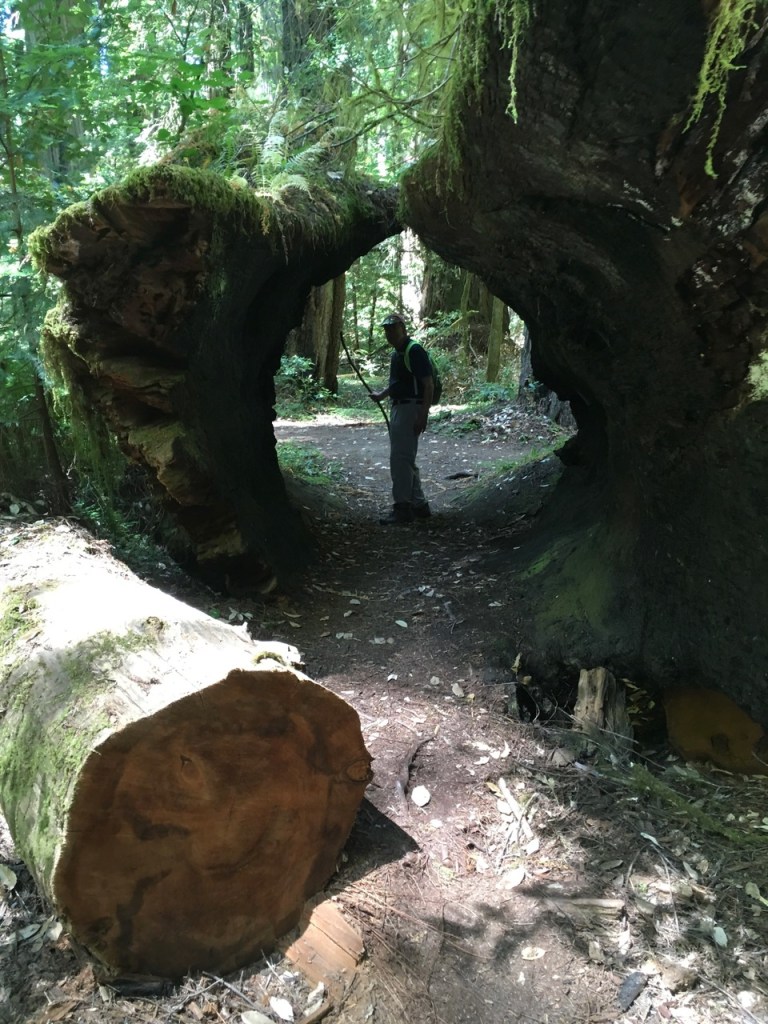
In a California red wood forest

# #

Ice

#

Last Palm Sunday, Mary Lee and I were supposed to begin a two-week retreat at a monastery in the hills of California. We’ve been going on retreats now for thirty years and I was eagerly looking forward to having more silence, being more aware of the world, doing more reading (I’m on a Buddhist kick right now), drawing closer to God of my not Understanding. Then, two weeks before we were supposed to fly to San Francisco, we received word rockslides had closed the roads, and that the monastery won’t open again until at least May. 

So instead of flying across the country on Palm Sunday, we spent the day encased in ice.

The previous evening, thanks to a day of snow changing to freezing rain, we lost power. That Sunday, we cooked oatmeal on top of our gas stove and wrapped in blankets in front of our gas fireplace. While the ice bent the trees and bushes lower and lower, Mary Lee and I read the Palm Sunday service from the Book of Common Prayer, wondering, along with the Psalmist, “My God, my God, why have you forsaken me.” 

For the next day and a half, we ate beans and rice, read, played Scrabble and cribbage, drove around the neighborhood to charge our phones, and finally gave in and stood in line at a restaurant in another town for breakfast. 

All in all, it wasn’t bad. Still, it’s hard for me to find much nice to say about ice. 

I like ice cubes in my water. I use ice packs to help the bursitis in my hips. Some ice sculptures are pretty. I’m glad to have a freezer in my refrigerator to preserve food. But that’s about it. When I used to go skating, I’d divide my time between flailing my arms to keep from falling and lying prone on the ice when I did. The one time I went ice fishing, I was days warming up.

Ice has all kinds of nasty connotations. It can mean frigid, as in sexually inadequate. It can mean unfriendly, reserved, aloof, rigid, inflexible. Fear sends icy chills down our spines. We hear about the icy fingers of death.

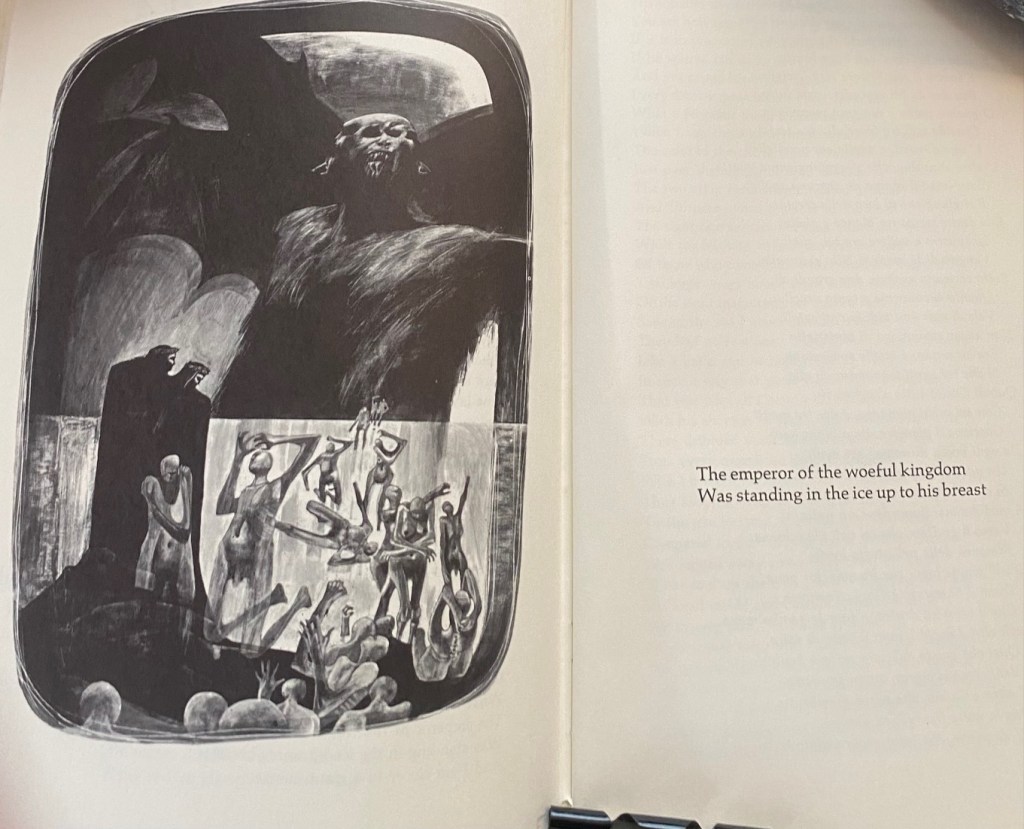
Speaking of death, while Hell (which is where some of my Fundamentalist friends tell me I’m going to go when I die) is usually pictured as a place of fire and brimstone, in Dante’s Inferno, the center of Hell is a vast lake of ice, in which Satan, along with sinners who committed treason and betrayal—such as Brutus, Cassius, and Judas—is incased.

from Dante’s The Divine Comedy, I Hell, translated by Louis Biancolli, 1966

Makes sense to me. Ice is cold. Ice is heavy. (The reason we lost electricity was because ice-laden trees fell on power lines). Ice prohibits movement. During the most hellish part of my life, after my daughter died, I couldn’t get warm. I felt as if I were carrying a 20 cubic foot freezer on my shoulders. My body was rigid and tense. Only after I’d had two or three large tumblers of scotch did I feel as if I were thawing. 

And yet. For someone who dislikes ice, I realize that one of my tendencies is to want to freeze experiences and beliefs, preserve them the way we preserve meat and vegetables. 

After those hellish first years when Laurie died, my life began to get better. I thought I was learning to live with loss. But five years later, at this time of year, it was as if my daughter has died all over again. I plunged back into rage and tears. I spent evenings drinking my tumblers of scotch (or maybe it was Wild Turkey 101 proof, at this point), going through old photograph albums of the two of us and listening to Laurie’s old tapes of Tracy Chapman and the Grateful Dead. The only difference was that those I was most angry with were people who talked about their own grief. I remember being at a retreat at a monastery in Cambridge, Massachusetts where a woman talked about almost losing her son in an automobile accident. A spasm of rage surged though me. I thought, What are you moaning about? He’s alive, isn’t he?

Then on Easter Sunday after this retreat, I heard a sermon based on the Gospel of Mark’s account of the Resurrection, which, unlike the other gospels, ends with Mary Magdalene, Mary the mother of James, and Salome, fleeing from the empty tomb, “for terror and amazement had seized them; and they said nothing to anyone, for they were afraid.”

Why fear, asked the preacher. Well, there might have been a lot of reasons—fear of soldiers, fear of grave robbers—but he also wondered if it wasn’t human nature to fear the unknown, to become used to, even comfortable with, our lives even if they’re full of pain and suffering. We prefer what we do know to what we don’t.

And I realized that over the years since Laurie’s death, I had grown comfortable with my image of myself as GRIEVING PARENT; I had made Laurie’s death MY STORY, trying to preserve memories of her, as in the old photograph albums I’d been perusing. And if anyone else had a similar story, I felt threatened. 

In other words, I was trying to freeze my sense of myself and Laurie rather than let them evolve, flow. I wasn’t angry about the death of my daughter, I was angry at the possible death of my grief, thinking it was grief that was keeping me close to her. 

That Sunday afternoon, sitting in Harvard Square amidst cigarette butts and pigeons, looking up at the sycamores and the brick buildings, listening to voices babbling in a half-dozen languages, I tried to focus on my daughter in the present moment. I don’t know where you are, Kid, I remember praying, but at some level I know you’re fine, and I want you to know that I love you.

And the sights and smells and noises of the Square seemed to fade and I felt a hand on my shoulder, and I knew it was Laurie’s.

I don’t care whether that hand was from another dimension or from my imagination. What I do know is that the great spiritual traditions are right: love transcends death. That is, if you don’t try to freeze it like leftover meatloaf.

But I’m still learning. Working a 12-Step Program, I’ve discovered traits that I developed to survive growing up in an alcoholic family—judgmentalism, people-pleasing, perfectionism—traits which no longer serve me, but have, in essence, remained frozen, damaging my relationships with others.

And I’m wondering if I may be trying to freeze my retreat experiences, and that Life, the Universe, or God of my not Understanding isn’t telling me by having this retreat in California canceled that I need to let the retreat experience—the silence, the awareness, the reading, the closeness to God— flow into my everyday life, here at home, even in the middle of an ice storm.

#

13 Ways of Looking at a Door

1

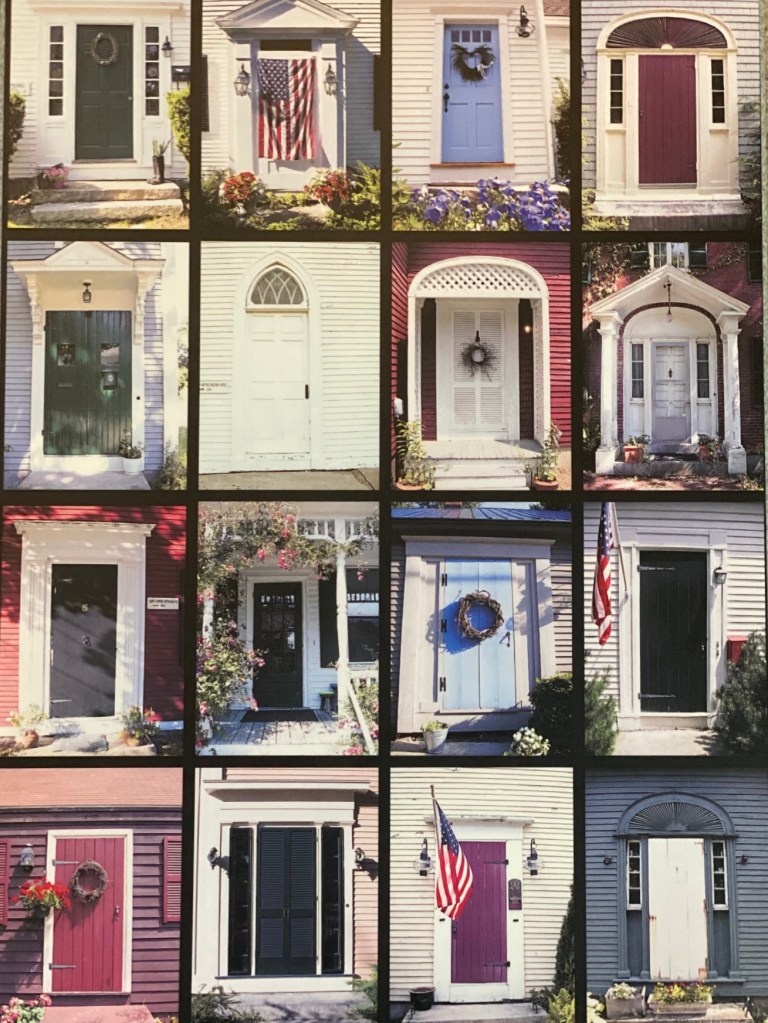
For Christmas one year, Mary Lee gave me a wooden wall hanging called “Doors of Yarmouth,” to remind me of the Maine town in which I lived for so many years. These are doors to old houses that have had careful tending (not to mention extensive and expensive remodeling). The doors come in a variety of colors. Most feature types of cross—sometimes called Christian—paneling. Three are plain wood with long hinges and latches. There are a couple of double doors and one shutter door. Some doors have glass windows, others are framed by small windows, shutters, cornices, lattice work, or flower vines. There’s a gothic arch over one door, a wooden fan over another, and several Greek canopies held up by pillars. All in all, they reveal how Yarmouth has changed from the working-class community I grew up in to the suburbia by the sea it is today. 

2

A little research on the web tells me that doors were conceived in ancient Egypt around 3000 B.C.E. but another site says that archeologists in Zurich Switzerland discovered an oak door possibly dating to 3063 B.C.E. Long before that, at least according to the Bible, Noah put a door in the ark. One assumes a pretty big one. (I’m curious how it opened and closed.)

3

 From the beginning, doors have had more than the utilitarian purpose of protection from nasty weather or people. They’ve identified the occupations of those living in the dwelling and served as marks of power and status. According to the Bible, when King Solomon built his great temple to show God’s power and prestige, he made doors of olivewood, covered with carvings of cherubim, palm trees, and open flowers, which he overlaid with gold. While technically not a door, I suppose, novelist Stephen King’s two iconic wrought-iron gates embellished with bats, a three-headed dragon and spider-like motifs have become a pilgrimage destination for King fans from all over the world.

4

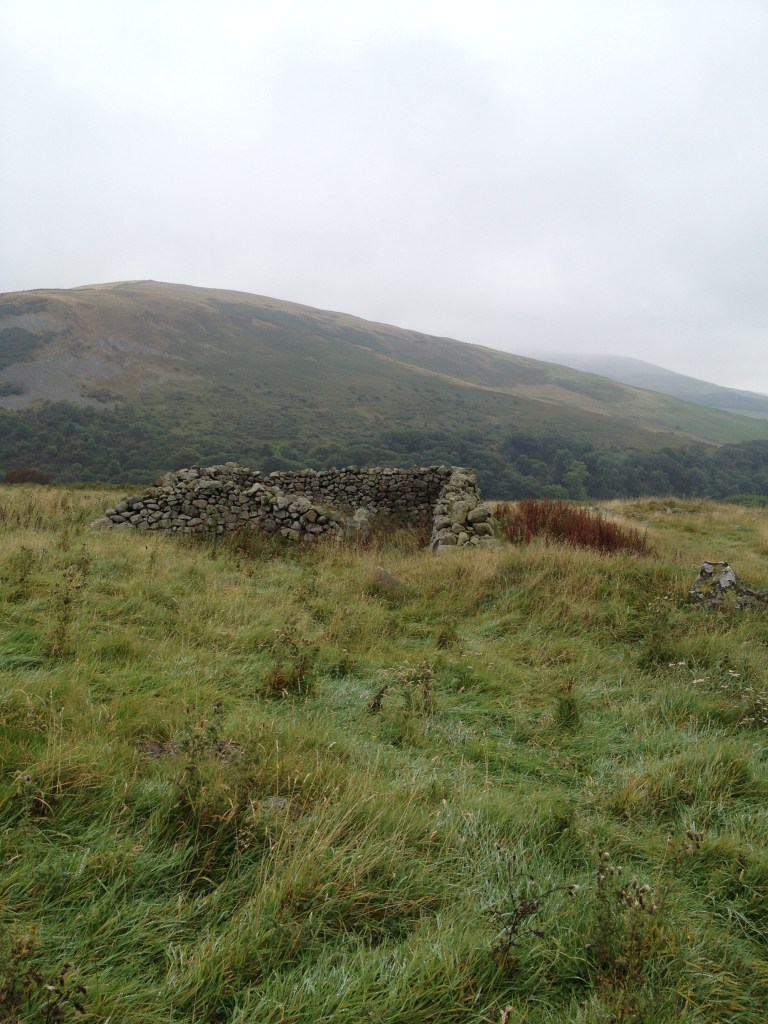
Speaking of pilgrimages, when Mary Lee and I were walking St. Cuthbert’s Way between Scotland and England, we passed a sheepfold, a circular wall of stones with an entrance, which for centuries, served as a place for shepherds to herd sheep at night for protection against predators such as wolves. To keep the sheep in and the wolves out, the shepherd would lie down across the entrance, becoming, as it were, a human door. 

5

Jesus uses this image of the shepherd protecting his flock by becoming a door when he refers to himself as “the gate,” who “lays down his life for the sheep.” Which may be why cross or Christian paneled doors are so prevalent in New England (all the units in our Housing Development have them, inside and out). When my wife Mary Lee—who is a Deacon in the Episcopal Church and a lover of icons—was teaching the in a local high school, she wanted to put up an icon in her classroom but realized it wouldn’t be appropriate in a public school, so she hung a large print of a door on her back wall where she could see it when she taught. It was a great comfort, especially with certain classes. 

6

 Besides Jesus, the Bible refers to other kinds of gatekeepers: those appointed to control who came and left the city through the gates. Thus, the term “gatekeeper” has come to mean a person who controls access, someone in authority who acts as an arbiter of quality or legitimacy, or someone who blocks you from speaking with a decision-maker. Gatekeepers access who is “in” or “out.” I’ve had a few of those in my life, athletic coaches, teachers, whom I’ve had to please in order to succeed. I suppose, as a teacher myself, I’ve also been a gatekeeper. 

7

I’ve also let others become gatekeepers, to whom I gave away authority, surrendered, as it were, the keys to doors I could have opened for myself. Growing up in an alcoholic family once limited my choices when I faced a decision to “What will the neighbors think?” to quote my mother. Through working an Al Anon program and learning to put the focus on me instead of on the me I thought you thought I was, I’ve found keys to open doors I never knew existed.

8

Some of those early Egyptian doors symbolized entrance to the afterlife. Doors can represent transition, confinement, new opportunities. Doors can be metaphors for the choices we make. We learn early on in life that we can walk through some doors and not others. As a WASP male, I know that I have more doors available to me than women, people of color, people of other religions. My destiny has been shaped by the doors I’ve walked through.

9

Or doors that have closed behind me. For a while, Mary Lee volunteered as a chaplain at the local prison. One Christmas, I helped her with a service. My clearest memory is of going through a series of doors and hearing the loud, definitive clang as each door closed behind me. I’ve had a few of those definitive door closings in my life: the death of my daughter, a divorce decree, a couple of retirement parties. Most of the time, however, I find that doors close behind me without my noticing. One reason I took early retirement from teaching high school English was that I saw too many colleagues still standing in front of their classes, even though, emotionally, they’d shut the door on their students years earlier. One of the things I dislike about the geriatric life is that doors keep silently closing, until suddenly I realize, I can’t do this anymore! Can’t climb that mountain, can’t reach that note, can’t eat that food, can’t…

10

On the other hand: My Quaker friends say that sometimes a door needs to close before another can open. That’s certainly been the case with me. I had to close the door on a forest management program before I could open the door to what’s been for me a fulfilling teaching career. I had to retire from public education before I started writing. After my daughter died, I had to lose every image of God I’d ever had before I encountered the Grace of God of my not Understanding.  

11

In late 1960’s, I listened to a rock group, The Doors, who named themselves after the title of Aldous Huxley’s book, The Doors of Perception, in which he reflects on his psychedelic experiences. Huxley himself had based his title on a line in English poet William Blake’s The Marriage of Heaven and Hell: “If the doors of perception were cleansed, everything would appear to man as it is: infinite.”

12

These days I’m trying to clean the doors of my perception through contemplative practices such as meditation, going on more retreats, walking meditation, contemplative reading, sessions with my Feldenkrais teacher, journaling, music, working on my listening, writing these blogs, and of course, making more pilgrimages, even if they’re only to the compost pile. 

13

And I’m not done opening new doors. I’m hoping I have a few longer trips left ahead of me. Speaking of trips, I note that interest in psychedelic drugs is again increasing, thanks to books like Michael Pollen’s book How to Change your Mind.Indeed, I have a 92-year-old friend who’s seriously considering a guided psychedelic experience. That’s another possible door. 

And, of course, there’s the Big Door ahead of me. That, too, will be quite a trip, I suspect. 

#

Connecting the Dots

“Only connect.”—E.M. Forster

#

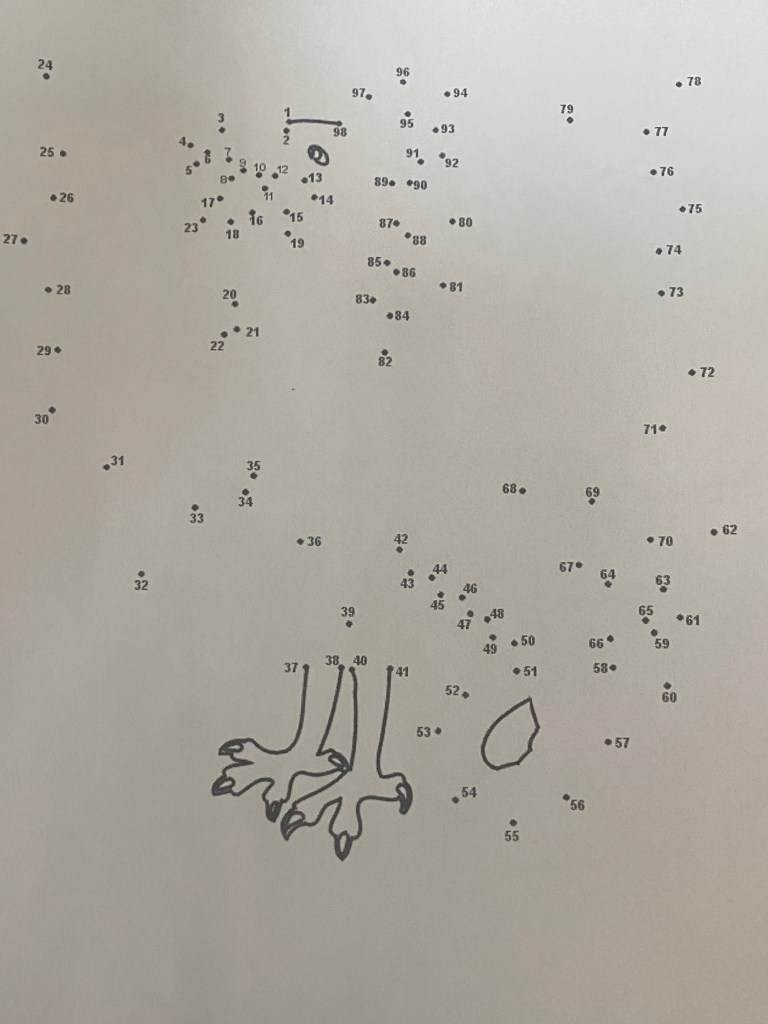
As a kid, some three-quarters of a century ago, I loved to “Follow the Dots.” You know, those puzzles where at first, you see nothing but a confusing morass of tiny spots, like black ants on the page, but if you connect these dots by the numbers, a cat or dog or giraffe or flower appears, as if by magic. Then, you can color it and have a lovely picture. (Or at least Mom said mine was lovely.)

And I still love following and connecting dots. It’s one reason I love poetry and admire those writers who draw connections I’ve never seen before. Everything I read about physics and the discoveries about our universe, everything I read about spirituality, everything I’ve learned about health, all say that everything is connected; what we need to do is connect the dots. 

“Connection is why we’re here,” says researcher/storyteller Brene Brown in a TED talk I recently watched. Then Brown went on to talk about our problems with connecting, problems caused by our fear of appearing vulnerable, our need for control and certainty, and most important, our shame. Because we don’t feel we’re worthy of connecting with others, we don’t try.

Well, that made me sit up and take notice. I’ve often said that shame has been the driving force of my life. Thanks to almost a dozen years working my Al Anon program, I’ve learned shame is part of growing up in a family riddled with generations of alcoholism, along with burying feelings, fearing confrontation, learning to hide behind personas, perfectionism, judgmentalism, and people-pleasing. Twelve-step literature calls these traits “character defects.” I think of them as survival mechanisms. Either way, they’ve kept me from connecting to other people. 

As Marie Howe’s writes in her poem “The Affliction”:

When I walked across a room I saw myself walking

as if I were someone else,

as if I were in a movie.

It’s what I thought you saw when you looked at me.

So when I looked at you, I didn’t see you

I saw the me I thought you saw, as if I were someone else.

This was (and can still be) me, walking into a room, convinced everyone is staring at me, first in judgment, then in disdain. I’ll run my tongue over my teeth to make sure there’s nothing stuck between them, check my fly to see if it’s zipped. Still, I’m sure people are deriding me for being the failure I know I am.

At no time was this truer than after I became a high school English teacher. Every time a student laughed, or whispered, or stared at me, I was convinced I was the subject of their ridicule. (And finding out I was known as Wiley Coyote didn’t help.)

So I created the persona of MRWILE. During the ever-more-casual 1970s, I dressed in flashy sport coats, bell-bottoms, with matching ties and pocket handkerchiefs. I spent weekends in my classroom changing bulletin boards, papering the walls with posters, and growing geraniums and begonias on the windowsills. At school, I used sarcasm and difficult reading assignments to control behavior, while at home I filled the margins of student essays with correction symbols and caustic comments—“Huh?” “What on earth does this mean?” 

Outside of school I attempted to encase myself in the same veneer of respectability. I smoked a pipe. I bought a white cape cod house with green shutters in a housing development. I put up a white picket fence and planted rose bushes. I joined the church choir, the church Board of Deacons, and the Rotary Club.

MRWILE

While MRWILE helped me gain some of the respect I craved, this persona killed my first marriage and almost killed me. I was never home, and when I was, I was never present. I began waking in the night, sweating, and panting for breath, suffocating, after nightmares of being tarred and feathered and ridden out of town on a rail.

What saved me was THE LIGHTBULB.

As I recall, I was teaching a class about a particular piece of literature. (Maybe a Shakespearean sonnet?) So that my students could understand the imagery, I was trying to connect the poet’s situation to theirs. Suddenly, I saw a face light up in understanding, as if I’d flipped a switch in the kid’s head. I remember feeling a corresponding charge, a release, that I’ve since said, felt right up there with sex. 

I’m serious. In that moment, and in the other moments since then that have kept me teaching long after I threw out the ties and matching pocket handkerchiefs, when I taught everyone from thirteen-year-olds with learning disabilities to students with combined College Board scores of 1600 to college seniors working on honors theses to homeless veterans with PTSD to Al Anon sponsees, as in sex, I’ve somehow connected with someone at a deeper level—a reciprocal give and take that goes far beyond “Oh, aren’t I a wonderful teacher!” Both teaching and sex have been means by which I have experienced real—maybe “pure” is a better word—relationship. 

If you don’t get this, I understand (when I talk about how exciting teaching can be, some people look at me as if I were extoling the taste of ground glass), but I will always remember the evening I talked about my lightbulb experiences to a teacher from Colorado when we were both reading essays for the College Board in New Jersey. She did understand. We began writing to each other. I found I could be open and vulnerable with her, and that for her, I could give up my secure and respectable life, leave the white cape and the picket fence and my advanced placement students in the middle of a school year for a three-room, 2nd floor apartment, and four classes of potential juvenile delinquents who’d driven their previous teacher to early retirement. 

And in the almost forty years since then, together we’ve faced the death of a child, financial uncertainty, several career shifts, and now, the diminishments and indignities of old age. 

As I tell the folks in my writing groups these days, I write to discover what I didn’t know I knew. Writing this blog, I’ve discovered that while shame has been one driving force in my life, my desire for connection has been another one, probably beginning with those days I spent connecting dots in puzzle books. And that when—I have to think it’s through Grace—I have connected not only to but also with my metaphorical dots, it’s resulted in a beautiful picture.

And should any of this should connect with you, dear reader, that would be pretty nice, too.

Thank you to my granddaughter Anastasia for connecting the dots and coloring the picture far better than I could

# #

Stick Season

#

As New Englanders know, each year has six seasons: the usual spring, summer, autumn, winter, plus mud season—between winter and spring—and stick season—between autumn and winter.

I’ve written about mud season before (https://geriatricpilgrim.com/2019/03/). Now it’s time to talk about stick season. 

You know about our autumns and winters. These are the seasons in all those lovely photographs of New England. You know, the flaming foliage ones, mountains ablaze in orange, yellow, and red, and the snowy ones, white trees bowing as skiers whiz past. But in between—usually it’s the entire month of November but it could be December as well—the leaves have left, the snow hasn’t arrived, and the trees become stick figures. “Bare ruin’d choirs, where late the sweet birds sang,” to quote Mr. Shakespeare.

Stick season has been getting a lot of press these days, thanks to a young singer named Noah Kahan, whose song “Stick Season” about the pain of lost love—“And I love Vermont, but it’s the season of the sticks/ And I saw your mom, she forgot that I existed…”—was a viral hit in 2022. (And as synchronicity would have it, as I was planning this blog, he sang it on Saturday Night Live, December 2nd. Check it out on YouTube.)

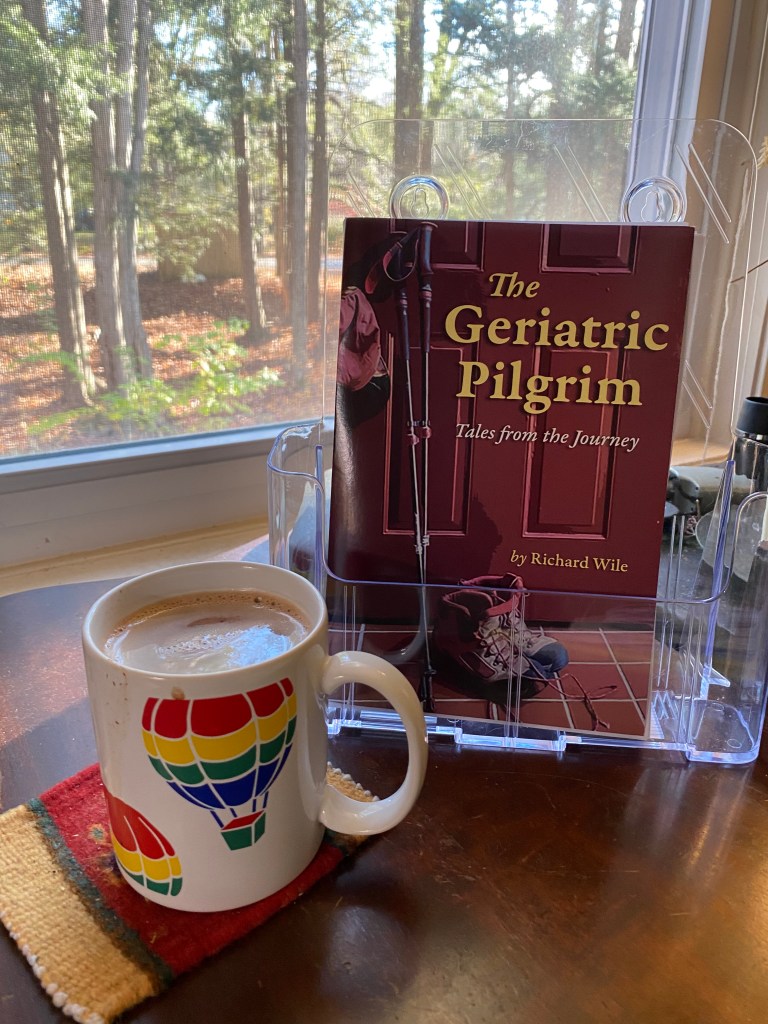
For years, Shakespeare and Kahan described the way I felt about this time of year. As readers of this blog and my book, The Geriatric Pilgrim: Tales from the Journey, know, my daughter Laurie entered Eastern Maine Medical Center in November of 1988 and died there on December 23rd. For those two months, I lived at a Ronald McDonald house about a mile away and walked back and forth to the hospital twice a day along the Penobscot River, where the skeletal maples, elms, birches, and oaks mocked any hope for Laurie’s recovery.

Over the next 30 years, each stick season was the backdrop for my anger, sorrow, withdrawal, guilt, and shame, exacerbated by a holiday season, which now starts about November 1, with its Hallmark images of healthy happy families gathered round a perfectly shaped Christmas tree. Throw in the Christian season of Advent—four weeks of paradoxical readings about Christ the child and Christ the judge, sin and grace, justice and mercy, comfort and challenge—and I came to dread this time of year.

But about five years ago, thanks to my Al Anon program, I was able to separate my shame, guilt, and anger from my grief. I saw that because of growing up in a family riddled with alcoholism, those noxious emotions were there long before Laurie died. And I realized that I didn’t have to hang on to them to grieve the sorrow and emptiness that one must accept when they lose a loved one. That I could feel sad without feeling angry. 

At the same time—and I’m sure it was no coincidence—as I walked the woods behind our house, I began to appreciate the stark beauty of stick season. Without all the foliage, the sky is larger, and sometimes it’s a November blue unlike at any other time of the year. The wind is bracing. The flies are gone. Unlike in mud season, the paths are still dry. Even the sticks themselves—the tree branches—have a stark beauty, like Japanese calligraphy. 

 I started to see the departed leaves as images of my departing shame, guilt, and anger.

Which helped me see Advent as a time for letting the spirit blow away what the Bible often calls our “iniquities,” but what I think of as my “survival mechanisms”: those behaviors I developed as a kid to survive family disfunction, but which have become injurious not only to my health but to those around me. 

These days I think of stick season as a time to simplify my life. Which has been especially easy this year. After 37 years of hosting a Thanksgiving for anywhere from ten to 24 people, Mary Lee and I turned over the apron to her younger son, who, along with his fiancé, did a fantastic job feeding and making us all feel comfortable.

Last week, Mary Lee retired after 22 years as the ordained Deacon at our Episcopal Church. For 22 years, churchy stuff has filled not only our Sundays, but other days of the week, as I have also been an active member of St. Paul’s. Now, as is our diocesan policy, we will worship elsewhere for a while. We will listen for other callings to where—as Aristotle said—the needs of the world and our talents cross.

Sadly, but I guess appropriately, our cat Zeke has used up his 9th life (I didn’t think he’d make it to 2023), leaving our house pet-less for the first time in our marriage.

I have given up driving 30 miles once a week to play in my old-time music jams. Mary Lee and I have decided we no longer enjoy going out for dinner once a week.

So, I suppose, I am in the stick season of my life. If so, it’s not bad. 

Let’s talk about Advent again. One thing I’ve always had trouble with is this idea that not only are we awaiting the celebration of the birth of Jesus, but we are supposed to be awaiting the Second Coming of Christ, when, according to some scripture passages, Christ will come to judge us and send some of us to hell and some of us to heaven. 

Sorry, I can’t buy the judgment thing. My experience is that I’m surrounded by Grace, if I can just (“just’? Ha!) open my eyes to it. So that when Jesus tells his disciples to “Keep awake!”—which he does a lot—I think he’s talking about opening our eyes to what’s already there, not what’s going to suddenly appear descending from a cloud.

Sort of like seeing the sky that’s always there, but only fully visible during stick season. 

(Or the water, for that matter)

So, for me, the Second Coming is an invitation to awaken into a new consciousness, a new appreciation, a new seeing, of life, the universe, and everything.

I watched a YouTube interview with Noah Kahan, in which he said that his hit song  represented a new musical path for him. And as blogger Mitch Teemley wrote recently about Advent, the word serves as the root of our word “adventure,” which, of course, I like because that makes me think of “pilgrimage.” “In short,” as Mitch wrote about Advent and I would write about pilgrimage,  it is “an experience that can change a person forever. If they let it.”

I’m going to stick with that for a Wile.

# #

Celebrating a Milestone

Looking back at the Eildon Hills in Scotland.

#

 “Great things are not done by impulse, but by a series of small things brought together.”

—Vincent Van Gogh

#

This blog is a milestone for me. Eight years ago this month, I published my first Geriatric Pilgrim blogs (https://geriatricpilgrim.com/2015/11/). And while I’m not big on party hats and horns, I want to celebrate.

The Romans erected the first stone markers to let travelers know not only the number of miles they had to go to reach their destinations, but also the distances they’d covered. Today, businesses talk about a milestone as something that demonstrates a significant, marked change or step in the development of a project. Parents keep track of milestones in their child’s development. (“Look, little Leslie’s walking! Where’s the camera?”)

When I think of the importance of milestones in my life, I think of the second day of our seven-day walking pilgrimage along St. Cuthbert’s Way through Scotland and England. Still apprehensive about being able to complete the 72-mile trek, I looked back across a newly mown field to the Eildon Hills fading into the dimly distant horizon. The day before, my wife Mary Lee and I had crossed those three hills.  I felt a burst of energy. Look at how far we’ve come, I thought. We can do this!

And as I look back at those first blogs from 2015, I’m also surprised and energized by how far I’ve come in the last eight years.

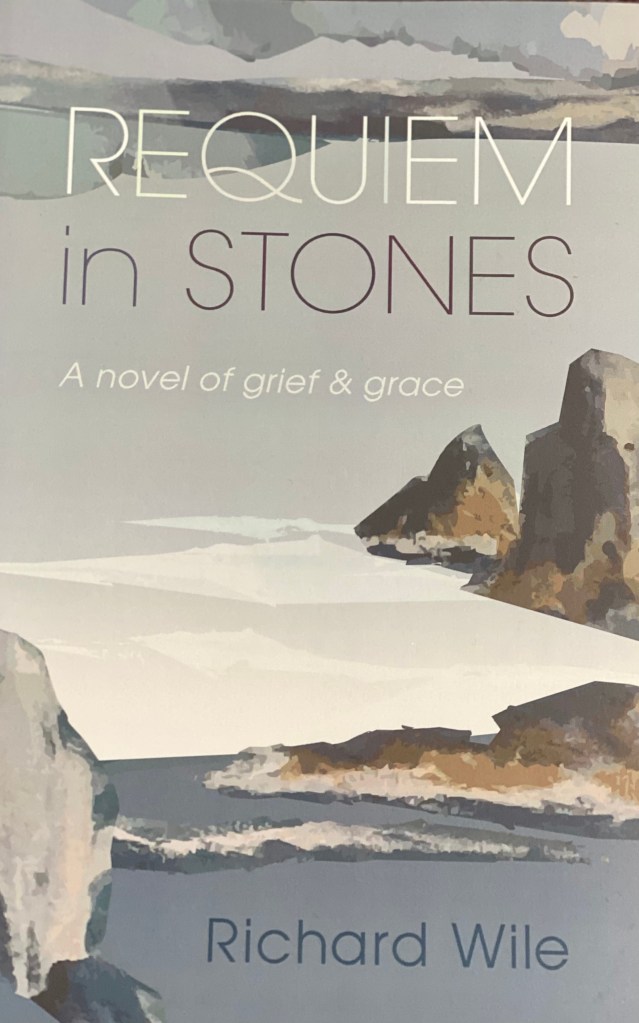
In 2015, I’d just published a novel, Requiem in Stones: A Novel of Grief and Grace, based on my experiences after my daughter Laurie died of cancer.

This novel about the effects of a child’s death upon a family, had taken me 20 years to write and I was emotionally drained. For the sake of my sanity (not to mention the wellbeing of those around me), I wanted to write something for fun.

Two years earlier, Mary Lee and I had walked St. Cuthbert’s Way, and I’d become curious as to how pilgrimages differed from vacations, business trips, escapes, or educational trips. I was especially interested in the inner journey one makes on a pilgrimage. I read books about some of the pilgrimages people had taken, drawn especially to those who approached the spiritual journey with humor and curiosity. I decided to try to use the same approach in a blog about my travels.

But now when I reread those first blogs, I can’t find much humor. Like the novel, they still seem to me focused on the effects of my grief—physical problems, nasty thoughts and visions. What humor I find now sounds to me sarcastic.

Still, because I’m also writing about specific places—Jerusalem, retreat houses—I can also see the beginnings of my detaching, of stepping back, of broadening my horizons.

And that’s what writing these blogs over the next eight years has done for me. By focusing first on my various exterior journeys, and then going inward, I’ve given my grief more room to live in, so that it doesn’t dominate either my life or my writing. My grief over Laurie’s death is no smaller, but the landscape in which it resides has expanded to include not only a dozen countries, but also my family history and my geriatric journey as well.

Probably nothing has helped me better understand this interior landscape over the last eight years than joining two 12-step programs. Al Anon, the program for families and friends of alcoholics, and ACA, the program for adult children of alcoholics, have become like lenses on a pair of binoculars, helping me view the effects of my grief—especially fear, anger, and shame—as mountains that make the Eildon Hills look as level as pool tables.

I remember telling my Al Anon sponsor in one of our first meetings, “I will always feel at some level that I killed my daughter.” Even 25 years after Laurie died, I blamed my daughter’s death on my divorcing her mother two years earlier or by not divorcing her mother soon enough. I said that every year, right around Thanksgiving, I could feel my body chemistry change. For the next month or so, right up until the anniversary of Laurie’s death on December 23, I said, I never knew how I would react. Some years I was angry at everyone, some years I cried at anything remotely sad, some years I spent the months hiding from the world by reading mysteries. I said that I’d just accepted this response as the way it would always be.

And I remember my sponsor’s reply: “Okay. Maybe… Let’s see what happens.”

Through working the Al Anon program, especially Step Four, taking “a fearless moral inventory” of myself, I discovered that because I’d grown up in a family riddled with alcoholism, I’d been clambering up and down those mountains of fear, shame, and anger long before Laurie’s death. Fear and my need for what I thought was security had driven me into an unhappy first marriage. Shame and my need for respect had driven me into erecting any number of false personas. My need to deaden my anger had driven me into my own alcoholic behaviors. Using ACA, I learned about the long-term effects of growing up in an alcoholic family, while Al Anon gave me the tools to separate my grief for my daughter’s death from my fear, anger, and shame over losing her.

So that four years ago, I realized that I was enjoying the Christmas season—no tears, no angry outbursts at the baggers at the grocery store, no reading marathons. And as I was collecting fifty of my blogs to put together in my second book, The Geriatric Pilgrim: Tales from the Journey, I had to revise several blogs which had talked about how hard the Christmas season still was for me.

There’s also nothing like successful heart surgery for expanding one’s inner landscape. Only through a timely wellness checkup and the perspicacity of my PCP—“No, being out of breath is not normal. I want you to take a stress test this week!”—did I avoid another family disease: falling dead of a heart attack. Only because of what I’ve called in these blogs “grace” am I’m still here. Only through grace am I grateful for the life I’ve lived, even for those demanding hikes over mountainous landscapes.

All of which is worth celebrating. If not with paper hats and party horns, at least with a cup of hot chocolate.

Cheers!

# #

An Allegrophobe’s Journey

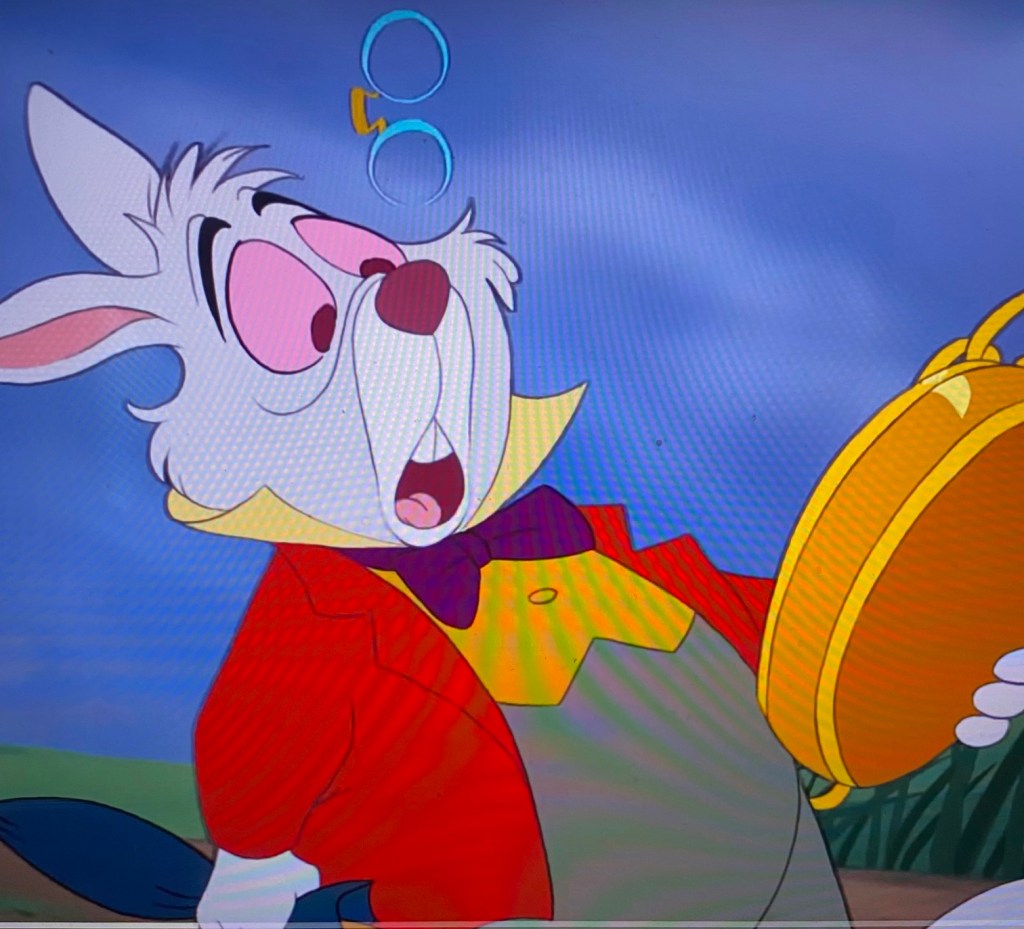
Icon of an allegrophobe: Alice’s White Rabbit (from the 1951 Disney Movie: https://www.youtube.com/watch?v=jHG2bMe9YxY&t=19s)

#

Why am I so worried about being late?

Why am I filled with anxiety?

Is it for fear of making people wait

That I worry so about being late?

Is my need for control so great

That it threatens my emotional sobriety?

All I know is that I worry about being late

So much that I’m filled with anxiety.

#

I wrote this poem (for those who care, it’s called a “triolet”) last month while on retreat, after realizing during my morning meditation that my stomach was clenched and my heart was racing because I feared being a minute or so late to the morning service at the monastery guest house. And that “a minute or so late” didn’t mean getting there a minute or two after the service had started, but a minute or two after the time I’d intended to get there, which was ten minutes before the service started.

I can see how stupid what I just wrote must sound to an ordinary person. But, as I realized on the retreat—possibly for the first time in 80 years—when it comes to needing to be early, I’m not ordinary.

Some of my earliest memories are of waking up an hour ahead of when I needed to on a school day and lying in the dark, worrying about everything from whether or not Buddy Gallant, one of the playground bullies, would twist my arm behind my back until I cried, to whether the fact that I still couldn’t ride a two-wheeled bicycle meant I had polio, like my cousin Frankie, who had to wear a leg brace, to how my family was going to afford to buy me another pair of shoes.

And yet, despite my fears of what might happen on the playground, I was always one of the first kids to arrive at school, establishing a pattern that continued for the next seventy years. When I started playing basketball at the town’s rec program, I would arrive at the gymnasium a good half hour early, often shuffling my feet outside the locked door to keep warm. When I began dating, I was always early, pacing or in a chair tapping my foot, which often got the evening off to a poor start. For 32 years, I was always one of the first teachers to arrive at school.

Back to the present, Mary Lee and I usually arrive at a movie, a concert, or a play twenty to thirty minutes early. I’m usually the first to get to our Men’s Group and the first to open any Zoom link. When I do a reading or a program based on the book I’m trying to market (The Geriatric Pilgrim: Tales from the Journey, for anyone reading this blog for the first time), I want to be there at the very least thirty minutes ahead of time. Forty-five minutes is better.

So what’s going on?

When in question, Google. Where, when I looked up “being early,” I found all kinds of positive stuff: being early is a sign of showing responsibility, of being conscientious. A sign of respect. Of leadership. And I like to think that’s often true of me. As a teacher, I used the extra time at school to prepare both my classroom and me for the day ahead. And when I’m doing a reading these days, I find it helpful to grow accustomed to the room—figure out how far I will have to project my voice. I want to respect the services at the monastery by not wandering in late. I arrive at Men’s Group early not only because I want to set up the equipment for our hybrid in person/Zoom meetings, but also because my name is on the church program as being the facilitator for the group, and I want to be dependable.

But when I looked up “fear of being late,” I found a different set of characteristics. First off, fear of being late has a name: allegrophobia, which, at least one writer thinks, may be connected to Responsibility OCD, or Inflated Responsibility Perfectionism. Allegrophobia, some websites say, is a sign of anxiety, codependence, and a deep-seated need for control. Other sites say allegrophobes worry obsessively about looming deadlines, relationship conflicts, and a sense that time is slipping away.

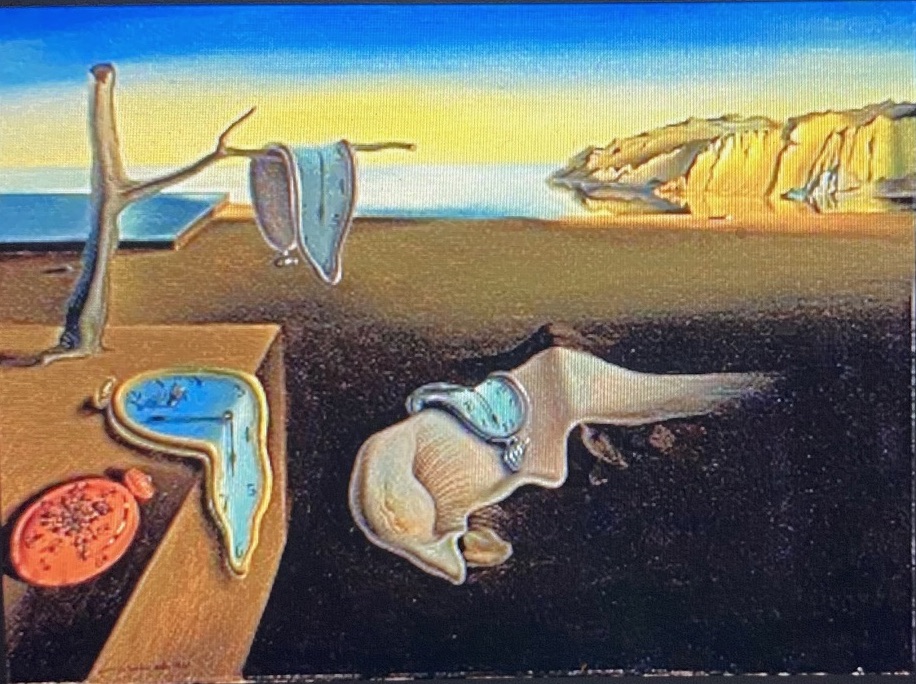
Salvador Dali: “The Persistence of Memory” (Wikipedia)

Which, I realized, are the same characteristics describing those of us who grew up in alcoholic or dysfunctional families.

Which answers a lot of questions.

For example, why did I worry as a kid about my parents—one, an adult child of a raging alcoholic and the other growing up in a broken home—not being able to afford new shoes? Because I often heard my parents worrying about their money problems. They also worried about a lot of other things, and I wonder if I channeled their anxiety into my fears of being taunted on the playground or coming down with polio. At the same time, was the reason I left early to school, basketball practice, and the like because I wanted to get out of the house and leave those worries behind?

If so, I’ve never been able to do it, so that I need to leave early for the movies because I’m afraid something will delay me between my house and the movie theater a mile away. Being early for school and to my readings and the Men’s Group helps me feel in control. And, as a codependent, being dependable and conscientious is not as important to me as having you think I’m dependable and conscientious.  

#

I suppose, at my age, I could just accept my allegrophobia. (And allegro, by the way, is a musical tempo that means very fast—124 to 160 beats per minute, which often describes my heart rate when I think I’m going to be late.)

But last week, I learned of the Judaic concept that upon reaching 70, one is considered having led a full life, but not necessarily a complete one. And as I thought of how I might make my life more complete, I thought again of my fear of being late. I did some more traveling on the internet and found a few suggestions for turning what has always been an anxious journey into a pilgrimage toward completeness.

One recommendation echoes what every spiritual tradition I know teaches: instead of worrying about the future, focus on the present moment. If you have a Higher Power, concentrate on how what some of us call God sees you instead of on how you think other people see you. If you don’t have a Higher Power, at least pause during your fears to center on your breathing.

Another suggestion I found is to imagine worse case scenarios, which sounds counterproductive, but is, I expect, a little like a vaccination, where you receive a little of the disease to protect yourself from more serious sickness. Ask yourself, “so what?” Imagine you are a few minutes late. So what? Will the Brothers at SSJE stop their service and give you hell? Will the Men’s Group fall apart if we start at 8:03 instead of 8:00?

And a third suggestion is to purposefully arrive at a gathering a minute or so late.

Aargh! Not ready for that one. Just writing that sentence gave me heartburn. I think I’d better work on the other suggestions first.

#

Notes From Squirrel Island

Circa 1940s. Wikipedia (It hasn’t changed much)

#

“A journey, in fact, appeals to Imagination, to Memory, to Hope—the three sister Graces of our mortal being.” Sir Richard Francis Burton (1821-1890)

#

I copied this quote from explorer Richard Burton into a pocket notebook, where it has remained for the last couple of years, along with any number of passwords, titles of books and movies people have recommended, email addresses, ideas for writing projects, directions for setting up new AV equipment, grocery lists, descriptions of sunsets, coffee shops, beaches, and airport terminals, Al Anon acronyms, and other quotes that have struck my fancy.

I can’t recall when I didn’t carry a pocket notebook and a pen. They are as essential a part of my wardrobe as underwear.

And before I add this notebook to the others going back to 1965, I’ve flipped back through it, trying—often unsuccessfully—to remember where I was when I wrote an entry, why it was important to write it down, and whether it’s important to me now.

What intrigues me is how the Burton quote helps me flesh out another entry a few pages later: a page and a half of description of a trip I made with my wife Mary Lee last July to Squirrel Island, Maine.

For those of you who don’t know, Squirrel Island is a small island in the Gulf of Maine—about 2 square miles, I think—established as a summer community in 1871. Apparently, it got its name not because of its squirrel population but rather because the shape of the island looks like a squirrel holding an acorn. Practically all its inhabitants are summer residents—I think there might be a caretaker or two who live there year-round—and most of the families have been coming to the island for a hundred or more years. The only motorized vehicles allowed are for maintenance workers. A boardwalk circles the island.

Besides beaches, tennis courts, a library, and a restaurant, there is also a chapel.

And for the last several years, Mary Lee has been asked to preach there one Sunday a summer. I go along as eye-candy.

To get to Squirrel Island, you take a ferry from Boothbay Harbor. It’s a nice half-hour trip (another reason I tag along), and this year, I remember the weather was warm and sunny. A nice woman from the chapel Board of Directors met us and took Mary Lee into the church to go over the various technicalities of the service, leaving me to walk the boardwalk until I found an Adirondack chair overlooking the water, where I sat, and, as is my wont, began to scribble in my notebook.

My first line noted the rotten egg smell of low tide, and how a smokey southwest breeze swayed some yellow lilies in front of me. I went on to describe a small harbor of motorboats pointing out to sea and the weathered cottages with gambrel roofs and wide verandas on the shore gazing out at South Port Island.

Reading those lines now reminds me that the first time I ever heard of Squirrel Island was when my Grandmother Cleaves worked summers into early October as a cook and caretaker for an old woman living on the island. I remember Nanny’s letters to me from there when I was in college, and how I chuckled at her rambling stories of people I’d never heard of and the latest gossip from the movie magazines she devoured like popcorn. (“Liberace’s Wig-maker Tells All.”)  Today I know my grandmother was an unhappy woman, the ex-wife of an alcoholic, who for years took her anger out on my brother, my sister, and me, but at the time, I denied the fact that she scared the hell out of me by imagining her as a comic figure. These days, I’m trying to accept that both her acid tongue and her love for her grandchildren were equally true.

My notebook tells me I noticed a seagull “dive-bombing a lobster boat,” and some sparrows chirping in the large mounds of beach roses under a blue sky “scarred with thin white stripes.” I mentioned the distant hum of lobster boats, the cry of an unhappy baby, and the “coo-coo-coo” of a dove. Which made me remember my friend and mentor Al, a retired Episcopal priest, who facilitated our church’s men’s group for many years. I wrote in my notebook of his love of pigeons, and worried about his severe asthma, compounded by heart problems, which had just sent him to the hospital and then to a nursing facility.

Al died about a month later, and I’ve just been asked to read at his funeral. I’m honored. Al was one of the kindest, gentlest men I ever knew, humble, with a great sense of humor. He was also a courageous advocate for social justice and civil rights. He attended Martin Luther King Jr’s March on Washington in 1963 and organized transportation from Newark, N.J. to the 1965 March from Selma to Montgomery, Alabama. He continued to work for equal rights for all, and in his last years wrote passionate letters to the editor urging us to become better stewards of our planet. He approached his death with dignity and curiosity, looking forward, he said, to the next stage in the journey. I hope to have the same attitude when it’s time for me to pass on.

I made more notes of white moths dancing over some sumac bushes and of a middle-aged woman in a black and white sleeve-less jersey walking her terrier along the boardwalk,  but when I heard the church bells from the chapel ringing out the old hymn, “Let Jesus Christ be Praised,” I thought again of Al, who, a year or so earlier, had written a children’s book, Soren’s Story: A Parable About Bullies and the Peaceable Kingdom.

As the full title makes clear, the book is not only about pigeons, but also about the dangers to children of bullying. I suspect Al, who had come from a dysfunctional family, had suffered bullying himself.

Soren’s Story ends in an old church, not unlike the one on Squirrel Island. Here’s the conclusion:

“Nor did anyone quite know how to explain it, but the great bell in the meeting house tower, long silent, began to move and then to swing and ring out ….

‘Hope on,’ it said. Gong!

            ‘Do justice and love kindness.’ Gong!

                        ‘Take courage and confront evil,’ it rang out. Gong!

                                    ‘And remember mercy.’ Gong!

                                                ‘For there is no future without forgiveness.’ Gong!”

 Reading notes from my Squirrel Island journey, I realize the truth of Sir Richard’s words. Memory takes me back to that day, imagination leads me to my grandmother and Al, and I’m hopeful. As I’ve written in these blogs before, hope for me is not based on some expectation of the future, but on what I’ve learned from the past. Keeping these various notebooks and going back to them, I can see where I’ve struggled, where I’ve been blind, where I’ve been down-right wrong, and yet how I’ve not only survived but thrived afterward. I can also sometimes see where I’ve had inklings of God of my not Understanding, often through mentors like Al, who give me hope that even in this time of threats to our country, both from home and abroad, in this time of one climate disaster after another, love, kindness, courage, and forgiveness can ring out.

#