13 Ways of Looking at a Door

1

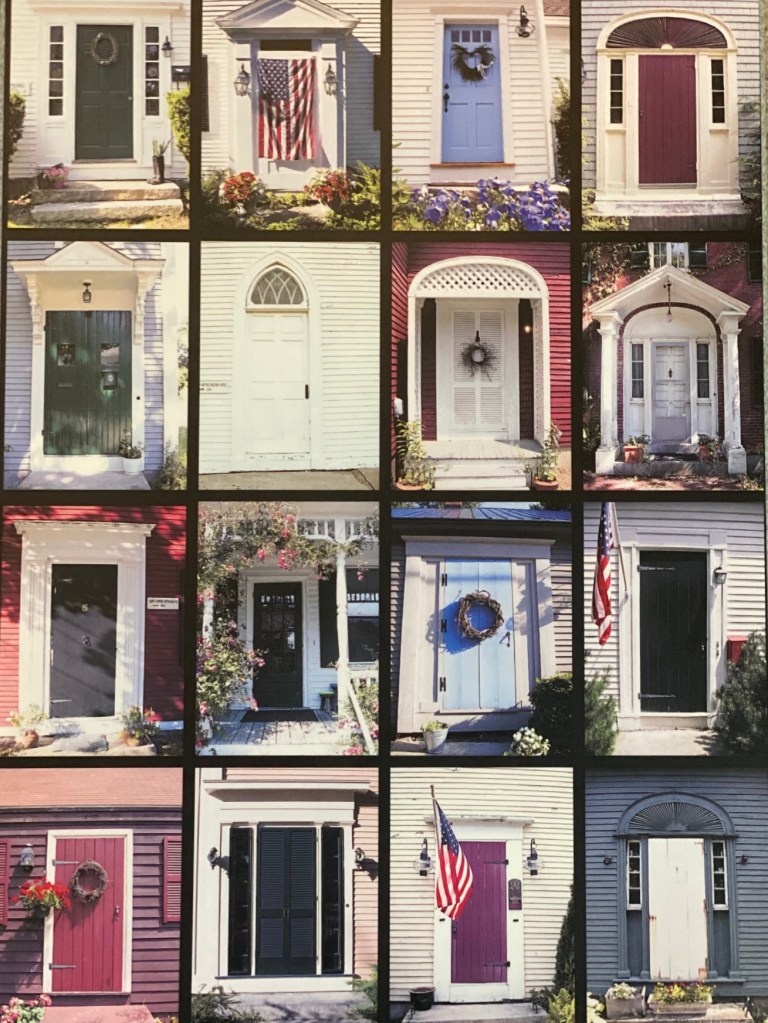
For Christmas one year, Mary Lee gave me a wooden wall hanging called “Doors of Yarmouth,” to remind me of the Maine town in which I lived for so many years. These are doors to old houses that have had careful tending (not to mention extensive and expensive remodeling). The doors come in a variety of colors. Most feature types of cross—sometimes called Christian—paneling. Three are plain wood with long hinges and latches. There are a couple of double doors and one shutter door. Some doors have glass windows, others are framed by small windows, shutters, cornices, lattice work, or flower vines. There’s a gothic arch over one door, a wooden fan over another, and several Greek canopies held up by pillars. All in all, they reveal how Yarmouth has changed from the working-class community I grew up in to the suburbia by the sea it is today. 

2

A little research on the web tells me that doors were conceived in ancient Egypt around 3000 B.C.E. but another site says that archeologists in Zurich Switzerland discovered an oak door possibly dating to 3063 B.C.E. Long before that, at least according to the Bible, Noah put a door in the ark. One assumes a pretty big one. (I’m curious how it opened and closed.)

3

 From the beginning, doors have had more than the utilitarian purpose of protection from nasty weather or people. They’ve identified the occupations of those living in the dwelling and served as marks of power and status. According to the Bible, when King Solomon built his great temple to show God’s power and prestige, he made doors of olivewood, covered with carvings of cherubim, palm trees, and open flowers, which he overlaid with gold. While technically not a door, I suppose, novelist Stephen King’s two iconic wrought-iron gates embellished with bats, a three-headed dragon and spider-like motifs have become a pilgrimage destination for King fans from all over the world.

4

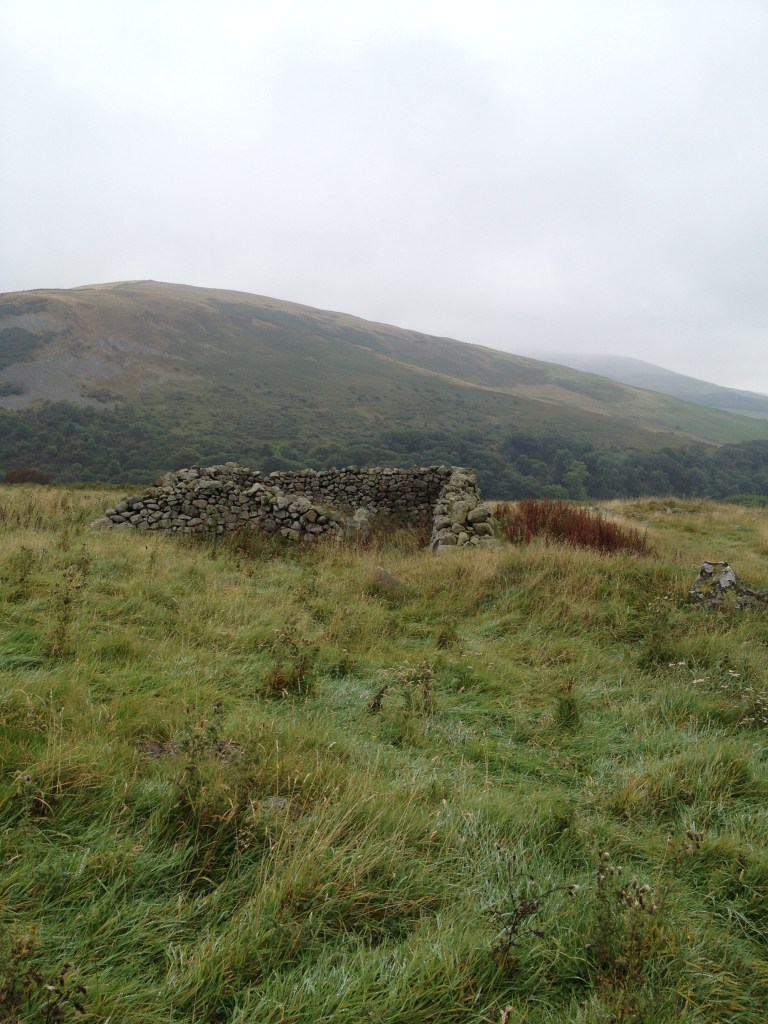
Speaking of pilgrimages, when Mary Lee and I were walking St. Cuthbert’s Way between Scotland and England, we passed a sheepfold, a circular wall of stones with an entrance, which for centuries, served as a place for shepherds to herd sheep at night for protection against predators such as wolves. To keep the sheep in and the wolves out, the shepherd would lie down across the entrance, becoming, as it were, a human door. 

5

Jesus uses this image of the shepherd protecting his flock by becoming a door when he refers to himself as “the gate,” who “lays down his life for the sheep.” Which may be why cross or Christian paneled doors are so prevalent in New England (all the units in our Housing Development have them, inside and out). When my wife Mary Lee—who is a Deacon in the Episcopal Church and a lover of icons—was teaching the in a local high school, she wanted to put up an icon in her classroom but realized it wouldn’t be appropriate in a public school, so she hung a large print of a door on her back wall where she could see it when she taught. It was a great comfort, especially with certain classes. 

6

 Besides Jesus, the Bible refers to other kinds of gatekeepers: those appointed to control who came and left the city through the gates. Thus, the term “gatekeeper” has come to mean a person who controls access, someone in authority who acts as an arbiter of quality or legitimacy, or someone who blocks you from speaking with a decision-maker. Gatekeepers access who is “in” or “out.” I’ve had a few of those in my life, athletic coaches, teachers, whom I’ve had to please in order to succeed. I suppose, as a teacher myself, I’ve also been a gatekeeper. 

7

I’ve also let others become gatekeepers, to whom I gave away authority, surrendered, as it were, the keys to doors I could have opened for myself. Growing up in an alcoholic family once limited my choices when I faced a decision to “What will the neighbors think?” to quote my mother. Through working an Al Anon program and learning to put the focus on me instead of on the me I thought you thought I was, I’ve found keys to open doors I never knew existed.

8

Some of those early Egyptian doors symbolized entrance to the afterlife. Doors can represent transition, confinement, new opportunities. Doors can be metaphors for the choices we make. We learn early on in life that we can walk through some doors and not others. As a WASP male, I know that I have more doors available to me than women, people of color, people of other religions. My destiny has been shaped by the doors I’ve walked through.

9

Or doors that have closed behind me. For a while, Mary Lee volunteered as a chaplain at the local prison. One Christmas, I helped her with a service. My clearest memory is of going through a series of doors and hearing the loud, definitive clang as each door closed behind me. I’ve had a few of those definitive door closings in my life: the death of my daughter, a divorce decree, a couple of retirement parties. Most of the time, however, I find that doors close behind me without my noticing. One reason I took early retirement from teaching high school English was that I saw too many colleagues still standing in front of their classes, even though, emotionally, they’d shut the door on their students years earlier. One of the things I dislike about the geriatric life is that doors keep silently closing, until suddenly I realize, I can’t do this anymore! Can’t climb that mountain, can’t reach that note, can’t eat that food, can’t…

10

On the other hand: My Quaker friends say that sometimes a door needs to close before another can open. That’s certainly been the case with me. I had to close the door on a forest management program before I could open the door to what’s been for me a fulfilling teaching career. I had to retire from public education before I started writing. After my daughter died, I had to lose every image of God I’d ever had before I encountered the Grace of God of my not Understanding.  

11

In late 1960’s, I listened to a rock group, The Doors, who named themselves after the title of Aldous Huxley’s book, The Doors of Perception, in which he reflects on his psychedelic experiences. Huxley himself had based his title on a line in English poet William Blake’s The Marriage of Heaven and Hell: “If the doors of perception were cleansed, everything would appear to man as it is: infinite.”

12

These days I’m trying to clean the doors of my perception through contemplative practices such as meditation, going on more retreats, walking meditation, contemplative reading, sessions with my Feldenkrais teacher, journaling, music, working on my listening, writing these blogs, and of course, making more pilgrimages, even if they’re only to the compost pile. 

13

And I’m not done opening new doors. I’m hoping I have a few longer trips left ahead of me. Speaking of trips, I note that interest in psychedelic drugs is again increasing, thanks to books like Michael Pollen’s book How to Change your Mind.Indeed, I have a 92-year-old friend who’s seriously considering a guided psychedelic experience. That’s another possible door. 

And, of course, there’s the Big Door ahead of me. That, too, will be quite a trip, I suspect. 

#

Connecting the Dots

“Only connect.”—E.M. Forster

#

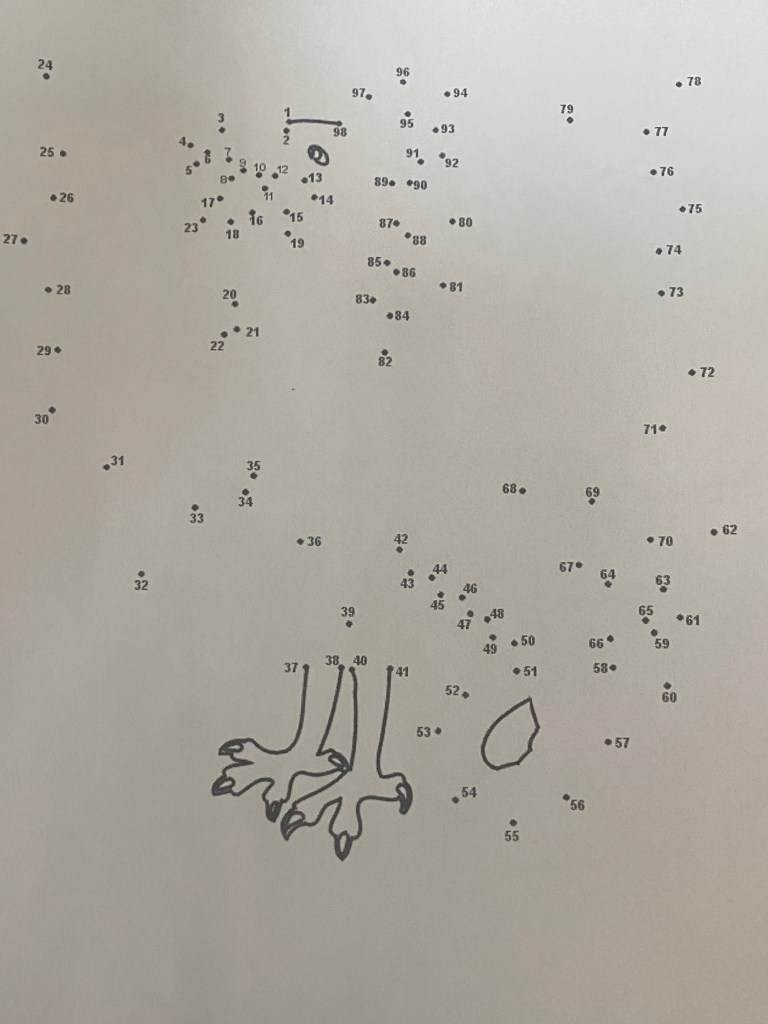
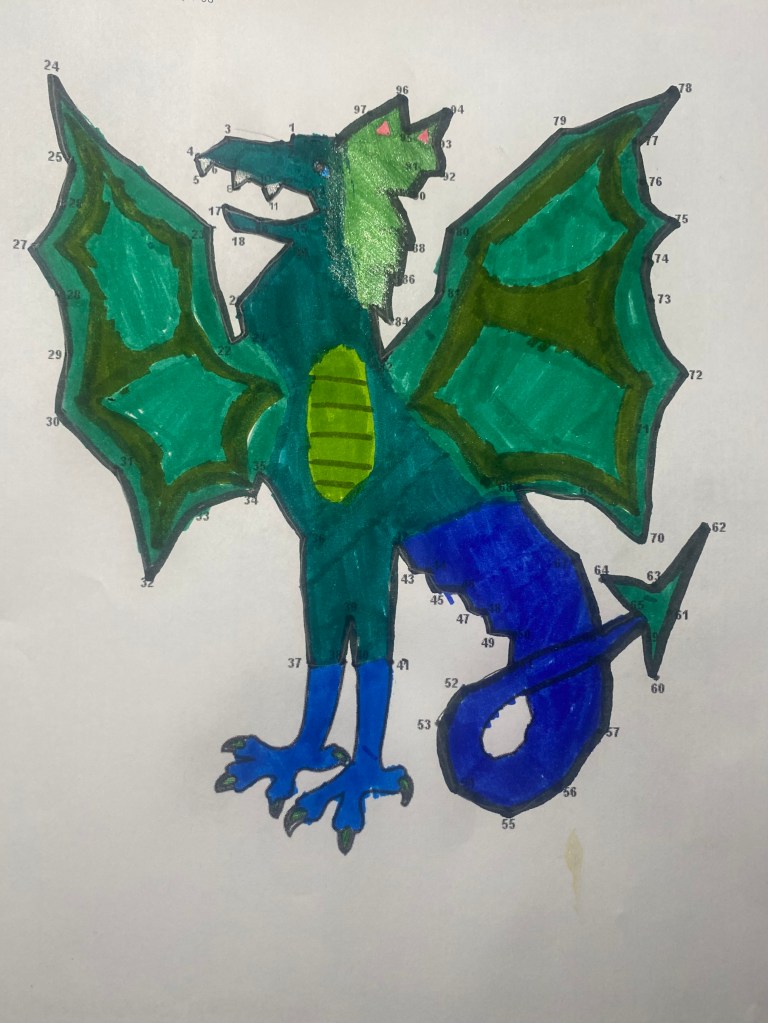
As a kid, some three-quarters of a century ago, I loved to “Follow the Dots.” You know, those puzzles where at first, you see nothing but a confusing morass of tiny spots, like black ants on the page, but if you connect these dots by the numbers, a cat or dog or giraffe or flower appears, as if by magic. Then, you can color it and have a lovely picture. (Or at least Mom said mine was lovely.)

And I still love following and connecting dots. It’s one reason I love poetry and admire those writers who draw connections I’ve never seen before. Everything I read about physics and the discoveries about our universe, everything I read about spirituality, everything I’ve learned about health, all say that everything is connected; what we need to do is connect the dots. 

“Connection is why we’re here,” says researcher/storyteller Brene Brown in a TED talk I recently watched. Then Brown went on to talk about our problems with connecting, problems caused by our fear of appearing vulnerable, our need for control and certainty, and most important, our shame. Because we don’t feel we’re worthy of connecting with others, we don’t try.

Well, that made me sit up and take notice. I’ve often said that shame has been the driving force of my life. Thanks to almost a dozen years working my Al Anon program, I’ve learned shame is part of growing up in a family riddled with generations of alcoholism, along with burying feelings, fearing confrontation, learning to hide behind personas, perfectionism, judgmentalism, and people-pleasing. Twelve-step literature calls these traits “character defects.” I think of them as survival mechanisms. Either way, they’ve kept me from connecting to other people. 

As Marie Howe’s writes in her poem “The Affliction”:

When I walked across a room I saw myself walking

as if I were someone else,

as if I were in a movie.

It’s what I thought you saw when you looked at me.

So when I looked at you, I didn’t see you

I saw the me I thought you saw, as if I were someone else.

This was (and can still be) me, walking into a room, convinced everyone is staring at me, first in judgment, then in disdain. I’ll run my tongue over my teeth to make sure there’s nothing stuck between them, check my fly to see if it’s zipped. Still, I’m sure people are deriding me for being the failure I know I am.

At no time was this truer than after I became a high school English teacher. Every time a student laughed, or whispered, or stared at me, I was convinced I was the subject of their ridicule. (And finding out I was known as Wiley Coyote didn’t help.)

So I created the persona of MRWILE. During the ever-more-casual 1970s, I dressed in flashy sport coats, bell-bottoms, with matching ties and pocket handkerchiefs. I spent weekends in my classroom changing bulletin boards, papering the walls with posters, and growing geraniums and begonias on the windowsills. At school, I used sarcasm and difficult reading assignments to control behavior, while at home I filled the margins of student essays with correction symbols and caustic comments—“Huh?” “What on earth does this mean?” 

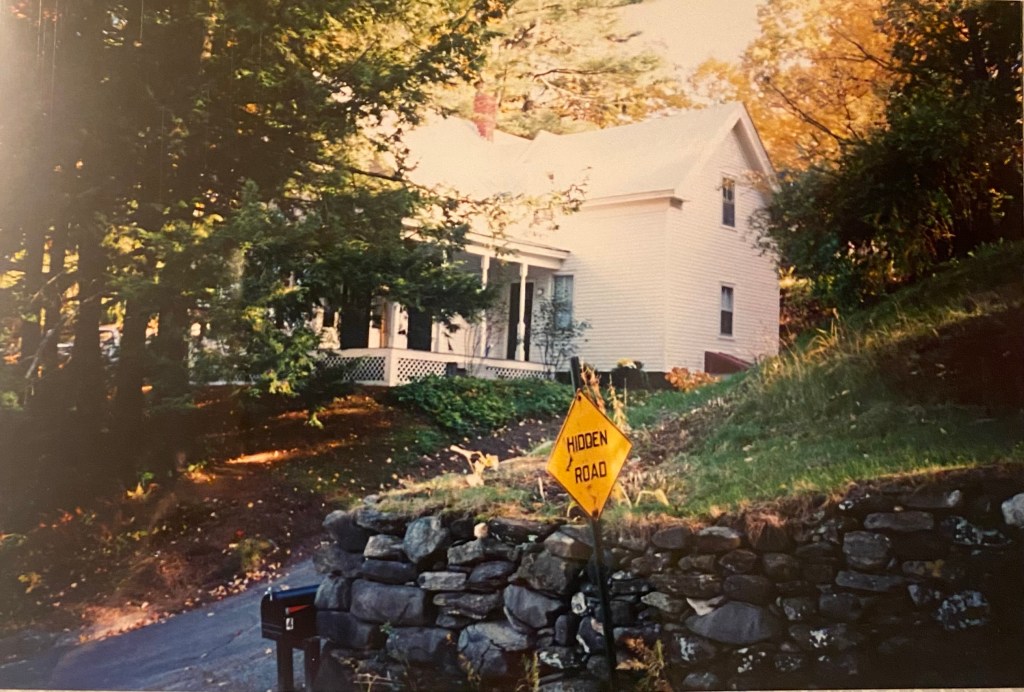
Outside of school I attempted to encase myself in the same veneer of respectability. I smoked a pipe. I bought a white cape cod house with green shutters in a housing development. I put up a white picket fence and planted rose bushes. I joined the church choir, the church Board of Deacons, and the Rotary Club.

MRWILE

While MRWILE helped me gain some of the respect I craved, this persona killed my first marriage and almost killed me. I was never home, and when I was, I was never present. I began waking in the night, sweating, and panting for breath, suffocating, after nightmares of being tarred and feathered and ridden out of town on a rail.

What saved me was THE LIGHTBULB.

As I recall, I was teaching a class about a particular piece of literature. (Maybe a Shakespearean sonnet?) So that my students could understand the imagery, I was trying to connect the poet’s situation to theirs. Suddenly, I saw a face light up in understanding, as if I’d flipped a switch in the kid’s head. I remember feeling a corresponding charge, a release, that I’ve since said, felt right up there with sex. 

I’m serious. In that moment, and in the other moments since then that have kept me teaching long after I threw out the ties and matching pocket handkerchiefs, when I taught everyone from thirteen-year-olds with learning disabilities to students with combined College Board scores of 1600 to college seniors working on honors theses to homeless veterans with PTSD to Al Anon sponsees, as in sex, I’ve somehow connected with someone at a deeper level—a reciprocal give and take that goes far beyond “Oh, aren’t I a wonderful teacher!” Both teaching and sex have been means by which I have experienced real—maybe “pure” is a better word—relationship. 

If you don’t get this, I understand (when I talk about how exciting teaching can be, some people look at me as if I were extoling the taste of ground glass), but I will always remember the evening I talked about my lightbulb experiences to a teacher from Colorado when we were both reading essays for the College Board in New Jersey. She did understand. We began writing to each other. I found I could be open and vulnerable with her, and that for her, I could give up my secure and respectable life, leave the white cape and the picket fence and my advanced placement students in the middle of a school year for a three-room, 2nd floor apartment, and four classes of potential juvenile delinquents who’d driven their previous teacher to early retirement. 

And in the almost forty years since then, together we’ve faced the death of a child, financial uncertainty, several career shifts, and now, the diminishments and indignities of old age. 

As I tell the folks in my writing groups these days, I write to discover what I didn’t know I knew. Writing this blog, I’ve discovered that while shame has been one driving force in my life, my desire for connection has been another one, probably beginning with those days I spent connecting dots in puzzle books. And that when—I have to think it’s through Grace—I have connected not only to but also with my metaphorical dots, it’s resulted in a beautiful picture.

And should any of this should connect with you, dear reader, that would be pretty nice, too.

Thank you to my granddaughter Anastasia for connecting the dots and coloring the picture far better than I could

# #

Our Rite of Hope for January 7, 2021

#

“…. by participating in a ritual, … [y]our consciousness is being re-minded of the wisdom of your own life. —Joseph Campbell

#

Yesterday we celebrated Epiphany,

When wise men worshipped the Christ child. 

& recalled the goons in MAGA caps who trashed the nation’s capital.

Still rattled today, we observe our annual ritual:

  We play The Christmas Revels 

                                                            Wassail, wassail, all over the town

  We strip the tree of 

   Ornaments:

     From pilgrimages—

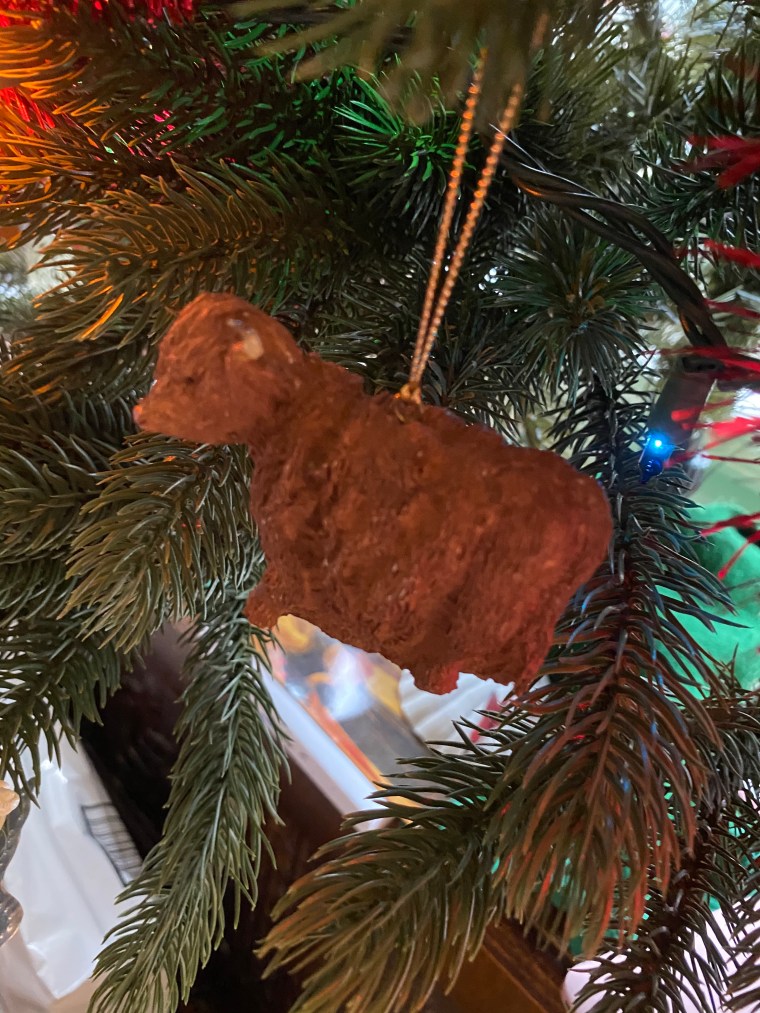
                 2 wooden sheep from Scotland 

          (my ancestors died for Bonnie Prince Charlie)

                          2 olive wood crusaders’ crosses from Jerusalem

                                    (Christians & Muslims slaughtered each other for centuries)

                          1 porcelain nazar from Istanbul

                                    (protection against evil)                      

Here come I, old Father Christmas

             From childhood—

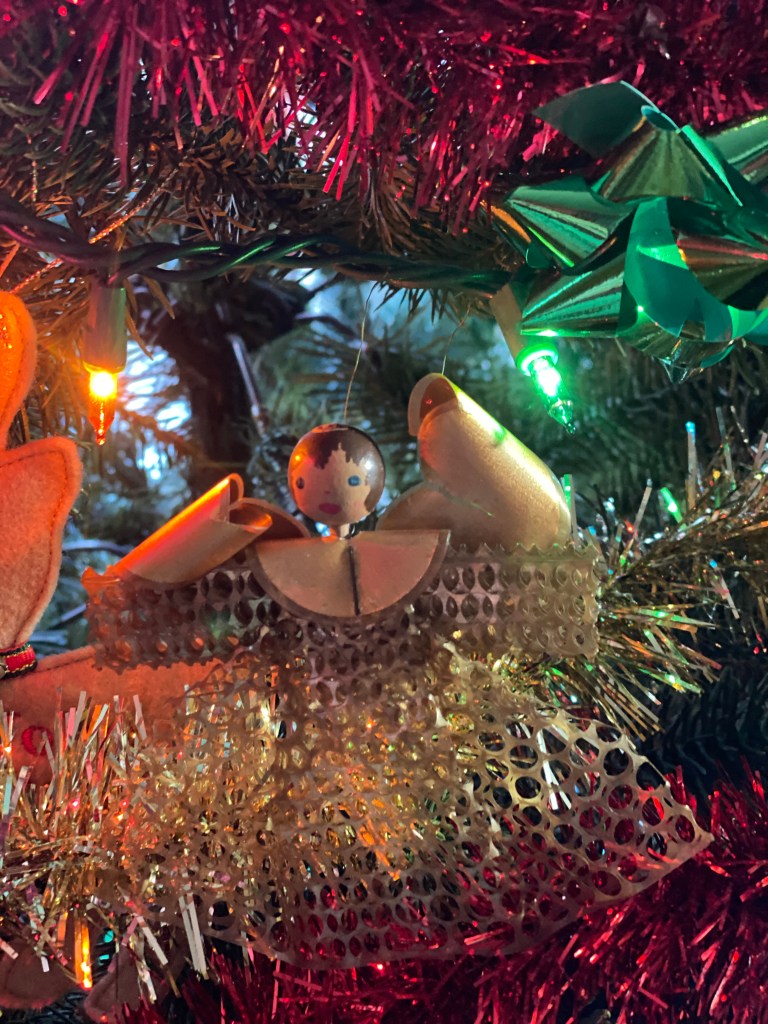
                          1 wooden and tin mesh angel from the turn of the 20th Century

(2 world wars, 2 flu epidemics, the Depression, Korea, Viet Nam, 3 assassinations, Watergate, 9-11, yesterday)


        1 plastic Santa from WWII                             

           (Dad in Belgium building bridges for tanks)

The boar’s head in hand have I

3 shiny ornaments my parents bought with green stamps 

                                    (To brighten memories of their broken childhoods)

                                                                                                There was a pig went out to dig

                                                                                                Christ-i-mas day, Christ-i-mas day  

            From children & grandchildren—

                        4 yarn & toothpick God’s-eyes

                        1 fuse-bead heart, 1 fuse-bead cat, 1 fuse-bead turtle, 

                        2 black felt cats honoring my step-son’s first pets

                        1 brown fur diarrhea microbe 

(from my daughter-in-law who helps impoverished countries improve water quality)

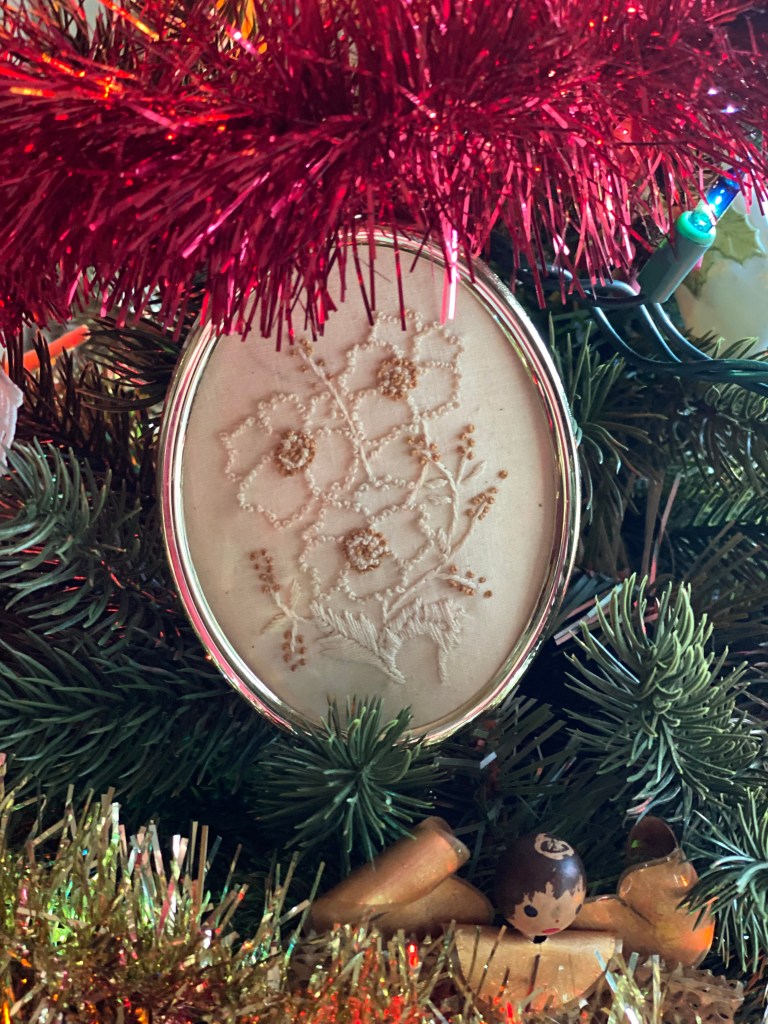
                        1 embroidered-flower ornament from my 16-year-old daughter

                                    (2 years before she died from cancer)

                                                                                                            The holly and the ivy…

     Lights:

            3 strings of red  blue  green  orange  bulbs

                        (The big painted ones long gone, but at least these aren’t white)                              

            1 yellow star

                        (“For we observed his star at its rising, and have come to pay him homage.”)

Dance, then, wherever you may be

                                                                                                I am the Lord of the Dance, said he.

So, we dance

between

Christianity & paganism

Past & present

Light & dark

Death & life

Sorrow & joy

Arms clinging to our rite of hope.

# #

Stick Season

#

As New Englanders know, each year has six seasons: the usual spring, summer, autumn, winter, plus mud season—between winter and spring—and stick season—between autumn and winter.

I’ve written about mud season before (https://geriatricpilgrim.com/2019/03/). Now it’s time to talk about stick season. 

You know about our autumns and winters. These are the seasons in all those lovely photographs of New England. You know, the flaming foliage ones, mountains ablaze in orange, yellow, and red, and the snowy ones, white trees bowing as skiers whiz past. But in between—usually it’s the entire month of November but it could be December as well—the leaves have left, the snow hasn’t arrived, and the trees become stick figures. “Bare ruin’d choirs, where late the sweet birds sang,” to quote Mr. Shakespeare.

Stick season has been getting a lot of press these days, thanks to a young singer named Noah Kahan, whose song “Stick Season” about the pain of lost love—“And I love Vermont, but it’s the season of the sticks/ And I saw your mom, she forgot that I existed…”—was a viral hit in 2022. (And as synchronicity would have it, as I was planning this blog, he sang it on Saturday Night Live, December 2nd. Check it out on YouTube.)

For years, Shakespeare and Kahan described the way I felt about this time of year. As readers of this blog and my book, The Geriatric Pilgrim: Tales from the Journey, know, my daughter Laurie entered Eastern Maine Medical Center in November of 1988 and died there on December 23rd. For those two months, I lived at a Ronald McDonald house about a mile away and walked back and forth to the hospital twice a day along the Penobscot River, where the skeletal maples, elms, birches, and oaks mocked any hope for Laurie’s recovery.

Over the next 30 years, each stick season was the backdrop for my anger, sorrow, withdrawal, guilt, and shame, exacerbated by a holiday season, which now starts about November 1, with its Hallmark images of healthy happy families gathered round a perfectly shaped Christmas tree. Throw in the Christian season of Advent—four weeks of paradoxical readings about Christ the child and Christ the judge, sin and grace, justice and mercy, comfort and challenge—and I came to dread this time of year.

But about five years ago, thanks to my Al Anon program, I was able to separate my shame, guilt, and anger from my grief. I saw that because of growing up in a family riddled with alcoholism, those noxious emotions were there long before Laurie died. And I realized that I didn’t have to hang on to them to grieve the sorrow and emptiness that one must accept when they lose a loved one. That I could feel sad without feeling angry. 

At the same time—and I’m sure it was no coincidence—as I walked the woods behind our house, I began to appreciate the stark beauty of stick season. Without all the foliage, the sky is larger, and sometimes it’s a November blue unlike at any other time of the year. The wind is bracing. The flies are gone. Unlike in mud season, the paths are still dry. Even the sticks themselves—the tree branches—have a stark beauty, like Japanese calligraphy. 

 I started to see the departed leaves as images of my departing shame, guilt, and anger.

Which helped me see Advent as a time for letting the spirit blow away what the Bible often calls our “iniquities,” but what I think of as my “survival mechanisms”: those behaviors I developed as a kid to survive family disfunction, but which have become injurious not only to my health but to those around me. 

These days I think of stick season as a time to simplify my life. Which has been especially easy this year. After 37 years of hosting a Thanksgiving for anywhere from ten to 24 people, Mary Lee and I turned over the apron to her younger son, who, along with his fiancé, did a fantastic job feeding and making us all feel comfortable.

Last week, Mary Lee retired after 22 years as the ordained Deacon at our Episcopal Church. For 22 years, churchy stuff has filled not only our Sundays, but other days of the week, as I have also been an active member of St. Paul’s. Now, as is our diocesan policy, we will worship elsewhere for a while. We will listen for other callings to where—as Aristotle said—the needs of the world and our talents cross.

Sadly, but I guess appropriately, our cat Zeke has used up his 9th life (I didn’t think he’d make it to 2023), leaving our house pet-less for the first time in our marriage.

I have given up driving 30 miles once a week to play in my old-time music jams. Mary Lee and I have decided we no longer enjoy going out for dinner once a week.

So, I suppose, I am in the stick season of my life. If so, it’s not bad. 

Let’s talk about Advent again. One thing I’ve always had trouble with is this idea that not only are we awaiting the celebration of the birth of Jesus, but we are supposed to be awaiting the Second Coming of Christ, when, according to some scripture passages, Christ will come to judge us and send some of us to hell and some of us to heaven. 

Sorry, I can’t buy the judgment thing. My experience is that I’m surrounded by Grace, if I can just (“just’? Ha!) open my eyes to it. So that when Jesus tells his disciples to “Keep awake!”—which he does a lot—I think he’s talking about opening our eyes to what’s already there, not what’s going to suddenly appear descending from a cloud.

Sort of like seeing the sky that’s always there, but only fully visible during stick season. 

(Or the water, for that matter)

So, for me, the Second Coming is an invitation to awaken into a new consciousness, a new appreciation, a new seeing, of life, the universe, and everything.

I watched a YouTube interview with Noah Kahan, in which he said that his hit song  represented a new musical path for him. And as blogger Mitch Teemley wrote recently about Advent, the word serves as the root of our word “adventure,” which, of course, I like because that makes me think of “pilgrimage.” “In short,” as Mitch wrote about Advent and I would write about pilgrimage,  it is “an experience that can change a person forever. If they let it.”

I’m going to stick with that for a Wile.

# #

Celebrating a Milestone

Looking back at the Eildon Hills in Scotland.

#

 “Great things are not done by impulse, but by a series of small things brought together.”

—Vincent Van Gogh

#

This blog is a milestone for me. Eight years ago this month, I published my first Geriatric Pilgrim blogs (https://geriatricpilgrim.com/2015/11/). And while I’m not big on party hats and horns, I want to celebrate.

The Romans erected the first stone markers to let travelers know not only the number of miles they had to go to reach their destinations, but also the distances they’d covered. Today, businesses talk about a milestone as something that demonstrates a significant, marked change or step in the development of a project. Parents keep track of milestones in their child’s development. (“Look, little Leslie’s walking! Where’s the camera?”)

When I think of the importance of milestones in my life, I think of the second day of our seven-day walking pilgrimage along St. Cuthbert’s Way through Scotland and England. Still apprehensive about being able to complete the 72-mile trek, I looked back across a newly mown field to the Eildon Hills fading into the dimly distant horizon. The day before, my wife Mary Lee and I had crossed those three hills.  I felt a burst of energy. Look at how far we’ve come, I thought. We can do this!

And as I look back at those first blogs from 2015, I’m also surprised and energized by how far I’ve come in the last eight years.

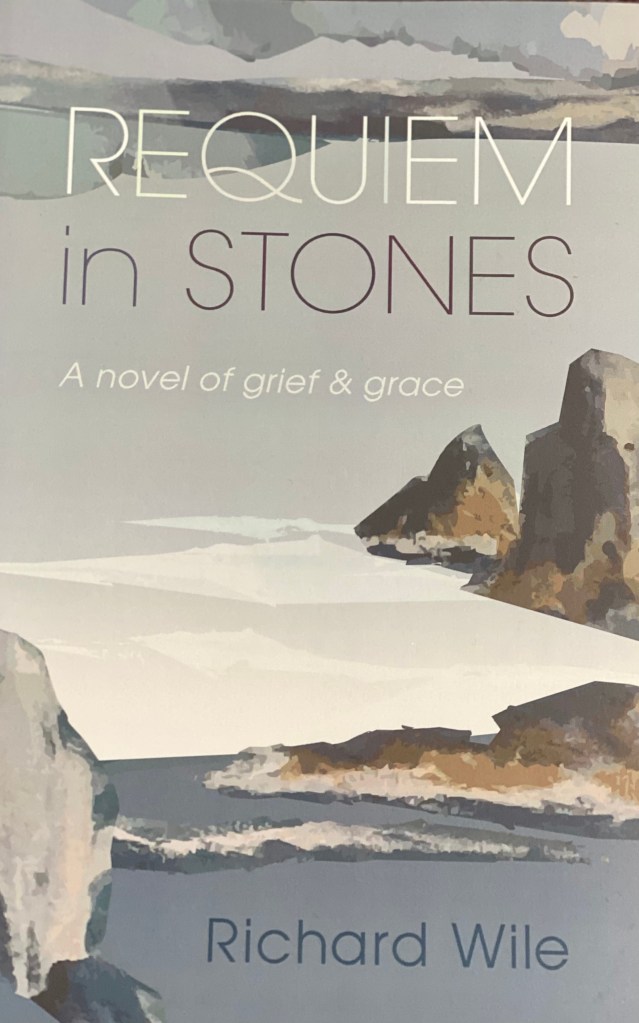
In 2015, I’d just published a novel, Requiem in Stones: A Novel of Grief and Grace, based on my experiences after my daughter Laurie died of cancer.

This novel about the effects of a child’s death upon a family, had taken me 20 years to write and I was emotionally drained. For the sake of my sanity (not to mention the wellbeing of those around me), I wanted to write something for fun.

Two years earlier, Mary Lee and I had walked St. Cuthbert’s Way, and I’d become curious as to how pilgrimages differed from vacations, business trips, escapes, or educational trips. I was especially interested in the inner journey one makes on a pilgrimage. I read books about some of the pilgrimages people had taken, drawn especially to those who approached the spiritual journey with humor and curiosity. I decided to try to use the same approach in a blog about my travels.

But now when I reread those first blogs, I can’t find much humor. Like the novel, they still seem to me focused on the effects of my grief—physical problems, nasty thoughts and visions. What humor I find now sounds to me sarcastic.

Still, because I’m also writing about specific places—Jerusalem, retreat houses—I can also see the beginnings of my detaching, of stepping back, of broadening my horizons.

And that’s what writing these blogs over the next eight years has done for me. By focusing first on my various exterior journeys, and then going inward, I’ve given my grief more room to live in, so that it doesn’t dominate either my life or my writing. My grief over Laurie’s death is no smaller, but the landscape in which it resides has expanded to include not only a dozen countries, but also my family history and my geriatric journey as well.

Probably nothing has helped me better understand this interior landscape over the last eight years than joining two 12-step programs. Al Anon, the program for families and friends of alcoholics, and ACA, the program for adult children of alcoholics, have become like lenses on a pair of binoculars, helping me view the effects of my grief—especially fear, anger, and shame—as mountains that make the Eildon Hills look as level as pool tables.

I remember telling my Al Anon sponsor in one of our first meetings, “I will always feel at some level that I killed my daughter.” Even 25 years after Laurie died, I blamed my daughter’s death on my divorcing her mother two years earlier or by not divorcing her mother soon enough. I said that every year, right around Thanksgiving, I could feel my body chemistry change. For the next month or so, right up until the anniversary of Laurie’s death on December 23, I said, I never knew how I would react. Some years I was angry at everyone, some years I cried at anything remotely sad, some years I spent the months hiding from the world by reading mysteries. I said that I’d just accepted this response as the way it would always be.

And I remember my sponsor’s reply: “Okay. Maybe… Let’s see what happens.”

Through working the Al Anon program, especially Step Four, taking “a fearless moral inventory” of myself, I discovered that because I’d grown up in a family riddled with alcoholism, I’d been clambering up and down those mountains of fear, shame, and anger long before Laurie’s death. Fear and my need for what I thought was security had driven me into an unhappy first marriage. Shame and my need for respect had driven me into erecting any number of false personas. My need to deaden my anger had driven me into my own alcoholic behaviors. Using ACA, I learned about the long-term effects of growing up in an alcoholic family, while Al Anon gave me the tools to separate my grief for my daughter’s death from my fear, anger, and shame over losing her.

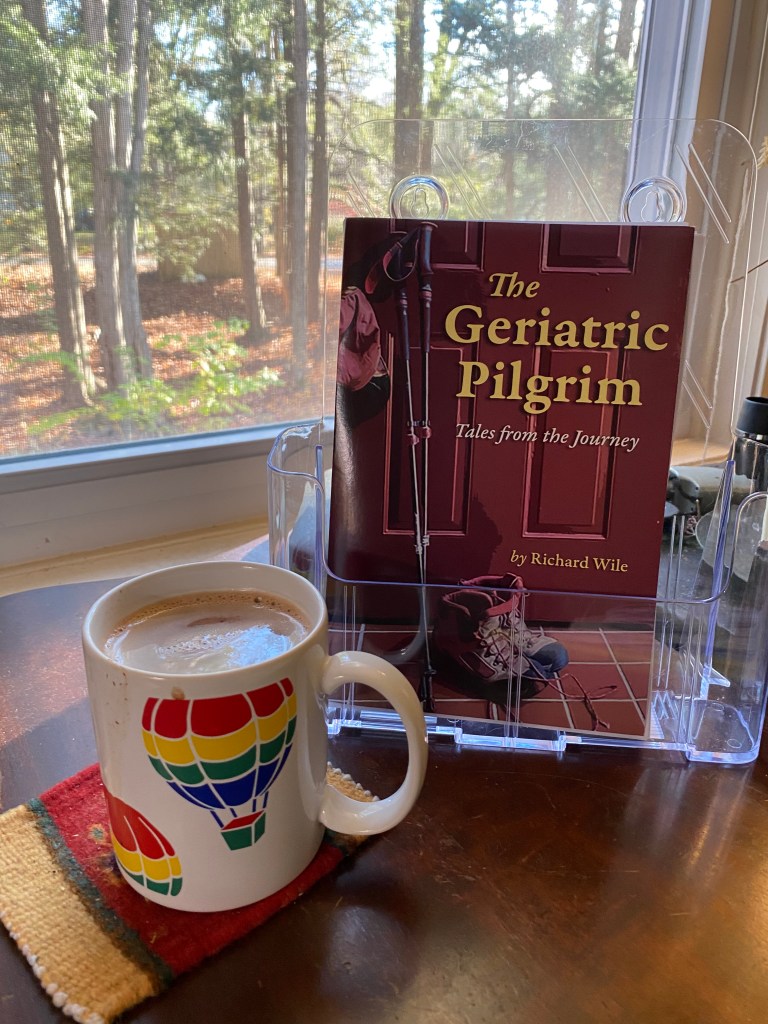
So that four years ago, I realized that I was enjoying the Christmas season—no tears, no angry outbursts at the baggers at the grocery store, no reading marathons. And as I was collecting fifty of my blogs to put together in my second book, The Geriatric Pilgrim: Tales from the Journey, I had to revise several blogs which had talked about how hard the Christmas season still was for me.

There’s also nothing like successful heart surgery for expanding one’s inner landscape. Only through a timely wellness checkup and the perspicacity of my PCP—“No, being out of breath is not normal. I want you to take a stress test this week!”—did I avoid another family disease: falling dead of a heart attack. Only because of what I’ve called in these blogs “grace” am I’m still here. Only through grace am I grateful for the life I’ve lived, even for those demanding hikes over mountainous landscapes.

All of which is worth celebrating. If not with paper hats and party horns, at least with a cup of hot chocolate.

Cheers!

# #

Storm Stories

Hurricane Carol: 1954. Northeast Historical Film

#

Recently, Hurricane Lee, at one point a Category 5 hurricane, churned up the Atlantic coast, bringing with it dire warnings such as, “Lee Drives Towards Us with a Hugh Wind Field, Damaging Waves, and Flooding.” The Episcopal Church of Maine’s website offered a prayer, which began: “Creator God, we ask you to calm the wind and the waves of the approaching hurricane and spare those in its path from harm.”

I put away lawn chairs, harvested basil, tomatoes, and beans from my garden, and checked to see that our flashlights all had new batteries and the lamps had oil. I cleaned out the garage, so that I could get my car out of the way of falling branches.

Well, the trees did some jitterbugging in the wind to the rhythm of our wind chimes, and our lawn had a smattering of small branches. My Zoom meeting with an Al-Anon sponsee on the coast ended early when his power went out, and my bean pole in the garden blew over, but all in all, the effects of the storm were minimal. A few years from now—if I’m still alive—I doubt if I’ll tell many stories about Hurricane Lee.

Hurricane Lee: 2023

There are other hurricanes, other storms, however, whose stories have stayed with me.

In 1954, Hurricane Carol, the first Category 5 hurricane to hit New England, roared through Maine, followed ten days later, by Hurricane Edna. A little research tells me that the two storms caused 25 million dollars in damages and destroyed 3500 cars and 3000 boats. What I remember was that at 11 years old, I thought hurricanes were neat. The thundering river down the hill mingled with the roar of the wind, and our house shook like some carnival ride. I couldn’t understand why my father was chain-smoking and pacing back and forth in front of the living room window, muttering, “I hope that goddamned tree doesn’t fall on us.” The day after Hurricane Carol, my friends and I walked through town, gaping at the elm trees that had blown over, amazed at the size of their roots, which rose several feet over our heads.

The next hurricane to hit Maine was Gloria, in September 1985. According to Wikipedia, this storm affected six counties in Maine, with multiple injuries, downed trees, and 250,000 people without power, some for up to fourteen days. I was living Down East at the time. Less than a month earlier, my first wife and I had separated, and the day after the storm I got up early to drive my daughter Laurie to church camp for the weekend. After dropping Laurie off, I continued on to visit my mother and father. When I pulled into the driveway, I saw Dad standing in strewn leaves and fallen branches, trying to fry bacon and eggs on a charcoal grill. My Grandmother Cleaves, who’d come over from her apartment for a hot breakfast, stood at the window.

What I recall even more clearly now was that my father, Laurie, and Nanny Cleaves all died within the next four years. Throw in a divorce and a second marriage, and I experienced an emotional hurricane that made Gloria feel like a summer breeze.

In 1991, Hurricane Bob came to Maine. Three people died, many residents lost power, and there was over five million dollars in damages. Again, the storm’s direct effect on my new family and me was minimal, but because of the heavy rains and losing power, my Grandmother Kimball’s cellar flooded because her sump pump stopped working. At 92, living alone, she couldn’t cope with the responsibility of keeping the house up, so she sold it to me. Mary Lee and I lived in that house for the next 22 years. Then, after a spring rainstorm and another flooded cellar (something like the fifth one in those 22 years), we sold the house and moved to where we now live (which, thankfully, has no cellar).

Our cellar after the Patriots’ Day Storm of 2007

I think of other storms in my life—natural ones, such as the ice storm of 1998, various nor’easters leaving two feet of snow; emotional storms, such as my defeats and disappointments, a divorce, Laurie’s death—and I realize that I remember them far more clearly than I do the sunny days—beach days, vacations with family in Florida and Bermuda—or the happy times: the victories, the times I’ve been recognized or honored. I don’t know about you, but it’s the storms rather than the sunny days in my life that have become the stories of my earthly pilgrimage, those narratives that have helped me navigate my life, and which I continue to look back on and refer to as I forge on towards whatever denouement awaits me.

So, why that is that even after sixty years, I remember my defeats on the basketball court more than the victories? That I remember my divorce settlement more than my first marriage ceremony? Laurie’s death more than her birth?

Maybe one reason these storms stay with me is that I’ve survived them all. Storms help me feel good about myself, less afraid of the future. I can be “defeated but not destroyed,” as the great storyteller Ernest Hemingway said. I recall meeting a woman who knew of Laurie’s death and who’d just lost her son in a fire. Her first words to me—even before saying hello—were “Tell me how you’ve survived!” At the time, a guy I’d come to know from being in grief counseling together, had just committed suicide and I realized surviving Laurie’s death really was an accomplishment.

As I think of it, storms have not only made me aware of surviving, they’ve made me feel more alive. And I don’t think I’m alone in feeling this way. There’s nothing like a good nor’easter or hurricane to draw people to watch the ocean waves crashing over the rock-bound coast of Maine. After Laurie died, I found myself missing those last weeks of her life when I was living at a Ronald McDonald House, spending the days beside her. There was a focus to those days, a purpose, and the great themes of Life and Death dwarfed the usual minutia of everyday life.

Speaking of less fear and more focus, I’m interested in the number of people I know who suffer from anxiety and depression but who become fearless when forced to face specific physical dangers such as a high wind or a flood.

In a storm, I let go of the old stories I tell myself about who I am. I’m forced to come to terms with the fact that life as I knew it may never be the same. I plunge into a new adventure, a tale of unknowing, which can also be a story of spiritual re-birthing if I can only recognize and surrender to that power greater than myself.

Looking back at the storm stories in my life helps me realize that while I may want to shrink God down to my size, God is always bigger than I am, will always be God of my not Understanding.

And of course I have to include a snowstorm picture—this from 2013.

# #

Of Hospitals and Pilgrimages

#

Recently, I took a trip to my local hospital for some minor surgery. As I was recovering, I started thinking (As my first wife used to say, “Rick, you think too much”) that as much as I like to say I’m in good health, I’ve spent a lot of my life preparing for, going to, and recovering from one hospital visit or another. And yet I, who’ve been trying to show in these blogs for almost eight years that any journey can be pilgrimage, have never really thought of my hospitalizations as pilgrimages.

Why not?

At first glance, the two trips look very much alike. Let’s look at some of the characteristics of a pilgrimage I’ve talked about over the years and see how they compare to making a trip to the hospital.

The call to healing. This is a no-brainer, right? I go to the hospital to be healed. From major stays for a back fusion, two hip replacements, one hip “revision,” one open-heart surgery, four (as of last week) hernia repairs, to quick trips to the Emergency Room for having run my arm through a washing machine wringer, almost cutting the tip of my finger off with a double-edged razor blade, and having our twenty-year old cat sink one of his four remaining teeth into an artery in my arm, I need healing from arthritis, heart disease, clumsiness, and stupidity.

Preparation. Just as I need to read up on where I’m going on a pilgrimage so that I know what clothes to bring, what currency to have with me, what customs I’ll need to follow, when I go to the hospital, I’ll probably have to stop eating twelve to twenty-four hours ahead of time, have my insurance cards with me, leave my valuables behind, and make sure I have someone to drive me home..

Crossing a threshold into another country. Entering through the revolving doors of the hospital, I enter what seems like a foreign country, where the natives speak a different language and wear strange clothing. They are relaxed, at home, joking with each other, while we visitors speak in hushed tones and glance around nervously.

Being in liminal space. Just as on a pilgrimage, when I’ve left home but haven’t yet arrived at Iona, the Holy Sepulchral in Jerusalem, the Holy Island of Lindisfarne, or City Lights Bookstore in San Francisco, in the hospital, I’m no longer suffering from a bad back, aching hips, a blocked artery, or a bulging hernia, but I’m also not fully awake, still sore, still unable to walk, still unable to move my bowels so I can go home.

Finding your own way by following the path of others. When I go on a pilgrimage, I am following the footsteps of thousands of pilgrims who have gone before me, yet I still must find the path, as I’ve struggled many times to do. Likewise, I’m sure all my doctors have performed many surgeries before mine (at least I hope so), but for me, all the operations are new and strange. I can’t rely on other people’s reactions to help me with mine. After my heart surgery, I didn’t want anything to eat for days; on his first day, my roommate ordered a lobster roll and French fries. Even I react differently at different times. My experience after my second hip surgery was far worse that after my first hip surgery only a week earlier.

Experiencing discomfort. Another no-brainer. When I go to the hospital, I expect pain. Even with this last minor surgery, it took three tries for the nurse to get a needle for the anesthesia into my arm and three days for me to get the anesthesia out of my system. Don’t get me going about having to walk 10 miles a day in February and March after my back surgery. (And if you want to read about my heart surgery, check out an earlier blog: https://geriatricpilgrim.com/2019/08/)

Beginning again. Pilgrims talk about cultivating “beginners’ mind”—learning to see with new eyes. In hospitals, beginning again means learning how to breathe again, as in after my heart surgery, or walk again, as after back and hip surgery.

Being vulnerable. If both the traditional pilgrimage and the hospitalization have taught me one thing, it’s that I am not in control. Rick the pilgrim is at the mercy of the weather, the people I encounter, and the situations that arise. Rick the patient is at the mercy of doctors, nurses, technicians, roommates, and his own body. The minute I gave Mary Lee my wallet, watch, and phone the other day, I gave up control. And nothing says vulnerable like a hospital johnny. Talk about feeling defenseless!

Coming home with new eyes. Just as I read the Bible with new eyes after being in Israel, my various surgeries have made me look at my body in a new light. I’m far more aware of how what happens in one part of my body affects other parts, and how closely connected my mind and body are.

So why have I never thought of my various hospitalizations as pilgrimages?

Simply because, for me, the pilgrimage needs to have a spiritual element. As one of my spiritual directors used to ask me after I’d updated him on my month, “Where’s God in all of this?”

Let’s go back and touch upon those characteristics of pilgrimage I’ve just been talking about. When I’ve experienced a “call to healing,” it’s been a call to “healing” in the original sense of the word: to be whole. And I can’t be whole unless all those other characteristics—the preparation, crossing a threshold, liminality, and so forth—are as much about an interior journey as an exterior one. For me, any interior journey involves traveling with what I call “God of my Not Understanding.”

And I confess that God of my Not Understanding has largely been absent during my hospitalizations. My experience with hospitals is that they are clean, efficient, sterile, square, and noisy. The lighting is artificial and despite efforts to duplicate the outside world through paintings and sculptures, nature seems far away.

Many hospitals have chapels, and I remain thankful for the one at the Eastern Maine Medical Center in Bangor, Maine, where I spent so much time when my daughter was dying of cancer. But those are for visitors, not patients. Hospitals have chaplains, but they’re stretched thin. The only chaplain I ever encountered was after I’d been in the hospital for two weeks.

I shouldn’t complain. Up until a hundred years ago or so, I’d have been confined by arthritis to a wheelchair by the age of fifty, and dead of what used to be called “severe indigestion” in my sixties. I’m grateful for those clean, efficient, and sterile operating rooms, and for all those nurses, doctors, and anesthesiologists who worked so hard to help me recover.

So, perhaps holding on to and cultivating that gratitude is what I need to do to turn even minor surgery into a pilgrimage?

Mmmm. I hadn’t thought of that before. Maybe any journey can be a pilgrimage after all.

# #
On Vulnerability

Will Kane, as the clock strikes high noon.

#
Perhaps it’s because I turned 80 this year. Maybe it’s because this summer has been hot and muggy. Whatever the reason, I’ve found myself more aware lately of my vulnerability. Walking in the woods these days requires changing into insect-resistant clothing because of ticks; on walks, working in the garden, I need to be sure to bring water with me or I get weak and dizzy; after heart surgery, I need to keep checking my fancy watch to make sure my heart rate doesn’t get much over 120 bpm. I’m tripping more often and have removed several rugs from our house. Earlier this year, I fell in my garden and only by grace/luck/whatever did I miss cracking my head on a rock by about 6 inches. And on a recent hot day, I was mulching my pumpkins, felt weak, saw that my heart rate was 145, sat down, and couldn’t get up. Fortunately, I had my water, and was finally able to get home after a half-hour or so (whereupon I had a 1½ hour nap).

I don’t like being this vulnerable, probably because I’ve spent a lot of my life trying to avoid showing vulnerability. As a boy in a small New England town in the 1950’s, I learned vulnerability was for sissies. Never ask for help; never let anyone see you cry. In high school, I learned success, whether on the basketball court or getting Suzie’s bra off, was a matter of will power. Mind over matter.

But these days, I find that what I mind doesn’t seem to matter. Which is why I’ve made a pilgrimage through the internet in search of something good to feel about vulnerability. At first, I didn’t have much luck. If you google the word “vulnerable,” most of the definitions have negative connotations: “capable of or susceptible to being attacked, damaged, or hurt; open to moral attack, criticism, temptation, etc.”

Still, looking up “Articles on Vulnerability,” I found advocates. Researcher and storyteller Dr. Brene Brown writes, “vulnerability is the core, the heart, the center, of meaningful human experiences.” Others write that vulnerability allows us to be authentic. It can bring a sense of closeness and fulfillment. It can bring about more honesty, more trust. Brene Brown again: “Vulnerability is the birthplace of innovation, creativity, and change.”

As synchronicity would have it, as I was reading about vulnerability, I was finishing the book, High Noon: The Hollywood Blacklist and the Making of an American Classic by Glenn Frankel. Which led me to watch for probably the tenth time, the movie on which the book was based. In case you’ve forgotten the plot, former marshal Will Kane (Gary Cooper) is preparing to leave the small town of Hadleyville, New Mexico, with his new bride, Amy (Grace Kelly), when he learns that local criminal Frank Miller has been set free and is coming to seek revenge on Kane for turning him in. When the marshal tries to recruit deputies to fight Miller, he finds the town’s people have turned cowardly. His wife, a Quaker opposed to violence, doesn’t understand why her new husband feels he must stay, so she decides to leave town. When the time comes for a showdown, Kane must face Miller and his three cronies alone.

This time, when I watched the film, I was aware of how the writer, Carl Foreman (who was being investigated for having been a Communist and who saw himself forsaken by people he thought were his friends), and the director emphasize Kane’s vulnerability. Through closeups of an aging Gary Cooper’s face, we see his fear, and scene after scene of overhead camera shots of his walking alone up and down what looks to be a deserted town show his smallness. Meanwhile, Tex Ritter is singing: “Do not forsake me, O my darlin’.” 

Well, his darlin’ doesn’t. Amy comes back to help Will kill those nasty bad guys, and, after throwing his marshal’s badge at the yellow-bellied citizens of Hadleyville, Will rides off with his wife into the afternoon sunlight.

But although law and order triumphs in the end, the movie apparently infuriated traditionalists, like movie hero John Wayne and director Howard Hawkes, who said he didn’t “think a good sheriff was going to go running around town like a chicken with his head cut off asking for help.” So, Hawkes and Wayne made the western, Rio Bravo. In this movie, gunslinger Joe Burdette kills a man in a saloon, and Sheriff John T. Chance (John Wayne) arrests him. Before long, Burdette’s brother, Nathan, comes around, threatening that he and his men are going to bust his brother out of jail. Chance decides to make a stand. Does he ask the townsfolk for help? No way. “They’ll only get hurt,” John Wayne growls.

John T. facing the bad guys.

Meanwhile, unlike Will Kane’s wife, Chance’s love interest (Angie Dickenson), refuses to leave town. As the time for the showdown nears, she tells Big John, “You better run along and do your job.”

The message here seems to be that real men don’t need to ask for help; they inspire loyalty. Other reinforcements arrive: Dude, the town drunk, an old cripple named Stumpy, and a baby-faced cowboy, Colorado Ryan. Rather than showing fear as they await the arrival of the bad guys, they sit in the sheriff’s office making wise cracks and singing songs. After winning the inevitable shootout, they all stay in town to sing and crack more jokes with the lovable town’s folk.

In the face of danger, real men don’t ask for help, the movie proclaims. Real men don’t show fear. Real men sing and tell jokes.

Maybe it’s a sign of the times (my times, anyway), but I admire Will Kane, who overcomes his age, his fear, and his despair to uphold his principles, more than I admire John T. Chance who doesn’t seem to have a vulnerable bone in his body. I realize that thirty-five years ago, after my daughter Laurie died, still thinking that will power solves all problems, I tried to avoid asking for help, and how the resulting anger almost tore me apart, until, exhausted, I finally surrendered my will to a god I didn’t really believe in. Only then was I able to feel relief, and eventually even experience moments of joy, an emotion I’d never felt before in my life because I’d been too concerned with not being vulnerable.

Brene Brown and others go so far as to say that vulnerability is a sign of courage and strength. I can see that. To be vulnerable, I need to have a strong sense of self. I have to be honest about what I can and I can’t do, and I have to be honest with others, even if it means being rejected. I need to stop trying to prove myself. I must own my past mistakes, make amends to others, and move on. I have to be able to face difficult emotions, especially these days, about my diminishments, dying, and death. I must continue to ask for help and accept it.

And I damn-sure need to wait until cooler weather to mulch pumpkins.

And spend more time in this chair by the garden.

# #

An Allegrophobe’s Journey

Icon of an allegrophobe: Alice’s White Rabbit (from the 1951 Disney Movie: https://www.youtube.com/watch?v=jHG2bMe9YxY&t=19s)

#

Why am I so worried about being late?

Why am I filled with anxiety?

Is it for fear of making people wait

That I worry so about being late?

Is my need for control so great

That it threatens my emotional sobriety?

All I know is that I worry about being late

So much that I’m filled with anxiety.

#

I wrote this poem (for those who care, it’s called a “triolet”) last month while on retreat, after realizing during my morning meditation that my stomach was clenched and my heart was racing because I feared being a minute or so late to the morning service at the monastery guest house. And that “a minute or so late” didn’t mean getting there a minute or two after the service had started, but a minute or two after the time I’d intended to get there, which was ten minutes before the service started.

I can see how stupid what I just wrote must sound to an ordinary person. But, as I realized on the retreat—possibly for the first time in 80 years—when it comes to needing to be early, I’m not ordinary.

Some of my earliest memories are of waking up an hour ahead of when I needed to on a school day and lying in the dark, worrying about everything from whether or not Buddy Gallant, one of the playground bullies, would twist my arm behind my back until I cried, to whether the fact that I still couldn’t ride a two-wheeled bicycle meant I had polio, like my cousin Frankie, who had to wear a leg brace, to how my family was going to afford to buy me another pair of shoes.

And yet, despite my fears of what might happen on the playground, I was always one of the first kids to arrive at school, establishing a pattern that continued for the next seventy years. When I started playing basketball at the town’s rec program, I would arrive at the gymnasium a good half hour early, often shuffling my feet outside the locked door to keep warm. When I began dating, I was always early, pacing or in a chair tapping my foot, which often got the evening off to a poor start. For 32 years, I was always one of the first teachers to arrive at school.

Back to the present, Mary Lee and I usually arrive at a movie, a concert, or a play twenty to thirty minutes early. I’m usually the first to get to our Men’s Group and the first to open any Zoom link. When I do a reading or a program based on the book I’m trying to market (The Geriatric Pilgrim: Tales from the Journey, for anyone reading this blog for the first time), I want to be there at the very least thirty minutes ahead of time. Forty-five minutes is better.

So what’s going on?

When in question, Google. Where, when I looked up “being early,” I found all kinds of positive stuff: being early is a sign of showing responsibility, of being conscientious. A sign of respect. Of leadership. And I like to think that’s often true of me. As a teacher, I used the extra time at school to prepare both my classroom and me for the day ahead. And when I’m doing a reading these days, I find it helpful to grow accustomed to the room—figure out how far I will have to project my voice. I want to respect the services at the monastery by not wandering in late. I arrive at Men’s Group early not only because I want to set up the equipment for our hybrid in person/Zoom meetings, but also because my name is on the church program as being the facilitator for the group, and I want to be dependable.

But when I looked up “fear of being late,” I found a different set of characteristics. First off, fear of being late has a name: allegrophobia, which, at least one writer thinks, may be connected to Responsibility OCD, or Inflated Responsibility Perfectionism. Allegrophobia, some websites say, is a sign of anxiety, codependence, and a deep-seated need for control. Other sites say allegrophobes worry obsessively about looming deadlines, relationship conflicts, and a sense that time is slipping away.

Salvador Dali: “The Persistence of Memory” (Wikipedia)

Which, I realized, are the same characteristics describing those of us who grew up in alcoholic or dysfunctional families.

Which answers a lot of questions.

For example, why did I worry as a kid about my parents—one, an adult child of a raging alcoholic and the other growing up in a broken home—not being able to afford new shoes? Because I often heard my parents worrying about their money problems. They also worried about a lot of other things, and I wonder if I channeled their anxiety into my fears of being taunted on the playground or coming down with polio. At the same time, was the reason I left early to school, basketball practice, and the like because I wanted to get out of the house and leave those worries behind?

If so, I’ve never been able to do it, so that I need to leave early for the movies because I’m afraid something will delay me between my house and the movie theater a mile away. Being early for school and to my readings and the Men’s Group helps me feel in control. And, as a codependent, being dependable and conscientious is not as important to me as having you think I’m dependable and conscientious.  

#

I suppose, at my age, I could just accept my allegrophobia. (And allegro, by the way, is a musical tempo that means very fast—124 to 160 beats per minute, which often describes my heart rate when I think I’m going to be late.)

But last week, I learned of the Judaic concept that upon reaching 70, one is considered having led a full life, but not necessarily a complete one. And as I thought of how I might make my life more complete, I thought again of my fear of being late. I did some more traveling on the internet and found a few suggestions for turning what has always been an anxious journey into a pilgrimage toward completeness.

One recommendation echoes what every spiritual tradition I know teaches: instead of worrying about the future, focus on the present moment. If you have a Higher Power, concentrate on how what some of us call God sees you instead of on how you think other people see you. If you don’t have a Higher Power, at least pause during your fears to center on your breathing.

Another suggestion I found is to imagine worse case scenarios, which sounds counterproductive, but is, I expect, a little like a vaccination, where you receive a little of the disease to protect yourself from more serious sickness. Ask yourself, “so what?” Imagine you are a few minutes late. So what? Will the Brothers at SSJE stop their service and give you hell? Will the Men’s Group fall apart if we start at 8:03 instead of 8:00?

And a third suggestion is to purposefully arrive at a gathering a minute or so late.

Aargh! Not ready for that one. Just writing that sentence gave me heartburn. I think I’d better work on the other suggestions first.

#

A Pilgrim’s Journal: May 31-June 4, 2023

The Hermitages at Emery House

#

The Society of Saint John the Evangelist, Emery House, West Newbury, Massachusetts:

5/31/arrival: Hermitage #5, 5 years after our last retreat here, 30 years after our first. Hazy ride down from Maine, courtesy, I’m told, of Canadian wildfires. I’m also hazy about my plans for the next four days, except to try to pay attention—something I haven’t been doing enough of lately. Have also brought to read Parker Palmer’s On the Brink of Everything: Grace, Gravity & Getting Old. May play with writing some poetry.

#

Later: It doesn’t take much effort to pay attention to my age. I’m guessing Mary Lee and I are older than the 3 brothers and 2 other retreatants here by 40 to 50 years. The hill from the hermitages to Emery House is steeper and I am moving more slowly than 5 years ago. Tonight, at supper, I didn’t have the strength in my left hand to hold a full bowl of soup (something called “ulna nerve entrapment). Mary Lee and I were the last to finish eating.

So it was important tonight to read in On the Brink of Everything, Wendell Berry saying, “…we are either beginning or we are dead.” What am I beginning these days? How can I cultivate what Buddhists call “Beginners’ mind”?

#

6/1/: Morning walk through Maudslay State Park, next door to the Emery House grounds: miles of blooming rhododendrons and azaleas, stone walls, & winding paths through groves of towering pine trees overlooking the Merrimac River. Hazy sunshine over the river, which may be more smoke, which may be why I had to rest my scarred lungs more often, once on a stone memorial bench in memory of F—B— “An Optimist, Local and World Wide.”

But I spent the most time this morning contemplating a dead tree by the side of the road:

Like this standing shell of a tree, gray and

Dry and cracked—that’s how I feel, as I watch

Young people walk or run past, wait for me

As I struggle to open a door, or

(and this is worse) open the door for me.

That’s of course when they’re able to see me;

Often, I feel invisible, like this

Dead tree amidst the towering white pines.

But the old tree still stands at attention,

Still offers its broken arms to the sky.

As beautiful as polished driftwood, it

Still provides a home for the animals

And maybe insects for the woodpeckers.

I could do a lot worse at my life’s end.

#

After the noon Eucharist and lunch at Emery House, I was walking back to the hermitage along the mowed path at the edge of the field, & almost stepped on a box turtle.

Turtle in the grass

Sudden shadow overhead

Karma, chance, or fate?

#

6/2/breakfast: Eating my Cheerios, looking out at the field between the hermitages and Emery House, & at the red-winged blackbirds swooping over the buttercups, I go back to 1993 when I first came here. Then, as now, I’m struck by how life & death, beauty & ugliness, good & evil intertwine in this place. Or—more probably—how I notice them more here—from the choirs of songbirds to the decaying & dead trees lining the road; from the lovely bluebells and buttercups to the poison ivy that seems to be everywhere; from the bucolic pond on one side of the bridge that leads to Maudslay Park to the mudflats of the tidal Merrimac on the other side.

What did I read last night in On the Brink? Okay, here it is: “Life’s most important realities often take the form of both/and rather than either/or.”

Green shoots in dead leaves

purple plants, poison ivy—

The dancing goes on.

#

Later in the morning: After traipsing through fields of long grass (check for ticks tonight!), I found the path I’d been searching for through the woods on the Emery House grounds. I’m now in front of the iron statue of Jesus on the Cross, which has been here I don’t know how many years …

Jesus hangs in shadow

Weather spots across bronze chest,

Legs looking splattered with dry mud.

In shadow, Jesus melts into

The pine tree overlooking the river.

Dead limbs surround him.

Still, overhead

Needles grow abundantly,

As if a crucifixion

Could create new life.

#

Later: For the last two days, the weather has been the hottest it’s been this year. Tonight, however, at Compline …

Through chapel windows

Layers of smudge-colored clouds.

Chilly winds whip trees

Distant thunder, rain splatters,

Candles flicker but don’t fail.

#

6/3: After two days of tee-shirts & shorts, I walked through Maudslay this morning in fleece & long pants. The flowers look bedraggled by last night’s storms. Found a charming dam I’d never been to.

Have been trying to avoid the phone, but noticed on my walk I’d a missed message, & back at the hermitage, I gave in. From Dick B—, friend & member of our Men’s Group, telling me that his wife Anne, had died in his arms at their camp. Both Dick and Anne are in their 90s. Anne & I did lay pastoral visiting together.  “She died peacefully,” Dick said. “After bidding one heart at Bridge.”

In life & death

O Thou, who remains a mystery

Abide with me,

Thou to whom I keep returning

In sorrow & joy, in sickness & health

In life & death.

Even as I remain ignorant,

Blind, deaf, & dumb, grasping for guidance,

Abide with me.

In the woods or the fields,

In 80° or 40, sun or rain,

In life & death,

No matter how much longer the road may be

No matter what, if anything lies at the end,

Abide with me.

From the sun’s rising to enveloping darkness,

Thou whom I do not know, but whose I am

In life & death,

Abide with me.

#

6/4: Have returned from Sunday Eucharist, walking to our hermitages past a large snapping turtle, plodding along beneath two flowering dogwood trees. Beautiful in an ugly, primordial way, the turtle almost took ML’s hand off when she put her hand on its shell.

Now, with cup of tea before I start to clean up for the next retreatant, I reflect that 30 years ago, when I was in Hermitage 4, next door, I was obsessed with my daughter’s death. Now, I view the world through the lens of my own death. Which, as I finish On the Brink, may not be a bad thing: “… Saint Benedict,” writes Parker Palmer, “said, ‘Daily keep your death before your eyes.’ If you hold a healthy awareness of your own mortality, your eyes will be opened to the glory and grandeur of life.”

Palmer also writes, “I can’t think of a sadder way to die than with the knowledge that I never showed up in this world as who I really am.”

So, I leave Emery House, recommitting myself to keeping my eyes open, and showing up as I really am. Hoping, like my friend Anne, to leave this life having bid my one heart.

Emery House, as seen walking up the (ever steeper) hill from the hermitages

##