Scotty

Thnx to Scotty’s daughter, Jeanie, for the photo

~

Served as Tail Twister of the Lions Club.

He liked his scotch and Camel cigarettes.

Cheered our team at high school basketball games.

Oh, and by the way, he was my pastor,

who, when he ascended to the pulpit,

his black cassock haloed by white candles,

showed me that even short men with bald spots

can be—if only for an hour—holy.

~

Sitting above me in his purple chair

he would sometimes just slightly turn his head,

look down at my family sitting in

the right front pew and give us all a wink.

God, I learned from Scotty, looks after us

with a neighborly twinkle in his eye.

~

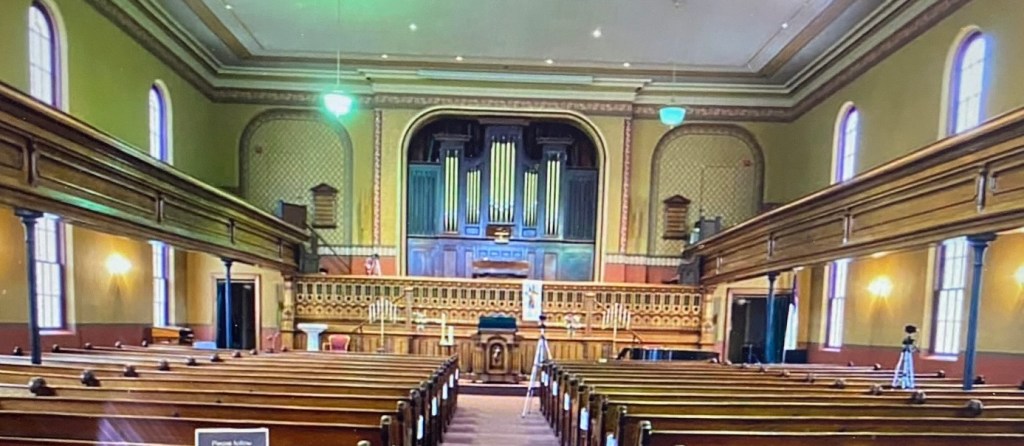
Sanctuary

First Parish Church of Yarmouth, Maine 70 years later

~          

Now is the time to sit, be still, recall

those Saturdays at the First Parish Church,

where through stained glass, sun shines on empty pews,

and dust mots dance a silent jitterbug,

while I, at twelve years old, help out my dad, 

who moonlights as the sexton of our church. 

                                    ~

The great green doors shut out the noisy world—

my school with bells, droning voices, “Pipe Down!”

playground bullies’ intimidating threats;

my house with TV cowboys, Lawrence Welk,

and anxious voices trying to decide

what bills to pay and which to set aside—

as I collect last Sunday’s bulletins

from red pews tagged with names from long ago.

                                    ~

My corduroy trousers whistle as I walk.

I add my voice, which echoes off high walls

 just like Elvis singing, “Heartbreak Hotel”:

“Since my baby left me (whistle, whistle), …” 

Generations of church parishioners

like those in the old photos down the hall

silently applaud, and I feel at peace—

safe from strident voices, embraced, strengthened, 

supported by a Something I can’t name.

                                    ~

Now is the time, when storms of every kind

assault my brittle bones with screaming winds,

that I will sit, be still, watch those dancing

rainbows, sense kindly clouds of witnesses 

enfolding me as I lift soul in song

 in the sanctuary of memory. 

                                    ~

The Snows of Christmas Past

#

After years of counseling and going to meetings, remembering Christmas when I was a kid now feels like peering through my frosted window at a soft and steady snow covering up dead leaves, discarded pumpkins, and broken branches under the diseased hemlocks beside the house.

My family’s disease was alcoholism. Mom’s memories of her drunken father passed out on Christmas Day, her shame at not being able to bring friends home, Dad’s bitter memories of Christmases in a Home for Wayward Boys and in the Army during WWII, his sense of being victimized by a social system he saw based on greed—feelings he tried to wash away with a pint of Old Crow—the arrival each Christmas of my mother’s mother, Nanny C, a large bitter woman whose acid tongue could peel paint, permeated our house during the holidays like their cigarette smoke.

In the weeks before Christmas, I’d hear Dad’s grumpy voice through the register in the floor of the bathroom asking where the hell were they going to get the money and Mom’s brittle reply they were just going to have to find a way; her children weren’t going to have the shitty Christmases she did. And I’d know it was up to me to make sure the holidays were happy. So that Christmas morning when Dad groaned because his head hurt, and Mom and Nanny perched on the edge of their chairs hovering like crows on telephone poles watching my younger brother and sister and me open our presents, and I ripped off Christmas wrapping to find a rainbow-colored wool hat that only a girl would wear, I said, “Oh, I love this. Thank you!” 

Ah, but here come the snows of nostalgia, which, I’ve discovered, is not all bad, especially when it brings memories of wading up to my knees in in the white stuff to help my father cut a tree, the smell of fresh fir as Mom and Dad set up the tree on the porch, decorating it with ornaments I still have 70 years later, popping corn and stringing it on the tree, smelling Nanny C’s fudge and Mom’s cookies and bread, and hearing my grandmother playing carols on our piano.

Or of walking home from sledding in the 5:00 p.m. darkness, carrying my Flexible Flyer past the drug store and the hardware store, their neon lights shimmering, casting shadows on the snow banks, past the big white Georgian houses on Main Street with their candles in the windows, then down Bridge Street, seeing my house and our lighted tree on the back porch, and feeling the Christmas excitement when the possibilities of happiness were as many as the stars in the frozen sky.

Or of helping my father, who moon-lighted as sexton in our church, get ready for the Christmas service by picking up last week’s bulletins from the Sanctuary, alone in this great empty space, the whistling of my corduroy pants as I walked echoing in a great and holy silence, and somehow feeling safe—held, enfolded by a Great Presence.

Then Christmas day: giggling in bed with Jaye and Roger, as we wait for 6:00 a.m. when we can wake the grownups, not knowing that Nanny C is in the next room listening to us with tears of joy running down her face—“Oh, you kids are so good, God bless you!” Christmas dinners of turkey, mashed potatoes, gravy, stuffing, homemade bread, and cranberry sauce (which is what I ate. Let the grownups eat the squash and turnips and beans), followed by Mom’s pumpkin, apple, and blueberry pies topped with Sealtest Ice Cream. In the afternoon, Dad slept off his hangover on the couch, Nanny went back to the piano and she and Mom sang “White Christmas,” “The Christmas Song,” “I’ll be Home for Christmas,” while I played with my new model airplane or helped my brother or sister put together their farm or showed them how to play the new Parcheesi game or took my new skates (but, gee, I forgot my new hat) which Mom and Dad had bought on time to the town rink behind the movie theater or went up to my room to read the book I’d received: maybe Treasure Island, Tom Sawyer, Herb Kent West Point Fullback, a Hardy Boy’s mystery, or Zane Gray.

On Christmas night I went to bed with a plate of cookies and a glass of milk, turning on the radio to my favorite programs, most of which were having Christmas specials: Jack Benny exclaiming after having spent the last thirty minutes buying the cheapest gifts he could find, “Good night, everyone, and merry Christmas!” George Burns telling his wife, “Say good night, Gracie,” and her reply, “Good night, Gracie, and Merry Christmas,” and of course, a version of Dicken’s “Christmas Carol,” probably starring Lionel Barrymore. I ate, finished my milk, and crawled completely under the covers with the cookie crumbs, following Scrooge on his journey from “Bah, humbug!” to “God bless us, everyone!”

 While outside the window, at least in my memory, snow fell in great white, silent flakes.

My sister, Jaye, circa 1954, with her new poodle skirt, doll, and whatever it is on her wrist.

# #

Family Triptych

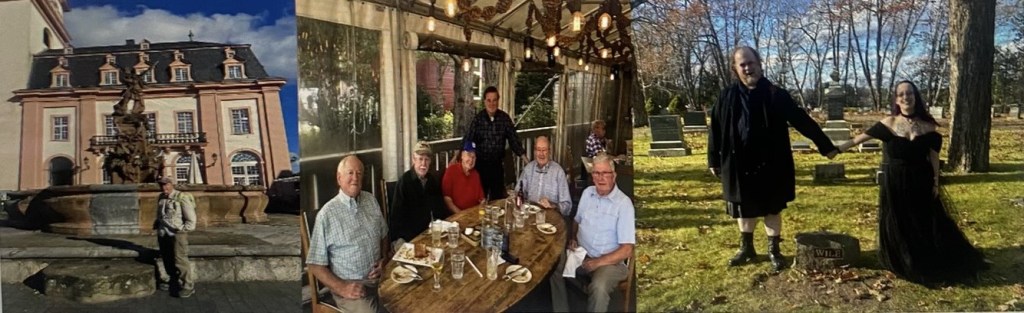
Weilburg

Traveling 3500 miles to a town in Germany

smaller than the one in Maine where I live—

no tours, no souvenir shops, 

no one speaking English except back at the hotel, 

I stand by Neptune’s Fountain 

in Market Square beneath the God of the Sea 

thrusting his trident into the head of some leviathan, 

my lungs still burning from climbing the hill to get here, 

trying to imagine 25-year-old Johann Frederich Weil 

wandering the square 

before leaving for Halifax, Nova Scotia, 

lured by the British Government’s offer 

of free passage, free land, & a year of free rations, 

knowing from Ancestry.com 

his descendants will anglicize the name & populate places 

like Wile’s Lake, Wileville, & Wiles Road, 

until the turn of the 20th Century 

when Lyman & Lester Wile 

leave Canada for a shoe factory 

in Marlboro, Massachusetts 

where Lyman will marry Edith Conrey 

& sire my father who 

because his mother left Lyman when Dad was 4 years old

(apparently because of spousal abuse) 

didn’t give a shit about his father or his family. 

Then Johann dissolves—

if he was ever here in the first place—

into the salmon & cream-colored two-story buildings, 

round-arched arcades, & a matching-colored four-story Italianate castle 

as my wife and I join the half-dozen folks in leather & wool 

sipping beer & coffee at outdoor tables by a small restaurant. 

Still, walking back to the hotel 

looking down the hill 

at the Lahn River, a small waterfall, an old stone bridge, 

I think of the hill I grew up on, the bridge below my house 

over a similar river by a similar waterfall, 

& I feel a weird calm, 

connected by currents beyond my ken.

The Royal River Grill

Walking into a restaurant 

with large windows looking out on the harbor 

& soft lights meant to look like candles, 

I see Buzz & Chuck & Ted sitting at a long oak table. 

A shiver of both anxiety & eagerness 

& the next thing I know it’s 1953, 

when this building was the site of the Stinson Sardine packing plant 

& I’m ten years old & in fourth grade 

& I’m going to my first meeting of Mike’nBuzzie’s Gang 

at Mike’s house just up the hill from here, 

because earlier that afternoon 

when it had been my turn to stay after school 

to erase blackboards, 

as soon as Mrs. Croudis left for the teachers’ room, 

Buzzie’s brother Craig ran into the classroom. 

“We’re getting a gang together 

for an apple fight with the uptown kids! 

Big meeting at Mike’s house! Let’s go!”

Dropping the eraser, I ran out the door—

the first time in my life I’d ever disobeyed one of my teachers. 

But for the first time in my life I didn’t care. 

A timid kid, raised in a family 

where a miasma of alcoholic anger & anxiety 

hung over us like the fumes 

from the neighboring paper company,

I’d lie awake mornings before school 

afraid of the day ahead, 

of having my arm twisted or my face washed with dirty snow 

by sixth graders like Mike’nBuzzie,

and now they want me to join them! 

Never mind that the apple fight with the uptown kids never happened, 

or that Mike now has Parkinson’s & stays home 

& that Buzz & Chuck & Ted & I, and later, Allie & John, 

have little in common these days 

except our L.L. Bean khakis & plaid shirts. 

I laugh & reminisce. 

At home. 

Still part of the gang.

The Cemetery

Under gnarled & broken maple trees, 

I walk around my family cemetery plot, 

taking pictures of the wedding—

of the bride, who stands 5 feet 

& maybe weighs 100 pounds, 

her upper chest tattooed with angels, 

her dyed magenta hair, & flowing black gown, 

& the groom, my stepson, 

probably 6’4” & 270, 

black lipstick & kilt, red-haired & bearded, 

standing in front of the family stone, 

originally part of the cellar of my mother’s grandfather’s house, 

while my second wife, 

an ordained Deacon in the Episcopal Church, 

performs the ceremony. 

My stepson’s two daughters stand as ring bearers 

near the memorial stone for my daughter, 

who died at 18. 

My wife’s ex-husband & his wife 

stand between my grandmother’s granite stone 

& the memorial stone for Nanny’s ex-husband. 

Not far from my great-grandfather & great-grandmother’s marble stone, 

my stepson’s nonbinary stepson from his first marriage 

& their partner also take pictures. 

The bride’s parents view the proceedings 

in front of my mother’s bronze marker 

between my father’s & my stepfather’s bronze markers 

while my second wife’s sister, her daughter & son-in-law 

watch both the wedding and a grandson 

climbing the near-by gravestones 

of my barber, my favorite teacher, 

a classmate killed in Viet Nam,  

& my little league baseball coach—

all of whom, I imagine, 

rolling over in horror at this spectacle 

of everyone dressed in black, 

everyone smiling, 

one big happy family.

#
Looking for What’s New

#

Besides dealing with a decaying body and a deteriorating mind, one of my biggest challenges these days is to keep from living in the past. (And I’m sure the two struggles are connected: of course, I want to recall when I could leap tall buildings in a single bound.) It’s so tempting to spend my days reminiscing with old classmates via email or Facebook, watching “American Bandstand” on YouTube, and replaying 65-year-old high school basketball games.

This last month has been especially challenging. May began at the history center in the town in which I grew up with a program that my oldest friend (going back to the first grade) and I spent the winter planning: “Yarmouth [Maine, for those of you reading this in Singapore and elsewhere], 1955-1962: Times of Change.” We wound up with probably thirty people there who’d grown up in town during those years, bathing in the warm waters of nostalgia, as we talked to newer residents about how Yarmouth changed during that time from a low-income community of shops and small factories to a bedroom-by-the-sea for urban lawyers, doctors, and bankers. A town we kids roamed at will because everyone looked after us—where the local telephone operator would call my classmate Barbara’s house at 3:30 in the afternoon (because she knew Barbara got out of school at 2:30 and would stop at the drug store for a coke, so that’s when she’d get home) to tell Barbara that her mother would be late and that she should turn the oven on 350° and put the roast in at 4:00. (Who needed cell phones?)

Later in the month, as my brother and sister and I cleaned off stones and planted impatiens in our family cemetery plot for Memorial Day, we swapped memories of Mom and Dad and our grandparents. (Amazing how different our recollections are!) Later that week, I went with my wife, Mary Lee, to her 55th college reunion, and for three days listened to other people’s stories about their pasts. Throw in a dream in which I ran into my ex-wife—who died eight years ago—dressed in a white karate gi (still trying to work out the symbolism there), and I’m starting to sink beneath these waves of nostalgia.

I need to get out and open my eyes. Stop looking at what’s behind me and start looking at what’s around me—what’s new. I decide to check out this year’s garden. Besides, I need to put in my tomato seedlings.

It’s a beautiful June morning and the world is new. The apple blossoms and rhododendrons are in full bloom, the air smells of lilacs, and the breeze is fresh. The world is spring green: the grass hasn’t yellowed, the leaves aren’t chewed, and the caterpillars haven’t yet built their ugly tents in the trees.

I put my seedlings and watering can and trowel in the car, drive up and park on the power line road between our community garden (which I wrote about a few years ago: https://geriatricpilgrim.com/?s=Up+to+the+Gahden) and a wooded swamp, home to all kinds of birds, many of whom are singing their ever-loving hearts out.

I had no idea how many birds there are here until I got one of those apps this year for my phone that identifies birds by their songs. So, I check it: cardinal—yes, I know their pulsating whistles; song sparrow—makes sense, I see all kinds of them; gold finch and chickadee—ditto. But what’s a great crested fly-catcher? And a red-eyed vireo? They’re new, at least to me. Cool. 

Turning to the garden, I think of the beginning of baseball season, when, no matter how poor a team’s prospects, there’s always hope for a championship year. 

This year, I’ve got three raised beds, and—God willing; I haven’t planted it yet—a small pumpkin patch. The garlic I put in last fall is up, as are the peas which I planted on May 1st. I decided this year to stake them with some of the branches that came down from last winter’s storms—the first time I’ve ever tried that, and it seems to be working: the peas are grabbing the branches with gusto. In another bed, I’ve got the usual two kale plants which will hold us until November, but for the first time, I’m trying a couple of eggplants and a purple pepper to see what happens. I’ve also planted bush beans for the first time in years. (Mainly because last year, I almost killed myself stringing pole beans, and vowed never again.)

 I wave to Karen down the way who’s working on her bee garden. She’s also building a new compost bin, for which I need to thank her. 

But first, let’s get those tomato seedlings in. 

The sun is warm. I take off my outer shirt and begin raking the bed where I’m going to transplant my tomatoes. I love the smell of the fresh dirt (apparently, it triggers the release of serotonin in the brain—at least that’s what I read somewhere) which makes me want to sing. And because the other night I watched a music documentary on Paul Simon, I serenade the birds with “50 Ways to Leave your Lover”—

            You just slip out the back, Jack

  Make a new plan, Stan

            You don’t need to be coy, Roy

            Just get yourself free—

The really neat thing about the documentary was it focused on Simon’s newest album of songs, many, if not all of them, as I recall, coming to him in a dream. And if at the age of what, 83?, he can still be creating new work, even though I guess he’s now deaf in one ear, then I, at 81, can, too, despite my various diminishments.

I dig six holes and put a little of Karen’s compost in each one. I find myself slipping again into the past: the summers in high school I used to work in a garden and the big garden I had during my first marriage. Cut it out! I think, and then decide, No, let’s use those memories as compost, fertilizer to help me grow.

Which would be more inspiring if my back didn’t already hurt from this minimal exercise. From my other garden bed, I grab my new kneeler and bench combination, which I bought this spring, and kneel on it to put the tomato seedlings into the dirt and the compost, which gets my hands dirty and the rest of me feeling clean. Then, I put collars that I’ve made from plastic medicine cups around the seedlings to protect them from cutworms, and, using the metal arms of the bench to get myself off my knees, rise to get my tomato cages from last year. Finally, I give my little darlings a drink to get them on their merry way.

Feeling accomplished, I sit down on the new iron bench with the “Welcome” sign that someone—probably Doug, who, along with Karen oversees our community garden—has donated. I think about how I still rely on community as much as I did when I was a kid all those centuries ago. 

Looking up, I follow an exhaust vapor trail in the blue sky until I see the sun flash on a plane, high in the sky, probably starting its descent into Boston. I imagine flying to new countries and seeing new vistas and new people.

But right now, right here, there are plenty of new things going on, thank you very much.

# #

13 Ways of Looking at a Door

1

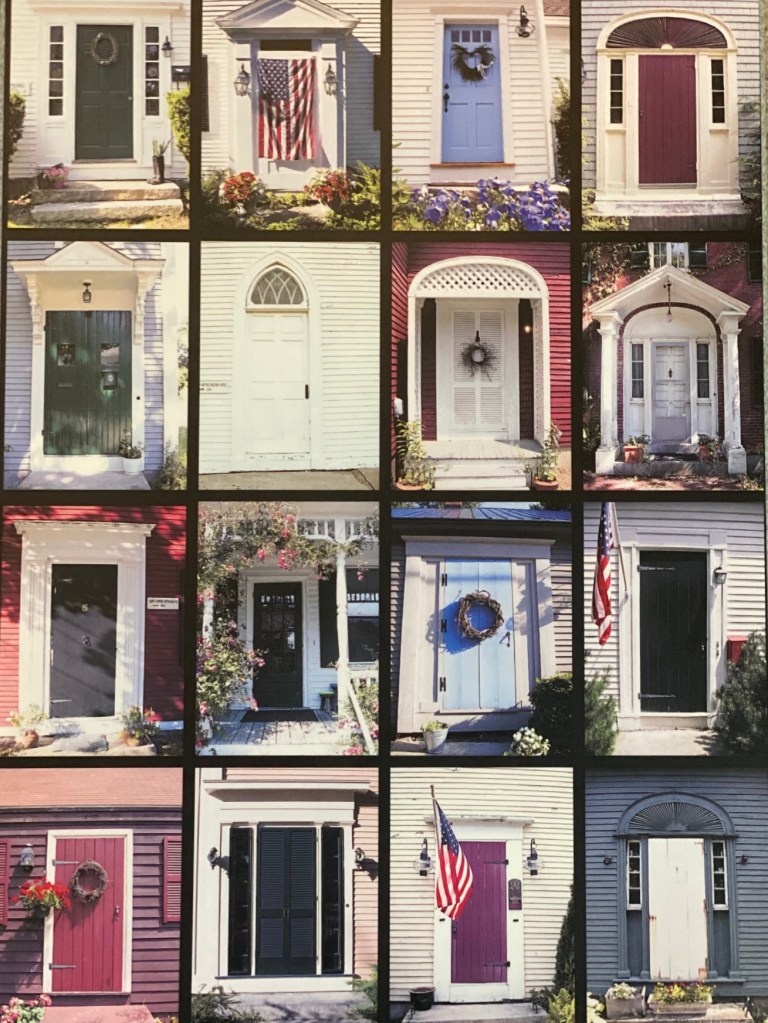
For Christmas one year, Mary Lee gave me a wooden wall hanging called “Doors of Yarmouth,” to remind me of the Maine town in which I lived for so many years. These are doors to old houses that have had careful tending (not to mention extensive and expensive remodeling). The doors come in a variety of colors. Most feature types of cross—sometimes called Christian—paneling. Three are plain wood with long hinges and latches. There are a couple of double doors and one shutter door. Some doors have glass windows, others are framed by small windows, shutters, cornices, lattice work, or flower vines. There’s a gothic arch over one door, a wooden fan over another, and several Greek canopies held up by pillars. All in all, they reveal how Yarmouth has changed from the working-class community I grew up in to the suburbia by the sea it is today. 

2

A little research on the web tells me that doors were conceived in ancient Egypt around 3000 B.C.E. but another site says that archeologists in Zurich Switzerland discovered an oak door possibly dating to 3063 B.C.E. Long before that, at least according to the Bible, Noah put a door in the ark. One assumes a pretty big one. (I’m curious how it opened and closed.)

3

 From the beginning, doors have had more than the utilitarian purpose of protection from nasty weather or people. They’ve identified the occupations of those living in the dwelling and served as marks of power and status. According to the Bible, when King Solomon built his great temple to show God’s power and prestige, he made doors of olivewood, covered with carvings of cherubim, palm trees, and open flowers, which he overlaid with gold. While technically not a door, I suppose, novelist Stephen King’s two iconic wrought-iron gates embellished with bats, a three-headed dragon and spider-like motifs have become a pilgrimage destination for King fans from all over the world.

4

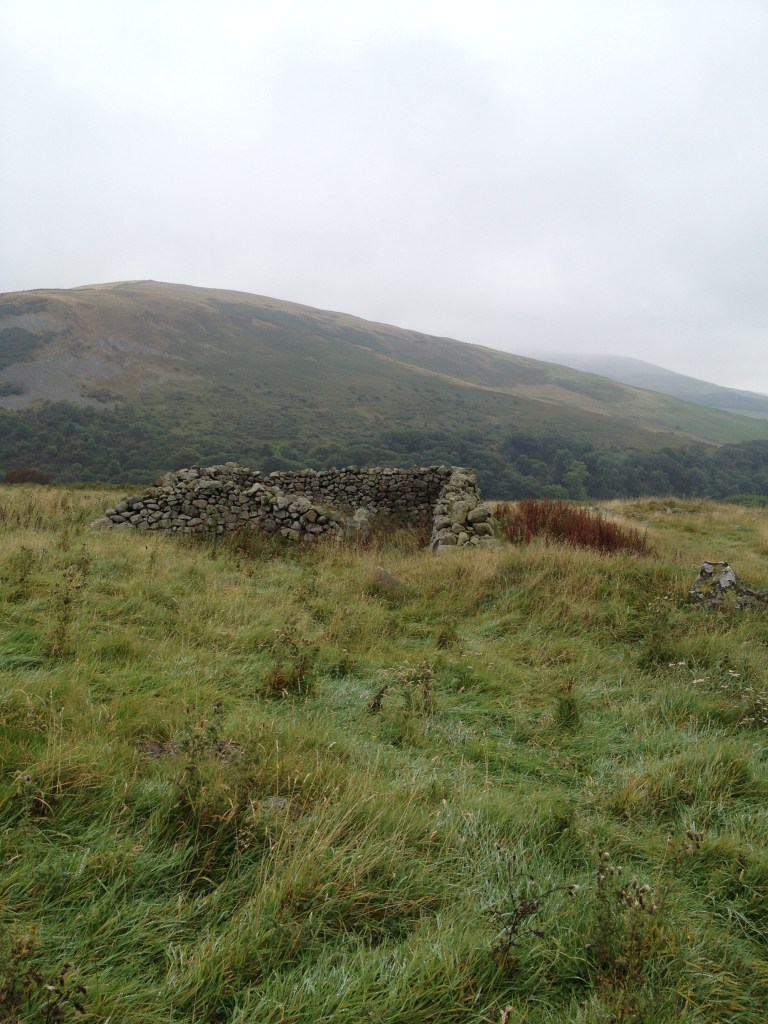
Speaking of pilgrimages, when Mary Lee and I were walking St. Cuthbert’s Way between Scotland and England, we passed a sheepfold, a circular wall of stones with an entrance, which for centuries, served as a place for shepherds to herd sheep at night for protection against predators such as wolves. To keep the sheep in and the wolves out, the shepherd would lie down across the entrance, becoming, as it were, a human door. 

5

Jesus uses this image of the shepherd protecting his flock by becoming a door when he refers to himself as “the gate,” who “lays down his life for the sheep.” Which may be why cross or Christian paneled doors are so prevalent in New England (all the units in our Housing Development have them, inside and out). When my wife Mary Lee—who is a Deacon in the Episcopal Church and a lover of icons—was teaching the in a local high school, she wanted to put up an icon in her classroom but realized it wouldn’t be appropriate in a public school, so she hung a large print of a door on her back wall where she could see it when she taught. It was a great comfort, especially with certain classes. 

6

 Besides Jesus, the Bible refers to other kinds of gatekeepers: those appointed to control who came and left the city through the gates. Thus, the term “gatekeeper” has come to mean a person who controls access, someone in authority who acts as an arbiter of quality or legitimacy, or someone who blocks you from speaking with a decision-maker. Gatekeepers access who is “in” or “out.” I’ve had a few of those in my life, athletic coaches, teachers, whom I’ve had to please in order to succeed. I suppose, as a teacher myself, I’ve also been a gatekeeper. 

7

I’ve also let others become gatekeepers, to whom I gave away authority, surrendered, as it were, the keys to doors I could have opened for myself. Growing up in an alcoholic family once limited my choices when I faced a decision to “What will the neighbors think?” to quote my mother. Through working an Al Anon program and learning to put the focus on me instead of on the me I thought you thought I was, I’ve found keys to open doors I never knew existed.

8

Some of those early Egyptian doors symbolized entrance to the afterlife. Doors can represent transition, confinement, new opportunities. Doors can be metaphors for the choices we make. We learn early on in life that we can walk through some doors and not others. As a WASP male, I know that I have more doors available to me than women, people of color, people of other religions. My destiny has been shaped by the doors I’ve walked through.

9

Or doors that have closed behind me. For a while, Mary Lee volunteered as a chaplain at the local prison. One Christmas, I helped her with a service. My clearest memory is of going through a series of doors and hearing the loud, definitive clang as each door closed behind me. I’ve had a few of those definitive door closings in my life: the death of my daughter, a divorce decree, a couple of retirement parties. Most of the time, however, I find that doors close behind me without my noticing. One reason I took early retirement from teaching high school English was that I saw too many colleagues still standing in front of their classes, even though, emotionally, they’d shut the door on their students years earlier. One of the things I dislike about the geriatric life is that doors keep silently closing, until suddenly I realize, I can’t do this anymore! Can’t climb that mountain, can’t reach that note, can’t eat that food, can’t…

10

On the other hand: My Quaker friends say that sometimes a door needs to close before another can open. That’s certainly been the case with me. I had to close the door on a forest management program before I could open the door to what’s been for me a fulfilling teaching career. I had to retire from public education before I started writing. After my daughter died, I had to lose every image of God I’d ever had before I encountered the Grace of God of my not Understanding.  

11

In late 1960’s, I listened to a rock group, The Doors, who named themselves after the title of Aldous Huxley’s book, The Doors of Perception, in which he reflects on his psychedelic experiences. Huxley himself had based his title on a line in English poet William Blake’s The Marriage of Heaven and Hell: “If the doors of perception were cleansed, everything would appear to man as it is: infinite.”

12

These days I’m trying to clean the doors of my perception through contemplative practices such as meditation, going on more retreats, walking meditation, contemplative reading, sessions with my Feldenkrais teacher, journaling, music, working on my listening, writing these blogs, and of course, making more pilgrimages, even if they’re only to the compost pile. 

13

And I’m not done opening new doors. I’m hoping I have a few longer trips left ahead of me. Speaking of trips, I note that interest in psychedelic drugs is again increasing, thanks to books like Michael Pollen’s book How to Change your Mind.Indeed, I have a 92-year-old friend who’s seriously considering a guided psychedelic experience. That’s another possible door. 

And, of course, there’s the Big Door ahead of me. That, too, will be quite a trip, I suspect. 

#

Sunday Afternoon Drives

Bridge St Party.1958
The Parents. Thanks to my sister, Jaye Sewall, for the photo.

#

A few weeks ago, I was sitting on the back patio, using my recent heart surgery as an excuse to doze in the sun, when I started thinking about a forgotten era in my life, in the life of many Americans, I suspect: the Sunday afternoon drive.

For me, this era lasted from the late 1940s, when my parents bought their first automobile (I think it was a used 1946 Ford), to the mid 50s, when the advent of television and Sunday afternoon sports kept my friends and their fathers at home. During that time, I recall that on Sunday afternoons from spring into the fall, anywhere from three to seven families—the Wiles and the Prides and the Loomises, the Rollstons and the Haskells, the Teffts and the Jameses—would pile into their cars and spend the afternoon traveling the back roads of southern Maine to places like Blackstrap Hill and Pleasant Mountain to look at foliage, Two-Lights and Reid’s State Parks to see the surf, and Sebago and Crystal Lakes to swim. Sometimes, we’d just take off and head into what I still think of as Maine’s Bermuda Triangle: a series of labyrinthian back roads that no matter which one we took always somehow ended up at a reed-infested body of water called Runaround Pond.

Every one of these families had a kid close to my own age, and it was great fun swapping parents, so I could ride in a car with Craig or Richie or Peter. Some parents were more lenient than mine, and let us rough house or yell or sometimes sing, which made me feel like I was playing hooky from school; other parents were more strict, making us sit still and whisper, which made me feel like my own parents weren’t so bad after all.

Watching all these parents interact gave me my first glimpse into the confusing world of being an adult. I couldn’t understand why all the men and most of the women puffed on cigarettes, filling the cars with smoke and stinging our eyes. They often spoke in a strange sort of code that I didn’t understand and laughed at things that made no sense.

(Eventually, I learned that many of these comments had to do with sex. I remember what might have been the earliest “dirty” joke I ever heard—although it took me a while to figure it out:

Question: Who was the first carpenter?

Response: Adam?

Answer: No, Eve. She made Adam’s banana stand.)

And I find that some seventy years later, my parents and their friends still seem to me to belong to a mysterious world beyond my understanding, a world now lost to me forever. Browsing through the 3”x 3” black and white photos in my mother’s old albums show them to look older than their children did at the same age: in their 40’s, they look to be in their 50’s and 60’s—probably the result of the cigarettes they smoked and the fatty foods they consumed (my father started the day with eggs and bacon right up until he died at the age of 66), but also probably because compared to today, they look dressed up. Men wore ties, some even on Sunday afternoon drives, and for the most part women wore dresses.

Compared to today, our mothers seldom used profanity and our fathers used a lot less when we were all together. And the “F Word” was rare even in a group of men. On the other hand, all our parents peppered their language with racial and cultural slurs, with epithets for Blacks, French-Canadians, Italians, Indigenous peoples, Gays, even Catholics. I could get my mouth washed with soap for saying “Goddamn,” but no one did anything except chuckle if I called John Nappi a wop.

All of our parents were affiliated with either the Congregational or Baptist Church in town, but except for my parents and the Haskells, the other families usually attended church only on Christmas and Easter. Their real religion was the United States of America. (It was during this time that “under God” was added to the Pledge of Allegiance.) One Memorial Day—I was probably 7 or 8—I was walking down the street carrying a full-sized American flag over my shoulder and Earle Pride yelled out the door of his store at me because the tip of the flag was dragging on the ground.

And if their religion was the United States, they worshipped the American Dream. New washing machines and dryers, larger television sets and “Hi-Fi” record players, pine paneled rec rooms, and most of all, new automobiles. It was common to trade in for a new car every couple of years or so, and when one of our parents did, the car became an object of veneration for weeks, with all us kids scrambling to ride in it on Sunday afternoons.

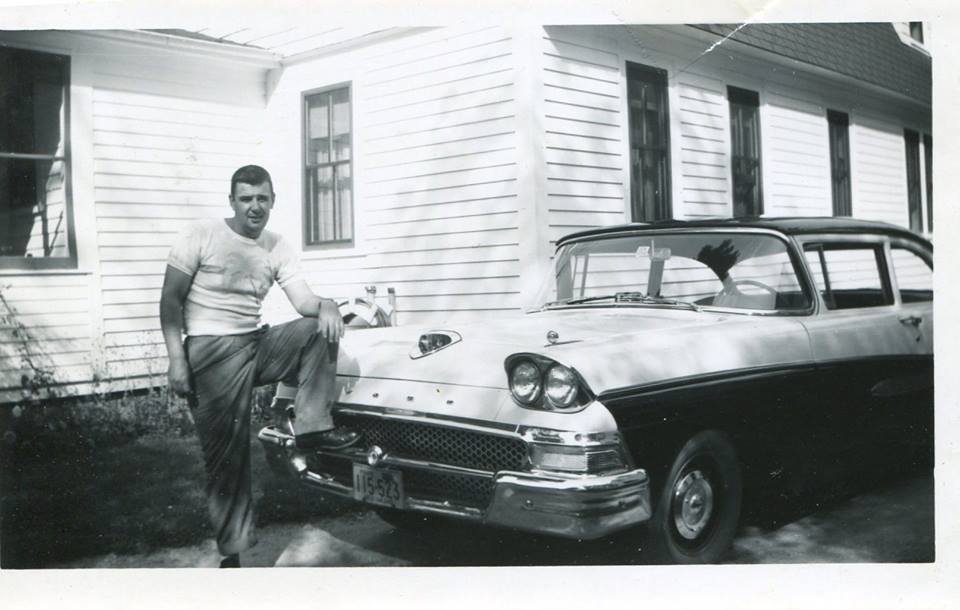
Dad
And thanks to my sister for this photo of  Dad standing by our first brand new car!

Those afternoon drives then became a worship service, celebrating our parents’—all of whom had grown up during the Depression—rise into American’s great Middle Class, with the freedom to follow new roads to a brighter foliage or higher surf or a longer beach. And if they got lost, or suddenly found themselves back at Runaround Pond, well, there was always next week.

It’s easy for me to criticize their provincialism and bigotry (and later in life, I did), but maybe because I tire easily these days, or maybe because I’m aware that I don’t have the goals, the dreams I used to have, I find that I miss the energy, the—excuse the pun—drive of those black and white people in the old photographs.

I also realize I miss the faith I had back then in my parents and their friends. Before the advent of Elvis and the generation gap, I believed in them more than I believed in God. I remember one Sunday drive. It must have been in the late 1940’s when forest fires burned large parts of Maine. One of our parents heard that there was a big fire in Brunswick, so we all piled into the cars to go look. I don’t remember the fire, only that as we turned the cars around to head back home, I was in the back seat of Earl Pride’s powder blue Dodge with Earl’s son Craig. One minute we were horsing around, and the next minute Craig was gone and the back door of the Dodge was swinging in the wind. Earl slammed on the brakes. I looked behind and saw the other cars screeching to stops. Doors opened and parents rushed to Craig, who was still rolling in the gravel beside the road. My stomach rose into my throat leaving a great empty cavern, until I saw Earl lift his screaming son into his arms, bring him back to the car, and lay him beside me in the back seat. “He’ll be okay,” he told his wife, Doris, “just some scraps and a bump on the head.” And Earl was right. Because he was just starting to accelerate when the door opened, the car wasn’t going that fast. But as far as I was concerned, Craig was never in any real danger. Once his father had him in his arms, I knew he’d be fine.

I had lunch with Craig last week. Like me, he’s had heart surgery, but all things considered, we’re both doing pretty well. Still, other friends have gone this year, some of them almost as suddenly as when Craig disappeared from his father’s blue Dodge. It seems as if one minute they’re here, the next minute, they’re not. And I find myself searching for some older, wiser voice, telling me that everything’s going to be all right. They’re going to be fine.

# #

Ebb and Flow

IMG_2923

IMG_2951
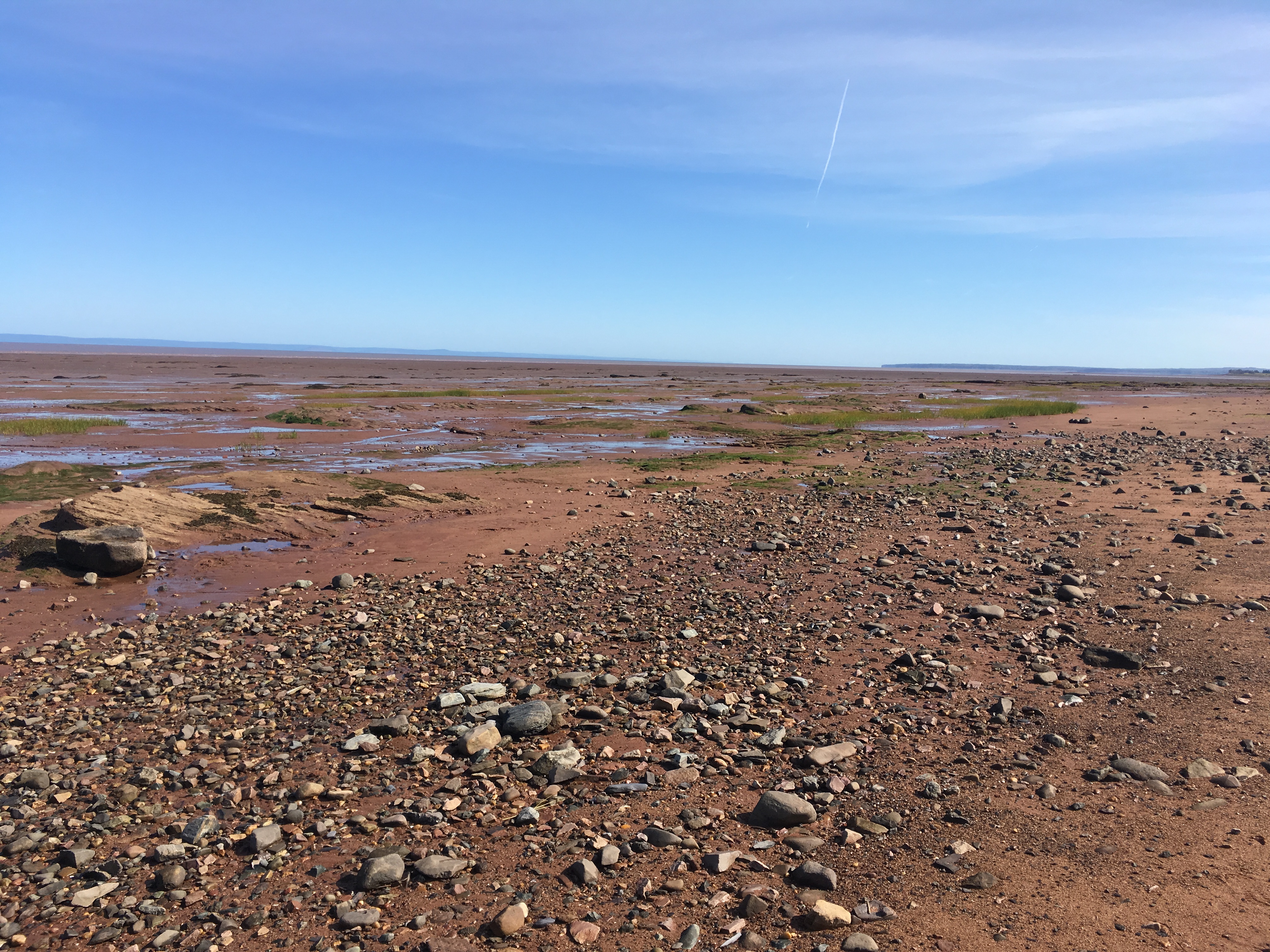
Minas Basin, Nova Scotia


#

Expose a child to a particular environment at his susceptible time and he will perceive in the shapes of that environment until he dies. —Wallace Stegner

#

I think one of the reasons I like to travel is because I’ve lived almost my entire life in one small part of the country: the Maine coast. Like the seamen who used to live here, I want to see the world but then return home—a kind of going out and coming back mirrored in the rising and falling of the tides I’ve grown up with. The ebb and flow of the ocean has embedded itself in my imagination, shaping the way I understand my life.

For example, when I was growing up in Yarmouth, Maine, I used to play—despite my mother’s warnings and wallops with her hairbrush—in what was called “The Black Ash,” acres of black soot and gravel created some twenty years earlier when the town’s paper company, at the turn of the twentieth century one of the largest in the world, burned to the ground, leaving a cavernous wasteland of toxic ash. In college, when I had dreams of becoming the next Ernest Hemingway, I used the Black Ash in my creative writing class as a symbol of how a once prosperous town had died. Today, however, the land is grass-covered and home to a post office, a number of businesses, doctors’ offices, and a large assisted-living facility. Ebb and flow.

What I don’t think I’ve ever realized before now is that for most of my life, I’ve tended to think of ebb as something negative or low, and flow as positive or high: low as in mud flats, empty, weak, enervated, poor; high as in more spiritual, more beautiful, full, at your peak, prosperous.

The thing is, I have great memories of the Black Ash. There were ash-gray canyons peopled with—depending on what movie I’d last seen at Carlton’s movie theater—Indians, space aliens, or Nazis. I’m sure the reason my mother didn’t want me playing there was because the landscape was punctuated with dangerously deep brick wells, but as far as I was concerned, the wells led down to a land of dinosaurs and curvaceous women in leopard-skin bikinis. In the 1950s, when I played in the Black Ash, the town was small and the people friendly. It was a great place to grow up.

When I moved back to Yarmouth as an adult, I took my two step-sons to the Black Ash a year or so before the town began to clean it up and got a chance to relive my childhood.

fullsizeoutput_1665

But, to be honest, one of the reasons I’ve since moved away again is because I never felt I belonged in the designer coffee shops, chiropractors’ and psychiatrists’ offices located where the Black Ash used to be.

Is high tide better than low tide? If you’re a swimmer, perhaps, but not for if you dig clams for a living. And while I may feel that the current political situation shows this country to be at its lowest ebb, I have conservative friends who feel we are at our highest point in history.

Ebb and flow, then, are relative, not only to each person, but, I find, to all of life. Albert Einstein’s Theory of Relativity and Max Planck’s work in quantum physics has shown how everything is dependent upon everything else. You can’t have an “in” without an “out,” you can’t have an “up” without a “down,” and you can’t have an “ebb” without a “flow.” Everything is relative; everything is connected.  Something the Buddhists have been telling us all along.

My daughter’s death was certainly the lowest point in my life, a time when I felt all my hope, contentment, and well-being had ebbed away. And yet, it is only in the years following her death, that I have felt joy, felt overflowing with happiness. Before Laurie’s death, my emotional life was limited by my New England upbringing compounded by being raised in an alcoholic family. Laurie’s death broke me open. Only by going to the depths was I able to realize the heights, feel the joy of music, grandchildren, and, most important, the physical, emotional, and spiritual love I share with my wife.

A couple of years ago, Mary Lee and I drove through Nova Scotia and spent several hours walking Minas Basin, the site of the world’s highest tidal ranges, where twice a day, the Bay of Fundy ebbs and flows through the Minas Channel between Cape Split and Cape Sharp, completely emptying and filling the Basin. At high tide, the ocean seems vast, while at low tide we walked through a landscape of red sandstone and volcanic rocks, cliffs, and sea stacks. Now you can see ocean vistas like Minas Basin at high tide up and down the Northeastern coast, and you can see sandstone and volcanic rock all over this planet. It’s the relationship between the two landscapes —the tidal range of what can be as much as 50 feet—that makes them both unique and one and the same. Much the same way Laurie’s death has emptied me with grief and let joy into my life.

As I travel further along this pilgrimage through life, I’m more aware of how its ebbs and flows run like water-colors, painting a single picture, one I can only see by looking back, but which gives me hope for what lies ahead.

And I find myself more and more intrigued by the question: Who is the artist painting this picture?

fullsizeoutput_1662
Watercolor by Laurie Wile

# #

For more on Nova Scotia, you might be interested in my blogs: https://geriatricpilgrim.com/2017/10/16/here-comes-the-judge/ https://geriatricpilgrim.com/2017/10/02/rooting-around/)