Behold, I give unto you power to tread on serpents and scorpions, and over all the power of the enemy: and nothing shall by any means hurt you.—Luke 10:19
Staring at my 3 a.m. fears—A burning planet, a demented president-elect, disease, death—I think of you for the first time in years: first friend, neighbor, bodyguard, mentor, and, although three years older than I, my classmate from fifth through seventh grade.
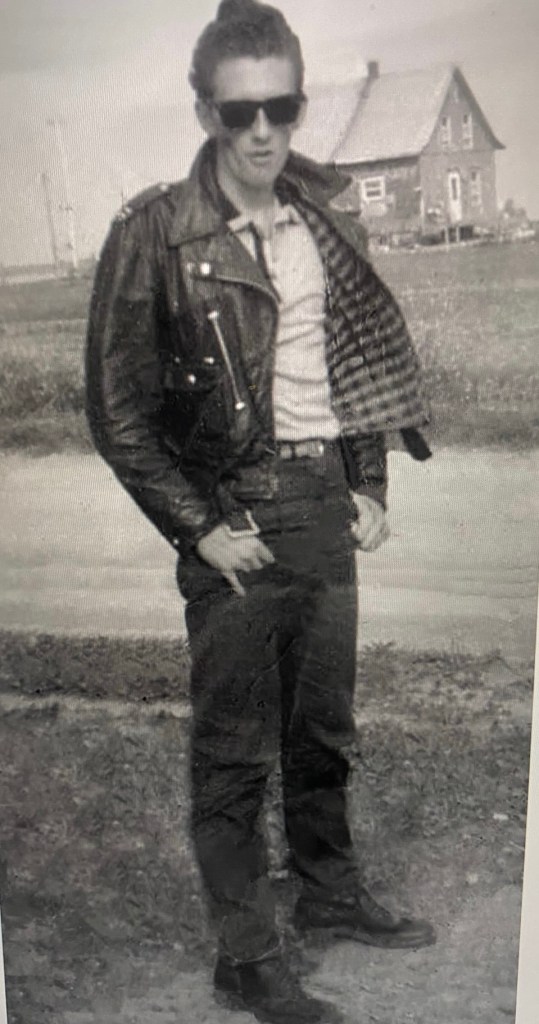
Thick black hair and an Elvis sneer, Kirk Douglas dimple in your chin, sleeves rolled up as far as they’d go to show those growing muscles, your dark eyes often flashed anger at the world, but also amusement and compassion for the pudgy, awkward kid who worshipped the ground under your motorcycle boots.
Buddy Fitts, Freddy Gallant, Bucky Lapoint—none of the playground bullies—dared trip me, twist my arm, scrub my face with snow, because they knew they’d have to fight you first. And you were tough: sauntering up Bridge Street coatless in a ten-degree storm, snow clinging to your hair like chainmail on the Black Knight, carving your name on your veiny forearm with a Gillette Blue Blade.
In class, you never raised hell, never passed in a paper, just sat in the back seat looking cool until you turned sixteen and could legally split the joint. You cut CAROL into your upper arm and went to work in the cotton mill.
Playing basketball, fumbling with the buttons on Daisey’s sweater, I hardly knew you’d left. Never saw you much afterwards. Heard you and Lapoint started a paving business.
Home from college, I once walked by your house. You hadn’t grown since grade school but your tattoo was cool—a tiger’s head spanning your boney back as you banged away on a rusty Chevy. We grunted greetings. I forgot you.
At our 50th high school reunion, your cousin Roland said you lived in Tennessee, belonged to some Pentecostal church that prays with poisonous snakes to show God’s power over evil.
This dark morning, my friend, I think of how you protected me, wish you were here to keep me safe from the serpents slithering around me.
I’m aware of how old I am when I recall that one of my chores when I was kid was to lug old newspapers, magazines, cards and letters, anything paper, out to the old oil barrel in the back yard and burn them. No curbside pickup in those days. (Hell, our town didn’t even have curbs.) It was not a job I liked. Sometimes, I burned myself; sometimes my fingers went numb in the cold; sometimes it took me two or three or more kitchen matches to get a fire started, depending on the wind, which sometimes blew acrid smoke in my eyes.
In those days, fire was a physical force to be endured, and I was more than a little afraid of it.
Sunday School didn’t help. Mrs. Raines warned that if I wasn’t good and didn’t do my chores, I might go to Hell, which was a place of fire and brimstone (I didn’t know what brimstone was, but I was pretty sure it burned)—words I often recall when I think of the fires around me these days: the ecocide of our planet, the continued threat of nuclear annihilation, riots on our streets, countless false messiahs fanning the flames of our differences.
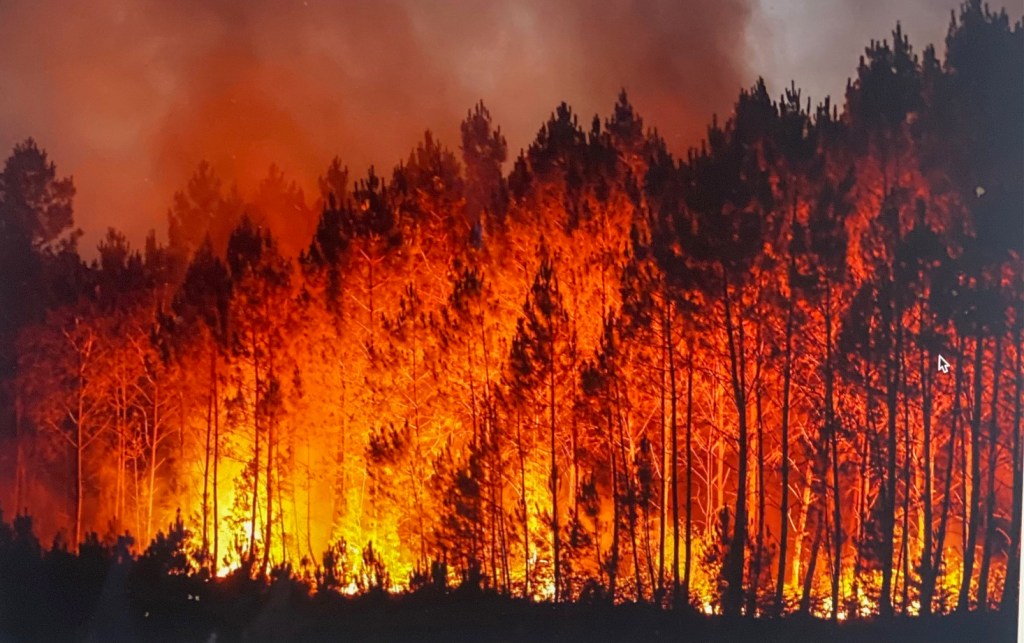
A dozen years or so after Sunday School, I saw worlds—or at least woods— go up in flames. I worked for the U.S. Forest Service on a regional Hotshot Crew based in McCall, Idaho. (The term “hotshot” describes those who work on the hottest part of a forest fire.) Looking back, it was hot, dangerous, and grueling work, and my lungs carry the scars from those fires.
But at the same time, I loved the physical challenge. (Hey, I was 20!) And there’s been nothing in my life like the thrill of watching a forest fire racing through the tops of trees. It was frightening, but at the same time enthralling.
I also learned that despite Smoky the Bear’s telling me, “Only you can prevent forest fires!” (What a burden to put on kids!) most of the fires I fought were caused by lightning strikes and that the occasional fire was actually good for the forest. When flames consume organic matter, nutrients are released back into the soil. Fires can thin the canopy allowing more sunlight to reach the forest floor, encouraging the growth of native species and eliminating invasive weeds. Fires can promote species diversity. (Some species, such as the karner blue butterfly and the wood lily depend on fire to survive.) Fires can improve habitats for wildlife by reducing dead vegetation and stimulating new growth, which can provide food and cover.
During my first marriage, I used to help my then father-in-law burn brush in the winter. It was an all-day activity. We gathered all the limbs and underbrush we’d cleared during the year from around his house, piled them on a couple of old tires filled with gasoline and set it ablaze. I was still in good physical shape, and I enjoyed the exercise. But I experienced another aspect of fire as well. Poking at the burning brush in the gathering darkness, gazing into the flickering shadows cast by the fire on the surrounding snow, I sensed my ice age ancestors dancing around the flames which protected them from wild animals and the cold.
A couple of weeks ago, Mary Lee and I watched two fireflies sparking the summer night. A little research told me that fireflies produce light in special organs in their abdomens to find mates. When a female sees a male making a signal, she flashes back. Then the two reciprocally signal as the male flies down to her. If everything goes right, they mate.
All I could think of was the Bob Seeger song, “They got the fire down below.”
Another kind of fire I remember.
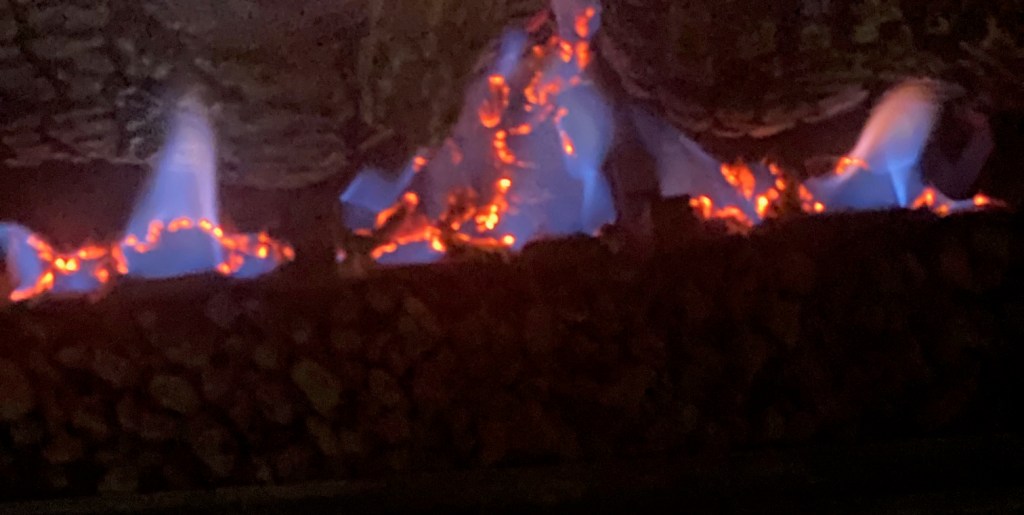
Now, it’s been sixty years since I’ve seen a live forest fire, let alone fought one, and probably forty since I’ve burned a pile of brush. I’m tired out after an hour in the garden. Often these days, a romantic evening is playing Scrabble or Canasta until 9:00 p.m. But I’m still drawn to fire: I can spend hours staring at the flames in our fireplace.
I’ve also become more aware of what I think of as the fire of Presence, represented, I think, in the Bible’s Old Testament by the burning bush that drew the attention of Moses and in the New Testament by the Holy Spirit descending upon Jesus’s followers as “Divided tongues, as of fire….”
One of my old spiritual directors used to tell a story from the Desert Fathers in which a young monk said to his teacher, “Abba, as far as I can, I say my little office, I fast a little, I pray and meditate, I live in peace as far as I can, I purify my thoughts. What else can I do?”
His teacher stood up and stretched his hands toward heaven. His fingers became like ten lamps of fire. And he said to him, “If you will, you can become all flame.”
So far, the closest I’ve come to experiencing this fire happened during the last two months of my daughter’s life. After spending the day in the hospital by Laurie’s bedside, I’d go each afternoon to the hospital chapel. I was almost always the only person there. Upon entering, I’d light two pillar candles on the altar, sit in the front row of chairs, and stare between the candles through a large round window looking out over the river. After a while, the candles would sometimes seem to glow more brightly, their light dancing. The flames would come together, enfolded by the stained glass around the window. Then, I too would become enfolded in a fiery feeling of being scoured of fear and anger and shame, which allowed me to face the next day.
These days, as I sit by our fireplace, it’s hard not to identify with the dying flames. But I realize even glowing embers can still, like forest fires and fiery brush piles, like altar candles in a hospital chapel, purge away what is false, promote new growth, light someone’s way in this burning world.
A few weeks ago, after seeing a doctor about increased soreness in her knee, my wife Mary Lee began a new regimen of physical therapy: quad stretches, hamstring stretches, mini squats, wall sits, looped elastic band hip extensions. These to go with exercises she’s been doing for years to restore movement to her right shoulder. (I like the one where her hands look like frightened spiders scampering up the wall, and another one where she uses a can of Great Northern beans.)
Because I’ve been doing various daily exercises since back surgery in 1977, mornings at the Wile residence resound with creaking bones, tendons rubbing on cartilage, occasional grunts punctuated by yawns and a “meow” or two from our cat, who has taken on the role of personal trainer.
“Faster! Move it, move it!”
Our bedroom looks a bit like Rick’s Sporting Goods, with two sizes of exercise mats, two sizes of weights (in addition to the can of beans), rubber stretch bands, and folding chairs. A treadmill resides in the guest bedroom across the hall.
Physical therapy after my back fusion was deceptively simple: walk ten miles a day for three months. Every day. Sun, rain, snow, sleet, hail. And since I was operated on at the end of December, I walked through it all. Sometimes in the same day. But you know, I grew to love those walks (Well, Route One got a little boring but at least it was clear after a snowstorm), and I kept walking—maybe not ten miles every day, but often five or six.
Twenty years later, after bi-lateral hip surgery, my physical therapy involved water exercises; walking back and forth for 30-45 minutes in the shallow end of a pool, pool dumb bells, and gloves that made me look and feel like Aqua-Man. But it worked. On a trip to Florida to visit my parents over school vacation, two months after the surgery, Mary Lee pushed me through Newark Airport in a wheelchair to get to our connecting flight. On our return a week later, after spending most of my time walking the swimming pool, I strode through the same airport feeling like Hercules Unchained.
That led to yoga, tai-chi, back to walking, this time with my hiking poles that I named Waldo & Henry (To learn why, go to https://geriatricpilgrim.com/2020/02/07/waldo-and-henry/), which led to the hikes and pilgrimages that became the blog you’re reading.
Flash ahead another twenty years: open heart surgery, and more physical therapy at a rehabilitation center, where three times a week for six weeks, I taped on my heart monitor, rode a stationary bike, walked a treadmill, and lifted weights. When the program ended, I bought the treadmill that sits in the guest bedroom (great for watching TED talks, but I still miss those cute nurses at ReHab) and the weights that I use instead of cans of Great Northern Beans.
I don’t do the Kettlebell Squat Swings
But I’m falling apart more quickly these days. Over the last two years I’ve added breathing exercises to help my “moderate” COPD, more stretches to help with the bursitis that seems to have camped out next to both my bionic hips, daily exercises at the computer to ward off Carpel Tunnel and something called Ulna Nerve Entrapment, and weekly sessions with a Feldenkrais instructor.
As Thomas Jefferson said, the price of freedom is eternal vigilance. Or in the words of my old PCP, move it or lose it.
#
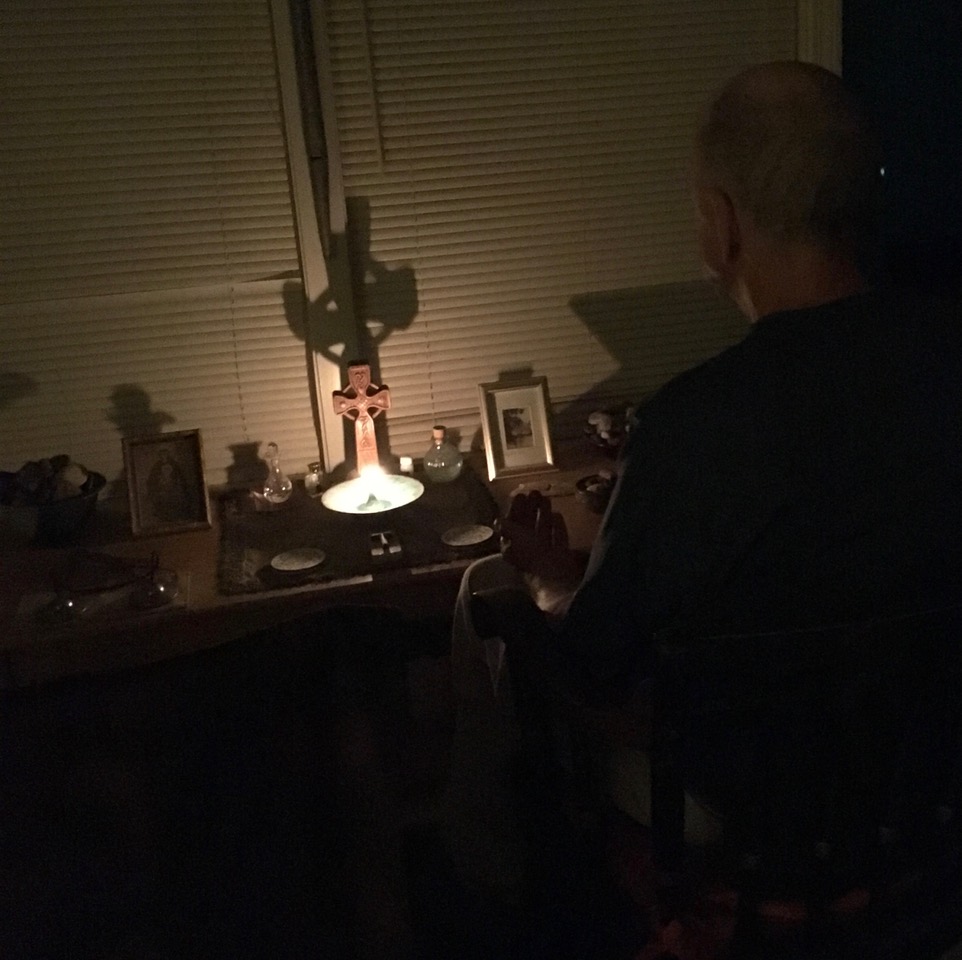
Before Mary Lee and I begin our morning grunting, stretching, creaking, and moaning, we sit in contemplative prayer for twenty minutes, a practice I’ve maintained since my daughter died 35 years ago, when, after raging at God for several years, I decided I needed to listen to what God had to say back. This listening—with my whole body, with all my senses—is what I continue to try to do. As I think about it, this, too, is a kind of physical therapy.
Starting the day
I’m reading a lot these days about quantum physics and spirituality. As I understand it, quantum physics posits that the universe is conscious, if by “conscious,” one means a system that can communicate or process information and then use this information to organize itself (which is what all those protons, neutrons, and electrons that make up the atoms that make up all matter do). So, mind and body aren’t two separate things but rather two aspects of the same cosmic material.
Modern writers about spirituality, such as Richard Rohr, Diana Butler Bass, Phillip Clayton, and Ilia Delio, seem to me to propose that this cosmic material, this “consciousness” that resides within me as well as around me, is the incarnational presence of God. So that in meditation, I am trying, as I am when I do my stretches and lift my weights, to reestablish pathways, strengthen relationship with what 12-steppers call a Higher Power.
Besides meditation, I do other exercises to strengthen my spiritual muscles. My Feldenkrais sessions, focusing on integrating eyes, head, shoulders, ribs, pelvis, legs, and feet to facilitate ease of movement, remind me that one of the great spiritual lessons is that everything is connected. And that my job—my “exercise,” if you will—is to recognize and facilitate these connections.(And for more about the importance of connecting, go to https://geriatricpilgrim.com/2024/02/01/connecting-the-dots/)
One of my character defects that keeps me from connecting is trying to control everything and everybody. So, at the suggestion of my Al Anon sponsor, I’ve been taking Waldo and Henry for walks without having a destination. When I first started doing this, I felt lost. I walked in circles. But as I persisted, I discovered roads in the neighborhood and paths in the woods I’d never noticed before. Which is leading me to try to approach other activities, such as meetings, book readings, and potential confrontations with family and acquaintances with the same curiosity, trying to surrender presumptions, looking for the sacred in situations I’ve always avoided and spiritual teachers in people I’ve always disliked.
Probably more than anything else, it’s the physical act of writing which connects me with the Sacred. The only way I can even begin to understand concepts such as quantum physics and the ideas of those spiritual writers I’ve mentioned is to first put the ideas down in my own words on a yellow legal pad with my bold-ink pen. I can write second/ third/ fourth/ ad infinitum drafts of my blogs on a computer. I can edit on a computer. But first I need to work those pen and paper muscles.
Of course, the ultimate integration of mind and body (and what I’ve been working my pen and paper muscles on for the last eight-plus years) is the pilgrimage. Last week, a friend sent me a recent article in The Guardian about the increasing numbers of people making pilgrimages. (In the early 1980s, for example, the number of people who walked the Camino de Santiago—the most famous of all pilgrimages—was in the low hundreds; last year, the number was 446,000.) I’m delighted that people are finding that this combination of physical and spiritual activity can be healthy, healing, and holy.









 The Geriatric Pilgrim: Traveling the Landscape of Faith and Grief