Names I’ve Carried

IMG_3232

#

One of the gifts of writing this blog is hearing from people I used to know in what I call my “other lives.” Recently, after a comment on my blog by an old high school classmate who called me Ricky, followed by one by a former student calling me Sir, I realized one way to identify these other lives is to look at how people from my past name me.

So far, in thinking about the names I’ve carried on this pilgrimage that’s approaching three quarters of a century, I’ve come up with Rickie, Ricky, Richard, Richman, Wile, Wildman, Twinkle-Toes, Sweetie, Lofty, Rick, Dick, Rich, Maine, Froggy, My Son, My Son the Educated Fool, Mr. Wile, Wiley Coyote, Perfessor, Mr. Advanced Placement, Honey, Officer, Sir, Bro, Brother, Da-Da, Dad, Your Father, You Son-of-a-Bitch, You Shit, Darling Rick, You Poor Bastard, Pastor, Ass-hole, Hey You! Gampa, Grampa Rick, Grampa Friday.

#

Once a year for at least the last twenty-five years, I’ve celebrated my birthday by watching the classic movie, Casablanca. When my mother saw that movie in 1943, she was, in the words of the King James Bible, “with child,” and thinking Humphrey Bogart’s character, Rick Blaine, looked like my father, decided to name me Richard and call me Ricky, the name I grew up with.

Almost all of the boys I knew had an “ie,” or a “y” at the end of their name: Willie, Allie, Teddy, Scotty, Dougie, to name just a few. The website “English Language and Usage” states that this practice dates from the Middle English, and denotes familiarity, intimacy, or tenderness—all feelings I was graced to grow up with. But by the time I was eighteen, I thought my name childish, a symbol of being overprotected, hemmed in. I wanted to be the Rick of Casablanca, the mysterious figure lurking in the shadows of Morocco, sucking on his unfiltered Camels, nursing his whiskey and his deep, dark past, and of course, his love for the beautiful Ilsa. The Camels and the whiskey led to what my doctor calls “mild” COPD and a few battles with booze before I surrendered to a twelve-step program. Still, one of the first things I noticed when I met my wife Mary Lee was how much she looks like Ingrid Bergman. Like Bogart’s Rick, I’m, in the words of Inspector Renault, “a sentimentalist,” hiding behind a veneer of sarcasm. I like to think I have Rick’s integrity and concern for the underdog.

fullsizeoutput_131e

#

I’ll never forget the first time a student called my Mr. Wile. I didn’t know who the hell he was talking about. But as other students called me Mr. Wile, I began to experience a pride, a sense of importance, authority, I’d never had before. N. Scott Momady writes in his memoir, The Names, that Native Americans receive names so that they might grow into them. This is what I did with my new name, Mr. Wile. I became that authority figure—stern, demanding. In the early 1970s, when teachers and students alike were dressing more and more informally, I wore double-breasted sport coats, bell-bottomed slacks, paisley ties, and matching pocket handkerchiefs. I covered my students’ essays with corrections and comments, and more than once reduced a school valedictorian to tears.

One summer, almost twenty years after becoming Mr. Wile, my first wife, our daughter, and I went to a local Fourth of July parade. I ran into some former students, now in college. They said nice things about how well they were doing in English, how thoroughly I’d prepared them for college expectations. I wished them all the best, lit my pipe, and blew a self-satisfied smoke ring. Above the clamor, a voice cried, “Hey, Mr. Wile!” I looked around for another student. I heard the voice behind me: “Mr. Wile?” Turning, I saw my daughter, Laurie—she was probably twelve at the time—her eyebrows raised, her forehead furrowed. “I’ve been saying Dad for the last five minutes,” she said, “but you never noticed me.”

My God, I remember thinking, is Mr. Wile all I am, even to my own child? Of course, that wasn’t the only reason I quit the Rotary Club, the church Board of Deacons, my job, and my marriage, but it became an easy reason to point to. And when Laurie died of cancer six years later, my guilt and shame over the memory of Mr. Wile and not Dad pounded in my chest like one of the monsters in the Alien movies that were so popular at the time, threatening to explode and tear me apart.

#

Most of the names I’ve carried have come from other people, but there was one name I gave myself. About eight years after Laurie died, at a time when I thought that I’d gone through the worst of my grieving and that Mary Lee and I were finally starting to enjoy life again, I experienced a period of darkness such as I hadn’t experienced since the first months after my daughter’s death. I became withdrawn, angry all over again, bitter, especially with other people who talked about having suffered a great loss in their own lives. In talking with Mary Lee, my rector, my spiritual director, and after difficult periods of meditation, I began to see—and I’ve since read this is common with a great grief—that what I was grieving was not the loss of my daughter, but the loss of my grief over the death of my daughter. Without knowing I’d done so, I’d given myself the name Grieving Father. At some level, I knew I had to lose this name if I were to move on with my life, but at the same time, it was really hard to let it go.

#

One of my hardest decisions after starting to write for publication was deciding what name to put on my work. Should I use Rick, as I am to everyone who knows me these days? Or should I go with the more formal Richard, a name I didn’t even know I had until I entered school? I saw that most of my mentors wrote under their formal names, and that my formal name was on my checkbook. Besides, I decided, authors calling themselves Rick seemed too new agey, especially for someone of my generation. I went with Richard.

But honestly, I feel like I’m using an alias.

fullsizeoutput_f75

#

When both of my stepsons and their wives announced that they were going to be parents, I had mixed feelings. I was delighted for them, but at the same time, while not bitter, I was apprehensive about becoming bitter. I will, I told myself, never have a “real” grandchild of my own. These children will already have two grandfathers. Will I be extraneous? The ghost of Mr. Wile whispered in my ear, You never spent enough time with your daughter. Are you going to avoid your grandchildren, too?

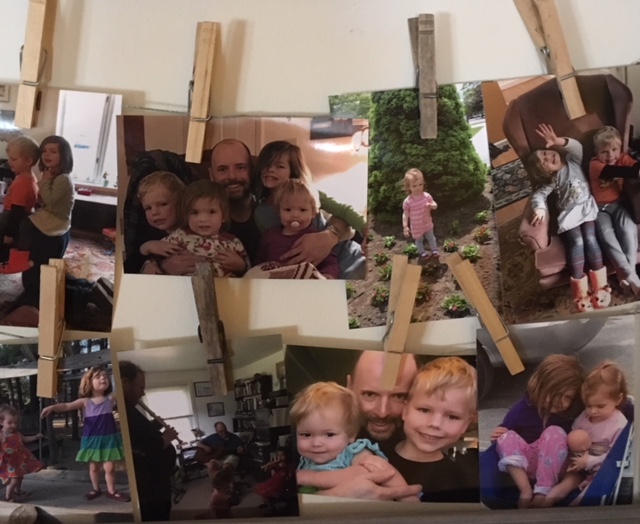
All of which changed the moment I held, first John and then six weeks later, Anastasia in my arms. All my baggage, all the solipsistic crap, melted in the depth of their eyes.

And now, that I’m some form of Grampa to five grandchildren has given me a name I prize.

IMG_3227

#

In my Bio for this blog two and a half years ago, I equated my various names with what Thomas Merton, Thomas Keating, Richard Rohr, and others call “false selves.” I think I felt then that these names had kept me from realizing my “true self”: myself as the image of God, “manifested,” as Father Keating says, “in our uniqueness.”

But today, I’m wondering if all of these names I’ve carried on my pilgrimage aren’t various facets of my true self—don’t, in fact, reveal my uniqueness. Madeleine L’Engle writes somewhere that to name something is to assign it meaning, value, importance, and significance. That essentially to name something is to love it. If so, my names, even those reminding me of how love can die, show me that my 75-year-old pilgrimage has largely been one through love.

Something worth remembering.

# #

On Diminishments

IMG_3202

#

The other day, Mary Lee and I took two of our grandchildren to a nearby playground. There, lying on the tarmac under a basketball hoop, was a basketball. Now, I spent part of almost every day from the time I was fourteen until I was eighteen with a basketball in my hands, and I continued to play competitively until I was in my thirties. Obeying some ancient siren’s song, I picked up the ball and flicked it towards the basket.

The ball went maybe two feet in the air, came back, and hit me on the head.

I recently read a book on aging in which the author used the word “diminishments” to describe what happens as we grow old. (I’d tell you the name of the book and the author, except I forget both, and I can’t find the book anywhere. Which isn’t unusual these days. I spend part of each day looking for something I’ve lost. What is new, though, is that lately, I’ll lose something, try to figure out where I left it, and realize I’m staring right at the goddamn thing.)

Eyesight, hearing, strength, reflexes, libido—all become diminished. I’m guessing most of you reading this know all too well what I’m talking about. You know the sinking feeling of having someone with gray hair offer you his or her seat on public transportation, of struggling to bend enough to get your socks on in the morning, of hating to drive after dark because the lights hurt your eyes. (Or, in my case, taking out a bank loan to buy a new car and then scrapping the side of it because I didn’t judge how close my new car was to a stone wall. But then, I expect you have your own story about aging to tell. When my father-in-law was in his seventies he used to say he was in his “anecdotage.”)

I’ve written here a number of times about how the pilgrimages I’ve made have made me aware of my diminishments: of being passed on the trail by everyone from eight to eighty, of gasping up hills, of falling down mountains. Indeed, most of the writers I’ve read on pilgrimage say that pilgrimage is really about diminishments, of purposely leaving parts of yourself behind in order to become more spiritually attuned to the world around you.

In fact, all of the spiritual traditions I’m familiar with talk about the need to let go of attachments, so I’m trying these days to find benefits in my diminishments—“Let go and let God,” as the twelve-steppers say. And I do think my physical and mental diminishments have allowed me to let go of some things that need letting go of.

I no longer search out mirrors or store windows to check my appearance—sometimes in admiration, sometimes in disgust—no longer obsess about my weight, no longer change hairstyles or grow and then shave off beards. I’ve given up climbing mountains, let go of feeling I should pick up the check when I go out to lunch with someone. I’ve accepted that my shoulders are not going to get any wider, my pot belly any smaller, and I’m not going to gain back the four inches I’ve lost since I played basketball. I no longer feel I need to write the Great American Novel.

I’m losing the need for approval. Like many people, I have always defined myself by what I do, but my well-being has been determined by what I imagine others think of what I do. One of the things I hated about cocktail parties (something I’ve very happily let go of) was when some doctor or lawyer or CEO would ask me, “And what do you do?” Often, despite the fact that my job usually gave me pride and purpose, I’d hunch my shoulders and mumble something about being “just a high school teacher,” as if teaching were the twentieth century equivalent of leprosy.

Writing for publication means receiving rejection notices. It goes with the territory. But for someone who has always needed the approval of others, each rejection felt as if I were being rejected as a person.  That fear of rejection is diminishing, and I feel freer than I ever have before.

But it’s still hard not to define myself by what I do, even if what I do has been diminished. Almost my first thought in the morning is “What am I going to do today?” And almost my last thought at night is “What did I do today? Did I write? Get exercise? Spend time in contemplative prayer? Play the banjo or guitar? Show Mary Lee how much I love her? Help somebody out?”

Don’t get me wrong. All of these are good to do, but I’ve found over the years that defining myself even by worthy activities has led to shame—why didn’t you do them better, you dolt?—judgmentalism—why didn’t you do more?— anxiety—am I going to be able to find time to do everything I want to do today?—all leading to a solipsistic preoccupation with self.

On the other hand, the few times that I’ve been able to focus more on being than doing, I find myself more grateful, more aware of grace in my life. I still don’t understand what I think of as the Great Mystery, but I’ve lived long enough to have experienced it.

I know that. My ego, however, doesn’t. And doesn’t want to. My ego says this “Let go and let God” stuff is weakness. “Stop doing and you’ll die!” it tells me.

Well, guess what? I’m going to die anyway. And maybe the real lesson of my diminishments is to remind me—more and more often these days—of that fact, and that I need to spend what time I have left being open to recognizing grace and being grateful for the joys I’ve experienced, most of which—Mary Lee, her children, my daughter, my grandchildren, my parents and siblings, music, Nature—I’ve received regardless, even in spite of, anything I ever did.

IMG_3089

My diminishments point out the need to surrender to my Higher Power/Great Mystery/God/Whatever while I’m still able. I’m struggling, but this week I’ve started to ask myself in the morning, “What do I get to do today?” Maybe it’s just semantics, but I’ve found the change helpful. Also helpful is remembering I’m making a pilgrimage, not a hundred-yard-dash. As Richard Rohr writes: “The surrender of faith does not happen in one moment, but is an extended journey, a trust walk, a gradual letting go, unlearning, and handing over.”

I’ve got time. I’m not that diminished yet.

# #

Holiday Hope

fullsizeoutput_64

A few weeks ago, I made a pilgrimage to Mount Desert Island, where I once lived and worked, to attend a five-day contemplative retreat. During the first session, our facilitator asked us to share a particular concern we’d brought to the retreat with us. When it was my turn, I found myself saying I worried that during what is traditionally a time of hope, I’d lost hope in the future of this country. At almost 75, I said, I wasn’t that distressed about my prospects, but I worried about those of my grandchildren.

I also said that this time of year has always been a hard for me to be hopeful because my daughter died on December 23, 1988, and for the past twenty-nine years, the increasing darkness outside mirrors the increasing darkness inside of me as I recall the two months I spent living at a Ronald McDonald House, walking back and forth to the hospital to sit by Laurie’s side watching her grow weaker every day.

Since that retreat, I’ve been thinking a lot about hope and about Laurie, and as strange as it might sound, I’m finding the more I look back over the years since her death, the more hopeful I am for my grandchildren and for myself.

One of the questions I asked myself after Laurie died, was “How am I going to survive this?” Well, my pilgrimage through grief hasn’t been easy, for me or my family. I still stumble in anger, still get mired down in resentments. But looking back over the twenty-nine years, I can also honestly say that I have discovered grace and joy and a peace that, as the Christian Apostle Paul wrote, “passes understanding.”

I’m not entirely sure where this serenity has come from, but so far, I can think of four possible sources, four reasons to give me hope, four legacies I want to pass on to my grandchildren for their futures:

The Strength of Family. I grew up in a family scarred by alcoholism, abuse, and abandonment. Some of those wounds were passed on to me and my siblings, and I’m still in recovery, still realizing how this background has influenced my behaviors over the years, from my own addictions to my arrogant and judgmental attitudes. But the work I’ve been doing lately in my twelve-step program has also shown me that I’ve reaped the benefits from having two parents who overcame their own hideous childhoods, who loved me, sacrificed for me, and, above all, gave me some of my character traits I’m most proud of, including the strength to overcome the loss of a child.

I want to pass that strength on to my grandchildren.

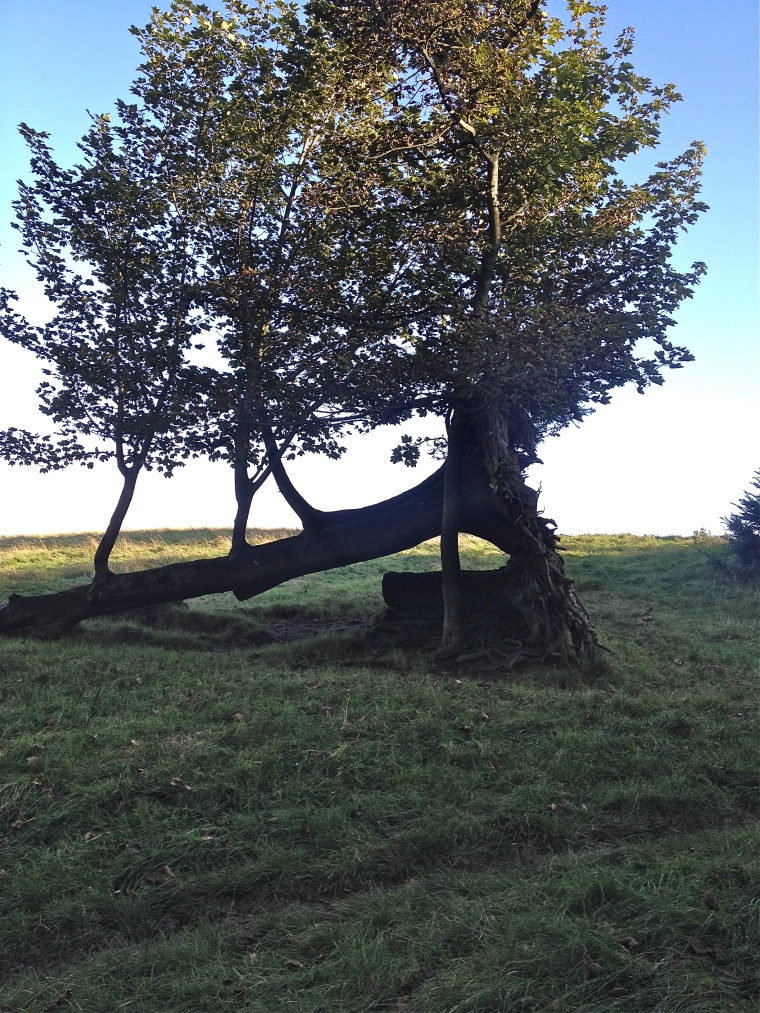
The Dynamic Detachment of Nature. I’ve spent some of the most “spiritual” moments of my life struggling up mountains, sweating in deserts, snowshoeing in bitter cold, and peering through ocean fog. What makes these landscapes spiritual for me is that they make me feel small and insignificant. The ocean is going to break over the rocks no matter if I’m filled with joy or filled with grief; the sunrise will paint the clouds pink regardless of what happens in Washington. Yes, Nature is filled with death, disease, and violence, but even in death it teems with life. One of my favorite images from hiking Saint Cuthbert’s Way from Scotland to England is of a blown-down tree, its roots exposed. The tree’s branches have grown into four new trees rising from the decaying trunk. That force, that instinct to grow and blossom and bloom, drives, I think, all life.

I need to remind myself that force runs through my grandchildren, giving them the power to flourish, no matter what obstacles they’ll face.

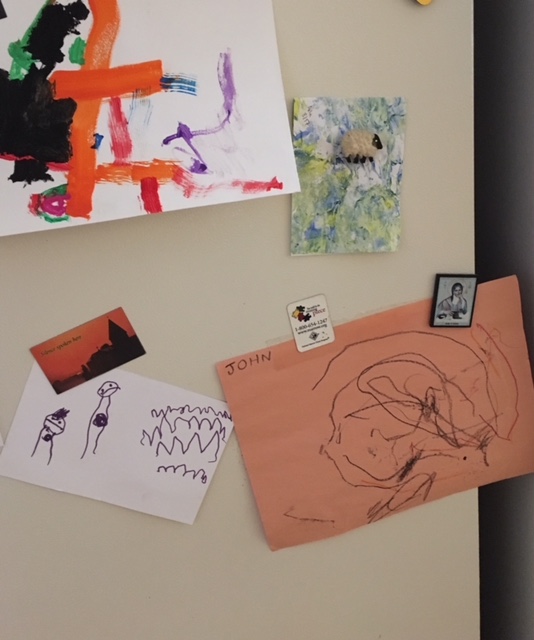
The Healing Power of the Arts. Before Laurie died, about the only writing I’d done was in my journals. I was an academic. My goal was to do more work for the College Board as a consultant. But after Laurie’s mother and I divorced, Laurie, who had also been focused on academic studies, swapped her L.L. Bean skirts and blazers for long sweaters and jeans, dyed a pink stripe in her hair, painted her fingernails black, and took up art, going to summer art programs, and planning to study art in college. After her death, I began going to summer writing programs, took early retirement from public school teaching, and went back to school for an MFA. Writing helped me identify my feelings, and became a way for me to harness my anger and my shame by writing a book and then revising it through God-knows how many rejection slips. More important, writing, like the banjo I wail on, like Laurie’s watercolor that hangs over my desk, reveals to me an essential order to what often seems, especially after a great loss, a chaotic and meaningless universe.

My grandchildren love to listen to stories, love to tell stories. It’s apparently natural for them to build and color and draw pictures. I want to nurture those instincts.

IMG_3187

The Chuckle in the Dark. In A Grief Observed, popular theologian C.S. Lewis recorded his anguish over the death of his wife. Never intending his words to be published, he railed against God for the suffering and pain his wife had endured, and for the sorrow that was tearing him apart and demolishing everything he’d previously believed about God. Gradually, however, he experienced an “impression which I can’t describe except by saying that it’s like the sound of a chuckle in the darkness. The sense that some shattering and disarming simplicity is the real answer [to the mystery of suffering and death].” The retreat that I participated in a few weeks ago focused on the works of an anonymous 14th century writer who felt that the only way one could experience God was in what he called a “Cloud of Unknowing.” Since the loss of my child, my experience of God/my Higher Power/ the Eternal/Whatever has been through subtraction rather than by addition. I’ve lost all I ever learned about God, especially the idea that God is some compassionate Superman: all-loving, all-powerful, and all-knowing. And like C.S. Lewis, like the anonymous 14th century author we discussed, as I’ve lost those images of God, I’ve experienced an unfathomable serenity, one that has lasted this year well into the holidays.

I’m still not optimistic about the future of this country. I’ve read too much history about the rise and fall of empires not to feel that our nation is in decline, if not free-fall. But over the last few weeks I’ve discovered a difference between optimism and hope. Hope—for me anyway—is as much about the past as it is about the future. Hope looks back and grieves the reality of death, disease, decline, and destruction but at the same time, hope gives thanks for a life filled with the grace not only to survive but to thrive.

Which gives me hope my grandchildren will do the same.

IMG_3185

# #