
Celebrating a Milestone

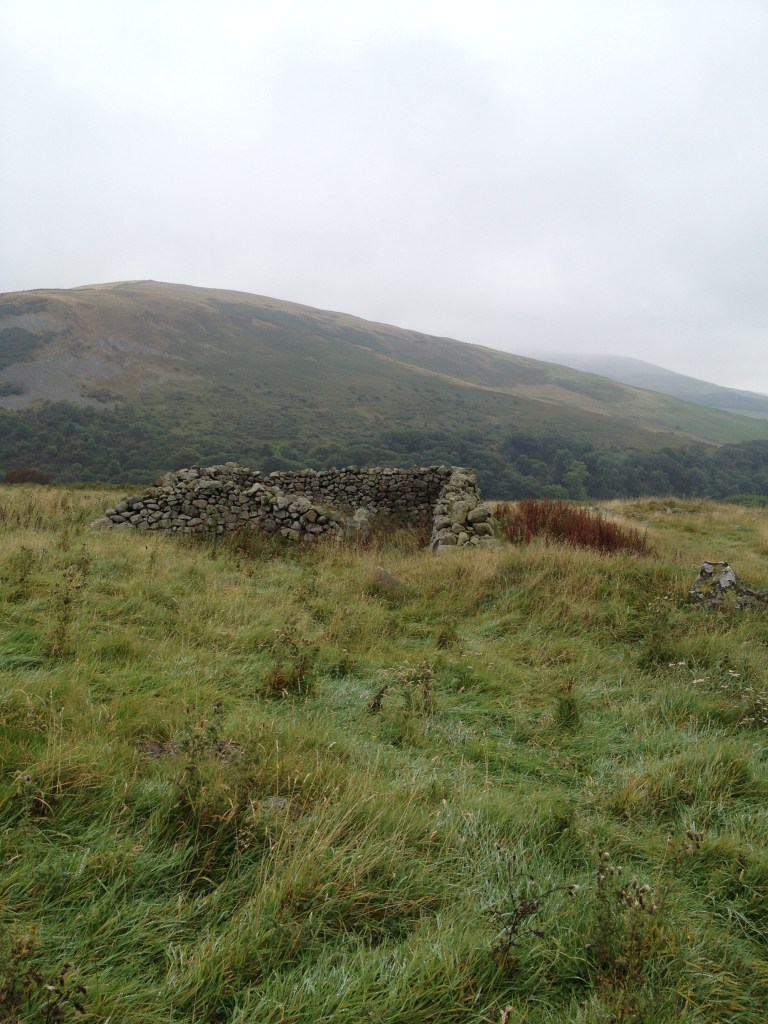
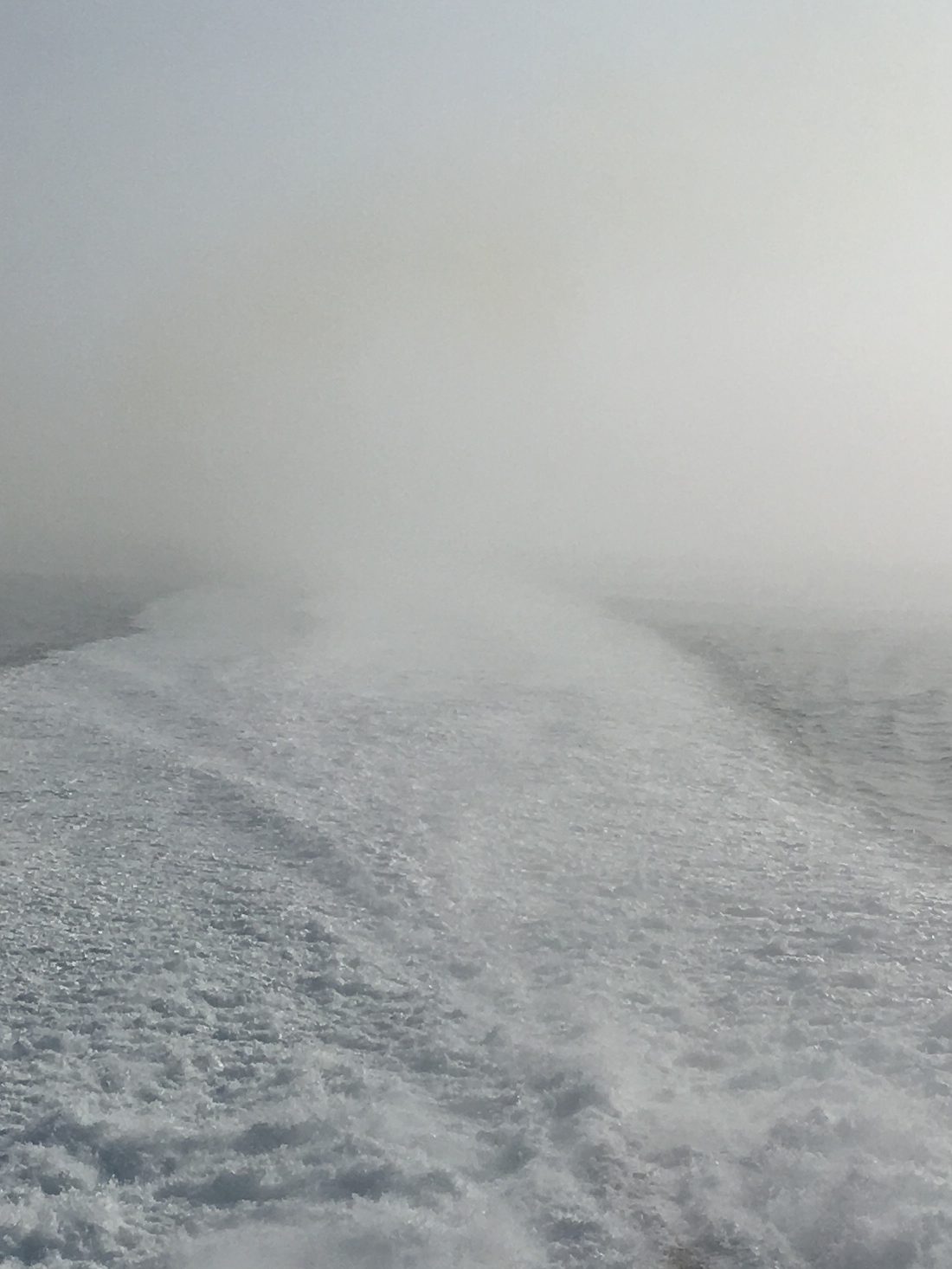
Looking back at the Eildon Hills in Scotland.

#

 “Great things are not done by impulse, but by a series of small things brought together.”

—Vincent Van Gogh

#

This blog is a milestone for me. Eight years ago this month, I published my first Geriatric Pilgrim blogs (https://geriatricpilgrim.com/2015/11/). And while I’m not big on party hats and horns, I want to celebrate.

The Romans erected the first stone markers to let travelers know not only the number of miles they had to go to reach their destinations, but also the distances they’d covered. Today, businesses talk about a milestone as something that demonstrates a significant, marked change or step in the development of a project. Parents keep track of milestones in their child’s development. (“Look, little Leslie’s walking! Where’s the camera?”)

When I think of the importance of milestones in my life, I think of the second day of our seven-day walking pilgrimage along St. Cuthbert’s Way through Scotland and England. Still apprehensive about being able to complete the 72-mile trek, I looked back across a newly mown field to the Eildon Hills fading into the dimly distant horizon. The day before, my wife Mary Lee and I had crossed those three hills.  I felt a burst of energy. Look at how far we’ve come, I thought. We can do this!

And as I look back at those first blogs from 2015, I’m also surprised and energized by how far I’ve come in the last eight years.

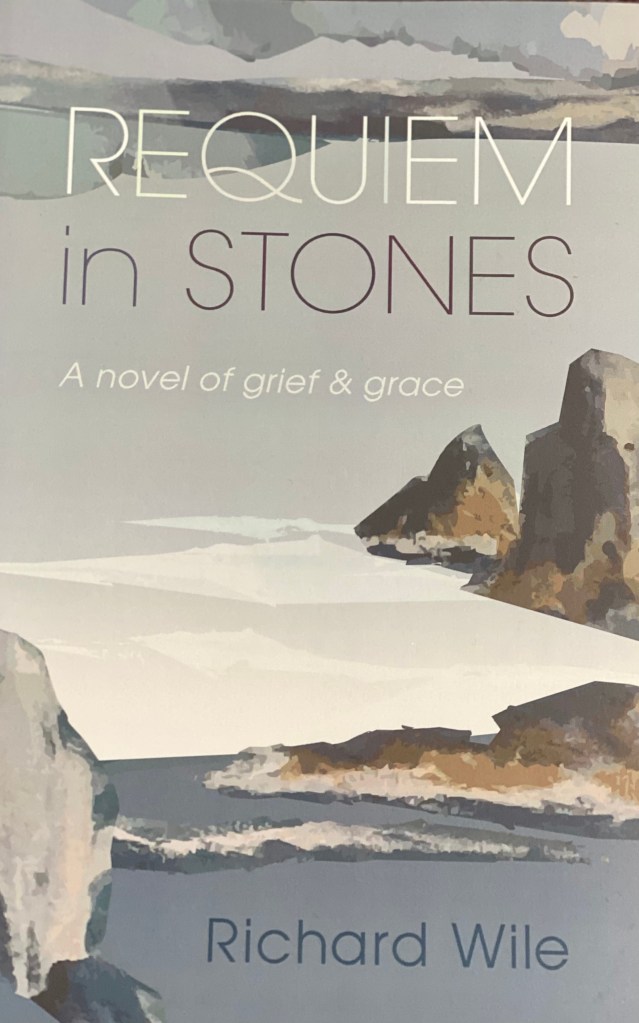
In 2015, I’d just published a novel, Requiem in Stones: A Novel of Grief and Grace, based on my experiences after my daughter Laurie died of cancer.

This novel about the effects of a child’s death upon a family, had taken me 20 years to write and I was emotionally drained. For the sake of my sanity (not to mention the wellbeing of those around me), I wanted to write something for fun.

Two years earlier, Mary Lee and I had walked St. Cuthbert’s Way, and I’d become curious as to how pilgrimages differed from vacations, business trips, escapes, or educational trips. I was especially interested in the inner journey one makes on a pilgrimage. I read books about some of the pilgrimages people had taken, drawn especially to those who approached the spiritual journey with humor and curiosity. I decided to try to use the same approach in a blog about my travels.

But now when I reread those first blogs, I can’t find much humor. Like the novel, they still seem to me focused on the effects of my grief—physical problems, nasty thoughts and visions. What humor I find now sounds to me sarcastic.

Still, because I’m also writing about specific places—Jerusalem, retreat houses—I can also see the beginnings of my detaching, of stepping back, of broadening my horizons.

And that’s what writing these blogs over the next eight years has done for me. By focusing first on my various exterior journeys, and then going inward, I’ve given my grief more room to live in, so that it doesn’t dominate either my life or my writing. My grief over Laurie’s death is no smaller, but the landscape in which it resides has expanded to include not only a dozen countries, but also my family history and my geriatric journey as well.

Probably nothing has helped me better understand this interior landscape over the last eight years than joining two 12-step programs. Al Anon, the program for families and friends of alcoholics, and ACA, the program for adult children of alcoholics, have become like lenses on a pair of binoculars, helping me view the effects of my grief—especially fear, anger, and shame—as mountains that make the Eildon Hills look as level as pool tables.

I remember telling my Al Anon sponsor in one of our first meetings, “I will always feel at some level that I killed my daughter.” Even 25 years after Laurie died, I blamed my daughter’s death on my divorcing her mother two years earlier or by not divorcing her mother soon enough. I said that every year, right around Thanksgiving, I could feel my body chemistry change. For the next month or so, right up until the anniversary of Laurie’s death on December 23, I said, I never knew how I would react. Some years I was angry at everyone, some years I cried at anything remotely sad, some years I spent the months hiding from the world by reading mysteries. I said that I’d just accepted this response as the way it would always be.

And I remember my sponsor’s reply: “Okay. Maybe… Let’s see what happens.”

Through working the Al Anon program, especially Step Four, taking “a fearless moral inventory” of myself, I discovered that because I’d grown up in a family riddled with alcoholism, I’d been clambering up and down those mountains of fear, shame, and anger long before Laurie’s death. Fear and my need for what I thought was security had driven me into an unhappy first marriage. Shame and my need for respect had driven me into erecting any number of false personas. My need to deaden my anger had driven me into my own alcoholic behaviors. Using ACA, I learned about the long-term effects of growing up in an alcoholic family, while Al Anon gave me the tools to separate my grief for my daughter’s death from my fear, anger, and shame over losing her.

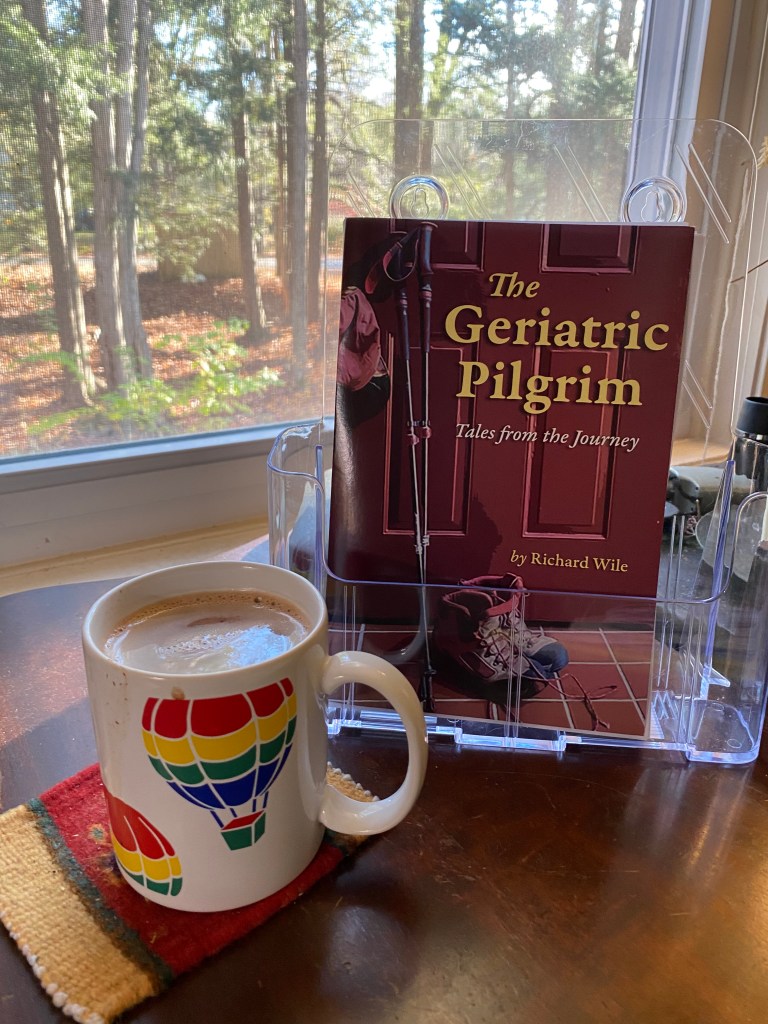
So that four years ago, I realized that I was enjoying the Christmas season—no tears, no angry outbursts at the baggers at the grocery store, no reading marathons. And as I was collecting fifty of my blogs to put together in my second book, The Geriatric Pilgrim: Tales from the Journey, I had to revise several blogs which had talked about how hard the Christmas season still was for me.

There’s also nothing like successful heart surgery for expanding one’s inner landscape. Only through a timely wellness checkup and the perspicacity of my PCP—“No, being out of breath is not normal. I want you to take a stress test this week!”—did I avoid another family disease: falling dead of a heart attack. Only because of what I’ve called in these blogs “grace” am I’m still here. Only through grace am I grateful for the life I’ve lived, even for those demanding hikes over mountainous landscapes.

All of which is worth celebrating. If not with paper hats and party horns, at least with a cup of hot chocolate.

Cheers!

# #

Storm Stories

Hurricane Carol: 1954. Northeast Historical Film

#

Recently, Hurricane Lee, at one point a Category 5 hurricane, churned up the Atlantic coast, bringing with it dire warnings such as, “Lee Drives Towards Us with a Hugh Wind Field, Damaging Waves, and Flooding.” The Episcopal Church of Maine’s website offered a prayer, which began: “Creator God, we ask you to calm the wind and the waves of the approaching hurricane and spare those in its path from harm.”

I put away lawn chairs, harvested basil, tomatoes, and beans from my garden, and checked to see that our flashlights all had new batteries and the lamps had oil. I cleaned out the garage, so that I could get my car out of the way of falling branches.

Well, the trees did some jitterbugging in the wind to the rhythm of our wind chimes, and our lawn had a smattering of small branches. My Zoom meeting with an Al-Anon sponsee on the coast ended early when his power went out, and my bean pole in the garden blew over, but all in all, the effects of the storm were minimal. A few years from now—if I’m still alive—I doubt if I’ll tell many stories about Hurricane Lee.

Hurricane Lee: 2023

There are other hurricanes, other storms, however, whose stories have stayed with me.

In 1954, Hurricane Carol, the first Category 5 hurricane to hit New England, roared through Maine, followed ten days later, by Hurricane Edna. A little research tells me that the two storms caused 25 million dollars in damages and destroyed 3500 cars and 3000 boats. What I remember was that at 11 years old, I thought hurricanes were neat. The thundering river down the hill mingled with the roar of the wind, and our house shook like some carnival ride. I couldn’t understand why my father was chain-smoking and pacing back and forth in front of the living room window, muttering, “I hope that goddamned tree doesn’t fall on us.” The day after Hurricane Carol, my friends and I walked through town, gaping at the elm trees that had blown over, amazed at the size of their roots, which rose several feet over our heads.

The next hurricane to hit Maine was Gloria, in September 1985. According to Wikipedia, this storm affected six counties in Maine, with multiple injuries, downed trees, and 250,000 people without power, some for up to fourteen days. I was living Down East at the time. Less than a month earlier, my first wife and I had separated, and the day after the storm I got up early to drive my daughter Laurie to church camp for the weekend. After dropping Laurie off, I continued on to visit my mother and father. When I pulled into the driveway, I saw Dad standing in strewn leaves and fallen branches, trying to fry bacon and eggs on a charcoal grill. My Grandmother Cleaves, who’d come over from her apartment for a hot breakfast, stood at the window.

What I recall even more clearly now was that my father, Laurie, and Nanny Cleaves all died within the next four years. Throw in a divorce and a second marriage, and I experienced an emotional hurricane that made Gloria feel like a summer breeze.

In 1991, Hurricane Bob came to Maine. Three people died, many residents lost power, and there was over five million dollars in damages. Again, the storm’s direct effect on my new family and me was minimal, but because of the heavy rains and losing power, my Grandmother Kimball’s cellar flooded because her sump pump stopped working. At 92, living alone, she couldn’t cope with the responsibility of keeping the house up, so she sold it to me. Mary Lee and I lived in that house for the next 22 years. Then, after a spring rainstorm and another flooded cellar (something like the fifth one in those 22 years), we sold the house and moved to where we now live (which, thankfully, has no cellar).

Our cellar after the Patriots’ Day Storm of 2007

I think of other storms in my life—natural ones, such as the ice storm of 1998, various nor’easters leaving two feet of snow; emotional storms, such as my defeats and disappointments, a divorce, Laurie’s death—and I realize that I remember them far more clearly than I do the sunny days—beach days, vacations with family in Florida and Bermuda—or the happy times: the victories, the times I’ve been recognized or honored. I don’t know about you, but it’s the storms rather than the sunny days in my life that have become the stories of my earthly pilgrimage, those narratives that have helped me navigate my life, and which I continue to look back on and refer to as I forge on towards whatever denouement awaits me.

So, why that is that even after sixty years, I remember my defeats on the basketball court more than the victories? That I remember my divorce settlement more than my first marriage ceremony? Laurie’s death more than her birth?

Maybe one reason these storms stay with me is that I’ve survived them all. Storms help me feel good about myself, less afraid of the future. I can be “defeated but not destroyed,” as the great storyteller Ernest Hemingway said. I recall meeting a woman who knew of Laurie’s death and who’d just lost her son in a fire. Her first words to me—even before saying hello—were “Tell me how you’ve survived!” At the time, a guy I’d come to know from being in grief counseling together, had just committed suicide and I realized surviving Laurie’s death really was an accomplishment.

As I think of it, storms have not only made me aware of surviving, they’ve made me feel more alive. And I don’t think I’m alone in feeling this way. There’s nothing like a good nor’easter or hurricane to draw people to watch the ocean waves crashing over the rock-bound coast of Maine. After Laurie died, I found myself missing those last weeks of her life when I was living at a Ronald McDonald House, spending the days beside her. There was a focus to those days, a purpose, and the great themes of Life and Death dwarfed the usual minutia of everyday life.

Speaking of less fear and more focus, I’m interested in the number of people I know who suffer from anxiety and depression but who become fearless when forced to face specific physical dangers such as a high wind or a flood.

In a storm, I let go of the old stories I tell myself about who I am. I’m forced to come to terms with the fact that life as I knew it may never be the same. I plunge into a new adventure, a tale of unknowing, which can also be a story of spiritual re-birthing if I can only recognize and surrender to that power greater than myself.

Looking back at the storm stories in my life helps me realize that while I may want to shrink God down to my size, God is always bigger than I am, will always be God of my not Understanding.

And of course I have to include a snowstorm picture—this from 2013.

# #

Of Hospitals and Pilgrimages

#

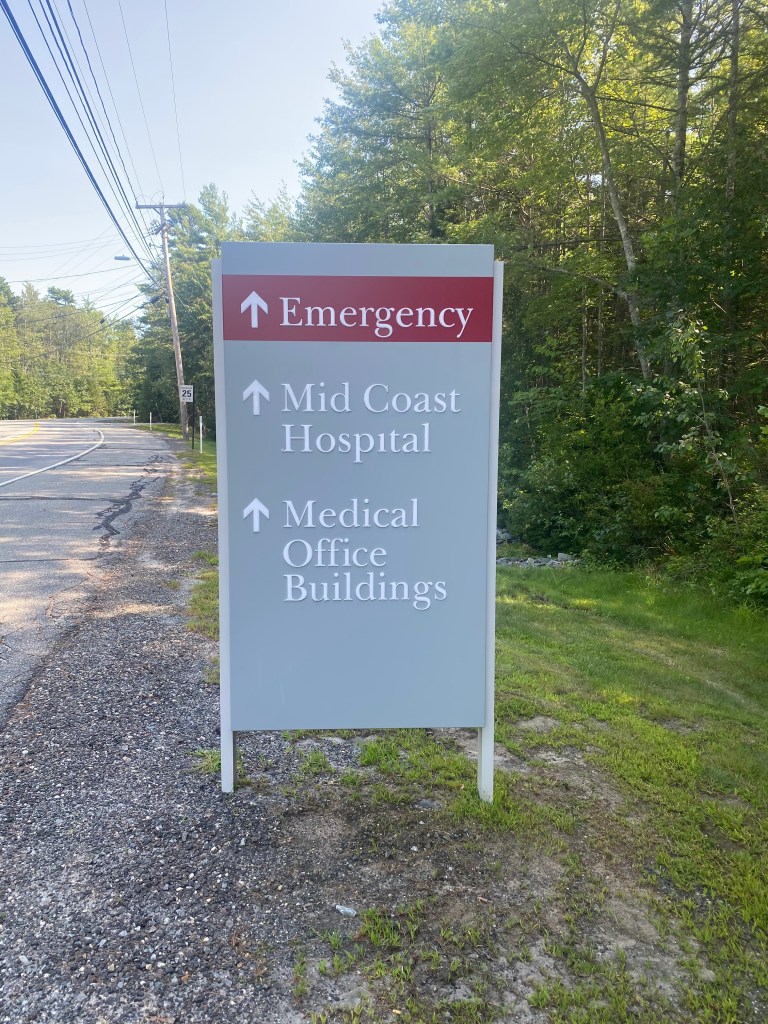
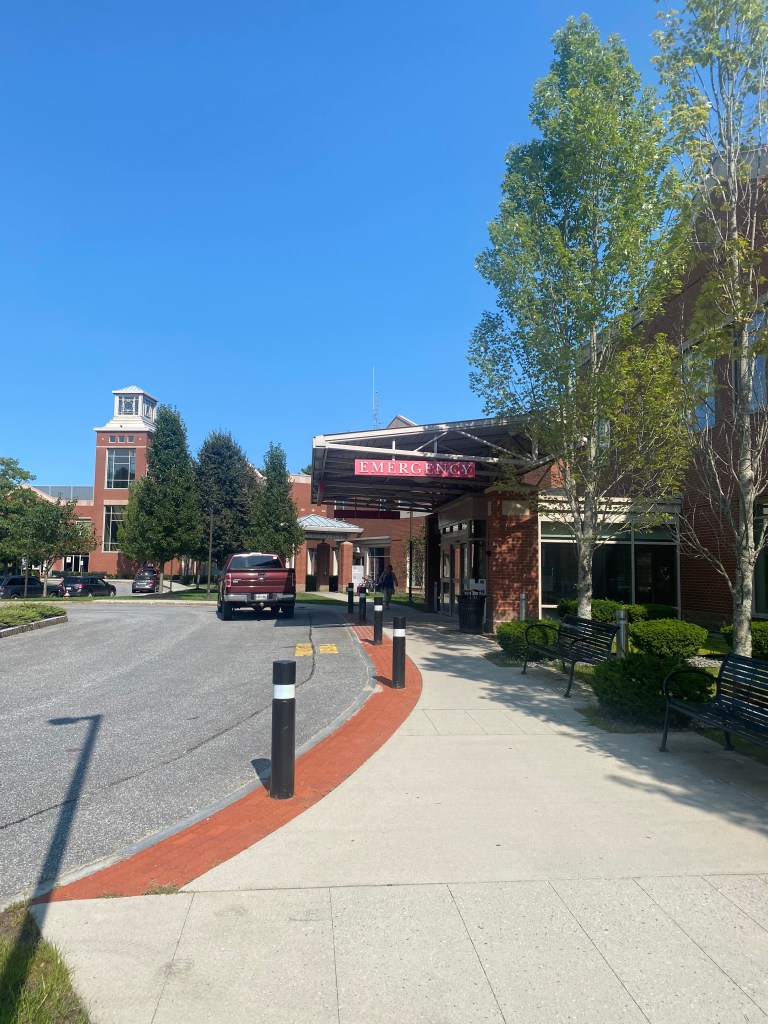
Recently, I took a trip to my local hospital for some minor surgery. As I was recovering, I started thinking (As my first wife used to say, “Rick, you think too much”) that as much as I like to say I’m in good health, I’ve spent a lot of my life preparing for, going to, and recovering from one hospital visit or another. And yet I, who’ve been trying to show in these blogs for almost eight years that any journey can be pilgrimage, have never really thought of my hospitalizations as pilgrimages.

Why not?

At first glance, the two trips look very much alike. Let’s look at some of the characteristics of a pilgrimage I’ve talked about over the years and see how they compare to making a trip to the hospital.

The call to healing. This is a no-brainer, right? I go to the hospital to be healed. From major stays for a back fusion, two hip replacements, one hip “revision,” one open-heart surgery, four (as of last week) hernia repairs, to quick trips to the Emergency Room for having run my arm through a washing machine wringer, almost cutting the tip of my finger off with a double-edged razor blade, and having our twenty-year old cat sink one of his four remaining teeth into an artery in my arm, I need healing from arthritis, heart disease, clumsiness, and stupidity.

Preparation. Just as I need to read up on where I’m going on a pilgrimage so that I know what clothes to bring, what currency to have with me, what customs I’ll need to follow, when I go to the hospital, I’ll probably have to stop eating twelve to twenty-four hours ahead of time, have my insurance cards with me, leave my valuables behind, and make sure I have someone to drive me home..

Crossing a threshold into another country. Entering through the revolving doors of the hospital, I enter what seems like a foreign country, where the natives speak a different language and wear strange clothing. They are relaxed, at home, joking with each other, while we visitors speak in hushed tones and glance around nervously.

Being in liminal space. Just as on a pilgrimage, when I’ve left home but haven’t yet arrived at Iona, the Holy Sepulchral in Jerusalem, the Holy Island of Lindisfarne, or City Lights Bookstore in San Francisco, in the hospital, I’m no longer suffering from a bad back, aching hips, a blocked artery, or a bulging hernia, but I’m also not fully awake, still sore, still unable to walk, still unable to move my bowels so I can go home.

Finding your own way by following the path of others. When I go on a pilgrimage, I am following the footsteps of thousands of pilgrims who have gone before me, yet I still must find the path, as I’ve struggled many times to do. Likewise, I’m sure all my doctors have performed many surgeries before mine (at least I hope so), but for me, all the operations are new and strange. I can’t rely on other people’s reactions to help me with mine. After my heart surgery, I didn’t want anything to eat for days; on his first day, my roommate ordered a lobster roll and French fries. Even I react differently at different times. My experience after my second hip surgery was far worse that after my first hip surgery only a week earlier.

Experiencing discomfort. Another no-brainer. When I go to the hospital, I expect pain. Even with this last minor surgery, it took three tries for the nurse to get a needle for the anesthesia into my arm and three days for me to get the anesthesia out of my system. Don’t get me going about having to walk 10 miles a day in February and March after my back surgery. (And if you want to read about my heart surgery, check out an earlier blog: https://geriatricpilgrim.com/2019/08/)

Beginning again. Pilgrims talk about cultivating “beginners’ mind”—learning to see with new eyes. In hospitals, beginning again means learning how to breathe again, as in after my heart surgery, or walk again, as after back and hip surgery.

Being vulnerable. If both the traditional pilgrimage and the hospitalization have taught me one thing, it’s that I am not in control. Rick the pilgrim is at the mercy of the weather, the people I encounter, and the situations that arise. Rick the patient is at the mercy of doctors, nurses, technicians, roommates, and his own body. The minute I gave Mary Lee my wallet, watch, and phone the other day, I gave up control. And nothing says vulnerable like a hospital johnny. Talk about feeling defenseless!

Coming home with new eyes. Just as I read the Bible with new eyes after being in Israel, my various surgeries have made me look at my body in a new light. I’m far more aware of how what happens in one part of my body affects other parts, and how closely connected my mind and body are.

So why have I never thought of my various hospitalizations as pilgrimages?

Simply because, for me, the pilgrimage needs to have a spiritual element. As one of my spiritual directors used to ask me after I’d updated him on my month, “Where’s God in all of this?”

Let’s go back and touch upon those characteristics of pilgrimage I’ve just been talking about. When I’ve experienced a “call to healing,” it’s been a call to “healing” in the original sense of the word: to be whole. And I can’t be whole unless all those other characteristics—the preparation, crossing a threshold, liminality, and so forth—are as much about an interior journey as an exterior one. For me, any interior journey involves traveling with what I call “God of my Not Understanding.”

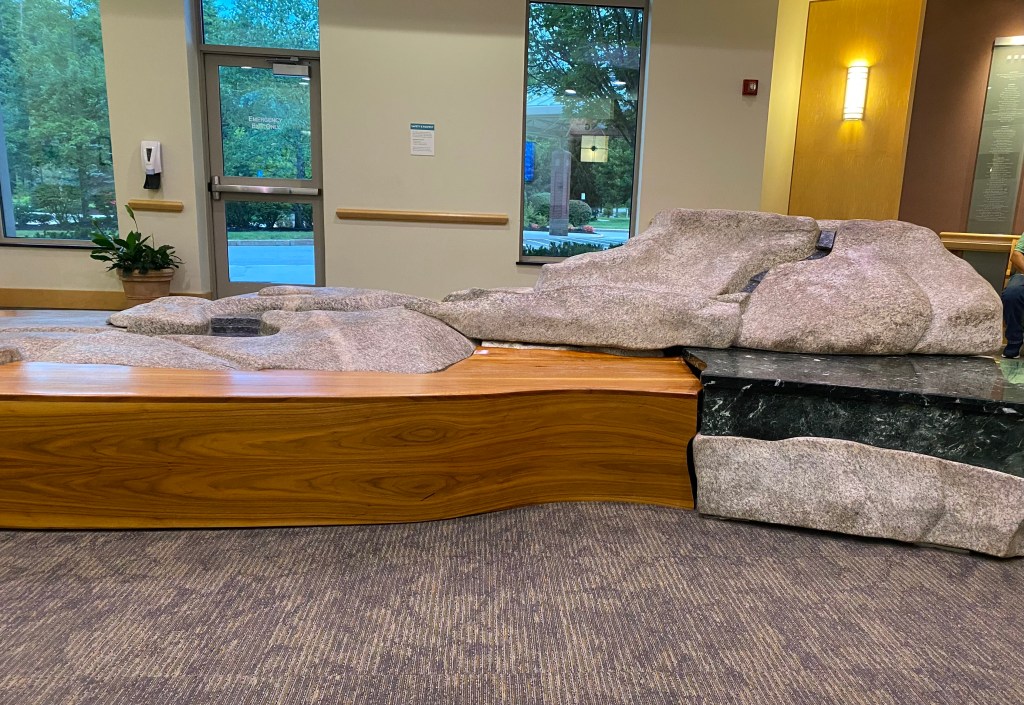
And I confess that God of my Not Understanding has largely been absent during my hospitalizations. My experience with hospitals is that they are clean, efficient, sterile, square, and noisy. The lighting is artificial and despite efforts to duplicate the outside world through paintings and sculptures, nature seems far away.

Many hospitals have chapels, and I remain thankful for the one at the Eastern Maine Medical Center in Bangor, Maine, where I spent so much time when my daughter was dying of cancer. But those are for visitors, not patients. Hospitals have chaplains, but they’re stretched thin. The only chaplain I ever encountered was after I’d been in the hospital for two weeks.

I shouldn’t complain. Up until a hundred years ago or so, I’d have been confined by arthritis to a wheelchair by the age of fifty, and dead of what used to be called “severe indigestion” in my sixties. I’m grateful for those clean, efficient, and sterile operating rooms, and for all those nurses, doctors, and anesthesiologists who worked so hard to help me recover.

So, perhaps holding on to and cultivating that gratitude is what I need to do to turn even minor surgery into a pilgrimage?

Mmmm. I hadn’t thought of that before. Maybe any journey can be a pilgrimage after all.

# #

On Vulnerability

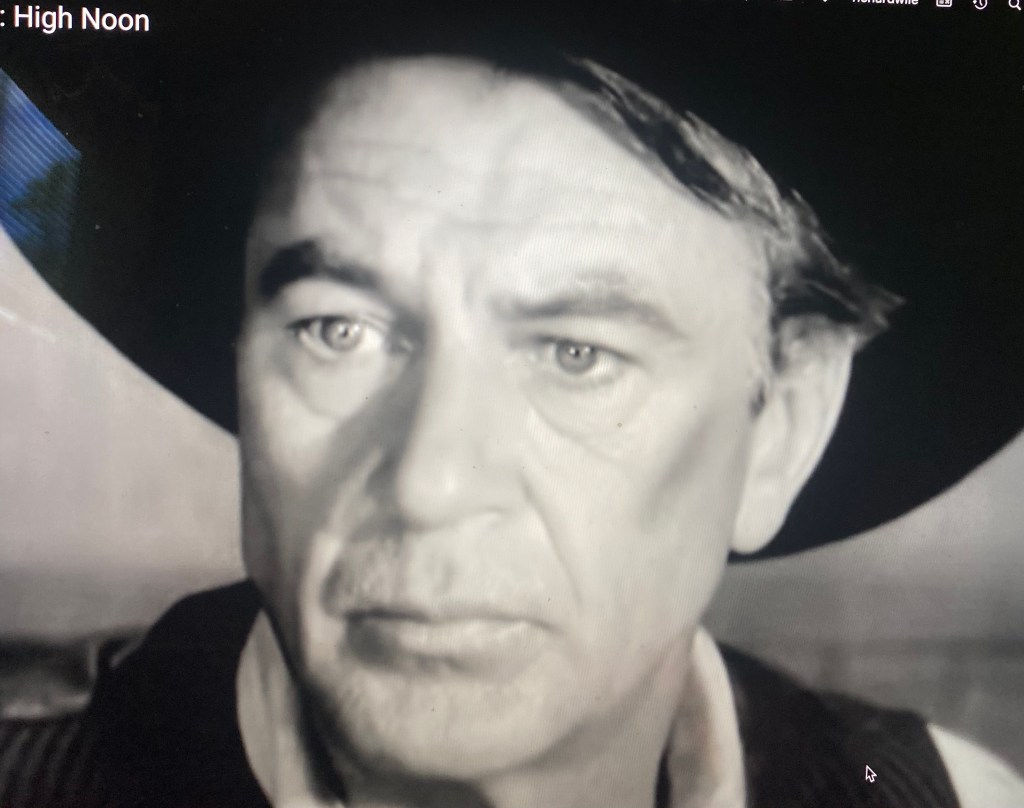
Will Kane, as the clock strikes high noon.

#

Perhaps it’s because I turned 80 this year. Maybe it’s because this summer has been hot and muggy. Whatever the reason, I’ve found myself more aware lately of my vulnerability. Walking in the woods these days requires changing into insect-resistant clothing because of ticks; on walks, working in the garden, I need to be sure to bring water with me or I get weak and dizzy; after heart surgery, I need to keep checking my fancy watch to make sure my heart rate doesn’t get much over 120 bpm. I’m tripping more often and have removed several rugs from our house. Earlier this year, I fell in my garden and only by grace/luck/whatever did I miss cracking my head on a rock by about 6 inches. And on a recent hot day, I was mulching my pumpkins, felt weak, saw that my heart rate was 145, sat down, and couldn’t get up. Fortunately, I had my water, and was finally able to get home after a half-hour or so (whereupon I had a 1½ hour nap).

I don’t like being this vulnerable, probably because I’ve spent a lot of my life trying to avoid showing vulnerability. As a boy in a small New England town in the 1950’s, I learned vulnerability was for sissies. Never ask for help; never let anyone see you cry. In high school, I learned success, whether on the basketball court or getting Suzie’s bra off, was a matter of will power. Mind over matter.

But these days, I find that what I mind doesn’t seem to matter. Which is why I’ve made a pilgrimage through the internet in search of something good to feel about vulnerability. At first, I didn’t have much luck. If you google the word “vulnerable,” most of the definitions have negative connotations: “capable of or susceptible to being attacked, damaged, or hurt; open to moral attack, criticism, temptation, etc.”

Still, looking up “Articles on Vulnerability,” I found advocates. Researcher and storyteller Dr. Brene Brown writes, “vulnerability is the core, the heart, the center, of meaningful human experiences.” Others write that vulnerability allows us to be authentic. It can bring a sense of closeness and fulfillment. It can bring about more honesty, more trust. Brene Brown again: “Vulnerability is the birthplace of innovation, creativity, and change.”

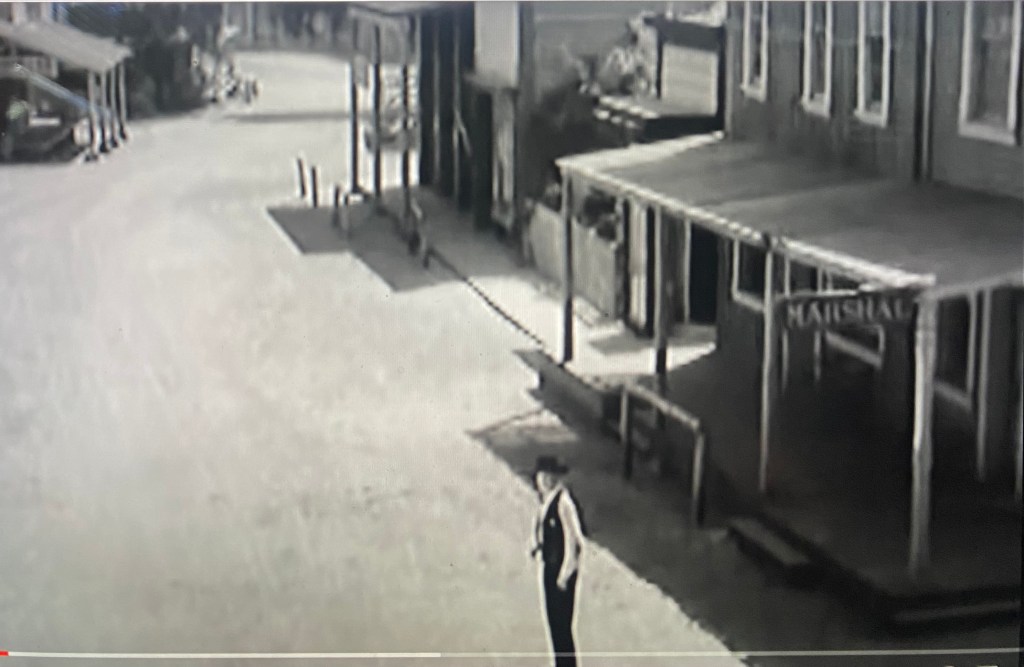
As synchronicity would have it, as I was reading about vulnerability, I was finishing the book, High Noon: The Hollywood Blacklist and the Making of an American Classic by Glenn Frankel. Which led me to watch for probably the tenth time, the movie on which the book was based. In case you’ve forgotten the plot, former marshal Will Kane (Gary Cooper) is preparing to leave the small town of Hadleyville, New Mexico, with his new bride, Amy (Grace Kelly), when he learns that local criminal Frank Miller has been set free and is coming to seek revenge on Kane for turning him in. When the marshal tries to recruit deputies to fight Miller, he finds the town’s people have turned cowardly. His wife, a Quaker opposed to violence, doesn’t understand why her new husband feels he must stay, so she decides to leave town. When the time comes for a showdown, Kane must face Miller and his three cronies alone.

This time, when I watched the film, I was aware of how the writer, Carl Foreman (who was being investigated for having been a Communist and who saw himself forsaken by people he thought were his friends), and the director emphasize Kane’s vulnerability. Through closeups of an aging Gary Cooper’s face, we see his fear, and scene after scene of overhead camera shots of his walking alone up and down what looks to be a deserted town show his smallness. Meanwhile, Tex Ritter is singing: “Do not forsake me, O my darlin’.” 

Well, his darlin’ doesn’t. Amy comes back to help Will kill those nasty bad guys, and, after throwing his marshal’s badge at the yellow-bellied citizens of Hadleyville, Will rides off with his wife into the afternoon sunlight.

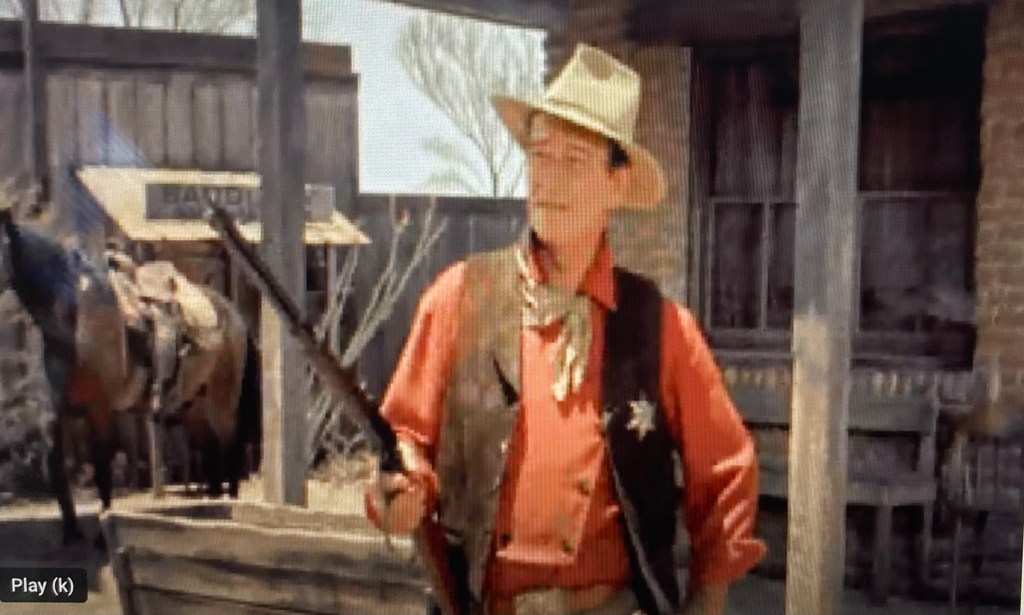
But although law and order triumphs in the end, the movie apparently infuriated traditionalists, like movie hero John Wayne and director Howard Hawkes, who said he didn’t “think a good sheriff was going to go running around town like a chicken with his head cut off asking for help.” So, Hawkes and Wayne made the western, Rio Bravo. In this movie, gunslinger Joe Burdette kills a man in a saloon, and Sheriff John T. Chance (John Wayne) arrests him. Before long, Burdette’s brother, Nathan, comes around, threatening that he and his men are going to bust his brother out of jail. Chance decides to make a stand. Does he ask the townsfolk for help? No way. “They’ll only get hurt,” John Wayne growls.

John T. facing the bad guys.

Meanwhile, unlike Will Kane’s wife, Chance’s love interest (Angie Dickenson), refuses to leave town. As the time for the showdown nears, she tells Big John, “You better run along and do your job.”

The message here seems to be that real men don’t need to ask for help; they inspire loyalty. Other reinforcements arrive: Dude, the town drunk, an old cripple named Stumpy, and a baby-faced cowboy, Colorado Ryan. Rather than showing fear as they await the arrival of the bad guys, they sit in the sheriff’s office making wise cracks and singing songs. After winning the inevitable shootout, they all stay in town to sing and crack more jokes with the lovable town’s folk.

In the face of danger, real men don’t ask for help, the movie proclaims. Real men don’t show fear. Real men sing and tell jokes.

Maybe it’s a sign of the times (my times, anyway), but I admire Will Kane, who overcomes his age, his fear, and his despair to uphold his principles, more than I admire John T. Chance who doesn’t seem to have a vulnerable bone in his body. I realize that thirty-five years ago, after my daughter Laurie died, still thinking that will power solves all problems, I tried to avoid asking for help, and how the resulting anger almost tore me apart, until, exhausted, I finally surrendered my will to a god I didn’t really believe in. Only then was I able to feel relief, and eventually even experience moments of joy, an emotion I’d never felt before in my life because I’d been too concerned with not being vulnerable.

Brene Brown and others go so far as to say that vulnerability is a sign of courage and strength. I can see that. To be vulnerable, I need to have a strong sense of self. I have to be honest about what I can and I can’t do, and I have to be honest with others, even if it means being rejected. I need to stop trying to prove myself. I must own my past mistakes, make amends to others, and move on. I have to be able to face difficult emotions, especially these days, about my diminishments, dying, and death. I must continue to ask for help and accept it.

And I damn-sure need to wait until cooler weather to mulch pumpkins.

And spend more time in this chair by the garden.

# #

A Pilgrim’s Journal: May 31-June 4, 2023

The Hermitages at Emery House

#

The Society of Saint John the Evangelist, Emery House, West Newbury, Massachusetts:

5/31/arrival: Hermitage #5, 5 years after our last retreat here, 30 years after our first. Hazy ride down from Maine, courtesy, I’m told, of Canadian wildfires. I’m also hazy about my plans for the next four days, except to try to pay attention—something I haven’t been doing enough of lately. Have also brought to read Parker Palmer’s On the Brink of Everything: Grace, Gravity & Getting Old. May play with writing some poetry.

#

Later: It doesn’t take much effort to pay attention to my age. I’m guessing Mary Lee and I are older than the 3 brothers and 2 other retreatants here by 40 to 50 years. The hill from the hermitages to Emery House is steeper and I am moving more slowly than 5 years ago. Tonight, at supper, I didn’t have the strength in my left hand to hold a full bowl of soup (something called “ulna nerve entrapment). Mary Lee and I were the last to finish eating.

So it was important tonight to read in On the Brink of Everything, Wendell Berry saying, “…we are either beginning or we are dead.” What am I beginning these days? How can I cultivate what Buddhists call “Beginners’ mind”?

#

6/1/: Morning walk through Maudslay State Park, next door to the Emery House grounds: miles of blooming rhododendrons and azaleas, stone walls, & winding paths through groves of towering pine trees overlooking the Merrimac River. Hazy sunshine over the river, which may be more smoke, which may be why I had to rest my scarred lungs more often, once on a stone memorial bench in memory of F—B— “An Optimist, Local and World Wide.”

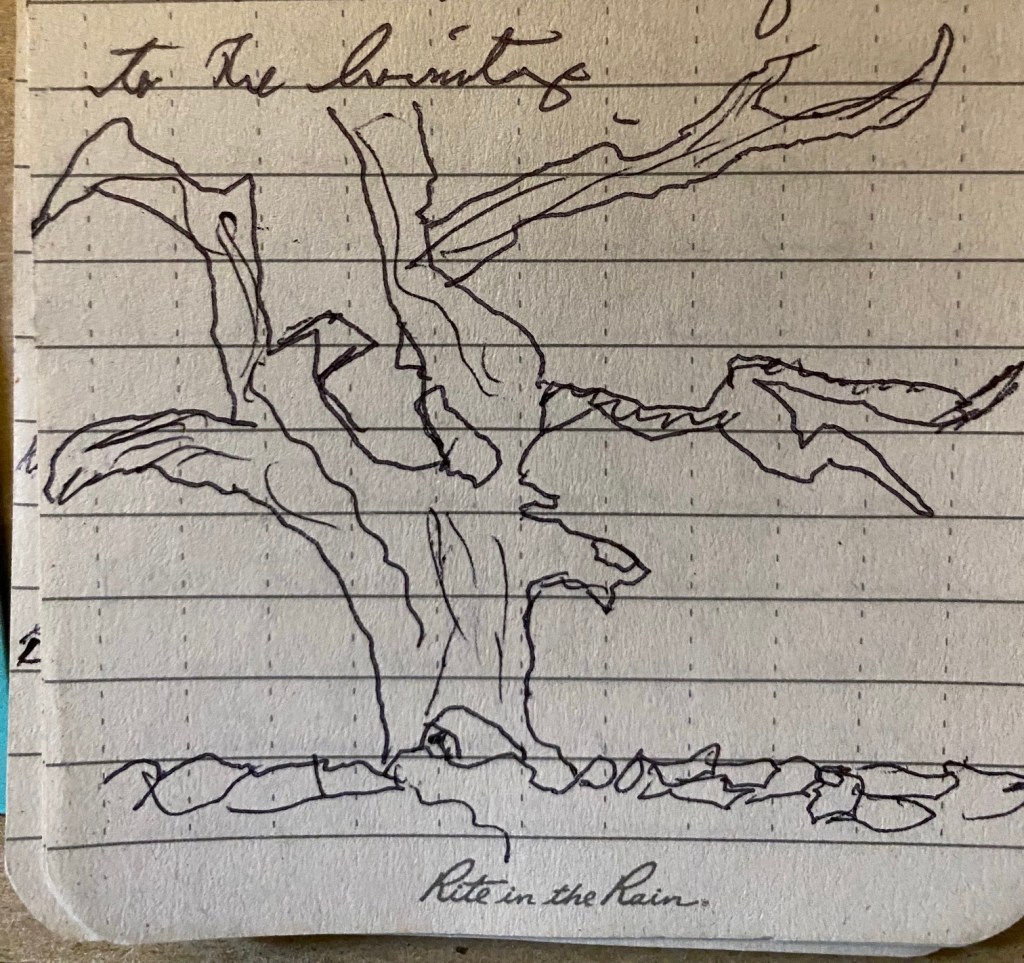
But I spent the most time this morning contemplating a dead tree by the side of the road:

Like this standing shell of a tree, gray and

Dry and cracked—that’s how I feel, as I watch

Young people walk or run past, wait for me

As I struggle to open a door, or

(and this is worse) open the door for me.

That’s of course when they’re able to see me;

Often, I feel invisible, like this

Dead tree amidst the towering white pines.

But the old tree still stands at attention,

Still offers its broken arms to the sky.

As beautiful as polished driftwood, it

Still provides a home for the animals

And maybe insects for the woodpeckers.

I could do a lot worse at my life’s end.

#

After the noon Eucharist and lunch at Emery House, I was walking back to the hermitage along the mowed path at the edge of the field, & almost stepped on a box turtle.

Turtle in the grass

Sudden shadow overhead

Karma, chance, or fate?

#

6/2/breakfast: Eating my Cheerios, looking out at the field between the hermitages and Emery House, & at the red-winged blackbirds swooping over the buttercups, I go back to 1993 when I first came here. Then, as now, I’m struck by how life & death, beauty & ugliness, good & evil intertwine in this place. Or—more probably—how I notice them more here—from the choirs of songbirds to the decaying & dead trees lining the road; from the lovely bluebells and buttercups to the poison ivy that seems to be everywhere; from the bucolic pond on one side of the bridge that leads to Maudslay Park to the mudflats of the tidal Merrimac on the other side.

What did I read last night in On the Brink? Okay, here it is: “Life’s most important realities often take the form of both/and rather than either/or.”

Green shoots in dead leaves

purple plants, poison ivy—

The dancing goes on.

#

Later in the morning: After traipsing through fields of long grass (check for ticks tonight!), I found the path I’d been searching for through the woods on the Emery House grounds. I’m now in front of the iron statue of Jesus on the Cross, which has been here I don’t know how many years …

Jesus hangs in shadow

Weather spots across bronze chest,

Legs looking splattered with dry mud.

In shadow, Jesus melts into

The pine tree overlooking the river.

Dead limbs surround him.

Still, overhead

Needles grow abundantly,

As if a crucifixion

Could create new life.

#

Later: For the last two days, the weather has been the hottest it’s been this year. Tonight, however, at Compline …

Through chapel windows

Layers of smudge-colored clouds.

Chilly winds whip trees

Distant thunder, rain splatters,

Candles flicker but don’t fail.

#

6/3: After two days of tee-shirts & shorts, I walked through Maudslay this morning in fleece & long pants. The flowers look bedraggled by last night’s storms. Found a charming dam I’d never been to.

Have been trying to avoid the phone, but noticed on my walk I’d a missed message, & back at the hermitage, I gave in. From Dick B—, friend & member of our Men’s Group, telling me that his wife Anne, had died in his arms at their camp. Both Dick and Anne are in their 90s. Anne & I did lay pastoral visiting together.  “She died peacefully,” Dick said. “After bidding one heart at Bridge.”

In life & death

O Thou, who remains a mystery

Abide with me,

Thou to whom I keep returning

In sorrow & joy, in sickness & health

In life & death.

Even as I remain ignorant,

Blind, deaf, & dumb, grasping for guidance,

Abide with me.

In the woods or the fields,

In 80° or 40, sun or rain,

In life & death,

No matter how much longer the road may be

No matter what, if anything lies at the end,

Abide with me.

From the sun’s rising to enveloping darkness,

Thou whom I do not know, but whose I am

In life & death,

Abide with me.

#

6/4: Have returned from Sunday Eucharist, walking to our hermitages past a large snapping turtle, plodding along beneath two flowering dogwood trees. Beautiful in an ugly, primordial way, the turtle almost took ML’s hand off when she put her hand on its shell.

Now, with cup of tea before I start to clean up for the next retreatant, I reflect that 30 years ago, when I was in Hermitage 4, next door, I was obsessed with my daughter’s death. Now, I view the world through the lens of my own death. Which, as I finish On the Brink, may not be a bad thing: “… Saint Benedict,” writes Parker Palmer, “said, ‘Daily keep your death before your eyes.’ If you hold a healthy awareness of your own mortality, your eyes will be opened to the glory and grandeur of life.”

Palmer also writes, “I can’t think of a sadder way to die than with the knowledge that I never showed up in this world as who I really am.”

So, I leave Emery House, recommitting myself to keeping my eyes open, and showing up as I really am. Hoping, like my friend Anne, to leave this life having bid my one heart.

Emery House, as seen walking up the (ever steeper) hill from the hermitages

##

Traveling the Landscapes of Anger

#

In my various pilgrimages, I’ve traveled through deserts where the temperature was 114° and snowshoed through forests at -10°. I’ve walked slippery rocks in a driving rain and picked up cactus stickers that took months to work themselves out of my skin. I’ve sprained ankles and wrists, brought home dysentery and COVID. But, as I’ve often written in these blogs, a pilgrimage is internal as well as external, and some of the most difficult landscapes I’ve traveled are the landscapes of anger.

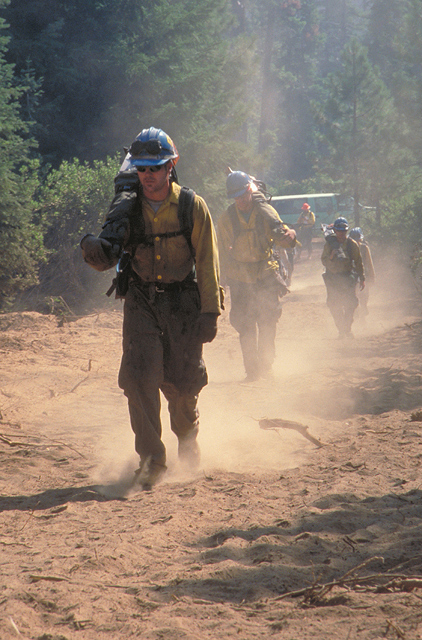
There’s more than one. Sometimes, anger can resemble burning terrain caused by the forest fires I used to fight when I was twenty: not only hot, but smokey, so that I can’t see where I’m going.

Most forest fires run along, or even under the ground, or to be more precise, under the “duff”— organic debris on top of mineral soil—of the forest floor, until, given the right conditions, a tree or trees will “candle,” suddenly bursting into flame.

That was my childhood. My parents, both of whom grew up in angry, even violent, environments—my mother once told me she was in her 30s before she learned people could drink and not yell at each other—usually kept their anger hidden under a duff of sarcasm. But when their anger did candle out, it frightened me, so that I spent much of my time trying to make sure they never got angry at me, which has led to a life of people-pleasing and other codependent behaviors.

Meanwhile, my own anger scared me even more than my family’s. Most of time, I could use sarcasm to mask my anger, but sometimes it would explode, often on the basketball court. (I may still hold the record for most fouls committed in the shortest period of time—four fouls in 18 seconds of game time.) And yet in other games, I was passive, easily intimidated by an aggressive opponent, because of my inability to control how I’d react.

A forest fire can smolder in the duff for years before bursting into flame. A year or so ago, I found myself engulfed in a blind rage of unfocused anger, which, I came to realize, was based on the same confusion, angst, and helplessness I often felt at sixteen.

Other times, I’ve crossed other landscapes. For almost exactly three years after my daughter died, my anger was a wasteland of burning rocks and rattlesnakes and prickly-pear cactus. I raged at the pastor of my church, my family, my teaching colleagues, my students, motorists on the road and pedestrians on the sidewalks. Evenings I would shut myself in my den, drink scotch, and write angry letters to the editor of the local newspaper (which, thank God, I never sent) about how my community, the country, and the world were falling apart.

Then, there’s the landscape of shame, often defined as anger turned inward. For me, shame is like walking through mud in a raging thunderstorm, hunched over, cold, frightened, head down, not looking anyone in the eye because I’m sure I’m being laughed at.

And it’s all my fault. So the angrier I get, the worse I feel. I’ve trudged this landscape as a child, convinced I was fat and ugly, as a college student often sleeping twelve hours a day, embarrassed by my lack of shoulders, buck teeth, and poor grades, as a young adult who used a bad back to get out of Viet Nam, as a grieving parent, sure I had somehow caused my daughter’s death, or as a vapid thinker, failed writer, and lousy parent and grandparent.

Still another landscape is the angry ocean of change. I feel as if I’m adrift in a rowboat amid mountainous waves, clinging to a tiny life preserver of nostalgia, which as someone once wrote is a form of anger, or at least resentment.

I long for a time I’ve lost. When life was simpler, the music better, the men stronger, the women better looking, and the food healthier.

Before I go any further, let me say what you may be thinking: anger is natural, and anger can be effective. Charles Duhigg, in a recent Atlantic article on anger, writes that anger can convey more information more quickly than any other emotion. Expressing anger in an argument can make people more willing to listen, more inclined to speak honestly, more accommodating of each other’s complaints.  Anger motivates us to undertake difficult tasks. We’re often more creative when we’re angry.

The problem, Duhigg and others note, is that to be effective, anger needs to be focused. That’s certainly been my experience. On the rare occasions on the basketball court when I could focus my anger, I had great games. (I think there might have been two or three.) Focusing my anger after Laurie died on God instead of other people led me to meditation practices and ultimately to sorrow instead of anger. Using anger as part of my physical therapy has helped me recovery from three major surgeries.

But. I find that most of the time I can’t focus because I can’t separate justified from unjustified anger. So, I’ve come to feel that just as there are people who can drink responsibly but I can’t, there are people who can channel anger in a way I’ll never be able to.

Which is why I try to replace anger with other reactions whenever and as soon as I can.

One other reaction is acceptance. Given my alcoholic upbringing, anger is always going be smoldering in my emotional duff. I need to accept that those fires were set generations before me. Which leads me to the importance of cultivating compassion, both for the angry 16-year-old and the raging geriatric of a year or so ago.

Still another response is surrender. Yes, anger at God helped me deal with my daughter’s death, but it wasn’t until I surrendered to God of my not Understanding that my tears of hot anger were replaced (and I can tell you exactly when this happened: three years almost to the day of Laurie’s death when I watched a high school Christmas concert) by soothing tears of sorrow.

I accept that anger is often going to be my first reaction to change, whether it’s grief over a major loss or simply the daily diminishments of being 80. But it doesn’t have to be my final response. Responses such as acceptance, compassion, surrender, curiosity, and patience are not going to change the landscapes of my anger, but they can water the deserts, dry up the mud holes, blow away the thunderstorms, and smooth the angry waves of change.

# #

Easter in the Time of Coronavirus

#

Having grown up going to church and continuing to be an active church member, I’ve always spent the Easter season preparing, reading, serving, and celebrating. This year, however, thanks to COVID-CRUD, Mary Lee and I were Easter observers rather than participants, viewing from our living room, isolated in a bubble of congestion, coughing fits, and fatigue.

But it was not entirely unpleasant. Sitting on the couch with Mary Lee, watching the live-stream services from our church, I drifted in and out, my mind sometimes considering the computer screen, other times contemplating memories of other times, other Easters.

#
I’m eleven years old, waking Easter Sunday to the smell of shoe polish in the kitchen, where my father has lined the family’s good shoes on the counter and put the Kiwi to them. Jumping out of bed, my younger brother and sister and I search for bright yellow marshmallow Peeps Dad and Mom scattered through the house the night before. After breakfast my brother and I put on new pants and socks and my sister wiggles into her new dress and maybe a new hat and gloves. Dad wears the suit he saves for Easter and Christmas, and Mom dons her best dress and a pink broad-brimmed hat that looks like a pastel frying pan. As crocuses bud and sparrows sing, we walk up Bridge Street past white houses and the brick buildings of North Yarmouth Academy to the First Parish Church. The air smells of fresh dirt. After walking together up the walkway and through the double doors, we split up: Dad stays in back to usher, Mom takes Jaye and Roger to the pew with the brass family nameplate on the arm, and I go up to the balcony to sing with the junior choir, looking down on the congregation as we all sing “Christ, the Lord is Risen Today,” our voices lifting our collective All-le-lu-ias! through the doors and windows of the church, carrying me over the streets of town, over fields and coastline, and into enfolding arms.

#

As a young father, I sit in another church balcony, singing in another choir the tenor part of Handel’s Halleluiah Chorus. It’s too high for me and I’m sure I sound like Tiny Tim singing “Tiptoe Through the Tulips.” Below me, my daughter Laurie in her new Easter outfit and haircut, smiles up at me from her seat with the youth choir. Earlier, I watched her sing, intense and enthused, her head thrust forward, swaying with the music, once again, feeling that yes, Virginia, there is a god.

#

A grieving parent now, I sit on a bench by the Charles River under Harvard’s golden cathedral domes glowing in wind-driven clouds, watching a man in faded flannel shirt and frayed cargo pants, curled in a stained sleeping bag against the Weeks Footbridge like a bedraggled cat. Around him, joggers seek endorphin blessings, couples reverently stroll hand in hand, parents rejoice in their children, and twelve ducks meditate on the river.

This morning, the Brother Superior of the monastery lit a bonfire and declared Lent over. I held my candle, sang “Hail Thee, Festival Day” “Now the Green Blade Riseth,” “Jesus Christ is Risen Today,” prayed to a god I no longer believe in, and walked to the Charles Hotel for bacon, eggs, hash browns, croissants, and coffee.

A black cumulus settles like a boulder over the sun. Wind suddenly pounds wet nails into my skin.

Runners and families scud away like the ghosts of those I’ve loved and lost. The river churns and ducks bow their heads. I turtle into my jacket. The man by the Weeks Footbridge entombs himself in the mummy bag. Earlier, I proclaimed, “The Lord is risen indeed!” but like the women in Mark’s Gospel who fled the tomb in terror, I’m afraid to believe it, for fear of resurrection’s undermining my understanding of the world, my security, even the security of an emptiness I carry like a cross.

Then the cloud is rolled away, the wind shifts to the south, and the man by the bridge rises. From his tattered trousers, he takes bread, breaks it, and casts it on the water. One by one, the ducks come forth to share his Eucharist.

#

It’s 11:00 p.m. on Holy Saturday. Father Paul lights a bonfire behind the Chapel at the Desert House of Prayer, outside Tucson, Arizona. As we retreatants gather under a full moon for prayer, coyotes howl in the distance. We process past a Saguaro, its arms lifted as if in prayer, into the chapel for the “Liturgy of the Word,” the Old Testament readings that prepare for the New Testament and the New Covenant, which we celebrate after midnight with Hosannas and Alleluias. Afterward, Mary Lee and I walk hand-in-hand back to the hermitage where we’re staying, a cottage with a double bed, a microwave, a coffee pot, and our own fox, who sometimes comes to the bird feeder when we turn on the outside light.

As we stroll under the moonlight, I recall Father Paul’s telling us at supper on Maundy Thursday that he thought Mary Lee and I were examples of trust and the love of Jesus in the face of Judas’s betrayal, and then think of how Mary Lee and I betrayed our former spouses. I recall at dawn this morning, Mary Lee and I renewing our wedding vows in front of the 15th Station of the Cross, and after breakfast, hiking the trails of the adjacent Saguaro National Park through mesquite, cactus, and red rocks to an abandoned mine. After lunch, the wind blew furiously, knocking a picture off the wall and a lamp off the desk in our hermitage. And I ponder how good and evil, loss and gain, Good Friday and Easter interweave.

Back at the hermitage, I turn on the outside light and Mary Lee and I sit in the darkness of the porch and wait for the fox, which like my faith this week, comes and goes as it wills.

Early Easter morning, it comes: large, I’d guess 25-35 pounds, the chest and some of the face reddish, but mostly gray. Silently, it moves in and out of the flood light, half-cat and half dog, as it mouths the apple peels we’ve set out. My heart races and I feel myself overflowing with gratitude.

The fox trots into darkness. The moon hovers overhead. Mary Lee and I rise and dance in its light.

#

Back on the couch in Brunswick, Maine, watching through fuzzy eyelids the tiny figures on the computer screen coming to the altar for Easter Communion, I reach for Mary Lee’s hand. For a moment, I experience something I choose to call Grace.

Maybe I’m more a participant in Easter this year than I’ve realized.

# #

Crossing to the Holy Island

#

One of the great beauties of making a pilgrimage is that the interior journey continues long after the physical one has ended.

Case in point: A friend who read The Geriatric Pilgrim: Tales from the Journey, emailed me that while he liked the book, he wanted to know more about the last leg of our walking pilgrimage along St. Cuthbert’s Way to the Holy Island of Lindisfarne, where Mary Lee and I walked to the island at low tide in our bare feet.

Replying to Finlay led me back through photographs, my travel journal, and books I’d read at the time, walking in my mind once more across the sands and mud to the Holy Island, seeing some things for the first time.

For new readers or as a reminder to old ones, St. Cuthbert’s Way is a 62-mile walk from Melrose. Scotland to Lindisfarne, off the coast of England, supposedly in the footstep of St. Cuthbert, who in the year 651, received a vision that propelled him to walk from Melrose to the Holy Island to become prior of Lindisfarne’s monastery, which had been founded by Saint Aidan of Iona in 634.

The island itself is 8 miles around the perimeter, which is shaped like an axe. Its most imposing (and photographed) feature is a castle, which looms against the horizon like something from Middle Earth, especially at sunrise, which is when I first saw it.

Twice a day for 5 hours, the island is completely cut off from the mainland, and you need to plan your walk around the tides—the best time being during a four-hour period before and after low tide, which when Mary Lee and I did it, was around 8:00 a.m.

As I recall, we left our B&B in Fenwick (“Fen-ick”) around 5:00 a.m., walking two or three miles through coastal pastures. I also remember crossing a high-speed railroad line, where you have to use a yellow phone to speak with the signalman before crossing, and passing I don’t remember how many anti-tank blocks from WWII. Along the way, a flock of over 70 sheep moved towards us, herding us on our way to the causeway between the mainland and the island. At some point, the sun rose above a line of clouds over the ocean to our right like a pale pink balloon.

There are two ways to cross to Lindisfarne: a causeway for cars or for walkers who don’t want to walk barefoot or in mud boots, and the Pilgrim’s Path, a 2.3-mile journey across the floor of the North Sea through sands and mud, marked by wooden poles, two with refuge boxes at the top, just in case you’re caught by the surging tide. (And it does surge. Every year, people must be rescued by boat or helicopter.)

We walked to the causeway and down onto the beach. At first the sands were like Maine beaches at low tide, light brown and rippled and firm underfoot. Mary Lee had tied her hiking boots to her backpack so she could use her hiking poles, but at first, I carried my boots in one hand and my poles the other.

I remember a sense of triumph—we’re almost there!—and exhilaration. A stiff breeze blew against our faces and the air smelled of salt and something else: fecund and primordial. Besides walking barefoot, Mary Lee had her blue hiking skirt and I’d put on shorts, which added a touch of titillation to the experience.

Until the brown sand turned to brown mud and then to something the color and consistency of cold tar. Nothing I had read prepared us for this. I, too, tied my boots around my neck and grabbed my hiking poles. At one point, I went into the mud over my ankles, leaving my feet and lower calves coated in black. I was doubly glad we’d left our legs bare.

But that stretch really was short lived and soon we were back on the sands, splashing through a shallow tidal stream to wash off the mud. Clouds reflected in the water, and along with the sound of the wind whipping the air, I heard a chorus of seals cheering us to our destination.

And lo, there was the beach at Lindisfarne, with the church and ancient priory peeking over a bank of seagrass. We sat on a bench in front of the bank and looked back, not only at the channel but at the entire pilgrimage. Rejuvenated (which I always am when I look back and see how far I’ve come), we put on our hiking boots and set out to explore the Holy Island.

#

I’m writing this at the beginning of Lent, which, as I think about it, is sort of like the low tide of the Christian year. It’s a time of emptying out, on deciding on what’s important in my life. A time to practice trust that, as one of my spiritual mentors wrote, “All will come of its own accord in good time and with abundant fullness (I’m suddenly thinking of the surge of the North Sea), so long as one does not attempt to hoard or cling.” I’m good at hoarding, whether it’s having too many hats (most of which I don’t wear), or too many habits (I must have my hot chocolate every morning), or too many doubts and prejudices (far too numerous to list). Lent is a time to let the tide take those away.

In Lent, I remember that most of what I euphemistically refer to as my “spiritual life,” has been about emptying out, a process that began over thirty years ago, when my daughter died from cancer. After a year of raging at God, I decided to shut up and listen to what God had to say. Which led me to Centering Prayer meditation: emptying myself of thoughts. I also remember that emptying myself of thoughts produced what an early spiritual advisor called an “unloading of the unconscious,” which, I’m realizing, was like mentally walking through noxious black mud, but which I had to do before I could reach the other side to acceptance.

I’m also aware that I am nearing the end of my earthly journey, one, as I wrote in the last blog, to what I sometimes visualize as an island. Even without Lent, I, by necessity, am “self-emptying,” losing vitality, agility, libido, short-term memory, but I’m also finding it easier to empty myself of judgmentalism, fear, co-dependency. So far, the journey has been across relatively smooth sands, but I’ve no doubt they’ll be some mud holes ahead. Still, I’ve slogged through a few of those before, and it’s helpful to stop and look back and see where walking through them has led me. Especially when I’ve kept my eyes open for the guide poles and rescue houses of grace along the way.

# #

My Pilgrimage to Paradise

Photo by Bernard Hermant on Unsplash

#

If you’ve read these blogs before (or my latest book, available on Amazon or through Maine Authors Publishing, hint,hint), you know that making physical pilgrimages to places like the Old City of Jerusalem or San Francisco’s City Lights Book Store helped me discover how my life itself has been a pilgrimage, one through both grief and grace.

These days, my great pilgrimage is one into old age, and I’m finding it helpful to try to bring the same curiosity towards aging that I had when Mary Lee and I walked St. Cuthbert’s Way—Hey, there’s a new pain in my shoulder. Never had that before!

Now, pilgrimages are all about having a destination, a place of personal, often spiritual, significance, and lately I’ve been asking myself, just what is my destination, as I age?

The obvious answer is death. My Christian faith teaches me that death means some kind of afterlife, and over the years Christians have been stereotyped as believing in two kinds: heaven and hell. I’m not big on either one. I prefer the way Brother Geoffrey Tristram of the Society of Saint John the Evangelist describes the afterlife: “We have a specific destination: our heavenly home. Our pilgrimage journey is toward God.”

My faith, and other religions with which I’m familiar (not to mention any number of secular books and films), often refer to this heavenly home as paradise. But while I can think of my own pilgrimage as being one toward God, perhaps because God remains such a mystery to me (I always refer in these blogs to God of my not Understanding), I have trouble imagining what this heavenly home, this paradise, looks, feels, tastes, sounds, and smells like.

I’ve just finished the book, The Half Known Life, by my favorite travel writer, Pico Iyer. Iyer tells us the word “paradise” comes from the old Iranian term paradaijah, a walled garden, which then became an emblem of and an enticement toward “the higher garden that awaits the fortunate.”

The Garden of Eden with the Fall of Man by Jan Grueghel the Elder and Pieter Paul Rubens, c. 1615. Public Domain

Christianity, of course, has the Garden of Eden as a paradise. And while I agree gardens are nice, having worked in a market garden 70 hours a week, I can tell you they’re not my idea of paradise. When Pico Iyer journeys to various “paradises”—Iran, North Korea, the Himalayas, Japan, Ireland, Jerusalem, Sri Lanka—he finds dirt, danger, and disappointment. So, he decides paradise is an “an elusive place where the anxieties, struggles, and burdens of life fall away.”

Now, this is a definition I can get my teeth into. Isn’t this where we all want to go, regardless of our spirituality, religion, or lack thereof?

But I still ask: where is this place and what does it look like?

My answer comes in remembering that after my daughter died, the only way I could visualize her was in a photograph album somewhere between one week and eighteen years old. Gradually, however, as I began, through meditation and counseling, to develop a new relationship with her, I began to imagine her in a stone cottage on a rocky cliff overlooking the ocean, painting, sculpting, and cooking gourmet vegetarian meals. Then, one day I was sitting in Harvard Square in Cambridge, Massachusetts, having coffee and picturing her at a potter’s wheel, when suddenly, I knew she was sitting beside me. I felt her hand on my shoulder. It was one of the most “real” experiences I’ve ever had.

These days, I can easily forget what Laurie looked like during her life here on earth (coming upon her photograph now will sometimes surprise me). Rather, my daughter is more like the air I breathe, unseen but vital to my life, no longer living in some distant land, but always with me.

You may say—and some people have— “It’s all in your head. It’s merely your imagination.”

Yes. But.

I think imagination is not in the head but in the heart. And there’s no “merely” about it. As I think about it, through imagination, I’ve experienced both hell and heaven. (How many times, I have a made a situation worse, hellish, actually—an operation, an argument, a power outage or a frozen pipe—by imagining the worse-case scenario, “awfulizing,” as 12-steppers say). But then, at least lately, if I can shift my focus, my imagination, to God of my not Understanding, grace happens.

So, what is my “imaginary” picture of paradise? As when I first envisioned Laurie, my paradise would be overlooking the ocean (got to have water!), on a bluff, surrounded by spruce, pine, and fir trees (complete with smells). I would have a cabin—wood, I think, with a lot of windows, at least one circular, framed in stained glass. A stone fireplace…bookcases…leather chairs… music (lots of music)….

And where is it?

Obviously, dummy, it’s right here. In front of my computer in what I call my cave, in my house, in my town, in my state, in my country. My destination these days should be to the here and now of this imperfect world, but the here and now of this imperfect world seen through the divine gift of imagination. Laurie came to me in the middle of the gassy fumes and dirty snow of Harvard Square to become this constant, vital, presence.

So I conclude paradise is a state of mind, and my pilgrimage a journey toward recognizing the divine in both the hell and the heaven of the everyday.

This state of mind is for me, and I expect for all of us, a never-ending work in progress, one which involves challenges and doubt at least as much as stability. It involves letting go of old habits, compulsions, and preconceived ideas: heaven is for “good” people, hell is for anyone I don’t like…I can find my daughter only in old photograph albums…I need to go to Jerusalem or India or the South Sea Islands to find paradise. Instead, it involves discovering serenity in the midst of confusion, trauma, and disappointment. It involves wonder and imagination and creativity.

All challenges. But as I think about it, I can’t imagine paradise, either here or in some afterlife, without having a challenge. I certainly don’t want to spend eternity just sitting in my heavenly log cabin looking through stained glass windows at the ocean and listening to early Elvis.

# #

Handling Change

Anastasia and Beatrix walking through the woods to our house

#

For the past ten years, Mary Lee and I have provided a second home for our granddaughters, first Anastasia and then three years later, Beatrix. Both girls became part of our daily lives—a big part.

Last weekend, Anastasia and Beatrix left Maine to live with their father, who has moved to Oregon. It’s a huge change for them, and Mary Lee and I worry about the girls. But it’s also a major change for us. The girls will be back, of course, and we will do Zoom and FaceTime; we will become frequent flyers from one Portland to another. Still their absence will create a huge change in our day-to-day lives. Even when Anastasia and Beatrix weren’t physically with us, Mary Lee, especially, was thinking of things to do when they would be. Their toys, books, and crafts were as much a part of our house as our carpets and chairs.

 At the same time as we were trying to prepare ourselves for the girls’ move, our thirteen-year-old cat, Zeke, developed—overnight it seems—pancreatitis and cancer. After taking out a sizable bank loan, we’ve been able to make him comfortable, but he’s definitely not the same lively and free-spirited pet he was. I miss the sound of his racing around with his toys after breakfast.

Many of our friends are also suddenly facing changes, many of which are far more serious than what we’re dealing with. Several couples are now coping with Alzheimer’s or dementia in one spouse; two church members I’ve worshipped with for over twenty years—both younger than I— now come to the services with walkers; it seems as if every week someone I know goes into the hospital for a major operation; one man in my men’s group just lost his wife.

My geriatric pilgrimage is starting to feel not as if I’m moving through a new landscape, but that a new landscape is coming at me, faster and faster, like one of those painted panoramas unrolling while I stand still, my head spinning.

The other day, my 12-step sponsor asked me how I was. Well, I said, I’m walking more, I’m meditating more, I’m—

“No,” my sponsor said, “I didn’t ask what you were doing, I asked how you’re doing. How are you feeling?”

“Okay,” I said, “Mary Lee and I are talking a lot, I’m playing the banjo—”

“No, no! Look, close your eyes. Take three or four deep belly-breaths. Get out of your head and into your body. Breathe… Now, how are you?”

I paused. I breathed. “Tense. My face is tight. My hands feel as if they’re clenched. As if I’m waiting for the next shoe to drop. Or maybe it’s a boulder.”

Probably because of the way the future is hurtling towards me, I’m turning to the past, longing for what seem like slower and more stable times. (And why wouldn’t they seem that way? I know how events turned out.)  But I’ve always resisted being one of those geriatrics who lives in nostalgia for a past which never existed, and I really don’t want to stay lost in the 1950s for the rest of my life.

What I should be doing, of course, is focusing on the present, as all the contemplative practices I’ve learned over the past thirty-some odd years have advised. But while I can still be in the moment occasionally during my daily meditation, I’m not taking that focus from the meditation corner of the house out into the world.

 What else can I do? How do I navigate the now, especially a now that seems to be more and more out of my control?

There’s an old saying in AA: “to change a thought, move a muscle.” This week, I started working with my Feldenkrais instructor on relaxation exercises, trying to soften the tension in my arms and my face. I’ve also begun practicing what I’ve come to call “geriatric walking”: walking not to get in any particular number of steps or to close the rings on my fancy watch, but paying more attention to the world around me, stopping frequently, breathing deeply, and noticing the lessons Nature has to teach me about change.

Thanks to a Christmas windstorm, trees have fallen across two different places on a well-worn path in the woods behind my house, which means I must learn how to climb over tree trunks.

The pond by that path is icing over, and every day I’ve watched ducks swimming in circles, trying to ward off the encroaching ice, much the way I’ve felt lately as if I’m running in circles trying to ward off change. The ducks aren’t going to be able to keep the ice away all winter, and I’m not going to be able to hold back change, not matter how many Buddy Holly songs I listen to.

I’m also reading about change, and last week I read a letter from Brother Paul Quenon, of Gethsemani Abbey in Kentucky to a friend contemplating a major vocational shift, in which Brother Paul wrote that just as monks make a vow to “stability of place,” he thinks they need to make “a vow of commitment to change—a vow of un-stability (his italics).”

And New Year’s Eve, I made a recommitment to seeing my life as a pilgrimage. To being the one doing the moving, even if I’m not moving the way I used to. To having a destination, a goal, a place of spiritual significance. And to be guided by my Higher Power, that God of my not Understanding, trusting, as the hymn says, that the Grace which “brought me safe thus far” will “lead me home.”

I’m not yet sure where the journey will take me next. I want to be more active in helping others through my 12-step work, talking with others—especially men—about grief and loss, and about the value of seeing life as a pilgrimage toward a closer connection with one’s Higher Power, especially these days, when, as Thomas Merton wrote, “the whole mechanism of modern life is geared for a flight from God.”

Because we 12-steppers love our acronyms, I’ve created one for CHANGE: “Contemplate How Action Needs God’s Embrace.”

Otherwise, I think we’re all just ducks, swimming in circles, trying to ward off the inevitable.

# #