On Vulnerability

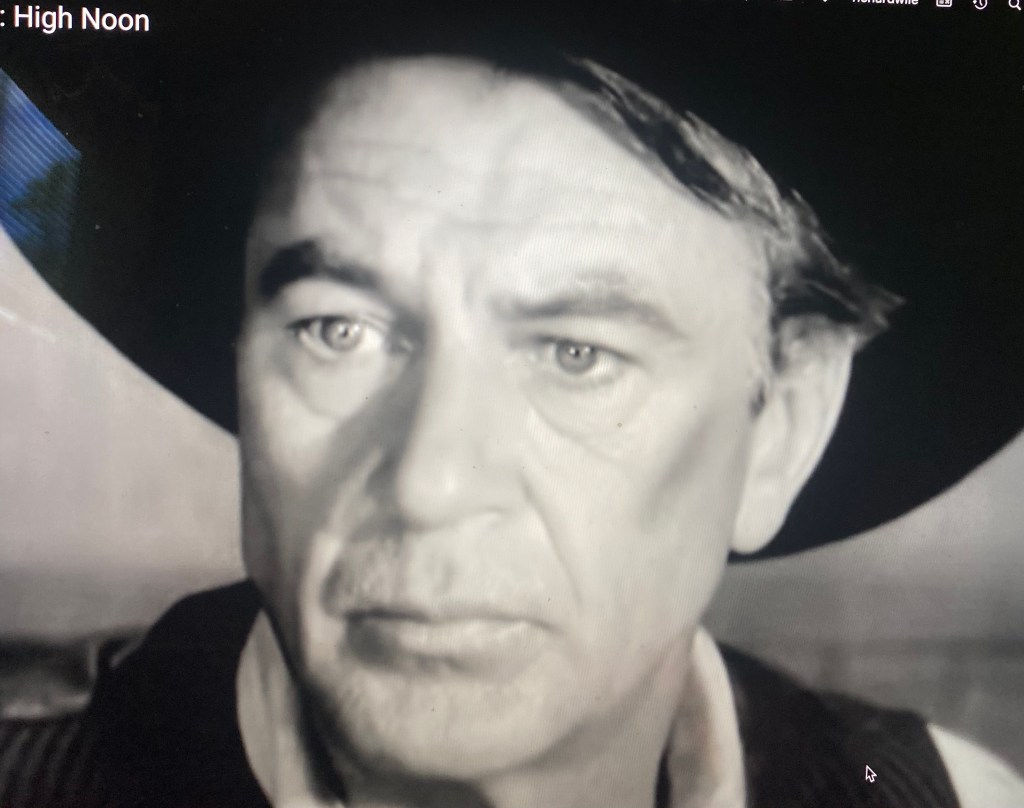
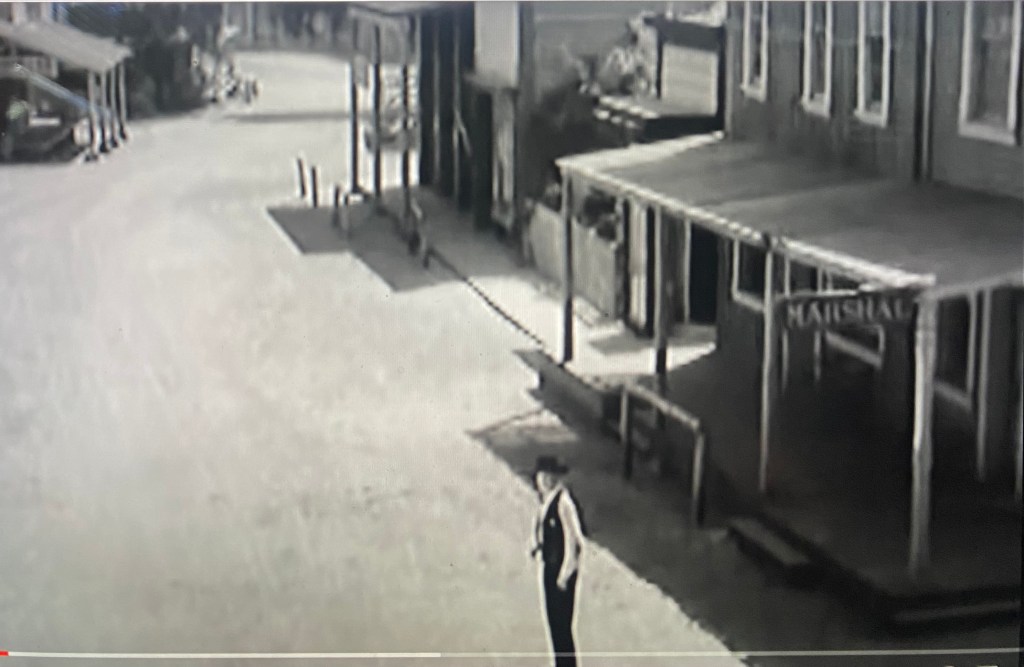
Will Kane, as the clock strikes high noon.

#

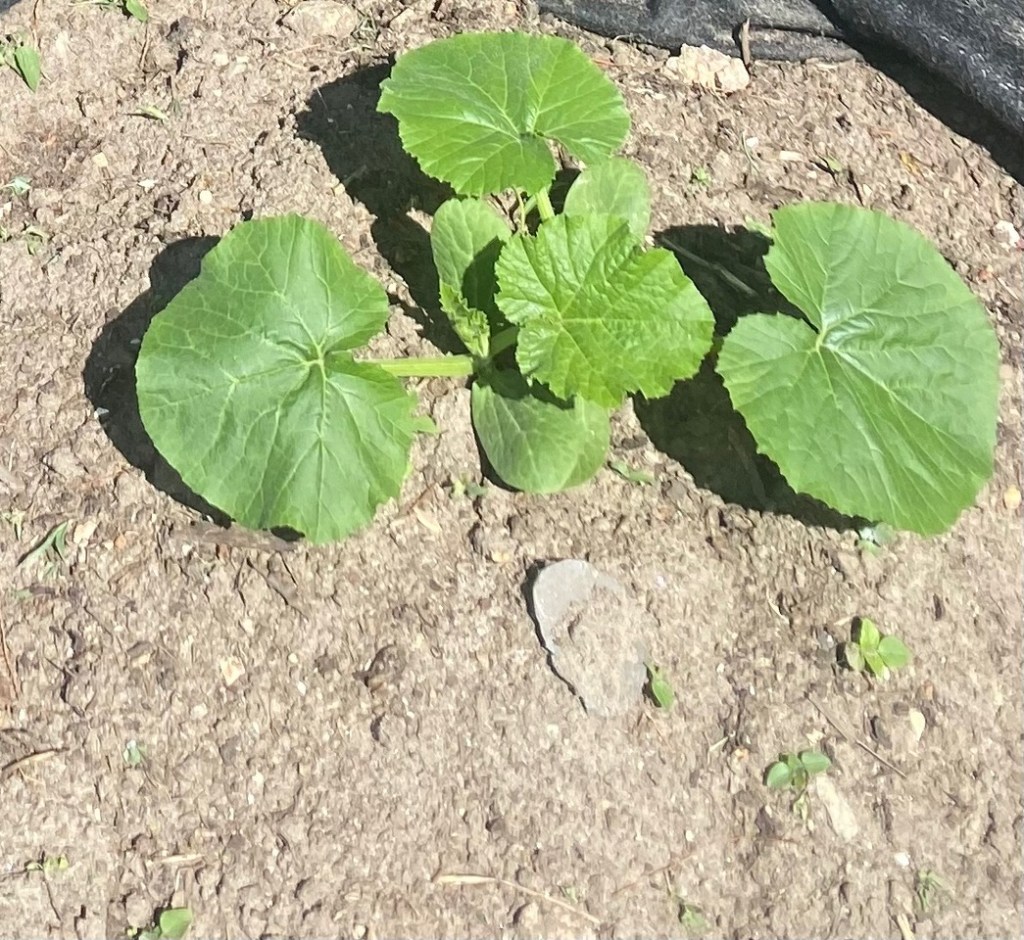
Perhaps it’s because I turned 80 this year. Maybe it’s because this summer has been hot and muggy. Whatever the reason, I’ve found myself more aware lately of my vulnerability. Walking in the woods these days requires changing into insect-resistant clothing because of ticks; on walks, working in the garden, I need to be sure to bring water with me or I get weak and dizzy; after heart surgery, I need to keep checking my fancy watch to make sure my heart rate doesn’t get much over 120 bpm. I’m tripping more often and have removed several rugs from our house. Earlier this year, I fell in my garden and only by grace/luck/whatever did I miss cracking my head on a rock by about 6 inches. And on a recent hot day, I was mulching my pumpkins, felt weak, saw that my heart rate was 145, sat down, and couldn’t get up. Fortunately, I had my water, and was finally able to get home after a half-hour or so (whereupon I had a 1½ hour nap).

I don’t like being this vulnerable, probably because I’ve spent a lot of my life trying to avoid showing vulnerability. As a boy in a small New England town in the 1950’s, I learned vulnerability was for sissies. Never ask for help; never let anyone see you cry. In high school, I learned success, whether on the basketball court or getting Suzie’s bra off, was a matter of will power. Mind over matter.

But these days, I find that what I mind doesn’t seem to matter. Which is why I’ve made a pilgrimage through the internet in search of something good to feel about vulnerability. At first, I didn’t have much luck. If you google the word “vulnerable,” most of the definitions have negative connotations: “capable of or susceptible to being attacked, damaged, or hurt; open to moral attack, criticism, temptation, etc.”

Still, looking up “Articles on Vulnerability,” I found advocates. Researcher and storyteller Dr. Brene Brown writes, “vulnerability is the core, the heart, the center, of meaningful human experiences.” Others write that vulnerability allows us to be authentic. It can bring a sense of closeness and fulfillment. It can bring about more honesty, more trust. Brene Brown again: “Vulnerability is the birthplace of innovation, creativity, and change.”

As synchronicity would have it, as I was reading about vulnerability, I was finishing the book, High Noon: The Hollywood Blacklist and the Making of an American Classic by Glenn Frankel. Which led me to watch for probably the tenth time, the movie on which the book was based. In case you’ve forgotten the plot, former marshal Will Kane (Gary Cooper) is preparing to leave the small town of Hadleyville, New Mexico, with his new bride, Amy (Grace Kelly), when he learns that local criminal Frank Miller has been set free and is coming to seek revenge on Kane for turning him in. When the marshal tries to recruit deputies to fight Miller, he finds the town’s people have turned cowardly. His wife, a Quaker opposed to violence, doesn’t understand why her new husband feels he must stay, so she decides to leave town. When the time comes for a showdown, Kane must face Miller and his three cronies alone.

This time, when I watched the film, I was aware of how the writer, Carl Foreman (who was being investigated for having been a Communist and who saw himself forsaken by people he thought were his friends), and the director emphasize Kane’s vulnerability. Through closeups of an aging Gary Cooper’s face, we see his fear, and scene after scene of overhead camera shots of his walking alone up and down what looks to be a deserted town show his smallness. Meanwhile, Tex Ritter is singing: “Do not forsake me, O my darlin’.” 

Well, his darlin’ doesn’t. Amy comes back to help Will kill those nasty bad guys, and, after throwing his marshal’s badge at the yellow-bellied citizens of Hadleyville, Will rides off with his wife into the afternoon sunlight.

But although law and order triumphs in the end, the movie apparently infuriated traditionalists, like movie hero John Wayne and director Howard Hawkes, who said he didn’t “think a good sheriff was going to go running around town like a chicken with his head cut off asking for help.” So, Hawkes and Wayne made the western, Rio Bravo. In this movie, gunslinger Joe Burdette kills a man in a saloon, and Sheriff John T. Chance (John Wayne) arrests him. Before long, Burdette’s brother, Nathan, comes around, threatening that he and his men are going to bust his brother out of jail. Chance decides to make a stand. Does he ask the townsfolk for help? No way. “They’ll only get hurt,” John Wayne growls.

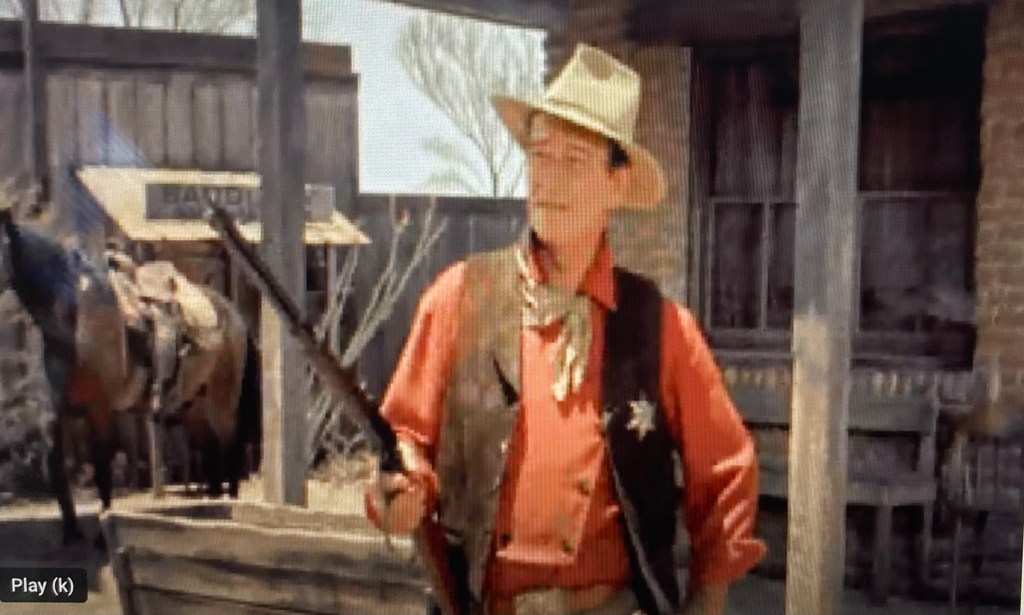
John T. facing the bad guys.

Meanwhile, unlike Will Kane’s wife, Chance’s love interest (Angie Dickenson), refuses to leave town. As the time for the showdown nears, she tells Big John, “You better run along and do your job.”

The message here seems to be that real men don’t need to ask for help; they inspire loyalty. Other reinforcements arrive: Dude, the town drunk, an old cripple named Stumpy, and a baby-faced cowboy, Colorado Ryan. Rather than showing fear as they await the arrival of the bad guys, they sit in the sheriff’s office making wise cracks and singing songs. After winning the inevitable shootout, they all stay in town to sing and crack more jokes with the lovable town’s folk.

In the face of danger, real men don’t ask for help, the movie proclaims. Real men don’t show fear. Real men sing and tell jokes.

Maybe it’s a sign of the times (my times, anyway), but I admire Will Kane, who overcomes his age, his fear, and his despair to uphold his principles, more than I admire John T. Chance who doesn’t seem to have a vulnerable bone in his body. I realize that thirty-five years ago, after my daughter Laurie died, still thinking that will power solves all problems, I tried to avoid asking for help, and how the resulting anger almost tore me apart, until, exhausted, I finally surrendered my will to a god I didn’t really believe in. Only then was I able to feel relief, and eventually even experience moments of joy, an emotion I’d never felt before in my life because I’d been too concerned with not being vulnerable.

Brene Brown and others go so far as to say that vulnerability is a sign of courage and strength. I can see that. To be vulnerable, I need to have a strong sense of self. I have to be honest about what I can and I can’t do, and I have to be honest with others, even if it means being rejected. I need to stop trying to prove myself. I must own my past mistakes, make amends to others, and move on. I have to be able to face difficult emotions, especially these days, about my diminishments, dying, and death. I must continue to ask for help and accept it.

And I damn-sure need to wait until cooler weather to mulch pumpkins.

And spend more time in this chair by the garden.

# #

An Allegrophobe’s Journey

Icon of an allegrophobe: Alice’s White Rabbit (from the 1951 Disney Movie: https://www.youtube.com/watch?v=jHG2bMe9YxY&t=19s)

#

Why am I so worried about being late?

Why am I filled with anxiety?

Is it for fear of making people wait

That I worry so about being late?

Is my need for control so great

That it threatens my emotional sobriety?

All I know is that I worry about being late

So much that I’m filled with anxiety.

#

I wrote this poem (for those who care, it’s called a “triolet”) last month while on retreat, after realizing during my morning meditation that my stomach was clenched and my heart was racing because I feared being a minute or so late to the morning service at the monastery guest house. And that “a minute or so late” didn’t mean getting there a minute or two after the service had started, but a minute or two after the time I’d intended to get there, which was ten minutes before the service started.

I can see how stupid what I just wrote must sound to an ordinary person. But, as I realized on the retreat—possibly for the first time in 80 years—when it comes to needing to be early, I’m not ordinary.

Some of my earliest memories are of waking up an hour ahead of when I needed to on a school day and lying in the dark, worrying about everything from whether or not Buddy Gallant, one of the playground bullies, would twist my arm behind my back until I cried, to whether the fact that I still couldn’t ride a two-wheeled bicycle meant I had polio, like my cousin Frankie, who had to wear a leg brace, to how my family was going to afford to buy me another pair of shoes.

And yet, despite my fears of what might happen on the playground, I was always one of the first kids to arrive at school, establishing a pattern that continued for the next seventy years. When I started playing basketball at the town’s rec program, I would arrive at the gymnasium a good half hour early, often shuffling my feet outside the locked door to keep warm. When I began dating, I was always early, pacing or in a chair tapping my foot, which often got the evening off to a poor start. For 32 years, I was always one of the first teachers to arrive at school.

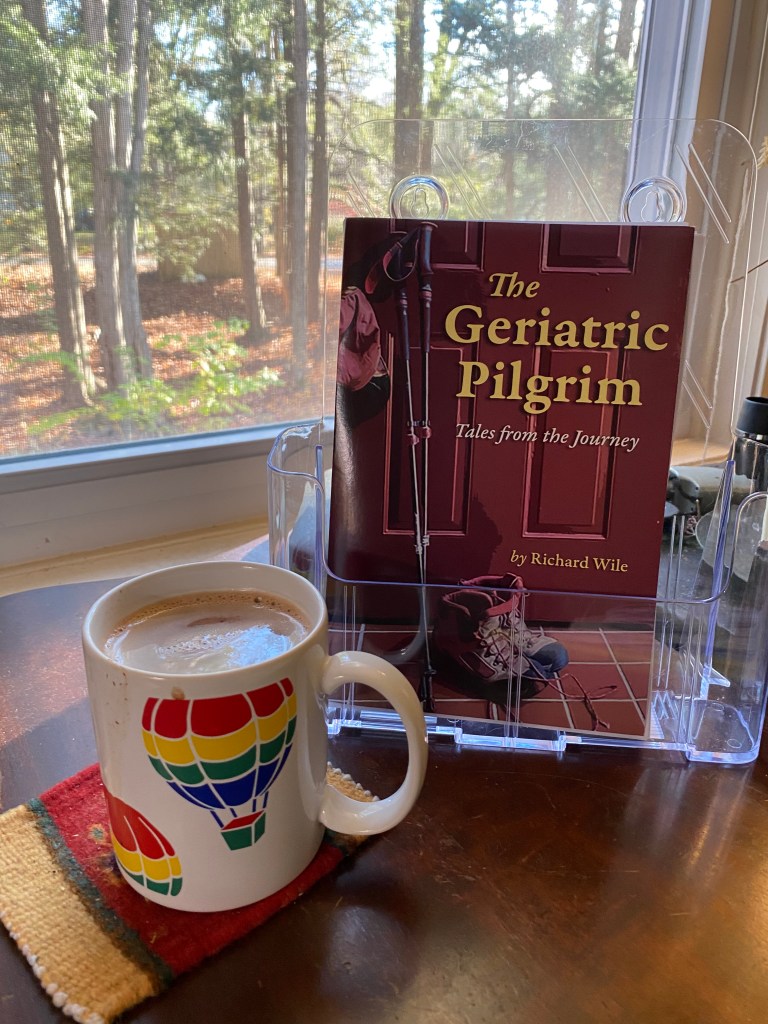
Back to the present, Mary Lee and I usually arrive at a movie, a concert, or a play twenty to thirty minutes early. I’m usually the first to get to our Men’s Group and the first to open any Zoom link. When I do a reading or a program based on the book I’m trying to market (The Geriatric Pilgrim: Tales from the Journey, for anyone reading this blog for the first time), I want to be there at the very least thirty minutes ahead of time. Forty-five minutes is better.

So what’s going on?

When in question, Google. Where, when I looked up “being early,” I found all kinds of positive stuff: being early is a sign of showing responsibility, of being conscientious. A sign of respect. Of leadership. And I like to think that’s often true of me. As a teacher, I used the extra time at school to prepare both my classroom and me for the day ahead. And when I’m doing a reading these days, I find it helpful to grow accustomed to the room—figure out how far I will have to project my voice. I want to respect the services at the monastery by not wandering in late. I arrive at Men’s Group early not only because I want to set up the equipment for our hybrid in person/Zoom meetings, but also because my name is on the church program as being the facilitator for the group, and I want to be dependable.

But when I looked up “fear of being late,” I found a different set of characteristics. First off, fear of being late has a name: allegrophobia, which, at least one writer thinks, may be connected to Responsibility OCD, or Inflated Responsibility Perfectionism. Allegrophobia, some websites say, is a sign of anxiety, codependence, and a deep-seated need for control. Other sites say allegrophobes worry obsessively about looming deadlines, relationship conflicts, and a sense that time is slipping away.

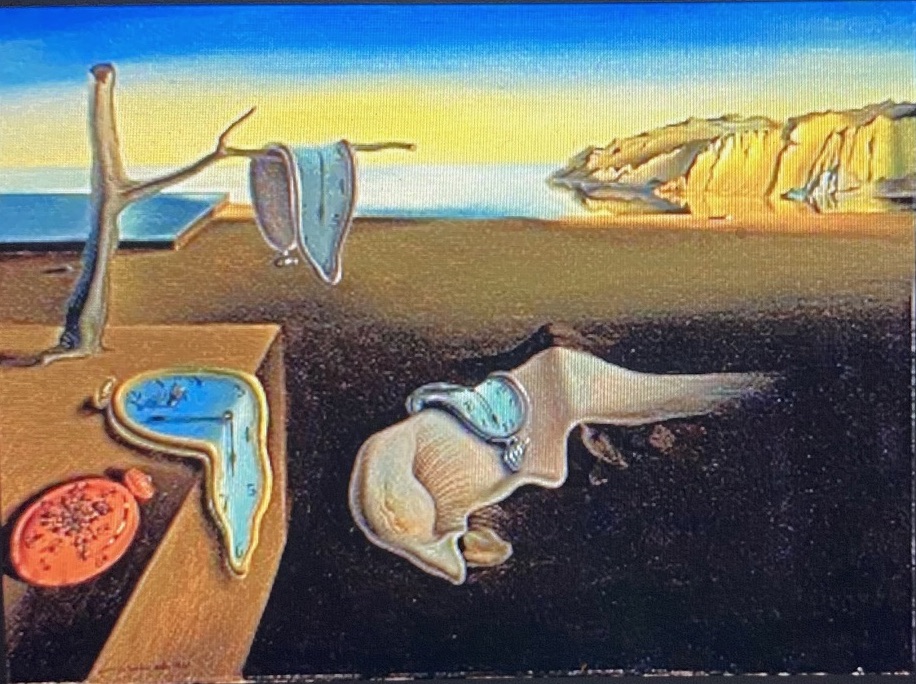
Salvador Dali: “The Persistence of Memory” (Wikipedia)

Which, I realized, are the same characteristics describing those of us who grew up in alcoholic or dysfunctional families.

Which answers a lot of questions.

For example, why did I worry as a kid about my parents—one, an adult child of a raging alcoholic and the other growing up in a broken home—not being able to afford new shoes? Because I often heard my parents worrying about their money problems. They also worried about a lot of other things, and I wonder if I channeled their anxiety into my fears of being taunted on the playground or coming down with polio. At the same time, was the reason I left early to school, basketball practice, and the like because I wanted to get out of the house and leave those worries behind?

If so, I’ve never been able to do it, so that I need to leave early for the movies because I’m afraid something will delay me between my house and the movie theater a mile away. Being early for school and to my readings and the Men’s Group helps me feel in control. And, as a codependent, being dependable and conscientious is not as important to me as having you think I’m dependable and conscientious.  

#

I suppose, at my age, I could just accept my allegrophobia. (And allegro, by the way, is a musical tempo that means very fast—124 to 160 beats per minute, which often describes my heart rate when I think I’m going to be late.)

But last week, I learned of the Judaic concept that upon reaching 70, one is considered having led a full life, but not necessarily a complete one. And as I thought of how I might make my life more complete, I thought again of my fear of being late. I did some more traveling on the internet and found a few suggestions for turning what has always been an anxious journey into a pilgrimage toward completeness.

One recommendation echoes what every spiritual tradition I know teaches: instead of worrying about the future, focus on the present moment. If you have a Higher Power, concentrate on how what some of us call God sees you instead of on how you think other people see you. If you don’t have a Higher Power, at least pause during your fears to center on your breathing.

Another suggestion I found is to imagine worse case scenarios, which sounds counterproductive, but is, I expect, a little like a vaccination, where you receive a little of the disease to protect yourself from more serious sickness. Ask yourself, “so what?” Imagine you are a few minutes late. So what? Will the Brothers at SSJE stop their service and give you hell? Will the Men’s Group fall apart if we start at 8:03 instead of 8:00?

And a third suggestion is to purposefully arrive at a gathering a minute or so late.

Aargh! Not ready for that one. Just writing that sentence gave me heartburn. I think I’d better work on the other suggestions first.

#

Notes From Squirrel Island

Circa 1940s. Wikipedia (It hasn’t changed much)

#

“A journey, in fact, appeals to Imagination, to Memory, to Hope—the three sister Graces of our mortal being.” Sir Richard Francis Burton (1821-1890)

#

I copied this quote from explorer Richard Burton into a pocket notebook, where it has remained for the last couple of years, along with any number of passwords, titles of books and movies people have recommended, email addresses, ideas for writing projects, directions for setting up new AV equipment, grocery lists, descriptions of sunsets, coffee shops, beaches, and airport terminals, Al Anon acronyms, and other quotes that have struck my fancy.

I can’t recall when I didn’t carry a pocket notebook and a pen. They are as essential a part of my wardrobe as underwear.

And before I add this notebook to the others going back to 1965, I’ve flipped back through it, trying—often unsuccessfully—to remember where I was when I wrote an entry, why it was important to write it down, and whether it’s important to me now.

What intrigues me is how the Burton quote helps me flesh out another entry a few pages later: a page and a half of description of a trip I made with my wife Mary Lee last July to Squirrel Island, Maine.

For those of you who don’t know, Squirrel Island is a small island in the Gulf of Maine—about 2 square miles, I think—established as a summer community in 1871. Apparently, it got its name not because of its squirrel population but rather because the shape of the island looks like a squirrel holding an acorn. Practically all its inhabitants are summer residents—I think there might be a caretaker or two who live there year-round—and most of the families have been coming to the island for a hundred or more years. The only motorized vehicles allowed are for maintenance workers. A boardwalk circles the island.

Besides beaches, tennis courts, a library, and a restaurant, there is also a chapel.

And for the last several years, Mary Lee has been asked to preach there one Sunday a summer. I go along as eye-candy.

To get to Squirrel Island, you take a ferry from Boothbay Harbor. It’s a nice half-hour trip (another reason I tag along), and this year, I remember the weather was warm and sunny. A nice woman from the chapel Board of Directors met us and took Mary Lee into the church to go over the various technicalities of the service, leaving me to walk the boardwalk until I found an Adirondack chair overlooking the water, where I sat, and, as is my wont, began to scribble in my notebook.

My first line noted the rotten egg smell of low tide, and how a smokey southwest breeze swayed some yellow lilies in front of me. I went on to describe a small harbor of motorboats pointing out to sea and the weathered cottages with gambrel roofs and wide verandas on the shore gazing out at South Port Island.

Reading those lines now reminds me that the first time I ever heard of Squirrel Island was when my Grandmother Cleaves worked summers into early October as a cook and caretaker for an old woman living on the island. I remember Nanny’s letters to me from there when I was in college, and how I chuckled at her rambling stories of people I’d never heard of and the latest gossip from the movie magazines she devoured like popcorn. (“Liberace’s Wig-maker Tells All.”)  Today I know my grandmother was an unhappy woman, the ex-wife of an alcoholic, who for years took her anger out on my brother, my sister, and me, but at the time, I denied the fact that she scared the hell out of me by imagining her as a comic figure. These days, I’m trying to accept that both her acid tongue and her love for her grandchildren were equally true.

My notebook tells me I noticed a seagull “dive-bombing a lobster boat,” and some sparrows chirping in the large mounds of beach roses under a blue sky “scarred with thin white stripes.” I mentioned the distant hum of lobster boats, the cry of an unhappy baby, and the “coo-coo-coo” of a dove. Which made me remember my friend and mentor Al, a retired Episcopal priest, who facilitated our church’s men’s group for many years. I wrote in my notebook of his love of pigeons, and worried about his severe asthma, compounded by heart problems, which had just sent him to the hospital and then to a nursing facility.

Al died about a month later, and I’ve just been asked to read at his funeral. I’m honored. Al was one of the kindest, gentlest men I ever knew, humble, with a great sense of humor. He was also a courageous advocate for social justice and civil rights. He attended Martin Luther King Jr’s March on Washington in 1963 and organized transportation from Newark, N.J. to the 1965 March from Selma to Montgomery, Alabama. He continued to work for equal rights for all, and in his last years wrote passionate letters to the editor urging us to become better stewards of our planet. He approached his death with dignity and curiosity, looking forward, he said, to the next stage in the journey. I hope to have the same attitude when it’s time for me to pass on.

I made more notes of white moths dancing over some sumac bushes and of a middle-aged woman in a black and white sleeve-less jersey walking her terrier along the boardwalk,  but when I heard the church bells from the chapel ringing out the old hymn, “Let Jesus Christ be Praised,” I thought again of Al, who, a year or so earlier, had written a children’s book, Soren’s Story: A Parable About Bullies and the Peaceable Kingdom.

As the full title makes clear, the book is not only about pigeons, but also about the dangers to children of bullying. I suspect Al, who had come from a dysfunctional family, had suffered bullying himself.

Soren’s Story ends in an old church, not unlike the one on Squirrel Island. Here’s the conclusion:

“Nor did anyone quite know how to explain it, but the great bell in the meeting house tower, long silent, began to move and then to swing and ring out ….

‘Hope on,’ it said. Gong!

            ‘Do justice and love kindness.’ Gong!

                        ‘Take courage and confront evil,’ it rang out. Gong!

                                    ‘And remember mercy.’ Gong!

                                                ‘For there is no future without forgiveness.’ Gong!”

 Reading notes from my Squirrel Island journey, I realize the truth of Sir Richard’s words. Memory takes me back to that day, imagination leads me to my grandmother and Al, and I’m hopeful. As I’ve written in these blogs before, hope for me is not based on some expectation of the future, but on what I’ve learned from the past. Keeping these various notebooks and going back to them, I can see where I’ve struggled, where I’ve been blind, where I’ve been down-right wrong, and yet how I’ve not only survived but thrived afterward. I can also sometimes see where I’ve had inklings of God of my not Understanding, often through mentors like Al, who give me hope that even in this time of threats to our country, both from home and abroad, in this time of one climate disaster after another, love, kindness, courage, and forgiveness can ring out.

#

Weeding

#

It’s 4:30 in the afternoon and the temperature is still over 80°. A breeze blows from the southwest, making the air feel even hotter. Black flies swarm around my floppy hat as I crawl through the dirt, weeding pumpkin plants. Every few minutes I need to lean back and stretch my aching back. My hand is cramping.

And I’m as happy as a clam at high tide.

From the swamp on the other side of the road by our community garden, sparrows and cardinals chirp and whistle. I listen and drop back to my hands and knees to pull up small bunches of crab grass, pigweed, and plantain. I’ll let the milkweed grow for the butterflies which should be here soon.

I’m not entirely sure I know why I enjoy weeding. I never used to. When I was in high school, working summers in a market garden, weeding was the worst job there was. I’d start out bending over, then drop to my hands and knees, then to my elbows, then to one side, and the next thing I knew I’d be asleep.

But now, far less agile and able than I was at seventeen, there’s something satisfying about seeing a weedless garden. Unlike grandparenting or writing or even playing my banjo—all things I enjoy—I can see immediate results. I really don’t have a lot of control over how many pumpkins I’ll get this fall. That’s up to how much rain and sun we get and whether animals chew things up. But I can control the weeds.

At least if I get them early. Once weeds take root, they take over, sending roots deep into the soil, so that when I pull the weed, the root remains, sending up new weeds, sometimes the next day, and I don’t have the strength anymore to wrestle them out of the ground. Then, my self-satisfaction turns to self-deprecation: Why didn’t you get those damn things earlier? You’re a failure as a gardener, just as you’re a failure at everything else.

So not only is it important to weed the landscape in which I move, I need to weed the landscape in which I think—those weedy thoughts that clutter the garden of my mind.

 While I have a lot of trouble with many parts of the Bible, I’m continually drawn to the parables of Jesus, and in two them, Jesus talks about weeds. In the Parable of the Sower, a farmer is sowing seeds. Some seeds fall on rocky soil, some on weedy soil, and some on good soil. The first seeds don’t grow on rock, the second seeds come up but are choked by thorns, while in the good soil, the seeds produce abundantly.

As Jesus explains, the sower represents someone sowing the word of God. Some who listen are like those who hear the word joyously but can’t take it in and grow from it because they “have no root,” as one of the gospels puts it.  Then there are those who hear the word, grow a bit, but then “the cares of the world and the deceitfulness of riches and the desires for other things enter in and choke the word, and it proves unfruitful.”

That me. How many times have I choked on “cares” and “desires for other things”! The Old Farmer’s Almanac lists 13 common weeds in Maine. I can easily come up with at least that many cares and desires that have choked my ability to become like those in the parable who “hear the word and accept it and bear fruit, thirtyfold and sixtyfold and a hundredfold”: from my sense that nothing I do is ever good enough to my judgmentalism of myself and others to my need for control and an even greater need for the approval of others to my passive-aggressive sarcasm to my perfectionism to…

I think that’s why, for me, any kind of spiritual growth has involved subtraction rather than addition. Whether it’s through meditation, Feldenkrais exercises, or working the 12-steps, I’m weeding rather than planting—trying to remove what 12-steppers call “defects of character.”

But, as 12-steppers know, we can’t do this ourselves. Step Six says, “Were entirely ready to have God remove all these defects in character,” and Step Seven says, “Humbly asked God to remove our shortcomings.”

Which gets me to the other parable Jesus tells, the parable of the wheat and the weeds.

In this story, a man plants wheat seed in his field. That night, while everyone is asleep, the man’s enemy plants weeds among the wheat (which, I guess did happen in those days). Later, when the wheat grows, so do the weeds. Then the man’s servants come to him and say, “Do you want us to go and pull up the weeds?” He answers, “No, because when you pull up the weeds, you might also pull up the wheat. Let the weeds and the wheat grow together until the harvest time. At the harvest time I will tell the workers first, to gather the weeds and tie them together to be burned, and then to gather the wheat and bring it to my barn.”

I like the parable. What I don’t like is the interpretation of it attributed to Jesus. The man who planted the good seed in the field is supposed to be Jesus, and the field is the world. The good seed are the people in God’s kingdom, and the weeds are the people who belong to the “Evil One.” The enemy who planted the bad seed is the devil. The harvest is the end of time, and the workers who gather are God’s angels. At the end of time, Jesus will send his angels, and they will find the people who cause sin and all those who do evil, take those people out of his kingdom and throw them into the place of fire. Then the “good” people will be taken into the kingdom of God.

This interpretation of separating “good” people from “bad” and condemning those bad folk to eternal hell fire not only seems contrary to Jesus’s other teaching about loving your enemy and his compassion for tax collectors, prostitutes, and other sinners, but also—it seems to me—cultivates self-righteous and judgmental behavior about who’s “good” and who’s “bad,” which, as I’ve already said, are some of the weeds in my interior garden.

So, for me, what the parable promises is that at some point—possibly at my death, possibly in some afterlife— those weeds that I struggle with, that I’ve let get out of control for the past 80 years, will be removed, and that what remains will be something pure and shining like wheat in the sun. (Or pumpkins in the field.)

In the meantime, I’m trying to pull out the newer weeds, asking myself the following questions:

—What seeds have I planted for the future?

—What recent weeds—complacency, smugness, procrastination, and the like—have taken hold and need to be pulled out for these seeds to grow and produce?

Now weeds I’m happy to send to “the place of fire.”

# #

Leaving “the Little Lightless Caverns”

#

I waste too much time in the little lightless caverns of my own mind.”

—Christian Wiman

#

            My first wife used to say to me, “Rick, you think too much.”

            It pains me to say it, but she was right. I can turn anything into a problem to be solved: what I want for breakfast, what clothes I want to wear for the day (I’m retired, for godssake, who cares what I wear?), where I want to go for a morning walk, whether I want to go first to the grocery store and then to the hardware store (well, the grocery store is closer and if I get delayed there, I can always wait until tomorrow to do the hardware store) or go first to the hardware story and then to the grocery store (but because the grocery store is closer, I need to get the refrigerated items home before they spoil).

            So that by lunchtime I’m tired out (and then do I want a nap or should I read?).

            Minor stuff, I know, but as I look back at my life, I see that overthinking has caused me and those around me serious problems. Part of the reason I almost flunked out of college was because I waffled about not only what career path to follow, but also whether I wanted to join a fraternity, ask Ginny out or Pat, hang out with jocks or artsy types, take a year off.

            In later years, I agonized over if I should get married, go to graduate school, take a college or a high school teaching job, join a church (what denomination?), join the Rotary, or tell my first wife I was unhappy in our marriage.

            After my daughter died, my mind became a prison. When all my efforts to understand why a previously healthy and happy 18-year-old should suddenly die from a rare cancer—radon in our water supply, McDonald’s cutting down rain forests, accident, fate, God wanting “another angel in heaven,”(all reasons people gave me)—failed, I decided I had to be the one to blame, either because Laurie’s mother and I divorced or because we didn’t divorce soon enough. For several years, the only relief I could find was through alcohol and anger, both of which threatened not only my life but the lives of those close to me.

            As I’ve written before in these blogs, I credit meditation with first helping me see the destructive nature of thoughts and to unload much of my anger and shame—give it to God, as one of my first mentors suggested.

But meditation can become its own “little lightless cavern,” as poet Christian Wiman calls his mind: a place to escape an argument or a fear or a resentment by retreating into old patterns of thinking. (What will I have for breakfast, what shall I wear today…)

            So, what else has helped?

            Seeing myself as the Geriatric Pilgrim has become more than a literary conceit. Looking at life as a pilgrimage has taught me to be curious, to look for surprises, to live without planning every single detail, to put myself in uncomfortable situations (even if it’s just going for a walk and having no destination or closing my eyes before grabbing a shirt to wear for the day). I’ve learned to embrace the unknown—including a Higher Power totally outside my understanding, and to look for evidence of that Higher Power—what I would call grace—all around me.

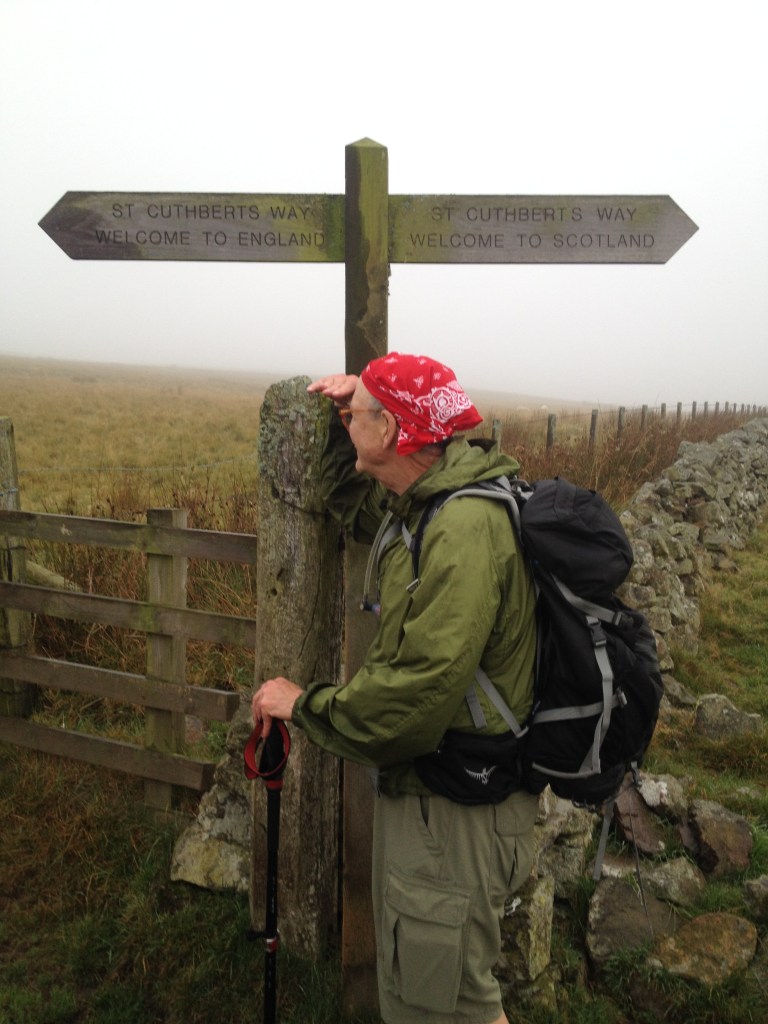
            A pilgrimage always involves some type of movement, whether it’s walking Saint Cuthbert’s Way or walking downtown. Despite having grown up playing sports, I’ve never paid more attention than I do these days to movement. Yes, regular exercise has long been known to improve and maintain key aspects of cognitive function such as attention, learning, and memory, but neuroscientist Daniel Wolpert posits that our brains evolved, not to think or feel, but to produce adaptable and complex movements. He points out that it’s a lot easier to create a computer that thinks than to create a computer which can move anything like we do. (If you’d like to learn more see https://www.ted.com/talks/daniel_wolpert_the_real_reason_for_brains.)

For the last year and a half, I’ve been practicing the Feldenkrais Method of exercise therapy, learning to reorganize connections between the brain and body, which has improved both the way I move and the way I think, helping me pay less attention to my mind and more attention to my heart and my gut—my instincts.

            The slogans of Al Anon, the 12-step program for families and friends of alcoholics, have become my roadmap on this pilgrimage out of the caverns of my mind. When I first started attending meetings and saw slogans set out on the floor, I thought, “God, how simplistic!” Another example of how thinking can mislead me. Try following a few of these slogans and see how simple they are. To give just one example, let’s look at “One Day at a Time.”

            What’s so hard about that? Well, for someone like me—and, I find, many people who’ve grown up in alcoholic families, who continually try to anticipate and resolve every problem they think they may encounter, attempting to make decisions on information they don’t have—it’s damn hard. Instead of responding to what’s in front of me, both the challenges and the gifts that come my way, I’m obsessing about all the possibilities (most of them bad) that might befall me, even though, looking back over the almost 80 years of my life, I can say that not once did any of this preparation spare me a single moment of pain. In fact, it just lengthened my suffering.

            Still, at my age, it’s hard for me not to think about—which in my case means understand, anticipant, awfulize—my death. It was helpful this week to hear a podcast in which Ariel Burger, protégé and friend of Holocaust survivor and Nobel Peace Prize recipient Elie Wiesel, talk about Wiesel’s teaching that there are no answers to life’s big questions, only responses.

            So, I’m trying to respond to these questions by breaking them into small daily tasks. Instead of trying to answer the question, how can my grandchildren survive in a world that seems to be hurtling toward destruction, I focus what I can do with them today. If I’m worried about the Supreme Court or the swelling in my jaw, what can I do about either one today? Call my senator? Pop into the walk-in clinic (which I did this weekend. It’s “an obstructed parotid gland”)? Then it’s time to go for a walk, pick up a banjo, write a poem or a blog. Get out of my head.

            In other words, as one of the AA’s oldest slogans puts it, “Move a muscle, change a thought.”

            And leave a little lightless cavern.

# #

Sifting Ashes

#

                        Grant that these ashes may be a sign of our mortality and penitence ….

  • “Ash Wednesday Liturgy,” Book of Common Prayer

I return to my pew, ashes feeling like paste on my forehead, past the smattering of people scattered throughout the church, their faces already smudged between their eyes, my mind sifting through ashy thoughts of age and mortality.

#

Love is the fire, and sighs the smoke, the ashes shame and scorns ….

—Robert Southwell

When I was growing up in a small Maine town in the 1950s, the only church that observed Ash Wednesday was the Catholic Church. (Those snooty Episcopalians drove to a more affluent community.) Which confirmed for my family and many others in town that Catholics were not like (meaning not a good as) us Congregationalists and Baptists. My great-grandfather told his daughter he’d rather see her dead than marry the Catholic man she loved, and when she did marry the man, her father never spoke to her again. On Ash Wednesday, we kids looked out of the corner of our eyes at the Catholic kids with the smudges on their foreheads as if they’d somehow become lepers with signs proclaiming them “Unclean.”

There was a lot of “Us and Them” in those days. In the newspapers and on TV, I read about Red-blooded Americans versus Dirty Commies; on Saturday afternoons I saw westerns with the White Hats against the Black Hats and science-fiction flicks with titles like Them; and on Friday night at the gym, there were our Good Guys versus the neighboring towns’ Bad Guys.

Thus, I started climbing what Courage to Change, an Al-Anon daily reader, calls “The Ladder of Judgment,” where everyone is somehow either below me or above me— economically, physically, intellectually, spiritually—with God far, far away at the top. Comparing myself to others—judging them, judging myself—has become a life-long addiction, isolating me from people, from God, even at times, from myself.

#

                                                A bucket of ash

                                                and smoke

                                                gone

                                                into the air.

                                                                        —David Budbill, “Smoke and Ash”

Still, I have a nostalgia for ashes. I don’t think I ever light our charcoal grill without remembering that one of my first jobs around the house when I was growing up was to take the trash to the back yard and burn it in an old oil drum set on top of cement blocks. After pulling the newspapers apart (because if I didn’t, they didn’t burn completely and my father had a fit), I lit the trash with a kitchen match. Then I’d usually stand for a while watching the smoke billow out of the oil drum. In winter, it was a lousy job, but most of the time, I liked being outside by the fire. I still do. There’s something primordially comforting about a fire.

Every few weeks, my father would shovel the ashes into a large pail and either take them to the town dump, or save them for winter, when he’d spread them on the icy driveway. I also remember Dad, who moon-lighted as sexton at our church, in his topcoat and fedora methodically dipping his coal shovel into a bucket of ashes from the furnace on Sunday mornings and spreading the cinders across the icy sidewalk so that no one would fall going into the service.

#

                        … I marle what pleasure or felicity they have in taking their roguish tobacco. It is good for nothing but to choke a man, and fill him full of smoke and embers. 

                                                                        —Ben Jonson, Every Man in His Humour

 I grew up surrounded by ashtrays. I recall square ashtrays and round ashtrays, glass ashtrays, wooden ashtrays, metal ashtrays. I remember a bumpy white ashtray in the dining room, and a small clear glass ashtray on the toilet tank in our bathroom and a matching one beside the bathtub. In the living room stood a metal stand holding a large glass brown ashtray beside Dad’s chair, where, on Friday nights, he sat and drank Blue Ribbon and ate Spanish peanuts and smoked his Camels, watching The Gillette Friday Night Fights on our black and white Philco. One memory I have of my mother is of her standing in the kitchen, ironing, with a cup of black coffee and a cigarette smoldering in an ashtray, singing along with Bing Crosby’s voice on our old record player: “Where the blue of the night meets the gold of the day  …”

My senior year in high school, the day after my last varsity basketball game, I filched a pack of Dad’s Camels from the carton he always had in his bedroom closet. I spent one afternoon learning to inhale and the next forty years trying to quit, something I remember every time I pant and gasp and puff walking up a hill.

#

Through [cremation] … the body is reduced to its basic elements, which are referred to as the “cremated body” or “cremated remains.”… Depending upon the size of the body, there are normally three to nine pounds of fragments resulting.

                                                                        — cremationinfo.com

The purpose of Ash Wednesday, which marks the beginning of Lent, is to remind us of our mortality—Remember that you are dust, and to dust you shall return. At my age, coming off heart surgery, watching friends die, I don’t need much reminding.

This year, I find myself wondering what will remain of me after my death. I don’t mean how many pounds of “cremains,” but what will I leave behind for others? A few published stories, a novel, hopefully another book or two. Far too many photograph albums. But I think it was Maya Angelou (it was; I just Googled it) who said, “At the end of the day people won’t remember what you said or did, they will remember how you made them feel.” And in this season of penitence, I realize that it’s not so much what I’ve done wrong in my life that I regret, it’s what I haven’t done to make people feel better that gnaws at me.

#

[Ashes form because]…almost everything in nature is what chemists call “heterogeneous”—that is, its composition is not uniform. For this reason, not every part is “pure” substance and will not burn.

                                                                                    —Caveman Chemistry

But I’m realizing in my “golden years” that to be human is to be, as us Protestant kids used to see the Catholic kids, “unclean,” in the sense of being impure, of being “what chemists call ‘heterogeneous.’” Looking back over the pilgrimage of my life, I see that it has been a mix of good and bad, joy and sorrow, celebration and penitence, things done and things left undone. Moments such as watching smoke waft into the sky that still comfort me; moments such as inhaling smoke that have scarred me for life.

And maybe what I want to leave behind for my grandchildren from what time I have left before I become three to nine pounds of ashes, is an example of living as if there is no Us and Them, only Us.

# #


Walking at Sunset

 fullsizeoutput_1756

#

After a wonderful but hectic Thanksgiving, Mary Lee and I spent a weekend on retreat at the Episcopal monastery of Society of Saint John the Evangelist in Cambridge, Massachusetts, a place we’ve been coming to for twenty-five years in search of silence and slow time. On Saturday afternoon, because the sun sets in this part of the world around 4:00 p.m., I decided to catch the last daylight and take a walk before Evening Prayer.

As I left the monastery, the sun was buttering tiers of purple clouds over the Boston skyline. I jay-walked across Memorial Drive, turned right, and joined the joggers, walkers, and cyclists on the path along the Charles River—a mix of races I don’t see in Maine, some talking into microphones and headsets, others conversing with one another, possibly in Chinese.

After about a quarter of a mile, I passed the Riverside Boat Club. I turned left to cross the Eliot Bridge, pulling up the collar of my coat against a raw wind coming down the river. The late afternoon sun and clouds reflected in the rippling waters of the Charles, the lengthening shadows of the sycamores, and the dank, November wind all churned up memories of another wind coming down another river thirty years earlier. I saw myself walking back from the Eastern Maine Medical Center to the Ronald McDonald House after spending the day watching my eighteen-year-old daughter die a little more from the cancer ravaging her body. I recalled the Christmas tree sellers in their vans and pick-up trucks in Cascade Park at the bottom of the hill across from the Penobscot River and how Christmas seemed at the time like some horrible joke played on the human race by a sadistic god promising peace on earth, good will to all, and then inflicting more war, poverty, disease, and death on us suffering buggers.

Now, however, I realized as I turned left after the bridge and started walking along Storrow Drive, that although I could still vividly picture details from my walk back from the hospital—the seagulls circling over the river, the mansard roofs on the houses—I could no longer feel the anger, confusion, and shame that once consumed me. Thanks to prayer and meditation and spiritual direction—much of which happened at the SSJE monastery—I’ve had joy as well as pain since Laurie’s death. Last summer I had heart surgery which has given me renewed hope that I may be around to watch my grandchildren grow up.

#

The sun dropped, gilding the tops of buildings on my right. The clouds became red and gray. Just outside a patch of skim ice near the shore of the river, a dozen geese floated tranquilly, while on the other side of me, rush hour traffic hurdled by. Horns honked.

The geese reminded me of my father-in-law, George, who used to urge his employees to work like ducks on the water: calm and serene on the surface, paddling like hell underneath. He was the one who introduced me to this walk around the Charles; he made it almost every day. One of the most gracious men I’ve ever known, he and his wife Elaine retired to Cambridge to an apartment just three doors down from the monastery, which made it that much easier for Mary Lee and me to become part of the SSJE community.

Hearing the whooshing traffic, I recalled that George used to carry a plastic bag with him when he walked here, collecting what he called “street glass,” bits of broken head and tail lights from the innumerable accidents caused by Massachusetts drivers along Memorial and Storrow Drives. By the time Elaine died and George left 985 Memorial Drive for a retirement community in Lexington, he’d collected enough colored glass and plastic to fill I don’t know how many glass jars, which reposed on bookcases and windowsills all over the apartment.

Looking across the river back at Memorial Drive, I imagined Elaine, standing in front of her window, holding her glass of gin, watching the sunset behind me before heading back to the kitchen to finish preparing another of her gourmet dinners. She used to rate sunsets; I thought she might give this one a “7” or an “8.” So I made it a “7.5.”

When she died, her service was held in the monastery, and I remembered the Brothers’ chanting, and the reception back at the apartment, monks mingling with the family of academics, doctors, and journalists I married into. When George remarried, four years later, it was in the monastery, as was his funeral ten years after that.

fullsizeoutput_1755
The SSJE Monastery from across the Charles River

#

Crossing the Weeks Foot Bridge in front of Harvard’s Leverett and Dunster Houses, I realized what an important part the monastery and the Brothers have played in my life for the last twenty-five years. I walked back Memorial Drive, past Winthrop and Eliot Houses, through John F. Kennedy Park, recalling my spiritual directors who guided me along the rocky road of grief—showed me that I couldn’t keep thinking of Laurie as some photograph in an old album, that if I actually believed in this thing called resurrection,  I needed to father an ongoing relationship with her, think of her as being somehow present, here and now.  And indeed, the first time after her death when I felt her touch was as I sat at a desk in one of the guest rooms of the monastery.

I thought about how my retreats and pilgrimages intertwine, like the design on the Celtic cross tattooed on my forearm. Yes, I go to the monastery on retreat to withdraw from what Jesus and St. Paul call “the world,” but I’m also making a pilgrimage to answer a call, draw near the sacred, find a source of healing, and pay homage to those I think of as the saints in my life: Laurie, George, Elaine, the Brothers who have died, like Brother Eldridge, who helped me see that like the Father in the Parable of the Prodigal Son, I can wait in continual hope for my child, sending out my love in the confidence that she’ll receive it, or Brother John, my first spiritual director, who told me, “No, I can’t help you cut down on your drinking, but if you decide you want to quit, I’ll do everything I can to help you.” Or those Brothers who continue to buoy me, like Brother Curtis, the first monk I ever talked to here, and Brother James, whom I’ve watched lose hair, put on thirty pounds, and become Brother Superior at SSJE.

IMG_4217

#

By the time I opened the gate and entered the monastery courtyard, the sun had disappeared; inky layers of clouds, however, were still striated with gold. Streetlights glowed and lambent windows in the apartments along Memorial Drive looked warm and urbane. The illuminated cross in front of the door to the guest house welcomed me home. Although I’d been gone less than an hour and had walked maybe two miles, it felt like a much longer journey.

IMG_4377

# #


Of Luck and Grace

The_First_Thanksgiving_cph.3g04961
The First Thanksgiving, 1621—J.L.G. Ferris/The Foundation Press, Inc./Library of Congress

#

The first time I ever heard about “pilgrims” was as a kid learning about some people by that name who sailed to America to have Thanksgiving dinner. Later, I learned it was a little more complicated than that—that these people were actually “Separatists” who had broken from the Church of England and come to this country by way of Holland in search of religious freedom. But they thought of themselves as pilgrims (the first child born in the Plymouth Colony was named “Peregrine,” which means pilgrim), travelers on a journey to find a home where they could worship the God of their understanding. The name stuck.

My sister tells me that she, my brother, and I are the descendants of John and Priscilla Alden and George and Mary Soule, couples who came over on the Mayflower, which may account for why I think of myself as a pilgrim and why Thanksgiving is my favorite holiday of the year. It’s a day to be with family and to give thanks.

This year, however, besides counting blessings, I’ve also been thinking a lot about luck.

Last spring, when I happened to mention to my family doctor during a routine follow-up to an earlier procedure that I was getting more and more out of breath, he told me to get a stress test and get it soon. Which I did and which led to an arterial catheterization which led to by-pass surgery. Now, I feel great. I have more energy than I’ve had in years.

I want to thank God for my good fortune, feel that I’ve been blessed. Except: as anyone who’s read this blog knows, the pivotal point in my life was the death of my eighteen-year-old daughter in 1988. Laurie didn’t smoke, didn’t drink, didn’t even eat meat. Still, she was the victim of Primitive Neuroectodermal Tumor, a rare and virulent cancer that when it strikes, usually attacks much younger children.

So how can I thank God for my life, while letting God off the hook for Laurie’s death?

Since my surgery in July, two men whom I’d known fairly well dropped dead from the same type of blocked left main artery that I had. Both men were active; both seemed healthy; neither was overweight; both died while exercising. Why am I still alive and they’re not?

I’m reminded of the evening of September 11, 2001, when our church held a meeting for all those who wanted to respond to the bombings of the twin towers and of the pentagon. At one point, a woman—let’s call her Agnes—rose and said that her son had been working that day in the South Tower, but that he was safe. “I want to take this opportunity to thank God for protecting my son four times.” Agnes said. “God showed him the way down the stairs. He moved him out of the way of fallen debris twice. He provided my boy with a private boat to offer him a ride across the river to Hoboken. I’m so grateful!”

I was happy for the woman. I was sure her son was a great guy. But I asked myself then and I ask myself now: why did God save him and let 7,000 other people die?

So although I want to thank God for my being able to be sitting here tapping out this blog instead of moldering in an urn under the snow in our family’s cemetery plot, I have to think that I was lucky, just as my daughter was unlucky enough to carry the wrong combination of inherited DNA to make her susceptible to the cancer than killed her.

Does this mean I’m not grateful this Thanksgiving? That I don’t think my Higher Power affects my life? That I’m not blessed?

Absolutely not.

As I think about how “unlucky” I was when Laurie died, and how “lucky” I am now, I find a common thread. In both instances I’ve seen, as I usually don’t, just how precious, how holy life is. I’ve never enjoyed the autumn foliage as much as I have this year. I don’t even mind (much) standing in line at the grocery checkout line.

I’m also aware, even though it’s hard to articulate, of a growing sense that this life is always being renewed, even reborn. That what I, as a Christian, call resurrection didn’t just happen once to one person, but happens to all of us many times. Someone said to me the other day that I looked like a new man. Well, in some ways, I am. I have a new heart.

Getting that new heart was at times painful; still, it was nothing like thirty years ago, when Laurie’s death broke me open. But although that hurt in ways I hope I’ll never have to feel again, her death also opened me to receive love and joy that I’d never experienced before in my closed off, child-of-alcoholic, New England male life. And it’s this experience that I’m guessing we’ve all had sometime in our lives—where from somewhere we get the strength not only to carry on but also to laugh and sing when by rights we ought to give up and die—that I give thanks for.

Which I think is the difference between luck and Grace. Luck depends on circumstances. Grace, on the other hand, is there for everyone all the time.

So I’m looking forward to Thanksgiving. This, despite sorrowful memories of my father, one of my grandmothers, and my mother-in-law all dying during the week of Thanksgiving, and a painful recollection of a Thanksgiving at the Ronald McDonald House after which Laurie’s two stepbrothers saw her for the last time. Or maybe those deaths actually help make the celebration more joyous. That when Mary Lee’s children and their families and her sister and sometimes her family come, we are surrounded by what St. Paul calls “Clouds of Witness.”

That these loved ones died, that my daughter-in-law is about to undergo surgery for cancer, and that one of my grandchildren is emotionally scarred from having been abused by her pre-school teacher is probably a matter of bad luck. That for the most part our families have the health and the means to come to our house for Thanksgiving and that Mary Lee and I feel well enough and are financially secure enough to host them is probably a matter of good luck. But that we are able to celebrate, to laugh, to cry, to love together is, I believe, a matter of Grace.

When I was finishing this blog, Mary Lee sent me a daily reading for November 22, 2019 (the anniversary of John F. Kennedy’s assassination, appropriately enough) from a website called gratefulness.org.

Grief and gratitude are kindred souls, each pointing to the beauty of what is transient and given to us by grace.—Patricia Campbell Carlson

Yup. Happy Thanksgiving, y’all.

IMG_0343
Another Thanksgiving, a few years later…

# #


Of Smells

fullsizeoutput_16e8

#

“Nothing revives the past so completely as a smell that was once associated with it.”

—Vladimir Nabokov

#

One of the joys of being 10 weeks past heart surgery is that I can resume daily walks, especially in the woods not far from where I live. And this is a great time of year for it. The leaves are beginning to turn, the air is drier, and the blackflies are gone. But I’m interested that the first thing I noticed when I entered woods after over two months were the smells: the musky, fecund tang of fallen leaves and pine needles, yellowing bracken, and decayed trees. Not only did the smells welcome me back into the present, they took me back to walks through Scotland and England, California, Massachusetts, Vermont, and even further back to the Ponderosa forests of Idaho during my college years and the piney woods behind my house when I was growing up.

Our sense of smell, I’m told, is linked to the part of our brains that processes emotions and memories. Probably every college English major (even if, like me, they’ve never read it) knows that Marcel Proust’s Remembrances of Things Past begins when the narrator tastes a cookie called a madeleine dipped in tea, which triggers seven volumes of memories.

Fear not, gentle reader, I’m not about to attempt anything of that magnitude, but I do feel compelled to ponder a few memories—some pleasant, some not so pleasant—I tripped over the other day as I sauntered through the woods.

I don’t think any smell evokes happier memories than the smell of baking bread. (I’m told real estate agents tell people who want to sell their houses to fill them with the smells of baked bread prior to showing them to prospective buyers.) Every Saturday morning when I was growing up, my mother would bake bread for the week, filling the house with the aroma of love and security. Having spent the last couple of years working with a sponsor in a twelve-step program, I find it healing to remember that in spite of the emotional scars I carry from being raised in an alcoholic family, I was always loved and cared for.

It’s probably nostalgia, but remembrances of my growing up are filled largely with happy smells: the smell of hay and cows and horses in my great-grandfather’s barn, the smell of fried onions and potatoes in my Nanny and Grampy Lufkin’s house, the smell of perfume and cigarettes in Nanny Cleaves’s apartment, the smell of  Aqua Velva, my first aftershave lotion, the White Shoulders perfume my first girlfriend Susan wore, even the smell of wet towels, dirty socks and jock-straps in the locker-room underneath the gymnasium where I spent so much time playing basketball. (Okay, that memory’s definitely nostalgia.)

Conversely, no smell brings back more pain than the smells of shit and disinfectant in nursing homes and hospitals (where between visiting others and my own stay I’m spending more and more time these days), which invariably take me back to the two months when my daughter lay in the hospital dying of cancer—a time of fear, loneliness, and guilt—literally a shitty time.

Memories of my unhappy college years come enveloped with the acrid smell of the Old Town Paper Company blown by a stiff wind down the Stillwater River in 10° temperatures, as I pulled my collar up and stumbled my way across campus to classes I never figured out how to study for, filled with students I felt no connection with, and who, I was convinced, disdained me. And the last years of my first marriage seem in my mind’s nostrils as rank as the dregs of the pipe tobacco I used to smoke during those years.

These days, I love the smell of Mary Lee beside me in the morning, of my hot chocolate in the afternoon, of popcorn in the evening. Of seaweed and mudflats along the Maine Coast. Of dirt in the spring. Of going into the school building to pick up my grandchildren and the smells of chalk and disinfectant and young bodies taking me back to my years as a public-school teacher. And speaking of grandchildren, is there anything more uplifting than the fresh, slightly sweet smell of a newborn child?

On the other hand, I hate the heavy perfumey smell when I enter the Maine Mall, damp cellars (probably because they remind me of the cellar I lived over for twenty-two years), car exhaust on a hot day, and now, the smell of the antibiotic Mupirocin, with which I had to swab my nose prior to and after this summer’s heart surgery.

Recalling smells revives memories of my various pilgrimages and retreats even more than photographs. The exotic and sometimes stomach-churning smells of the Old City of Jerusalem—schwarma, spices, and pita bread mingled with the dust of centuries of pilgrims.

fullsizeoutput_16e9

The aroma of apple tea in Turkey. The salt-laden breezes on Iona. The tangy musk smell of the cow pastures through which Mary Lee and I hiked St. Cuthbert’s Way. The dry smoky smell of Tanzania. One of my first memories of the Episcopal monastery in Massachusetts with which I’m associated is the smell of incense wafting up from the altar into the stony steeple.

At this time of year, the woods are full of smells, full of ambivalent emotions. Fall in Maine is when the trees let go of their leaves, which brings for me not only nostalgia, but also a kind of grief. I’m well into the autumn of my life, which, along with the recent surgery, has me thinking about my mortality. So many of the smells in the woods I’ve started walking again arise from dead and dying vegetation. And yet, autumn is also the season I always feel most alive, and never more so than this year, as I find my strength (not to mention gratitude) returning. Yes, the leaves and needles and branches under my feet are dying, but at the same time the decay upon which I walk and which I smell teems with the seeds of regeneration—not only the forest’s, but also, I like to think, mine as well.

  fullsizeoutput_f5c

 # #


Sunday Afternoon Drives

Bridge St Party.1958
The Parents. Thanks to my sister, Jaye Sewall, for the photo.

#

A few weeks ago, I was sitting on the back patio, using my recent heart surgery as an excuse to doze in the sun, when I started thinking about a forgotten era in my life, in the life of many Americans, I suspect: the Sunday afternoon drive.

For me, this era lasted from the late 1940s, when my parents bought their first automobile (I think it was a used 1946 Ford), to the mid 50s, when the advent of television and Sunday afternoon sports kept my friends and their fathers at home. During that time, I recall that on Sunday afternoons from spring into the fall, anywhere from three to seven families—the Wiles and the Prides and the Loomises, the Rollstons and the Haskells, the Teffts and the Jameses—would pile into their cars and spend the afternoon traveling the back roads of southern Maine to places like Blackstrap Hill and Pleasant Mountain to look at foliage, Two-Lights and Reid’s State Parks to see the surf, and Sebago and Crystal Lakes to swim. Sometimes, we’d just take off and head into what I still think of as Maine’s Bermuda Triangle: a series of labyrinthian back roads that no matter which one we took always somehow ended up at a reed-infested body of water called Runaround Pond.

Every one of these families had a kid close to my own age, and it was great fun swapping parents, so I could ride in a car with Craig or Richie or Peter. Some parents were more lenient than mine, and let us rough house or yell or sometimes sing, which made me feel like I was playing hooky from school; other parents were more strict, making us sit still and whisper, which made me feel like my own parents weren’t so bad after all.

Watching all these parents interact gave me my first glimpse into the confusing world of being an adult. I couldn’t understand why all the men and most of the women puffed on cigarettes, filling the cars with smoke and stinging our eyes. They often spoke in a strange sort of code that I didn’t understand and laughed at things that made no sense.

(Eventually, I learned that many of these comments had to do with sex. I remember what might have been the earliest “dirty” joke I ever heard—although it took me a while to figure it out:

Question: Who was the first carpenter?

Response: Adam?

Answer: No, Eve. She made Adam’s banana stand.)

And I find that some seventy years later, my parents and their friends still seem to me to belong to a mysterious world beyond my understanding, a world now lost to me forever. Browsing through the 3”x 3” black and white photos in my mother’s old albums show them to look older than their children did at the same age: in their 40’s, they look to be in their 50’s and 60’s—probably the result of the cigarettes they smoked and the fatty foods they consumed (my father started the day with eggs and bacon right up until he died at the age of 66), but also probably because compared to today, they look dressed up. Men wore ties, some even on Sunday afternoon drives, and for the most part women wore dresses.

Compared to today, our mothers seldom used profanity and our fathers used a lot less when we were all together. And the “F Word” was rare even in a group of men. On the other hand, all our parents peppered their language with racial and cultural slurs, with epithets for Blacks, French-Canadians, Italians, Indigenous peoples, Gays, even Catholics. I could get my mouth washed with soap for saying “Goddamn,” but no one did anything except chuckle if I called John Nappi a wop.

All of our parents were affiliated with either the Congregational or Baptist Church in town, but except for my parents and the Haskells, the other families usually attended church only on Christmas and Easter. Their real religion was the United States of America. (It was during this time that “under God” was added to the Pledge of Allegiance.) One Memorial Day—I was probably 7 or 8—I was walking down the street carrying a full-sized American flag over my shoulder and Earle Pride yelled out the door of his store at me because the tip of the flag was dragging on the ground.

And if their religion was the United States, they worshipped the American Dream. New washing machines and dryers, larger television sets and “Hi-Fi” record players, pine paneled rec rooms, and most of all, new automobiles. It was common to trade in for a new car every couple of years or so, and when one of our parents did, the car became an object of veneration for weeks, with all us kids scrambling to ride in it on Sunday afternoons.

Dad
And thanks to my sister for this photo of  Dad standing by our first brand new car!

Those afternoon drives then became a worship service, celebrating our parents’—all of whom had grown up during the Depression—rise into American’s great Middle Class, with the freedom to follow new roads to a brighter foliage or higher surf or a longer beach. And if they got lost, or suddenly found themselves back at Runaround Pond, well, there was always next week.

It’s easy for me to criticize their provincialism and bigotry (and later in life, I did), but maybe because I tire easily these days, or maybe because I’m aware that I don’t have the goals, the dreams I used to have, I find that I miss the energy, the—excuse the pun—drive of those black and white people in the old photographs.

I also realize I miss the faith I had back then in my parents and their friends. Before the advent of Elvis and the generation gap, I believed in them more than I believed in God. I remember one Sunday drive. It must have been in the late 1940’s when forest fires burned large parts of Maine. One of our parents heard that there was a big fire in Brunswick, so we all piled into the cars to go look. I don’t remember the fire, only that as we turned the cars around to head back home, I was in the back seat of Earl Pride’s powder blue Dodge with Earl’s son Craig. One minute we were horsing around, and the next minute Craig was gone and the back door of the Dodge was swinging in the wind. Earl slammed on the brakes. I looked behind and saw the other cars screeching to stops. Doors opened and parents rushed to Craig, who was still rolling in the gravel beside the road. My stomach rose into my throat leaving a great empty cavern, until I saw Earl lift his screaming son into his arms, bring him back to the car, and lay him beside me in the back seat. “He’ll be okay,” he told his wife, Doris, “just some scraps and a bump on the head.” And Earl was right. Because he was just starting to accelerate when the door opened, the car wasn’t going that fast. But as far as I was concerned, Craig was never in any real danger. Once his father had him in his arms, I knew he’d be fine.

I had lunch with Craig last week. Like me, he’s had heart surgery, but all things considered, we’re both doing pretty well. Still, other friends have gone this year, some of them almost as suddenly as when Craig disappeared from his father’s blue Dodge. It seems as if one minute they’re here, the next minute, they’re not. And I find myself searching for some older, wiser voice, telling me that everything’s going to be all right. They’re going to be fine.

# #