
Family Triptych

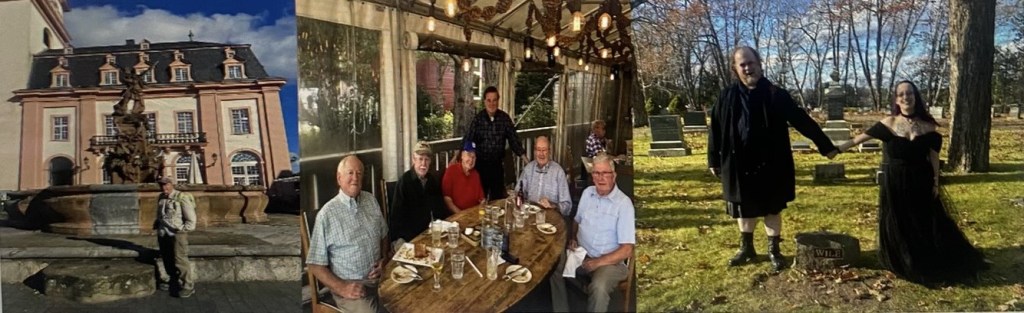
Weilburg

Traveling 3500 miles to a town in Germany

smaller than the one in Maine where I live—

no tours, no souvenir shops, 

no one speaking English except back at the hotel, 

I stand by Neptune’s Fountain 

in Market Square beneath the God of the Sea 

thrusting his trident into the head of some leviathan, 

my lungs still burning from climbing the hill to get here, 

trying to imagine 25-year-old Johann Frederich Weil 

wandering the square 

before leaving for Halifax, Nova Scotia, 

lured by the British Government’s offer 

of free passage, free land, & a year of free rations, 

knowing from Ancestry.com 

his descendants will anglicize the name & populate places 

like Wile’s Lake, Wileville, & Wiles Road, 

until the turn of the 20th Century 

when Lyman & Lester Wile 

leave Canada for a shoe factory 

in Marlboro, Massachusetts 

where Lyman will marry Edith Conrey 

& sire my father who 

because his mother left Lyman when Dad was 4 years old

(apparently because of spousal abuse) 

didn’t give a shit about his father or his family. 

Then Johann dissolves—

if he was ever here in the first place—

into the salmon & cream-colored two-story buildings, 

round-arched arcades, & a matching-colored four-story Italianate castle 

as my wife and I join the half-dozen folks in leather & wool 

sipping beer & coffee at outdoor tables by a small restaurant. 

Still, walking back to the hotel 

looking down the hill 

at the Lahn River, a small waterfall, an old stone bridge, 

I think of the hill I grew up on, the bridge below my house 

over a similar river by a similar waterfall, 

& I feel a weird calm, 

connected by currents beyond my ken.

The Royal River Grill

Walking into a restaurant 

with large windows looking out on the harbor 

& soft lights meant to look like candles, 

I see Buzz & Chuck & Ted sitting at a long oak table. 

A shiver of both anxiety & eagerness 

& the next thing I know it’s 1953, 

when this building was the site of the Stinson Sardine packing plant 

& I’m ten years old & in fourth grade 

& I’m going to my first meeting of Mike’nBuzzie’s Gang 

at Mike’s house just up the hill from here, 

because earlier that afternoon 

when it had been my turn to stay after school 

to erase blackboards, 

as soon as Mrs. Croudis left for the teachers’ room, 

Buzzie’s brother Craig ran into the classroom. 

“We’re getting a gang together 

for an apple fight with the uptown kids! 

Big meeting at Mike’s house! Let’s go!”

Dropping the eraser, I ran out the door—

the first time in my life I’d ever disobeyed one of my teachers. 

But for the first time in my life I didn’t care. 

A timid kid, raised in a family 

where a miasma of alcoholic anger & anxiety 

hung over us like the fumes 

from the neighboring paper company,

I’d lie awake mornings before school 

afraid of the day ahead, 

of having my arm twisted or my face washed with dirty snow 

by sixth graders like Mike’nBuzzie,

and now they want me to join them! 

Never mind that the apple fight with the uptown kids never happened, 

or that Mike now has Parkinson’s & stays home 

& that Buzz & Chuck & Ted & I, and later, Allie & John, 

have little in common these days 

except our L.L. Bean khakis & plaid shirts. 

I laugh & reminisce. 

At home. 

Still part of the gang.

The Cemetery

Under gnarled & broken maple trees, 

I walk around my family cemetery plot, 

taking pictures of the wedding—

of the bride, who stands 5 feet 

& maybe weighs 100 pounds, 

her upper chest tattooed with angels, 

her dyed magenta hair, & flowing black gown, 

& the groom, my stepson, 

probably 6’4” & 270, 

black lipstick & kilt, red-haired & bearded, 

standing in front of the family stone, 

originally part of the cellar of my mother’s grandfather’s house, 

while my second wife, 

an ordained Deacon in the Episcopal Church, 

performs the ceremony. 

My stepson’s two daughters stand as ring bearers 

near the memorial stone for my daughter, 

who died at 18. 

My wife’s ex-husband & his wife 

stand between my grandmother’s granite stone 

& the memorial stone for Nanny’s ex-husband. 

Not far from my great-grandfather & great-grandmother’s marble stone, 

my stepson’s nonbinary stepson from his first marriage 

& their partner also take pictures. 

The bride’s parents view the proceedings 

in front of my mother’s bronze marker 

between my father’s & my stepfather’s bronze markers 

while my second wife’s sister, her daughter & son-in-law 

watch both the wedding and a grandson 

climbing the near-by gravestones 

of my barber, my favorite teacher, 

a classmate killed in Viet Nam,  

& my little league baseball coach—

all of whom, I imagine, 

rolling over in horror at this spectacle 

of everyone dressed in black, 

everyone smiling, 

one big happy family.

#

Memories of a 50’s 4th

Google Image

#

Back then

firecrackers popped all day long.

Anyone could buy them at the drug store,

along with caps for your pistol,

and black pellets that, when lit,

curled into snakes.

Stores, many draped in American flag, closed,

and until noon or so, a dog could

lie down in the middle of Main Street

without fear of being run over

by anything except a bicycle

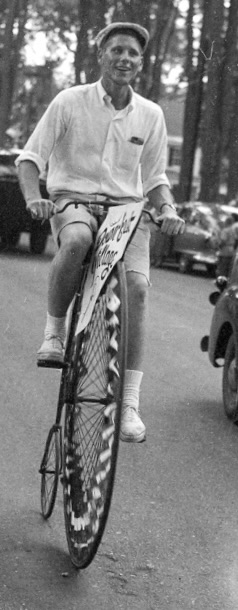
papered in red, white, and blue crepe.

Well, most bicycles didn’t look like this, but you get the idea.

In the afternoon, relatives got together

or families drove to the beach

or attended a baseball game

between neighboring town teams.

Family gathering at my grandparents.

Back then

after supper, many folks drove

over to John Rizzoli’s for fireworks.

A large man with a big smile and cold eyes,

John had immigrated here after WWI,

becoming, rumor had it,

“Al Capone’s man in Maine,” during Prohibition.

He and his eight or ten sons,

now legally supplied the state with beer:

Budweiser,

Schlitz,

Pabst,

and Narragansett

(“Nasty-Ganset,” my grandfather, who lived on the stuff, called it).

“Thank-a-full for what this-a country

give-a me,” once a year, John opened his garage,

moved out his Cadillacs, put in a bar,

and sold red, white, and blue dixie cups of his wares

prior to shooting off the fireworks.

Back then

as the sun set over the field behind the Rizzoli’s

families spread blankets.

While their children in shorts

and Keds and Davy Crocket caps

played cowboys and Indians

and shot off more firecrackers,

women, wearing bright lipstick and checkered dresses,

their hair curled, courtesy of Toni or Lilt,

visited each other,

comparing kids,

their new washing machines and dryers,

the cost of pine-paneling their rec rooms.

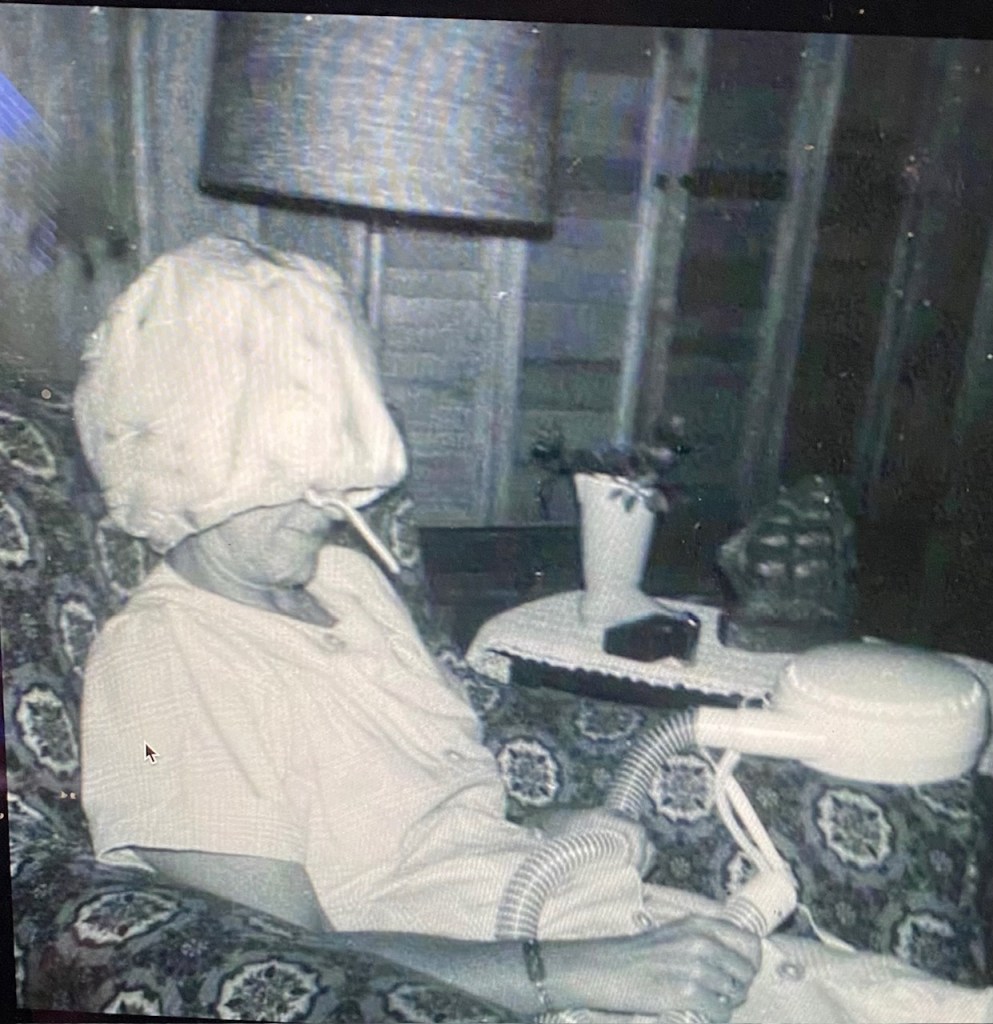
Mom getting ready to go out.

Men, clean-shaven with crewcuts, many in white shirts and gabardine pants,

visited John’s garage,

complained about the Red Sox,

argued the merits of the new Fords, Chevys, Dodges, and Hudsons,

swapped war stories and dirty jokes.

Dad’s new car

Teenagers in jeans stood around the edges of the field

bragging about their new “Hi Fi” record players,

arguing who kicked more ass, Elvis or Jerry Lee,

wondering who was going all the way,

while single men in overalls and slouch hats, stood against the garage

bitching about

taxes,

teenagers,

the new interstate through-way.

Back then

somewhere close to 9:00 p.m.

when it got completely dark,

men returned to their families

and a holy hush fell over the field.

Flashes of fireflies, like votive candles,

lit the night.

The smell of cigarette, cigar, and pipe smoke

wafted like incense.

As someone started singing, “God, Bless America,”

dixie cups were passed.

Suddenly, light and noise filled the sky—

rockets’ red glares, bombs bursting in air—

and sounds of a collective “Aahhh”

rose into the heavens,

as we worshipped the American Dream.

Google Image

# #

Looking for What’s New

#

Besides dealing with a decaying body and a deteriorating mind, one of my biggest challenges these days is to keep from living in the past. (And I’m sure the two struggles are connected: of course, I want to recall when I could leap tall buildings in a single bound.) It’s so tempting to spend my days reminiscing with old classmates via email or Facebook, watching “American Bandstand” on YouTube, and replaying 65-year-old high school basketball games.

This last month has been especially challenging. May began at the history center in the town in which I grew up with a program that my oldest friend (going back to the first grade) and I spent the winter planning: “Yarmouth [Maine, for those of you reading this in Singapore and elsewhere], 1955-1962: Times of Change.” We wound up with probably thirty people there who’d grown up in town during those years, bathing in the warm waters of nostalgia, as we talked to newer residents about how Yarmouth changed during that time from a low-income community of shops and small factories to a bedroom-by-the-sea for urban lawyers, doctors, and bankers. A town we kids roamed at will because everyone looked after us—where the local telephone operator would call my classmate Barbara’s house at 3:30 in the afternoon (because she knew Barbara got out of school at 2:30 and would stop at the drug store for a coke, so that’s when she’d get home) to tell Barbara that her mother would be late and that she should turn the oven on 350° and put the roast in at 4:00. (Who needed cell phones?)

Later in the month, as my brother and sister and I cleaned off stones and planted impatiens in our family cemetery plot for Memorial Day, we swapped memories of Mom and Dad and our grandparents. (Amazing how different our recollections are!) Later that week, I went with my wife, Mary Lee, to her 55th college reunion, and for three days listened to other people’s stories about their pasts. Throw in a dream in which I ran into my ex-wife—who died eight years ago—dressed in a white karate gi (still trying to work out the symbolism there), and I’m starting to sink beneath these waves of nostalgia.

I need to get out and open my eyes. Stop looking at what’s behind me and start looking at what’s around me—what’s new. I decide to check out this year’s garden. Besides, I need to put in my tomato seedlings.

It’s a beautiful June morning and the world is new. The apple blossoms and rhododendrons are in full bloom, the air smells of lilacs, and the breeze is fresh. The world is spring green: the grass hasn’t yellowed, the leaves aren’t chewed, and the caterpillars haven’t yet built their ugly tents in the trees.

I put my seedlings and watering can and trowel in the car, drive up and park on the power line road between our community garden (which I wrote about a few years ago: https://geriatricpilgrim.com/?s=Up+to+the+Gahden) and a wooded swamp, home to all kinds of birds, many of whom are singing their ever-loving hearts out.

I had no idea how many birds there are here until I got one of those apps this year for my phone that identifies birds by their songs. So, I check it: cardinal—yes, I know their pulsating whistles; song sparrow—makes sense, I see all kinds of them; gold finch and chickadee—ditto. But what’s a great crested fly-catcher? And a red-eyed vireo? They’re new, at least to me. Cool. 

Turning to the garden, I think of the beginning of baseball season, when, no matter how poor a team’s prospects, there’s always hope for a championship year. 

This year, I’ve got three raised beds, and—God willing; I haven’t planted it yet—a small pumpkin patch. The garlic I put in last fall is up, as are the peas which I planted on May 1st. I decided this year to stake them with some of the branches that came down from last winter’s storms—the first time I’ve ever tried that, and it seems to be working: the peas are grabbing the branches with gusto. In another bed, I’ve got the usual two kale plants which will hold us until November, but for the first time, I’m trying a couple of eggplants and a purple pepper to see what happens. I’ve also planted bush beans for the first time in years. (Mainly because last year, I almost killed myself stringing pole beans, and vowed never again.)

 I wave to Karen down the way who’s working on her bee garden. She’s also building a new compost bin, for which I need to thank her. 

But first, let’s get those tomato seedlings in. 

The sun is warm. I take off my outer shirt and begin raking the bed where I’m going to transplant my tomatoes. I love the smell of the fresh dirt (apparently, it triggers the release of serotonin in the brain—at least that’s what I read somewhere) which makes me want to sing. And because the other night I watched a music documentary on Paul Simon, I serenade the birds with “50 Ways to Leave your Lover”—

            You just slip out the back, Jack

  Make a new plan, Stan

            You don’t need to be coy, Roy

            Just get yourself free—

The really neat thing about the documentary was it focused on Simon’s newest album of songs, many, if not all of them, as I recall, coming to him in a dream. And if at the age of what, 83?, he can still be creating new work, even though I guess he’s now deaf in one ear, then I, at 81, can, too, despite my various diminishments.

I dig six holes and put a little of Karen’s compost in each one. I find myself slipping again into the past: the summers in high school I used to work in a garden and the big garden I had during my first marriage. Cut it out! I think, and then decide, No, let’s use those memories as compost, fertilizer to help me grow.

Which would be more inspiring if my back didn’t already hurt from this minimal exercise. From my other garden bed, I grab my new kneeler and bench combination, which I bought this spring, and kneel on it to put the tomato seedlings into the dirt and the compost, which gets my hands dirty and the rest of me feeling clean. Then, I put collars that I’ve made from plastic medicine cups around the seedlings to protect them from cutworms, and, using the metal arms of the bench to get myself off my knees, rise to get my tomato cages from last year. Finally, I give my little darlings a drink to get them on their merry way.

Feeling accomplished, I sit down on the new iron bench with the “Welcome” sign that someone—probably Doug, who, along with Karen oversees our community garden—has donated. I think about how I still rely on community as much as I did when I was a kid all those centuries ago. 

Looking up, I follow an exhaust vapor trail in the blue sky until I see the sun flash on a plane, high in the sky, probably starting its descent into Boston. I imagine flying to new countries and seeing new vistas and new people.

But right now, right here, there are plenty of new things going on, thank you very much.

# #