Scars

fullsizeoutput_1373

#

For fifty years, I’ve been facilitating writing groups of various kinds. Participants have ranged in age from fourteen to eighty. They’ve been students, white-collar professionals, blue-collar workers, unemployed, and homeless. Over that time, I’ve begged, borrowed, or stolen certain writing prompts that always seem to work, no matter who’s there. For example, when a group meets for the first time, and I want to avoid the standard introductions and at the same time establish an atmosphere of trust, I’ll have us (since I always write, too) write about our scars.

#

Almost everyone begins by at least mentioning physical scars. Men, especially, seem proud of them. The other night, I was watching a Netflix series called Longmire, in which Sheriff Longmire has been stabbed and his female deputy Vic is helping him bandage the wound.

“You’ve got a lot of scars,” Vic says. “How many do you have?’

“Oh, I don’t know.”

“Come on. All men know how many scars they have.”

Silence. Then, “Twelve…thirteen now.”

Perhaps it’s a sign of the times that women are becoming less reticent about their physical scars. Last October’s Cosmopolitan magazine ran a series of photographs of women proudly showing their mastectomy scars. Photographer Ami Barwell said in the press release, “These photographs show that, despite what they’ve been through, these women are empowered. They are strong, happy, and sexy.”

Scars are part of growing up, and in many cultures children are intentionally scarred when they reach puberty as part of sacred rituals to celebrate their becoming adults. Richard Rohr, whom I often reference in my blogs, wonders if the popularity of tattoos and body piercings these days isn’t a secular substitute for what young men and women once gained through circumcision, scarification, shaving of heads, and knocking out of teeth.

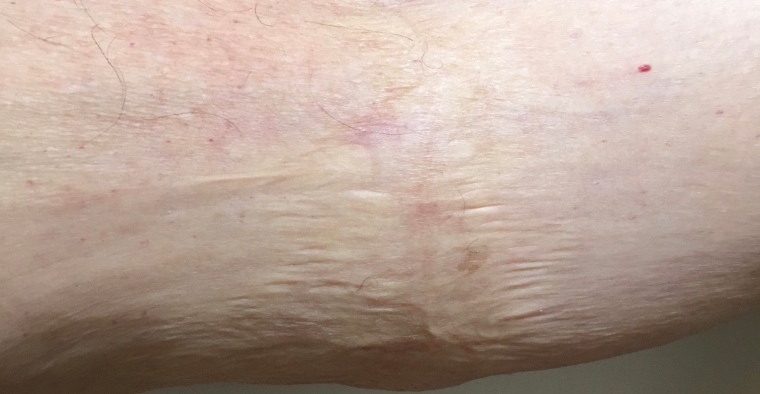
Our scars tell a story of our lives. My most unusual scar is the one on the inside of my right elbow that looks like a burn. I like to show it to people to see if they can guess what caused it. Most can’t, because the scar tells not only of my past but also of an era long ago and far away. When I was four years old, I was in the cellar with my mother one day while she was doing the weekly laundry in our wringer washing machine. Fascinated by the rotation of the rollers, I stuck my hand up to touch them. The next thing I knew, I was screaming as the wringers went round and round on my arm— the first of what we in my twelve-step program call our “goddamned learning experiences.”

wringer washer

As I moved into something resembling adulthood, I scarred the back of my head when I fell down some school steps onto a broken bottle. I garnered several knife scars from working in a market garden cutting lettuce, spinach, and beet greens, and a black scar when my friend Jerry and I were sword fighting with pencils in a high school chemistry class. (The lead is still in my hand.) Recent X-rays of my scarred lungs remind me of the years in college I worked fighting forest fires, inhaling wood smoke for hours until I could take a break, get away from the smoke, and light up a cigarette.

As an adult, I have a two-inch scar on my back from a fusion of L-2 and L-3 vertebrae, which kept me out of Viet Nam. I have two hernia scars (I’ll spare you a photograph), and two longer scars from bi-lateral hip replacement that I’ve always thought of as resulting from the time after my daughter died, when, like Jacob, in the Old Testament, I wrestled with angels.

#

But if we’re proud of our physical scars, we tend, I think, to hide our emotional ones. I’ve spent seventy years hiding the scars of shame, rejection, and fears of confrontation and failure caused by growing up in an alcoholic family. And the death of my eighteen-year-old daughter Laurie has left a scar that feels more like an amputation, one that, even after thirty years, gets ripped open every time I visit someone in the hospital or read in the newspaper about the death of a young person. (That scar has been ripped open a lot lately.)

For some reason, our physical scars, which almost always are signs that we’ve failed at something, make us proud, while our emotional scars, which often aren’t the result of anything we’ve done, but have had done to us, make us ashamed. Maybe it’s because our physical scars say: “I can take it. I’m not a victim. I’ve survived,” while our emotional scars say, “I should be stronger, more in control.” When Laurie died, I felt weak and powerless. I did not go to her funeral. I refused to run her obituary in the local newspaper. I had recurring dreams about old high school basketball teammates making fun of me for being uncoordinated and slow. In other words, I was ashamed of myself, not because of anything specific that I’d done or not done, but because of who I thought I was: a loser.

#

As I reach the seventy-sixth year of my earthly pilgrimage, one of my goals is to become as proud of my emotional scars as I am of my physical ones. This Easter has helped. As a practicing Christian, I believe in resurrection. But this year, I realized that even the risen Christ carried the scars of his death. In fact, in one of the most famous of these stories, his disciple Thomas will not believe that Jesus is risen until, as Thomas says, “I see the mark of the nails in his hand, and put my finger in the mark of nails and my hand in his side…” Only when Thomas is able to do so does he cry, “My Lord and my God!”

It’s Jesus’s scars that show his disciples who he is; I need to realize it’s my scars—physical and emotional—that reveal not only who I am, but also the ways in which I’ve become resurrected.

Or, as Bill, living in the local homeless shelter after losing his construction career because he’d broken his back and become addicted to pain killers, but who, nonetheless, was trying to put his life back together by taking on on-line course in computers, wrote for one of my writing groups,

“Scars are the ledger of life. The reminders of when we lacked experience. Wounds are due to ignorance and inattention, apathy, and sometimes poor coincidence. Some we hide from others, some from ourselves. Some are shared with only a few. Some we display proudly. You would think scars are grievous things. In truth they are wondrous. Scars are badges of life’s ills and trepidations…healed.”

Version 2

# #

Bedside Pilgrimage

IMG_2610
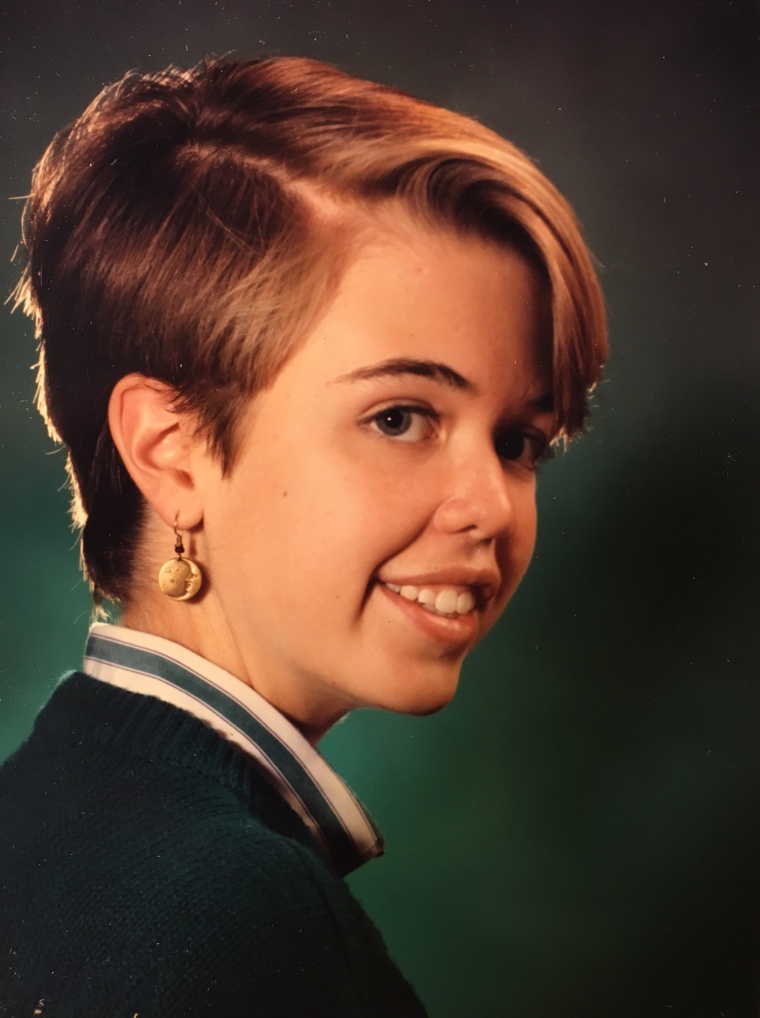
High School Graduation 1988. I can see the cyst on the back of my daughter’s head.

#

For the last few months, up until his death from cancer, I regularly sat in a nursing and rehab center by the bed of an old friend. The long corridors, the smell of disinfectant, the sounds of TV sets, the charts on the walls of Scott’s room, the nurses with their clipboards, brought back memories of when my daughter Laurie was in the Eastern Maine Medical Center in Bangor, Maine, and what I would now call my six-week pilgrimage through strange, often surrealistic landscapes.

A little background: From the time she was twelve years old, my daughter had a cyst on the back of her head. Her pediatrician said it was probably harmless, but that if it got larger, she could have it removed. During her senior year in high school, the cyst doubled in size, so during February vacation, Laurie went for surgery. In March of 1988, a routine biopsy determined the cyst to be malignant.

Suddenly, my daughter, her mother, and I were picking up the pieces of our lives and trying to put them back together. The diagnosis forced Laurie to withdraw from an American Field Service program to spend a year abroad, but that summer, when the tumor disappeared after radiation and chemotherapy, she applied to The Portland School of Art, planning to continue her treatments while taking one or two classes. Then, less than a week before school started in September, her leg collapsed while she was walking along a beach. She began physical therapy and made plans to reapply to art school in January. Confined to a walker at home, she found a job painting murals and designing menus for a new restaurant in town. When physical therapy did nothing but cause her more pain, she went into the hospital, at first for more tests, but after she developed a fever, her primary care physician decided to keep her there and begin another round of chemotherapy. That was when I took a leave of absence from teaching and moved into a Ronald McDonald House, less than a mile away from EMMC.

IMG_3386
Summer, 1988, when we were hopeful. It’s hard not to see the irony of her tee-shirt.

#

Every morning and evening at the Ronald McDonald House, strangers on a journey none of us wanted to take would sit down together in the dining room to share stories. I’ve forgotten names, but I remember a woman—square and sixtyish—moving in slow motion in and out of the morning shadows cast by the light coming through the window over the sink, as she fried sausages for her husband, getting radiation for prostate cancer. I recall a five-year-old girl who was being treated for a brain tumor, and her stuffed penguin, Opus, sitting on the chair beside her at meals. And a man whose nineteen-year-old daughter’s transplanted kidney, the one he’d given her twelve years earlier, was failing and no one knew what to do next. “I can’t help her this time,” he’d often say to me. “What the hell do I do?”

At no time in my life have I ever felt more like a stranger wandering through an alien land. I had no control over the day’s events, no say in the final outcome. Every day, I would enter Laurie’s room and see that the morphine level on the gizmo intravenously feeding pain medicine was higher than the day before. Contractions in her throat and pain in her esophagus made eating more difficult, until Dr. Brooks made decision to stop the second chemotherapy and to feed her through another IV.  She experienced pain in her leg, ankle, and foot. “I only want it to be over!” she told me. Yet, with each new setback, she’d ask, “What’s next?” What’s next was pneumonia, and test results that revealed her pelvis to be riddled with cancer. Soon she could only sleep for half to three quarters of an hour before contorting with pain. When Doctor Brooks prescribed an epidermal catheter put in so that the morphine could be administered directly to the nerve endings, the doctor who put in the catheter told me Laurie was now receiving as much morphine as anyone had ever received at EMMC.

I recall the morning she opened one eye at me while I sat by her bedside, holding her hand. She was on her back, but her head remained turned to the left, so her left eye was swollen. She reached up and touched my beard. “You need a shave,” she said. Those were the last words she ever said to me. Soon, her breathing became a combination of moaning and gargling. A nurse brought in some kind of suction device to clean out Laurie’s throat. The next night, when I walked into her room, all I could think of was the sound of my mother’s old coffee pot percolating from Laurie’s bed. That morning at 12:15 a.m. my daughter died.

I wish I could say that being with Laurie when she died was some kind of mystical experience, but all I remember was holding her hand and trying to keep her mouth cleared of mucus while tears and snot ran down my face. There was no feeling of the transcendent, no sense of having arrived anywhere. During those weeks, I read books on spirituality and theology. I spent time in the hospital chapel between visits. Yet I have to say that I never felt anything like the presence of God during that time, never felt comforted, experienced nothing except numb emptiness.

Yet, if there’s one thing I’ve learned from writing these blogs it’s that pilgrimage is an interior journey that continues long after the external one is over. As I found out in the months and years after I came back from the Ronald McDonald House, what I now call the God of my Not Understanding had been there. There had been a purpose to each of those days that I’ve never had since. I knew in the morning where I was going and why I was going there. No matter what else was going on, the great mysteries of life and death were always present. I learned more about courage, grace, and strength in the face of suffering from my daughter than from any coach, athlete, or soldier I’ve ever known. The reading I did, my experience with the silence of the hospital chapel, my giving up of control and entering into the unknown, all became the foundation for my life after Laurie’s death.

There were many times during November and December of 1988 when I wished Laurie’s doctor would just give her a shot that would end her suffering, but today, I treasure those last weeks I had with my daughter, They have become a sacred time, and my chair by Laurie’s bedside a sacred place, turning the experience into a pilgrimage— the most arduous of my life, and one I’m still, at some level, making.

Laurie
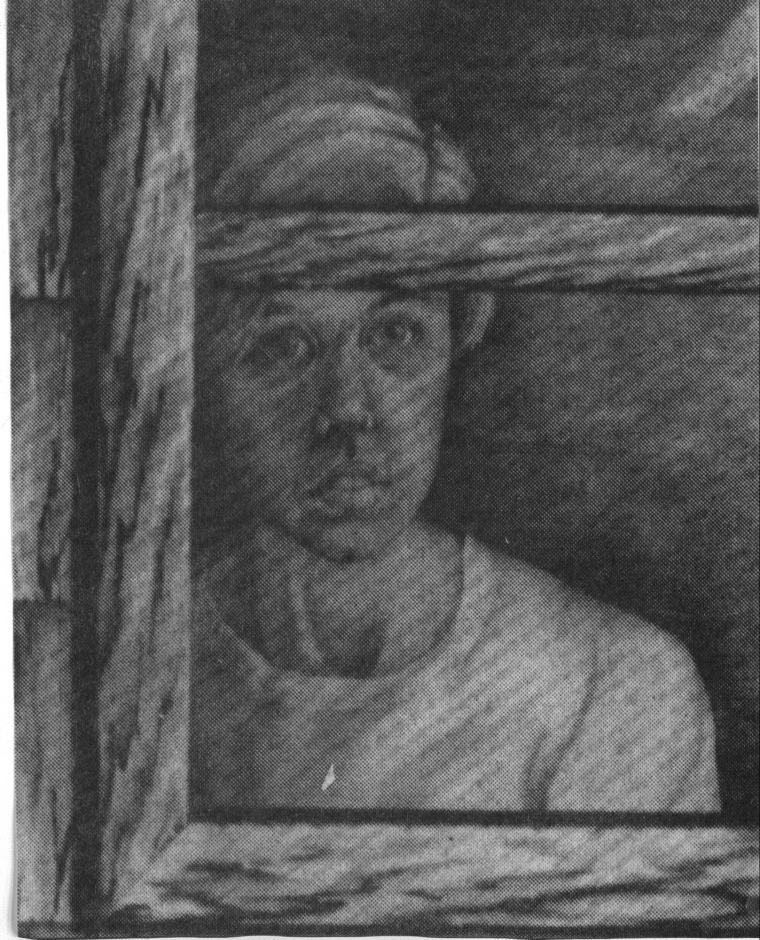
1987 Self-Portrait

# #