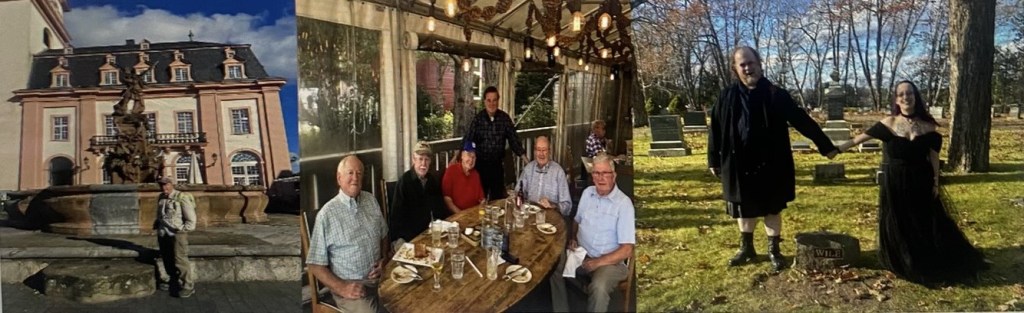
Family Triptych

Weilburg

Traveling 3500 miles to a town in Germany

smaller than the one in Maine where I live—

no tours, no souvenir shops, 

no one speaking English except back at the hotel, 

I stand by Neptune’s Fountain 

in Market Square beneath the God of the Sea 

thrusting his trident into the head of some leviathan, 

my lungs still burning from climbing the hill to get here, 

trying to imagine 25-year-old Johann Frederich Weil 

wandering the square 

before leaving for Halifax, Nova Scotia, 

lured by the British Government’s offer 

of free passage, free land, & a year of free rations, 

knowing from Ancestry.com 

his descendants will anglicize the name & populate places 

like Wile’s Lake, Wileville, & Wiles Road, 

until the turn of the 20th Century 

when Lyman & Lester Wile 

leave Canada for a shoe factory 

in Marlboro, Massachusetts 

where Lyman will marry Edith Conrey 

& sire my father who 

because his mother left Lyman when Dad was 4 years old

(apparently because of spousal abuse) 

didn’t give a shit about his father or his family. 

Then Johann dissolves—

if he was ever here in the first place—

into the salmon & cream-colored two-story buildings, 

round-arched arcades, & a matching-colored four-story Italianate castle 

as my wife and I join the half-dozen folks in leather & wool 

sipping beer & coffee at outdoor tables by a small restaurant. 

Still, walking back to the hotel 

looking down the hill 

at the Lahn River, a small waterfall, an old stone bridge, 

I think of the hill I grew up on, the bridge below my house 

over a similar river by a similar waterfall, 

& I feel a weird calm, 

connected by currents beyond my ken.

The Royal River Grill

Walking into a restaurant 

with large windows looking out on the harbor 

& soft lights meant to look like candles, 

I see Buzz & Chuck & Ted sitting at a long oak table. 

A shiver of both anxiety & eagerness 

& the next thing I know it’s 1953, 

when this building was the site of the Stinson Sardine packing plant 

& I’m ten years old & in fourth grade 

& I’m going to my first meeting of Mike’nBuzzie’s Gang 

at Mike’s house just up the hill from here, 

because earlier that afternoon 

when it had been my turn to stay after school 

to erase blackboards, 

as soon as Mrs. Croudis left for the teachers’ room, 

Buzzie’s brother Craig ran into the classroom. 

“We’re getting a gang together 

for an apple fight with the uptown kids! 

Big meeting at Mike’s house! Let’s go!”

Dropping the eraser, I ran out the door—

the first time in my life I’d ever disobeyed one of my teachers. 

But for the first time in my life I didn’t care. 

A timid kid, raised in a family 

where a miasma of alcoholic anger & anxiety 

hung over us like the fumes 

from the neighboring paper company,

I’d lie awake mornings before school 

afraid of the day ahead, 

of having my arm twisted or my face washed with dirty snow 

by sixth graders like Mike’nBuzzie,

and now they want me to join them! 

Never mind that the apple fight with the uptown kids never happened, 

or that Mike now has Parkinson’s & stays home 

& that Buzz & Chuck & Ted & I, and later, Allie & John, 

have little in common these days 

except our L.L. Bean khakis & plaid shirts. 

I laugh & reminisce. 

At home. 

Still part of the gang.

The Cemetery

Under gnarled & broken maple trees, 

I walk around my family cemetery plot, 

taking pictures of the wedding—

of the bride, who stands 5 feet 

& maybe weighs 100 pounds, 

her upper chest tattooed with angels, 

her dyed magenta hair, & flowing black gown, 

& the groom, my stepson, 

probably 6’4” & 270, 

black lipstick & kilt, red-haired & bearded, 

standing in front of the family stone, 

originally part of the cellar of my mother’s grandfather’s house, 

while my second wife, 

an ordained Deacon in the Episcopal Church, 

performs the ceremony. 

My stepson’s two daughters stand as ring bearers 

near the memorial stone for my daughter, 

who died at 18. 

My wife’s ex-husband & his wife 

stand between my grandmother’s granite stone 

& the memorial stone for Nanny’s ex-husband. 

Not far from my great-grandfather & great-grandmother’s marble stone, 

my stepson’s nonbinary stepson from his first marriage 

& their partner also take pictures. 

The bride’s parents view the proceedings 

in front of my mother’s bronze marker 

between my father’s & my stepfather’s bronze markers 

while my second wife’s sister, her daughter & son-in-law 

watch both the wedding and a grandson 

climbing the near-by gravestones 

of my barber, my favorite teacher, 

a classmate killed in Viet Nam,  

& my little league baseball coach—

all of whom, I imagine, 

rolling over in horror at this spectacle 

of everyone dressed in black, 

everyone smiling, 

one big happy family.

#

My One, Unfolding Life

The beach just down the hill from where I used to live in my “other life.”

#

6:45 a.m. Driving up the turnpike from Brunswick to Bangor, headed down east to Mount Desert Island, I’m apprehensive. I’m returning to what I’ve always called my “other life”: different marriage, different house, different job, different hobbies, different self. A self, quite frankly, I’ve never liked very much.

But I’ve received an invitation to attend the 50th high school reunion of the Mount Desert Island Class of 1974. For many of these students, I was their English teacher as well as senior class advisor. And while I have, at best, mixed feelings about this other life, I enjoyed teaching at MDIHS and have continued to be in contact with some of these former students. I’d really like to see them.

My name tag at the reunion.

The reunion is tomorrow, but besides an invitation to the reunion, I’ve been asked to talk about my book, The Geriatric Pilgrim: Tales from the Journey at a gathering—which I figure will mostly be former students— in Bar Harbor a few hours from now. So, while I watch the leaves change color as I drive north, I try to figure out what I’m going to say. 

I know I’ll start by saying the most important thing I learned in writing The Geriatric Pilgrim was that the physical pilgrimages Mary Lee and I made to places like Iona, Big Sur and the redwoods, Nova Scotia, Israel, Africa, and Turkey have shown me that any journey—including the one we make as we age (and these former students are now all pushing 70. Good God!)—can be a pilgrimage. Especially if looked at with curiosity and openness, as explorations to discover new facets of ourselves, seeking surprises rather than security, looking for evidence of and trusting in a power greater than ourselves. 

Then, I think, Okay, if any journey can be a pilgrimage, that means this trip back into my other life is a pilgrimage. How?

When Mary Lee (who is sitting beside me, looking at a map of Maine—she loves those big unfolding maps that take up half the front seat) have gone on a pilgrimage, we often talk about what new insights we’re bringing back with us which we can use in the future. So, what lessons did I learn during the seventeen years I spent at MDIHS that have stayed with me? 

Well, I’ve always said that those years were the best teaching years of my life. I’ve taught in other schools, some with more impressive teachers, some with smarter students, some with better sports programs, a wider variety of extracurricular activities, more opportunities for materially or intellectually challenged students. But what made MDIHS different was that, despite the annual arguments about the budget and the tensions about dress codes and what was being taught, the parents, the school board, the administration, the faculty, and the students all agreed on one thing: MDIHS was a good school. And because we all thought it was a good school, it was—winning national awards for excellence.

MDIHS in the early years. My room was the closest on the end.

 Making a pit stop at the rest area outside of Bangor, I realize how I frame the reality of my life determines how I see that reality, which in turn determines how I live that reality. Thinking we had a good school, I went to work each day excited and proud to be there (okay, not every day, but I can honestly say, most days) which made me work harder, which made me a better teacher and the students better students. Fifty years later, when I can think of my aging not as a problem, but as an opportunity for growth, I’m less anxious about what I can no longer do and more curious about finding new things I can do, more grateful for those things, which makes me more pleasant to be around.

Back in the car, however, turning on to Route 1A and heading for the coast, I ask: if MDIHS was such a great place to teach, why did I leave, and in the middle of the school year? What’s the lesson there?

It probably begins with that guy I used to be—the one I’ve never liked. Come to think of it, he didn’t like himself either. Despite the accolades (one state evaluator said my Advanced Placement English class rivaled the one at Phillips Exeter), I was not a happy camper. I’d created this persona—loud sports coats, matching ties and pocket handkerchiefs, green ink corrections symbols and sarcastic comments in the margins of papers, pictures of sixty-four famous authors glaring down from the walls—which began to feel like a body bag. 

Soon after waking up one morning gasping for breath as if someone had their hands around my throat, I resigned. In the middle of the school year. Moved out of my house, divorced my wife, married another woman, and moved 120 miles away to teach not AP seniors but freshman juvenile delinquents (one of whom as far as I know is still in prison for murder).

And I think the reason I’ve never liked that guy in my other life is that I’ve always thought he was a fraud. But thinking about it, I honestly liked my job, and I wanted to honor my profession by looking and acting my best. I recall reading in David Whyte’s book, Work as a Pilgrimage of Identity, something to the effect that the things which once served us can imprison us if we remain with them too long. 

Which, as I think about it, is also true as I age. I can’t hold onto those activities, that self-image, those beliefs that once sustained me. When I think about making a new pilgrimage, I can’t plan—or I shouldn’t, anyway or I’m going to be disappointed, either that or die—to hike the Appalachian Trail or climb Mount Katahdin, but I can continue the journey toward what I might, for lack of a better word, call my true self. A journey, I realize, that began when I left Mount Desert Island, maybe even before.

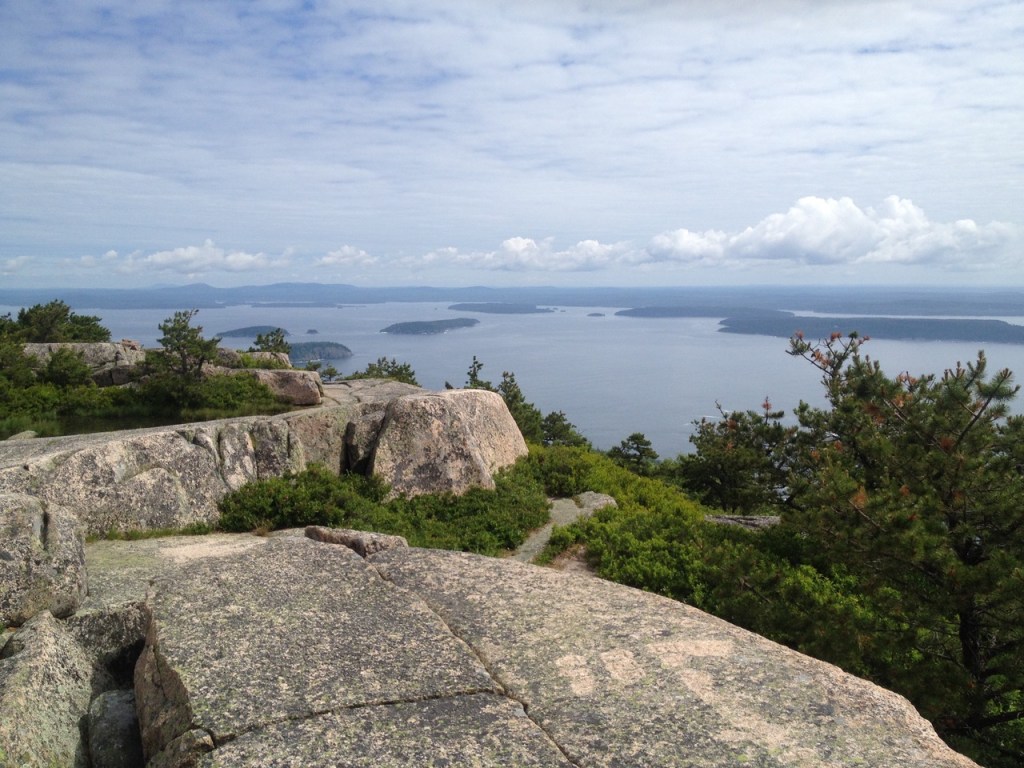
Speaking of which, I can now see MDI on the horizon, its rocky silhouette reminding me that this is one of the most beautiful places on earth. I remember, especially in those days when most of the tourists went home after Labor Day, how many afternoons and weekends I spent walking the trails and beaches there. And I realize that those walks were the beginning of what I call —somewhat euphemistically perhaps—my spiritual journey. Sitting on the top of one of the mountains, looking out over the neighboring islands, I experienced not only the inchoate presence of a Higher Power, but also a vague sense that everything belongs.

I needed help interpreting these experiences. Which led me to religion. When I first began teaching on the island, I hadn’t been in a church since I was married in one, and by the time I left seventeen years later, I was not only a member of a church but a member of the Board of Deacons. I sang in the church choir. I advised a church youth group. 

It dawns on me that without Mount Desert Island, there’d be no Geriatric Pilgrim.

I also see that I have no “other lives,” only this one—one that has been unfolding, like one of Mary Lee’s maps, from the beginning until now and will keep unfolding (I’m guessing; I’m curious to find out) after my earthly death. 

Wow! Now, if I can just remember to talk about some of this an hour from now…

# #

The Geriatric Pilgrim: Traveling the Landscape of Faith and Grief


Image 2

November 30, 2015

RETREATING

Going on a pilgrimage and going on retreat are for me interlaced, like one of those Celtic knots. Both have a spiritual component, both involve both external and interior journeys, and both carry the risks and rewards of renewal.

My first retreat came 25 years ago this December, on the second anniversary of my daughter’s death from cancer: at a time when I was angry with myself for somehow causing Laurie’s death, angry with the world for ignoring my grief, and angry with God for being a Super Saddist getting kicks torturing innocent eighteen-year-olds.

But the previous fall, I’d attended a program on “Meditation as Part of the Christian Tradition,” led by the Reverend Cynthia Bourgeault, now a nationally recognized retreat leader and author of a number of neat books on the spiritual life, who that evening introduced my wife and me to Centering Prayer, a form of Christian meditation. While I wasn’t sure how I felt about Centering Prayer—part of me thought it was absurd, while another part wondered if, after swearing at God for two years, I at least ought to shut up and listen to what God had to say—I grew interested when Cynthia said she was going to lead a retreat in December on Swan’s Island in Maine’s Penobscot Bay. The idea of spending the anniversary of Laurie’s death on an island made a hell of lot more sense to me than what I’d done on the first anniversary: namely, drink myself into oblivion.

I thought a “retreat” would mean withdrawing from the world to a sanctuary, a safe place. That weekend was anything but. As I got out of the car to catch the ferry, my back felt as if someone had suddenly shoved a hot iron into my spine. The fog shut in for two days, so as far as scenic views were concerned, the farmhouse in which we met might as well have been encased in garbage bags. My meditations were filled with surrealistic, frightening images: huge teeth which turned into tentacles that I could feel squeezing me until I couldn’t breathe, a vision of climbing into a biplane piloted by your quintessential WWI flying ace, another image of someone who may or may not have been Jesus in a trench coat and fedora, vivid memories of Laurie’s last tortured breaths. The sound of a teakettle softly steaming on the woodstove became a deafening wind. Sitting in the softest chair in the room felt like sitting on broken glass.

Saturday afternoon, during our free time, my small 3rd floor bedroom turned into an asylum for the insane (which, I’ve since learned, is one of the definitions of the word “retreat”). Instead of the nap I’d planned on, the grief—the sorrow and the anger and the pain and the guilt and the shame—which I’d suppressed (usually with booze) for the past two years erupted in molten spasms. I remember doubling over, as racking sobs tore into my stomach. Of sliding or falling off the bed on to the floor. Of holding on to the iron bedpost with one hand and punching the bed with my other hand, driving my fist into the mattress. Then I grabbed the bed with both hands, raised myself onto my knees and slammed my head into the mattress. I drew back and slammed my head into the mattress again. Again. All the while making yelping noises and kicking the floor until, exhausted, I fell asleep.

The next day, however, I left the retreat feeling less angry, less guilty, and more serene than I had since Laurie died. The feeling didn’t last of course, but it was never as bad as it had been. Looking back, I see myself broken open, which, to paraphrase Leonard Cohen, was how the light got in. Even before Laurie’s death, good New England male that I am, I’d always keep my feelings hidden, even from myself. Feeling grief—really down and dirty and covered with shit grief—would ironically make it possible for me later to feel joy.

My wife and I attended more of Cynthia’s retreats on various Maine Islands. Later, after becoming Members of the Fellowship of the Society of Saint John the Evangelist, we started going to their monastery in Cambridge and their retreat house in West Newbury, Massachusetts. These days, we also try to travel at least once a year to somewhere we’ve never been before, such as the Desert House of Prayer outside Tucson, the New Camaldoli Heritage at Big Sur in California, the Norbertine Retreat Hermitage in New Mexico, the islands of Iona and Lindisfarne in Great Britain.

IMG_0033

I’ve often asked myself—usually after seeing my American Express bill—if I need to go so far away for these retreats. Can’t I just put my phone on airplane mode, lock the door, and walk in the woods behind my house?

I do and it’s helpful, but the only way to completely pull the plug on all those radio stations playing in my head is to get out of Dodge. Physical and spiritual withdrawal are as entwined for me as pilgrimage and retreat.

And learning to see the world as interwoven has been one of the greatest gifts of going on retreat. Like most Westerners, I tend toward a dualistic view of the world. I grew up learning to distinguish between “us” and “them”: white hats and black hats, Commies and Red Blooded Americans, Maine residents and flatlanders, good and bad, smart and stupid, strong and weak. “You can’t have it both ways,” my mother would tell me. It’s taken me over 70 years to learn that most things are not “either …or” but “both … and.” Such as when I’m on retreat: both “withdrawing” and “confronting,” both in solitude and in community, both in continued grief over Laurie’s death and in gratitude for the gifts that continually grace me.

##

November 16, 2015

WHEN PILGRIMAGE FEELS LIKE EXILE

I think the first time I ever thought about the word “pilgrimage” was just before the trip my wife and I took to Israel. Before we left, I happened to read a magazine article in which the author distinguished between pilgrims and tourists. Tourists, she wrote, go out from the center of their worlds, their homes, in order to vacation; pilgrims, on the other hand, seek to travel from the edges of their lives to their center, their homes. Well, that sounded like a pretty good distinction to me. Faithful Christians that we are, ML and I were, I thought, going “home” to the origin of our faith.

However, while ML had a great time, my trip felt like being exiled to the furnace of fire Jesus talks about in the Gospel of Matthew, “where there will be weeping and gnashing of teeth,” Or in my case, the gnashing of bowels.

Every day the temperature soared to well over 90°. Within two days I picked up an intestinal bug and was popping Lomotil like sunflower seeds. From the moment we arrived, we were lost. The first day we wandered for three hours through the labyrinth of streets and alleyways of the old city looking for a way back to St. George’s Cathedral Guest House and its friendly hollyhocks and familiar Evensong. The next day we found ourselves locked in the Garden of Gethsemane and wandering blindly on the backside of the Mount of Olives.

31_big

On Friday, we joined the Franciscan Friars on their Walk of Devotion up the Via Dolorosa to The Church of the Holy Sepulchre, built where tradition says Jesus was crucified and buried. Walk of Agony was more like it. If you’ve never been to the old city of Jerusalem, know that every one of those damned cobblestone streets rises at least 45°. Every twenty steps my stomach felt as if one of the ubiquitous Israeli soldiers had kicked it with a combat boot. Swarms of young boys tried to pull us into booths featuring five-foot posters of baby Jesus and the Virgin, baskets of wooden rosaries, and passages of scripture woven on dishtowels.

The Church of the Holy Sepulchre was a sauna. My intestines twisted as ML and I were funneled into a room where Jesus hung on a cross, wearing what looked like a tin diaper, his head covered from ear to ear with a semi-circle of silver. Cameras flashed. Voices babbled. Smells of incense, body odor, and stale cigarettes.

Downstairs, the Holy Sepulchre looked like a block of dirty cement. Some kind of priest in a tall black hat berated a woman for having bare shoulders. More cramps as people pushed me through a doorway into damp sour air, candles, aluminum icons and Jesus wearing another tin hat.

The place felt about as holy as a sardine factory.


The_Garden_Tomb_2008

And then three days later, I sat in the Garden Tomb, the alternative site of Jesus’ crucifixion and burial. Yellow and red roses covered the stones and cool, shaded paths wound under cypress, palm, and pine trees to a large platform with wooden benches looking out over “Skull Hill,” whose crumbling stones and small caves make a face in the side of a cliff. Earlier, our guide told us that in 1882, General Charles Gordon, Bible student and British soldier, decided this was the true Golgotha, or Place of the Skull.

Our guide also showed us a burial spot in the side of an adjacent hill. Inside, the rock was smooth and looked as if you could lie down on it and get a good night’s sleep. He pointed to a hole cut above the entrance through which light shone into the cave. “The first spot light of the world,” he said in his charming British voice.

I inhaled the fragrance of the flowers and the trees, watched swallows swoop through the leaves. Now I was home.

And that’s why I knew this was the wrong place for Jesus’ crucifixion and burial. If your message is that love of God and love of your neighbor are the greatest of all the commandments, the only way to prove it is by seeing this teaching tested in the worst possible conditions: heat and crowds of conflicting nationalities, soldiers and souvenir sellers, physical pain and taunting ridicule. I thought of ten years earlier, when each day I walked what I realized was my own Via Dolorosa from the Ronald McDonald House to the Eastern Maine Medical Center, where my daughter lay dying from a rare cancer diagnosed only months earlier. I’d felt exiled from my wife and stepson to a living hell of doctors and CT scans and catheters and—most of all—hopelessness. During those endless frustrating days, I needed to know that someone had cried out as I did, “My God, my God, why have you forsaken me?” and yet had overcome death. I needed to believe that Laurie would enter into eternal life.

And I think it was at that point, sitting under the trees in the Garden Tomb, that my exile became pilgrimage, not in the sense of experiencing the beauty of the sun rising through the fog over Maine waters, but of having an emotional and physical encounter that deepened my understanding of what holy means.

Even if it did take two more weeks before I could eat solid food.


# #