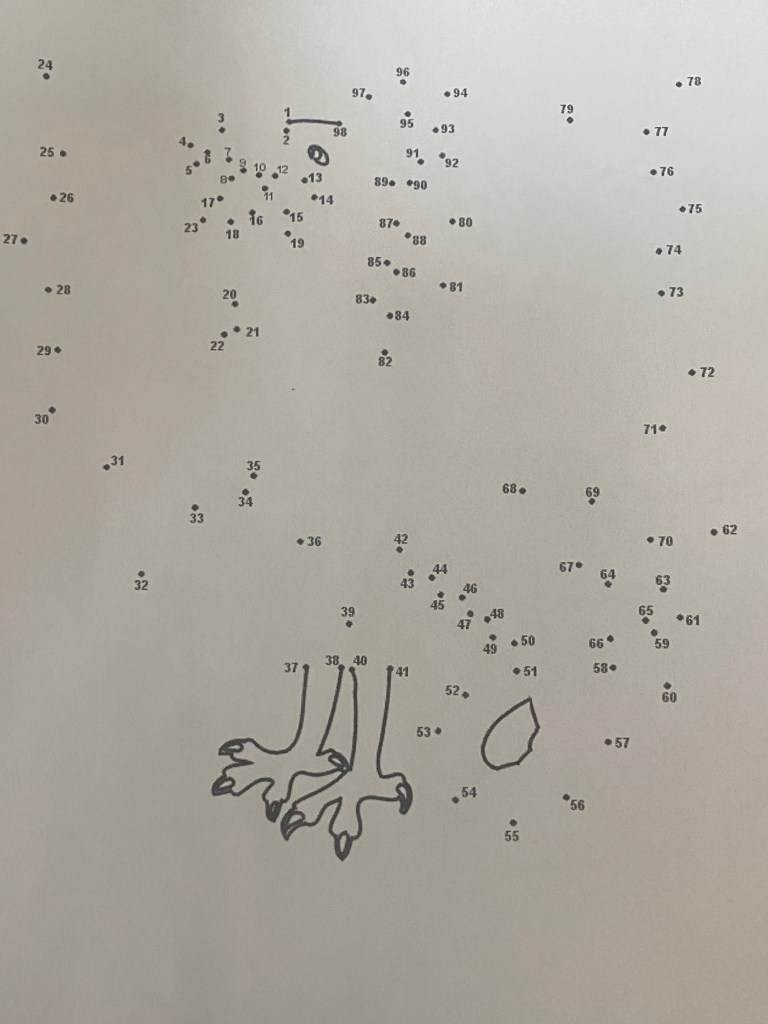
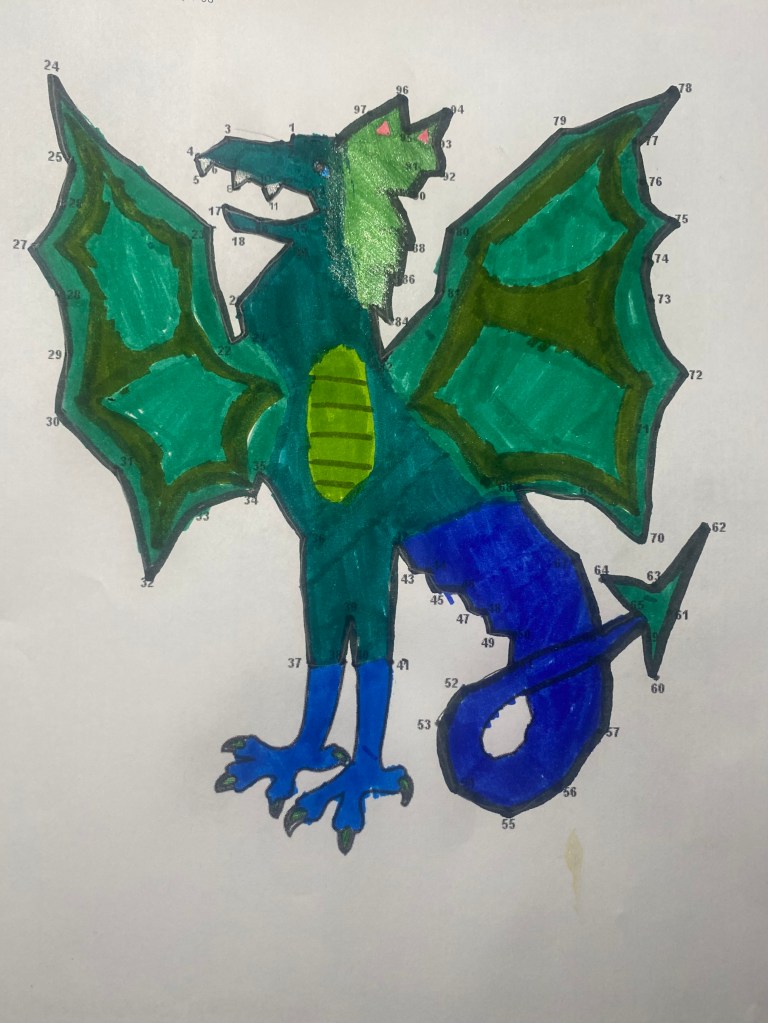
As a kid, some three-quarters of a century ago, I loved to “Follow the Dots.” You know, those puzzles where at first, you see nothing but a confusing morass of tiny spots, like black ants on the page, but if you connect these dots by the numbers, a cat or dog or giraffe or flower appears, as if by magic. Then, you can color it and have a lovely picture. (Or at least Mom said mine was lovely.)
And I still love following and connecting dots. It’s one reason I love poetry and admire those writers who draw connections I’ve never seen before. Everything I read about physics and the discoveries about our universe, everything I read about spirituality, everything I’ve learned about health, all say that everything is connected; what we need to do is connect the dots.
“Connection is why we’re here,” says researcher/storyteller Brene Brown in a TED talk I recently watched. Then Brown went on to talk about our problems with connecting, problems caused by our fear of appearing vulnerable, our need for control and certainty, and most important, our shame. Because we don’t feel we’re worthy of connecting with others, we don’t try.
Well, that made me sit up and take notice. I’ve often said that shame has been the driving force of my life. Thanks to almost a dozen years working my Al Anon program, I’ve learned shame is part of growing up in a family riddled with generations of alcoholism, along with burying feelings, fearing confrontation, learning to hide behind personas, perfectionism, judgmentalism, and people-pleasing. Twelve-step literature calls these traits “character defects.” I think of them as survival mechanisms. Either way, they’ve kept me from connecting to other people.
As Marie Howe’s writes in her poem “The Affliction”:
When I walked across a room I saw myself walking
as if I were someone else,
…
as if I were in a movie.
It’s what I thought you saw when you looked at me.
So when I looked at you, I didn’t see you
I saw the me I thought you saw, as if I were someone else.
This was (and can still be) me, walking into a room, convinced everyone is staring at me, first in judgment, then in disdain. I’ll run my tongue over my teeth to make sure there’s nothing stuck between them, check my fly to see if it’s zipped. Still, I’m sure people are deriding me for being the failure I know I am.
At no time was this truer than after I became a high school English teacher. Every time a student laughed, or whispered, or stared at me, I was convinced I was the subject of their ridicule. (And finding out I was known as Wiley Coyote didn’t help.)
So I created the persona of MRWILE. During the ever-more-casual 1970s, I dressed in flashy sport coats, bell-bottoms, with matching ties and pocket handkerchiefs. I spent weekends in my classroom changing bulletin boards, papering the walls with posters, and growing geraniums and begonias on the windowsills. At school, I used sarcasm and difficult reading assignments to control behavior, while at home I filled the margins of student essays with correction symbols and caustic comments—“Huh?” “What on earth does this mean?”
Outside of school I attempted to encase myself in the same veneer of respectability. I smoked a pipe. I bought a white cape cod house with green shutters in a housing development. I put up a white picket fence and planted rose bushes. I joined the church choir, the church Board of Deacons, and the Rotary Club.
MRWILE
While MRWILE helped me gain some of the respect I craved, this persona killed my first marriage and almost killed me. I was never home, and when I was, I was never present. I began waking in the night, sweating, and panting for breath, suffocating, after nightmares of being tarred and feathered and ridden out of town on a rail.
What saved me was THE LIGHTBULB.
As I recall, I was teaching a class about a particular piece of literature. (Maybe a Shakespearean sonnet?) So that my students could understand the imagery, I was trying to connect the poet’s situation to theirs. Suddenly, I saw a face light up in understanding, as if I’d flipped a switch in the kid’s head. I remember feeling a corresponding charge, a release, that I’ve since said, felt right up there with sex.
I’m serious. In that moment, and in the other moments since then that have kept me teaching long after I threw out the ties and matching pocket handkerchiefs, when I taught everyone from thirteen-year-olds with learning disabilities to students with combined College Board scores of 1600 to college seniors working on honors theses to homeless veterans with PTSD to Al Anon sponsees, as in sex, I’ve somehow connected with someone at a deeper level—a reciprocal give and take that goes far beyond “Oh, aren’t I a wonderful teacher!” Both teaching and sex have been means by which I have experienced real—maybe “pure” is a better word—relationship.
If you don’t get this, I understand (when I talk about how exciting teaching can be, some people look at me as if I were extoling the taste of ground glass), but I will always remember the evening I talked about my lightbulb experiences to a teacher from Colorado when we were both reading essays for the College Board in New Jersey. She did understand. We began writing to each other. I found I could be open and vulnerable with her, and that for her, I could give up my secure and respectable life, leave the white cape and the picket fence and my advanced placement students in the middle of a school year for a three-room, 2nd floor apartment, and four classes of potential juvenile delinquents who’d driven their previous teacher to early retirement.
And in the almost forty years since then, together we’ve faced the death of a child, financial uncertainty, several career shifts, and now, the diminishments and indignities of old age.
As I tell the folks in my writing groups these days, I write to discover what I didn’t know I knew. Writing this blog, I’ve discovered that while shame has been one driving force in my life, my desire for connection has been another one, probably beginning with those days I spent connecting dots in puzzle books. And that when—I have to think it’s through Grace—I have connected not only to but also with my metaphorical dots, it’s resulted in a beautiful picture.
And should any of this should connect with you, dear reader, that would be pretty nice, too.
Thank you to my granddaughter Anastasia for connecting the dots and coloring the picture far better than I could


 The Geriatric Pilgrim: Traveling the Landscape of Faith and Grief