#
If I ever commit suicide, it will be in March. I can handle December, January, and February. Snow is supposed to fall; it’s supposed to be cold. But during March—at least here in Maine— winter drags on, gray and cold and windy, except for the occasional sunny day that turns everything to mud.
March is when my soul is at low tide. The world situation is scariest, the national political scene is its most indigestible, and people on the street turn into assholes. Looking after grandchildren, volunteer activities, hobbies—all of which I usually enjoy—become burdens.
As March began this year, besides everything else, I was still depressed over the seventeen students gunned down at Marjorie Stoneman Douglas High School in Florida, and the partisan politics blocking any kind of meaningful discussion over what to do about the bloodshed that threatens to drown this country. Closer to home, one of my oldest friends was dying of cancer, and watching one of the best athletes I ever played with struggle to get out of bed was a painful and foreboding glimpse of mortality.
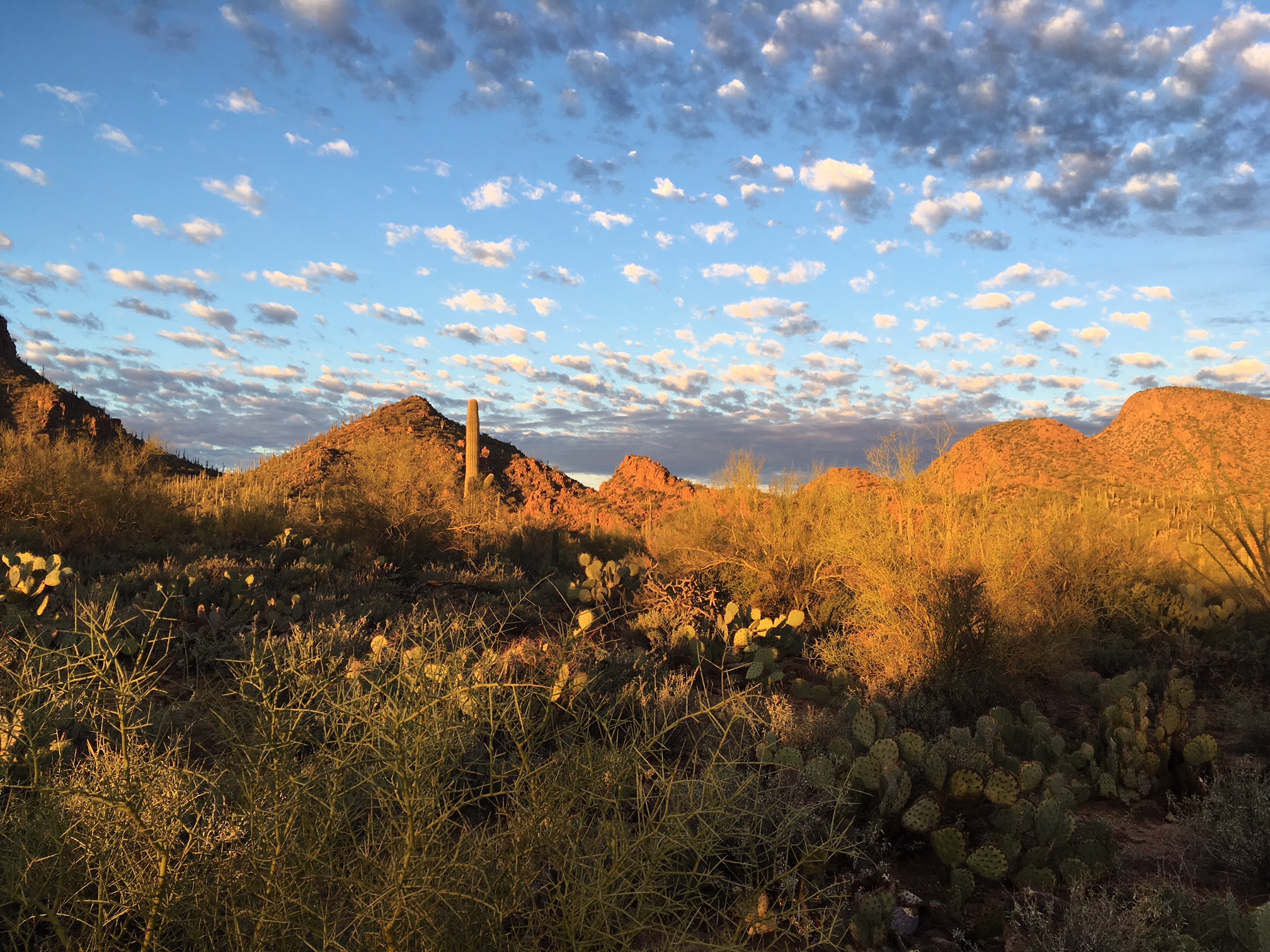
Fortunately, this year, Mary Lee and were able to return to the desert, specifically to the Desert House of Prayer just outside Tucson, Arizona. Why there? What draws me, a geriatric who has spent almost his entire life in northern New England? What makes the desert a source of healing?
One reason, I suppose, is nostalgia. I have a picture of me at my birthday party—I’ve probably turned five or six—wearing a cowboy hat, chaps, shirt, and belt.

Every Saturday afternoon, I watched Buck Jones, Tom Mix, Gene Autry, Roy Rogers, or Hopalong Cassidy chase bad guys through the sagebrush. I’d practice throwing my younger sister Jaye over my shoulder the way Gene Autry did when Black Bart tried to sneak up on him. After graduating from high school, I spent two summers working for the U.S. Forestry Department in the mountains of Idaho, where I wore a real cowboy hat and Frisco Jeans, fought forest fires, and picked up a little beer money throwing an axe into a tree from twenty-five feet away.
Maybe part of the appeal of the West, then, is recalling when l could tell the good guys from the bad guys by the color of their hats, and when I was as strong as I’ve ever been, and the world was new, and excitement was just over the next mountain. When the stars seemed so close at night that I knew I could grab one any time I wanted.
It was that sense of transcendence that I later found in contemplative prayer practices, which began in the deserts of Egypt in the early days of Christianity. I’ve always enjoyed reading about the Desert Fathers and Mothers, who went to the desert to escape the Roman Government’s appropriation of Christianity, who practiced what has become known as the “Apophatic” way to God, where the presence of God may, as often as not, be perceived as an absence. In the stark silence of the desert, these men and women found a setting for what they referred to as “Agnosia,” or “unknowing.” Casting aside all images of God, they made themselves deserts, stripped of everything but the spark of soul that they felt was God.
After my daughter Laurie died of cancer, when the world had become a barren landscape of pain and confusion, frustration and doubt of everything and everybody, especially anything to do with the Christian faith I’d grown up with, this apophatic or “Negative Way” was the one thing that made sense. And I’m still more comfortable talking about who God isn’t than who or what God may or may not be. I suppose it’s no accident that my favorite gospel is Mark, which has been called the “desert gospel,” both for its starkness of language—it’s the shortest of the four gospels—and the location of many of its major scenes.
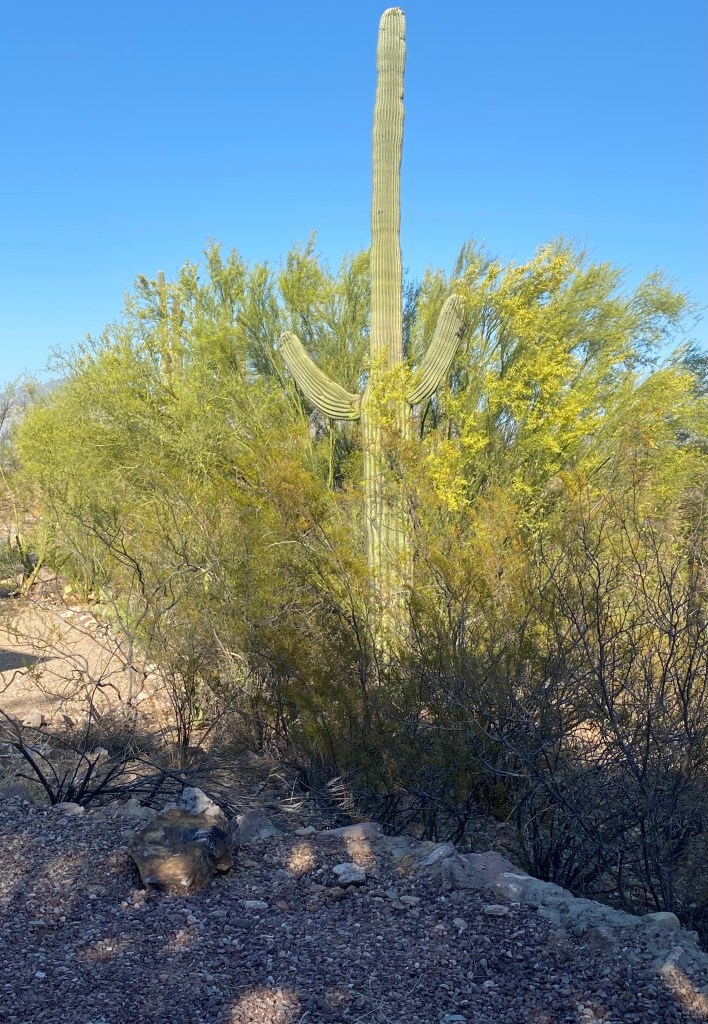
Beldan Lane, in his book The Solace of Fierce Landscapes, thinks of the desert as being like a vaccination, in which we are given a small amount of whatever we need healing from. In my case this year, I needed healing from a violent and grotesque world that had begun to seem overwhelming: increasing economic injustice, ugly racism, obscene wealth, and a government of Barnum & Bailey clowns and would-be big game hunters trampling on the Constitution. I needed some kind of antidote for my fear that every stomach ache, every pain in my back, every new mole on my body was cancerous. For a New Englander like me, the desert, with its tall Saguaro growing out of volcanic rock, the cholla and prickly pear cacti that left their spikes in my arms and legs as I walked past, the desert sage, mesquite, and creosote bushes provided the right shot of the grotesque and the painful.
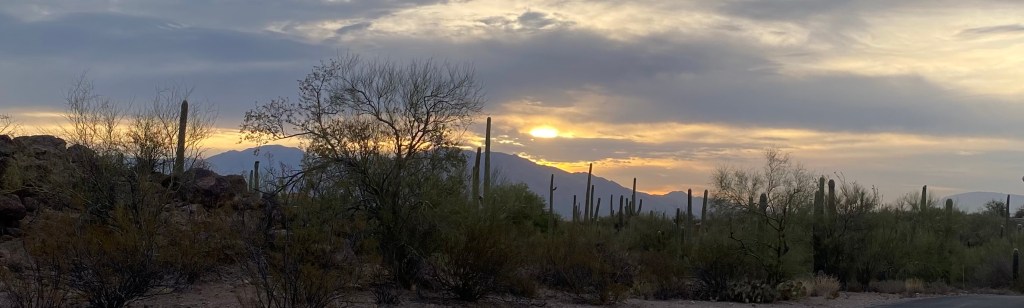
But at the same time, the desert is also a place of surprise and beauty. The silence is thundering. The sunrises and sunsets are often spectacular. This time of year, the cacti are blossoming bright yellow and red. Rabbits poke along under the creosote bushes. The songs of doves, cardinals, wrens, thrushes, and finches fill the air. On a morning hike last week, Mary Lee and I rounded a corner and met a coyote, who stared indifferently at me while I fumbled for my camera, and then, as if growing tired of my inability to get it out of my pocket, loped up a rocky hill toward a cave.
Later, thinking about the coyote, I remembered a quote by Andrew Harvey: “We are saved in the end by the things that ignore us.” I’m still not entirely sure why, but I think he’s right. In part, I guess, because the desert reminds me that I’m not the center of the universe. The coyote, the cacti, the rocks, the birds here exist independent of what I think or feel. The sun will rise and set no matter what condition my soul is in. Those volcanic red and gray rocks at my feet were here long before me and will remain long after I’m gone. I am but a small part of a fundamental creative force moving in all things. Bleak at times, but also breathtakingly beautiful.
So I’ve come home from the desert with a little more of “… the serenity to accept the things I cannot change.” The political circus is still the same. The weather isn’t any better. (Two days after I got back, it snowed for three days.) My friend Scott died. Still, the desert has given me hope that even in desolation, even amidst the grotesque, even in death, life blooms. With or without me.
#
In memory of Scott Dunham: 1943-2018

# #

 The Geriatric Pilgrim: Traveling the Landscape of Faith and Grief