The Snows of Christmas Past

#

After years of counseling and going to meetings, remembering Christmas when I was a kid now feels like peering through my frosted window at a soft and steady snow covering up dead leaves, discarded pumpkins, and broken branches under the diseased hemlocks beside the house.

My family’s disease was alcoholism. Mom’s memories of her drunken father passed out on Christmas Day, her shame at not being able to bring friends home, Dad’s bitter memories of Christmases in a Home for Wayward Boys and in the Army during WWII, his sense of being victimized by a social system he saw based on greed—feelings he tried to wash away with a pint of Old Crow—the arrival each Christmas of my mother’s mother, Nanny C, a large bitter woman whose acid tongue could peel paint, permeated our house during the holidays like their cigarette smoke.

In the weeks before Christmas, I’d hear Dad’s grumpy voice through the register in the floor of the bathroom asking where the hell were they going to get the money and Mom’s brittle reply they were just going to have to find a way; her children weren’t going to have the shitty Christmases she did. And I’d know it was up to me to make sure the holidays were happy. So that Christmas morning when Dad groaned because his head hurt, and Mom and Nanny perched on the edge of their chairs hovering like crows on telephone poles watching my younger brother and sister and me open our presents, and I ripped off Christmas wrapping to find a rainbow-colored wool hat that only a girl would wear, I said, “Oh, I love this. Thank you!” 

Ah, but here come the snows of nostalgia, which, I’ve discovered, is not all bad, especially when it brings memories of wading up to my knees in in the white stuff to help my father cut a tree, the smell of fresh fir as Mom and Dad set up the tree on the porch, decorating it with ornaments I still have 70 years later, popping corn and stringing it on the tree, smelling Nanny C’s fudge and Mom’s cookies and bread, and hearing my grandmother playing carols on our piano.

Or of walking home from sledding in the 5:00 p.m. darkness, carrying my Flexible Flyer past the drug store and the hardware store, their neon lights shimmering, casting shadows on the snow banks, past the big white Georgian houses on Main Street with their candles in the windows, then down Bridge Street, seeing my house and our lighted tree on the back porch, and feeling the Christmas excitement when the possibilities of happiness were as many as the stars in the frozen sky.

Or of helping my father, who moon-lighted as sexton in our church, get ready for the Christmas service by picking up last week’s bulletins from the Sanctuary, alone in this great empty space, the whistling of my corduroy pants as I walked echoing in a great and holy silence, and somehow feeling safe—held, enfolded by a Great Presence.

Then Christmas day: giggling in bed with Jaye and Roger, as we wait for 6:00 a.m. when we can wake the grownups, not knowing that Nanny C is in the next room listening to us with tears of joy running down her face—“Oh, you kids are so good, God bless you!” Christmas dinners of turkey, mashed potatoes, gravy, stuffing, homemade bread, and cranberry sauce (which is what I ate. Let the grownups eat the squash and turnips and beans), followed by Mom’s pumpkin, apple, and blueberry pies topped with Sealtest Ice Cream. In the afternoon, Dad slept off his hangover on the couch, Nanny went back to the piano and she and Mom sang “White Christmas,” “The Christmas Song,” “I’ll be Home for Christmas,” while I played with my new model airplane or helped my brother or sister put together their farm or showed them how to play the new Parcheesi game or took my new skates (but, gee, I forgot my new hat) which Mom and Dad had bought on time to the town rink behind the movie theater or went up to my room to read the book I’d received: maybe Treasure Island, Tom Sawyer, Herb Kent West Point Fullback, a Hardy Boy’s mystery, or Zane Gray.

On Christmas night I went to bed with a plate of cookies and a glass of milk, turning on the radio to my favorite programs, most of which were having Christmas specials: Jack Benny exclaiming after having spent the last thirty minutes buying the cheapest gifts he could find, “Good night, everyone, and merry Christmas!” George Burns telling his wife, “Say good night, Gracie,” and her reply, “Good night, Gracie, and Merry Christmas,” and of course, a version of Dicken’s “Christmas Carol,” probably starring Lionel Barrymore. I ate, finished my milk, and crawled completely under the covers with the cookie crumbs, following Scrooge on his journey from “Bah, humbug!” to “God bless us, everyone!”

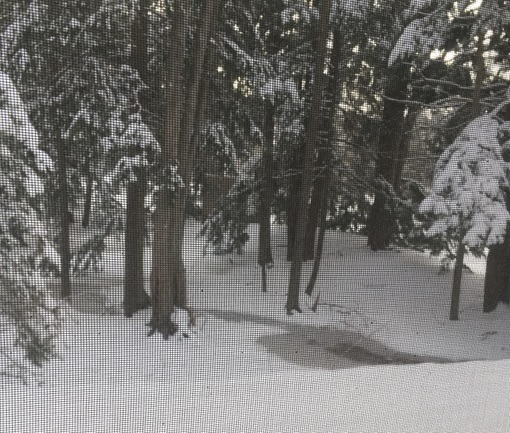
 While outside the window, at least in my memory, snow fell in great white, silent flakes.

My sister, Jaye, circa 1954, with her new poodle skirt, doll, and whatever it is on her wrist.

# #

Family Triptych

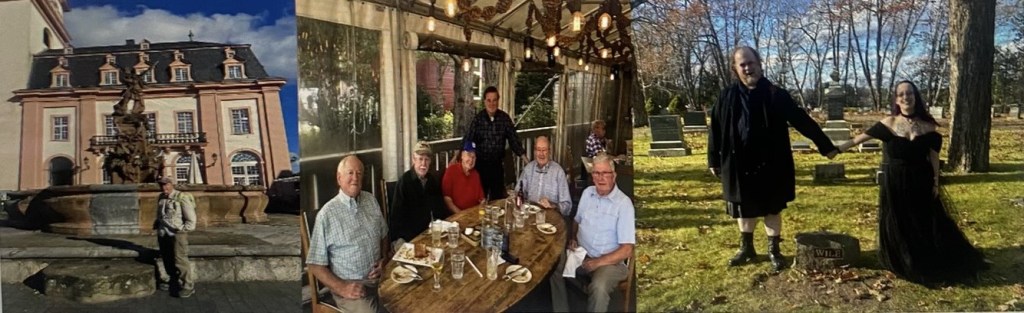
Weilburg

Traveling 3500 miles to a town in Germany

smaller than the one in Maine where I live—

no tours, no souvenir shops, 

no one speaking English except back at the hotel, 

I stand by Neptune’s Fountain 

in Market Square beneath the God of the Sea 

thrusting his trident into the head of some leviathan, 

my lungs still burning from climbing the hill to get here, 

trying to imagine 25-year-old Johann Frederich Weil 

wandering the square 

before leaving for Halifax, Nova Scotia, 

lured by the British Government’s offer 

of free passage, free land, & a year of free rations, 

knowing from Ancestry.com 

his descendants will anglicize the name & populate places 

like Wile’s Lake, Wileville, & Wiles Road, 

until the turn of the 20th Century 

when Lyman & Lester Wile 

leave Canada for a shoe factory 

in Marlboro, Massachusetts 

where Lyman will marry Edith Conrey 

& sire my father who 

because his mother left Lyman when Dad was 4 years old

(apparently because of spousal abuse) 

didn’t give a shit about his father or his family. 

Then Johann dissolves—

if he was ever here in the first place—

into the salmon & cream-colored two-story buildings, 

round-arched arcades, & a matching-colored four-story Italianate castle 

as my wife and I join the half-dozen folks in leather & wool 

sipping beer & coffee at outdoor tables by a small restaurant. 

Still, walking back to the hotel 

looking down the hill 

at the Lahn River, a small waterfall, an old stone bridge, 

I think of the hill I grew up on, the bridge below my house 

over a similar river by a similar waterfall, 

& I feel a weird calm, 

connected by currents beyond my ken.

The Royal River Grill

Walking into a restaurant 

with large windows looking out on the harbor 

& soft lights meant to look like candles, 

I see Buzz & Chuck & Ted sitting at a long oak table. 

A shiver of both anxiety & eagerness 

& the next thing I know it’s 1953, 

when this building was the site of the Stinson Sardine packing plant 

& I’m ten years old & in fourth grade 

& I’m going to my first meeting of Mike’nBuzzie’s Gang 

at Mike’s house just up the hill from here, 

because earlier that afternoon 

when it had been my turn to stay after school 

to erase blackboards, 

as soon as Mrs. Croudis left for the teachers’ room, 

Buzzie’s brother Craig ran into the classroom. 

“We’re getting a gang together 

for an apple fight with the uptown kids! 

Big meeting at Mike’s house! Let’s go!”

Dropping the eraser, I ran out the door—

the first time in my life I’d ever disobeyed one of my teachers. 

But for the first time in my life I didn’t care. 

A timid kid, raised in a family 

where a miasma of alcoholic anger & anxiety 

hung over us like the fumes 

from the neighboring paper company,

I’d lie awake mornings before school 

afraid of the day ahead, 

of having my arm twisted or my face washed with dirty snow 

by sixth graders like Mike’nBuzzie,

and now they want me to join them! 

Never mind that the apple fight with the uptown kids never happened, 

or that Mike now has Parkinson’s & stays home 

& that Buzz & Chuck & Ted & I, and later, Allie & John, 

have little in common these days 

except our L.L. Bean khakis & plaid shirts. 

I laugh & reminisce. 

At home. 

Still part of the gang.

The Cemetery

Under gnarled & broken maple trees, 

I walk around my family cemetery plot, 

taking pictures of the wedding—

of the bride, who stands 5 feet 

& maybe weighs 100 pounds, 

her upper chest tattooed with angels, 

her dyed magenta hair, & flowing black gown, 

& the groom, my stepson, 

probably 6’4” & 270, 

black lipstick & kilt, red-haired & bearded, 

standing in front of the family stone, 

originally part of the cellar of my mother’s grandfather’s house, 

while my second wife, 

an ordained Deacon in the Episcopal Church, 

performs the ceremony. 

My stepson’s two daughters stand as ring bearers 

near the memorial stone for my daughter, 

who died at 18. 

My wife’s ex-husband & his wife 

stand between my grandmother’s granite stone 

& the memorial stone for Nanny’s ex-husband. 

Not far from my great-grandfather & great-grandmother’s marble stone, 

my stepson’s nonbinary stepson from his first marriage 

& their partner also take pictures. 

The bride’s parents view the proceedings 

in front of my mother’s bronze marker 

between my father’s & my stepfather’s bronze markers 

while my second wife’s sister, her daughter & son-in-law 

watch both the wedding and a grandson 

climbing the near-by gravestones 

of my barber, my favorite teacher, 

a classmate killed in Viet Nam,  

& my little league baseball coach—

all of whom, I imagine, 

rolling over in horror at this spectacle 

of everyone dressed in black, 

everyone smiling, 

one big happy family.

#

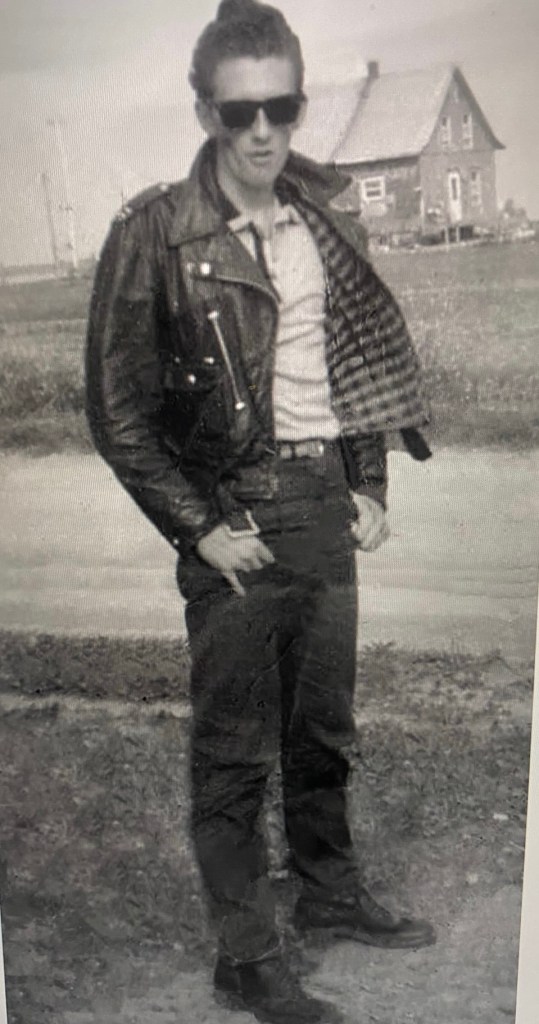
Wild Willy


Phone curtesy of Wikipedia Commons

                        1.

Around the time this log cabin 

sold moccasins I’d see

Wild Willy Crockett 

on the corner 

with Pea Soup, Spider, and the Goose.

Taller than the others,

he stood with knees rigid, 

pigeon-toed, gazing 

up and down the street,

searching for someone with a car,

a summer chick on the make,

or Crazy Benny,

who’d buy him beer.

Balanced on a line 

between cool and caricature:

the shiny D.A.

French-inhaling Camels,

rocking with Dee Dee Dinah, 

whose tits stuck out 

of her sweater like oil funnels,

chugging three beers before the game 

and coming off the bench 

to score six straight points,

graduating high school with his pants

on backwards.

            2.

Now the log cabin 

sells organic and new-age produce, 

and Willy Crockett stands 

at the corner of tofu and prunes.

Fifty pounds heavier, 

still tall.

Wears a toupee 

that looks like roadkill,

carries a cell phone 

clipped to an alligator belt.

Assistant manager 

at the local hardware store, 

divorced from Dee Dee, 

He tells me he belongs 

to the Church of the New Kingdom.

Says the old days are long gone

—Praise the Lord!

Toes pointed in, 

he cradles his yellow basket 

of flax oil and sulfur supplement,

gazes at displays 

of crystal pyramids,

Himalayan incense,

and Navajo dreamcatchers,

still searching…

Memories of a 50’s 4th

Google Image

#

Back then

firecrackers popped all day long.

Anyone could buy them at the drug store,

along with caps for your pistol,

and black pellets that, when lit,

curled into snakes.

Stores, many draped in American flag, closed,

and until noon or so, a dog could

lie down in the middle of Main Street

without fear of being run over

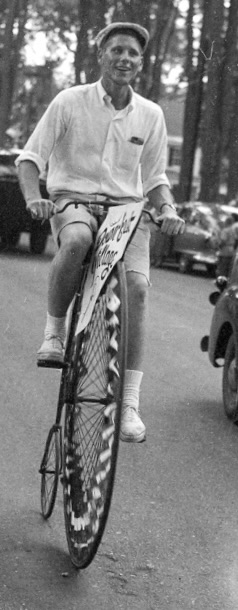
by anything except a bicycle

papered in red, white, and blue crepe.

Well, most bicycles didn’t look like this, but you get the idea.

In the afternoon, relatives got together

or families drove to the beach

or attended a baseball game

between neighboring town teams.

Family gathering at my grandparents.

Back then

after supper, many folks drove

over to John Rizzoli’s for fireworks.

A large man with a big smile and cold eyes,

John had immigrated here after WWI,

becoming, rumor had it,

“Al Capone’s man in Maine,” during Prohibition.

He and his eight or ten sons,

now legally supplied the state with beer:

Budweiser,

Schlitz,

Pabst,

and Narragansett

(“Nasty-Ganset,” my grandfather, who lived on the stuff, called it).

“Thank-a-full for what this-a country

give-a me,” once a year, John opened his garage,

moved out his Cadillacs, put in a bar,

and sold red, white, and blue dixie cups of his wares

prior to shooting off the fireworks.

Back then

as the sun set over the field behind the Rizzoli’s

families spread blankets.

While their children in shorts

and Keds and Davy Crocket caps

played cowboys and Indians

and shot off more firecrackers,

women, wearing bright lipstick and checkered dresses,

their hair curled, courtesy of Toni or Lilt,

visited each other,

comparing kids,

their new washing machines and dryers,

the cost of pine-paneling their rec rooms.

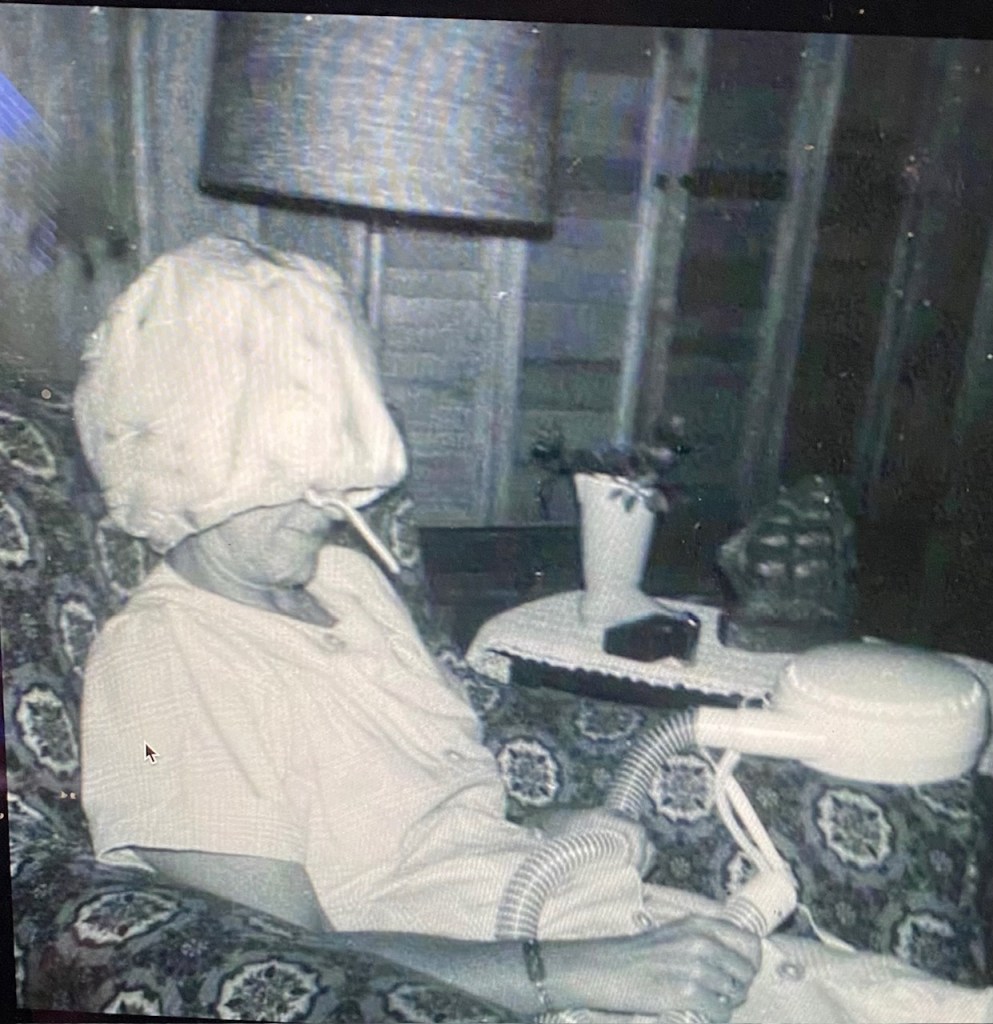
Mom getting ready to go out.

Men, clean-shaven with crewcuts, many in white shirts and gabardine pants,

visited John’s garage,

complained about the Red Sox,

argued the merits of the new Fords, Chevys, Dodges, and Hudsons,

swapped war stories and dirty jokes.

Dad’s new car

Teenagers in jeans stood around the edges of the field

bragging about their new “Hi Fi” record players,

arguing who kicked more ass, Elvis or Jerry Lee,

wondering who was going all the way,

while single men in overalls and slouch hats, stood against the garage

bitching about

taxes,

teenagers,

the new interstate through-way.

Back then

somewhere close to 9:00 p.m.

when it got completely dark,

men returned to their families

and a holy hush fell over the field.

Flashes of fireflies, like votive candles,

lit the night.

The smell of cigarette, cigar, and pipe smoke

wafted like incense.

As someone started singing, “God, Bless America,”

dixie cups were passed.

Suddenly, light and noise filled the sky—

rockets’ red glares, bombs bursting in air—

and sounds of a collective “Aahhh”

rose into the heavens,

as we worshipped the American Dream.

Google Image

# #

Sunday Afternoon Drives

Bridge St Party.1958
The Parents. Thanks to my sister, Jaye Sewall, for the photo.

#

A few weeks ago, I was sitting on the back patio, using my recent heart surgery as an excuse to doze in the sun, when I started thinking about a forgotten era in my life, in the life of many Americans, I suspect: the Sunday afternoon drive.

For me, this era lasted from the late 1940s, when my parents bought their first automobile (I think it was a used 1946 Ford), to the mid 50s, when the advent of television and Sunday afternoon sports kept my friends and their fathers at home. During that time, I recall that on Sunday afternoons from spring into the fall, anywhere from three to seven families—the Wiles and the Prides and the Loomises, the Rollstons and the Haskells, the Teffts and the Jameses—would pile into their cars and spend the afternoon traveling the back roads of southern Maine to places like Blackstrap Hill and Pleasant Mountain to look at foliage, Two-Lights and Reid’s State Parks to see the surf, and Sebago and Crystal Lakes to swim. Sometimes, we’d just take off and head into what I still think of as Maine’s Bermuda Triangle: a series of labyrinthian back roads that no matter which one we took always somehow ended up at a reed-infested body of water called Runaround Pond.

Every one of these families had a kid close to my own age, and it was great fun swapping parents, so I could ride in a car with Craig or Richie or Peter. Some parents were more lenient than mine, and let us rough house or yell or sometimes sing, which made me feel like I was playing hooky from school; other parents were more strict, making us sit still and whisper, which made me feel like my own parents weren’t so bad after all.

Watching all these parents interact gave me my first glimpse into the confusing world of being an adult. I couldn’t understand why all the men and most of the women puffed on cigarettes, filling the cars with smoke and stinging our eyes. They often spoke in a strange sort of code that I didn’t understand and laughed at things that made no sense.

(Eventually, I learned that many of these comments had to do with sex. I remember what might have been the earliest “dirty” joke I ever heard—although it took me a while to figure it out:

Question: Who was the first carpenter?

Response: Adam?

Answer: No, Eve. She made Adam’s banana stand.)

And I find that some seventy years later, my parents and their friends still seem to me to belong to a mysterious world beyond my understanding, a world now lost to me forever. Browsing through the 3”x 3” black and white photos in my mother’s old albums show them to look older than their children did at the same age: in their 40’s, they look to be in their 50’s and 60’s—probably the result of the cigarettes they smoked and the fatty foods they consumed (my father started the day with eggs and bacon right up until he died at the age of 66), but also probably because compared to today, they look dressed up. Men wore ties, some even on Sunday afternoon drives, and for the most part women wore dresses.

Compared to today, our mothers seldom used profanity and our fathers used a lot less when we were all together. And the “F Word” was rare even in a group of men. On the other hand, all our parents peppered their language with racial and cultural slurs, with epithets for Blacks, French-Canadians, Italians, Indigenous peoples, Gays, even Catholics. I could get my mouth washed with soap for saying “Goddamn,” but no one did anything except chuckle if I called John Nappi a wop.

All of our parents were affiliated with either the Congregational or Baptist Church in town, but except for my parents and the Haskells, the other families usually attended church only on Christmas and Easter. Their real religion was the United States of America. (It was during this time that “under God” was added to the Pledge of Allegiance.) One Memorial Day—I was probably 7 or 8—I was walking down the street carrying a full-sized American flag over my shoulder and Earle Pride yelled out the door of his store at me because the tip of the flag was dragging on the ground.

And if their religion was the United States, they worshipped the American Dream. New washing machines and dryers, larger television sets and “Hi-Fi” record players, pine paneled rec rooms, and most of all, new automobiles. It was common to trade in for a new car every couple of years or so, and when one of our parents did, the car became an object of veneration for weeks, with all us kids scrambling to ride in it on Sunday afternoons.

Dad
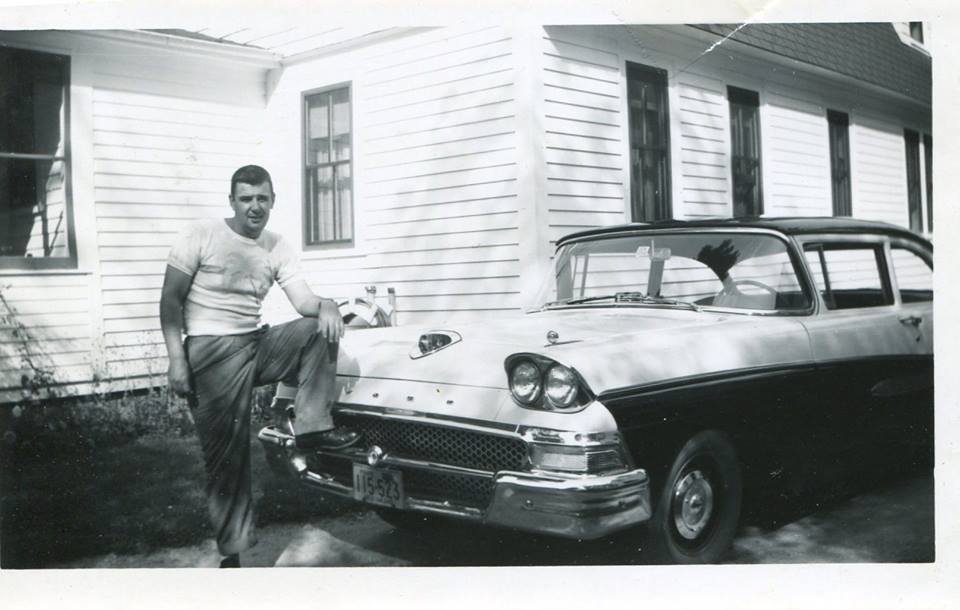
And thanks to my sister for this photo of  Dad standing by our first brand new car!

Those afternoon drives then became a worship service, celebrating our parents’—all of whom had grown up during the Depression—rise into American’s great Middle Class, with the freedom to follow new roads to a brighter foliage or higher surf or a longer beach. And if they got lost, or suddenly found themselves back at Runaround Pond, well, there was always next week.

It’s easy for me to criticize their provincialism and bigotry (and later in life, I did), but maybe because I tire easily these days, or maybe because I’m aware that I don’t have the goals, the dreams I used to have, I find that I miss the energy, the—excuse the pun—drive of those black and white people in the old photographs.

I also realize I miss the faith I had back then in my parents and their friends. Before the advent of Elvis and the generation gap, I believed in them more than I believed in God. I remember one Sunday drive. It must have been in the late 1940’s when forest fires burned large parts of Maine. One of our parents heard that there was a big fire in Brunswick, so we all piled into the cars to go look. I don’t remember the fire, only that as we turned the cars around to head back home, I was in the back seat of Earl Pride’s powder blue Dodge with Earl’s son Craig. One minute we were horsing around, and the next minute Craig was gone and the back door of the Dodge was swinging in the wind. Earl slammed on the brakes. I looked behind and saw the other cars screeching to stops. Doors opened and parents rushed to Craig, who was still rolling in the gravel beside the road. My stomach rose into my throat leaving a great empty cavern, until I saw Earl lift his screaming son into his arms, bring him back to the car, and lay him beside me in the back seat. “He’ll be okay,” he told his wife, Doris, “just some scraps and a bump on the head.” And Earl was right. Because he was just starting to accelerate when the door opened, the car wasn’t going that fast. But as far as I was concerned, Craig was never in any real danger. Once his father had him in his arms, I knew he’d be fine.

I had lunch with Craig last week. Like me, he’s had heart surgery, but all things considered, we’re both doing pretty well. Still, other friends have gone this year, some of them almost as suddenly as when Craig disappeared from his father’s blue Dodge. It seems as if one minute they’re here, the next minute, they’re not. And I find myself searching for some older, wiser voice, telling me that everything’s going to be all right. They’re going to be fine.

# #