Food for the Journey

IMG_2525
Local market Selçuk, Turkey

#

One of the joys of my various pilgrimages is remembering them: looking at the photographs, rereading journals, comparing notes with other people who’ve made the same journeys. I can always discover something I haven’t seen before. The other night, when Mary Lee and I were reminiscing about our 72-mile walking pilgrimage from Melrose, Scotland to the Island of Lindisfarne off the east coast of England, we found ourselves asking each other what foods we recalled. Remember when we got off the bus in Melrose, how hungry we were, and how good that ham and cheese toastie was? And that salmon in Dryburgh? Nothing was better that the lamb, though, in Jedburgh. Unless it was the scallops in Fenwick. And weren’t the chips always good, no matter where we were?

Which got me thinking that food has always been part of every pilgrimage I’ve ever been on: Brother Bernie’s blueberry pie the first time we went to what turned out to be our favorite retreat center; the falafel and shawarma, figs and dates in Israel; Scottish haigis (I actually like the stuff); ploughman’s lunches in England and once for breakfast, the largest kipper I’ve ever seen; Irish soda bread; New Mexican tamales; just about anything on the menu in San Francisco’s China Town; Turkish mezze platters; Nova Scotia seafood chowder.

Likewise, I often identify the stages of my life’s pilgrimages by the food I remember: the smell of the bread and rolls my mother baked every Saturday morning and the taste of butter melting on hot, yeasty dough; chicken fried steak and creamed sausage over biscuits when I worked for the Forest Service in Idaho; the pizza in Orono, Maine, where I went to college; pancakes soaked in Vermont maple syrup; baked beans and codfish cakes when I lived in Down East Maine; butterflied leg of lamb, new potatoes, and fresh corn on the cob with Mary Lee’s Wellesley Fudge Cake for dessert.

I’m not sure about the future, but based on my observation of the active octogenarians and nonagenarians I know, I expect I’ll eat a lot of oatmeal and ice cream.

Maybe because years of smoking have dulled my taste buds, or because I don’t cook, or because it’s just the way I see the world, food for me is seldom just food. For example, I think of food as romantic love. Yes, there is our traditional Valentine’s night out at a four-star restaurant, but thirty-two years ago, after Mary Lee and I stood on the rocks of Casco Bay with an Episcopal priest who blessed our civil marriage, the three of us went to the local pizza place, which is still where Mary Lee and I go on our anniversary. Even though we no longer live in town, we also try to stop there on the way home after being on a trip. Our love, one might say, is grounded in pizza.

When I had basketball practice in high school, my mother made the rest of the family wait to eat dinner until I got home. I really didn’t care if they waited for me and I think my father was pissed, but since then, I’ve read that one of the marks of successful, well-adjusted young people is that they eat dinner with their families—something that happens less and less in these days of individual TVs, computers, sports practices, and erratic work schedules. Food, then, helps bond the family unit.

Don’t most family celebrations revolve around food? Thanksgiving is the big one for us. Ever since Mary Lee and I were living in a small apartment, with next to no money, beginning our lives all over again at the age of forty, we hosted our families—adults sitting on couches with TV trays, children on the stairs, so that grandparents could sit at our tiny dining room table. (Not that we had a dining room.) We felt it important to make both sides of our families know they were part of our new lives. Now, as the oldest members of our families, we host not only Thanksgiving, but also often Christmas, Easter, and birthdays, as a way to stay connected to the next generations.

IMG_1920
How many photographs do you have of holiday meals?

Food is friendship. After my weekly Men’s Group meeting at our church, most of us go for coffee at a local bakery, where I have some kind of muffin, scone, or coffee cake, savoring the calories and the conversation. Every month or so, I join the ROMEOs (Retired Old Men Eating Out) from the high school class of 1961 at an area restaurant for lunch. Sometimes, we search out new places for German or Indian or Japanese food; other times we return to old standbys for fish & chips, burgers, and fried clams. But the kind and quality of the food is not the reason we’re often the first customers to arrive, and some of the last to leave.

IMG_1426
The ROMEOS (R.I.P. Scott)

When my non-church going friends ask me why I go to church every week and several times a day when I’m on retreat, I say I go to be fed. I don’t know what happens to that wafer and wine on Sunday, but I’ll take it. And do. Not to mention the refreshments at coffee hour, the pot luck suppers, picnics, and other meals our church serves.

During a brief flirtation with Buddhism, I attended six-hour sesshins, which, besides silent meditation, included walking meditation, talking meditation, and eating meditation. At the end of the day, we were served tea and a cookie. That cookie was the best tasting cookie I’ve ever eaten. A year or so later, after I’d decided I was a Christian and had stopped going to these sesshins, I discovered those same cookies in the grocery store. I brought them home and made a cup of tea. At my kitchen table, away the Zen community which had fed me, those same cookies tasted like cardboard.

So, maybe the lesson here—for me at least—is that the meals I remember have less to do with food, and more to do the people who’ve been with me when I’ve eaten that food. In the Bible’s Gospel of John, Jesus alienates the religious authorities and loses many of his followers when he talks about being “the bread of life,” and that “whoever eats this bread will live forever.”  But I think I get it: looking back at my various pilgrimages, I have been fed more by the companionship (the word “companion” literally means “with bread”) than by the bread itself. And if I am to continue to live, not just exist, I need to be nourished by more than oatmeal and ice cream.

IMG_0159
On my mother’s 90th birthday, her church threw her a party,

# #


Holiday Hope

fullsizeoutput_64

A few weeks ago, I made a pilgrimage to Mount Desert Island, where I once lived and worked, to attend a five-day contemplative retreat. During the first session, our facilitator asked us to share a particular concern we’d brought to the retreat with us. When it was my turn, I found myself saying I worried that during what is traditionally a time of hope, I’d lost hope in the future of this country. At almost 75, I said, I wasn’t that distressed about my prospects, but I worried about those of my grandchildren.

I also said that this time of year has always been a hard for me to be hopeful because my daughter died on December 23, 1988, and for the past twenty-nine years, the increasing darkness outside mirrors the increasing darkness inside of me as I recall the two months I spent living at a Ronald McDonald House, walking back and forth to the hospital to sit by Laurie’s side watching her grow weaker every day.

Since that retreat, I’ve been thinking a lot about hope and about Laurie, and as strange as it might sound, I’m finding the more I look back over the years since her death, the more hopeful I am for my grandchildren and for myself.

One of the questions I asked myself after Laurie died, was “How am I going to survive this?” Well, my pilgrimage through grief hasn’t been easy, for me or my family. I still stumble in anger, still get mired down in resentments. But looking back over the twenty-nine years, I can also honestly say that I have discovered grace and joy and a peace that, as the Christian Apostle Paul wrote, “passes understanding.”

I’m not entirely sure where this serenity has come from, but so far, I can think of four possible sources, four reasons to give me hope, four legacies I want to pass on to my grandchildren for their futures:

The Strength of Family. I grew up in a family scarred by alcoholism, abuse, and abandonment. Some of those wounds were passed on to me and my siblings, and I’m still in recovery, still realizing how this background has influenced my behaviors over the years, from my own addictions to my arrogant and judgmental attitudes. But the work I’ve been doing lately in my twelve-step program has also shown me that I’ve reaped the benefits from having two parents who overcame their own hideous childhoods, who loved me, sacrificed for me, and, above all, gave me some of my character traits I’m most proud of, including the strength to overcome the loss of a child.

I want to pass that strength on to my grandchildren.

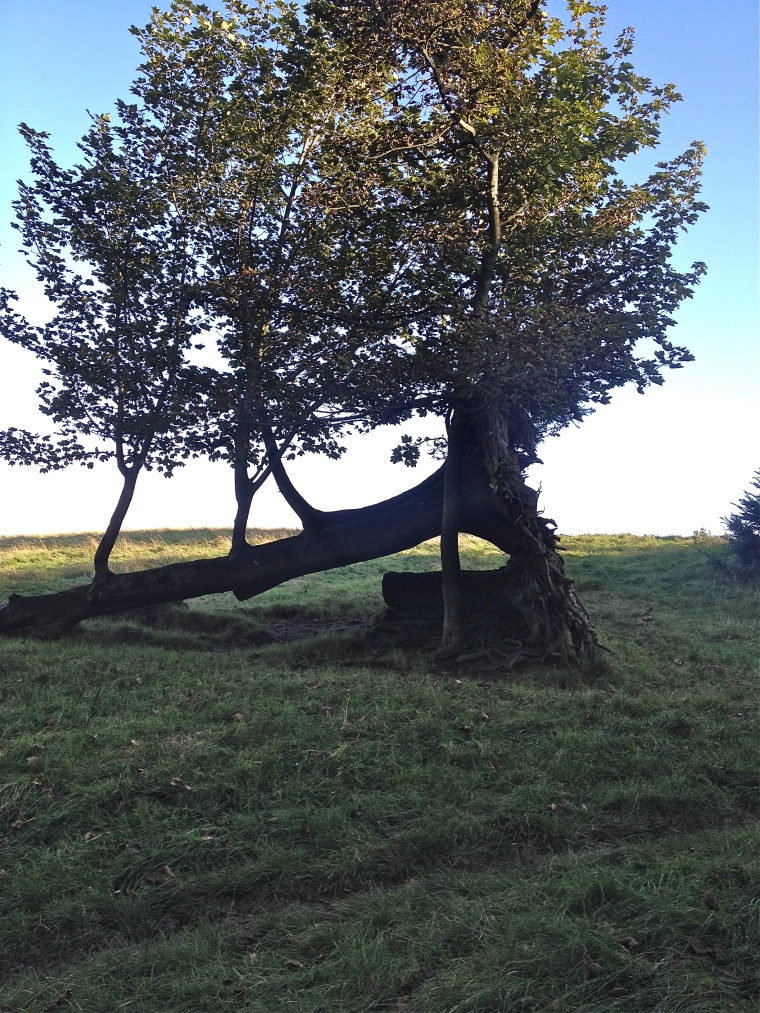
The Dynamic Detachment of Nature. I’ve spent some of the most “spiritual” moments of my life struggling up mountains, sweating in deserts, snowshoeing in bitter cold, and peering through ocean fog. What makes these landscapes spiritual for me is that they make me feel small and insignificant. The ocean is going to break over the rocks no matter if I’m filled with joy or filled with grief; the sunrise will paint the clouds pink regardless of what happens in Washington. Yes, Nature is filled with death, disease, and violence, but even in death it teems with life. One of my favorite images from hiking Saint Cuthbert’s Way from Scotland to England is of a blown-down tree, its roots exposed. The tree’s branches have grown into four new trees rising from the decaying trunk. That force, that instinct to grow and blossom and bloom, drives, I think, all life.

I need to remind myself that force runs through my grandchildren, giving them the power to flourish, no matter what obstacles they’ll face.

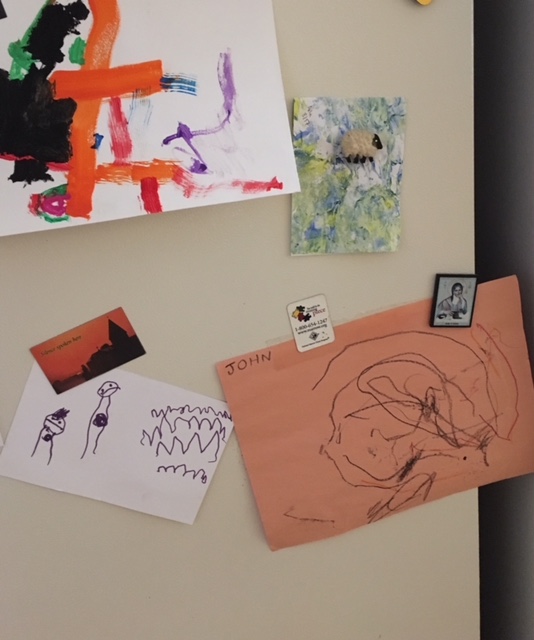
The Healing Power of the Arts. Before Laurie died, about the only writing I’d done was in my journals. I was an academic. My goal was to do more work for the College Board as a consultant. But after Laurie’s mother and I divorced, Laurie, who had also been focused on academic studies, swapped her L.L. Bean skirts and blazers for long sweaters and jeans, dyed a pink stripe in her hair, painted her fingernails black, and took up art, going to summer art programs, and planning to study art in college. After her death, I began going to summer writing programs, took early retirement from public school teaching, and went back to school for an MFA. Writing helped me identify my feelings, and became a way for me to harness my anger and my shame by writing a book and then revising it through God-knows how many rejection slips. More important, writing, like the banjo I wail on, like Laurie’s watercolor that hangs over my desk, reveals to me an essential order to what often seems, especially after a great loss, a chaotic and meaningless universe.

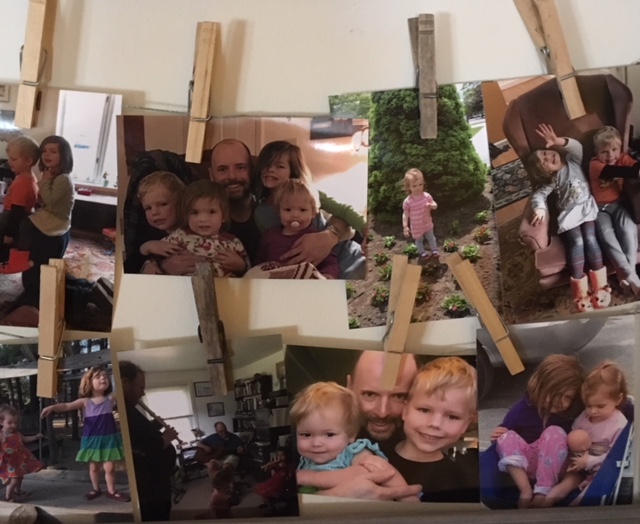
My grandchildren love to listen to stories, love to tell stories. It’s apparently natural for them to build and color and draw pictures. I want to nurture those instincts.

IMG_3187

The Chuckle in the Dark. In A Grief Observed, popular theologian C.S. Lewis recorded his anguish over the death of his wife. Never intending his words to be published, he railed against God for the suffering and pain his wife had endured, and for the sorrow that was tearing him apart and demolishing everything he’d previously believed about God. Gradually, however, he experienced an “impression which I can’t describe except by saying that it’s like the sound of a chuckle in the darkness. The sense that some shattering and disarming simplicity is the real answer [to the mystery of suffering and death].” The retreat that I participated in a few weeks ago focused on the works of an anonymous 14th century writer who felt that the only way one could experience God was in what he called a “Cloud of Unknowing.” Since the loss of my child, my experience of God/my Higher Power/ the Eternal/Whatever has been through subtraction rather than by addition. I’ve lost all I ever learned about God, especially the idea that God is some compassionate Superman: all-loving, all-powerful, and all-knowing. And like C.S. Lewis, like the anonymous 14th century author we discussed, as I’ve lost those images of God, I’ve experienced an unfathomable serenity, one that has lasted this year well into the holidays.

I’m still not optimistic about the future of this country. I’ve read too much history about the rise and fall of empires not to feel that our nation is in decline, if not free-fall. But over the last few weeks I’ve discovered a difference between optimism and hope. Hope—for me anyway—is as much about the past as it is about the future. Hope looks back and grieves the reality of death, disease, decline, and destruction but at the same time, hope gives thanks for a life filled with the grace not only to survive but to thrive.

Which gives me hope my grandchildren will do the same.

IMG_3185

# #