
#
It started when I left my phone behind.
I’ve always known that my phone provides many of the same comforts cigarettes used to. My phone fits easily into my pocket so it’s handy. It gives me something to do with my hands if I’m nervous or bored. If I’m waiting for someone, I can check on how the Red Sox did, or when I need to use a bathroom, I can do something besides look out the window, assuming there is a window, and if there isn’t, I don’t care because I’m checking my email on my phone.
But until now I’ve never realized how, like cigarettes, psychologically addictive a phone can be. All that weekend, I felt tense, anxious.
Now, the reason I suffered for an entire weekend was that Mary Lee and I spent it in Vermont celebrating my sister-in-law Anne’s birthday. I couldn’t very well say, “I left my phone in our bedroom. Would you excuse me while I drive four hours back home so I can see how many ‘likes’ my last post got on Facebook?”
And for those of you who don’t live in New England, the reason it takes four hours to go 160 miles, as the crow flies, from Maine to Vermont is that you can’t go by crow. The most direct route cuts through western Maine and central New Hampshire—a narrow two-lane road through small towns and past lakes and cabins and antique shops and combination hardware stores/greenhouses/ice cream parlors—and takes two hours longer than the quickest route which is to first drive south for 85 miles then west for 31 miles, then north for 69 miles, then west again until you get lost.
And you will get lost, because while the first 185 miles are doable if your car has a GPS and you follow the signs, once you get to Vermont, you’re driving through small towns and along one lane dirt roads through mountains that baffle even the best GPS systems. At least, you do if you want to get to my sister-in-law’s place.

But although I left my phone behind and got lost for a bit that weekend, I remained reasonably calm. It was a nice day and Vermont was beautiful. As I often do (hence these blogs) I tried to think of the trip as a pilgrimage, this one honoring my past. I lived in Vermont for four years and my first teaching job was actually in the town just down the mountain from Anne’s. The wide, shallow streams paralleling the roads, the cow pastures under the green hills, the sweeping vistas were worth dead ending in a driveway. Especially when the nice lady there gave us directions to Anne’s, saying, “You couldn’t follow the damn GPS even if it worked… not unless you have a Humvee and a chainsaw.”
Still, while we had a lovely weekend celebrating my sister-in-law’s birthday, the anxiety of smart phone withdrawal grew. It was like I wasn’t me anymore—a feeling that metastasized when I tried show Mary Lee the first apartment I ever lived in. It was as if someone had moved the street to a completely different part of town.
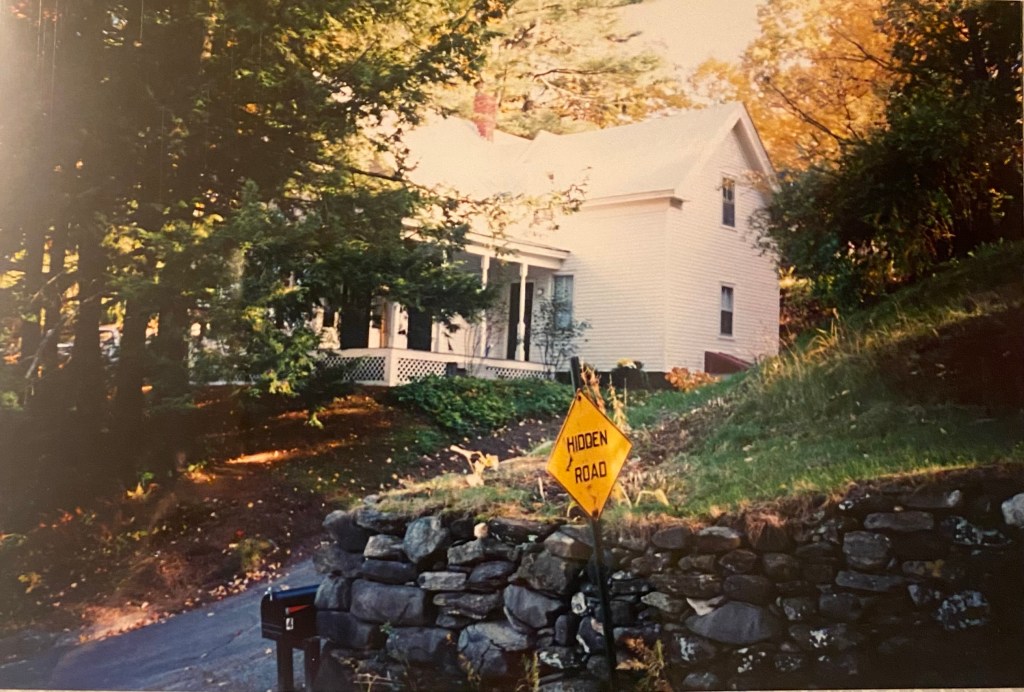
By the time we headed back to Maine, I was feeling unhinged and uncertain. To regain my manly sense of mastery (at least that’s the only reason I can think of) I decided I didn’t need any help from any GPS getting from Anne’s to the paved road to the interstate to the Maine Turnpike to home, thank you very much.
Setting the car radio on “50’s Gold,” I drove south on the interstate, missing the exit for New Hampshire and Maine, and continuing for another ten miles before I turned around and headed north. After an hour of ignoring Mary Lee’s suggestion that it might be time to find out where we were, I pulled off the interstate and plugged our home address into the GPS, which informed us that we were almost fifty miles north of where we should be. Surrendering to that damn voice (which I swear was snickering)— “In one half-mile, prepare to turn left… turn left in 100 yards…turn left”—we eventually came to that cow path I talked about earlier through New Hampshire and Maine, the one that got us home two hours later than we would have if I’d used the GPS the way I should have. By that time, my hands were shaking, my stomach was in knots, and my head was pounding. Even the familiar roads near home looked strange and forbidding.
At one point on that interminable drive home, we drove by Squam Lake, where the movie On Golden Pond was filmed, and since then, I’ve been thinking about Henry Fonda’s 80-year-old character getting lost picking strawberries in a place he’d been going to for years, stumbling through the forest, become more and more disoriented, more and more frightened.
And I ask myself: Is that who I’m becoming?
I’m trying not to panic. I tell myself that as I’ve become 80, I’ve been focused on my physical diminishments, and maybe God of my not Understanding is telling me it’s time to prepare for the mental changes ahead—that I should think of that weekend as—to use a 12-step term—another “Goddamned learning experience.”
I’ve just read David Shields’s book, The Thing About Life is That One Day You’ll Be Dead. Normal geriatrics, he says, don’t have poorer memories, but it does take us longer to retrieve those memories. We’re more susceptible to distractions, have trouble coordinating multiple tasks, and suffer decreased attention spans. In simple duties and common situations, we’re fine, but when stress is added (loss of a smart phone, for example) we often struggle. “Perhaps,” Shields writes, “this is why some older people, finding it harder to cope, tend to start searching for comfort rather than excitement.”
I’m tempted, but I’m not ready. Instead, I’m going to send my ego to the store for a quart of milk and do what Mary Lee does and make a checklist for when I travel:
Underwear? Check.
Pills? Check.
Phone? Check.
And at the top of the list, I’m going to write:
Don’t assume you know where you’re going.
Ask for help.
Actually, that sounds like pretty good advice for any pilgrimage.

# #
 The Geriatric Pilgrim: Traveling the Landscape of Faith and Grief