Locked in the Garden of Gethsemane

Image


They went to a place called Gethsemane; and he said to his disciples, “Sit here while I pray.” He took with him Peter and James and John…. And he said to them, “I am deeply grieved, even to death; remain here, and keep awake.” And going a little farther, he threw himself on the ground and prayed that, if it were possible, the hour might pass from him. …. He came and found them sleeping … for their eyes were very heavy; and they did not know what to say to him. (Mark 14: 32-40. NSV)

#

“I come to the garden alone

While the dew is still on the roses

And the voice I hear falling on my ear

The Son of God discloses.”

The singers, a tour from some place like the Second Baptist Church of Wayward, Georgia, stood just inside the filigreed iron gate set in a wall of cream-colored stone on the side of the Mount of Olives. Trying to be unobtrusive, my wife and I walked by them, down a row of olive trees to a bench, where we sat and looked across the Kidron Valley at the Old City.

I listened to the distant voices—“And He walks with me, and He talks with me”—and to the birds singing, watched the sun play upon the leaves of ancient olives trees looking as if they’d been carved from stone and on cedar trees pointed toward the sky. Overhead, the sky was cloudless blue and it wasn’t yet hot. Mary Lee and I talked for a while about the purple flowers growing around the cedars (clematis, maybe?) and then simply sat savoring the silence. This, the part of the Garden of Gethsemane across the road from the Church of the Agony, was the first peaceful place we’d been since we’d arrived in Jerusalem two days earlier.

The folks from Georgia left, leaving us the only people there, and I don’t know how long we sat—maybe twenty minutes—before we got up to leave. We hadn’t yet been to the church across the road and we were planning on hiking to the top of the Mount of Olives and the Church of the Ascension.

But when we reached the gates, they were locked.

I remember thinking, “‘Locked in the Garden of Gethsemane,’ what a great title for a poem!” I may have even laughed. I wasn’t really worried; another tour would be by shortly (There’s always another tour coming by in Jerusalem). So Mary Lee and I found another bench, and I tried to imagine what I might write. I thought about the death of my daughter ten years earlier from cancer, about how I’d locked myself away in a den to drink myself into oblivion, about the way some of the people I called friends disappeared from my life when I needed them most, about how I’d felt like Handel’s Messiah, “despised and rejected … a man of sorrows and acquainted with grief.” But I kept humming “In the Garden,” and enjoying the view of golden domes across the valley, the music of birds, the smell of cedars, and the feel of sun. After fifteen minutes or so, the gate opened for a tour of Spanish nuns.

That day I felt no sense of suffering, no feeling of betrayal. All I recall is a little heartburn, some sweat as the day began to heat up, and sense of failure, not for getting locked in, but for feeling like a tourist and not a pilgrim. I couldn’t make the experience—the history, the holiness—part of me. I was an outsider, an onlooker, there in body but not in spirit.

#

IMG_2287

In the woods across the road from Gethsemane Abbey in Kentucky is Walker Hancock’s sculpture of Jesus and the three disciples in that garden from which the Trappist monastery takes its name. As you walk along the path through the woods, you first encounter Hancock’s depiction of Peter, James, and John sleeping on some stones, hands folded or stretched out peacefully, their bodies curled up comfortably, their faces smooth and serene. You have to walk further—possibly around a corner, I don’t remember—before you behold Jesus, kneeling on a stone, his head thrown back, his hands over his face, his body wrenched backward as if he were a bow waiting for an arrow. Standing in front of this larger than life figure, you can see tension pulling at his chest and throat.

IMG_2289

            Looking today at the photographs I took ten years ago, I note the distance—both physical and emotional—between the disciples and Jesus. I think of the morning I was locked in the Garden of Gethsemane, and I find myself sympathetic to Peter, James, and John. Like them, I could not grasp the significance of what was around me.

And it also strikes me that the years after my daughter died, when I felt alone, betrayed by friends and family and colleagues, reveal the vast chasm that exists between those who grieve and those around them.

Grief is the most isolating of all experiences. At least it has been in my life, both when I’ve grieved and when I’ve tried to comfort someone in grief. Even if I know what it is to lose a child, when I’ve been called upon to support another grieving parent, I remain, as Mark tells us Peter, James, and John were, not knowing what to say. Even if I’ve experienced what it feels like to suffer deeply, when I know someone else is suffering, my first response is to curl up and close my eyes.

All I’ve learned over the last twenty-plus years is the importance of at least physically narrowing the gap between the person grieving and myself. To paraphrase Woody Allen, 80 % of compassion is just showing up—staying awake, listening, and trusting that the gates will eventually become unlocked.

# #


Hiking Towards Humility

Image 1


Every spiritual tradition I know of says that the greatest obstacle between God and me is my ego. The Bible warns of what happened to Adam and Eve after the serpent tempted them into believing that they could become like God simply by eating a certain fruit. (A little, come to think of it, like the guru I just read who tells me I can live practically forever if I drink a glass of kale juice every morning.) Ralph Waldo Emerson called egotism a disease. Thomas Merton wrote that we tend to worship the ego instead of God, while the Dalai Lama says that ego is the number one enemy of compassion. An acronym for ego—“Easing God Out”— is included in the Alcoholics’ Anonymous Handbook.

So what do I do to stop listening to my ego, become more humble, start focusing on God? A woman in the spiritual writing group I facilitate has begun a book on incorporating the Zen Buddhist principal of “wabi sabi”—which she describes as “the celebration of the incomplete, impermanent, and imperfect”—into her pottery-making and into her life as a way to counter her competitive perfectionism, her ego.

Hiking also works.

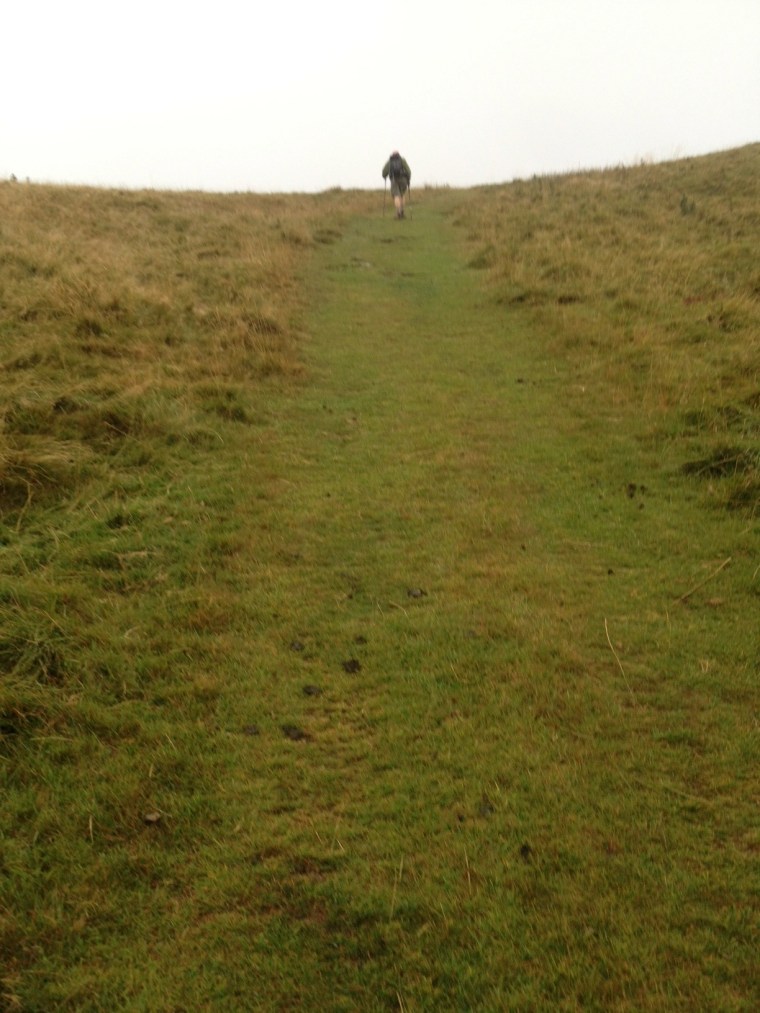
For example, my wife and I are walking St. Cuthbert’s Way, the 62-mile hike from Melrose on the Scottish Border to the island of Lindisfarne off the Northumberland Coast, and I’m admiring views, trying to achieve a walking meditation (“Breathe through your feet … move your attention slowly to your ankles, the calf muscles, the thighs … relax … now focus on the chakras … feel the wind, the sun, the way your clothes touch your skin … become one with your surroundings …”), and then ahead of me is one of those damn hills. Jaws clench. Hands tighten around hiking poles. Head goes down. I’m seventeen years old, diving for a loose ball in the 1961 State Basketball Championship; I’m twenty-one, arm-wrestling a smoke jumper after a few beers; I’m forty, hefting a boulder out of my new garden. I can do this! I charge up the hill. Until about halfway up, my chest is pounding, my lungs are burning, I can’t see from the sweat in my eyes, and I have to stop or die.

Or, later into the hike, I’m trying to become Emerson’s Transparent Eye-ball: becoming nothing; seeing all. I hear voices growing louder and clearer as two hikers catch up with us. It was okay on Maine’s Bold Coast to be overtaken by twenty-year-old anorexics in microfiber, but not in the UK by 75-year-old women in wool hats bounding by us while talking about a new chowder recipe. I try to quicken my pace, become irritated at Mary Lee for stopping to look at the wildflowers, and then, as the women go by us saying, “Cheerio, lovely day for a ramble.” I paste on a smile while my pride hangs its head in shame.

I know—I knew it then—I was being ridiculous, but as my wife and I walked on, I started to make sense out of something I’d never understood before, something more serious: how embarrassing grief can be. Embarrassment explains why, after my eighteen-year-old daughter Laurie died of cancer, I refused to put her obituary in the local paper. I told my family, upset by my decision, that nobody knew Laurie in this part of the state, but the real reason was because I imagined former classmates looking up from their newspapers and Cheerios and saying, “Too bad about old Ricky. He always was a loser.” For years, I answered the question, “How many children do you have?” by saying that I had two stepsons, before trying to change the subject. I didn’t want to embarrass anyone, I told myself. No, the truth was I didn’t want to feel embarrassed myself. I’m still not sure I fully understand where this embarrassment came from, but I think it had to do with feeling like a failure as a father for not being able to keep my daughter alive. In other words, ego.

Some three days into walking St. Cuthbert’s Way, I began to experience discomfort in one of my Achilles tendons. Of course, I obsessed—“Will I rupture it? Need to be helicoptered out of here?” I finally realized, however, that every time I’d charged up one of those hills, I wound up waiting for Mary Lee, putting all of my weight on that ankle, cooling it off prior to heating it up again. It also dawned on me (if you can call something that takes you three days to recognize a “dawn”) that we weren’t going to get to our next stop any faster than the slower of us could go. So I slowed to a steadier pace, practiced my walking meditation, noticed more birds and flowers and trees, gave my best “Jolly fine day” the next day when the same two goddamned women bounced by us on the trail again, and still made better time.

I wish getting over the embarrassment of grieving were that easy.  I do feel, however, that the slowing down and paying attention I’ve learned in contemplative prayer has helped, watching my feelings and not trying to judge them—“I shouldn’t be feeling: (pick one) a. embarrassed; b. sad; c. angry; d. all of the above”—and realizing that the most egotistical thing I can do is think I can stop being egotistical through my own efforts.

But it’s hard, especially perhaps for us adult children of alcoholics. One of the slogans I often sit in front of once a week is “Let go and Let God.” I find that easier said than done. I’ll sit with some obsessive thought, thinking, “Let go … Let go … Let it go … LET GO … LET IT GO, GODDAMN IT!”

Recently, I’ve found it more beneficial not to think in terms of letting go, but of surrendering. Tucked into the blotter on my desk these days is a poem, “The Man Watching,” by Rainer Maria Rilke and translated by Robert Bly, which ends, “This is how …[one] grows: by being defeated, decisively, by constantly greater beings.”

Like one of those hills along St. Cuthbert’s Way.

IMG_1283

# #


Don’t Ask Why, Just Ask For Help

IMG_1946_1

The Desert House of Prayer

Cortaro, Arizona

April 22, 1999

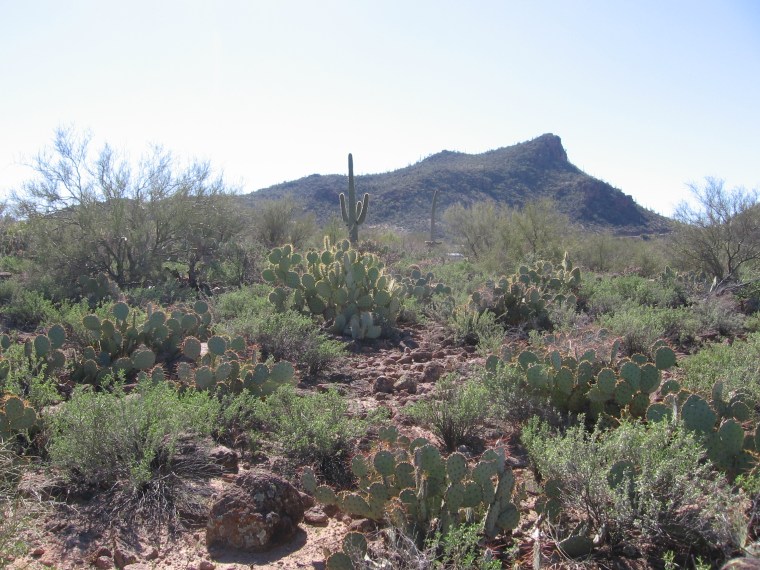
Sitting in the chapel, watching through the large window behind the altar as sun rises over saw-toothed mountains, splashing light over cactus—prickly pear, cholla, barrel, a saguaro—as well as sage, creosote, and mesquite bushes. The air is full of doves, cardinals and pyrrhuloxia, wrens, thrushes, and house finches. Just outside the window, a scrawny rabbit hops out of some sagebrush and down a path toward the guesthouses.

I’ve left Maine’s mud season behind, but not my ongoing anxieties. Last night, as the wind rattled windows and coyotes howled like elementary kids on a playground, I continued wrestling with God, with Jesus, and with what I should do with my life after leaving the high school classroom—all compounded by yesterday’s news from Colorado.

I suppose the lesson here is that even on retreat you can’t escape the world. I’d gone for a walk through the Saguaro National Park, hiking along washes through red cliffs sentineled with saguaro, expecting any minute to run into John Wayne leading a cavalry troop singing “She Wore a Yellow Ribbon,” returning from my reverie to find Mary Lee in tears as she told me of the shooting of 25 high school students by two of their classmates. Violating my resolution to avoid reading the newspaper while on retreat, I read of the horror show that was Columbine, imagining the scene—the baggy pants, the hats worn backwards—seeing I don’t know how many students I’ve had over the past thirty years, either dead or wounded or pulling the trigger.

This morning, unable to sleep, I’ve come to the chapel to sit in front of the butcher block altar and the candles in their wrought-iron holders, and wait for 7:00 a.m. and morning prayer and to look out the window and wait for some kind of answer, some kind of serenity.

The sun has crept over the mountains, setting the top of the giant saguaro aglow. All of a sudden I’m not looking at a cactus in the desert, but at a birch tree swaying in the wind, and I’m sitting in front of another altar, staring through another window, this one overlooking the Penobscot River in Bangor, Maine.

I haven’t spent a lot of time with my daughter this week. Oh, she’s been here, sort of like the sky overhead, but, two thousand miles away from home, wrestling with this other stuff, I haven’t paid much attention to her. Now, however, I think of the November day a month or so before she died, when I discovered the chapel in the Eastern Maine Medical Center.

It had been a particularly ugly day in Room 436. Laurie developed a fever of 102°, Mary Lee’s latest letter complained about bouncing a check, I’d argued with Laurie’s mother, who wanted me to complain to our daughter’s primary physician about one of the nurses.

When I left Laurie and my ex-wife to go back to the Ronald McDonald House, I took the elevator as usual, but, still upset about the day, got off on the wrong floor. Just as I realized my mistake, I found myself in front of a door marked with a small brass sign: “Chapel.” I didn’t know the hospital had one. Tentatively I turned the doorknob and walked in. The first thing I saw was a large round window framed by brown, gold, blue, and red glass behind the altar, looking out over the river. Along the riverbanks, a large birch tree metronomed in the wind. I felt as if I were looking at an animated stained glass window.

I lit two pillar candles on the altar, sat down in the front row of chairs, and stared out the window at the rushing water. This room seems so quiet, I thought. Even in Laurie’s single room at the end of the hall, there was always a steady undercurrent of noise from machines or voices in the hall or near-by TV sets. Here, there was only the beating of my heart and the word “Why?” pounding in my head. Why couldn’t anything be done to make my daughter more comfortable? Why did she have to get sick in the first place? Why was she dying?

I stared into the circle of stained glass. The window blurred. Wet flakes of snow lathered the glass, turning the circle white, scouring me to bone. The candles on either side of the altar seemed to glow more brightly, their light dancing. As I watched, the flames seemed to come together, enfolded by the stained glass around the white window. Then, I too become enfolded and from somewhere I heard the words, “Don’t ask why, just ask for help.”

At first, I didn’t realize what I’d heard. When I did, I became angry. Okay, help, I thought. Help me make sense of this mess. Help me understand the reason for Laurie’s pain and why she’s going to die before she’s ever really lived.

But I couldn’t take my eyes from the candles. From somewhere in the ceiling fresh air cooled my face. I felt my body loosen. The stained glass seemed to keep drawing first my angry words and then all of me into its embrace.

“Don’t ask why, just ask for help.” The words didn’t come from a “voice” and they didn’t come as any kind of sudden epiphany—just a gentle, insistent, ever deepening understanding, as if the words had always been there, but that only now, in the silence of the chapel, could I hear them.

My sense of peace, of course, didn’t last. When I returned to the hospital that evening, Laurie was vomiting dark green bile, and although I began stopping regularly at the chapel after that, I didn’t think much about the words I’d heard until after my daughter died.

And it’s not until now, over ten years later in Arizona that I realize that “don’t ask why, just ask for help” is the only response I know of to the death of a child, whether from cancer or from a bullet. I think of all the help I’ve received over the past ten years—from counselors, from clergy, from spiritual directors, from friends and family, especially Mary Lee, who may have kept me alive. And I wonder if it’s not time for me to start thinking about trying to help others. God knows I don’t have much advice, but maybe just telling my story and listening to others is enough.

So while I haven’t been able to leave the past behind, perhaps leaving home and coming here has given me a new perspective on that past—a new way to respond to it. I look again out the window at the giant saguaro cactus, standing with its arms upraised, as if in prayer or praise. Sometime this week, I learned that these cacti, which often live to be a hundred and fifty, even two hundred years old, don’t start growing arms until they’re sixty. Next week I’ll be 56.

I’ve got time.

IMG_0069

# #


No Matter how much you Prepare, You’ll Never be Ready

IMG_1245

#

My wife and I first started talking about going on some kind of walking pilgrimage after seeing the movie, The Way, in which Martin Sheen’s character walks the El Camino de Santiago from the Pyrenees through the interior of northern Spain to Santiago de Compostela in honor of his son, who’d died making that pilgrimage. Reading about the 500 miles of the Camino, however, convinced us that it was nothing two people dancing around 70 were ready for, so we began looking at other pilgrimages, eventually finding St. Cuthbert’s Way, a 62-mile hike from Melrose on the Scottish Border, where one of the early English church’s most revered saints started his religious life in 650AD, to the Holy Island of Lindisfarne off the Northumberland Coast of England, where he served as both prior and bishop.

For the next six months, Mary Lee and I prepared. We booked our flights to and from Edinburgh. We researched travel companies who reserve B&B’s, transport luggage, provide information about where to stay each day and what to see, recommend where to eat in the evening. We watched every You Tube video there was on St. Cuthbert’s Way. I read ten books on pilgrimages, hiking trips, or St. Cuthbert. (Bibliography available upon request.) We increased our walking from one to four miles a day, with eight to fourteen mile walks on the weekends. Because the last two miles of St. Cuthbert’s Way are traditionally walked barefoot at low tide across to Holy Island, we walked Maine’s beaches carrying our shoes around our necks like amulets against injuries which I was afraid might keep us from going. ( I took out travel insurance, just in case.)

All of which led to multiple trips to L.L. Bean for walking sticks, backpacks, water bladders, a compass, a pedometer, two hiking skirts for Mary Lee, a fleece jacket for me, microfiber underwear and a half dozen pairs of socks for each of us. I went to a podiatrist, who looked at my high arches and prescribed custom orthotics. I had my annual physical, my annual eye-exam, and my semi-annual dentist visit to make sure I was prepared.

Prepared, yes, ready, no. Our first surprise came the night before we started hiking. Nothing I read told us that when Melrose Abbey closes, nobody checks to see if there’s anyone still on the grounds before locking the gates, so that in order to leave, Mary Lee and I had to clamber up a stone wall and hoist ourselves over a wrought iron fence designed by Vlad the Impaler.

And do you think we could find the beginning of St. Cuthbert’s Way? Not until we’d walked by it three times. No one tells you that the start of the Way, marked on a sign with words about the size of the bottom row of print on my eye exam chart, is through an alley, past two trash bins, and down a cement walk. It’s only after you make a left and walk a muddy path around a hill that you find the 133 wooden steps that mark the real beginning of the pilgrimage.

If 133 steps sounds like a lot, they were only the beginning of our climb up the Eildon Hills. Nothing I read, nothing I saw, prepared me for the up-and-down nature of St. Cuthbert’s Way. To be honest, there’s nothing really high (Wideopen Hill, at 1208 feet, is the highest point) or sheer, or steep, unless you’re from southern Maine, where we call a 485-foot pimple on the face of the landscape Bradbury Mountain. I would estimate that we spent about two-thirds of our walk either going up or coming down. Our legs were fine; our wind was not.

The guidebooks, the videos, don’t talk about shit. Many show bucolic photographs of sheep and cows dotting the countryside, but none show them standing and defecating on your path. Once we had to walk through a dozen young bulls, and while they all moved out of our way, what they deposited did not.

IMG_1260

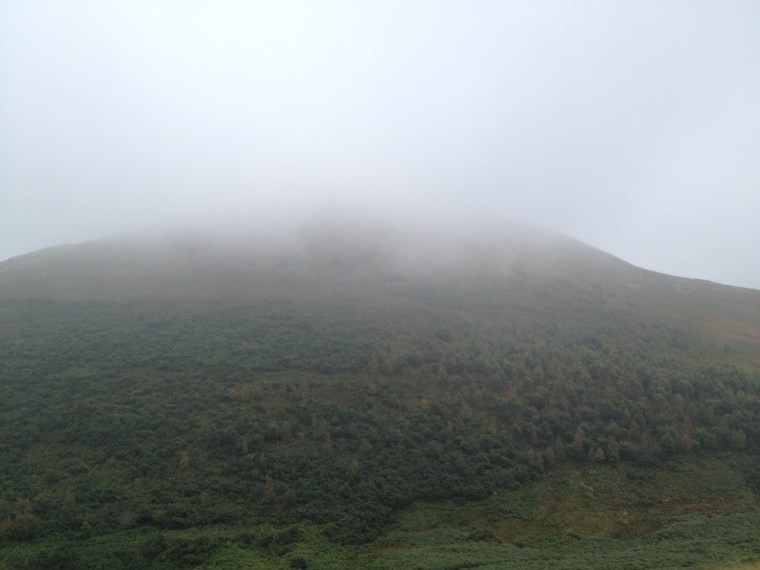
 On the other hand, nothing I saw or read prepared me for the beauty of gorse bushes in the fog, their spiky branches laced with dew-covered spider webs, the huge oaks and sycamores and maple and beech trees whose gnarled roots and branches look like something out of J.R.R. Tolkien, a flock of white geese splashing in the River Teviot, the ruins of three lovely abbeys and a castle, the smell of wild garlic, the sight of feral goats, the views from Wideopen Hill and the Cheviots, acres of purple heather, the cool eeriness of St. Cuthbert’s Cave, our first glimpse of the ocean, the wild sound of seals as we walked across the sands to Lindisfarne.

#

I should have known that no matter how much you prepare, you’ll never be ready. I’d had plenty of time to prepare for the death of my eighteen-year-old daughter, but I sure as hell wasn’t ready for what came next. Three months after Laurie was diagnosed in March with Primitive Neuroectodermal Turmor (PNET), the doctors at Dana Farber were clear that her chances of survival were slim. When, after radiation and chemotherapy, cancer reappeared in her pelvis in September, those chances dropped to nothing. Her mother and I spent the next three months preparing for her death. The day after Laurie died, I recall telling one of the nurses that I’d already done my grieving, and now it was time to start living again.

Talk about bullshit. Nothing I had done, felt, or imagined made me ready for the next (as I write) twenty-seven years: the anger, the guilt, the tears, the terror, the demolition of everything I’d ever believed about life, the universe, and everything.

Even after all these years, I can feel my body chemistry change around Halloween and a weight lift off my shoulders after Christmas. And I can prepare for that. What I am never ready for is how I will react each year. Some years I try to sleep for two months; some years I write suicidal short stories; some years angry letters to the editor or to people who piss me off. This past year, after my cranky back’s being almost pain-free for a year or more, it throbbed and burned until December 24th, the day after the anniversary of Laurie’s death. After Christmas, the pain was gone.

At the same time, nothing in those months by Laurie’s side in the hospital prepared me for the way she entered, first, my dreams, then, my waking life. Her voice in my ear (“Look at that, Dad!) as the sun rose over the island of Lindisfarne. Her hand on my shoulder as Mary Lee and I sat on the side of Wideopen Hill eating our cheese and pickle sandwiches. The joy that I continue to get from her on-going presence. Since Laurie died, I have never felt so godforsaken and broken. I have also never been so grateful and joyous.

Of course, it’s important to prepare—who am I to argue with the Boy Scouts?—but as walking St. Cuthbert’s Way reminded me: the best way to prepare for any pilgrimage is to be ready for surprises.

IMG_1316

# #

Some Stones from the Journey

Stones-1

Go inside a stone,

That would be my way….

—Charles Simic

#

Two weeks ago, I wrote of collecting stones from my various travels as a way to retain some of the pilgrimage experience. And I’m not talking just a few stones; I’m talking bowls of stones in almost every room of the house. Fountains of stones. Stone paper weights and bookends. Stones too large for the house lining the back patio.

#

Before I ever thought much about pilgrimages, my then twelve-year-old daughter Laurie gave me a “rock concert” for Father’s day: a dozen small stones she’d painted blue and red and arranged in clay on a wooden oval. She painted black and white eyes, like a raccoon’s on each stone, a nice touch, typical of her attention to detail.

Rock concert-

#

You can also see her attention to detail in the watercolor she painted when she was seventeen. In the center of the picture, a pale turquoise hand reaches up through large green-brown stones toward a diaphanous orange petal drifting down from a cluster of flower blossoms. Laurie gave me this painting before her cancer diagnosis, when her future seemed bright and limitless, but after her death I spent hours sitting in front of that watercolor, feeling the desperation embodied in the hand as it reaches for one fragile blossom of beauty before being crushed under the weight of those stones.

#

According to Hasidic legend, after Moses came down from Mount Sinai with the Ten Commandments carved on stone tablets and saw the children of Israel worshipping a golden calf, he smashed the tablets to the ground, leaving behind a pile of stone fragments. The people, not bearing to leave the pieces there, picked them up and carried them in their pockets all through their desert wanderings toward the home they were hoping to find.

#

When my wife, her son, and I decided it was time to “graduate” from the Center for Grieving Children, a local organization offering counseling to families who’ve lost loved ones, we each received a leather pouch containing four stones. Three were round and smooth, representing “the bright and shiny parts of you, the parts that have healed and grown, and are stronger than before.” One was flat and rough, “like the corner of your heart that may always feel a little rough and painful because of what’s happened to you.” I carried that stone for years. Sometimes when I was tearful or angry or felt especially guilty for Laurie’s death because of what I had or hadn’t done, it felt good to grip the stone tightly so that the edges cut into the palm of my hand. The surface of the stone was cracked and pitted, and sometimes I’d dig with my thumbnail into the crevices. That was very satisfying.

#

Jungians talk about a “collective unconscious,” a mental package of instinctual feelings passed down from life’s beginnings. Perhaps, Robert M. Thorson, postulates in his book on New England stone walls, Stone by Stone, we all carry with us a primitive need for stones as the material for tools and weapons, as shelters for homes, as natural enclosures into which to drive game, as caches for hiding food, or as places for ambush or escape.

#

For years after my daughter’s death, I dreamed of long, lop-side stones, smoke colored, lying on their sides. Sometimes they fit together in a wall or a house. Sometimes they were in the rubble of destroyed cities. Sometimes I used them to navigate my way through wilderness.

#

Thorson explains that we imbibe stones every day, because unless artificially distilled, all of the earth’s water carries with it the dissolved constituents of stones. So in a way, all of us are built of stones.

stones-3

#

During a trip to England, the year after Laurie died, my wife bought me a stone from Salisbury Cathedral. It’s a block of ash-gray limestone, about two inches wide, four inches long, and three quarters of an inch thick. On the back, there’s a “Certificate of Authenticity,” part of which reads

 … centuries of storm and frost, and, more recently, the deadly corrosion of acid rain, have eaten the medieval stonework away. This fragment is a genuine piece of the original masonry removed from the spire, to be replaced with fresh stone from the same quarry.

When we’d arrived at Salisbury Cathedral I was disappointed to see the famous spire encased in scaffolding. Holding Mary Lee’s gift, however, comforted me with the knowledge that this ancient stone monument to both God and the human spirit needed to be—and could be—repaired, offering hope that I might do the same with my own life.

#

The Psalmist cries, “Be my strong rock!” One of the Jewish names for God is “The Rock of Israel.” Saint Peter (from petros, meaning “rock”) talks about Jesus as the “stone that was rejected” becoming the chief cornerstone in the new house of faith.

#

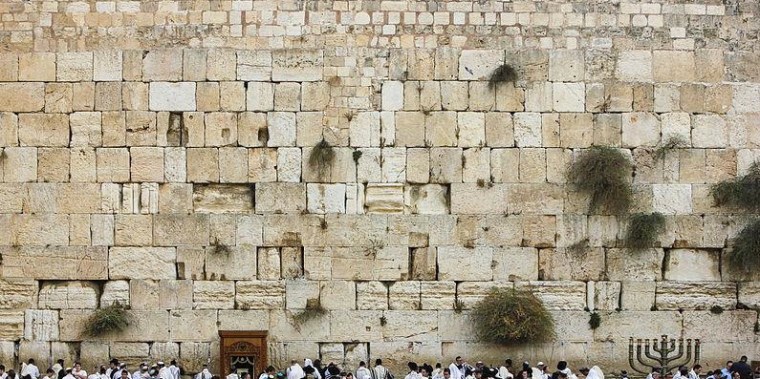
One of the holiest sites in the Old City of Jerusalem is The Western Wall, comprised of huge blocks of cream-colored limestone called Jerusalem stone. Several years after Laurie’s death, I stood before the wall, feeling the weight of the stones pressing down on me. Then I began to notice cracks and veins running through the stones, every cleft stuffed with prayers written on anything from Post-It Notes to legal stationery. I watched a man write on a piece of paper, fold it, and carefully tuck it into a fissure in the wall. He leaned forward and gently touched his lips to the stone. Although the night was warm, a chill ran up my arms as I remembered the night Laurie died, just after she had taken her last tortured breath, when I touched my lips to her forehead. Although I hadn’t planned to do so, I ripped a page out of my notebook, wrote a prayer for my daughter, and tucked it into one of the crevices.

Image 12

#

Some of the stones on the Scottish island of Iona are almost three billion years old. They have seen the formation of continents, the rise and fall of mountain ranges, several reversals of the magnetic poles, and at least five mass extinctions of the world’s species.

#

They are also alive. Geologists tell us that if we could, as Charles Simic would like, go inside a stone, we’d find that it is comprised of elements made up of plus and minus charges, negative electrons circling protons like tiny solar systems. So that, far from being dead and inert—stone cold, a heart of stone—stones are full of energy.

#

Which doesn’t surprise me. There’s a primordial power, a mysterious force in stones that has often made me wonder if that instead of my collecting all these stones over the years, these stones haven’t been collecting me.

Stones-2

# #


Down From the Mountain

IMG_1701

My ex-smoker’s lungs and I found the climb difficult, but we made it. I stood on a rocky bluff on Mount Desert Island gazing out over Penobscot Bay, thinking of Elizabeth Coatsworth’s poem, View from Cadillac Mountain:

So might a Chinese sage have seen the world,

seen mist and humpbacked islands from a mountain,

with a hawk hanging in a silver sky.

I wasn’t on Cadillac, but on nearby Champlain and although I hadn’t seen a hawk, I’d just had a very nice conversation with a warbler who assured me that, yes, all shall be well and all manner of thing shall be well.

And then I had to come down from the mountain.

Heart rate back to normal, breathing easily, entranced by a view, I didn’t pay attention at first, tripped on a root, and fell, scraping a knee and an elbow. After that, I grew anxious, even shaky. I slipped several times descending from the ledges and acquired a matching set of scrapes on the other knee and elbow. Finally, although I didn’t want to, I accepted the help of two of my companions who took turns giving me a literal hand down the rest of the trail.

“The return home is as much a part of the sacred art of pilgrimage as setting forth and the journey along the way,” writes Sheryl Kujawa-Holbrook, in Pilgrimage—The Sacred Art: Journey to the Center of the Heart. Likewise, those who walk the labyrinth as a spiritual discipline emphasize that getting to the center is only half the journey, and that you must take as much time leaving as you do getting there in order integrate what you have received, nourish yourself to go back out into the world.

But it’s not easy coming down from the mountain, literally or figuratively. I remember a homily given by a young (Hell, everybody’s young these days) minister on the story in Mark’s Gospel, in which three of the disciples follow Jesus to a high mountain, where he is transfigured and Moses and Elijah appear and God speaks. Then Jesus, Peter, James, and John return to an arguing crowd and a young man possessed by a demon. The minister talked of mountaintop experiences: how often we feel transfigured by pilgrimages and retreats where everybody seems filled with love and harmony. “But then,” he said, “we’re thrust back into the real world and all its demons.”

One of the demons I wrestle with is my anger at the death of my daughter. After twenty-five years, I usually do a pretty good job turning this anger over to God, but not always. One spring after spending four days at Emery House, a retreat center run by the Brothers of the Society of Saint John the Evangelist—living in solitude, reading scripture and books on spirituality, meditating before icons in my hermitage, walking woodland paths and attending services in the chapel four times a day—my wife and I drove into Boston to pick up her son, who was a student at Emerson College. As we attempted to get out of the city on Friday afternoon at 5:00 on Storrow Drive in front of Massachusetts General Hospital where five lanes of traffic narrow to two, we found ourselves and our Toyota Corolla jammed next to a shiny black SUV roughly the size and shape of Rhode Island.

trafficAs our compact car sat helpless and forlorn, the SUV inched its way closer and closer until, as it went by, it scraped our rear-view mirror. Just when I was breathing more easily, grateful that the mirror hadn’t been knocked off and the bastard was now in front of me, the door to the SUV swung open and this guy jumps out and starts pounding on the hood of my car. “Look what the fuck you’ve done! Look at the scratch on my door! This is an $800 paint-job!” The next thing I know, I’m out of the car, swearing back at him, while all around us people are yelling and blowing their horns.

So much for taking the love of God back into the world.

How do we, then, as Philip Cousineau says in The Art of the Pilgrimage, “remember to remember” after returning home from our journeys? He cites the “Pilgrim’s Law: … you must share whatever wisdom you have been blessed with on your journey with those who are about to set out on their own journey.” Which I suppose is the main reason I’ve started writing these blogs. They’re a way for me to relive some of the important moments of my life. But even if one doesn’t start a blog, keeping a travel journal for writing or sketching is helpful not only for remembering the trip, but in paying closer attention during the pilgrimage itself. Later, once I get home, a journal also helps me look at how I’ve been changed and how I might stay that way.

There are other ways, of course to remember. Like everyone these days, we take pictures, and Mary Lee and I have a great time organizing them into albums or collages. We also bring back stones (God, we have a lot of stones!), seeds, feathers, postcards.

One of our favorite ways of trying to keep a pilgrimage part of our lives once we’re back in the daily grind is by continuing to have meals featuring foods we ate: falafel from the Middle East, haggis from Scotland (I actually like the stuff, although it’s hard to find around here), enchiladas from Arizona.

But coming down from the mountain is still tough, both on the knees and on the psyche, probably because I want to see the top of the mountain as the end of my journey instead of the middle. And maybe that’s why Mary Lee and I celebrate another meal when we return from one of our journeys: we stop at our favorite pizza place before we go back to the house. It’s a way to celebrate that home ain’t such a bad place to be, either.


# #


Iona, Scotland, August 9, 2002.

iona-stcolumbasbay-2007pano

On what would be my daughter Laurie’s thirty-second birthday, I sit on a ledge by the shore of Columba’s Bay on the island of Iona, off the west coast of Scotland. Waves break on the rocks, ethereal light shimmers around me, and huge white clouds lie low over the water. Some fifteen hundred years ago, an Irish monk landed on this shore with twelve brothers and established the monastery in which Western Christianity was born. Long before Columba arrived, however, Iona was home to Druid and other pagan religions. Some books call this island a “thin place,” where the connection between God and humanity, the eternal and the temporal, is most apparent.

The stones on Iona have a lot to do with that feeling. On Columba’s Bay you are surrounded by stones: yellow, pink, violet, white, gray, and green, sometimes all marbled together in one rock. Some of these stones are almost three billion years old. Holding one of them is the closest I have ever come to imagining eternity.

Sheep bleat in the distance, and four teenagers giggle and scream as they wade in the chilly water. Up and down the rocky beach, more young people in shorts and backpacks—perhaps thirty altogether—pick up stones or sit on stones, walk on stones or throw stones into the bay. Earlier this morning, Laurie’s stepmother and I joined the weekly pilgrimage around Iona’s various holy sites led by staff of the Iona Community, an ecumenical Christian organization. This week is the Community’s annual Youth Conference, and instead of the meditative walk I imagined, Mary Lee and I have found ourselves on a gallop, the young people racing up and down hills and jumping over rocks like mountain goats, while we plod along behind, catching up at the various stations along the way, always arriving at the tag end of a prayer.

Since Laurie died fourteen years ago, only months after  being diagnosed with cancer, I am sometimes more aware of her continued presence in my life than at other times. On the pilgrimage around Iona, I see her in these young people, the way they bounce when they run, the intensity in their eyes when they talk, their uninhibited laughter.

As always, my pleasure in my daughter’s company is tempered by the loss of her physicality. Even if I can occasionally feel her touch, I cannot hold her. I cannot see her face become more interesting as it ages. Emptiness starts to burn, and I lift my eyes to the hills—to the sunlight shimmering over lichen-covered rocks.

Jennie, our student guide, calls us together. “As part of our pilgrimage,” she says, raising her voice above the sound of the wind and the waves, “we take two pebbles from the beach. One we throw into the sea as a symbol of something in our lives we would like to leave behind, while the other we take back with us as a sign of a new commitment in our heart.”

I watch the kids turn and race down over the rocks. I follow, not sure just what I want to leave behind, until I pick up a black and white and red stone, flat and jagged at one end. I feel once more the sharp-cornered ache that I will never—at least in this lifetime—have recompense for the loss of my child. At the water’s edge, I put my index finger around the stone, and dipping my shoulder, skim the rock across the water.

Jutting out into the ocean in front of me, a rocky promontory is layered like a birthday cake, yellow turning to black, then dove-gray, crowned with green-brown grass frosted with pink heather and yellow wild flowers. Splashes of yellow lichen pattern the gray rock. I’ve read that in order to attach firmly to the rocks, lichen manufacture solvents capable of dissolving stone, and it occurs to me that even the ancient stones of Iona dissolve, wash to the sea, and recycle back into rock or some other organic form.

That these stones can be both eternal and transitory is something I can’t fathom, but I decide it is the koan I should take back with me along with a green heart-shaped stone I’ve just picked up.

I put the green heart in my pocket, turn, and clamber up the fifty or so yards of stones rising at an almost forty-five degree angle between the water and a field. The stones shift, slide and sink under my feet. Once, I stumble and fall to my knees. Finally, I give up trying to walk straight up and begin to weave my way back and forth. When I reach the top of the final tier of stones, I turn again and look once more out over Columba’s Bay. I feel Laurie nudge me with her elbow, hear her voice in my ear: “Pretty neat day I painted you, huh, Dad?”

The surf crashes and the layers of stone shift in a chorus of clanks, thuds, clatters, pings, rattles, and taps, a Sanctus that pulls at me as Mary Lee and I trek through the boggy fields, over shimmering hills, past the cairn of Cul ri Eirinn, where Columba turned his back forever on Ireland, and across the Machair, where fairies are said to dance in the moonlight.

columbasbay

# #

Gifts

Three Wise Men
The Three Wise Men by John Hall Thorpe


For Christians at least, the Magi—those “wise men from the East”—made the first pilgrimage, journeying to Bethlehem some 2000 years ago. They bore with them gifts of gold, frankincense, and myrrh, and ever since, giving gifts has been an indelible part of the Christmas season.

I hate getting gifts.

Okay, that may be a tad melodramatic, but there have been many times in my life when I’ve felt I owe the giver something I’m not rich enough or clever enough or loving enough to repay, which, instead of making me grateful, makes me feel second-rate, resentful.

I expect my problems with receiving gifts go back to my alcohol-fumed childhood. When he’d had enough to drink, my grandfather would try to give me one of his rifles or a hunting knife. Usually, my mother would head him off at the pass, but I remember when he talked her into letting him give me a 7mm Mauser and then showed up the next week to take it back, only to give it to me again a year later.

Grampy’s ex-wife, who unfortunately never heard of Al Anon, the 12-step program for families of alcoholics (and wouldn’t have gone if she had), was apparently convinced that her grandchildren could never love her unless she brought us a gift when she visited. Sometimes, it was cheap, like the model airplane that broke the first time I flew it. Other times, she’d spend money she couldn’t afford on presents such as a Hopalong Cassidy cap pistol in a genuine leather holster. Either way—if the wing fell off the plane or Nanny couldn’t pay her phone bill—I felt I was to blame. And no matter what the gift, I could never act happy enough. “Mmph. He must not like it,” Nanny would say to Mom, as if I wasn’t standing between them. “I don’t know why I bother.”

Which probably explains why, of all the teachings of my faith, the one I struggle the hardest with is grace: that God’s gifts come to us with no strings attached. At Christmas, I’m expected to believe that God became human solely out of love, not because of anything we’ve done to earn that love. I’d rather believe “God helps those who help themselves.” I’d rather be the transformed Scrooge, buying the biggest turkey in the market to give to Tiny Tim, than I would Joseph, standing off to one side of the manger, welcoming a baby he hadn’t fathered.

Ironically, it’s been the death of my daughter that has helped me see—although as “through a glass, darkly”—how grace works. Like every parent who’s ever lost a child I suppose, I kept asking “Why?” Why did my previously healthy daughter, who didn’t drink or smoke, didn’t even eat meat for God’s sake, die from this rare cancer?

Then, maybe ten years after Laurie died, I had coffee with a woman who’d recently watched her son die in a fire. The first thing she said to me was, “How have you survived?” I thought her question was extreme, until I recalled Stan, whom I’d gotten to know a little when we were in grief counseling together (he’d also lost a daughter), who had committed suicide. Recently, I’d read about another grieving father who hung himself in his garage.

How had I survived?

I recalled all the clergy, spiritual directors, and mentors who appeared unannounced in my life just when I needed them most. The way my wife, whom I’d barely known when we decided to leave our spouses and live together, and who by all logic, should have left me years earlier, stayed by me. Why had these people appeared when they did? Why did Mary Lee remain? I had no more answers than I did for why Laurie died.

Thus, I took my first steps in trying to live, in the words of the medieval mystic Meister Eckhart, “without why,” which, even if we’re not mystics, is what I expect all of us who’ve lost children learn to do.

Since then I’ve been better about being open to grace. Pilgrimages have helped. I think of Paul, a young priest in Jerusalem, who gave Mary Lee and me a personal tour of the Old City the first night we arrived; of an Agape service on the island of Iona in Scotland, where we shared raisins and water while a young man standing in an alcove in the ancient abbey played “Round Midnight” on a saxophone; the large gray fox that visited us every night under a full moon at the Desert House of Prayer in Arizona.

Still, it’s hard not to want to be more active, set things right, help those I see as having less than I do. What’s even more difficult is to ask for something specific for myself. Unless I ask for the impossible, like having a healthy daughter back, or the generic, like world peace, or try to be funny by asking for broader shoulders, I feel selfish, sinful, not to mention dependent and needy.

But Jesus often asked people some form of “What is it that you want?”

How would I answer him?

The best I can do is to fall back on the Serenity Prayer: “God, grant me the serenity to accept the things I cannot change, the courage to change the things I can, and the wisdom to know the difference.”

And, I might add, the eyes to see the grace that surrounds me.


##


The Circular Pilgrimage

Alcyon Center Seal Cove, Maine
Alcyon Center
Seal Cove, Maine

The summer after graduating from high school, I worked for the Maine State Forest Service, wandering around wood lots looking for the gooseberry bushes that cause white pine blister rust. I can’t tell you the number of times I’d start out planning to walk in a straight line from one end of the lot to the other, only to find an hour later that I’d made some kind of lopsided circle and was back to where I’d begun.

I didn’t realize at the time (God, how many times have I said that?) that this was going to be the pattern of my life.

So many memoirs I’ve read detail the author’s linear journey from a youth mired in a swamp of sex, drugs, and rock and roll to a mountaintop of serenity, compassion, and enlightenment. Much as I’d like to see my life that way, beginning in ignorance and leading step-by-step to wisdom, my journey seems to have been more labyrinthine.

Which makes me wonder if the reason you see more and more labyrinths on church grounds or at retreat houses is that other people also see the labyrinth as a more appropriate symbol of their spiritual or psychological (Jung has a lot to say about labyrinths) journeys, too.

Labyrinths have been around since antiquity in every culture and just about every spiritual tradition. They come in a number of styles, but the one most popular today is based on the labyrinth at Chartres Cathedral in France, built around 1200, apparently as a substitute for the pilgrimages people were making to Jerusalem. If you were too poor, too infirm, too sick, or too old to journey that far, you could go to Chartres and walk the labyrinth.

While most people I know who regularly walk a labyrinth do so to meditate, pray, or find serenity, I find the experience frustrating. I get impatient with all those damn loops and turns.

Which is what the labyrinth has to teach me, I guess.

Redemptorist Center Tucson, Arizona
Redemptorist Center
Tucson, Arizona

If you’ve never walked a labyrinth, know that your goal is follow the circuitous path from the outside to the center, which, symbolically, can represent wholeness and authenticity, the so called “true self,” enlightenment, repentance, healing, whatever your interior goal might be.

What’s frustrating is that as you start out, the center is immediately in front of you. If you walked a straight line, you’d get there in seconds. Then, you swing to the left, but that’s okay, because soon you loop around and now the center is even closer to you. You walk toward it until, just before you get to the center, the path veers and you find yourself circling the center without being able to enter it. From there, it’s one goddamned loop after another, taking you further and further from where you want to be, every now and then moving towards the center again so that you think, “Ah, now I’m going to get there,” before taking you to the outer edges, as far away from your goal as possible. Until eventually, finally, and at the same time suddenly, you loop back and you’re standing at the entrance to the center.

And this has been the template of my life, whether it’s playing basketball or the banjo, writing a novel, or stumbling through grief. There’s that initial “Oh, this isn’t going to be too bad, there’s my goal right ahead of me,” followed by anger and frustration as I get further and further away from where I want to be.

After my daughter died, for example, I could see what happiness looked like—hell, most of the people I knew were happy, happier than I was anyway—but grief’s path turned away: into my den with a box of cigars and a bottle of scotch. Six months or so after Laurie died, however, my wife and I took a trip to visit some of her friends and family in Colorado. We stayed in a motel that looked out over the Rockies, and I bought a cowboy hat and a western belt buckle, drank margaritas, and pretended I was Tommy Lee Jones in Lonesome Dove.

“There. I’m over it,” I thought.

And the next few months were okay, until I went to a school band concert and saw a girl with hair the color of Laurie’s leaning forward at the piano, eyes intent on the sheet music. I recalled my daughter’s practicing scales in the living room over and over until I thought I’d scream, my nervousness as I sat in the audience at her recitals, the way my heart kicked when she hit a wrong note.

Then I saw Laurie not at the piano but in a hospital bed. No hair. Eyes deep and recessed like sunken marbles. Drugged voice: “Whazz up, Dad?” And I began the long, winding trek through grief, one that has taken years to walk.

Brunswick-Topsham Land Trust, Brunswick, Maine
Brunswick-Topsham Land Trust,
Brunswick, Maine

The good news is that a labyrinth is not a maze. You can’t get lost. There is only one path to the center, and what you have to do is to trust that no matter how far away from your goal you seem to be, you’ll get there. I look back and see that no matter how lost I felt, I wasn’t. The work has been to have the faith (in myself? in God? probably some combination thereof) and the patience to believe that the path, the one C.S. Lewis in his book A Grief Observed, said often feels like “a circular trench,” leads to the center: to wholeness, to healing.

And it has. Eventually, finally, and at the same time suddenly, I found myself less self-absorbed, laughing more easily, singing more often.

But as for walking in the woods, I still need to bring a compass.

##

The Geriatric Pilgrim: Traveling the Landscape of Faith and Grief


Image 2

November 30, 2015

RETREATING

Going on a pilgrimage and going on retreat are for me interlaced, like one of those Celtic knots. Both have a spiritual component, both involve both external and interior journeys, and both carry the risks and rewards of renewal.

My first retreat came 25 years ago this December, on the second anniversary of my daughter’s death from cancer: at a time when I was angry with myself for somehow causing Laurie’s death, angry with the world for ignoring my grief, and angry with God for being a Super Saddist getting kicks torturing innocent eighteen-year-olds.

But the previous fall, I’d attended a program on “Meditation as Part of the Christian Tradition,” led by the Reverend Cynthia Bourgeault, now a nationally recognized retreat leader and author of a number of neat books on the spiritual life, who that evening introduced my wife and me to Centering Prayer, a form of Christian meditation. While I wasn’t sure how I felt about Centering Prayer—part of me thought it was absurd, while another part wondered if, after swearing at God for two years, I at least ought to shut up and listen to what God had to say—I grew interested when Cynthia said she was going to lead a retreat in December on Swan’s Island in Maine’s Penobscot Bay. The idea of spending the anniversary of Laurie’s death on an island made a hell of lot more sense to me than what I’d done on the first anniversary: namely, drink myself into oblivion.

I thought a “retreat” would mean withdrawing from the world to a sanctuary, a safe place. That weekend was anything but. As I got out of the car to catch the ferry, my back felt as if someone had suddenly shoved a hot iron into my spine. The fog shut in for two days, so as far as scenic views were concerned, the farmhouse in which we met might as well have been encased in garbage bags. My meditations were filled with surrealistic, frightening images: huge teeth which turned into tentacles that I could feel squeezing me until I couldn’t breathe, a vision of climbing into a biplane piloted by your quintessential WWI flying ace, another image of someone who may or may not have been Jesus in a trench coat and fedora, vivid memories of Laurie’s last tortured breaths. The sound of a teakettle softly steaming on the woodstove became a deafening wind. Sitting in the softest chair in the room felt like sitting on broken glass.

Saturday afternoon, during our free time, my small 3rd floor bedroom turned into an asylum for the insane (which, I’ve since learned, is one of the definitions of the word “retreat”). Instead of the nap I’d planned on, the grief—the sorrow and the anger and the pain and the guilt and the shame—which I’d suppressed (usually with booze) for the past two years erupted in molten spasms. I remember doubling over, as racking sobs tore into my stomach. Of sliding or falling off the bed on to the floor. Of holding on to the iron bedpost with one hand and punching the bed with my other hand, driving my fist into the mattress. Then I grabbed the bed with both hands, raised myself onto my knees and slammed my head into the mattress. I drew back and slammed my head into the mattress again. Again. All the while making yelping noises and kicking the floor until, exhausted, I fell asleep.

The next day, however, I left the retreat feeling less angry, less guilty, and more serene than I had since Laurie died. The feeling didn’t last of course, but it was never as bad as it had been. Looking back, I see myself broken open, which, to paraphrase Leonard Cohen, was how the light got in. Even before Laurie’s death, good New England male that I am, I’d always keep my feelings hidden, even from myself. Feeling grief—really down and dirty and covered with shit grief—would ironically make it possible for me later to feel joy.

My wife and I attended more of Cynthia’s retreats on various Maine Islands. Later, after becoming Members of the Fellowship of the Society of Saint John the Evangelist, we started going to their monastery in Cambridge and their retreat house in West Newbury, Massachusetts. These days, we also try to travel at least once a year to somewhere we’ve never been before, such as the Desert House of Prayer outside Tucson, the New Camaldoli Heritage at Big Sur in California, the Norbertine Retreat Hermitage in New Mexico, the islands of Iona and Lindisfarne in Great Britain.

IMG_0033

I’ve often asked myself—usually after seeing my American Express bill—if I need to go so far away for these retreats. Can’t I just put my phone on airplane mode, lock the door, and walk in the woods behind my house?

I do and it’s helpful, but the only way to completely pull the plug on all those radio stations playing in my head is to get out of Dodge. Physical and spiritual withdrawal are as entwined for me as pilgrimage and retreat.

And learning to see the world as interwoven has been one of the greatest gifts of going on retreat. Like most Westerners, I tend toward a dualistic view of the world. I grew up learning to distinguish between “us” and “them”: white hats and black hats, Commies and Red Blooded Americans, Maine residents and flatlanders, good and bad, smart and stupid, strong and weak. “You can’t have it both ways,” my mother would tell me. It’s taken me over 70 years to learn that most things are not “either …or” but “both … and.” Such as when I’m on retreat: both “withdrawing” and “confronting,” both in solitude and in community, both in continued grief over Laurie’s death and in gratitude for the gifts that continually grace me.

##

November 16, 2015

WHEN PILGRIMAGE FEELS LIKE EXILE

I think the first time I ever thought about the word “pilgrimage” was just before the trip my wife and I took to Israel. Before we left, I happened to read a magazine article in which the author distinguished between pilgrims and tourists. Tourists, she wrote, go out from the center of their worlds, their homes, in order to vacation; pilgrims, on the other hand, seek to travel from the edges of their lives to their center, their homes. Well, that sounded like a pretty good distinction to me. Faithful Christians that we are, ML and I were, I thought, going “home” to the origin of our faith.

However, while ML had a great time, my trip felt like being exiled to the furnace of fire Jesus talks about in the Gospel of Matthew, “where there will be weeping and gnashing of teeth,” Or in my case, the gnashing of bowels.

Every day the temperature soared to well over 90°. Within two days I picked up an intestinal bug and was popping Lomotil like sunflower seeds. From the moment we arrived, we were lost. The first day we wandered for three hours through the labyrinth of streets and alleyways of the old city looking for a way back to St. George’s Cathedral Guest House and its friendly hollyhocks and familiar Evensong. The next day we found ourselves locked in the Garden of Gethsemane and wandering blindly on the backside of the Mount of Olives.

31_big

On Friday, we joined the Franciscan Friars on their Walk of Devotion up the Via Dolorosa to The Church of the Holy Sepulchre, built where tradition says Jesus was crucified and buried. Walk of Agony was more like it. If you’ve never been to the old city of Jerusalem, know that every one of those damned cobblestone streets rises at least 45°. Every twenty steps my stomach felt as if one of the ubiquitous Israeli soldiers had kicked it with a combat boot. Swarms of young boys tried to pull us into booths featuring five-foot posters of baby Jesus and the Virgin, baskets of wooden rosaries, and passages of scripture woven on dishtowels.

The Church of the Holy Sepulchre was a sauna. My intestines twisted as ML and I were funneled into a room where Jesus hung on a cross, wearing what looked like a tin diaper, his head covered from ear to ear with a semi-circle of silver. Cameras flashed. Voices babbled. Smells of incense, body odor, and stale cigarettes.

Downstairs, the Holy Sepulchre looked like a block of dirty cement. Some kind of priest in a tall black hat berated a woman for having bare shoulders. More cramps as people pushed me through a doorway into damp sour air, candles, aluminum icons and Jesus wearing another tin hat.

The place felt about as holy as a sardine factory.


The_Garden_Tomb_2008

And then three days later, I sat in the Garden Tomb, the alternative site of Jesus’ crucifixion and burial. Yellow and red roses covered the stones and cool, shaded paths wound under cypress, palm, and pine trees to a large platform with wooden benches looking out over “Skull Hill,” whose crumbling stones and small caves make a face in the side of a cliff. Earlier, our guide told us that in 1882, General Charles Gordon, Bible student and British soldier, decided this was the true Golgotha, or Place of the Skull.

Our guide also showed us a burial spot in the side of an adjacent hill. Inside, the rock was smooth and looked as if you could lie down on it and get a good night’s sleep. He pointed to a hole cut above the entrance through which light shone into the cave. “The first spot light of the world,” he said in his charming British voice.

I inhaled the fragrance of the flowers and the trees, watched swallows swoop through the leaves. Now I was home.

And that’s why I knew this was the wrong place for Jesus’ crucifixion and burial. If your message is that love of God and love of your neighbor are the greatest of all the commandments, the only way to prove it is by seeing this teaching tested in the worst possible conditions: heat and crowds of conflicting nationalities, soldiers and souvenir sellers, physical pain and taunting ridicule. I thought of ten years earlier, when each day I walked what I realized was my own Via Dolorosa from the Ronald McDonald House to the Eastern Maine Medical Center, where my daughter lay dying from a rare cancer diagnosed only months earlier. I’d felt exiled from my wife and stepson to a living hell of doctors and CT scans and catheters and—most of all—hopelessness. During those endless frustrating days, I needed to know that someone had cried out as I did, “My God, my God, why have you forsaken me?” and yet had overcome death. I needed to believe that Laurie would enter into eternal life.

And I think it was at that point, sitting under the trees in the Garden Tomb, that my exile became pilgrimage, not in the sense of experiencing the beauty of the sun rising through the fog over Maine waters, but of having an emotional and physical encounter that deepened my understanding of what holy means.

Even if it did take two more weeks before I could eat solid food.


# #