Rooting Around

FullSizeRender

“To be rooted is perhaps the most important and least recognized need of the human soul.”

—Simone Weil

#

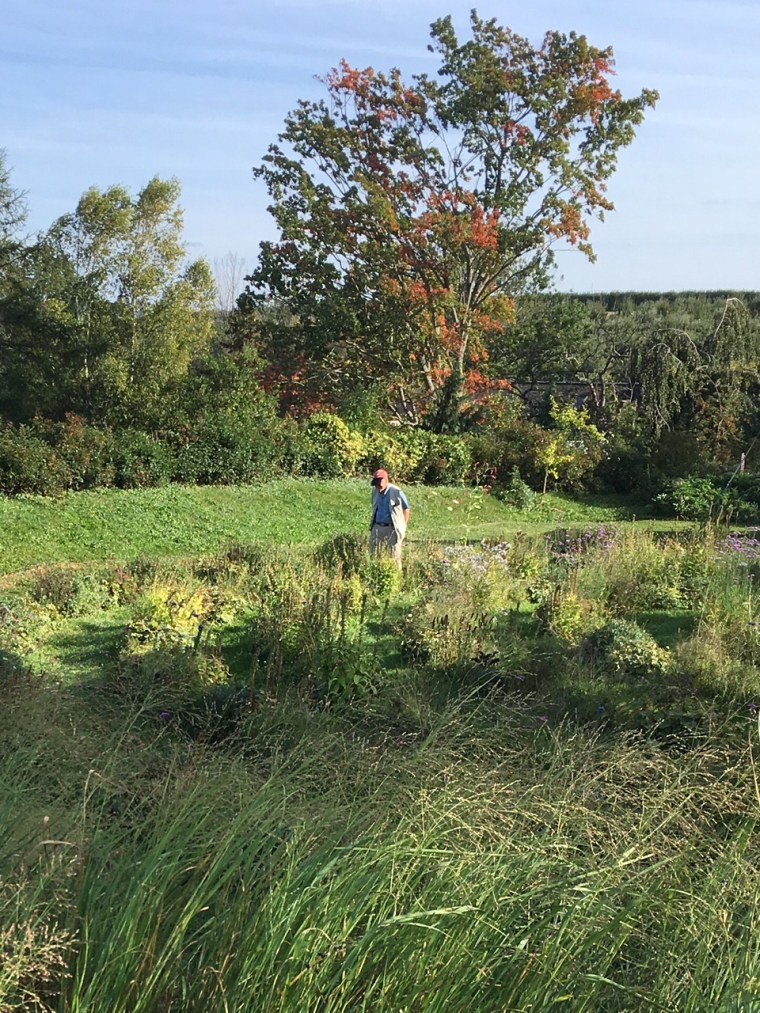
By the shore of the Minas Basin, Nova Scotia I’m walking a classic, seven-circuit labyrinth. In Tangled Garden, outside of Grand Pre, I circle through lavender, mint, thyme, blue stem, heather, rosemary, ferns, and other herbs I don’t recognize. Each breath I take is scented. Monarch butterflies flitter between plants.

I’m starting to appreciate walking labyrinths, learning to recognize their pattern in my daily life. The spiral, mystics say, is sacred. Their geometry (sometimes called the Fibonacci sequence) recurs at every scale of existence, from the arrangement of DNA to the coils of the brain to fingerprints to plants to the formation of stars in their nebulae. Walking a labyrinth is fraught with twists and turns, as is life.

As has been the morning.

Leaving Halifax, I thought Mary Lee and I would stop to see my great-grandfather’s grave on our way to Wolfville. I knew that Enoch Wile’s stone was in the East Gore Cemetery. I knew where East Gore was. I knew what the cemetery looked like. I knew how to get there. But apparently, I missed a turnoff, and labyrinth-like, we drove up to Maitlin on the Bay of Fundy, circled over to Noel, and back down again through West Gore, and then Gore, and finally to East Gore, which consisted of a meeting hall, a grain silo, and a former church now serving as a food pantry. Figuring a church would be in close proximity to a graveyard, I stopped the car and walked around the building, seeing nothing. I got back in the car and started driving in circles past the occasional farm and one hell of a lot of trees. Eventually, I came to a dirt road marked “Settlement” which I remembered seeing when I stopped at the church. This must be the other end, I thought, so I took it, thinking maybe an old cemetery would be on an old road. The road narrowed and curved and narrowed some more, then dipped down over a bridge marked “Road Floods” before coming out back at the church. Still no cemetery.

“Now where?” I asked my wife. As I looked to her for advice, I saw over her shoulder, across the road and up a hill, an arched gate reading “East Gore Cemetery.” We had passed it three times without noticing.

#

In the center of the labyrinth of Tangled Garden is a large upright circle of woven herbs, through which I gaze across the historic dyke lands of Grand Pre to the Minas Basin, which, at low tide, looks like an expanse of desert. In 1755, this area was the site of the British expulsion of French Catholic Acadians who refused to swear loyalty to England. Families were broken up. People were pulled from their roots.

I think of finally finding the center of my labyrinthian drive this morning, standing in front of Enoch Wile’s gravestone, discovering roots I never knew I had.

IMG_2911

As I wrote in the last blog, one of the reasons for coming to Nova Scotia was to try to find out more about my Grandfather Lyman Wile, whom no one in my family ever talked about because my grandmother left him when my father was four years old. With the help of my sister, who’s become interested in genealogy, I learned that Lyman’s father was Enoch, and that Lyman had fifteen brothers and sisters. I found that south central Nova Scotia is filled with Wiles: there’s a Wileville, a Wile Settlement, a Wile Lake, and several Wile roads. I discovered yesterday in Halifax that all of these Wiles go back to one Johann Frederich Weil from Germany, who was one of several thousand “Foreign Protestants,” brought over by the British (whose King, George II, had grown up in Germany) in 1750 to settle Nova Scotia, and to take the place of the Acadians they were deporting.

My mind goes back to Enoch’s grave, which looks out past the church steeple and the grain silo toward the rolling, forested hills of East Gore, and I realize that after my grandmother had left Lyman Wile, she put her son, my father—who’d been named for Lyman’s brother who died in the influenza pandemic of 1918-19—into what was called “a Home for Wayward Boys” for eight years. Dad, then, grew up without any sense of what I’ve discovered was a huge family, and I find myself understanding for the first time some of his character traits that used to drive me foolish: his negativity, his gluttony, his alcoholism. Dr. Sharon Deloz Parks writes that people typically have two major support sources in their early lives—what she calls “threshold people,” who help us cross into another stage of life, and “hospitable spaces,” that provide a sense of home. My father, as far as I can tell, had neither. He was, in the words of theologian Denise Starkey, “spiritually homeless,” which, she notes, is often connected with addiction.

I think of how important my family has been to me, even though I’ve often tried to ignore them. I’ve spent a lot of time, especially since starting to attend Al Anon meetings, aware of how growing up in an alcoholic family has scarred me, but I realize that at some level I’ve always known my family would be there if I needed them. After I told my first wife I was moving out of our house, the first thing I did was call my parents to ask if I could stay with them for a while. When Mary Lee traveled from Colorado to be with me, I knew we could stay with my parents until we found a place to live. And after my daughter died, it was buying my grandmother’s house in the town in which I’d grown up that provided an anchor in what felt like a tsunami of grief. I’ve always known where the center of my internal labyrinth was, even though it’s taken a long circular journey through what bell hooks calls the “geography of the heart” to get there.

#

Before leaving the labyrinth, I stop to take a picture of three monarch butterflies. Every year monarch butterflies from all over North American are driven by forces we still don’t understand to make a two-thousand-mile trip home to the Monarch Butterfly Reserve in Michoacan, some hundred miles north of Mexico City, spending the winter together, becoming so many that their collective weight bends the trees. Then they make their separate ways north again in the spring. Not only are butterflies metaphors of the power of family and the journey home, they are symbols of the cycle of life—growing from egg to caterpillar to pupa to butterfly—i.e. life, death, and rebirth.

I’m not sure I feel reborn, but finding the heritage that I never knew I had, feeling a closer connection with my father, has made me feel more rooted. More whole. Healed in some way.

As Mary Lee and I leave Tangled Garden for our B&B in Wolfville, I see the Minas Basin filling with water.

fullsizeoutput_126b

# #

The Shadow Knows

IMG_2797

#

“Who knows what evil lurks in the hearts of men?

The Shadow knows. (Bwhahahahaha!)”

The Shadow, 1937-1954 radio program

#

As you read this, Mary Lee and I are in Nova Scotia, on what I think of as a genetic pilgrimage, traveling through the country that my Grandfather, Lyman Beecher Wile, left in 1906 to work in a Marlborough, Massachusetts shoe factory. Wile is a common name in the Lunenburg area of Nova Scotia—I’m looking forward to visiting Wileville—and I’ve made arrangements to meet with some distant cousins.

My grandfather Wile is a shadowy figure in my life. When I was growing up, no one in our family ever talked about him. I guess my grandmother left him around 1923, when my father was four years old. My mother told me that Lyman once beat my father with his belt, and Nanny told him if he ever did that again, she’d take Dad and leave. Apparently, he did and so did she. (I expect there was more to the story.) Other than that, all I knew until my sister started compiling a genealogy of the Wiles, was my Grandfather Wile came from Nova Scotia and lived in Massachusetts. I have a vague memory of an interminably long car ride to Marlborough ending in a series of winding streets and tenement houses and a hazy image of my father talking to someone who, except for being older and heavier, looked a lot like him. I don’t know the purpose of the trip—I expect my mother might have had something to do with it—but I know Dad never visited his father again and seldom mentioned him.

The way my family dealt with Dad’s father was typical of us, and many families I knew growing up (and actually, quite a few families I know now): if there’s something embarrassing or unpleasant or shameful in your past, never talk about it. If you’re afraid, if you’re in pain, don’t show it.

One the revelations of my life was to discover that all families, all people, have these dark sides that they don’t want to acknowledge. Psychiatrist Carl Jung coined the word “shadow” to describe the negative, socially unacceptable impulses, the sexual lusts, selfishness, greed, anger, and so on, that we try to deny and bury in our subconscious. This denial, Jung posited, is damaging because the most common way to avoid looking at our negative impulses is to project them on to others so that we don’t have to confront them in ourselves. Both as individuals and as groups, even as countries, we create scapegoats upon which to inflict those prejudices, fears, perversions that we won’t admit we have.

My most vivid memory of the power of my own shadow goes back to the year I moved from the two-room primary school just up the street from my house to the third grade in adjoining elementary and junior high schools. Suddenly, I was thrust into an intimidating world of sixth, seventh, and eighth graders, and because in those days students routinely repeated grades, some of these kids were sixteen and seventeen years old. Bullying, fighting, taunting were common occurrences. Up until then a serious and solitary kid who liked to crawl into a cabinet next to the chimney in his living room and nestle in the warm darkness, or pull the bed covers over his head when he listened to “The Shadow” on the radio, I started waking up early on school mornings, shivering with apprehension.

Fortunately (for me, not for her), there was girl I’ll call Ester Morin. She was repeating the third grade. Possibly twelve or thirteen, she lived in a section of town filled with tarpaper shacks. She was thin and round-shouldered. I recall a long face and I want to say she had bad teeth. I remember dark, tangled hair falling over one eye, a faded dress, probably too short to cover her scabby knees, dirty socks puddled around her ankles, and scuffed shoes with at least one broken strap. The perfect target for ridicule and teasing.

It was a no-brainer. I could try to hide from the big kids on the playground, or I could join the gang of anywhere from five to ten guys surrounding Ester with their hands over their noses and mouths, hopping up and down like crows and cackling, “Fart-smeller Moron!” I soon became one of those guys. In the halls, we tried to trip her; in class, we targeted her with spit-balls. Sometimes we would wait for her after school and run circles around her until she shrieked and swung her long, bony arms.

It was, I discovered, great fun. I had found someone uglier and clumsier and weaker than I was. Ridiculing her made me stop thinking of myself as a loser. If I was self-consciousness about being fat, it helped to know someone who was ugly. If I was afraid that an eighth grader would beat me up, it was reassuring to know there was someone I could hit and no one would care. Ester became my way to strike back at those morning fears, ridicule them with names like “fart-smeller” and “cootie-lover.” Every time she screamed and waved her arms like some broken doll because of something I’d said, I felt stronger.

#

I’m deeply sorry for the way I treated Ester. Still, I was 8 years old, I didn’t know any better, and I can’t do anything to make it up to her now. But Jung and others would say that I need to bring that memory to light. Richard Rohr, one of my spiritual gurus, writes: “Human consciousness does not emerge in any depth except through struggling with our shadow. It is in facing our conflicts, criticisms, and contradictions that we grow.” Maybe I need to remember Ester to help me confront and learn from my continuing sexist and racist tendencies.

Jung said that the shadow contains “positive potentialities,” such as creativity and spirituality. One example supporting his theory is that for the last several months, the Bowdoin College Museum of Art has featured an exhibit called “The Ivory Mirror: The Art of Mortality in Renaissance Europe.” The exhibit contains a variety of art, especially ivory statues, prayer beads, and jewelry boxes, urging us to “remember death.” Many of the figures have a human face on one side and a skeleton, sometimes with snakes crawling around the eye sockets, on the other side—a great depiction, I think, of our shadow side.

Last week I heard a speaker say that this art of “momento mori” reveals the renaissance search for meaning in death, which of course was commonplace. People apparently collected these figures and showed them to others. I couldn’t help but compare their attitude of curiosity to our present fear of death. We don’t want to look at death, so we relegate the dying to hospitals and hospice centers away from the rest of the world, and assuage our fears through caricatures of death in books and movies about zombies, demons, and vampires.

So perhaps I’m on a pilgrimage into the shadow side of my family. And possibly of myself. How much Lyman is there in me? Can I look at my own violent streaks, the pain I’ve caused my children, bring it to the surface, and reintegrate it into my life in a healthy way?

At this point, only the Shadow knows. (Bwhahahahaha!)

fullsizeoutput_124e

# #

On Quitting

IMG_0669

# #

August 1, 2013. Outside of Ghost Ranch about 15 miles north of Abiquiu, New Mexico, I gazed across vistas of worn rocks layered red and brown and tan, punctuated with dark green brush. In the distance, Cerro Pedernal, the flat-topped mountain that inspired so many of Georgia O’Keefe’s paintings and where her ashes are scattered loomed against the sky. The view, however, was streaked with thick spirals of rain falling from low black clouds moving toward me. I looked through the skeletal arms of a creosote bush at Chimney Rock, my destination, rising like an arthritic finger into the darkening sky. I really wanted to get up to it. But I thought of the sign at Ghost Ranch warning of how quickly violent thunderstorms can arise. I called to my wife that we’d better turn around.

Back at the ranch, I looked up at Chimney Rock, bathed in sunlight. The storm had gone around us. I was pissed. Not because I wanted a better view, not because I was particularly interested in what Chimney Rock looked like up close, but because of this voice in my head: Damn it, there you go, quitting.

Growing up with a basketball in my hands, I remember playing in the Portland Maine YMCA, and the signs over the backboards at either end of the court. One read: When the Going Gets Tough, the Tough Get Going; the other: A Winner Never Quits and A Quitter Never Wins. I carved these commandments into my psyche.

And they have often served me in good stead, inspired me to continue when I’ve wanted to stop. They’ve helped me recover from back surgery, two hip operations, and two hernia surgeries. They play in my head as I do my twenty minutes of exercises every morning. Recalling those words helped me get through some of the darkest days after my daughter’s death. I can’t tell you how many times I relied on those words during the twenty years of rejection letters, rewrites, course work, and financial expense until my novel Requiem in Stones (available—hint, hint—on my website, Amazon, and Maine’s finest independent bookstores) was finally published.

These backboard words of wisdom have also sent me on many a guilt trip. I often regret quitting the trombone—something I was pretty good at—in high school. I still feel guilty about deciding right after my final high school basketball game not to play ball in college, still wonder if I could have played at the college level. I dropped out of the University of Maine forestry program after a year. I’ve quit on a marriage, I left a teaching job in the middle of the year, and quit teaching altogether long before most of my colleagues.

Our society disdains quitters. If you google quotes about quitting, you’ll find that almost all of them say that it’s bad—un-American:

“Pain is temporary. Quitting lasts forever,” said Lance Armstrong, famous America cyclist.

“Americans never quit,” said General Douglas MacArthur.

“A man is not finished when he’s defeated. He’s finished when he quits,” said U.S. President Richard Nixon.

And yet, as I look again at all those things I quit on, I wonder, was quitting the trombone, basketball, the marriage, that job, really such a bad thing? What’s wrong with swapping a trombone for a banjo? Let’s say I’d played basketball in college. I certainly would never have starred; I was too short and too slow. (Hell, I never starred in high school.) So I’d have sat on the bench, and probably become a high school basketball coach—a job I could never imagine doing. The marriage was lousy; if I’d stayed in that relationship, I’d be dead now, I’m sure. If I’d never left teaching, I could very well have become one of the many cynical, depressed teachers I’ve worked with counting the days until their first retirement check so they could wait for the coffee shops to open in the morning.

While I was searching the net for thoughts about quitting, I found a PBS interview with Ewan Harris, founder of Quitter Quarterly. (It’s now a blog. Look it up.) In 2004, she published a book called The Art of Quitting. In the interview, Harris made a number of arguments in favor of quitting. The story of our lives, she said, is framed by quitting. The essential nature of a quitter is not laziness but a drive to move on. We quit because we’re bored, trapped, or because out dreams don’t match reality. The more things we quit, the more we do. The whole point of quitting is to move in the world.

Which got me thinking. I’m proud of the fact I quit smoking. Quitting booze has improved and possibly saved my life. I’ve got a number of other bad habits I should probably quit as well.

I discovered that the word “quit” is related to the word “quiet,” and originally meant freed or acquitted of a crime. Buddhism and other spiritual traditions warn that clinging strongly to anything or anybody causes suffering, and urge “detachment” or “letting go” as a way to freedom. Jesus’s disciples quit their jobs—threw down their nets—to follow him, and, in turn, he quit his life to show us that love is more powerful than death.

Going back to those Google quotes about the dangers of quitting, considering that Lance Armstrong has been barred from cycling for using illegal performance enhancing drugs to win his Tour de France championships, that President Truman fired MacArthur for insubordination, and that Nixon had to resign from office because of trying to cover up illegal campaign activities, I wonder if they—and the country—might have been better off if they had quit.

In her PBS interview, Harris talked about what she called the “quitting cycle.” Our “early quits,” she said, often involve schools and romances. (my God, I can’t imagine what my life would have been like had I married my first girlfriend!) Our “midlife quits” are our midlife crises. (Mine was the best thing that ever happened to me.) Finally, Harris talked about “older quits,” when we don’t give a damn what people think. I’m not there yet—I still wished I’d made it up to Chimney Rock—but I’m getting better.

As I was writing this essay, I received word that my oldest friend going back to before grade school had suddenly died. Which has driven home to me the fact that I have another “quit” in the cycle right around the corner, one that I have no choice but to make.

Rest in peace, Roger.

Version 3

# #

The Path is Made by Walking

IMG_1387

#

Wanderer, there is no path,

the path is made by walking.

—Antonio Machado

#

Mention “pilgrimage” and folks usually think of walking the Santiago de Compostela or similar perambulations. Walking is synonymous with pilgrimage. In the Middle Ages, Chaucer’s Canterbury pilgrims walked to the tomb of Thomas Becket, while serious pilgrims walked from Europe to the Holy City of Jerusalem. The practice of walking the labyrinth began then in order that older or more infirm pilgrims who couldn’t make it to Jerusalem could at least take their own spiritual walk.

So maybe one reason I’ve come to see my life as a pilgrimage is that I’ve spent a large part of it walking.

As kids growing up in Yarmouth, Maine, we walked to the school, to the store, to the ball field, to work. When I had back surgery in 1978, I was told to walk ten miles a day for three months, which I did, even though those months were January, February, and March. When I moved back to Yarmouth, I began walking around town, one foot in the twenty-first century and one foot in 1955. Now living in Brunswick, Maine, I often walk the two miles to and from down town. I co-facilitate a contemplative silence group, where we practice not only sitting but also walking meditation: focusing on raising, lifting, pushing, dragging, touching, and pressing down each foot—to remind us that the body is always in the present moment.

And some of the major formative experiences of my life—the joy of first love, the pain of homesickness, the surrealistic disorientation of grief—have come while I was walking.

Whenever I hear Johnny Mathis sing “Misty,” I am immediately pulled back to an autumn Sunday in 1959, walking home from an afternoon with my first girlfriend. Floating was more like it, down Spring Street to East Main, to Willow, to Bridge Street, past white houses shaded by leaves shining ruby and golden in the sun, the smell of burning leaves like incense, buoyed by the taste of Susan’s lips, the feel of her breast in my hand, the smell of her “White Shoulders” perfume, and the memory of Mathis’s high tenor: “Oooonnnn my own, would I wander through this wonderland alone…” playing on her hi fi as we kissed.

On other Sunday, November 24, 1963, I walked through the evening mist and fog and the almost empty campus of the University of Maine at Orono, still in shock after the events of the weekend: Walter Cronkite’s voice, “From Dallas, Texas, the flash, apparently official: President Kennedy died at 1 p.m. Central Standard Time”; the closed casket draped in black crepe lying first in the East Room of the White House before being taken by the horse-drawn caisson to the Capitol Rotunda; the subsequent killing of a puffy-eyed Lee Harvey Oswald; the funeral procession.

I remember walking past Dunn Hall and Hannibal Hamlin and Oak Hall, standing like silent spectators at my one-man procession, the afternoon’s funeral drums beating in my head—dum dum dum da dum—trying to feel like Jack Kerouac’s Sal Paradise surveying a dying America, but instead, feeling like a twenty-year old hick from Maine, lost and unhappy. Following the sidewalk down the hill, through some white birches looking ghostly in the misty light cast by the street lamps, past Sigma Nu and Beta Theta Pi fraternities. Past the President’s house, where on the lawn, the few remaining leaves of an oak tree hung like flags at half-mast. Past the Women’s Athletic Building and Deering Hall to the UMaine farm buildings with their smell of hay and shit and the sounds of horses moving in one of the barns. The mist turned to steady rain. I lit a cigarette and pulled the collar of my jacket around my neck. I realized that not one person in the entire world knew where I was, or, more important, cared, except for my family. A feeling of loneliness such as I had never felt before, full of emptiness, longing, and sorrow cascaded over me. I began to cry.

During the months of November and December of 1988, I walked a mile each way back and forth between the Ronald McDonald House in Bangor, Maine to the fourth floor of the Eastern Maine Medical Center, where my eighteen-year-old daughter lay dying of cancer.  I especially remember the walk back, through what I still think of as the bowels of the hospital. Confused and angry after a day by Laurie’s bedside watching her slip further and further away from me, I’d take the elevator to the main lobby, walk through a waiting room, around a corner and down a corridor lined at first with photographs of lighthouses and lobster boats, and then with memorial plaques hanging like rows of wooden shields along the wall. Often, I’d pause here, read a name or two, and wonder how long it would be until Laurie’s memorial plaque joined them. (About a year as it turned out.)

Past a row of gray lockers, the cinderblock walls turned to brick. I’d come to the laundry rooms, passing men and women in light-blue coats and plastic hairnets, looking like zombies in the dim florescent light as they pushed carts, baskets, and gurneys. Further on, metal and wooden doors marked Records Retention Center Office, Respiratory Medicine Office, Hospital Staff Only, Procedure Room #1, Procedure Room #2. Machines hummed. The corridor turned left and narrowed. The lighting grew dimmer, the air damper. Pipes and valves clunked overhead. More rooms: Data Processing, Computers, and Housekeeping Maintenance. When I turned another corner into a still narrower corridor, the walls closed in on me, and it was here I sometimes heard voices of people walled up like victims of an Edgar Allen Poe short story, sensed ax murders following me down the hall.

Just when it seemed the corridor would dead-end, a turn to the left led me to a narrow door, where I’d suddenly feel excreted out into a parking lot by a river, the light, even on the darkest days momentarily blinding me. But when my eyes adjusted to behold the cascading water and the russet oak trees and white birches on the river banks, their beauty was more painful than the ugliness I’d been living with for the previous six hours.

#

These days, I do a lot of walking with grandchildren. Research has shown that babies are happiest when they’re carried while parents, grandparents, or the like are walking at a speed of three to four miles an hour. I know one grandfather who’s pretty happy at this speed as well.

I’m also finding that walking with older grandchildren is a good reminder that, as Christine Valters Paintner writes, “Ultimately, the pilgrimage journey asks us…to relinquish our grasp on certainty and control.” Have you ever tried taking a two-year-old and a four-year-old on a walk? They go where they want to, not where you do. Do you have someplace you need to be? Tough. Time does not exist.

But Valters Paintner goes on to say, “In that process we allow ourselves…to receive gifts far bigger than our own limited imaginations could ponder.” Amen. My grandchildren notice everything, and usually with a delight I’d long forgotten. What is more beautiful than a child’s smile? More joyous than her laugh?

Most of the paths I’ve walked have been well-worn ones. I’m guessing most of you have also walked (if not physically, then emotionally) paths of love, sorrow, happiness, and grief. But I also suspect each of us still has to find our own way forward along these paths—walk them as if they’ve never been walked before.

IMG_9841

# #

The Eagle

LOCAL BALD EAGLE GEE

I’m due at the Winter Harbor, Maine Library in an hour to do an “author talk,” but the drive up from Brunswick didn’t take as long as I’d thought it would, so I have time to kill. Obeying a sudden impulse, I keep on driving another 10 miles along Route One until I come to a small sign, “Gouldsboro Point,” and take a right down a road I haven’t been on for 30 years.

My journey changes from self-promotion to pilgrimage.

#

Once upon a time I lived and taught not far from here. On weekends and school vacations, my first wife, my daughter, and I drove down this road to my wife’s parents’ cottage of weathered shingles, perched on a grassy bank overlooking Gouldsboro Bay, one of Maine’s more secluded coastal indentations.

To me, “the Point” was a spiritual, even mystical place, where I could adore a mostly unspoiled Nature. I loved wandering the woods—ten square miles of spruce, birch, and maple trees, bounded on three sides by roads and on the fourth side by West Bay, which juts from Gouldsboro Bay like the claw from a lobster. Summer, fall, winter, spring—the season made no difference. The pungent smell of autumn leaves, the anthems sung by a June breeze through the spruce trees, the caress of the sun or the rain or the snow on my face called to a longing inside me.

And then, as my marriage began to sink beneath swells of bickering and troughs of silent condemnation, these weekend walks in the woods became a life raft: both an escape from the rest of the week and a call to another life, although at the time I couldn’t have told you what that other life might be.

#

Today, the road down to Gouldsboro Bay is both eerily familiar and startlingly strange. There must be twice as many houses as I recall—one and two-stories with large windows and long driveways that contrast with the faded white houses that have been here for probably a hundred years or more. Rounding the bend at the end of Gouldsboro Bay, I see a new pier thrusting into the water with a large yacht tied up beside it.

Driving a few hundred yards further, I see the cottage where I spent some 20 years’ worth of weekends and holidays. It has new siding and a second story now. Across the road, where I used to enter the woods for my weekend walks, stands a large log cabin.

Which gets me thinking about the logging roads behind the cabin I used to walk, and the day I followed one of them past some old cellar holes and gnarled apple trees until I saw West Bay in front of me, high tide twinkling in the sun.

I remember turning right and re-entering the woods, up a faint path that ran along a bluff overlooking the bay, then stopping to walk under a canopy of spruce trees toward the bay to get a better view of the water. Standing in cool dark shadows under a huge spruce, I gazed across the glittering bay. I don’t recall what I was thinking about—probably daydreaming about travel or writing fame or sex or my unhappy marriage—until I heard a muffled noise—almost a thud—that seemed both faint and powerful at the same time. The air around me shifted perceptively, and then part of the shadow moved.

Twenty feet above my head, dark wings extended to over six feet across, the interlocking feathers a kaleidoscopic pattern of browns. Tapered wingtips separated and lengthened like sepia colored knives. A white tail fanned, lifted. One flap of wings sent the bird away from the trees, its legs down, curved talons extended. As it arced, I beheld a massive white head, a yellow hook of a beak, and one black eye under a furrowed brow. Then the eagle caught a thermal of wind and soared into the sky, and slowly began to circle the bay.

I felt numb or dumb for a moment—Gee, wasn’t that an eagle that just flew off over my head?—followed by an excitement that was a mix of joy and awe —God, that was an eagle that just flew off over my head! My legs trembled as I stood on the embankment and watched the bird become a tiny cross in a royal blue sky. Even after the eagle vanished over the islands at the end of Gouldsboro Bay, my heart kept up its tattoo. A small waterspout churned across the bay, raising white caps. Seaweed undulated below me. The world seemed to be dancing and I wanted to dance with it.

#

As I turn around in the driveway to the log cabin across the road from my former in-law’s cottage, I remember my excitement at just seeing an eagle at a time when, because of pesticides and other pollutants, only about 30 pair lived in the entire state. I recall the grace with which the eagle took flight. I recollect my mixed feelings of fear and awe and joy. But as I drive back towards Route One, what I remember most is the dead weight of sadness and frustration I felt when I tried to tell my wife what I’d experienced.

“That’s nice,” she said. “But I wish you’d stayed here and helped me paint the porch railing. Now I’ll have to finish it next week. Wash your hands. It’s almost time for supper.”

I know many people prefer to make their pilgrimages alone. Some writers say all real pilgrimages are solitary experiences. Maybe so, but today I see that being under the eagle’s wings might have been my first realization of how much of the longing I’d been feeling on my woodland walks had been for someone to share my joy and my sorrow, my uncertainty and my plans. I think of my loneliness on those nights when my first wife and I drove back from the Point to our house, funereal distance separating us like a fogbank, and then I recall the night I met my second wife, Mary Lee, when we talked until three in the morning about everything from snake hunting to God. Our letters to each other sometimes reached thirty pages a week. I wish she were here now, even though I kissed her good-bye only a few hours ago and will kiss her hello tonight.

I realize it’s when I isolate myself that I get into trouble: not only how often I get lost when I walk alone, but also after my daughter Laurie’s death, when I retreated into my den with a bottle of scotch, when my guilt and my anger alienated me from my family and friends, when I stopped going to counseling because I was convinced that my story was worse than anyone else’s, when I miss a few weeks of my twelve-step program, when I don’t meet regularly with a spiritual director.

I don’t know about you, but I need to share not only my anger, shame, and confusion, but also my happiness, dreams, and successes with someone else, someone who can make me feel that what I’m experiencing matters.

Which is why I think most of us need a spouse, a partner, a good friend. Why a lot of us need God.

I’m back on Route One now, heading for Winter Harbor—looking forward to talking with people about my writing, but anticipating even more getting home and telling Mary Lee about my day.

IMG_2367

# #

Our Embedded Remains

IMG_2444.JPG
A Wall in Selcuk, Turkey

#

Of course, not every trip needs to be a pilgrimage.

I know, I know: given the title of this blog and the pilgrimages and retreats I’ve described over the last year and a half, you’d think the only worthwhile journeys I’ve ever made have involved intense planning, a degree of discomfort, and an even greater degree of “spirituality.”

But a few years ago, Mary Lee and I had a wonderful trip to Turkey. Our purpose was to visit friends and to escape a Maine winter that had extended, as it often does, into April. For a week, we were chauffeured around and fed royally by Lynne and Finlay, who, after teaching in Istanbul for ten years, had bought a home in Selcuk (as in “sell-chuck”) in the western part of the country. I hadn’t prepared for the trip and knew next to nothing about Turkey, except that the apostle Paul, one of Christianity’s heroes, spent a lot of time there.

I had no idea that the ancient city of Ephesus, where Paul lived for a while and for whom he wrote one of his Epistles, is part of Selcuk. Nor did I know that Selcuk is also the site of several other holy places: The Temple of Artemis, one of the Seven Wonders of the ancient World; the Basilica of St. John, built on the tomb of John the Beloved Disciple and author (perhaps) of the Bible’s Book of Revelation; the Home of the Virgin Mary, where Jesus’s mother is thought by pilgrims to have spent her last days; and Isa Bey Mosque, which dates from the fourteenth century.

And perhaps because I didn’t come to Turkey as a pilgrim, or perhaps because the hordes of tourists—a lot of Asians, Germans, and Australians—reminded me of the tourists in Old Orchard and Bar Harbor in Maine, none of these places ever felt to me particularly holy.

What I did feel was a palpable sense of history. For centuries, Turkey has resided at the crossroads between Eastern and Western cultures. Part of Istanbul is in Europe and part of the city is in Asia. Turkey is where Noah’s ark is supposed to have come to ground after the flood. The Grand Fortress of Selcuk rests on the site of castles going back to before 5,000 BCE.  Before becoming a republic in 1923, the country was, at various times, part of Greek, Roman, Christian, and Islamic empires.

And I’m not exaggerating when I say this history is palpable; visitors can see and touch it. Turkey’s historic civilizations are literally embedded in one another, stone next to stone, sometimes in strange ways—carved marble cornices in the middle of granite walls, for example.

This embedded history is clearly evident in Selcuk. You find very little left of the Temple of Artemis, once known throughout the ancient world for its mix of classic Greek and near Eastern design, because after its final destruction in 262 CE, its marble stones were used in construction of later buildings, including the Basilica of St. John. And when the Basilica became unusable after a fourteenth century earthquake, some of its stones, along with stones from the Temple of Artemis were used in building Isa Bey Mosque in 1375.

IMG_2474
What’s left of the Temple of Artemis. In the background: Isa Bey Mosque, the Basilica of St. John, and the Grand Fortress of Selcuk.

#

Even on vacation, however, you can never entirely escape your own history. Seeing, touching, the stones that make up Selcuk’s past, I couldn’t help but wonder if, just as Turkey’s civilizations were built using the remains from previous cultures, who I am today isn’t built of some of the destroyed remains of previous selves I’ve reassembled.

I thought of when, a year or so after my eighteen-year-old daughter Laurie died of cancer, I’d read a review in the New Yorker by Terrence Rafferty of the movie, “Black Rain,” about the survivors of the destruction of Hiroshima in WWII, and how I’d identified with the way Rafferty described them:

They “…live in a perpetual state of suspension, a constant twilight. Their survival is too tenuous to give them much joy; it’s more like a wary, static persistence… They’re contaminated by uncertainty, and every gesture they make, every word they speak, is halting, self-conscious, tentative.”

I’m guessing that anyone reading this who’s lost a child understands what Rafferty is talking about. Your entire world—your past, your present, your future—is destroyed. All your old landmarks become rubble, and you have no point of reference, nothing to guide you. You wander lost and fearful.

But maybe one of the ways we grieving parents survive is by embedding parts of our old, destroyed selves into transformed ones, possibly becoming stronger in the process.

I was raised in the Christian tradition. If I could draw pictures of my early faith, they would resemble a child’s book of an idealized 1950’s small town, filled with quaint Andy Griffin meets Ozzie and Harriet characters. God was, like my pastor and next-door neighbor, Scotty Campbell, a nice guy who winked and always seemed to be around, even when your parents were busy. As I grew older, I replaced those images with a Sierra Club calendar of majestic, forest-covered mountains glowing in a brilliant sunrise, filled with possibility. When I met Mary Lee, I added more images to include her, the two of us being guided along bucolic trails by a creative, loving Presence.

And then I learned that God was capable of creating not only purple mountains’ majesty but cancer cells. At first, God disappeared, then reappeared as the Great Saddist, inflicting pain on innocent children. Eventually, God became the Great Opponent, with whom I, like the Biblical Jacob, wrestled, until I finally surrendered to what I now think of as the Great Mystery of Grace.

Today, I realize that should I try to blueprint my faith, it would look a lot like some of the buildings Mary Lee and I saw in Turkey, with images of God as caretaker, God as creator, God as opponent, God as mystery, God as lover, embedded—along with sorrow and joy, doubt and faith, shame and compassion, grief and hope—into one edifice.

Sort of the way, come to think of it, a pilgrimage can sometimes become embedded in a vacation.

IMG_2472.JPG

# #


The Annual Pilgrimage

  • fullsizeoutput_120f

In the 1950s and 60s, high school basketball was the king of Maine sports. Communities rallied around their teams and the twice-weekly games were the social events of the season. Fights broke out, tires were slashed, romances—even marriages—began and ended before, during, and after the games.

One of the highlights, not only of the winter, but of the year, were the high school basketball tournaments. Not only did schools shut down for the week, businesses closed. Some townspeople took their vacations in February, not to fly to Florida but to drive to Lewiston, eat at Stickino’s Restaurant, and watch the Western Maine Basketball Tournament at the Memorial Armory.

I first heard the call to become part of what I now think of as the annual pilgrimage to Lewiston in the eighth grade, when I began playing basketball. By the following year, while I might have gone to church on Sunday and listened to my pastor and next-door neighbor, Scotty Campbell, tell us about a loving God, my real worship service was in my backyard, shooting my new yellow Voit basketball into the hoop my father had put up over the garage door. My scriptures were the sports pages of the Portland Press Herald and the Portland Evening Express. My icons the pictures I cut from Sport magazine: Hot Rod Hundley, Jungle Jim Loscutoff, Bill Russell.

The twenty-six-mile drive from Yarmouth to Lewiston took us small-town kids into another world: a city of bright lights and dark alleys, where everyone, it seemed, spoke French, and tall spires of stone churches loomed against the horizon. The Memorial Armory itself, built in 1922-23, also stone, cavernous, inspired an even greater feeling of awe.

But as with any good pilgrimage, it was the journey itself that was as important as the destination. Riding on the team bus, I learned about sex (even though at least half the information was wrong), what makes a good joke, and any number of songs. I learned how to hold my own swapping insults—what we called “cutting”— and I made friendships that continue to this day.

The first time I walked into the Armory, I realized at some level I’d crossed the threshold into what today I would call liminal space—out of ordinary time, neither past nor present nor future. The smell of smoke, sweat, and popcorn was like incense to my nostrils. My ordinary life—my family, my interests in music and reading, even my fantasies about girls—dissolved, and I was completely in the moment, focused only on the other team, the basketball, the basket.

In those days, the Western Maine Basketball Tournament was comprised of eight teams each from small, medium, and large schools. The teams with the best win/loss records played those with lesser records, with the winner going on to play other winners until there was only one winner left: the Western Maine Class S, M, and L Champions, who would then face the Eastern Maine Champions in the even bigger cities of Portland or Bangor. Every game was a 32-minute morality play, complete with heroes—our guys—and villains—their guys. There were always upsets, increasing the drama. And, of course, there were more losing teams than winning ones: one of life’s great lessons.

Pilgrimage is about dealing with disappointment, learning from mistakes. It’s interesting to me that during the four years I played basketball for North Yarmouth Academy, the town’s high school at the time, our team lost no more than maybe a dozen games, and yet I remember the losses far more than the victories. For three years, NYA won its first tournament games and then met Freeport in the Western Maine Finals, where we lost every time. During my senior year, we finally beat Freeport, as well as all the other teams we faced in the Western Maine Tournament, besting Cape Elizabeth to win the Class L Championship. I remember little about any of those games. What I do remember vividly, even 56 years later, is our loss to Orono in the State Championship. I can tell you the score—74-52—as well as where I scored each of my 10 points—one long jump shot to start the game, two foul-line jump shots, one put back off a rebound, and two foul shots.

Pilgrimage, however, is also about beginning again. For me, the next basketball season started the day after the tournament ended. I estimate that during my four years in high school, I had a basketball in my hand 350 days a year. I was always looking ahead to the next year. Playing basketball gave my life a meaning and a purpose. It gave me hope.

One reason I had such a hard time adjusting to college was that once I stopped playing organized basketball, I no longer had the next season to look forward to, nothing to work towards. This turned out to be a great lesson, one I’ve needed, still need more than ever these days: for serenity, I have to have a goal—some kind of basket, if you will—to shoot for.

As a teacher, I continued to attend the high school tournaments, now as a spectator, watching the game change, observing some of my former opponents in the crowds or refereeing the games. And I still watch the occasional tournament game on Maine’s Public Television channel.

I watch as some people go to church occasionally, as reminders of how the experiences of my youth have molded me. For example, there was always a spiritual component to basketball for me. Those many hours I spent shooting my yellow ball into the make-shift hoop—the sense of first extending and then leaving myself, as if the ball were part of me, so that releasing the ball toward the basket was like soaring into the air, leaving the secular world behind—I see now as precursor to years of meditation.

And after my daughter died from cancer, I found myself thinking of Mr. Beal, my first basketball coach, and the way he had driven me. I heard his voice sometimes in the morning, “Come on, Wile, move it!” and I began to think of my grief as a basketball opponent, one I needed to work as hard to defeat as I had had to work to beat Freeport.

Except for some rural parts of the state, basketball is no longer king of Maine sports. Hockey, football, soccer, lacrosse—both men’s and women’s teams—all draw big crowds. A good thing, I think. (People who talk about the good old days seem to forget how few opportunities there were then for women to participate in much of anything except cheerleading.)

And while I’m sorry the Lewiston Armory no longer hosts high school tournaments, I’m glad to see it is still hosts recreation programs, gun shows, the “Androscoggin Falls Angels Roller Derby League,” and, once a year, large numbers of the Somalis now residing in Lewiston who gather to celebrate Eid al-Fitr, the end of Ramadan.

Nice to see that the Armory remains a destination for pilgrims.

ArmoryPhoto-720dpi_420x280_thumb

# #

Negotiating the Past

IMG_1184

#

I suspect the past

does not resemble its photos.

—Richard Hoffman

#

So I was all set to call this week’s blog, “Past as Prologue.” My first paragraph was going to tell you about the second day of a seven-day walking pilgrimage along St. Cuthbert’s Way, when, still apprehensive about being able to complete the 62-mile trek from Melrose, Scotland to the Holy Island of Lindisfarne off the east coast of England, I looked back across a newly mown field to the Eildon Hills my wife Mary Lee and I had climbed the day before and thought, Hey, I climbed those. I can do this!

In the next paragraph, I’d planned to quote one of the Brothers at the Society of Saint John the Evangelist, who said in a homily that hope is not about the future so much as about the past: that it is from our past experiences we gain the strength and the knowledge to give us hope for the future.

From there I figured I’d continue with all the ways my past has helped me deal with everything from canceled plane flights to the death of my daughter to the challenges of aging.

And then this skeptical voice in my ear said, Wait a minute. Are you sure the past has always been that helpful?

I recalled how when Mary Lee and I began our St. Cuthbert’s Way pilgrimage in Melrose, we’d had a hard time finding where the damn walk begins. You’d think it would have been easy to find. The village is small and the St. Cuthbert’s Way markers are distinctive. But the sign that marks the turnoff from the street is tiny and part of a brick wall, and Mary Lee and I missed it several times. Each time, I grew more and more panicky. What do you expect? another voice—my judgmental one—chided. You’ve always been a loser. You’ve never been able to do anything right. You might as well go home. Memories of years of falling off my bicycle before I was finally able to learn balance, of fouling out of a basketball game in 19 seconds (some kind of record, I’m sure), of being jilted by girlfriends swarmed through my head until I heard Mary Lee call, “Hey, I found it. It’s down this alley.”

Which started me thinking about the times when the past, rather than make me hopeful, has made me feel hopeless. A few weeks ago, the Al Anon group I attend was talking about resentments. As I thought of mine—usually against people with more money than I have, people who haven’t worked as hard as I have, people who just seem to have more luck than I do—I realized that every one of these resentments was passed down to me by my parents. The shame of growing up in an alcoholic family has been the driving force in my life, dictating the vocation I followed [See my previous blog], my nightmares (always some situation where I’ve lost control and feel humiliated), my difficulties identifying and talking about my emotions.

#

As I understand it, memories are snapshots our brain takes of each moment, which it then files away until we retrieve them. What seems to be in doubt is why we retrieve certain memories and not others, and what we do with these memories once we do retrieve them.

I know that sometimes, we—I, at least—change them.

Racked with guilt after the death of my daughter, for example, I found it impossible to recall any of the good times I’d had with Laurie, only those times when I’d spoken harshly to her or spanked her, times when she’d been angry with me, times in which I failed her in some way.

And then there was the afternoon, about a year after Laurie’s death, when my grandmother, Nanny Cleaves, lay dying in a nursing home. I stood by her bedside looking through a window on the town in which I’d grown up and suddenly recollected a scene thirty-five years earlier. The memory was vivid: I sat at a folding counter-top my father had built in front of a tall window with light green curtains that looked down the street to the river. I was eleven years old, pudgy with smooth round cheeks and blond highlights in my crew cut, wearing a jersey with horizontal stripes, corduroy pants that whistled when I walked, and black P.F. Fliers. I had sheep-like brown eyes that I kept focused out the window as I ate my bologna sandwich, trying not to think about my mother, who was in the hospital because the baby she’d been carrying inside her had come out too early and died.

Nanny, who had come to stay with us kids while Mom was in the hospital, stood behind me. Her shoulders were broad and her bosom was massive. Her arms looked like thighs, too big for the short-sleeved flowered dress she wore. Her hair was short and parted like a man’s under a hairnet. Her mouth was a straight line. Her eyes were hard and black. She spoke in her flat, Maine voice: “If you’d carried the laundry for your mother the way you were supposed to, she wouldn’t have lost that baby.”

I didn’t look at her. I ate my sandwich and tried to think about playing baseball after lunch, but her words stung and my eyes burned.

At the nursing home window, I turned and stared across the room at my grandmother. I heard her labored breathing. I thought of those afternoons I’d listened to my daughter’s breathing—ash…es, ash…es—and of the rattling in her lungs the night she died. My cheeks burned with guilt and rage as I thought of how my grandmother had accused me of murder.

I never questioned that memory—never doubted what I’d heard my grandmother say—until fifteen years later, when I was recording some of my now-eighty year old mother’s memories, and she talked about her miscarriage of a five-month baby girl in the kitchen of our house and of how she’d almost died of ensuing infection.

“I’d been helping your father carry lumber up to the second floor so that he could add on to one of the bedrooms,” she said. “And I overdid it.”

When I told her of my guilt for not having carried laundry, she said, “That was never one of your jobs. You were usually in school when I was doing laundry.”

And I realized that what Nanny had probably said to me was that when Mom came home from the hospital I would need to help her around the house, especially with lifting things such as laundry baskets. But in my grief that year after Laurie’s death, I remembered not the actual events of thirty-five years earlier, but an eleven-year old boy’s solipsistic sense of responsibility.

#

All of which is not to say that the past hasn’t helped me live in the present. I wouldn’t write so much about my past if it didn’t help. But I am aware in ways I wasn’t before I started writing this week’s blog that the past is something that needs negotiating.

A little, I guess, like negotiating the hills and animal pastures of St. Cuthbert’s Way. The walk is definitely worth taking, but there are some shitty places you have to walk through, mud holes in which you can get bogged down.

IMG_1316

I’m sure I’ll still use the past as a way to guild me into the future; I just need to be careful about getting bogged down, either by sentimental nostalgia for a time that never existed except in my imagination (a real problem as I get older) or by the baggage of seventy years worth of wounds, some of which I’ve also fabricated.

The trick, I suppose, is to keep one eye looking back at the Eildon Hills, and the other looking ahead to the Holy Island.

# #

Work as Pilgrimage

IMG_2615

#

“Work…like life, is a pilgrimage, a journey in which we progress not only through the world but through stages of understanding.” David Whyte

#

A friend who knows I write this blog recently gave me David Whyte’s book, Crossing the Unknown Sea: Work as a Pilgrimage of Identity. “Work,” writes Whyte, is “an opportunity for discovering and shaping the place where the self meets the world.” Even as we are shaping the work we do, he says, our work is shaping us.

I’ve always thought I should separate who I am from what I am, always disliked the fact that when I meet people for the first time, one of their first questions is invariably, “What do you do?” (Or now, “What did you do?) But this book has me pondering how much the work I’ve done has made me—shaped me, if you will—into the person I am today.

For most of my working life, I’ve been, in one form or another, a teacher—a vocation, I now see, I was cut out for. I still remember the jolt of energy I felt my first day of teaching, when I overheard a kid whisper to another: “Hey, he’s pretty cool!” And for the next thirty years, seeing faces light up after I’d shown kids something in a Hemingway short story, a Frost poem, or a Shakespearean play was one of the greatest feelings in the world. Right up there with sex.

I can certainly see how I shaped my work, especially during the first half of my teaching career. As head of the English Department at Mount Desert Island High School on the coast of Maine, I helped instigate and administer a new English curriculum, which included two Advanced Placement English programs that, one state evaluator said, rivaled the curriculum at Phillips Exeter Academy.

But I’ve never realized before now that at the same time I was shaping the curriculum, this curriculum was shaping me. During those years, I created a persona based on the college professors I admired. Driven by the shame of growing up in an alcoholic family, teaching at MDIHS gave me the respect I craved, even to the point of becoming intimidating. At a time when teachers were dressing more and more informally, I wore suits and vests and ties with matching pocket-handkerchiefs. I assigned abstruse literary works by William Faulkner and James Joyce; I covered student compositions with acerbic comments, which more than once reduced school valedictorians to tears.

I became a local legend at MDIHS. And, for a while, I loved it.

Then suddenly I was suffocating. “I have become everything I hate,” I wrote in my journal. My teaching persona felt more and more like a body bag. This urge to break out of what seemed like prison led to the break up of my marriage, which, ironically, had been weakened over the years by the amount of time I’d spend preparing lessons, correcting compositions, and designing English programs.

Finally, I left MDIHS in the middle of the school year to marry another woman and live in southern Maine.

Since then, I’ve looked back at those fifteen years as misspent, seen myself as phony, blamed myself for hiding behind walls. Overlooking the students from those years who still write to me, I’ve focused only on the students I failed by not taking into account a horrific home life or a major learning disability.

Whyte’s book is helping me understand those years differently: “…often it is simply the nature of things that walls that once served and sheltered us…only imprison us when we have remained within their confines for too long.”

The book also shows me how I broke out of that prison. Whyte talks about our need for “an outlaw figure,” an image from our youth to emulate of someone who represented freedom, who seemed to live outside society’s walls. I see now that for me that figure was a composite of the writers I’d been teaching—Hemingway, the Romantic poets, Thoreau—and whom I began to understand not as puzzles to be solved, but as writers, seeking to understand the world around them. At MDIHS, remembering my own high school dreams of being the next Ernest Hemingway, I’d started a creative writing elective, which became the one place I could catch my breath. After I remarried and found a new teaching position at Brunswick High School, I created another creative writing class, open to all students, so that I had “special needs” kids sitting next to the advanced placement students. When offered the chance to teach senior A.P. English again and become English Department head, I turned both offers down. “We must,” writes Whyte, “give up exactly what we thought was necessary to protect us from further harm.” Whether by accident or grace or something, I realized that to put on my old persona would like sentencing myself to life a behind bars.

After the death of my eighteen-year-old daughter from cancer, it was impossible for me not to look at some of my more unpleasant students and think, “Why the hell are you alive when my daughter is dead?” I found it harder and harder to teach at the high school level. Driven also by my own need to write, I took early retirement from public education, thinking that my teaching days were over. But to bring in money while I went back to school, I started working in a writing center at Bates College. I soon came to enjoy working with college students, not seeing myself as a font of wisdom standing in front of a classroom, but as a pair of ears sitting beside them.

Even after receiving my MFA, I continued at Bates for another ten years. During that time I began facilitating spiritual writing groups at my church, which I continue to do. Then after leaving Bates, I started volunteering at the Gathering Place, a day shelter for the homeless and materially poor in Brunswick. After a month or so there, I was sitting with a guy and we started shooting the breeze. He told me he’d lost his construction job and was living in the homeless shelter. I said I’d been a teacher.

“What’d you teach?” he asked.

“English,” I said. “Literature and writing. I really liked teaching creative writing.”

“Why don’t you offer something like that here?” he said. “I’ve got a lot I’d like to say.”

And I’ve been doing “something like that” now for over five years.

IMG_0156

Looking back on my career as a pilgrimage, I see that I began teaching by working my damnedest to appear powerful, wise, and in control, and that I’m ending it sitting with others in my various writing groups, all of us “writing to discover” some of this mystery we call life.

So maybe Whyte is right when he says that we shape our work, and are in turned shaped by the work we have done. If so, I count myself fortunate to have spent my life working at a job I’ve almost always enjoyed, work which may have shaped me to become more vulnerable and more open, even though I have a long way to go.

But hell, that’s what a pilgrimage is for, isn’t it?

# #

Earning Grace

IMG_1319

In one of my early blogs—https://geriatricpilgrim.com/?s=Gifts—I talked about my difficulty accepting grace—which I defined as God’s gifts to us, gifts we haven’t earned, gifts we receive simply because God loves us unconditionally. Still, I wrote, looking back at the pilgrimage I’d been on since the death of my daughter, I could see any number of places where I’d received grace.

Less than a year later, just before I submitted it to the publisher, I decided to subtitle my novel, Requiem in Stones, “A novel of grief and grace.”

So you’d think I’d figured it out.

But no, I continue to wrestle with the concept of grace—where it comes from, how we get it, and especially, how we recognize it. It’s one thing to look back at my various journeys and see moments of grace, but these days, as I grow more concerned with the future, not only with my own growing decrepitude and eventual death, but also with the illnesses and deaths of those I love, I want—no, need—to know if it’s possible, and if so how, to open myself up to grace, appreciate it during, not just after the fact.

Especially since I’m still not sure what grace is.

Maybe I’m just struggling because I’m a man. “Men don’t respect anything they get for nothing…,” writes Richard Rohr in On the Threshold of Transformation, his book of daily meditations for men. But I suspect both men and women of my generation, or at least those of us raised in Puritan New England, have trouble with grace. “There’s no such thing as free lunch,” my friend Joe used to say.

And yet, at some level I know better. God/Life/the Great Intangible/my Higher power has given me any number of free lunches.

So how do I reconcile these apparently conflicting concepts? How do I decide whether grace is simply received or if it’s earned?

Or—new thought—can grace be both gift and something earned, or at least prepared for?

#

As usual, when I start seeing my life as a pilgrimage, I get my answer.

Writers on pilgrimage agree that preparation for pilgrimage is an important aspect of the pilgrimage itself. “…[P]reparation no more spoils the chance for spontaneity and serendipity than discipline ruins the opportunity for genuine self-expression in sports, acting…,” writes Philip Cousineau in his classic, The Art of the Pilgrimage. Cousineau advises a balance of planned and unplanned time. He talks about reading sacred texts and myths connected to where the pilgrim is going, ritual ceremonies before leaving, meditation on the purpose of the trip, appropriate music, even a ritual meal. Most important, Cousineau says, constantly remind yourself of the purpose of your journey.

My wife Mary Lee and I have tried to follow his advise. On our pilgrimages, even short ones to retreat houses less than a hundred miles away, we try to spend the week before gathering readings, whether it’s Fred Brancato’s Ancient Wisdom and the Measure of our Days—on my “To Read” list for months—to take to the retreat house; or, when we walked St. Cuthbert’s Way, reading about St. Cuthbert and the Holy Island of Lindisfarne. When we went to San Francisco, I reread Jack Kerouac’s On the Road beforehand, and his Big Sur on the way home. We have our ritual practices: increased meditation, especially on the purpose of the upcoming trip, cleaning our water bladders and back packs, buying postcards to leave at places we stay, sending our itineraries to family. We have ritual clothing: travel shirts and vests (both with lots of pockets) that we wear only on pilgrimage. Ritual meals: eating at “The Friendly Toast” in Portsmouth, New Hampshire on the way there and at “Pat’s Pizza” in Yarmouth, Maine on the way home. When we were getting ready to walk St. Cuthbert’s way, we increased our walking distances, I went to a podiatrist for orthotics, and we both saw our doctors for check-ups. When we went on a winter pilgrimage to our favorite retreat house, I bought new bindings for my snowshoes and new long underwear.

All of which, I think, helps us to be open to the unexpected, both good and bad—my back pain and the northern lights at the retreat house, the cow shit and gorgeous vistas along St. Cuthbert’s Way, the lack of buses and the plethora of great food in San Francisco—and turns a simple trip into a pilgrimage.

#

But how do I prepare to be open to whatever’s around the bend in my pilgrimage into older (I’m already old) age? When I look back over the almost thirty years since my daughter died, I can see I did make preparations that helped open me to grace and healing. The thing was, I didn’t know it.

For example, one of the first things I did was to inadvertently follow Cousineau’s advice and create ritual space for ritual ceremonies. The day after Laurie’s death, I turned what had been the bedroom she stayed in when she visited us into what I called my “den,” complete with candles that I burned every night, while I wrote in my journal—both of which I still do. I read scripture, books about grief, especially about parents after the deaths of their children, and books on spirituality and prayer.

At first, my intention for all this—my “purpose for pilgrimage,” if you will—was to try to answer the question “Why?” Why did my daughter, who’d never smoked, never even ate meat, exercised, and did everything you’re supposed to do to live to be a hundred, have to die from this rare cancer at eighteen? Which led me to a confrontation with God, at least the God of my understanding: a sadistic bastard, who got His (and God was definitely a He then) kicks torturing innocent children. From there, I was introduced to Centering Prayer, which I decided was a way to hear what God had to say back to me, and from there, to a series of mentors and teachers who helped open me to grace and healing.

#

One of those mentors was a sailor, and I recall her telling a group of us that she didn’t sail her boat; God did: God provided the wind and the water. What she did was learn how to use the sails and the tiller and the other stuff to maximize what God provided. Which reminds me that for much of my life (until my back said, “no more”), I worked in gardens, planting and harvesting greens, tomatoes, squash, cucumbers, potatoes, peas, beans, broccoli, Brussels sprouts, and flowers. Still, I didn’t grow the vegetables and flowers; what I did was prepare the soil, do the groundwork, and pray for the right combination of sun, rain, and temperature—all of which I had no control over.

IMG_2603

And maybe it’s by doing the groundwork that one “earns” grace.

If so, what can I do to ready myself for the grace that past experiences, past pilgrimages, tell me will accompany me to the nursing home, and to Riverside Cemetery where my ashes will be interred? What can I read? What rituals should I observe?

And most important, what purpose do I keep before me for whatever life I’ve got left?

One of the most haunting lines I’ve read lately is from Richard Hoffman’s new collection of poetry, Noon Until Night: “I seldom knew that I was happy.”

I don’t want to say this on my deathbed.