Call to the Redwoods


IMG_2166

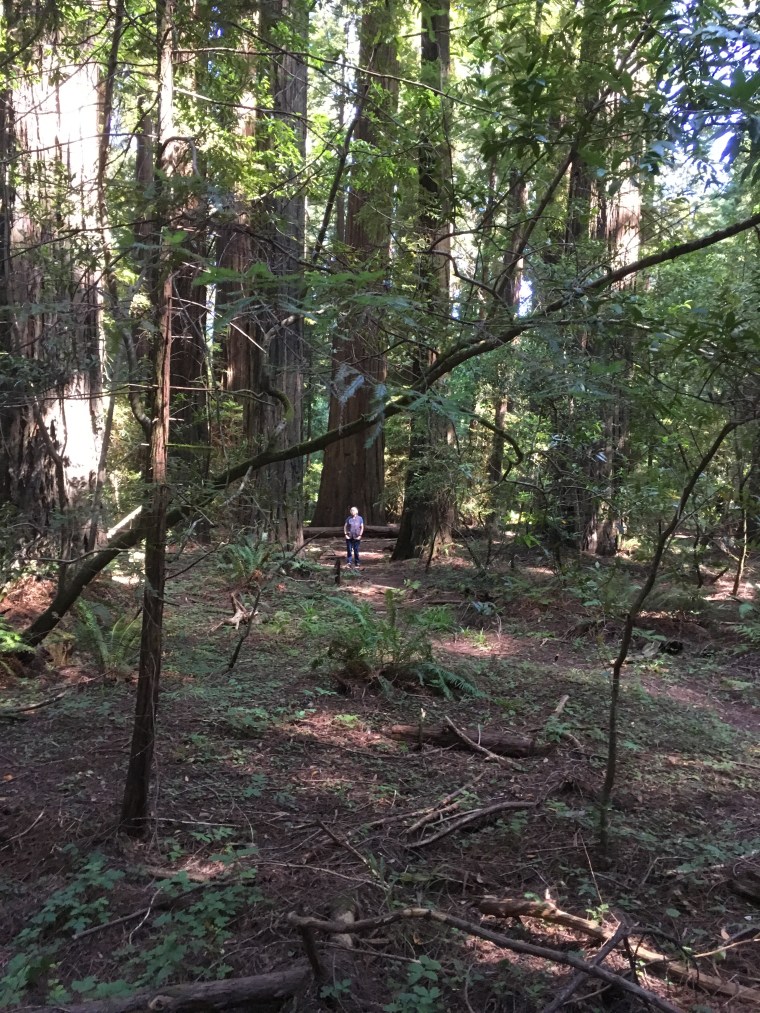
In her book The Soul of a Pilgrim, Christine Valters Paintner writes: “In the practice of hearing the call—whether it was a call we desired or one that was unbidden—we respond and assent to a new journey as pilgrims.” Since returning from California this summer, I’ve been pondering what it was that called me to journey three thousand miles to the Humboldt Redwoods State Park, and I’ve realized for the first time just how often trees have always called to me.

When I was a kid, I used to play in the acre or so of woods behind my house. There was one pine tree that especially called out. Pitch smearing my hands, I’d make my way a mile or more, it seemed, up to the top of that tree, where I would nestle into the friendly crotch, feel the wind gently rocking me, and watch the clouds floating just over my head.

How else to explain why I started out in college as a forestry major? I didn’t know anything about the science of trees. I wasn’t even that interested in hunting and fishing. Which I’m sure is why I hated my classes. But through that program, I worked for two summers in McCall, Idaho on a regional hotshot crew, fighting forest fires throughout the Rockies. Besides the thrill of a little danger, there were nights at six and seven thousand feet in Colorado and Wyoming and Idaho where the stars seemed so close I could reach up and grab a handful anytime I wanted.

Even then I recognized those moments as somehow holy, and they led, I think now, to my becoming an English major, with a special love for the Romantic poets and the American Transcendentalists. When I became an English teacher, I used to spend my Sunday afternoons walking in the woods of Down East Maine. The pungent smell of autumn leaves, the anthems sung by a June breeze through the spruce trees, the caress of the sun or the rain or the snow on my face called to something inside me: a vague concept I called God.

After my 18-year-old daughter died of cancer, I lived in southern Maine for twenty years in a house I bought from my grandmother. One of the things I loved and miss about living there was the maple tree in the back yard: a wonderful tree, a good six feet in diameter. I thought of it as my family tree, complete with a jagged limb where a large branch had been broken off in the Ice Storm of 1998, and which symbolized for me, the jagged scar on my heart left by the death of my daughter.

These days, I walk the trails through the woods preserved by Brunswick/Topsham Land Trust behind our condo and go for longer hikes with my wife Mary Lee through other stands of Maine trees. (Maine is called the Pine Tree State for good reason: ninety percent of the state is forested, the highest percentage of any state in the union.)

Trees, then, have always sung their siren song, and so it was just a matter of time before I made a pilgrimage to the oldest, tallest trees on earth. I’m still mulling over the lessons they taught and the gifts they gave.

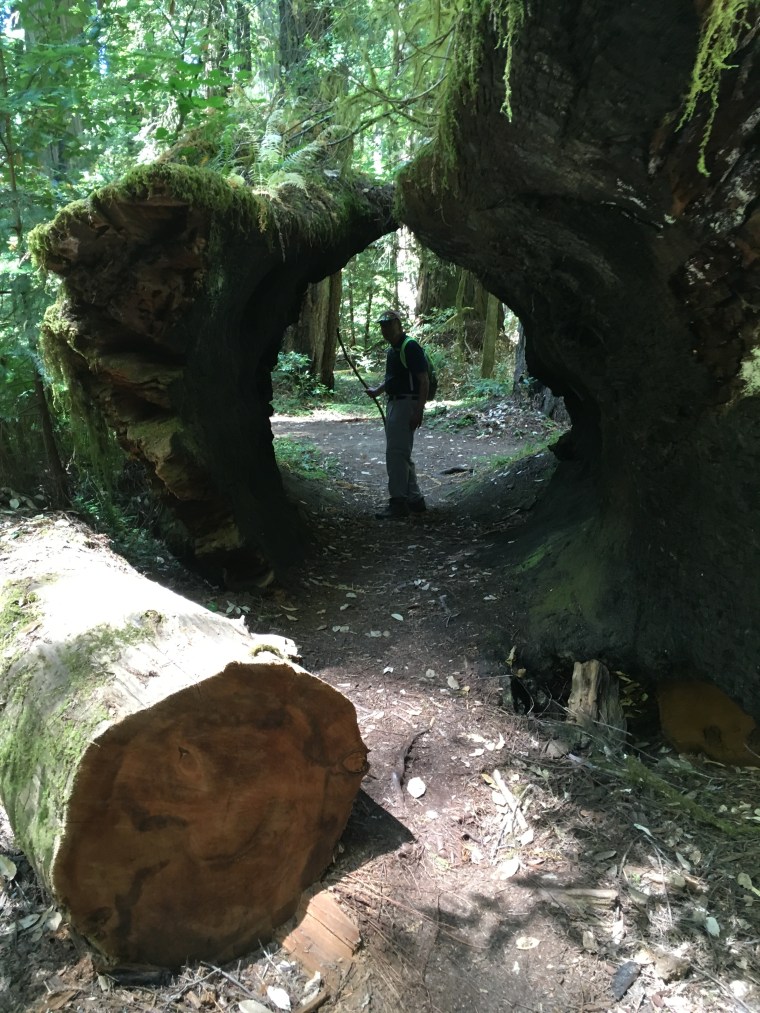
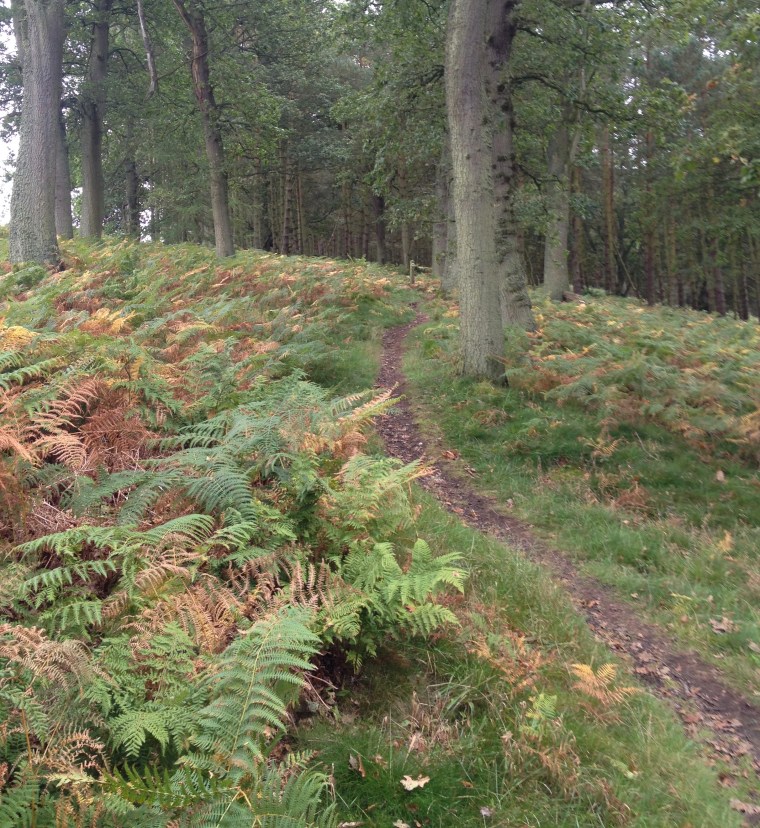
Redwoods are great teachers. Perhaps because of my forest fire fighting years, I noticed early in a seven and a half mile hike through the Rockefeller Forest in the Humboldt Redwoods State Park how fire had scarred many, if not most, of the redwoods Mary Lee and I saw. Yet they continue to grow and thrive. You may be scarred, they say, but you can still flourish. Redwoods don’t start producing branches until they’re some 150-200 feet high. Hey, you still have time! they proclaim. Even after falling, redwoods continue to produce new growth. They reproduce, not only through cones, but also by sending shoots up from their roots, which ring the trees. Eventually (and I’m talking 1500-2000 years) the parent dies, leaving behind a circle of great trees. What offspring will you leave to the world? they ask.

For trees as tall and as long-lived as they are, redwoods have a very shallow root system. Their roots, however, spread out hundreds of yards, where they intermingle with other roots from other redwoods—a network that keeps all of them standing tall. It’s an image, I realize, of the networks of support groups that have sustained me in the years since my daughter’s death, and what I will always need to keep upright and growing.

Redwood trees also resonate in me at a deeper level. They are magical, mythic—more than what I think of as “spiritual.” Age has something to do with it. The earliest redwoods began growing on earth just after the dinosaurs, about 240 million years ago. Some redwoods Mary Lee and I walked beneath were alive when Christianity was just beginning. Those circles of redwood trees I talked about earlier are called “Fairy Rings,” and I often thought of J.R.R. Tolkien’s Middle Earth. Early in our hike I found a branch that I used as a walking staff, which made me feel like Gandalf leading the Fellowship of the Ring or Merlin on his way to Camelot.

IMG_2176

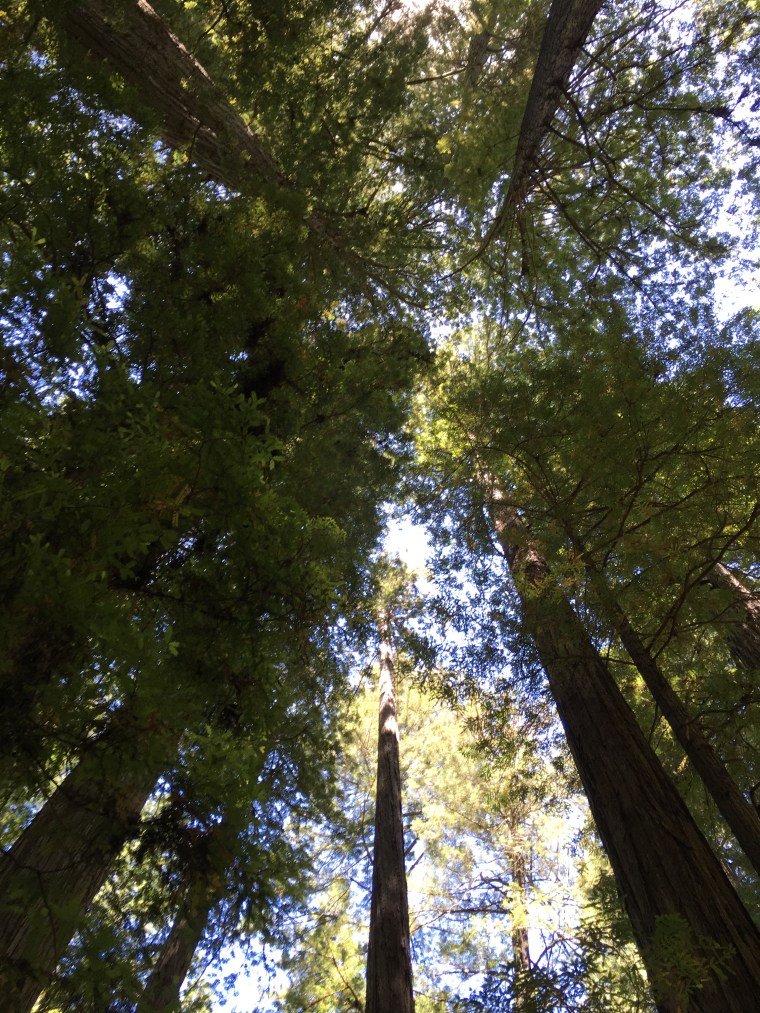
The light through the redwoods also contributes to this magical/mythical feeling. Hiking under the redwoods was like walking in a great cathedral, the trees like pillars reaching into the sky, the sun casting yellow and green shades of light through a stained glass canopy.

And I don’t recall ever experiencing such sustained silence. Any wildlife live three hundred feet overhead. The same with the wind. Because of the tannin in their bark, redwoods are not beset with insects (and thus, neither are hikers)—another reason the trees live so long.

And grow so high. If people don’t know anything else about redwoods they know they’re big. Still, I never appreciated their size until beholding them in person. Redwoods grow up to 378 feet high, which is over the length of a football field, and sometimes 20 feet or more in diameter (think the three-point line in professional basketball). And yet instead of my feeling small, defensive, or apprehensive, I was aware of an immense comforting presence watching over me, enfolding my problems, my defects—sins, if you will—and my grief.

I wonder if that presence isn’t always around me, and I’m too preoccupied to be aware of it until it calls me once more to pilgrimage. The redwoods, I now realize, had been calling me all my life.

IMG_2188

# #


The Wall Between

Viet Nam Wall


#

Almost everything I’ve read on pilgrimage says that preparing for the pilgrimage is part of the journey. There have been times in my life, however, when I haven’t prepared, when what started out to be a vacation or just a trip became a doorway to another dimension.

For example, it’s April 1987, and my wife Mary Lee and I are in Washington, D.C. visiting her cousin Peggy and sightseeing. We turn a corner somewhere around the Lincoln Monument and find ourselves beside a black granite wall. In the midst of the noisy city, I’m suddenly in a cloister of quiet. Maybe twenty-five people are walking slowly along the wall in silence. Many reach out tentatively to touch the wall, or trace one of the names engraved in stone. Some are weeping. A tall man with a white beard stands to one side, his arms wrapped around himself, as if holding himself together. His face is like marble. He does not move the entire time I’m there.

Obeying some kind of call I don’t understand, I walk down the cobblestones in front of the wall to the book that tells me where to find the name of my high school classmate, Bobbie Boyd. By the time I identify him—Panel 27E-Line 98: Robert White Boyd. 1LT-02. Died October 13, 1967—I am overwhelmed by the almost 60,000 names of those who died in the Viet Nam War and by my sense of guilt over how hard I worked the year Bobbie was killed to parlay a congenital back deformity into a 1Y deferment. Placing my hand against the polished black stone, I feel the solidity of the wall between those of my generation who served in the military and those who didn’t.

Thirty years later, I’m still on the other side of that wall. When the guys in the men’s group I go to who served in Viet Nam talk of their experiences, I shrink in shame. I wonder how much of my continued back pain is due to guilt rather than deformed bones. Still, I know that those who served in Viet Nam suffer far more than I for being on their side of the wall. Some guys talk about returning to the US after serving their country and being yelled at, spit upon. Several talk about depression. More Viet Nam veterans have now died by their own hand than died in combat, the result, many people think, of the way our society shunned them. And in his book Tribe, Sebastian Junger points out that since Viet Nam, the problem for returning soldiers has become even worse because more and more people in our society don’t want to acknowledge the ruthlessness and aggression needed for combat.

 vie7

A year and a half after visiting the Viet Nam Memorial, I found myself on the other side of another wall when my eighteen-year-old daughter Laurie died of cancer. I’ve written in earlier blogs about the isolating effects of grief. Certainly much of my isolation, especially my guilt, was self-imposed, but, as I’ve said before, even the most sociable parents find themselves isolated in their grief. Most people, at least most people I’ve come in contact with, don’t want to think about what it’s like to have a child die. Oh, they’re happy enough to read about parents who are raising money for scholarships in their child’s name or who are planting trees or building memorial gardens. They enjoy hearing stories of dying children cracking jokes or comforting their parents. Our society loves to hear of heroic struggles, determined resilience in the face of death. My experience has been that what society doesn’t want to hear about, any more than it wants to acknowledge the brutality of combat, are the sleepless nights, the irrational anger, the self-medicating, the tears, the shame. Even close colleagues and friends who are sympathetic at first can become impatient after a year or so. “Get over it,” I’ve been told. “Lighten up.”

My clearest memory of the wall between those who grieve and those who don’t comes from December 23, 2000. I know the date because it was the twelfth anniversary of my daughter Laurie’s death. That night I sat at a card table in the middle of the Maine Mall with Mary Lee, selling CDs to benefit the Jason Program, which provided pediatric hospice services for terminally ill children and their parents. Some of the artists on the album were performing in the circle where two of the main arteries of the mall come together. As the Christmas shoppers flowed by—teens in their oversized pants and undersized tank-tops, the guys in their baseball caps and leather jackets, the families, the occasional older folks looking tired and lost—they swerved, as if being jolted by an electric fence, when they saw the poster promoting the Jason Program, which featured the picture of a little girl (I can’t remember her name, but she had already died of cancer before the CD came out) in a bright red hat picking flowers. No matter where I placed the poster, it was as if there were a wall about five feet in diameter around her. Even people who bought CDs or made a donation to the Jason Program stayed away from the poster, as if the little girl’s cancer were a communicable disease.

IMG_2235

I have no clue how to tear down these walls, either between society and the increasing number of soldiers returning from duty with PTSD, or between those who mourn and those who don’t. The only thing I do know is that Robert Frost was right when he wrote, “Something there is that doesn’t love a wall.” Walls, it seems to me, are the result of our baser instincts—certainly mine, and probably society’s as well: guilt and shame, anger and envy, selfishness and fear—what psychologist Carl Jung called our “shadow side.” Jung advised his patients to recognize and acknowledge that we all have our shadow side and then work to overcome it. The Viet Nam Memorial was built in part to both acknowledge and tear down the walls between veterans and the country they felt they were fighting for. Organizations such as Compassionate Friends and Maine’s Center for Grieving Children (unfortunately, the Jason Program is no longer in existence) continue to work to raise awareness of how grief affects not just those who are suffering the loss of a loved one, but all of us.

I have to add that I, who usually avoid talking politics, can’t for the life of me see how building a wall around part of this country is going to do anything but give in to our shadow side and separate us even more than we already are. I spend enough time trying to climb over the walls we—and I’m as guilty as anyone else—have already erected. I don’t need another one, thank you very much.

# #


Joy and the Banjo

IMG_1834.JPG

#

Linus to Charlie Brown: “I feel sorry for little babies…When a little baby is born in this cold world, he’s confused! He’s frightened! He needs something to cheer him up…

The way I see it, as soon as a baby is born, he should be issued a banjo!

#

It was, as Lord Lytton wrote, a dark and stormy night. I sat in the Emery House chapel and listened to the rain beat upon the windows and the wind blow through the trees. I was beginning a weekend retreat, run by the Society of Saint John the Evangelist, called “Blowing Zen: Meditating with the Shakuhachi.” I didn’t know much about the shakuhachi except that it was a kind of flute. I was there because one of the facilitators of the retreat was Robert Jonas, who’d written a book about his daughter’s death, Rebecca: A Father’s Journey from Grief to Gratitude. A year or so earlier, I’d written Jonas, as he prefers to be called, a letter saying how his book had helped me after my own daughter’s death. He’d written back, we’d carried on a correspondence, and I wanted to meet him.

That first evening, Jonas and Martin Smith, Brother Superior at SSJE, both of whom played the shakuhachi, passed around several of the instruments and gave us a brief history lesson. Dating from the eighth century, the shakuhachi, or Zen flute, is made from bamboo root—hard as rock—and served as a weapon as well as a musical instrument for mendicant monks who wandered the countryside seeking enlightenment. These komoso, or “straw mat monks,” considered the instrument a religious tool, and gave primary attention to each breath-sound rather than to musical elements like melody. Their aim was to become, in the words of our handout, “a Buddha in one sound.”

We ended the first evening in meditation, while Jonas played a song called “Crossing Over,” which he said he’d had played at Rebecca’s funeral. I sat on my Zen pillow, eyes closed, listening to the mournful tones of the flute (If you want to hear a shakuhachi, go to You Tube), mingled with the sounds of the wind and the rain and the wind chimes. I focused on my breathing, missed my daughter Laurie, wondered what I would do with my life now that I was retiring from public school teaching, and missed Laurie some more. Then, suddenly, as Marlon Brando says in the movie Apocalypse Now, “…I realized…like I was shot…like I was shot with a diamond…a diamond bullet right through my forehead…”:

I wanted to learn to play the banjo.

#

I come from Alabama with a banjo on my knee.

—Stephen Foster.

#

A month later, I’m walking into a music store in a rundown strip mall in Portland, Maine. Two guys in ripped black tee-shirts are behind the counter and some kid with hair down to his ass is beating on an electric guitar. When I say I’m here for a banjo lesson, one of the guys behind the counter pinches some snuff from a round can, puts it under his lower lip, and points down a narrow aisle between racks of sheet music and guitar, mandolin, and banjo straps, picks, capos, and tuners. At the end of the aisle, I almost step on what looks for all the world like a pile of dog shit, and it is. A rubber pile of dog shit.

My first teacher is from West Virginia. Let’s call him Gid. He smells of pot and body odor and he says things like, “Hey, Man! What’s happenin’?” His three-month old daughter (“Man, was she a surprise!”) sleeps in a guitar case beside us. Gid starts me on what’s called claw-hammer style banjo, where my right hand is supposed to come down on the strings and hit the head of the banjo, almost as if I were knocking on a door. He is not so much concerned with hitting the right notes as he is establishing a rhythm. “Bounce, bounce!” he shouts, “Keep that rhythm going!”

I love it. Later, I will realize it’s because of being totally focused, completely in the moment.

#

I’m goin’ to a better world where everything is right…

where you never have to work at all or need to change your socks…

(American Folk Song)

#

Several years after I began playing the banjo, I went to “Banjo Camp North,” in Massachusetts. While the weekend was set up in much in the same way as the spiritual retreats and writers’ workshops I’d been going to—classes during the day, performances in the evening, informal get-togethers afterwards—instead of the silence of the spiritual retreat or the intense, cerebral focus of the writing workshop, just about everyone at Banjo Camp was loose and laughing. It was impossible to tell the instructors, even some of the nationally known musicians, from the students. None of them sat at separate tables during meals. Like the rest of us, they talked about their kids and their bills and their clogged toilets.

The second afternoon, I attended a workshop called “Singing with the Banjo.” I’ve always liked folk songs and figured we’d gather round and sing “Kumbya,” together. What I didn’t expect was that we were all supposed to solo. The closer it got to my turn, the more first my hands and then my entire body trembled. I tried to pass, but Peggy Seeger, one of the famous Seegers of folk music, give me this pep talk about how she’d learned early in her career that she didn’t have anything to prove, only something to share. So I shared my stage fright by stumbling my way through a hobo song (see above lyrics), forgetting some of the words, and butchering the chords. Still, I did get through it.

We kept going on around the room until a woman—her voice quaking in fear—began her song. About halfway through, she stopped, started to cry, and ran from the building. I sought her out the next day to commiserate. Turned out, she was a journalist, and we agreed that writers—at least writers like us—were observers, not participants.

#

What a long strange trip it’s been…

—Jerry Garcia

(Who, before he was a member of the Grateful Dead, played banjo for such groups as the Sleepy Hollow Stompers and the Thunder Mountain Tub Thumpers.)

#

Which, in a perverse sort of way, is why I’ve kept playing the banjo now for almost twenty years, performed with some local groups, even sung on occasion. For someone who spends the bulk of his time alone in front of a computer screen, who often goes on silent retreats, sits in silence gazing at his navel (although I prefer the term omphaloskepsis), and still daily misses his daughter, the instrument is a great antidote.

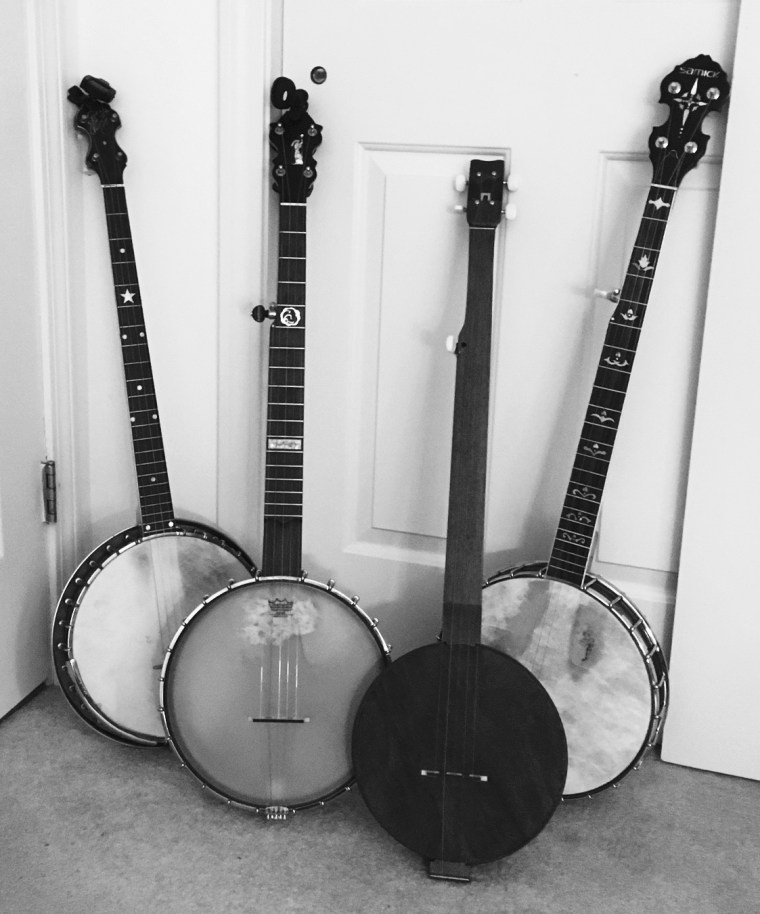
It’s also a great instrument for pilgrimage. First made from an animal skin tacked over a hollowed half of a gourd, with three or four strings stretched over a planed stick, the “banza” or “banjar” came to this country from Africa with the slaves, who played it in the same style that Gid taught me, and which I’ve stayed with. The banjo traveled across country with settlers and around the world on whaling ships (The banjo travels more easily than a guitar, as a matter of fact).

The banjo also brings a little humor to the journey. It was a comic prop in minstrel shows, and banjo players remain the butt of any number of jokes. To wit:

Q: What’s the difference between playing a banjo and jumping on a trampoline? A: You don’t have to take your shoes off to jump on a trampoline.

Q: What do you call a banjo player who’s just broken up with his girlfriend? A: Homeless.

Like humor, like most of my favorite kinds of music (including the shakuhachi, the instrument of homeless, impoverished monks and at least one grieving parent, Robert Jonas) the banjo has its roots in sadness and loss, yet blossoms in spontaneity and joy. In fact, I don’t think I ever knew what joy was until I began whaling away on the banjo, knew that, unlike simple happiness or contentment or pleasure, joy contains the element of sadness, of longing.

The Christian writer C.S. Lewis defined joy as “an unsatisfied desire, which is itself more desirable than any satisfaction.” I think what he’s describing is similar to being on a pilgrimage: the desire is to reach a destination, but the joy comes from the journey.

Do you suppose C.S. Lewis ever played a banjo?

IMG_2230

# #


Pilgrimage to City Lights

Image 1

June 25, 2016

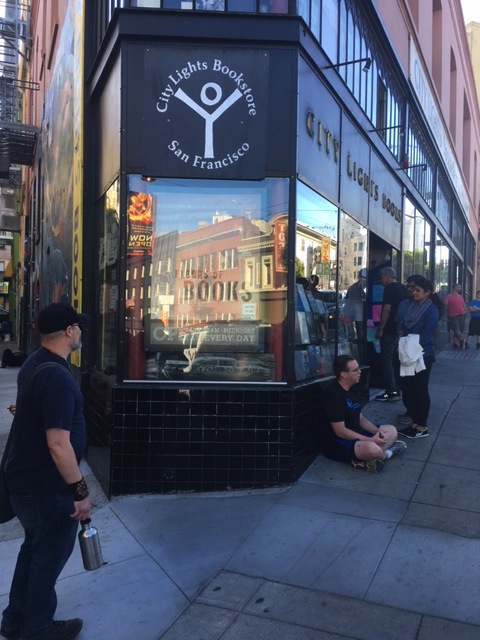
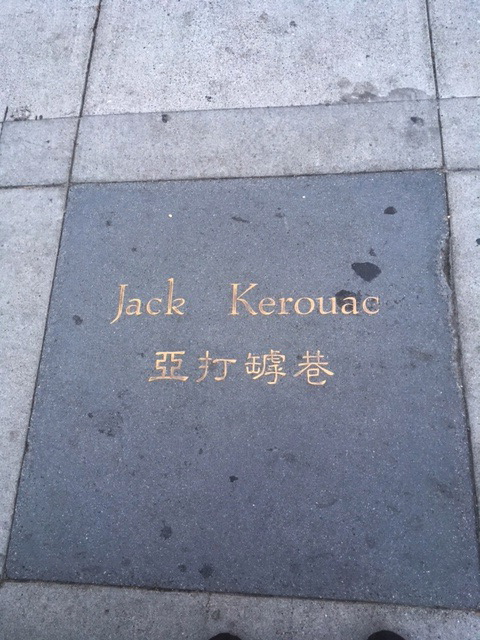
A pilgrimage needs a destination—a place where, as one writer puts it, God dwells. Having left Maine at 3:00 this morning to get by a bus and two planes to San Francisco, I find myself in front of one of my destinations, City Lights book store, known since 1953 as alternative culture’s literary landmark. I’m here because City Lights was a home for the writers of the so-called Beat Generation: Allen Ginsberg, Gary Synder, Lawrence Ferlinghetti, and the god at whose feet I once worshipped, Jack Kerouac.

Many readers see the road trips in Kerouac’s autobiographical novel, On the Road, as a series of pilgrimages, whose destination is, as one critic writes, “a limitless pursuit of possibility.” Certainly in the early 1960s, as I left adolescence and began stumbling along that dark and mysterious road to adulthood, On the Road was a beacon proclaiming that I could achieve anything I desired. A senior in high school, I made up my mind to leave behind the old farts, dumb parents, and dim-witted classmates who lived in the small Maine town in which I’d grown up, and challenge conventional thinking, search out new vistas. That summer, I left Maine for the first time in my life to visit the Smoky Mountains of Tennessee, and a year later, I found a summer job working on a hotshot crew out of McCall, Idaho, fighting conventionality as well as forest fires. When I returned to The University of Maine the following fall, I continued to pursue an inchoate image of myself as romantic hero—sitting in the back of the Bear’s Den in my black Frisco jeans, khaki shirt, and smokejumper boots, disdaining the guys in pinstripes and chinos, the girls in plaid skirts and white blouses, for being weak-spined conformists. I read Kerouac’s The Dharma Bums, identifying with the protagonist who works in a forest fire lookout tower in the Cascade Mountains of Washington State where I’d been on a fire. I switched my major from forestry to English, and decided to become a Great Writer.

Of course, like so many others of my generation, I was just dabbling in the Beat life. I didn’t participate in sex orgies—seldom dated at all—didn’t have peyote or mescaline visions (I’ve never even smoked pot), wasn’t rolled through the streets of New York in a barrel. It didn’t take more than a couple of years for my dreams of tooling down the road less traveled to wither away in a desert of loneliness, and for me to buy some chinos and pin striped shirts, get married three days after graduating from college, and become a high school English teacher.

Some twenty years later, however, when that marriage had become sterile and I found myself suffocating in my own pseudo-academic self-image, I reread On the Road—lying awake at night remembering the joy of driving across the country at 2:00 a.m., the endless cups of coffee, the third pack of cigarettes that day, my eyes burning like headlights cutting through the darkness. I began to recognize a spiritual component to the time I’d followed Sal Paradise and Dean Moriarty on the road: the highway stretched out straight and flat before me, my body tingling, free, filled with a combination of joy and longing.

And in some ways, I’ve come to City Lights to honor having extricated myself from that marriage and from that self-image, which I now think of as just one of my many false selves. I’m in California with the woman I never would have found if I hadn’t bucked conventionality, the woman with whom I have shared pilgrimages for the last thirty years. It’s our wedding anniversary and we’re celebrating by visiting San Francisco before heading north into redwood country.

Eyes itchy, stomach vaguely queasy from lack of sleep, I peruse the three shelves of books by and about Jack Kerouac, and decide, in homage, to buy a book I haven’t read, Big Sur. I take it to the checkout register, where a young woman with dyed black hair, pale skin heavily tattooed, and bright red lips, rings me up.

I give her my best Kerouac smirk.

Image 2

July 2, 2016

On the plane ride home, still trying to process the holiness of the redwoods, I read Big Sur, and notice facets of Kerouac I’d not noticed in my earlier lives. I see that what may have drawn me to him in ways that Allen Ginsberg and William Burroughs and Gary Snyder never did is the lower middle class New England background he and I share, a strong, even dominating, mother, and our inability to let go of early religious upbringing. I am also introduced to a Kerouac I’d heard about, but ignored: Kerouac the alcoholic.

Written some years after the author’s best-known works, Big Sur follows “Jack Duluoz” and his descent into alcoholism after the unwanted fame of On the Road. Using a cabin in northern California (the property of the owner of City Lights book store), as the focal point, Kerouac details his alcohol delirium tremens, his insecurities, his transient joys, his deep sorrows.

Many of the scenes show him to be nasty, self-absorbed, and combative, with occasional bursts of spiritual insight.

I can identify.

The day after my eighteen-year-old daughter Laurie died of cancer, I turned the guest room where she used to stay when she visited into a den, in which I spent the next three of four months drinking myself into a stupor and writing nasty letters to my former pastor, Laurie’s doctor, and the superintendent of schools. I kept a journal in which I railed against the evils of our society, everything from athletes using steroids to my students taking drugs to women getting Botox treatments to men popping Viagra. I ignored my wife and her son, shortchanged my students, made biting remarks to my mother and family and old friends.

And yet, unlike Kerouac, who died in his mother’s house at forty-seven from a massive abdominal hemorrhage brought on by booze, I’m now seventy-three, relatively healthy, and sober. In part, I’m sure the reason is that just as I was never really a hipster, I was never a full-blown raging alcoholic like Kerouac (or even my grandfather, for that matter).

But as I look over across the aisle of the airplane at the woman who endured much of my inebriated nastiness, I know there’s more to my story. Phillip Cousineau writes, in The Art of the Pilgrimage, “The story that we bring back [from our pilgrimage]…is the gift of grace that was passed to us in the heart of the journey.” I don’t know any other way to explain why, in the aftermath of Laurie’s death, I decided to leave that den, why Mary Lee and I have stayed married for thirty years, how I continue to find joy in my life, except through grace.

I certainly haven’t earned it.

And it’s this recognition that I take back with me from California, as well as a continuing sense of gratitude for Jack Kerouac. From him, I learned that contempt for conventional thinking is both necessary and healthy, and that life needs to be lived with passion. Learned this twice, in fact. But his life also teaches me that nonconformity is healthy only if it is grounded in faith in a higher power and free from solipsism and self-delusion. I’m no expert on Kerouac, but I think those weaknesses comprise his tragedy.

They’re certainly what keep me going on these pilgrimages.

Image

# #


The Inner Pilgrimage of Centering Prayer

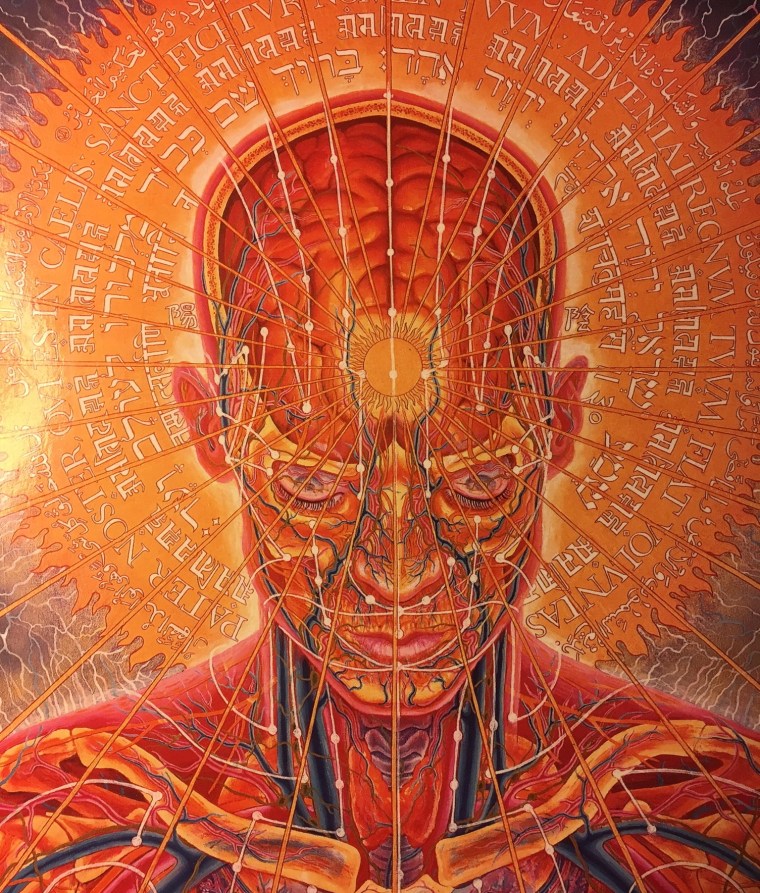
I("Praying," by Alex Gray, Oil on canvas, 1984)
(“Praying,” by Alex Gray, Oil on canvas, 1984)

#

“I felt the need of a great pilgrimage so I sat still for three days.”—Hafiz

#

As I’ve mentioned in an earlier blog (“Retreating,” November 30, 2015) some year and a half after my daughter Laurie’s death, I attended a program at my church called “Meditation as Part of the Christian Tradition.” That night I was introduced to Centering Prayer, a form of Christian meditation, and soon began a journey that’s been part of my life ever since—one winding through an interior landscape complete with mountains, valleys, deserts, seas, and cities.

For those of you who aren’t familiar with Centering Prayer, it differs from many other types of meditation in that the practice is “intentive,” rather than “attentive.” Instead of focusing on a word or various breathing techniques, you find a simple word such as ‘Abba,’ ‘God,’ or ‘Love’ to signify your intention to surrender to God, but don’t focus on it; you merely use the word as a pointer away from all the thoughts which will rush into your head. The idea is to sit, relax, and watch those thoughts pass by. When you find yourself (as you will, again and again and again) becoming attached to one of those thoughts, you use your sacred word to help you let that thought go.

Of course, this is a lot easier to describe than do. What’s kept me going, I think, is Centering Prayer’s emphasis on letting go, known in some Christian circles as kenosis, or self-emptying. Cynthia Bourgeault, Richard Rohr, and others tell us is that kenosis was what Jesus was trying to teach us. They quote Paul in Philippians: Jesus “emptied himself, taking the form of a slave ….”

Over the past twenty-four years, Centering Prayer’s embodiment of kenosis— self-emptying—has helped me travel grief’s rocky terrain, while letting go of the insidious false selves that want to trip me up along the way.

What do I mean by false selves? Father Thomas Keating, one of the early proponents of Centering Prayer, defines the false self as the self-image we develop in early childhood to cope with emotional trauma, and to satisfy our instinctual needs for survival, affection, and control. My experience is that even as adults, we continue to create false selves, especially in times of turmoil. After an emotional trauma such as the loss of a child, we grieving parents struggle to live with our pain. Out of our need for survival, we create a self-image that will help us pick up the pieces of our lives and go on. The problem is that this false self winds up exacerbating the pain. At least it has in my case.

In my efforts to make sense of Laurie’s death, to answer the question of why my up-until-now healthy, happy, beautiful, compassionate, intelligent, eighteen-year-old daughter had to die, I created an image of myself as Sinner. Having grown up in a religious background, and since I had divorced Laurie’s mother two years before our daughter’s diagnosis in order to marry another woman, I concocted a drama about a man who sells his child’s life to the Devil in order to satisfy his own lustful desires. I continued to embellish the narrative until I’d convinced myself that I had murdered my daughter, just as if I’d put a gun to her head and pulled the trigger.

At the same time, however, there was part of me that kept telling myself, “Don’t be foolish. Millions of fathers are divorced from the mother of their children and the children grow up perfectly fine.”

So that when I first began to practice Centering Prayer, I kept trying—unsuccessfully—to let go of my self-image as Sinner. Then, after three years or so, I found myself one day letting go not of my image of myself as murderer, but of censoring the thought—letting myself admit, “Okay, I will always feel that at some level, I killed my child.” It was if a two hundred pound rock had lifted from my shoulders. I learned that once I accepted the thought, it lost its power.

After letting go of my sense of self as Sinner, however, I encountered the second—and harder to destroy—false self: that of Bereaved Parent. What makes this self-image so hard to let go of is that parents who’ve lost children are bereft, suddenly isolated from most of our friends and colleagues. No one who has not lost a child has any idea what the pain is like, and frankly, no one wants to know. Add the fact that grief totally absorbs each person involved in it, and we find ourselves isolated even from others who are grieving.

What can happen is that we become comfortable with this self-image and begin to cling to it. After all, our grief is our link to our child, and letting go of the grief can feel like letting go of our child all over again. Suffering begins to define who we think we are. All the while, however, grief continues to eat away at us like a cancer.

Eight years after Laurie’s death, after several years of relative serenity, I found myself once again angry, guilty, often in tears. At a Lenten retreat, when my wife shared a poem she’d written about grief, I sat, enraged that she had written about MY story. Centering Prayer practice became like sitting at the edge of a black abyss, enveloped in a cold fog. Sometimes, I rose from meditation with tightness pushing at my temples; sometimes I got up shaking with cold.

Then, on Easter Sunday, I listened to a sermon focusing on the women at the empty tomb in Mark’s Gospel:

So they went out and fled from the tomb, for terror and amazement had seized them, and they said nothing to anyone, for they were afraid.

The priest focused on the fear that keeps many of us from entering into the joy of Easter, the fear of what the resurrection means to our understanding of the way the world works, to our security, even if it’s the security of our own suffering. An icy snake slithered across my neck and shoulders. Had I become secure, I wondered, possibly even happy in my vision of myself as Grieving Parent? Did I want my daughter only as memories pasted on the pages of a scrapbook? Did I want to keep the stone rolled in front of her tomb? I realized that if I were serious about my Christian faith, I needed to stop dwelling on old memories of my daughter, and trust that she too had become resurrected as a living, growing presence. I needed to let go of my vision of myself as Grieving Parent.

I’m not sure I’ve completely let go of that false self, but when I do, I find that I am hearing my daughter’s voice in my ear, feeling her hand in mine. She tells me that while death may end a life, it doesn’t end a relationship, a relationship, which, ironically, grows by letting go.

My various pilgrimages to retreat houses and other holy sites are, for me, manifestations of an inner journey. Each helps me understand the other. Each hopefully keeps me learning, growing, and moving towards my true self—what Keating calls the self as the image of God, “manifested in our uniqueness.” But each is also helping me let go: I’ve never yet been on a pilgrimage when I wasn’t humbled, wasn’t forced to let go of my inflated self-image.

As I age, as I’m forced to let go of my health and my height, my friends and my memory, as I contemplate having to let go of my life, I figure that’s pretty good practice.

Image 2

# #

Looking Back at Big Sur

If you look closely, you can see the New Camaldoli Monastery in Big Sur. It was never that clear when I was there.


#

“…we look back, with thanksgiving, in order to look forward. We cannot stand still. God is always calling us on to larger life.”

—Br. Geoffrey Tristram, Society of Saint John the Evangelist, “Brother, Give Us a Word,” June 6, 2016

#

One of the neat things about writing this blog is that I get to go back and reread old journals. If I’m doubly fortunate, I can see how far I’ve come—psychologically, spiritually—sort of like standing on a bluff looking back at the trail you’ve been traveling, realizing you can see a lot further than you once could. This week I’ve been looking back at my journal for August 7-12, 2005, when my wife Mary Lee, my brother Roger, and I stayed at the New Camaldoli Hermitage in Big Sur, California, some 1300 feet up into the Santa Lucia Mountains, overlooking the Pacific Ocean.

The first thing I notice is how often I write about the fog that lay over the ocean for almost all of the time we were there. We almost never saw water, only a bank of clouds that I kept trying to describe: a “blanket of white foam,” “a soufflé,” “like something from a dry ice machine,” “beaten egg whites,” “shaving cream,” “a snow field,” “a white carpet”—I’m not sure I ever did find the right words. During the day, I sat on my hermitage patio and looked down at the clouds, feeling like God looking down at an uncreated firmament. At sunset, the clouds rushed up the ravine, turning pink in the sunset before enveloping the hermitage in a dense, but somehow comforting, fog. One day, I quoted T.S. Eliot—“Only the divine stands firm/ the rest is smoke.” (“Or,” I added, “fog.”)

I think I took the Eliot quote from a book I read while I was at Big Sur. Paul Elie’s The Life You Save may be Your Own: an American Pilgrimage compares and contrasts the religious journeys of four American writers: Flannery O’Connor, Walker Percy, Thomas Merton, and Dorothy Day. Until I reread my notes, I’d forgotten quite how long the image of being on a pilgrimage has been part of my personal mythology—those stories I tell myself about myself.

And I never included Elie’s definition of pilgrimage with all the other definitions I’ve collected over the years. For the author, the pattern of his four subjects’ pilgrimages is “the journey to first hand experience.” Which helps me see the difference between those journeys I’ve been on when I’ve felt like a pilgrim, and those when I’ve felt like a tourist: when I’ve been a participant in an experience versus when I’ve been an observer of someone else’s experience.

#

I see that on August 10, I went to a “Collato,” which was a study with the Brothers at the New Camaldoli monastery of the following Sunday’s scripture readings. The gospel reading was Matthew 15: 21-28. A woman from Canaan—and thus, a non-Jew—comes to Jesus and asks him to heal her daughter, who is being tormented by a demon. Jesus tells her that he was sent only to “the lost sheep of Israel,” going on to say (somewhat cruelly, it seemed to me then and seems to me now), “It is not fair to take the children’s food and throw it to the dogs.” The woman replies, “Yes, Lord, yet even the dogs eat the crumbs that fall from their master’s table.” Apparently impressed, Jesus says, “Woman, great is your faith! Let it be done for you as you wish.” And as Matthew writes, “…her daughter was healed instantly.”

The discussion that followed was, I write, “heady.” The gathering of Brothers and guests referred to other passages of scripture, Biblical commentaries, even, my notes say, Jungian psychology. The big issue for the Brothers seemed to be if the woman really changed Jesus’ mind or whether he was testing her faith, which led to discussion of how divine Jesus was and how human.

I recall being bored with all the talk. The day before, August 9, had been my daughter Laurie’s birthday. She would have been thirty-five. She had been dead for seventeen years, almost as long as she’d been alive, and the story made me envious that the woman’s child had been not only healed but healed “instantly.” I remembered Laurie’s months of suffering from radiation, chemotherapy, her intense physical and emotional pain. Before I knew what I was doing, I became a participant in the discussion instead of an observer. “Do you realize,” I said, “how hard this story is for people whose children are suffering from disease, addiction, and mental illness, not to mention parents who’ve lost children? All this story does is imply that if we had more faith, our children would get better. I don’t need any more guilt, thank you very much.”

My journal notes that none of the Brothers seemed to want to deal with my question, but that one of the other people there, a pastor from San Francisco, stopped me later and said I’d given him the basis for his sermon the following Sunday. (I’m sorry now I didn’t think to ask him to send me a copy of what he’d said.)

What strikes me today, however, is that these stories of Jesus’ healing, of raising children from the dead, no longer make me angry. I don’t know when it happened, but sometime within the last eleven years (Laurie’s forty-sixth birthday is coming up this summer. Good Lord!), I started to think of the healing stories in the Bible as moral lessons, not necessarily historical facts—as dramatizations of a larger Truth: God heals our children, and us, for that matter. The healing may not take place in this lifetime, but it will come. And faith, I now believe, lies in believing, accepting, waiting.

Am I still angry that my child suffered? That she died before she’d ever really lived? Absolutely. But somewhere along my “journey to first hand experience,” this anger seems to have been enveloped, sort of like the white clouds of fog that climbed the ravine from the ocean to the monastery at Big Sur every night, wrapped now in a blanket of—dare I say it?—love.

Image 3

# #

Baseball as Pilgrimage

I'm the third kid on the right, front row, beside Harry Agganis
Fenway Park, 1954: I’m the third kid from the right, front row, beside Harry Agganis

#

Every year, millions of people make a pilgrimage to see their favorite baseball team. I’m sure most of them don’t think of taking in a ball game as pilgrimage, but as with all pilgrimages, going to a game often at some level involves making a journey that is both physical and spiritual, taking risks, paying homage, and searching for a source of healing and renewal.

It’s possible, then, that the first pilgrimage I ever took was to Fenway Park in 1954 to see the Red Sox play the Detroit Tigers. I remember the ride to and from Boston was interminable, Fenway Park was huge, Red Sox first baseman Harry Agganis (who would die a year later of a pulmonary embolism) looked like a god, and I ate lobster at a restaurant on the ride back, courtesy of my little league coach, a saint named Frank Knight (who would live to be 103).

I was reminded of my early love of baseball a few weeks ago when I started reading Dingers: The 101 Most Memorable Home Runs in Baseball History, by Joshua Shifrin and Tommy Shea. I’ve had the good fortune to have shared coffee and conversation with Tommy Shea, who was a reporter for the Springfield (Massachusetts) Republican for forty years, including six years covering the Red Sox, and whose very being exudes the joy I once felt about the game. (Nobody’s perfect, however; Tommy is a Yankees fan.)

#

 I hit two dingers in my baseball career. The first, in little league, cleared the fence and almost hit my family’s car. The second, when I was in what was then called junior high school, disappeared into the fog blowing in off Cape Elizabeth, Maine, but since there was no fence, I had to run it out. I run like a wheelbarrow, so I barely beat the throw home. Still, I thought I had won our team the game, until Ronnie Bancroft, the Cape third baseman, tagged me after I’d crossed the plate, and the umpire called me out. “Sorry, son,” he said, “but your foot missed third base by a good two feet.” (For those of you who don’t know much about baseball, the runner must touch every bag before touching home plate.)

So much for my making it into Shifrin’s and Shea’s book.

But one of the home runs that did make it into the book—Shifrin and Shea rank it as the fifth most memorable home run in baseball history—is Kirk Gibson’s game winning home run in the 1988 World Series against Hall of Fame relief pitcher, Dennis Eckersley. In fact, Dingers features on its cover what has become an iconic picture (so iconic that I can’t find one to post that’s not copyrighted) of Gibson, hand raised over his head in victory.

I remember Gibson’s homerun even more than I remember my own. His took place on the October weekend when my wife Mary Lee and I were visiting my eighteen-year-old daughter Laurie in Ellsworth, Maine. That spring, Laurie had been diagnosed with Primitive Neuroectodermal Tumor, a virulent cancer. Over the summer, chemotherapy and radiation had shrunk the tumor and we were hopeful, but in September, while she was walking a beach, her leg collapsed under her, and since that time, the only way she could walk was with a walker. In continual pain, my daughter was trying to remain positive, living at home with her mother, working on various art projects and designing placemats for a new restaurant in town, but she was discouraged and afraid, often dissolving in tears as she talked with me on the phone. To give both Laurie and my ex-wife a break, Mary Lee and I drove up for the weekend, rented a motel room, and took Laurie to stay with us.

On Saturday afternoon, we drove around Hancock County looking at foliage until a freak snowstorm sent us back to our motel. That evening we went to the new restaurant that featured Laurie’s placemats, but my daughter’s leg pain grew so bad that we couldn’t finish our meal. Mary Lee and I had to carry her out to the car.

Back at the motel, Laurie lay down on our bed, closed her eyes, and, I thought, fell asleep. I turned on the television just in time to see Gibson, of Los Angeles Dodgers, who hadn’t been in the game because of a severely strained hamstring in one leg and a bad knee in the other, come to the plate as a pinch hitter. The Dodgers were behind the Oakland Athletics by one run in the bottom of the ninth inning. They had a man on first base, but there were two outs. With a count of three balls and two strikes, Gibson, with what Shifrin and Shea describe as “an awkward upper body swipe,” hit his home run. As he limped around the bases, pumping his fist, and one talking head after another extolled his courage in the face of pain, I heard Laurie say to Mary Lee, who lay beside her on the bed, “I know this cancer might—probably will—kill me, but hopefully not for years. I need to make the most of whatever time I’ve got left.”

I looked at my daughter, her bright red bandanna and matching socks, her eyes sunken, her face drawn by pain. Those assholes on TV have no idea what courage is, I thought bitterly.

#

And there’s part of me that still feels that way. I’m certainly not the first person to complain about how we have glorified beyond reason sports and deified grown people playing games. But like pilgrimage, sports—and I would say especially baseball—is a way to encapsulate the human journey in a few hours. We fans travel to what one of my favorite movies calls our “Field of Dreams,” and the players themselves try to get, as we all do, “Home,” where, as James Earl Jones says in the movie, “… what once was good … will be again.”

Home is where my daughter went less than three months after Gibson’s dramatic “dinger.” Now that I’m in my seventies, it helps to see myself rounding third base (making sure to touch it this time), heading to join her.

Fenway_Park02

# #


Finding Thomas Merton

IMG_2312

I come out of the woods and cross Monk’s Road to another road that says “No Trespassing.” I’ll bet this is it, I think, and decide I’ll be damned if I’m going to travel two thousand miles not to see the hermitage of Thomas Merton, the closest thing to a hero I’ve had since John F. Kennedy.

When my wife, Mary Lee, first introduced me to Merton’s writings, I knew some of his story—cosmopolitan young man and promising writer leaves New York, enters the monastery here at Gethsemane and becomes a Trappist monk—but I didn’t understand much of what he wrote. Then, when my daughter was lying in the hospital, dying from cancer, I hated what I thought I did understand. I remember one night at the Ronald McDonald House reading from New Seeds of Contemplation—“All sorrow, hardship, difficulty, pain, unhappiness, and ultimately death itself can be traced to rebellion against God’s love for us”—and throwing the goddamned book across the room.

Ten years later, however, as I recovered from bilateral hip surgery, I read Merton’s autobiography, The Seven Storey Mountain. This came at a time when I was starting to feel that after thirty years in public education, it was time for me to do something else. But what? Merton showed me that I should start living the life I wanted to, and trust that God would reveal some way to make it work. So I began writing—took a summer workshop, joined a writing group—became more active in my church, started going on spiritual retreats. And it worked: I retired from public school teaching, found a part-time job as a writing assistant at a nearby college and worked on my writing, which soon became tied to my discovery of contemplative prayer, where Merton became my guide through books such as Conjectures of a Guilty Bystander, The Secular Journals, Selected Poems, Wisdom of the Desert, Raids on the Unspeakable, Zen and the Birds of Appetite. I even reread New Seeds of Contemplation.

Now, I’ve made a pilgrimage to Gethsemane Abbey because I’m again struggling, both with my writing and with the rest of my life. After years of working on a memoir about the death of my daughter and my resulting faith journey, I’ve realized I still don’t have the perspective to analyze the years since Laurie’s death that a good memoir requires. I’ve decided to turn the memoir into a novel, in the hopes of distancing myself from the events as I change them to suit the arc of the story. But someone whose opinion I value wondered recently if I’m not stuck in the past, unable to let go of Laurie’s memory and my grief; and I’m worried that he might be right—that I’m wasting both my time and God’s with my writing instead of doing something more active, such as teaching a class at the state prison, doing more pastoral care, working in the soup kitchen or with Compassionate Friends.

So far, this pilgrimage hasn’t helped me find any answers. Ever since Mary Lee and I have been at Gethsemane, I’ve felt like an outsider, a tourist instead of a pilgrim. As a non-Catholic, I haven’t been able to take communion. Merton’s hermitage, where he wrote so many of his books, is, I’m told, off limits to visitors. Late September in Kentucky is hot. The air smells charred. Leaves are chewed and full of holes, tinged with brown or black. In the afternoon, storm clouds mass over the burnt-brown hills like an army preparing to attack.

My only consolation has been reading in Merton’s journals about how often here at Gethsemane, he, too, felt like an outsider, how often he questioned his life, whether he ought to be writing, even whether he ought to be a monk.

Then, yesterday afternoon, as I sat under a tree beside the cemetery of white crosses where Merton is buried, I read a journal entry in which he writes about how he’d found his “deepest self” through a “creative consent to God.”

I’m not sure what that means, but this morning I’ve been on “A Walk to the Statues,” along a stone walkway leading to a field, past a lake, and up some wooden stairs to a path through the woods, where I passed a variety of statues—some modern, some traditional—of cherubs, monks, and a variety of Madonnas.

IMG_2284

Turning a corner, I saw two statues depicting Jesus and three of his disciples in the Garden of Gethsemane. (And if you’d like to see and read more about these statues, see my earlier blog, “Locked in the Garden of Gethsemane.) At first—probably because of my mood over the last few days—I identified with Jesus’s feeling despised and forsaken. But then I saw on a rock, a bronze plaque explaining that sculptor Walker Hancock created these two statues in memory of Jonathan Daniels, an Episcopal divinity student who was martyred in Alabama in 1965.

Suddenly, I remembered the end of poet Gregory Orr’s memoir The Blessing, when eighteen-year-old Gregory, still suffering the trauma of having accidently killed his brother in a hunting accident, beholds artist David Smith’s almost three hundred sculptures arrayed in long rows across a field, and sees in them the human spirit rising up, trying to transcend the limitations of our mortal, human bodies and at the same time trying to celebrate them; and how Orr realized that language, too, can transcend death by giving it shape. Poetry, Orr wrote in another essay, “sustains us in crises…[as] “…an expression of your experience with disorder and your need for order.”

And I realized that by giving shape to my grief, my writing was helping me stay alive: that I couldn’t not write. What might or might not happen to anything I wrote afterwards wasn’t up to me. Jesus’s words from that night in the Garden of Gethsemane came back to me, “Yet not my will, but yours be done.”

Maybe, I thought, this is the kind of “creative consent” Merton was talking about in his journal.

Which made me feel better, and which has prompted me to follow this forbidden road behind Gethsemane Abbey, figuring I can plead ignorance—“Oh, am I trespassing? I didn’t see the sign”—if anyone comes along.

I come to another turn off, this one marked “Monastic Enclosure.” I decide not to push my luck and keep going until I come to a power line. I follow it and then double back through the woods to a clearing. Yes! I recognize from photographs that I am indeed looking at Merton’s hermitage. Wiping the sweat from my eyes, I take a picture.

IMG_2298

I turn to see the fields and the barn and the monastery grounds that he wrote about from where he saw them—memories I will take home with me both for the strength and solace to continue writing and for the serenity to accept whatever happens to it.

I head back to the power line. I suppose I should pray, Forgive me my trespasses, but I’m not very sorry. Somehow, in finding Merton’s hermitage, I’ve found something in myself.


# #


Inside a Self-Directed Retreat

IMG_2026

#

Let me get this straight—you’ve come to another crossroads. Okay, it’s more like a rotary, with about four different directions you can go with your life. And you can’t make up your mind so you go round and round. You carefully consider each turn off, each option, but they all look equally desirable or undesirable depending on the time of day. You stare at the scenery, pulling on your lower lip. Round and round and round.

You decide to stop and get away from it all, so you go on retreat to a hermitage in the New England countryside, close to nature. But what do you discover? Nature can’t seem to make up his/her/its mind either. It’s April. The sky wavers between dark clouds and bright sun. Driving here, you stop at a light and watch somebody wearing a down parka pulled over his or her head walk past a guy wearing shorts and a T-shirt.

You reach the hermitage and it’s the same ambivalence. The fields are green; the trees are bare and brown. Looking into the woods, all you see are dead leaves, while beside your porch, yellow daffodils wave in the wind. The first night you walk along a tidal river. Standing on a bridge, you look to your right and the river is full, reflections of trees etched on the water. Turning to your left, you see the water drained away, leaving mud, broken tree limbs, and more dead leaves.

The next day is worse. Most of the day is hot—94 degrees according to the thermometer outside the main guest house—with a southwest wind that must have blown directly from Arizona. Until suddenly, in late afternoon, the wind suddenly shifts to the east and picks up, bending the spruce trees and churning the river into white caps, and you’re shivering and trying to find a sweatshirt. The sky darkens and for about ten minutes, a cold rain falls. Then the wind dies, the sun returns, and it’s spring again.

None of which helps you make up your mind.

Let’s walk by the river on this carpet of dead leaves. See, sticking up through all that brown—green shoots. Kick some of those leaves aside and what do you find: more green. Has it ever occurred to you that Nature is not indecisive? That what you are witnessing is the evolution of winter into spring, a process that doesn’t happen in any kind of linear progression, but which ebbs and flows like that tidal river in front of you. Look up. Into the trees. See? Today’s heat has brought out the leaves in the birch trees, like tiny green butterflies fluttering on the branches.

It’s April. It’s the Easter season. In Sabbatical Journey, Henri Nouwen writes:


The resurrection stories reveal the always-present tension between coming and leaving, intimacy and distance, holding and letting go, at-homeness and mission, presence and absence. We face that tension every day. It puts us on the journey to the full realization of the promise given to us.


Have you considered that on this journey—this pilgrimage, as you like to call it—we are always in the process of becoming? That we’re always facing decisions, one rotary after another? That there is always tension? The promise of Easter is that you are loved, no matter what you decide: “and lo, I am with you always; even to the end of the age.”

Look, you’re not going to reach a decision about what to do with your life here on this retreat, but you might realize that what seems like inaction and indecision is actually a time of germination and growth. Your decision will come, as surely as the leaves will burst from the branches of the maple trees around you.

In the meantime, look at those trees along the river outlined against the sunset. See how their fine, bare branches fan out like a net one might cast into the sky, perhaps in hope of catching a few stars. Watch the blue sky turn to gray and the pink clouds darken to red. Listen to the chorus of birds. Look at how the houses on the opposite shore send chalk-lines of light across the river. See the new moon.

IMG_1609


# #

Healed Doesn’t Mean Cured

Image 1

Pilgrimage is … an act of devotion to find a source of healing ….”

—Phillip Cousineau, The Art of the Pilgrimage,

#

Right after my parents bought our first television set in 1953, our family watched everything from test patterns to evangelist Oral Roberts sitting in a tent healing people’s various medical misfortunes—you name it: tuberculosis, speech impediments, polio (“Praise God, Billy Ray, I can feel the stiffness leaving your little foot!”). Since my father was skeptical (What he said was that the show was a crock of shit), I too doubted the healing power of the prayer.

But I never felt strongly against the idea that faith can cure disease and other afflictions until my eighteen-year-old daughter was diagnosed with cancer. The object of my most intense anger was not TV evangelism, but the alternative health industry. I recall sitting by Laurie’s bedside in the hospital, reading ads to her from a glossy magazine she subscribed to for Royal Jelly, Ayurvedic Ginseng, and macrobiotic hair care, “Refreshing Summer Seaweeds,” “Non-toxic Alternatives to Mercury Fillings,” and “Curing Infertility through Chinese Medicine.”

One afternoon, she wanted me to read an article titled “Alternative Cures for Cancer.” The gist of the article was that rather than “deadly chemicals and mind-altering drugs” (I remember those words), the best way to cure cancer is with a healthy, positive self-image built on faith and love. I think the article posited that eighty to ninety percent of all cancer is preventable.

When I finished reading, I heard a thick voice slurred by morphine: “I’ve tried … to be positive … but I guess I’m just not strong enough … I wish I weren’t such a wimp.”

Her words still haunt me. Bad enough that my daughter had to die, but for her to feel that it was somehow her fault because she didn’t have enough faith fills me with rage. Over the twenty-eight years years since Laurie’s death, I have walked out of a teacher workshop on “Wellness” in order to write angry letters to my principal and superintendant on the dangers of trying to teach what I saw as unrealistic expectations. I have seethed at Biblical stories of Jesus bringing some people back to life, while others die. And I remember grinding my teeth after 9/11 when a parishioner at the church I attend publically thanked God for saving her son who worked in one of the twin towers.

“What about the other 7000 who died?” I muttered to my wife. “What did God have against them?”

My attitude began to change, however, after Mary Lee and I attended a healing service on the Island of Iona, in Scotland. The pastor began by saying that we need to remember that healing doesn’t mean curing. The word “heal,” he said, comes from the word “whole,” and he believed that God’s purpose for us all is a life of wholeness. The healing service, he said, was not about changing God, but about learning to trust God, even as we don’t know when or how or what kind of healing will happen.

Gradually—very gradually—I’ve begun to understand his distinction. For example, when Mary Lee and I started training for our pilgrimage along Saint Cuthbert’s Way, the sixty-two mile hike from Melrose, Scotland to the island of Lindisfarne off the Northumberland coast, we both experienced back, hip, hamstring, calf, ankle, and foot pain. I have two artificial hips. The latest CT scan of my back has revealed severe narrowing of the lower thoracic disks, “vacuum disc phenomena,” severe narrowing of L2-L3 disc, “degenerative hypertrophic bone,” “mild compression, mild spinal stenosis, ossification,[and] lower lumbar facet degenerative disease.” I’m not sure what all that means, but I do know I’m four inches shorter than I was in high school. Mary Lee has had her right foot completely reconstructed. One of her shoulders is higher than the other because of scoliosis, and she has suffered from allergies and thyroid trouble.

And you know what? After walking the 62 miles of Saint Cuthbert’s Way, we still hurt. Neither my back nor Mary Lee’s miraculously straightened. My wife’s allergies didn’t go away. No amount of walking could cure the fatal disease of being human.

And yet, we returned from our pilgrimage feeling more than the rejuvenation one feels when returning from a vacation, or even from most of our retreats. We’ve bought bicycles, we’ve climbed some mountains, and recently taken up snowshoeing. I’ve tried to incorporate the walking meditation I practiced along St. Cuthbert’s Way not only into my daily walks around town but also into washing dishes, vacuuming the house, and sitting through this election’s political mud-slinging.

I think distinguishing between being cured and being healed is even more important when talking about grief. Over the years, a number of people have asked me if the pain of losing Laurie has become less. My answer lately is that my grief isn’t any less, but it’s less important. I still cry when I think of my daughter, I’m still angry at God for creating a world in which innocent children suffer and die, and I still feel irrationally responsible for her death, either because of what I did or what I didn’t do.

But at the same time, I am no longer consumed by anguish. I no longer base my identity on being Grieving Parent. My sadness, anger, and guilt have become enveloped, maybe even embraced, by something larger. I am more whole now than I probably have ever been, even if I’m not cured of wanting to watch my daughter become an adult, of talking to her on the phone, or of seeing her interact with my grandchildren, maybe even with children of her own.

Hell, I’m not cured of wishing I were 6’2” again.

IMG_1359

# #