The Annual Pilgrimage

  • fullsizeoutput_120f

In the 1950s and 60s, high school basketball was the king of Maine sports. Communities rallied around their teams and the twice-weekly games were the social events of the season. Fights broke out, tires were slashed, romances—even marriages—began and ended before, during, and after the games.

One of the highlights, not only of the winter, but of the year, were the high school basketball tournaments. Not only did schools shut down for the week, businesses closed. Some townspeople took their vacations in February, not to fly to Florida but to drive to Lewiston, eat at Stickino’s Restaurant, and watch the Western Maine Basketball Tournament at the Memorial Armory.

I first heard the call to become part of what I now think of as the annual pilgrimage to Lewiston in the eighth grade, when I began playing basketball. By the following year, while I might have gone to church on Sunday and listened to my pastor and next-door neighbor, Scotty Campbell, tell us about a loving God, my real worship service was in my backyard, shooting my new yellow Voit basketball into the hoop my father had put up over the garage door. My scriptures were the sports pages of the Portland Press Herald and the Portland Evening Express. My icons the pictures I cut from Sport magazine: Hot Rod Hundley, Jungle Jim Loscutoff, Bill Russell.

The twenty-six-mile drive from Yarmouth to Lewiston took us small-town kids into another world: a city of bright lights and dark alleys, where everyone, it seemed, spoke French, and tall spires of stone churches loomed against the horizon. The Memorial Armory itself, built in 1922-23, also stone, cavernous, inspired an even greater feeling of awe.

But as with any good pilgrimage, it was the journey itself that was as important as the destination. Riding on the team bus, I learned about sex (even though at least half the information was wrong), what makes a good joke, and any number of songs. I learned how to hold my own swapping insults—what we called “cutting”— and I made friendships that continue to this day.

The first time I walked into the Armory, I realized at some level I’d crossed the threshold into what today I would call liminal space—out of ordinary time, neither past nor present nor future. The smell of smoke, sweat, and popcorn was like incense to my nostrils. My ordinary life—my family, my interests in music and reading, even my fantasies about girls—dissolved, and I was completely in the moment, focused only on the other team, the basketball, the basket.

In those days, the Western Maine Basketball Tournament was comprised of eight teams each from small, medium, and large schools. The teams with the best win/loss records played those with lesser records, with the winner going on to play other winners until there was only one winner left: the Western Maine Class S, M, and L Champions, who would then face the Eastern Maine Champions in the even bigger cities of Portland or Bangor. Every game was a 32-minute morality play, complete with heroes—our guys—and villains—their guys. There were always upsets, increasing the drama. And, of course, there were more losing teams than winning ones: one of life’s great lessons.

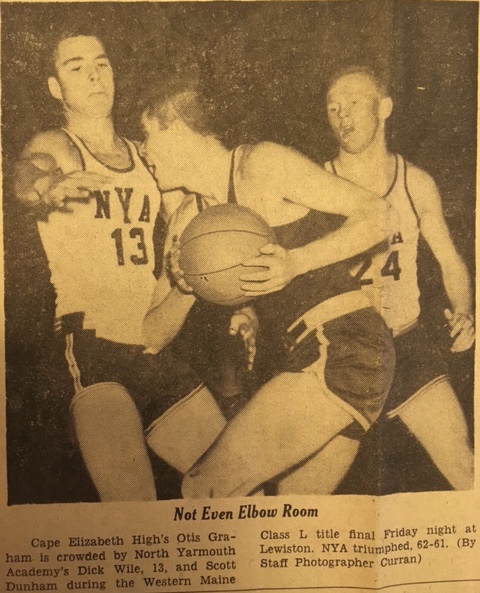
Pilgrimage is about dealing with disappointment, learning from mistakes. It’s interesting to me that during the four years I played basketball for North Yarmouth Academy, the town’s high school at the time, our team lost no more than maybe a dozen games, and yet I remember the losses far more than the victories. For three years, NYA won its first tournament games and then met Freeport in the Western Maine Finals, where we lost every time. During my senior year, we finally beat Freeport, as well as all the other teams we faced in the Western Maine Tournament, besting Cape Elizabeth to win the Class L Championship. I remember little about any of those games. What I do remember vividly, even 56 years later, is our loss to Orono in the State Championship. I can tell you the score—74-52—as well as where I scored each of my 10 points—one long jump shot to start the game, two foul-line jump shots, one put back off a rebound, and two foul shots.

Pilgrimage, however, is also about beginning again. For me, the next basketball season started the day after the tournament ended. I estimate that during my four years in high school, I had a basketball in my hand 350 days a year. I was always looking ahead to the next year. Playing basketball gave my life a meaning and a purpose. It gave me hope.

One reason I had such a hard time adjusting to college was that once I stopped playing organized basketball, I no longer had the next season to look forward to, nothing to work towards. This turned out to be a great lesson, one I’ve needed, still need more than ever these days: for serenity, I have to have a goal—some kind of basket, if you will—to shoot for.

As a teacher, I continued to attend the high school tournaments, now as a spectator, watching the game change, observing some of my former opponents in the crowds or refereeing the games. And I still watch the occasional tournament game on Maine’s Public Television channel.

I watch as some people go to church occasionally, as reminders of how the experiences of my youth have molded me. For example, there was always a spiritual component to basketball for me. Those many hours I spent shooting my yellow ball into the make-shift hoop—the sense of first extending and then leaving myself, as if the ball were part of me, so that releasing the ball toward the basket was like soaring into the air, leaving the secular world behind—I see now as precursor to years of meditation.

And after my daughter died from cancer, I found myself thinking of Mr. Beal, my first basketball coach, and the way he had driven me. I heard his voice sometimes in the morning, “Come on, Wile, move it!” and I began to think of my grief as a basketball opponent, one I needed to work as hard to defeat as I had had to work to beat Freeport.

Except for some rural parts of the state, basketball is no longer king of Maine sports. Hockey, football, soccer, lacrosse—both men’s and women’s teams—all draw big crowds. A good thing, I think. (People who talk about the good old days seem to forget how few opportunities there were then for women to participate in much of anything except cheerleading.)

And while I’m sorry the Lewiston Armory no longer hosts high school tournaments, I’m glad to see it is still hosts recreation programs, gun shows, the “Androscoggin Falls Angels Roller Derby League,” and, once a year, large numbers of the Somalis now residing in Lewiston who gather to celebrate Eid al-Fitr, the end of Ramadan.

Nice to see that the Armory remains a destination for pilgrims.

ArmoryPhoto-720dpi_420x280_thumb

# #

Negotiating the Past

IMG_1184

#

I suspect the past

does not resemble its photos.

—Richard Hoffman

#

So I was all set to call this week’s blog, “Past as Prologue.” My first paragraph was going to tell you about the second day of a seven-day walking pilgrimage along St. Cuthbert’s Way, when, still apprehensive about being able to complete the 62-mile trek from Melrose, Scotland to the Holy Island of Lindisfarne off the east coast of England, I looked back across a newly mown field to the Eildon Hills my wife Mary Lee and I had climbed the day before and thought, Hey, I climbed those. I can do this!

In the next paragraph, I’d planned to quote one of the Brothers at the Society of Saint John the Evangelist, who said in a homily that hope is not about the future so much as about the past: that it is from our past experiences we gain the strength and the knowledge to give us hope for the future.

From there I figured I’d continue with all the ways my past has helped me deal with everything from canceled plane flights to the death of my daughter to the challenges of aging.

And then this skeptical voice in my ear said, Wait a minute. Are you sure the past has always been that helpful?

I recalled how when Mary Lee and I began our St. Cuthbert’s Way pilgrimage in Melrose, we’d had a hard time finding where the damn walk begins. You’d think it would have been easy to find. The village is small and the St. Cuthbert’s Way markers are distinctive. But the sign that marks the turnoff from the street is tiny and part of a brick wall, and Mary Lee and I missed it several times. Each time, I grew more and more panicky. What do you expect? another voice—my judgmental one—chided. You’ve always been a loser. You’ve never been able to do anything right. You might as well go home. Memories of years of falling off my bicycle before I was finally able to learn balance, of fouling out of a basketball game in 19 seconds (some kind of record, I’m sure), of being jilted by girlfriends swarmed through my head until I heard Mary Lee call, “Hey, I found it. It’s down this alley.”

Which started me thinking about the times when the past, rather than make me hopeful, has made me feel hopeless. A few weeks ago, the Al Anon group I attend was talking about resentments. As I thought of mine—usually against people with more money than I have, people who haven’t worked as hard as I have, people who just seem to have more luck than I do—I realized that every one of these resentments was passed down to me by my parents. The shame of growing up in an alcoholic family has been the driving force in my life, dictating the vocation I followed [See my previous blog], my nightmares (always some situation where I’ve lost control and feel humiliated), my difficulties identifying and talking about my emotions.

#

As I understand it, memories are snapshots our brain takes of each moment, which it then files away until we retrieve them. What seems to be in doubt is why we retrieve certain memories and not others, and what we do with these memories once we do retrieve them.

I know that sometimes, we—I, at least—change them.

Racked with guilt after the death of my daughter, for example, I found it impossible to recall any of the good times I’d had with Laurie, only those times when I’d spoken harshly to her or spanked her, times when she’d been angry with me, times in which I failed her in some way.

And then there was the afternoon, about a year after Laurie’s death, when my grandmother, Nanny Cleaves, lay dying in a nursing home. I stood by her bedside looking through a window on the town in which I’d grown up and suddenly recollected a scene thirty-five years earlier. The memory was vivid: I sat at a folding counter-top my father had built in front of a tall window with light green curtains that looked down the street to the river. I was eleven years old, pudgy with smooth round cheeks and blond highlights in my crew cut, wearing a jersey with horizontal stripes, corduroy pants that whistled when I walked, and black P.F. Fliers. I had sheep-like brown eyes that I kept focused out the window as I ate my bologna sandwich, trying not to think about my mother, who was in the hospital because the baby she’d been carrying inside her had come out too early and died.

Nanny, who had come to stay with us kids while Mom was in the hospital, stood behind me. Her shoulders were broad and her bosom was massive. Her arms looked like thighs, too big for the short-sleeved flowered dress she wore. Her hair was short and parted like a man’s under a hairnet. Her mouth was a straight line. Her eyes were hard and black. She spoke in her flat, Maine voice: “If you’d carried the laundry for your mother the way you were supposed to, she wouldn’t have lost that baby.”

I didn’t look at her. I ate my sandwich and tried to think about playing baseball after lunch, but her words stung and my eyes burned.

At the nursing home window, I turned and stared across the room at my grandmother. I heard her labored breathing. I thought of those afternoons I’d listened to my daughter’s breathing—ash…es, ash…es—and of the rattling in her lungs the night she died. My cheeks burned with guilt and rage as I thought of how my grandmother had accused me of murder.

I never questioned that memory—never doubted what I’d heard my grandmother say—until fifteen years later, when I was recording some of my now-eighty year old mother’s memories, and she talked about her miscarriage of a five-month baby girl in the kitchen of our house and of how she’d almost died of ensuing infection.

“I’d been helping your father carry lumber up to the second floor so that he could add on to one of the bedrooms,” she said. “And I overdid it.”

When I told her of my guilt for not having carried laundry, she said, “That was never one of your jobs. You were usually in school when I was doing laundry.”

And I realized that what Nanny had probably said to me was that when Mom came home from the hospital I would need to help her around the house, especially with lifting things such as laundry baskets. But in my grief that year after Laurie’s death, I remembered not the actual events of thirty-five years earlier, but an eleven-year old boy’s solipsistic sense of responsibility.

#

All of which is not to say that the past hasn’t helped me live in the present. I wouldn’t write so much about my past if it didn’t help. But I am aware in ways I wasn’t before I started writing this week’s blog that the past is something that needs negotiating.

A little, I guess, like negotiating the hills and animal pastures of St. Cuthbert’s Way. The walk is definitely worth taking, but there are some shitty places you have to walk through, mud holes in which you can get bogged down.

IMG_1316

I’m sure I’ll still use the past as a way to guild me into the future; I just need to be careful about getting bogged down, either by sentimental nostalgia for a time that never existed except in my imagination (a real problem as I get older) or by the baggage of seventy years worth of wounds, some of which I’ve also fabricated.

The trick, I suppose, is to keep one eye looking back at the Eildon Hills, and the other looking ahead to the Holy Island.

# #

Work as Pilgrimage

IMG_2615

#

“Work…like life, is a pilgrimage, a journey in which we progress not only through the world but through stages of understanding.” David Whyte

#

A friend who knows I write this blog recently gave me David Whyte’s book, Crossing the Unknown Sea: Work as a Pilgrimage of Identity. “Work,” writes Whyte, is “an opportunity for discovering and shaping the place where the self meets the world.” Even as we are shaping the work we do, he says, our work is shaping us.

I’ve always thought I should separate who I am from what I am, always disliked the fact that when I meet people for the first time, one of their first questions is invariably, “What do you do?” (Or now, “What did you do?) But this book has me pondering how much the work I’ve done has made me—shaped me, if you will—into the person I am today.

For most of my working life, I’ve been, in one form or another, a teacher—a vocation, I now see, I was cut out for. I still remember the jolt of energy I felt my first day of teaching, when I overheard a kid whisper to another: “Hey, he’s pretty cool!” And for the next thirty years, seeing faces light up after I’d shown kids something in a Hemingway short story, a Frost poem, or a Shakespearean play was one of the greatest feelings in the world. Right up there with sex.

I can certainly see how I shaped my work, especially during the first half of my teaching career. As head of the English Department at Mount Desert Island High School on the coast of Maine, I helped instigate and administer a new English curriculum, which included two Advanced Placement English programs that, one state evaluator said, rivaled the curriculum at Phillips Exeter Academy.

But I’ve never realized before now that at the same time I was shaping the curriculum, this curriculum was shaping me. During those years, I created a persona based on the college professors I admired. Driven by the shame of growing up in an alcoholic family, teaching at MDIHS gave me the respect I craved, even to the point of becoming intimidating. At a time when teachers were dressing more and more informally, I wore suits and vests and ties with matching pocket-handkerchiefs. I assigned abstruse literary works by William Faulkner and James Joyce; I covered student compositions with acerbic comments, which more than once reduced school valedictorians to tears.

I became a local legend at MDIHS. And, for a while, I loved it.

Then suddenly I was suffocating. “I have become everything I hate,” I wrote in my journal. My teaching persona felt more and more like a body bag. This urge to break out of what seemed like prison led to the break up of my marriage, which, ironically, had been weakened over the years by the amount of time I’d spend preparing lessons, correcting compositions, and designing English programs.

Finally, I left MDIHS in the middle of the school year to marry another woman and live in southern Maine.

Since then, I’ve looked back at those fifteen years as misspent, seen myself as phony, blamed myself for hiding behind walls. Overlooking the students from those years who still write to me, I’ve focused only on the students I failed by not taking into account a horrific home life or a major learning disability.

Whyte’s book is helping me understand those years differently: “…often it is simply the nature of things that walls that once served and sheltered us…only imprison us when we have remained within their confines for too long.”

The book also shows me how I broke out of that prison. Whyte talks about our need for “an outlaw figure,” an image from our youth to emulate of someone who represented freedom, who seemed to live outside society’s walls. I see now that for me that figure was a composite of the writers I’d been teaching—Hemingway, the Romantic poets, Thoreau—and whom I began to understand not as puzzles to be solved, but as writers, seeking to understand the world around them. At MDIHS, remembering my own high school dreams of being the next Ernest Hemingway, I’d started a creative writing elective, which became the one place I could catch my breath. After I remarried and found a new teaching position at Brunswick High School, I created another creative writing class, open to all students, so that I had “special needs” kids sitting next to the advanced placement students. When offered the chance to teach senior A.P. English again and become English Department head, I turned both offers down. “We must,” writes Whyte, “give up exactly what we thought was necessary to protect us from further harm.” Whether by accident or grace or something, I realized that to put on my old persona would like sentencing myself to life a behind bars.

After the death of my eighteen-year-old daughter from cancer, it was impossible for me not to look at some of my more unpleasant students and think, “Why the hell are you alive when my daughter is dead?” I found it harder and harder to teach at the high school level. Driven also by my own need to write, I took early retirement from public education, thinking that my teaching days were over. But to bring in money while I went back to school, I started working in a writing center at Bates College. I soon came to enjoy working with college students, not seeing myself as a font of wisdom standing in front of a classroom, but as a pair of ears sitting beside them.

Even after receiving my MFA, I continued at Bates for another ten years. During that time I began facilitating spiritual writing groups at my church, which I continue to do. Then after leaving Bates, I started volunteering at the Gathering Place, a day shelter for the homeless and materially poor in Brunswick. After a month or so there, I was sitting with a guy and we started shooting the breeze. He told me he’d lost his construction job and was living in the homeless shelter. I said I’d been a teacher.

“What’d you teach?” he asked.

“English,” I said. “Literature and writing. I really liked teaching creative writing.”

“Why don’t you offer something like that here?” he said. “I’ve got a lot I’d like to say.”

And I’ve been doing “something like that” now for over five years.

IMG_0156

Looking back on my career as a pilgrimage, I see that I began teaching by working my damnedest to appear powerful, wise, and in control, and that I’m ending it sitting with others in my various writing groups, all of us “writing to discover” some of this mystery we call life.

So maybe Whyte is right when he says that we shape our work, and are in turned shaped by the work we have done. If so, I count myself fortunate to have spent my life working at a job I’ve almost always enjoyed, work which may have shaped me to become more vulnerable and more open, even though I have a long way to go.

But hell, that’s what a pilgrimage is for, isn’t it?

# #

Earning Grace

IMG_1319

In one of my early blogs—https://geriatricpilgrim.com/?s=Gifts—I talked about my difficulty accepting grace—which I defined as God’s gifts to us, gifts we haven’t earned, gifts we receive simply because God loves us unconditionally. Still, I wrote, looking back at the pilgrimage I’d been on since the death of my daughter, I could see any number of places where I’d received grace.

Less than a year later, just before I submitted it to the publisher, I decided to subtitle my novel, Requiem in Stones, “A novel of grief and grace.”

So you’d think I’d figured it out.

But no, I continue to wrestle with the concept of grace—where it comes from, how we get it, and especially, how we recognize it. It’s one thing to look back at my various journeys and see moments of grace, but these days, as I grow more concerned with the future, not only with my own growing decrepitude and eventual death, but also with the illnesses and deaths of those I love, I want—no, need—to know if it’s possible, and if so how, to open myself up to grace, appreciate it during, not just after the fact.

Especially since I’m still not sure what grace is.

Maybe I’m just struggling because I’m a man. “Men don’t respect anything they get for nothing…,” writes Richard Rohr in On the Threshold of Transformation, his book of daily meditations for men. But I suspect both men and women of my generation, or at least those of us raised in Puritan New England, have trouble with grace. “There’s no such thing as free lunch,” my friend Joe used to say.

And yet, at some level I know better. God/Life/the Great Intangible/my Higher power has given me any number of free lunches.

So how do I reconcile these apparently conflicting concepts? How do I decide whether grace is simply received or if it’s earned?

Or—new thought—can grace be both gift and something earned, or at least prepared for?

#

As usual, when I start seeing my life as a pilgrimage, I get my answer.

Writers on pilgrimage agree that preparation for pilgrimage is an important aspect of the pilgrimage itself. “…[P]reparation no more spoils the chance for spontaneity and serendipity than discipline ruins the opportunity for genuine self-expression in sports, acting…,” writes Philip Cousineau in his classic, The Art of the Pilgrimage. Cousineau advises a balance of planned and unplanned time. He talks about reading sacred texts and myths connected to where the pilgrim is going, ritual ceremonies before leaving, meditation on the purpose of the trip, appropriate music, even a ritual meal. Most important, Cousineau says, constantly remind yourself of the purpose of your journey.

My wife Mary Lee and I have tried to follow his advise. On our pilgrimages, even short ones to retreat houses less than a hundred miles away, we try to spend the week before gathering readings, whether it’s Fred Brancato’s Ancient Wisdom and the Measure of our Days—on my “To Read” list for months—to take to the retreat house; or, when we walked St. Cuthbert’s Way, reading about St. Cuthbert and the Holy Island of Lindisfarne. When we went to San Francisco, I reread Jack Kerouac’s On the Road beforehand, and his Big Sur on the way home. We have our ritual practices: increased meditation, especially on the purpose of the upcoming trip, cleaning our water bladders and back packs, buying postcards to leave at places we stay, sending our itineraries to family. We have ritual clothing: travel shirts and vests (both with lots of pockets) that we wear only on pilgrimage. Ritual meals: eating at “The Friendly Toast” in Portsmouth, New Hampshire on the way there and at “Pat’s Pizza” in Yarmouth, Maine on the way home. When we were getting ready to walk St. Cuthbert’s way, we increased our walking distances, I went to a podiatrist for orthotics, and we both saw our doctors for check-ups. When we went on a winter pilgrimage to our favorite retreat house, I bought new bindings for my snowshoes and new long underwear.

All of which, I think, helps us to be open to the unexpected, both good and bad—my back pain and the northern lights at the retreat house, the cow shit and gorgeous vistas along St. Cuthbert’s Way, the lack of buses and the plethora of great food in San Francisco—and turns a simple trip into a pilgrimage.

#

But how do I prepare to be open to whatever’s around the bend in my pilgrimage into older (I’m already old) age? When I look back over the almost thirty years since my daughter died, I can see I did make preparations that helped open me to grace and healing. The thing was, I didn’t know it.

For example, one of the first things I did was to inadvertently follow Cousineau’s advice and create ritual space for ritual ceremonies. The day after Laurie’s death, I turned what had been the bedroom she stayed in when she visited us into what I called my “den,” complete with candles that I burned every night, while I wrote in my journal—both of which I still do. I read scripture, books about grief, especially about parents after the deaths of their children, and books on spirituality and prayer.

At first, my intention for all this—my “purpose for pilgrimage,” if you will—was to try to answer the question “Why?” Why did my daughter, who’d never smoked, never even ate meat, exercised, and did everything you’re supposed to do to live to be a hundred, have to die from this rare cancer at eighteen? Which led me to a confrontation with God, at least the God of my understanding: a sadistic bastard, who got His (and God was definitely a He then) kicks torturing innocent children. From there, I was introduced to Centering Prayer, which I decided was a way to hear what God had to say back to me, and from there, to a series of mentors and teachers who helped open me to grace and healing.

#

One of those mentors was a sailor, and I recall her telling a group of us that she didn’t sail her boat; God did: God provided the wind and the water. What she did was learn how to use the sails and the tiller and the other stuff to maximize what God provided. Which reminds me that for much of my life (until my back said, “no more”), I worked in gardens, planting and harvesting greens, tomatoes, squash, cucumbers, potatoes, peas, beans, broccoli, Brussels sprouts, and flowers. Still, I didn’t grow the vegetables and flowers; what I did was prepare the soil, do the groundwork, and pray for the right combination of sun, rain, and temperature—all of which I had no control over.

IMG_2603

And maybe it’s by doing the groundwork that one “earns” grace.

If so, what can I do to ready myself for the grace that past experiences, past pilgrimages, tell me will accompany me to the nursing home, and to Riverside Cemetery where my ashes will be interred? What can I read? What rituals should I observe?

And most important, what purpose do I keep before me for whatever life I’ve got left?

One of the most haunting lines I’ve read lately is from Richard Hoffman’s new collection of poetry, Noon Until Night: “I seldom knew that I was happy.”

I don’t want to say this on my deathbed.

Of Pilgrimage and Creativity

FullSizeRender

#

Most authors who write about pilgrimage recommend carrying some kind of a journal in which to record your impressions. I’d go a step further and suggest you write about not only what transpired during the pilgrimage itself, but also what was going on before and afterwards. This way, you can see if the trip really was a pilgrimage—an inner journey as well as an outer one—or simply a vacation.

I realized this the other day when I looked at my journal from 1995. Reading it, I saw that the year had been a pivotal one for me, and that the year itself had pivoted around a trip Mary Lee and I made to Key West and the Ernest Hemingway Mansion.

Before we went, my journal was filled with quotations about art and creativity—for example, Ralph Waldo Emerson’s saying, “The creation of beauty is art”—coupled with paragraph after paragraph lamenting that my own writing was stifled and stale:

“Five years ago, I told myself it would take 10 years of constant writing to develop any skill and that there would be huge obstacles along the way, and now after five years, here are the obstacles, but not the obstacles I imagined: criticism, rejection slips, time. There’s just this feeling of lethargy. I have trouble even reading a short story, let alone writing one.”

Since I had begun writing fiction after the death of my eighteen-year-old daughter from cancer, in some ways to create something to take her place, in some ways to honor her interest in art by trying to carry on her creative legacy, this lethargy contributed to the shame I felt for not being a better father. I couldn’t protect her while she was alive, and now I couldn’t honor her after her death.

#

When Mary Lee and I visited Key West, the Hemingway Mansion was not my top priority. Like a lot of readers and writers, I no longer worshipped at the altar of Ernest Hemingway. His writing, with the exception of a few short stories and a couple of novels, now seemed a funhouse parody of masculinity. I wanted to see beaches, nightlife, cool restaurants. Still, in my journal, I recalled that before there was Jack Kerouac as an influence in my life, there was Hemingway, not so much for his writing, but for his star power. I write about sitting in Snap Moxcey’s barber shop looking at Life Magazine and photographs of Hemingway in Africa posing with the big game he’d shot, Hemingway at the bull fights in Spain, Hemingway with movie actresses Ingrid Bergman and Ava Gardner, Hemingway piloting his boat, Pilar, in the Caribbean. It was then that I first began to picture myself as a writer, on the cover of Time magazine after winning the Nobel Prize for literature, standing under a spruce tree on the rocky coast of Maine staring out to sea.

But when we toured the mansion, it wasn’t Hemingway’s fame that fed my sense of failure; it was his creativity:

“2-21-95: How all occasions do inform against me! Regardless of how one feels about old Papa, the house is a monument to the creative impulse. The African art, the marble cutting board in the kitchen, the headboard of his bed created from the hand-carved gate of some Spanish monastery, his fifty 6-toed cats, the fountain fashioned from a large vase and part of the men’s urinal at “Sloppy Joe’s Bar,” his workroom connected by a cat-walk from the house, which apparently only he navigated, the animal trophies on the wall—all show a powerful and imaginative mind, at least compared to mine.”

#

One of the values of a pilgrimage, however, is that it helps you regain what some writers call your “beginner’s mind,” that you return home with renewed awareness, and that you start to strike out on a new path.

I knew none of this, but I see that on the plane ride back home from Florida, even as I continue to lament my lack of creativity, I used my journal to write drafts of essays for an application to a Humanities Institute program called “Shaping Identities: Autobiography and the American Experience,” which asked me to look at my life as a mirror of our nation’s experiences. I began to see not only how McCarthyism, the cold war, the Kennedy Assassination, and Viet Nam had impacted my life, but also how the research I’d been doing on the house I’d bought from my grandmother mirrored my experience of Laurie’s death, in that every owner of this house prior to my grandparents had lost at least one child.

After that, my journal entries begin to focus more about my spiritual life than on my writing life. Instead of lamenting rejection slips or sounding envious of the success of a member of my writing group, I have notes from a series of retreats at the Society of Saint John the Evangelist, an Episcopal monastery in Massachusetts. I have notes from Brother David Allen’s retreat on Julian of Norwich, a talk Brother James Koester gave on George Herbert, and—what fascinates me now—pages of notes from Brother Martin Smith’s retreat called “Co-creating with God.” Brother Martin defined creativity as making meaning out of chaos. The Genesis creation story, he said, tells us that all creativity comes from God. And, he continued, God expects creativity back from us. “We are not on this earth to execute some master plan,” my notes read. “God is not going to tell you the meaning of your life. God wants the two of you to create it together.”

Nowhere in my journal does it appear that I saw the connection between the program on “Shaping Identities” and Brother Martin’s retreat, but it seems to me now that this was when I began to look at writing as a way for me to find out more about myself and my grief, shape it, concretize it, and give it meaning.

In what seemed at the time like another unrelated event, I took a workshop through Maine Writers and Publishers on journal writing, learning new ways to use my journal, so that the later pages of this 1995 journal are full of dialogues with my fears, my monsters, my journal itself, lists of goals, obstacles to my goals, dreams, sketches, diagrams, floor plans.

FullSizeRender

#

All of which, I would say now, prepared me for the end of 1995, and bilateral hip surgery. Laid up from November to the end of the year, I read Thomas Merton’s Seven Story Mountain about his leaving a promising writing life in New York City to become a Trappist monk in Kentucky, and ended my journal for 1995 by reviewing the year and contemplating my own future. I saw that I’d grown more that year than I’d previously thought, but that, rather than linear, my growth had been circular, like climbing a mountain in a spiral motion, passing the same spots, but at different levels, gaining a little greater perspective each time. For example:

“…I notice that once I stopped obsessing about publishing and quitting teaching to become a WRITER, I started enjoying writing again. I am still a teacher more than I’m a writer. What I need to work towards is the idea that I’m a Christian more than I am a teacher. When I’ve lived the year this way, the year has been satisfying; when I haven’t…I’ve fragmented into these tiny “selves,” banging into each other like drunken pigmies….”

#

Twenty-two years later, although I still waver in my faith, I continue to believe that creativity, no matter what form it may take, rather than fame is the way to give meaning the world. And creativity begins with seeing the world through new eyes, which is one of the values of pilgrimage. Even if I don’t perceive any new awareness at the time, I can look back through my journal and see where I crossed a threshold to some new understanding, which helps me recognize a pattern to what seemed at the time like chaos.

Which helps me believe that “Yes, Ricky, there really is a God.”

# #


Finding My Parents

img158
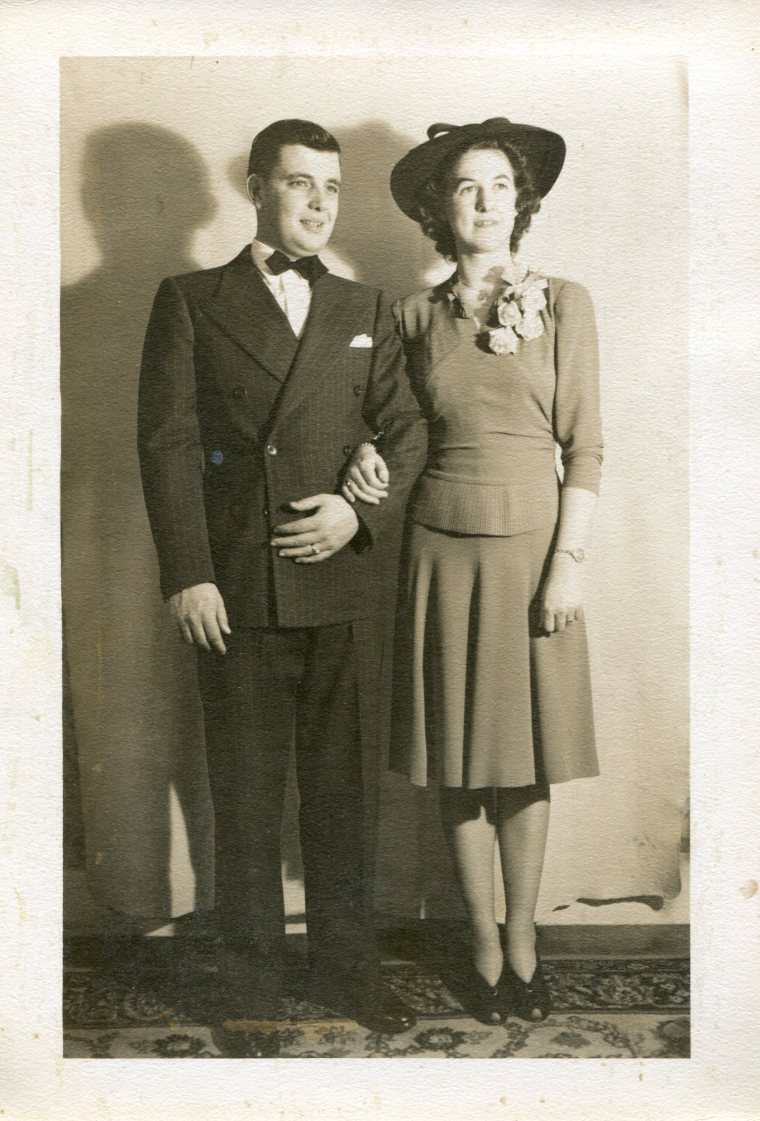
My parents’ wedding: December 25, 1941. Dad was 22 years old; Mom, 19.

“The spiritual journey is about discovering our birthright, our beginning, with the same excitement of an orphan or adopted child looking for his birth parents.”

—Richard Rohr

#

I was in my sixties before I discovered who my parents were.

Until I was thirteen or fourteen, I’d accepted the man and the woman with whom I lived as my parents, but once I hit adolescence, it was clear that there was no way this carpenter who lived in overalls and drank Narragansett Beer and his wife who seemed to spend her time gossiping on the telephone could be my real parents. No, I was like a prince in a folk tale, stolen at birth by a wicked witch and given to some peasants named Lester and Florence to raise in poverty, but who somehow knew he had the blood of royalty coursing through his veins.

My sense of frustrated entitlement grew once I left for college. Lester and Florence had never been to college, nor had anyone else in their families, which was just another clue that they weren’t really my parents.

I recall my anger at Lester one Christmas when I was home for the holidays. I talked him in to watching Dylan Thomas’s A Child’s Christmas in Wales on PBS. “What kind of nonsense is this?” Lester muttered as he lay on the couch, a beer resting on his gut. You’re such a lout! I thought.

Florence, on the other hand, kept asking questions, prying into my private life—“How are your courses?” “Are you dating?” “What do you plan to do after college?”—each question a reminder that my grades were mediocre, I had no idea what I wanted to do after I graduated, and that I was lonely as hell.

In other words, Lester wasn’t interested in my life, while Florence couldn’t keep her nose out of it.

After I got married, I tried to put as much distance between these people and myself as I could. My wife, and later, my daughter, and I seldom visited, and when we did, I could barely wait to leave. Lester was becoming more and more critical of everything and everybody. He wouldn’t stop smoking, and would wake us up at 4:00 in the morning with these coughing fits. He was drinking more, and usually fell asleep in the evening about 7:00, so that any attempt at conversation took place over the sound of a good-sized buzz saw.

After four years of asking my wife and me, “When am I going to be a grandmother?” Florence now asked, “Is Laurie going to have a brother or sister?” A reminder that my wife had told me—to my disappointment—that she didn’t want any more children. Even though neither of them said anything to me, I could see that Florence and my wife didn’t get along. I’d catch Florence looking at me with pity whenever my wife would criticize me or I would snap at her, and I knew Florence felt that my marriage was in trouble. She’d talk about what was going on at the church we’d all gone to, and I could feel her criticism for not being active in my own church.

When Lester died at the age of sixty-six of oat cell carcinoma—a highly malignant form of lung cancer that occurs only in smokers—I had too many other things on my mind to feel particularly upset. My marriage had just broken up and I’d fallen in love with another woman, who was planning to move from Colorado to Maine to join me. Then, two years after I remarried, my daughter died of cancer, and I spent the next fifteen years in solipsistic grief, too absorbed in sorrow to think of either of my parents.

Some twenty years after Lester’s death, however, as I began to approach the age he was when he died, I began to think about him more and more, even dream about him. I started to peruse photograph albums, read old newspaper clippings, searching for the father I felt I never had.

And I found him. In memories of his showing me how to play baseball and basketball; of recalling him at all my little league games and high school events. How when he and my mother would visit my first wife, our daughter, and me, I’d take him fishing; how, the weekend I left my first wife and drove to my parents because I couldn’t think of any other place to go, he took me fishing in his boat; how, the last time I saw him, in bed and riddled with cancer, he reached up and clasped my arm, and tried to smile.

I began to realize the difficulties my father had faced growing up. Of having to live for eight years—years Dad never talked about—in what 1920’s Massachusetts called “A Home for Wayward Boys,” while his mother, who’d divorced Dad’s father for beating their son with a belt, worked at a W.T. Grant’s department store, and visited him on weekends. Of moving to Yarmouth, Maine when his mother remarried, where, because of having had little education, he was placed in classes two years below other students his age. Of spending five years in the Army during WWII, two of those years in Europe away from my mother and me.

I learned in talking with my mother what I’d forgotten: that that Christmas vacation when I’d been so angry at my father for not understanding Dylan Thomas, he’d just been let go by the construction company he’d been working for, and was facing the winter with no job and three children to feed, one of whom had goofed off enough in college to lose his scholarship.

And in learning about my father, I began to understand my mother. Her struggles growing up in an alcoholic family. Her fear as child of inviting friends into her house, because the one time she did, her father walked into the living room drunk and naked. (Small wonder she never learned about boundaries!) Her mother’s acid tongue and spend-thrift habits. Being smart enough to go to college, but never having the money. Spending her life overcoming her shame by striving to be in complete control, while always presenting herself as sunny and confident, so that by the time she retired from her job at a large insurance company, she’d become an administrative assistant, while at the same time, holding every position in her church but pastor. A woman on her deathbed (and April 30th was the third anniversary of her death), who smiled at every nurse, and who was disappointed in herself for not being able to endure her pain without drugs.

So I found my mother and father at last, two people brought together by hardship and shame, who together built a life in which they raised three children in the kind of stable environment neither of them ever had for themselves.

My regret, of course, is that it took me so long to find them, and that, in the case of my father, especially, I was never able to tell him how much he’d meant to me.

Still, it’s been an exciting search, for in finding my parents I’ve also found my birthright. We don’t talk a lot about birthrights these days, but these rights or privileges to which someone is entitled by birth used to be very important, especially when it came to property or inheritance. My birthright was certainly not anything material, but rather something my parents created together and then passed on: the example that love can overcome shame, can even reach across the chasm between life and death.

Something I hope I can pass on as well.

IMG_2569
Last picture of my parents: October, 1985. Dad died two months later.

# #

The Fugitive in the Photo

IMG_2560

While I’ve written quite a bit in these blogs about the difference between pilgrimages and vacations, there are, of course, other reasons to travel: education and escape, for example. The man in this photograph would probably tell you he’s traveling for educational reasons; I think, however, he’s a fugitive, trying to escape his past and his pain.

According to the journal I kept for this trip, this photograph was taken on Saturday, July 21, 1990. The place is Stratford-Upon-Avon, and the guy is standing in front of Shakespeare’s birthplace. His wife Mary Lee (who snapped the picture) and he are in England, taking a summer program called “Shakespeare’s World.” That evening, along with the rest of their winter teacher/summer student classmates, they’ll watch the Royal Shakespeare Company’s production of “Much Ado About Nothing,” before getting on the bus and returning to Cambridge University for another week of classes.

When I first looked at the man in this photograph, I noticed our similar tastes. We both wear hats (not crazy about the one he’s wearing, but he likes it), we both prefer chinos to blue jeans, and we both keep a notebook in our shirt pocket. Although the snappy cap and the camera suggest he’s a tourist, he, like me, hates identifying himself this way, maybe because we both grew up in Maine, “Vacationland,” where we learned to disdain visitors we called “summer complaints.”

As I continued looking at the photograph, I began to notice differences between this man and me, some of which only I would know. For example, he’s taller than I am by several inches, and his face is freer of wrinkles, lines, and age spots. He doesn’t have a fatty lump on his back. He’s got a beard, which as I remember, grows and wanes almost as often as the moon. Same with his hair, which I don’t have much of any more.

When I decided to write about the picture, I was hoping to discover that the journey to Stratford shows that he thinks of himself the way I do these days: as a pilgrim. After all, what English teacher doesn’t feel a deep connection with Shakespeare? But deep down I knew words like “pilgrim” and “pilgrimage” aren’t part of his vocabulary. He and Mary Lee have just decided not to stand in the long line going into Shakespeare’s birthplace. He’d much rather leave, watch some street entertainers, and get another pint at a nearby pub called the “Slug and Lettuce.”

No, the man thinks of himself as an academic, a teacher. After all, teaching has been the only fulltime job he’d ever held, and he’d been doing it for twenty-five years. Writers are his heroes, and watching a student’s eyes light up when he’s able to connect him or her to Macbeth or Romeo and Juliet is one of  life’s great pleasures, along with sex and booze. When he and Mary Lee were looking at travel opportunities, they chose an academic program, in order to—as they wrote in their applications to their respective school boards for continuing education credits—improve their teaching.

The problem is the man in the photograph is not sure he wants to teach anymore. Certainly not in high school, where his seventeen and eighteen-year-old students remind him of his daughter. He has no patience with their excuses, their backtalk, their acting up. “Why are you alive,” he wants to yell sometimes, “and my brilliant, sensitive, compassionate daughter is dead?”

The truth is that what this man wants to do this summer is escape from his pain. The more I gazed into the photograph, the more clearly I saw a pale, halting, self-conscious man, picking at his camera strap as if it’s part of a straight jacket, waving his arm as if he wants to fly away.

Except that he has no idea which direction he wants to go.

#

Dictionary.com defines “fugitive” as “a person who is fleeing from prosecution, or intolerable circumstances.” Both are true of this man. Since his daughter’s death a year and a half earlier, he has prosecuted himself mercilessly, convinced that his divorce and remarriage caused his daughter’s cancer. And life has become, if not intolerable, than unpleasant—a wary, static existence, punctuated by waves of pain, less frequent than before, but as a result, more unexpected, stronger. He and his wife eye each other warily from behind their respective barricades, as careful with their words as with sticks of dynamite, afraid some careless comment might light the fuse and blow their marriage to pieces.

Besides trying to get away from his students, his unhappy home life, and his guilt, he’s also trying to flee from God. At least, the God of his understanding: a Super Saddist, who gets His kicks torturing innocent eighteen-year-old girls. It would be easier if he didn’t believe in God at all, but he tried that, tried to disappear into Albert Camus’ existentialism, but he can’t. So he alternates between raging at God and running away, like Jonah.

And like Jonah, he’s finding out, there is no escaping the past. Three weeks into the program, his wife is missing her two sons spending the summer with their father in Colorado, upset that, because of the time difference, she hasn’t been able to talk to them on the phone. Which always triggers this nasty voice in his head: “Well, they’re alive, aren’t they?”

He’s sick of feeling the stab in his heart from the question, “How many children do you and your wife have?” and when one woman in the program looked at a photograph of his wife’s son and remarked on how much Jeremy looked like both Mary Lee and him, he thought he might barf up his Green King Ale. Instead of Shakespeare, he keeps hearing F. Scott Fitzgerald: “So we beat on, boats against the current, borne back ceaselessly into the past.”

#

IMG_2562

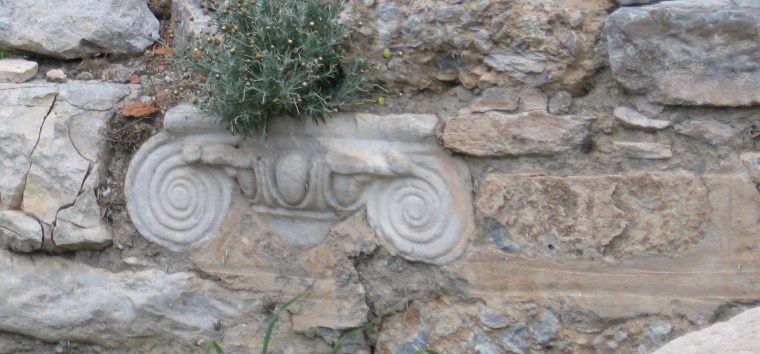
While I feel sorry for the fugitive in the photograph, I also want to tell him that he will return from England carrying the seeds of his rebirth. Part of the Shakespeare program is to visit English cathedrals, and by the time he leaves England, he will have spent time in St. Benedict’s, King’s College Cathedral and St. John’s College Cathedral in Cambridge, Salisbury Cathedral, St. Mary’s in Bath, Peterborough Cathedral, Ely Cathedral, and Holy Trinity Church in Stratford. Because for most people these days, these are places of historical, rather than spiritual sites, he doesn’t connect them with his anger and fear of God; rather, he will find in these old cathedrals a certain peace, and also a certain hope. He will see ancient buildings comprised of stones even older, created by a confluence of spirit, sweat, intellect, and prayer. Many are in a state of continual renovation, and he will start to wonder if the fact that these ancient stone monuments to God and the human spirit need to be—and can be—periodically repaired from damage may offer hope that he can rebuild his own life.

Returning to Maine, recalling these three weeks, he will see in these remodeled cathedrals that he needs to come up with not only a goal, but also a blueprint for getting there. The following fall, he will get learn about Centering Prayer, which becomes his handbook of instructions for not running from his fears, to simply watch them, watch himself react, and then let them go. He will, in the words of the twelve-step program he joins, “Let go and let God.” Not God the Super Saddist, but God the Great Embrace.

My journal tells me that after Mary Lee took this picture, we walked through the park by the River Avon to Trinity Church, where Shakespeare is buried. The church, like everywhere else in Stratford, was full of people, but, I write, the mood was far less frenetic. That’s because (and I quote from my journal), “…as Mary Lee said, they were pilgrims, not tourists.”

I’m pretty sure this was the first time, I ever heard anyone I knew talk about someone’s trip being a pilgrimage.

It was certainly not the last.

# #

Winter Pilgrimage

IMG_8849

#

“What does someone do on a retreat, anyway?”

#

2-16-17: The sun sets, a glowing ball pulsating through the bare birches and maples. A stiff northwest wind whips dervishes of snow across the field between two stone walls. The bare trees form a network of branches across a pink and blue sky.

#

Someone sat in his hermitage, reading a book on the spirituality of aging and nursing a bad back. Funny how his back often began to act up when he went on retreat. And he’d been relatively pain-free this winter, too.

Occasionally, he wrote in his journal: the view from his window or notes from the book. He jotted down what the author of the book called the “gifts” of aging: a greater capacity to love and be loved. Greater ability to receive and connect with others. A greater sense of freedom.

Well, maybe. Of course, his ability to make love had diminished, the number of people he’d always connected with had shrunk, and his chances to enjoy his freedom were fewer.

He thought about the author’s emphasis on letting go as we age. He’d been practicing letting go in his meditation for over twenty years, and on his Wednesday AlAnon meetings he often sat before the slogan “Let Go, and Let God,” printed in neon-green block letters. Yet he still had trouble, still found himself as he sat in what was supposed to be contemplation, muttering, “Let go… let go… LET GO… LET GO, GODDAMN IT!”

He copied a sentence from the book: We cannot know the great mystery, but we can experience it.

Absolutely. After almost 74 years of experience, his life was still as great a mystery as ever. Including why the hell his back ached so much.

#

2-17-17: Waning gibbous moon setting in the morning sky. The wind whistles around, rattling windows and doors.

#

Returning from morning prayer, he fixed what, over the twenty years he’d come here on retreat, had become his standard retreat breakfast: granola and an English muffin slathered with peanut butter. He gazed out the window and listened to the wind. He thought of the Brothers, how they were aging, like everyone else he knew, and of the young interns here at the retreat house. If there were a word to describe them as a group, it was “intense”—the young man with the gangly, adolescent body and the 60-year-old cultivated English voice, who, when he crossed himself, looked like a sailboat tacking into the wind; the short, androgynous young person with a heavenly, boy’s-choir voice, who knelt on the hardwood floor during communion; the gypsy-looking lad, who wore a silver and black scarf in any number of ways, and who kissed the chalice instead of drinking from it.

My God, he thought, they could be my grandchildren.

Which reminded him of his daughter, dead now for twenty-eight years. He said good morning to her, and felt a hot iron poker stab his lower back.

He opened his book on the spirituality of aging.

#

2-17: Buffeted by a wind down the Merrimac River from Canada or Hudson Bay or points north, Jesus hangs on a pine tree, keeping watch over the snow. Open water. Ice hugs the shore.

#

After snow-shoeing across the field in front of the hermitage into the woods, he followed the riverbank up to a high point where there was a bench that looked upon a bronze statue of Jesus on the cross and the Merrimac River snaking its way north. He brushed snow from the bench, sat and adjusted one of the bindings on his old wooden snowshoes. Twice the size of the newer ones, they were awkward things to walk in, but his grandfather had given them to him almost 60 years earlier, and he wasn’t ready to give them up.

He thought of the last time he’d seen Grampy: in the hospital, coughing up phlegm, yet still smoking. His father had died the same way. When doctors asked him about his family history, he said that all the women lived into their 80’s and 90’s, but that the men had died in their 60’s from bad habits.

He thought a minute and realized he’d already outlived every man in his family but two.

Feeling the wind, he pulled his hood around his head, and practiced watching himself watch a cold sunlight splash across Jesus’ compassionate face.

#

2-18: A star or planet that appears twice the size and brightness of the others hangs over the river. After a sunset of blues and reds and pinks, bright clouds circle into the evening sky like northern lights.

#

That night at dinner, their music had been a CD of a violinist—well, more of a fiddler, actually—playing traditional hymns. As he listened to “What Wondrous Love is This?” he saw his daughter, probably around ten, and himself trekking the woods of eastern Maine. Then, walking down the road from the main house to the hermitage, staring up at a glorious night sky, he’d had a vision of his daughter welcoming him into Eternity.

When he opened the door to his hermitage, he suddenly saw the elephant on the retreat, the one he’d come here carrying (No wonder his back hurt!): his fear of dying. Not so much death itself, but the events leading up to death: diagnosis, struggle, pain, loss of control, saying good-bye to his wife and her children and grandchildren whom he loved so much.

Was this fear part of learning how to die, as the author of his book recommended, or was he needlessly obsessing over something he had no control? Should he work to follow the wisdom of the Shawnee prophet, Tecumseh, whose words he’d copied into his journal earlier that day: … when it comes your time to die, be not like those whose hearts are filled with fear…Sing your death song and die like a hero going home? Or should he simply ask, “God, give me the serenity to accept the things I cannot change…” and focus more on enjoying the time he had left?

#

2-19: A ‘V’ of geese flies across the field toward the Merrimac. Snow melts in the bright sun.

#

On this, the last morning of his retreat, he decided to skip morning prayer and spend a half-hour or so in front on an icon in the hermitage prayer corner of Mary and the baby Jesus. Eventually, he became aware that even as Mary held her child, her hands were already open, as if preparing for him to leave her. He watched the Christ child stroking his mother’s face, and recalled the last time his daughter had been conscious enough to recognize him: on her hospital bed, two days before she died, four catheters puncturing her body, one of which was filling her with what her doctor said was “more morphine than I’ve ever given anyone.” She’d groaned and he’d gone to her bedside. She opened her eyes, saw him, and stroked his face. “You need a shave,” she’d slurred, and then dropped into something between a coma and a drug-induced sleep.

He thought again of the need to let go, even of our children, even of our lives, and at the same time, of the presence of love that continues, that endures, that is stronger than death.

Later in the day, he packed his things, stripped and remade his bed, vacuumed the hermitage. His backache was almost gone. Taking his suitcase and backpack to the car, he watched the geese flying overheard and recalled a snatch of psalm:

For I am but a sojourner with you

a wayfarer, as all my forbears were.

Turn your gaze fro me, that I may be glad again

before I go my way and am no more.

He got in the car, inserted Leonard Cohen’s last album, the one he made while dying of cancer, and continued on his pilgrimage.

IMG_2503


The Road More Traveled

img_1213
Along St. Cuthbert’s Way, Scotland

#

    Two roads diverged in a wood, and I—

I took the one less traveled by,

And that has made all the difference.

—Robert Frost

#

Last week, Mary Lee and I climbed a mountain (a very small mountain) in New Hampshire. Returning in late afternoon, we crossed a stream and started through the woods to our car. Suddenly, we realized that we were no longer on the trail. Perhaps because I was tired, or perhaps because twilight was setting in, I had a brief moment of panic—My God, we’ll be wandering these woods all night!—before retracing our steps and finding the comforting yellow tree markers and the path to the parking lot.

During what I think of as my Kerouac years, my great desire was to be free, independent of family and responsibility, to take the road less traveled. I disdained what I saw as my generation’s spaghetti-spined conformity. Fifty years later, however, I’m drawn to follow the path more traveled, worn down by the feet of those before me. And I wonder if, at some level, this isn’t true for many of us as we age.

One definition of pilgrimage I don’t often read about is that on a pilgrimage you’re following in the footsteps of others. Pilgrims have been traveling to Jerusalem since 900 years before Christ. Within a hundred or so years of Jesus’s crucifixion, St. Justin Martyr was writing: “If anyone wants proof for the birth of Jesus Christ, let him go to Bethlehem and see for himself both the cave in which he was born and the manger in which he was laid.” In Jerusalem, you can see carvings on the door of the Church of the Holy Sepulcher made by the Crusaders, prayers tucked into crevices of the Western Wall written by thousands of pilgrims, walkways and thresholds worn smooth by travelers. When Columba came to Iona in the fifth century, the Scottish island had long been a destination for Druids, and it soon became a burial place for early Scottish kings. Today, you can see cairns of stones pilgrims have left behind. Pilgrims have been walking the Santiago de Compostela since the 9th century.

Even on less ancient pilgrimages, such as St. Cuthbert’s Way between Melrose, Scotland and the Holy Island of Lindisfarne, or to Gethsemane Abbey in Kentucky, or to the New Calmaldoli Hermitage in Big Sur, California, I’ve followed  paths worn down by the pilgrims before me. And as I wrote in the last blog, when I drive to the cemetery to visit the graves of my parents and my daughter, I am making a pilgrimage millions of people make every year.

Like meditation, pilgrimage is a Celtic knot of solitude and companionship. And it’s important to embrace both. One gives you the opportunity to contemplate the other: to see yourself as being in communion, drinking the waters of renewal, eating the Eucharist of sacrifice and penance.

Of course, at the heart of any pilgrimage—at least any I’ve been on—is the desire to be in communion with someone you revere by walking in his or her footsteps. And there have been times when I’ve experienced the presence of some of those people. There was a moment, for example, as I sat in the chapel of Dominus Flevit on the side of the Mount of Olives, looking through the window of the church across the Kidron Valley to the Old City of Jerusalem, when Jesus spoke in my head: “O Jerusalem, Jerusalem, the city that kills the prophets and stones those who are sent to it! How often would I have gathered your children together as a hen gathers her brood under her wings, and you were not willing!” And I thought of all the blood shed on the streets of that city for thousands of years, and felt my eyes water in sorrow.

jerusalem_dominus_flevit_bw_2010-09-20_07-01-11
Through the window of the Church of Dominus Flevit, the Mount of Olives

There was an afternoon when I sat perhaps thirty feet from the grave of Thomas Merton at Gethsemane Abbey in Kentucky, and was suddenly aware of the monk’s presence within me, urging me to write my story. And catching my first glimpse of the Holy Island of Lindisfarne, the sun reflecting off the waters around it, I felt for a moment like the young Cuthbert ready to begin his life, instead of the old Rick approaching the end of his.

I’m not sure what was going on in any of those cases. As many people have noted, on a pilgrimage, perhaps because of the confluence of landscape and story, past and present, you disconnect from your everyday life so you can connect with something or someone deeper.

But it’s also easy to disconnect from reality. The “Jerusalem Syndrome” is a well-documented phenomenon that dates to medieval times where foreign visitors suffer psychotic delusions that they are figures from the Bible. An Irish schoolteacher comes to a Jerusalem hospital convinced she is about to give birth to the Baby Jesus when in fact she’s not even pregnant. A Canadian tourist believes he’s the Biblical strongman Sampson and tries to tear stone blocks out of the Wailing Wall. An Austrian man rages when a restaurant refuses to prepare the Last Supper for him.

I’m hoping my experiences were spiritual instead of psychotic, and that I’m seeing myself not as Jesus or St. Cuthbert but as one of those following their paths, wearing it down for others to follow. (That’s how, by the way, Mary Lee and I were sometimes able to keep to St. Cuthbert’s way: by walking the most trodden path.)

It’s taken me more than half my life to recognize the value of following the paths of others. After the death of my daughter, it was a group called the Center for Grieving Children in Portland, Maine (and if you’re looking for a good cause to give a donation to, please consider them) which helped me regain control over my life by listening to the stories other grieving parents told of their journeys through grief and by learning from their examples. Today, much of my spiritual growth has been nurtured not only by silence, but also by the men’s group I belong to through my church and the Al Anon group I attend. And as I approach the end of my earthly pilgrimage, it has been seeing with what grace and dignity my mother, my father-in-law, and some of my friends have died that shows me how I might walk that path myself.

The last time I consciously took the road less traveled was late this spring when I was walking in the woods behind our house. There are a number of well-worn trails I walk on, but this time I left the trail to, I thought, save time on the way home. Not only did I tear my shirt fighting my way through the puckerbrush, I wound up digging a tick out of my arm and going to the hospital for antibiotics.

I’m not sure that was the difference Robert Frost was writing about.

img_2404
The road less traveled behind my house in Maine.

# #