
The Geriatric Pilgrim: Tales From the Journey

In The Geriatric Pilgrim: Tales from the Journey, Richard Wile explores how his own pilgrimage experiences have shown him that life itself can be a pilgrimage. Part travelogue, part rumination on grief and grace, part coming of (old) age memoir, The Geriatric Pilgrim reveals how viewing life as a pilgrimage can bring us healing and hope.
What others say:
From the green hills of Scotland’s St. Cuthbert’s Way to the Old City of Jerusalem streets to Maine’s piney woods and alongside the bed of his dying daughter, Richard Wile takes the reader on journeys that are haunting and heartbreaking. In achingly beautiful prose, he shares his pilgrimages and moments in which he felt godforsaken and broken, fortunate and blessed. His poignant essays are a hopeful reminder that we all can journey from darkness to light, if we dare to cross the threshold between the past and the present.
— Barbara A. Walsh, author of August Gale: A Father and Daughter’s Journey into the Storm.
The Geriatric Pilgrim: Tales From the Journey, a spiritual memoir-in-essays, is eloquent, humble, and wise. Wile’s essays are beautifully written, deeply moving, and bursting with humanity and love. At times heartbreaking and other moments humorous, this book–a journey through grief to acceptance–is inspiring, and a pure joy to read.
— Maureen Stanton, author of Body Leaping Backward: Memoir of a Delinquent Girlhood
Like a sage uncle, Rick Wile invites you to tag along as he shares his pilgrimage, his wanderings through life. Ever honest, ever humble, ever wry, Rick never hides his hurts or regrets. At the same time, he doesn’t wallow in the past; as an explorer, he’s always looking to the future, what’s over the next hill, around the next corner. With his mastery at self reflection, Rick helps readers take stock of their own pilgrimages. That is his gift, and that is the magic of this book.
–David Treadwell Writer and fellow explorer
What ultimately shines through this deeply honest book of continuous, light-filled inner journeys (alongside the earthly ones) is the realization that life itself is a pilgrimage. And there are stations (some as humble as a pebble turning under foot, some as soul ravaging as the death of a beloved daughter) along the way. Stations of revelation. Maybe even redemption. If we stop and stay with them a while. It’s a book that offers deep spiritual nourishment to the people who read it. Not many books do that.
— Dianne Benedict, author of Tiny Objects (Iowa Short Fiction Award)
…engaging…effective, reflective…—Kirkus Review
To order The Geriatric Pilgrim visit Maine Authors Publishing
Requiem in Stones
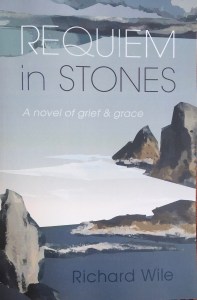
The death of his daughter Annie two days before Easter destroys everything Tom Jacobs had ever believed about himself, his teaching career, his new wife, his stepson, and his god. Over the next eighteen Easter seasons, Tom must journey into the heart of his grief before he can emerge, resurrected by faith and love.
Anyone who has ever wondered, “Where in hell is God when a child dies?” will want to read Requiem in Stones.
What others say:
Richard Wile, a widely-published nonfiction writer, uses fiction to lead us through a profound, archetypal Christian journey of suffering, bottoming out, and redemption. Following the death of his child, the narrator loses his faith. He grapples with God as his harrowing spiritual path gradually leads him toward surrender, service, and transcendence. Requiem in Stones offers spiritual consolation to those who struggle to reconcile grief and belief.
–Lee Hope, Author of Horsefever, a novel
Rick Wile pulls no punches in this urgent novel, taking his protagonist deep into the very marrow of a father’s grief. Tom Jacob’s sojourn becomes, through his encounter with the darkest corners of his complex and cavernous self, a pilgrimage toward peace and a soulful abiding that amounts to a restoration of his devastated faith. The reader who makes this pilgrimage with him may well be similarly restored.
–Richard Hoffman, author of Half the House and Love & Fury
To order Requiem in Stones visit Maine Authors Publishing
Questions For Discussion
Chapter One:
What draws Tom to Christine?
How would you answer Christine’s question?
Chapter Two:
How does the way Tom perceives God change after he meets Christine?
Are there indications, even before Annie’s diagnosis and death, that Tom’s and Christine’s marriage is not as unshakable as he thinks it is?
Chapter Three:
What reasons (besides those he gives his mother) can you think of for Tom’s not attending his own daughter’s funeral or putting Annie’s obituary in the newspaper?
Chapter Four:
How does Annie’s death initially change Tom’s relationship with Christine? Nathan? God? Himself?
Chapter Five:
What finally sends Tom to make an appointment to talk to Father Curtis Matthews?
For what reasons do you think Tom finds Father Curtis’s advice helpful?
Chapter Six:
What is the connection between Red Bailey and Tom’s grief?
Chapter Seven:
How do the Family Center for Grief and Loss and Sam and Diane’s wedding help assuage Tom’s grief?
What indications are there that this respite is temporary?
Chapter Eight:
When Tom’s grief returns, how has it changed from the grief of the previous spring?
Chapter Nine:
How do Chapters Eight and Nine show the destructive nature of grief?
Tom actively cultivates Albert Camus’s “disdain” for an “absurd world.” Why then do you think he reacts so emotionally when Carol talks about God?
Chapter Ten:
How did Tom’s childhood, especially his mother and father, contribute to the guilt he carries for Annie’s death?
Chapter Eleven:
How does Tom’s second trip to the EMMC Chapel mark a turning point in this journey through grief?
Have you ever been angry with God? How did you express this anger?
Chapter Twelve:
How does Tom and Christine’s trip to England change their relationship?
How does it change Tom’s “story”?
Chapter Thirteen:
How does the Christian meditation called Centering Prayer help Tom deal with his grief?
Chapter Fourteen:
In what ways does Tom’s grief start to subside? Why?
Chapter Fifteen:
How do Tom’s feelings towards his father change during his meditation?
Why does he decide to get a memorial stone for Annie?
Chapter Sixteen:
Grief counselors say that sometimes the hardest grief to let go of is grief itself. How do you see that happening in this chapter?
Chapter Seventeen:
Has Nathan’s new family changed his relationship with Tom? If so, how? If not, why not?
Chapter Eighteen:
Why does Tom find lay pastoral visiting so difficult?
Chapter Nineteen:
When Rachel Silas says that Tom had been a big help to her, Tom wonders, how? How do you think he gives her help?
Chapter Twenty:
How has Tom and Christine’s relationship changed since they first met?
What have they lost?
What have they gained?
General Questions:
1. How are the following people important to Tom on his journey through grief:
Curtis Matthews Red Bailey
Jonathan Bennett Ike Jacobs
Brother Jeremiah Paul Tibbets
2. How do the following Biblical stories help Tom:
The Israelites wandering in the desert
The Healing of Lazarus
The Parable of the Prodigal Son
The transfiguration of Jesus and the healing of the demoniac
Jacob wrestling with the angel
3. How does the Hymn “Jesus Christ/Christ the Lord is Risen Today” change meaning for Tom during the course of the novel?
4. Requiem in Stones is “a Novel of Grief and Grace.” Finding grief in the book is easy; what examples of grace can you find in the novel?
5. Tom’s inner journey through grief and grace is often revealed through his dreams. Have dreams been important to you? In what ways?
6. Discuss Tom’s various “false selves.” What are some of yours?
 The Geriatric Pilgrim: Traveling the Landscape of Faith and Grief