Winter Pilgrimage

IMG_8849

#

“What does someone do on a retreat, anyway?”

#

2-16-17: The sun sets, a glowing ball pulsating through the bare birches and maples. A stiff northwest wind whips dervishes of snow across the field between two stone walls. The bare trees form a network of branches across a pink and blue sky.

#

Someone sat in his hermitage, reading a book on the spirituality of aging and nursing a bad back. Funny how his back often began to act up when he went on retreat. And he’d been relatively pain-free this winter, too.

Occasionally, he wrote in his journal: the view from his window or notes from the book. He jotted down what the author of the book called the “gifts” of aging: a greater capacity to love and be loved. Greater ability to receive and connect with others. A greater sense of freedom.

Well, maybe. Of course, his ability to make love had diminished, the number of people he’d always connected with had shrunk, and his chances to enjoy his freedom were fewer.

He thought about the author’s emphasis on letting go as we age. He’d been practicing letting go in his meditation for over twenty years, and on his Wednesday AlAnon meetings he often sat before the slogan “Let Go, and Let God,” printed in neon-green block letters. Yet he still had trouble, still found himself as he sat in what was supposed to be contemplation, muttering, “Let go… let go… LET GO… LET GO, GODDAMN IT!”

He copied a sentence from the book: We cannot know the great mystery, but we can experience it.

Absolutely. After almost 74 years of experience, his life was still as great a mystery as ever. Including why the hell his back ached so much.

#

2-17-17: Waning gibbous moon setting in the morning sky. The wind whistles around, rattling windows and doors.

#

Returning from morning prayer, he fixed what, over the twenty years he’d come here on retreat, had become his standard retreat breakfast: granola and an English muffin slathered with peanut butter. He gazed out the window and listened to the wind. He thought of the Brothers, how they were aging, like everyone else he knew, and of the young interns here at the retreat house. If there were a word to describe them as a group, it was “intense”—the young man with the gangly, adolescent body and the 60-year-old cultivated English voice, who, when he crossed himself, looked like a sailboat tacking into the wind; the short, androgynous young person with a heavenly, boy’s-choir voice, who knelt on the hardwood floor during communion; the gypsy-looking lad, who wore a silver and black scarf in any number of ways, and who kissed the chalice instead of drinking from it.

My God, he thought, they could be my grandchildren.

Which reminded him of his daughter, dead now for twenty-eight years. He said good morning to her, and felt a hot iron poker stab his lower back.

He opened his book on the spirituality of aging.

#

2-17: Buffeted by a wind down the Merrimac River from Canada or Hudson Bay or points north, Jesus hangs on a pine tree, keeping watch over the snow. Open water. Ice hugs the shore.

#

After snow-shoeing across the field in front of the hermitage into the woods, he followed the riverbank up to a high point where there was a bench that looked upon a bronze statue of Jesus on the cross and the Merrimac River snaking its way north. He brushed snow from the bench, sat and adjusted one of the bindings on his old wooden snowshoes. Twice the size of the newer ones, they were awkward things to walk in, but his grandfather had given them to him almost 60 years earlier, and he wasn’t ready to give them up.

He thought of the last time he’d seen Grampy: in the hospital, coughing up phlegm, yet still smoking. His father had died the same way. When doctors asked him about his family history, he said that all the women lived into their 80’s and 90’s, but that the men had died in their 60’s from bad habits.

He thought a minute and realized he’d already outlived every man in his family but two.

Feeling the wind, he pulled his hood around his head, and practiced watching himself watch a cold sunlight splash across Jesus’ compassionate face.

#

2-18: A star or planet that appears twice the size and brightness of the others hangs over the river. After a sunset of blues and reds and pinks, bright clouds circle into the evening sky like northern lights.

#

That night at dinner, their music had been a CD of a violinist—well, more of a fiddler, actually—playing traditional hymns. As he listened to “What Wondrous Love is This?” he saw his daughter, probably around ten, and himself trekking the woods of eastern Maine. Then, walking down the road from the main house to the hermitage, staring up at a glorious night sky, he’d had a vision of his daughter welcoming him into Eternity.

When he opened the door to his hermitage, he suddenly saw the elephant on the retreat, the one he’d come here carrying (No wonder his back hurt!): his fear of dying. Not so much death itself, but the events leading up to death: diagnosis, struggle, pain, loss of control, saying good-bye to his wife and her children and grandchildren whom he loved so much.

Was this fear part of learning how to die, as the author of his book recommended, or was he needlessly obsessing over something he had no control? Should he work to follow the wisdom of the Shawnee prophet, Tecumseh, whose words he’d copied into his journal earlier that day: … when it comes your time to die, be not like those whose hearts are filled with fear…Sing your death song and die like a hero going home? Or should he simply ask, “God, give me the serenity to accept the things I cannot change…” and focus more on enjoying the time he had left?

#

2-19: A ‘V’ of geese flies across the field toward the Merrimac. Snow melts in the bright sun.

#

On this, the last morning of his retreat, he decided to skip morning prayer and spend a half-hour or so in front on an icon in the hermitage prayer corner of Mary and the baby Jesus. Eventually, he became aware that even as Mary held her child, her hands were already open, as if preparing for him to leave her. He watched the Christ child stroking his mother’s face, and recalled the last time his daughter had been conscious enough to recognize him: on her hospital bed, two days before she died, four catheters puncturing her body, one of which was filling her with what her doctor said was “more morphine than I’ve ever given anyone.” She’d groaned and he’d gone to her bedside. She opened her eyes, saw him, and stroked his face. “You need a shave,” she’d slurred, and then dropped into something between a coma and a drug-induced sleep.

He thought again of the need to let go, even of our children, even of our lives, and at the same time, of the presence of love that continues, that endures, that is stronger than death.

Later in the day, he packed his things, stripped and remade his bed, vacuumed the hermitage. His backache was almost gone. Taking his suitcase and backpack to the car, he watched the geese flying overheard and recalled a snatch of psalm:

For I am but a sojourner with you

a wayfarer, as all my forbears were.

Turn your gaze fro me, that I may be glad again

before I go my way and am no more.

He got in the car, inserted Leonard Cohen’s last album, the one he made while dying of cancer, and continued on his pilgrimage.

IMG_2503


The Road More Traveled

img_1213
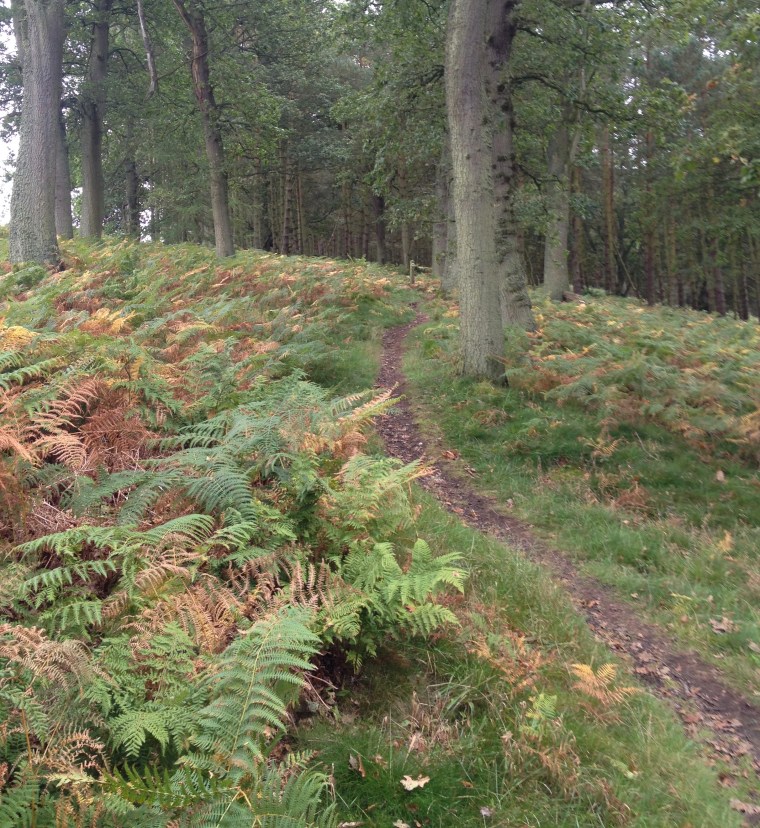
Along St. Cuthbert’s Way, Scotland

#

    Two roads diverged in a wood, and I—

I took the one less traveled by,

And that has made all the difference.

—Robert Frost

#

Last week, Mary Lee and I climbed a mountain (a very small mountain) in New Hampshire. Returning in late afternoon, we crossed a stream and started through the woods to our car. Suddenly, we realized that we were no longer on the trail. Perhaps because I was tired, or perhaps because twilight was setting in, I had a brief moment of panic—My God, we’ll be wandering these woods all night!—before retracing our steps and finding the comforting yellow tree markers and the path to the parking lot.

During what I think of as my Kerouac years, my great desire was to be free, independent of family and responsibility, to take the road less traveled. I disdained what I saw as my generation’s spaghetti-spined conformity. Fifty years later, however, I’m drawn to follow the path more traveled, worn down by the feet of those before me. And I wonder if, at some level, this isn’t true for many of us as we age.

One definition of pilgrimage I don’t often read about is that on a pilgrimage you’re following in the footsteps of others. Pilgrims have been traveling to Jerusalem since 900 years before Christ. Within a hundred or so years of Jesus’s crucifixion, St. Justin Martyr was writing: “If anyone wants proof for the birth of Jesus Christ, let him go to Bethlehem and see for himself both the cave in which he was born and the manger in which he was laid.” In Jerusalem, you can see carvings on the door of the Church of the Holy Sepulcher made by the Crusaders, prayers tucked into crevices of the Western Wall written by thousands of pilgrims, walkways and thresholds worn smooth by travelers. When Columba came to Iona in the fifth century, the Scottish island had long been a destination for Druids, and it soon became a burial place for early Scottish kings. Today, you can see cairns of stones pilgrims have left behind. Pilgrims have been walking the Santiago de Compostela since the 9th century.

Even on less ancient pilgrimages, such as St. Cuthbert’s Way between Melrose, Scotland and the Holy Island of Lindisfarne, or to Gethsemane Abbey in Kentucky, or to the New Calmaldoli Hermitage in Big Sur, California, I’ve followed  paths worn down by the pilgrims before me. And as I wrote in the last blog, when I drive to the cemetery to visit the graves of my parents and my daughter, I am making a pilgrimage millions of people make every year.

Like meditation, pilgrimage is a Celtic knot of solitude and companionship. And it’s important to embrace both. One gives you the opportunity to contemplate the other: to see yourself as being in communion, drinking the waters of renewal, eating the Eucharist of sacrifice and penance.

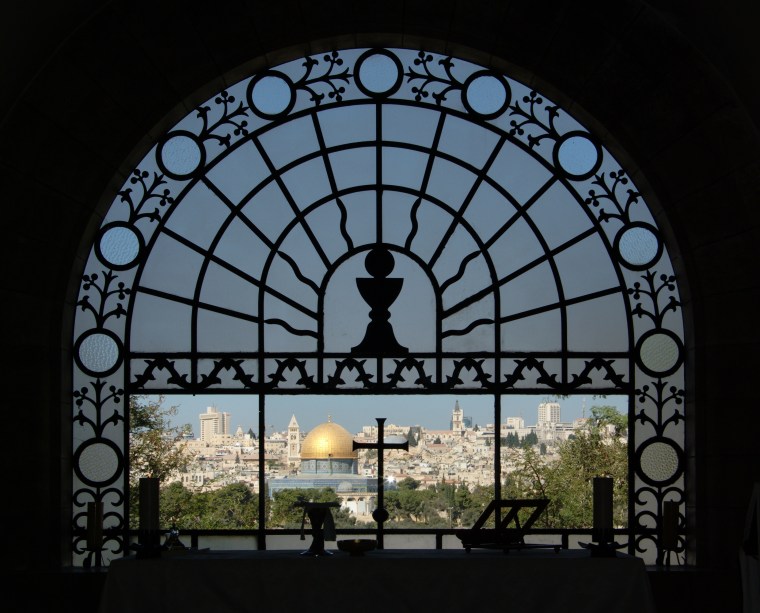
Of course, at the heart of any pilgrimage—at least any I’ve been on—is the desire to be in communion with someone you revere by walking in his or her footsteps. And there have been times when I’ve experienced the presence of some of those people. There was a moment, for example, as I sat in the chapel of Dominus Flevit on the side of the Mount of Olives, looking through the window of the church across the Kidron Valley to the Old City of Jerusalem, when Jesus spoke in my head: “O Jerusalem, Jerusalem, the city that kills the prophets and stones those who are sent to it! How often would I have gathered your children together as a hen gathers her brood under her wings, and you were not willing!” And I thought of all the blood shed on the streets of that city for thousands of years, and felt my eyes water in sorrow.

jerusalem_dominus_flevit_bw_2010-09-20_07-01-11
Through the window of the Church of Dominus Flevit, the Mount of Olives

There was an afternoon when I sat perhaps thirty feet from the grave of Thomas Merton at Gethsemane Abbey in Kentucky, and was suddenly aware of the monk’s presence within me, urging me to write my story. And catching my first glimpse of the Holy Island of Lindisfarne, the sun reflecting off the waters around it, I felt for a moment like the young Cuthbert ready to begin his life, instead of the old Rick approaching the end of his.

I’m not sure what was going on in any of those cases. As many people have noted, on a pilgrimage, perhaps because of the confluence of landscape and story, past and present, you disconnect from your everyday life so you can connect with something or someone deeper.

But it’s also easy to disconnect from reality. The “Jerusalem Syndrome” is a well-documented phenomenon that dates to medieval times where foreign visitors suffer psychotic delusions that they are figures from the Bible. An Irish schoolteacher comes to a Jerusalem hospital convinced she is about to give birth to the Baby Jesus when in fact she’s not even pregnant. A Canadian tourist believes he’s the Biblical strongman Sampson and tries to tear stone blocks out of the Wailing Wall. An Austrian man rages when a restaurant refuses to prepare the Last Supper for him.

I’m hoping my experiences were spiritual instead of psychotic, and that I’m seeing myself not as Jesus or St. Cuthbert but as one of those following their paths, wearing it down for others to follow. (That’s how, by the way, Mary Lee and I were sometimes able to keep to St. Cuthbert’s way: by walking the most trodden path.)

It’s taken me more than half my life to recognize the value of following the paths of others. After the death of my daughter, it was a group called the Center for Grieving Children in Portland, Maine (and if you’re looking for a good cause to give a donation to, please consider them) which helped me regain control over my life by listening to the stories other grieving parents told of their journeys through grief and by learning from their examples. Today, much of my spiritual growth has been nurtured not only by silence, but also by the men’s group I belong to through my church and the Al Anon group I attend. And as I approach the end of my earthly pilgrimage, it has been seeing with what grace and dignity my mother, my father-in-law, and some of my friends have died that shows me how I might walk that path myself.

The last time I consciously took the road less traveled was late this spring when I was walking in the woods behind our house. There are a number of well-worn trails I walk on, but this time I left the trail to, I thought, save time on the way home. Not only did I tear my shirt fighting my way through the puckerbrush, I wound up digging a tick out of my arm and going to the hospital for antibiotics.

I’m not sure that was the difference Robert Frost was writing about.

img_2404
The road less traveled behind my house in Maine.

# #

Pilgrimage to Riverside

img_2345

#

I’ve read that one of the most common pilgrimages is the graveside visit. Just about all the strands of pilgrimage are present: the call to leave ordinary life, the need to pay homage, the crossing of a threshold, the act of sacrifice or penance, the return home. I would also add that pilgrimage—at least for me—also thrusts you into what seems to be another time zone, somewhere between past and present and future. Which is certainly true when I drive across that threshold between the two stone pillars shaded by maple trees at the entrance to Riverside Cemetery in Yarmouth, Maine. I can feel my body chemistry change.

When I consider how far the cemetery has expanded on the other side the road, I think of the line from the Isaac Watts hymn I once sang growing up in Yarmouth: “Time, like an ever rolling stream.” Across the road was once part of a market garden I used to work in. I spent hours planting, cultivating, and harvesting beet greens, spinach, lettuce, cucumbers, and squash where now marble and granite stones grow in evenly spaced rows. Even more jarring is that the stones lie under trees at least twenty years younger than I am, and which now stand some seventy-five to a hundred feet high.

Dead leaves and yellow daisies—images of death and life—punctuate the green and yellow grass as I drive around to the back of the cemetery overlooking the river—first past the newer stones, with laser prints of cars, boats, dogs, even photographs, and then by the older, lichen-dotted marble, granite, and slate stones that feature names I immediately put faces to: Snap Moxcey, my old barber, Frank Knight, my little league coach, Red Beal, my eighth-grade teacher and coach, parents of many of my former classmates.

It’s a gray, windy day, the first real day of autumn. An inky dragon-shaped cloud prowls the horizon. In the back of the cemetery, the maple trees look ancient, yet blush orange, like bashful teenagers. I park the car in front of our family lot and get out. I pull a few dead blossoms from the impatiens around my mother’s grave. I straighten the American flag in the VFW marker by my father’s flat bronze memorial, and then move over to clean the sticks and dead leaves from the memorial stone for my daughter, who died of cancer three years after Dad. Just up from Laurie’s stone, a similar granite stone honors my Grandmother Cleaves, who died less than a year after my daughter.

fullsizerender

I recall that a year before Dad died, Hurricane Gloria knocked out power in parts of Maine for up to two weeks. I was living Down East at the time, and the day after the storm I got up early to drive Laurie to church camp for the weekend. I continued on to visit my mother and father, and when I pulled into the driveway I saw Dad standing in strewn leaves and fallen branches, trying to fry bacon and eggs on a charcoal grill. Nanny Cleaves, who’d come over from her apartment for a hot breakfast, stood at the window.

What I think of as pilgrimage time can not only expand memories but also compress them, so that today, the deaths of my father, my daughter, and my grandmother in less than four years become one moment that I recall as an emotional hurricane that made Gloria feel like a summer breeze. Throw in a divorce and remarriage during that time, and I can see now why I needed an anchor in all the winds that seemed to be assailing me.

Riverside cemetery, I realize, was and remains that anchor. I walk to the center of our lot, to the granite stone from the old cellar hole of my mother’s grandfather and grandmother’s house. I clear away fallen leaves around the stone with my foot, knowing full well that by tomorrow more leaves will take their place. Somehow, though, it’s important for me to tidy things up. Cemeteries, of course, are for the living not the dead: a way to show respect, certainly, but also to concretize the great mystery of death—shape it in stone, decorate it.

It took me three years after my daughter’s death to realize this. Laurie had not wanted to be buried; she’d wanted her ashes scattered. Once she died, however, her mother was adamant that she wanted our daughter’s ashes buried in her family’s plot in Steuben, Maine. Reeling from Laurie’s death, I couldn’t handle any more confrontation, so I said to go ahead, but that I was not going to go to any funeral, would not attend any graveside services. Three years of spending Memorial Days in this cemetery planting flowers, however, and summer evenings tending them, and autumn afternoons taking away pots and the St. Francis statue my brother, sister, and I added, made me realize that Laurie needed to be here as well—No, that’s not right. I realized that I needed Laurie to be here as well.

I run my hand over the creviced surface of the stone that once was part of the foundation of the old family homestead. This granite is thousands of years old, yet as with the rest of us, time will eventually wear it away. Still, it won’t be in my time, not in what I’ve heard called Chronos, or human time.

No, these stones, this cemetery, make me aware of what’s called Kairos, God’s time. (Isaac Watts again: “A thousand ages in Thy sight/Are like an evening gone…”) And maybe that’s what pilgrimages do: help us to leave, even briefly, ordinary time, and experience God’s time.

I walk to the bank, which overlooks the river that gives this cemetery its name. Through the birch and the oak and the scrub maple, I see the Royal River flowing into the harbor and then on a mile or so to Casco Bay. Starting somewhere in the middle of the state, its waters swirl past the house my parents lived in when Hurricane Gloria struck, down over the waterfall by the house in which I grew up, and into the boat yard, where my father kept his little sixteen foot boat, the boat I inherited when he died, the boat my daughter Laurie liked to go out on before she died. Now, almost thirty years later, I look through the trees to the river. I watch a cormorant fly down the channel and disappear around the bend toward the bay and the ocean, where I imagine my father and my daughter in that tiny boat, waiting for me to join them.

img_2339

# #

The Stories We Carry

img_8038
(My sister Jaye on our cruise of Casco Bay.)

#

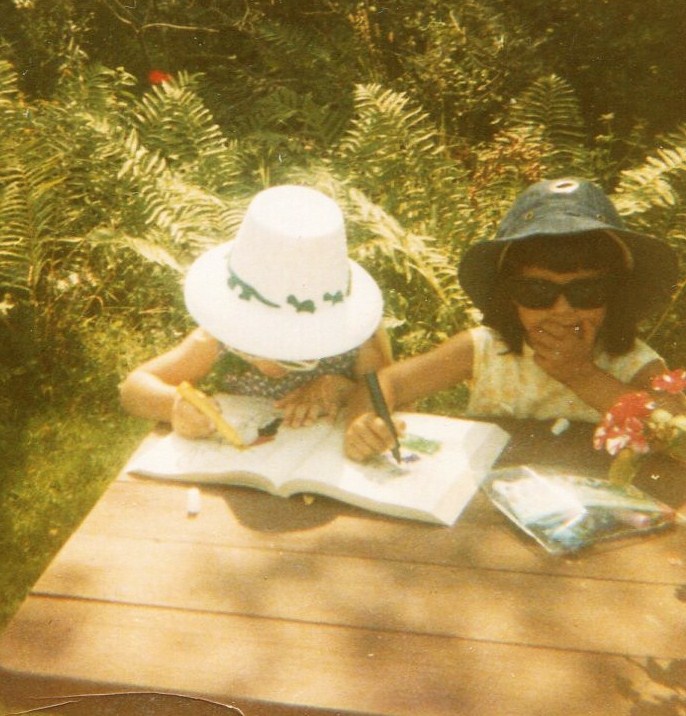
Once upon a time, before my daughter Laurie was diagnosed with cancer and I began this pilgrimage through grief and grace, I tried my hand at writing a children’s story about Laurie and her best friend, Sharon, who lived next door to us. The girls were both about five at the time, both were the same size, and both wore their hair short, with straight bangs across their foreheads. But while Laurie was fair-skinned and blond, Sharon was dark-complexioned, with the blackest hair I think I’ve ever seen. Sitting together at the picnic table, they looked like Yin and Yang.

img098

My story told of Melilia and Gotha, two little girls, one with blond hair and one with black hair, and began just after some catastrophe had befallen the world —I can’t remember now if it was a nuclear war, or if the earth had been bombarded by asteroids, or if creatures from outer space were stealing children for slaves. Anyway, Melilia and Gotha journey along the rockbound coast of Maine, following the instructions of Melilia’s dying parents, who tell her if she can get to the Celestial Islands off the coast, she will find peace and safety. As Melilia and Gotha struggle over the rocky bluffs, they are set upon by side-hill badgers, so named because the legs on one side of their bodies are longer than those on the other side, which allow them to move quickly around the piles of rocks, the males moving clockwise and the females counter-clockwise. The side-hill badgers are odious and ferocious creatures and Melilia and Gotha might have been captured and eaten had it not been for a pipe-smoking sea turtle—I smoked a pipe in those days—who comes out of the ocean to drive the badgers back to their caves.

I never got any further in the narrative than this and probably would have forgotten all about the story, except that ten years later, I read that Sharon, whose family had moved away earlier, had been murdered, stabbed in the back some fifteen times. Police arrested a thirty-one year old patient at the Augusta Mental Health Institute, who over the last ten years had attacked three different women with knives, but who, for some reason, had been given court-authorized permission to leave the AMHI campus unsupervised for several hours a day.

Three years later, a routine biopsy of a cyst on the back of Laurie’s head revealed a malignant tumor at the base of her brain. Nine months later, two days before Christmas, my daughter died.

#

All the books and articles on pilgrimage I’ve read stress the importance of traveling light. I agree, but my experience has been that there are also things I have to carry with me. The story fragment of Mililia and Gotha is one of those things; and I’ve carried it now for nearly thirty years.

I suspect many of you carry your own stories.

Right after Laurie died, my story of two innocent girls beset upon by catastrophe was like a great weight. Why couldn’t Laurie’s mother and I have been the ones to die like they do in the story instead our daughter and her friend? Why couldn’t I protect them the way my avatar, the turtle, did? And a celestial home of peace and safety? Hah! All I could see was a world of nastiness and death.

So I tried to throw the story away. I spent a lot of time in my den, drinking myself into forgetfulness. I read existential philosophy, especially Albert Camus’s Myth of Sisyphus, in which the author sees Sisyphus—condemned by the gods to forever roll a rock to the top of a mountain, from where the stone falls back because of its own weight—as representing how humanity tries to impose meaning on a meaningless world, a condition the author labels “absurd.” Made sense to me. To look for any meaning in Laurie’s cancer and Sharon’s murder was, I decided, absurd. Their deaths were statistical accidents, like being struck by lightning. The story of Melilia and Gotha was merely that: a story. Get rid of it, I told myself. Otherwise it will continue to roll back on you, like Sisyphus’s stone.

#

Except I couldn’t and it didn’t. Although I certainly felt for a long time that I was pushing the same rock up the same mountain, gradually I became aware that I was actually on a journey similar to Mililia and Gotha’s—picking my way along a rocky coastline of shame, sorrow, and despair, beset upon by any number of nasty creatures (many of my own making), but saved by an equal number of protectors—loved ones, counselors, spiritual mentors—who appeared out of an ocean of love when I most needed them.

Which makes me realize—perhaps for the first time—that I’d always envisioned some kind of ocean bay beside Mililia and Gotha on their travels, but had never thought about it because I’ve always taken oceans for granted. Still, the sea has always been for me a source of healing, of cleansing. I grew up in a coastal community in Maine. I first learned to swim in Casco Bay. After living in Vermont for four years, I moved back to Maine because I missed the ocean. When I was teaching, I almost always took the long way home from work so I could drive by water. Whenever I’ve made pilgrimages, I’ve often sought out places close to the sea.

On August 9th of this year, as celebration of what would have been Laurie’s forty-sixth birthday, my wife Mary Lee, my sister Jaye, and I took a cruise around Casco Bay: a mini-pilgrimage, in homage to the young woman we loved. For the first time in years, we cruised by islands that we’d all visited years ago, often with Laurie. It was a great day. Jaye remembered taking Laurie with her digging clams off Little John’s, the two of them plastered with mud and seaweed. Mary Lee remembered the summer of Laurie’s chemotherapy, when we took her and her stepbrothers on a whale watch, and instead of Laurie, it was Mary Lee who got seasick. I recalled coming through the channel between Long Island and Chebeague Island with Laurie and Mary Lee, a wave catching our little sixteen-foot boat and throwing it just inches from a humongous ledge.

#

Even on pilgrimage you can’t leave the past behind. But I’ve found that what a pilgrimage can do is redeem the past—give it back to you, transformed, healed, enfolded. George Fox, founder of the Society of Friends, or Quakers, wrote in 1647:

“I saw that there was an ocean of darkness and death, but an infinite ocean of light and love, that flowed over the ocean of darkness. In that, I also saw the infinite love of God…”

At one point on our cruise, the captain called our attention to two dolphins playing in the channel between our boat and an island. As I watched them roll and leap and plunge, it seemed to me that I could see Melilia and Gotha riding on their backs, laughing and singing, on their way to the Celestial Islands.

img_0794

# #


We Pilgrims

Class Picture

You’re looking at a photograph from one of my high school reunions. The class of 1961 is standing on a beach in front of Sebago Lake, Maine under storm driven clouds that will eventually drive us inside the pavilion and cancel our boat ride. Probably because I’ve started writing this blog on pilgrimage, I look at the photograph and see all of us now as pilgrims, “reunioning” every five years or so to catch up on where our journeys have taken us.

Along the way, most of us have gained weight. Men have gone gray, white, or bald. Some of the women are gray haired and buxom, while others color their hair and show that sinewy look that comes from regular aerobic exercise. Most of the class is smiling. Several of us in the front row don’t know what to do with our hands, so we cross them in front of ourselves, like those paintings of Adam and Eve after they learn about sin and realize they’re naked.

Reunions are a unique combination of past and present. One minute four of us guys rhapsodize about drag racing over the Cousins Island Bridge, while the next minute we compare the fiber contents in our breakfast cereals. Gazing into the picture, I can hear Doug’s HAW HAW HAW booming over the sand the same way it used to echo in the gym when we called him “Spider.” Some of us who used to work in Bornheimer’s Market Garden are chuckling about how many beet greens we’d be able to cut these days. My old jazz band, “The Ivy Leaguers,” remembers our appearance on Channel 6’s “Youth Cavalcade.”

We began our respective pilgrimages by crossing the threshold of the familiar, and going separate but similar ways. At some level, we all wore tie-dyes and long hair, went to Viet Nam, saw Nixon’s name on the ballot and waited in gas lines. We’ve listened to Elvis and Little Richard, Dylan and Baez, the Beatles and the Stones; we’ve given up cigarettes and taken up bottled water, personal computers, and cell phones.

Like all pilgrims, we’ve had to relinquish our grasp on certainty and control. We’ve been to one degree or another broken. Half of us—the national average—are divorced. Most of us have lost our parents, some have lost brothers or sisters, and several of us have lost children.

And then there’s our own decay. We try to make fun of our creaky backs and artificial hips and knees and arthritic shoulders, the hearing aids and pacemakers, but cancer and COPD and CHF are not laughing matters. Almost twenty per cent of our class has died, mostly to cancer and heart failure. I recall Marty, who’d already died from cancer of the esophagus when this picture was taken, and Tom who died from lung cancer shortly afterward. I hear Marty and me singing “Palisades Park” in his uncle’s Ford as we peeled out of the Scarborough A&W Drive-In; I watch Tom and me playing pool at the Pine Tree Billiards Center—“The Tree”—in Portland.

A pilgrimage requires a degree of discomfort, even sacrifice. At least half of the men standing on this beach in front of Sebago Lake served in the military. Most of us—men and women—have put in long hours working to support our families. Some of us are still working. We’ve gotten out of bed in the middle of the night to look after our sick children, taken aging parents into our homes, sat in the hospital with ailing parents, siblings, and children.

But in the process of being broken, we’ve received gifts far greater than we ever could have imagined in 1961: children and grandchildren, the knowledge that we have been loved, the solace of memories, the joy of lasting friendships.

Of course, the fact that we came from a small graduating class in a little Maine town may explain why so many aspects of our journeys look the same. We had no minorities, no “one-percenters,” no refugees, nobody who was not a U.S. citizen, and, as far as I know, nobody for whom English wasn’t a first language. Even our differences reflect a common background. Some of us look back with nostalgia at the way we lived 55 years ago. It’s a rare month that I don’t receive an email or Facebook litany of all the ways our lives were better than those of today’s kids: we worked harder, we were better disciplined, we were healthier, smarter, better looking, and more respectful. Our pleasures were simpler, our food was better, and our music was cooler. Others of us remember the narrow-minded small-town provincialism, the lack of opportunities for women, prejudice against gays (“homos,” we called them), French Canadians, Jews, the closet alcoholism and sexual abuse, the lack of education for those of us with learning disabilities, the jock culture, and teacher brutality.

There are those of us who want to keep things the way we remember them being when we grew up, and those of us who want to eliminate those prejudices and provide more opportunities. At no time is this more evident than during elections years. And because of the acerbic nature of this year’s national campaign, it’s almost impossible to avoid the rhetoric that masquerades as discussion. I cringe every time one of my classmates posts something espousing his or her political stance, no matter the position. (Okay, okay. I cringe more when it’s a view counter to mine, and suppress the urge to hit the “Like” icon when I see something that says what I’ve been thinking.)

But as the philosopher said, this, too, shall pass. We in the class of ‘61 are tied together in deep and special ways. We know things about each other that no one, not even our parents or our spouses or partners, let alone our children, know: sneaking into the Yarmouth Drive-In movie theater by hiding in the trunk of Scott’s car, Craig bouncing a cue ball through the window of George Soule’s pool room, Jerry letting the tarantula out of the jar in Mr. List’s biology class. We share not only a history, but also a private language (“Fire up!” “Walk on it one time!”)

And our small and largely homogeneous class also walks  the larger human pilgrimage. Although we have different ideas of where our journey leads and what it means, we’re all hoping to find our way to a better place. And, as with all pilgrims, no matter where we eventually go, no matter to whom we’ve paid homage, no matter what gifts we’ve received on our journey, we are all eventually called home.

Some are already there. Waiting to welcome the rest of us.

FullSizeRenderFullSizeRender

Call to the Redwoods


IMG_2166

In her book The Soul of a Pilgrim, Christine Valters Paintner writes: “In the practice of hearing the call—whether it was a call we desired or one that was unbidden—we respond and assent to a new journey as pilgrims.” Since returning from California this summer, I’ve been pondering what it was that called me to journey three thousand miles to the Humboldt Redwoods State Park, and I’ve realized for the first time just how often trees have always called to me.

When I was a kid, I used to play in the acre or so of woods behind my house. There was one pine tree that especially called out. Pitch smearing my hands, I’d make my way a mile or more, it seemed, up to the top of that tree, where I would nestle into the friendly crotch, feel the wind gently rocking me, and watch the clouds floating just over my head.

How else to explain why I started out in college as a forestry major? I didn’t know anything about the science of trees. I wasn’t even that interested in hunting and fishing. Which I’m sure is why I hated my classes. But through that program, I worked for two summers in McCall, Idaho on a regional hotshot crew, fighting forest fires throughout the Rockies. Besides the thrill of a little danger, there were nights at six and seven thousand feet in Colorado and Wyoming and Idaho where the stars seemed so close I could reach up and grab a handful anytime I wanted.

Even then I recognized those moments as somehow holy, and they led, I think now, to my becoming an English major, with a special love for the Romantic poets and the American Transcendentalists. When I became an English teacher, I used to spend my Sunday afternoons walking in the woods of Down East Maine. The pungent smell of autumn leaves, the anthems sung by a June breeze through the spruce trees, the caress of the sun or the rain or the snow on my face called to something inside me: a vague concept I called God.

After my 18-year-old daughter died of cancer, I lived in southern Maine for twenty years in a house I bought from my grandmother. One of the things I loved and miss about living there was the maple tree in the back yard: a wonderful tree, a good six feet in diameter. I thought of it as my family tree, complete with a jagged limb where a large branch had been broken off in the Ice Storm of 1998, and which symbolized for me, the jagged scar on my heart left by the death of my daughter.

These days, I walk the trails through the woods preserved by Brunswick/Topsham Land Trust behind our condo and go for longer hikes with my wife Mary Lee through other stands of Maine trees. (Maine is called the Pine Tree State for good reason: ninety percent of the state is forested, the highest percentage of any state in the union.)

Trees, then, have always sung their siren song, and so it was just a matter of time before I made a pilgrimage to the oldest, tallest trees on earth. I’m still mulling over the lessons they taught and the gifts they gave.

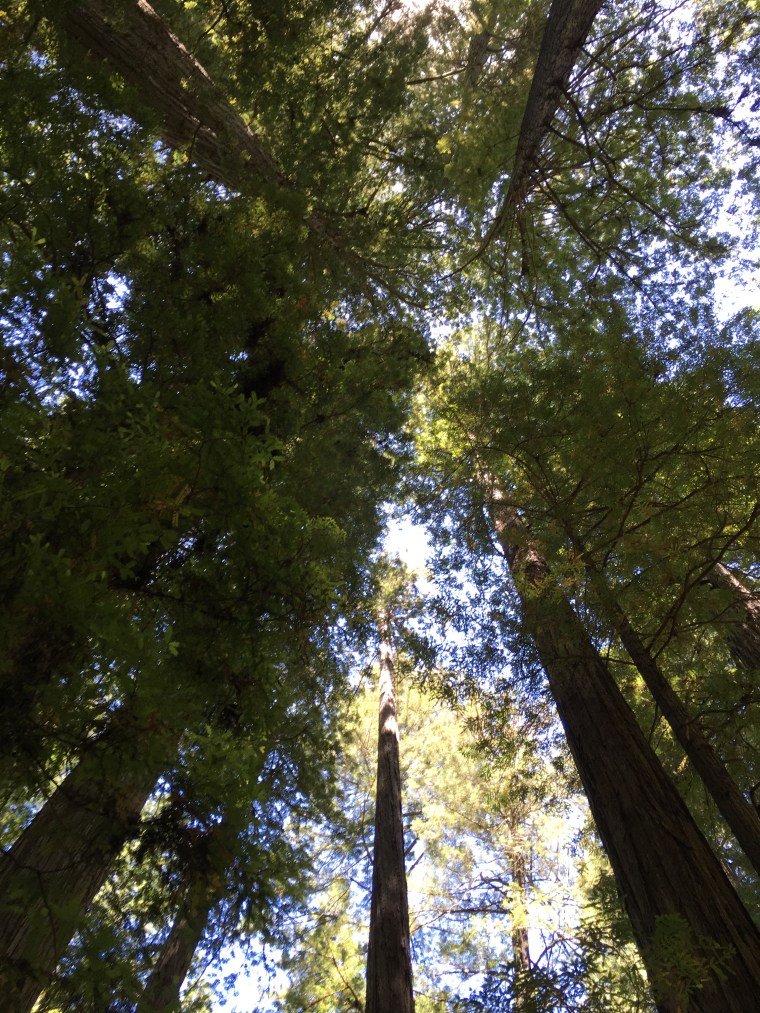
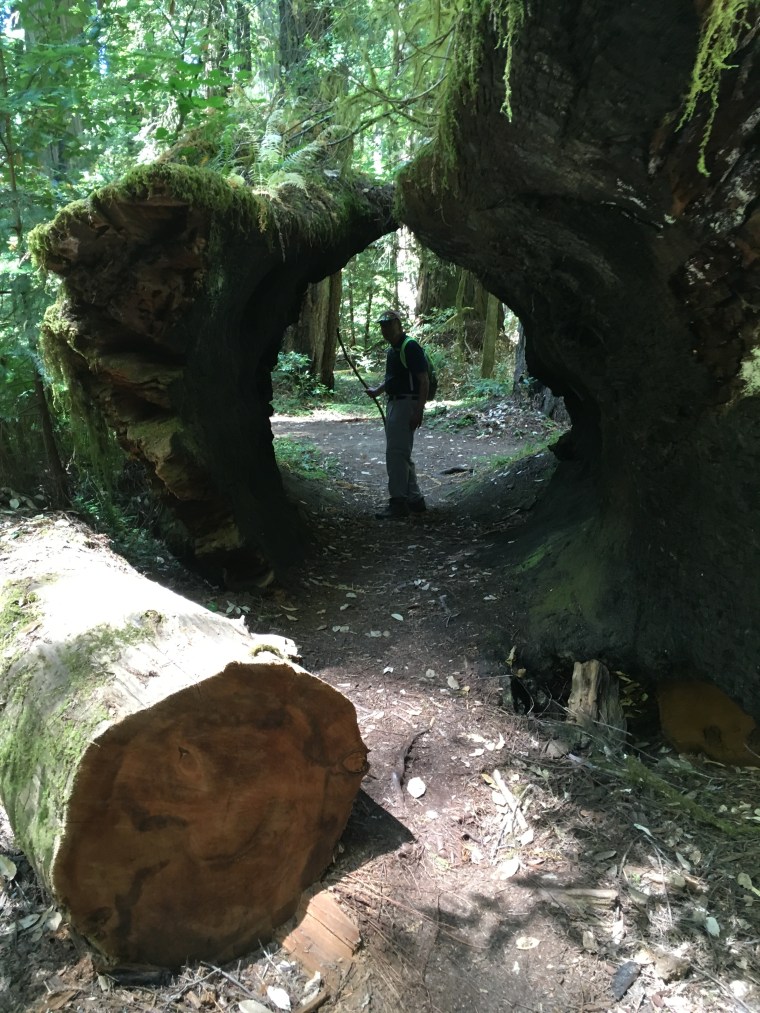
Redwoods are great teachers. Perhaps because of my forest fire fighting years, I noticed early in a seven and a half mile hike through the Rockefeller Forest in the Humboldt Redwoods State Park how fire had scarred many, if not most, of the redwoods Mary Lee and I saw. Yet they continue to grow and thrive. You may be scarred, they say, but you can still flourish. Redwoods don’t start producing branches until they’re some 150-200 feet high. Hey, you still have time! they proclaim. Even after falling, redwoods continue to produce new growth. They reproduce, not only through cones, but also by sending shoots up from their roots, which ring the trees. Eventually (and I’m talking 1500-2000 years) the parent dies, leaving behind a circle of great trees. What offspring will you leave to the world? they ask.

For trees as tall and as long-lived as they are, redwoods have a very shallow root system. Their roots, however, spread out hundreds of yards, where they intermingle with other roots from other redwoods—a network that keeps all of them standing tall. It’s an image, I realize, of the networks of support groups that have sustained me in the years since my daughter’s death, and what I will always need to keep upright and growing.

Redwood trees also resonate in me at a deeper level. They are magical, mythic—more than what I think of as “spiritual.” Age has something to do with it. The earliest redwoods began growing on earth just after the dinosaurs, about 240 million years ago. Some redwoods Mary Lee and I walked beneath were alive when Christianity was just beginning. Those circles of redwood trees I talked about earlier are called “Fairy Rings,” and I often thought of J.R.R. Tolkien’s Middle Earth. Early in our hike I found a branch that I used as a walking staff, which made me feel like Gandalf leading the Fellowship of the Ring or Merlin on his way to Camelot.

IMG_2176

The light through the redwoods also contributes to this magical/mythical feeling. Hiking under the redwoods was like walking in a great cathedral, the trees like pillars reaching into the sky, the sun casting yellow and green shades of light through a stained glass canopy.

And I don’t recall ever experiencing such sustained silence. Any wildlife live three hundred feet overhead. The same with the wind. Because of the tannin in their bark, redwoods are not beset with insects (and thus, neither are hikers)—another reason the trees live so long.

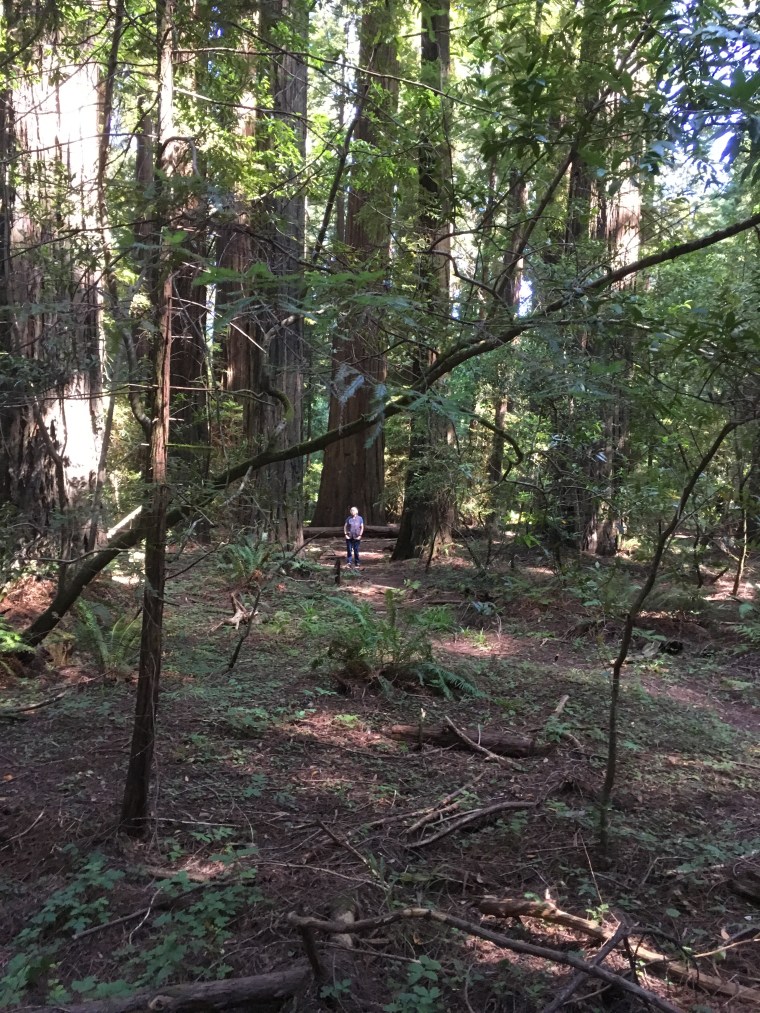
And grow so high. If people don’t know anything else about redwoods they know they’re big. Still, I never appreciated their size until beholding them in person. Redwoods grow up to 378 feet high, which is over the length of a football field, and sometimes 20 feet or more in diameter (think the three-point line in professional basketball). And yet instead of my feeling small, defensive, or apprehensive, I was aware of an immense comforting presence watching over me, enfolding my problems, my defects—sins, if you will—and my grief.

I wonder if that presence isn’t always around me, and I’m too preoccupied to be aware of it until it calls me once more to pilgrimage. The redwoods, I now realize, had been calling me all my life.

IMG_2188

# #


The Wall Between

Viet Nam Wall


#

Almost everything I’ve read on pilgrimage says that preparing for the pilgrimage is part of the journey. There have been times in my life, however, when I haven’t prepared, when what started out to be a vacation or just a trip became a doorway to another dimension.

For example, it’s April 1987, and my wife Mary Lee and I are in Washington, D.C. visiting her cousin Peggy and sightseeing. We turn a corner somewhere around the Lincoln Monument and find ourselves beside a black granite wall. In the midst of the noisy city, I’m suddenly in a cloister of quiet. Maybe twenty-five people are walking slowly along the wall in silence. Many reach out tentatively to touch the wall, or trace one of the names engraved in stone. Some are weeping. A tall man with a white beard stands to one side, his arms wrapped around himself, as if holding himself together. His face is like marble. He does not move the entire time I’m there.

Obeying some kind of call I don’t understand, I walk down the cobblestones in front of the wall to the book that tells me where to find the name of my high school classmate, Bobbie Boyd. By the time I identify him—Panel 27E-Line 98: Robert White Boyd. 1LT-02. Died October 13, 1967—I am overwhelmed by the almost 60,000 names of those who died in the Viet Nam War and by my sense of guilt over how hard I worked the year Bobbie was killed to parlay a congenital back deformity into a 1Y deferment. Placing my hand against the polished black stone, I feel the solidity of the wall between those of my generation who served in the military and those who didn’t.

Thirty years later, I’m still on the other side of that wall. When the guys in the men’s group I go to who served in Viet Nam talk of their experiences, I shrink in shame. I wonder how much of my continued back pain is due to guilt rather than deformed bones. Still, I know that those who served in Viet Nam suffer far more than I for being on their side of the wall. Some guys talk about returning to the US after serving their country and being yelled at, spit upon. Several talk about depression. More Viet Nam veterans have now died by their own hand than died in combat, the result, many people think, of the way our society shunned them. And in his book Tribe, Sebastian Junger points out that since Viet Nam, the problem for returning soldiers has become even worse because more and more people in our society don’t want to acknowledge the ruthlessness and aggression needed for combat.

 vie7

A year and a half after visiting the Viet Nam Memorial, I found myself on the other side of another wall when my eighteen-year-old daughter Laurie died of cancer. I’ve written in earlier blogs about the isolating effects of grief. Certainly much of my isolation, especially my guilt, was self-imposed, but, as I’ve said before, even the most sociable parents find themselves isolated in their grief. Most people, at least most people I’ve come in contact with, don’t want to think about what it’s like to have a child die. Oh, they’re happy enough to read about parents who are raising money for scholarships in their child’s name or who are planting trees or building memorial gardens. They enjoy hearing stories of dying children cracking jokes or comforting their parents. Our society loves to hear of heroic struggles, determined resilience in the face of death. My experience has been that what society doesn’t want to hear about, any more than it wants to acknowledge the brutality of combat, are the sleepless nights, the irrational anger, the self-medicating, the tears, the shame. Even close colleagues and friends who are sympathetic at first can become impatient after a year or so. “Get over it,” I’ve been told. “Lighten up.”

My clearest memory of the wall between those who grieve and those who don’t comes from December 23, 2000. I know the date because it was the twelfth anniversary of my daughter Laurie’s death. That night I sat at a card table in the middle of the Maine Mall with Mary Lee, selling CDs to benefit the Jason Program, which provided pediatric hospice services for terminally ill children and their parents. Some of the artists on the album were performing in the circle where two of the main arteries of the mall come together. As the Christmas shoppers flowed by—teens in their oversized pants and undersized tank-tops, the guys in their baseball caps and leather jackets, the families, the occasional older folks looking tired and lost—they swerved, as if being jolted by an electric fence, when they saw the poster promoting the Jason Program, which featured the picture of a little girl (I can’t remember her name, but she had already died of cancer before the CD came out) in a bright red hat picking flowers. No matter where I placed the poster, it was as if there were a wall about five feet in diameter around her. Even people who bought CDs or made a donation to the Jason Program stayed away from the poster, as if the little girl’s cancer were a communicable disease.

IMG_2235

I have no clue how to tear down these walls, either between society and the increasing number of soldiers returning from duty with PTSD, or between those who mourn and those who don’t. The only thing I do know is that Robert Frost was right when he wrote, “Something there is that doesn’t love a wall.” Walls, it seems to me, are the result of our baser instincts—certainly mine, and probably society’s as well: guilt and shame, anger and envy, selfishness and fear—what psychologist Carl Jung called our “shadow side.” Jung advised his patients to recognize and acknowledge that we all have our shadow side and then work to overcome it. The Viet Nam Memorial was built in part to both acknowledge and tear down the walls between veterans and the country they felt they were fighting for. Organizations such as Compassionate Friends and Maine’s Center for Grieving Children (unfortunately, the Jason Program is no longer in existence) continue to work to raise awareness of how grief affects not just those who are suffering the loss of a loved one, but all of us.

I have to add that I, who usually avoid talking politics, can’t for the life of me see how building a wall around part of this country is going to do anything but give in to our shadow side and separate us even more than we already are. I spend enough time trying to climb over the walls we—and I’m as guilty as anyone else—have already erected. I don’t need another one, thank you very much.

# #


Joy and the Banjo

IMG_1834.JPG

#

Linus to Charlie Brown: “I feel sorry for little babies…When a little baby is born in this cold world, he’s confused! He’s frightened! He needs something to cheer him up…

The way I see it, as soon as a baby is born, he should be issued a banjo!

#

It was, as Lord Lytton wrote, a dark and stormy night. I sat in the Emery House chapel and listened to the rain beat upon the windows and the wind blow through the trees. I was beginning a weekend retreat, run by the Society of Saint John the Evangelist, called “Blowing Zen: Meditating with the Shakuhachi.” I didn’t know much about the shakuhachi except that it was a kind of flute. I was there because one of the facilitators of the retreat was Robert Jonas, who’d written a book about his daughter’s death, Rebecca: A Father’s Journey from Grief to Gratitude. A year or so earlier, I’d written Jonas, as he prefers to be called, a letter saying how his book had helped me after my own daughter’s death. He’d written back, we’d carried on a correspondence, and I wanted to meet him.

That first evening, Jonas and Martin Smith, Brother Superior at SSJE, both of whom played the shakuhachi, passed around several of the instruments and gave us a brief history lesson. Dating from the eighth century, the shakuhachi, or Zen flute, is made from bamboo root—hard as rock—and served as a weapon as well as a musical instrument for mendicant monks who wandered the countryside seeking enlightenment. These komoso, or “straw mat monks,” considered the instrument a religious tool, and gave primary attention to each breath-sound rather than to musical elements like melody. Their aim was to become, in the words of our handout, “a Buddha in one sound.”

We ended the first evening in meditation, while Jonas played a song called “Crossing Over,” which he said he’d had played at Rebecca’s funeral. I sat on my Zen pillow, eyes closed, listening to the mournful tones of the flute (If you want to hear a shakuhachi, go to You Tube), mingled with the sounds of the wind and the rain and the wind chimes. I focused on my breathing, missed my daughter Laurie, wondered what I would do with my life now that I was retiring from public school teaching, and missed Laurie some more. Then, suddenly, as Marlon Brando says in the movie Apocalypse Now, “…I realized…like I was shot…like I was shot with a diamond…a diamond bullet right through my forehead…”:

I wanted to learn to play the banjo.

#

I come from Alabama with a banjo on my knee.

—Stephen Foster.

#

A month later, I’m walking into a music store in a rundown strip mall in Portland, Maine. Two guys in ripped black tee-shirts are behind the counter and some kid with hair down to his ass is beating on an electric guitar. When I say I’m here for a banjo lesson, one of the guys behind the counter pinches some snuff from a round can, puts it under his lower lip, and points down a narrow aisle between racks of sheet music and guitar, mandolin, and banjo straps, picks, capos, and tuners. At the end of the aisle, I almost step on what looks for all the world like a pile of dog shit, and it is. A rubber pile of dog shit.

My first teacher is from West Virginia. Let’s call him Gid. He smells of pot and body odor and he says things like, “Hey, Man! What’s happenin’?” His three-month old daughter (“Man, was she a surprise!”) sleeps in a guitar case beside us. Gid starts me on what’s called claw-hammer style banjo, where my right hand is supposed to come down on the strings and hit the head of the banjo, almost as if I were knocking on a door. He is not so much concerned with hitting the right notes as he is establishing a rhythm. “Bounce, bounce!” he shouts, “Keep that rhythm going!”

I love it. Later, I will realize it’s because of being totally focused, completely in the moment.

#

I’m goin’ to a better world where everything is right…

where you never have to work at all or need to change your socks…

(American Folk Song)

#

Several years after I began playing the banjo, I went to “Banjo Camp North,” in Massachusetts. While the weekend was set up in much in the same way as the spiritual retreats and writers’ workshops I’d been going to—classes during the day, performances in the evening, informal get-togethers afterwards—instead of the silence of the spiritual retreat or the intense, cerebral focus of the writing workshop, just about everyone at Banjo Camp was loose and laughing. It was impossible to tell the instructors, even some of the nationally known musicians, from the students. None of them sat at separate tables during meals. Like the rest of us, they talked about their kids and their bills and their clogged toilets.

The second afternoon, I attended a workshop called “Singing with the Banjo.” I’ve always liked folk songs and figured we’d gather round and sing “Kumbya,” together. What I didn’t expect was that we were all supposed to solo. The closer it got to my turn, the more first my hands and then my entire body trembled. I tried to pass, but Peggy Seeger, one of the famous Seegers of folk music, give me this pep talk about how she’d learned early in her career that she didn’t have anything to prove, only something to share. So I shared my stage fright by stumbling my way through a hobo song (see above lyrics), forgetting some of the words, and butchering the chords. Still, I did get through it.

We kept going on around the room until a woman—her voice quaking in fear—began her song. About halfway through, she stopped, started to cry, and ran from the building. I sought her out the next day to commiserate. Turned out, she was a journalist, and we agreed that writers—at least writers like us—were observers, not participants.

#

What a long strange trip it’s been…

—Jerry Garcia

(Who, before he was a member of the Grateful Dead, played banjo for such groups as the Sleepy Hollow Stompers and the Thunder Mountain Tub Thumpers.)

#

Which, in a perverse sort of way, is why I’ve kept playing the banjo now for almost twenty years, performed with some local groups, even sung on occasion. For someone who spends the bulk of his time alone in front of a computer screen, who often goes on silent retreats, sits in silence gazing at his navel (although I prefer the term omphaloskepsis), and still daily misses his daughter, the instrument is a great antidote.

It’s also a great instrument for pilgrimage. First made from an animal skin tacked over a hollowed half of a gourd, with three or four strings stretched over a planed stick, the “banza” or “banjar” came to this country from Africa with the slaves, who played it in the same style that Gid taught me, and which I’ve stayed with. The banjo traveled across country with settlers and around the world on whaling ships (The banjo travels more easily than a guitar, as a matter of fact).

The banjo also brings a little humor to the journey. It was a comic prop in minstrel shows, and banjo players remain the butt of any number of jokes. To wit:

Q: What’s the difference between playing a banjo and jumping on a trampoline? A: You don’t have to take your shoes off to jump on a trampoline.

Q: What do you call a banjo player who’s just broken up with his girlfriend? A: Homeless.

Like humor, like most of my favorite kinds of music (including the shakuhachi, the instrument of homeless, impoverished monks and at least one grieving parent, Robert Jonas) the banjo has its roots in sadness and loss, yet blossoms in spontaneity and joy. In fact, I don’t think I ever knew what joy was until I began whaling away on the banjo, knew that, unlike simple happiness or contentment or pleasure, joy contains the element of sadness, of longing.

The Christian writer C.S. Lewis defined joy as “an unsatisfied desire, which is itself more desirable than any satisfaction.” I think what he’s describing is similar to being on a pilgrimage: the desire is to reach a destination, but the joy comes from the journey.

Do you suppose C.S. Lewis ever played a banjo?

IMG_2230

# #


Pilgrimage to City Lights

Image 1

June 25, 2016

A pilgrimage needs a destination—a place where, as one writer puts it, God dwells. Having left Maine at 3:00 this morning to get by a bus and two planes to San Francisco, I find myself in front of one of my destinations, City Lights book store, known since 1953 as alternative culture’s literary landmark. I’m here because City Lights was a home for the writers of the so-called Beat Generation: Allen Ginsberg, Gary Synder, Lawrence Ferlinghetti, and the god at whose feet I once worshipped, Jack Kerouac.

Many readers see the road trips in Kerouac’s autobiographical novel, On the Road, as a series of pilgrimages, whose destination is, as one critic writes, “a limitless pursuit of possibility.” Certainly in the early 1960s, as I left adolescence and began stumbling along that dark and mysterious road to adulthood, On the Road was a beacon proclaiming that I could achieve anything I desired. A senior in high school, I made up my mind to leave behind the old farts, dumb parents, and dim-witted classmates who lived in the small Maine town in which I’d grown up, and challenge conventional thinking, search out new vistas. That summer, I left Maine for the first time in my life to visit the Smoky Mountains of Tennessee, and a year later, I found a summer job working on a hotshot crew out of McCall, Idaho, fighting conventionality as well as forest fires. When I returned to The University of Maine the following fall, I continued to pursue an inchoate image of myself as romantic hero—sitting in the back of the Bear’s Den in my black Frisco jeans, khaki shirt, and smokejumper boots, disdaining the guys in pinstripes and chinos, the girls in plaid skirts and white blouses, for being weak-spined conformists. I read Kerouac’s The Dharma Bums, identifying with the protagonist who works in a forest fire lookout tower in the Cascade Mountains of Washington State where I’d been on a fire. I switched my major from forestry to English, and decided to become a Great Writer.

Of course, like so many others of my generation, I was just dabbling in the Beat life. I didn’t participate in sex orgies—seldom dated at all—didn’t have peyote or mescaline visions (I’ve never even smoked pot), wasn’t rolled through the streets of New York in a barrel. It didn’t take more than a couple of years for my dreams of tooling down the road less traveled to wither away in a desert of loneliness, and for me to buy some chinos and pin striped shirts, get married three days after graduating from college, and become a high school English teacher.

Some twenty years later, however, when that marriage had become sterile and I found myself suffocating in my own pseudo-academic self-image, I reread On the Road—lying awake at night remembering the joy of driving across the country at 2:00 a.m., the endless cups of coffee, the third pack of cigarettes that day, my eyes burning like headlights cutting through the darkness. I began to recognize a spiritual component to the time I’d followed Sal Paradise and Dean Moriarty on the road: the highway stretched out straight and flat before me, my body tingling, free, filled with a combination of joy and longing.

And in some ways, I’ve come to City Lights to honor having extricated myself from that marriage and from that self-image, which I now think of as just one of my many false selves. I’m in California with the woman I never would have found if I hadn’t bucked conventionality, the woman with whom I have shared pilgrimages for the last thirty years. It’s our wedding anniversary and we’re celebrating by visiting San Francisco before heading north into redwood country.

Eyes itchy, stomach vaguely queasy from lack of sleep, I peruse the three shelves of books by and about Jack Kerouac, and decide, in homage, to buy a book I haven’t read, Big Sur. I take it to the checkout register, where a young woman with dyed black hair, pale skin heavily tattooed, and bright red lips, rings me up.

I give her my best Kerouac smirk.

Image 2

July 2, 2016

On the plane ride home, still trying to process the holiness of the redwoods, I read Big Sur, and notice facets of Kerouac I’d not noticed in my earlier lives. I see that what may have drawn me to him in ways that Allen Ginsberg and William Burroughs and Gary Snyder never did is the lower middle class New England background he and I share, a strong, even dominating, mother, and our inability to let go of early religious upbringing. I am also introduced to a Kerouac I’d heard about, but ignored: Kerouac the alcoholic.

Written some years after the author’s best-known works, Big Sur follows “Jack Duluoz” and his descent into alcoholism after the unwanted fame of On the Road. Using a cabin in northern California (the property of the owner of City Lights book store), as the focal point, Kerouac details his alcohol delirium tremens, his insecurities, his transient joys, his deep sorrows.

Many of the scenes show him to be nasty, self-absorbed, and combative, with occasional bursts of spiritual insight.

I can identify.

The day after my eighteen-year-old daughter Laurie died of cancer, I turned the guest room where she used to stay when she visited into a den, in which I spent the next three of four months drinking myself into a stupor and writing nasty letters to my former pastor, Laurie’s doctor, and the superintendent of schools. I kept a journal in which I railed against the evils of our society, everything from athletes using steroids to my students taking drugs to women getting Botox treatments to men popping Viagra. I ignored my wife and her son, shortchanged my students, made biting remarks to my mother and family and old friends.

And yet, unlike Kerouac, who died in his mother’s house at forty-seven from a massive abdominal hemorrhage brought on by booze, I’m now seventy-three, relatively healthy, and sober. In part, I’m sure the reason is that just as I was never really a hipster, I was never a full-blown raging alcoholic like Kerouac (or even my grandfather, for that matter).

But as I look over across the aisle of the airplane at the woman who endured much of my inebriated nastiness, I know there’s more to my story. Phillip Cousineau writes, in The Art of the Pilgrimage, “The story that we bring back [from our pilgrimage]…is the gift of grace that was passed to us in the heart of the journey.” I don’t know any other way to explain why, in the aftermath of Laurie’s death, I decided to leave that den, why Mary Lee and I have stayed married for thirty years, how I continue to find joy in my life, except through grace.

I certainly haven’t earned it.

And it’s this recognition that I take back with me from California, as well as a continuing sense of gratitude for Jack Kerouac. From him, I learned that contempt for conventional thinking is both necessary and healthy, and that life needs to be lived with passion. Learned this twice, in fact. But his life also teaches me that nonconformity is healthy only if it is grounded in faith in a higher power and free from solipsism and self-delusion. I’m no expert on Kerouac, but I think those weaknesses comprise his tragedy.

They’re certainly what keep me going on these pilgrimages.

Image

# #